
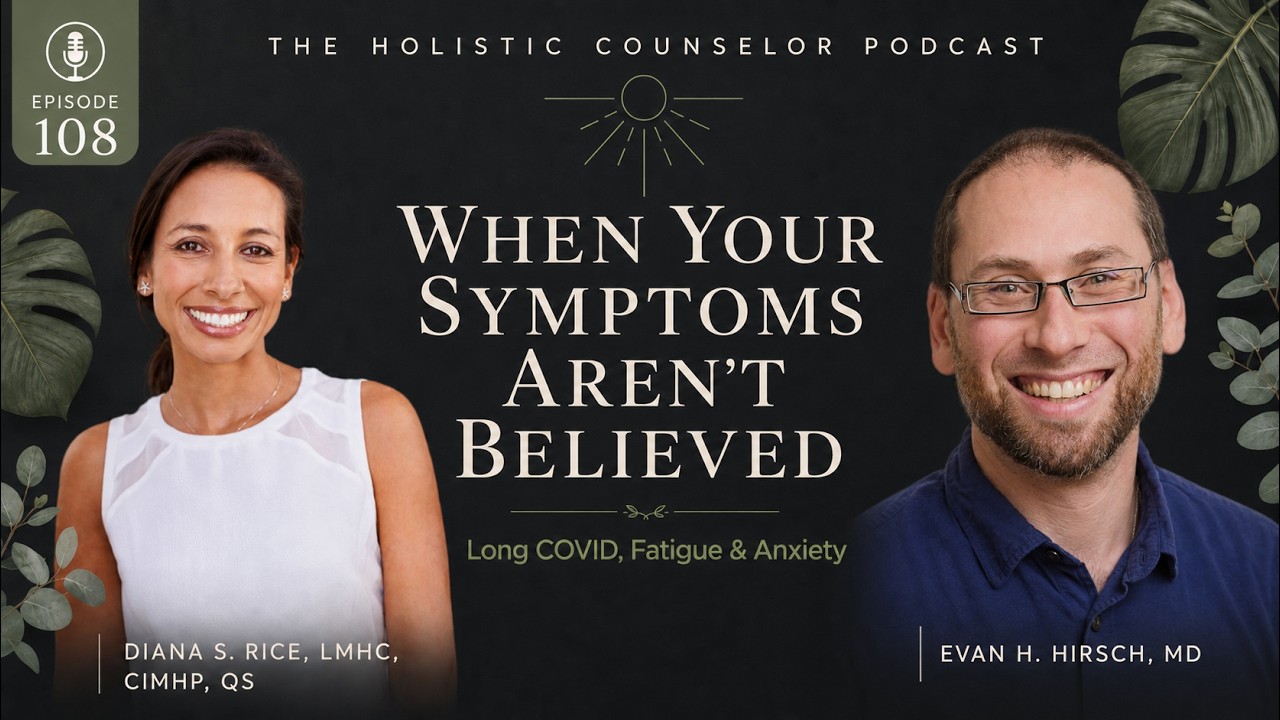
Episode 108
Long Covid, Chronic Fatigue, and Anxiety — When the Body Isn't Believed and the Nervous System Suffers | Evan H. Hirsch, MD
Hosted by Diana S. Rice, LMHC, CIMHP, QS
Hello there, fearfully and wonderfully made human. In this powerful and deeply human conversation, host Diana S. Rice, LMHC explores what happens when physical illness, nervous system dysregulation, anxiety, and depression collide — especially in a medical…
Listen to the Episode
Press play when you’re ready.
Educational content only; this podcast is not therapy, diagnosis, or medical care.
About This Conversation
Show notes
Jump to a section
Hello there, fearfully and wonderfully made human. In this powerful and deeply human conversation, host Diana S. Rice, LMHC explores what happens when physical illness, nervous system dysregulation, anxiety, and depression collide — especially in a medical system that often minimizes or dismisses symptoms it cannot easily explain.
Six years after COVID changed the world, many people are still struggling with lingering symptoms, exhaustion, brain fog, anxiety, depression, and a profound sense of not feeling like themselves. For some, these experiences are labeled as "just anxiety." For others, answers never come at all.
In Episode 108 of The Holistic Counselor Podcast, Diana is joined by Evan H. Hirsch, a physician known as EnergyMD, to unpack the complex intersection of Long Covid, Chronic Fatigue Syndrome (ME/CFS), trauma, nervous system dysregulation, and mental health.
This episode is not about quick fixes or miracle cures. It's about understanding the whole person — mind, body, and spirit — and restoring self-trust after prolonged illness and medical invalidation.
What You'll Learn in This Episode
- What Long Covid is and why symptoms can persist months or years after infection
- Why anxiety and depression can be symptoms, not root causes, of unresolved physical stress
- How medical gaslighting impacts mental health and nervous system regulation
- The concept of the "Toxic 5" (heavy metals, chemicals, mold, infections, nervous system dysfunction)
- How trauma (including ACEs) and chronic illness interact in the body
- Why the nervous system plays a central role in healing chronic fatigue and Long Covid
- A layperson explanation of sympathetic vs. parasympathetic nervous system states
- What a Herxheimer (die-off) reaction is and why it can temporarily worsen symptoms
- Practical, accessible steps listeners can start today to support healing
- Why healing requires pace, patience, and support, not hustle or perfection
Nervous System, Trauma, and Mental Health
This conversation emphasizes a trauma-informed, whole-person lens. Diana and Evan discuss how unresolved infections, inflammation, mold exposure, and environmental stressors can alter neurotransmitters, intensify anxiety and depression, and keep the body stuck in survival mode.
Listeners will hear why nervous system retraining, breathwork, gratitude practices, mindset shifts, and lifestyle changes are not "extra" — they are foundational.
Resources & Links Mentioned
- EnergyMD Method (Dr. Hirsch's practice & masterclass): https://www.energymdmethod.com
- Is Your Fatigue Fixable? Assessment: https://www.myfatiguescore.com
- Book: Fix Your Fatigue by Evan H. Hirsch, MD (An overview of his 4-step framework for chronic fatigue and complex illness)
- Key Concepts Discussed:
-
Long Covid
- Chronic Fatigue Syndrome (ME/CFS)
- Chronic Inflammatory Response Syndrome (CIRS)
- ACEs (Adverse Childhood Experiences)
- Vagus nerve & polyvagal theory
- Nervous system retraining
- Breathwork, gratitude, and mindset practices
-
A Note from Diana
If you've been told "everything looks normal" while your body says otherwise — you are not imagining things, and you are not broken. Anxiety and depression are often signals, not verdicts.
This episode is an invitation to listen to your body with curiosity instead of shame, to move slowly, and to seek care that honors your whole story.
Listen, Share & Stay Connected
If this episode resonated with you, please consider sharing it with someone who feels exhausted, unheard, or discouraged.
Subscribe, rate, and review The Holistic Counselor Podcast Follow Diana's work at Through the Valley Therapy and Transformed Mind Consulting & Coaching
Check out the merch store: https://theholisticcounselorpodcast.printful.me/
Trust in the Lord. Guard your heart. Renew your mind.
Episode transcript
Read the full transcript Close transcript
Automatically generated from YouTube captions. Names and wording may contain errors; listen to the episode for the original conversation.
Hello there fearfully and wonderfully made human. It's me Diana from Through the Valley Therapy and Transform Mind Consulting and Coaching and the host of the Holistic Counselor podcast. Thanks for being here today. It's hard to believe, but it's been almost six years since CO rocked our world.
And when I say rocked, I don't just mean medically or so socially. I mean collectively. That season brought fear, uncertainty, isolation, anxiety, and grief into nearly every home. It changed how many of us relate to our bodies, our health, and even our sense of safety in ways we're still trying to understand.
I remember that year like it was yesterday. the anxiety, the heaviness, the lowgrade depression that just seemed to hang in the air. And then when I personally got CO, whoa, recovery was not quick or simple. It took months. The word I kept using was sizzling, like every membrane in my body was on fire.
I felt overstimulated, inflamed, and exhausted all at once. Even now, I sometimes wonder whether I'm still carrying elements of long COVID on top of living with chronic inflammatory response syndrome. And I know many of you listening have wondered similar things. Why don't I feel like myself?
Why is my nervous system on edge? And why does it feel like no one really has answers? That's why today's conversation matters. Today we're talking about long COVID, chronic fatigue, nervous system dysregulation, and the emotional toll of being unwell in a medical system that often minimizes what it can't easily explain.
I'm truly grateful to be joined by someone who has dedicated his work to supporting people who feel exhausted, unheard, and overwhelmed by complex symptoms. Dr. Dr. Evan Hirs, also known as Energy MD, is a physician who specializes in helping individuals with longcoid and chronic fatigue syndrome, also known as MECFs, using integrative and functional approaches aimed at restoring energy and quality of life.
After recovering from his own five-year journey with chronic fatigue, he went on to develop what he calls the Energy MD method, a researchinformed, clinically tested four-step framework designed to explore underlying contributors to persistent fatigue and complex illness. Though his work as a physician physician physician, author, speaker, and educator, Dr.
Hirs has supported thousands of people around the world who are searching for answers and hope. Today's conversation is not about quick fixes or miracle cures. It's about listening to the body, understanding the nervous system, and restoring self-rust after long seasons of uncertainty. Dr.
Hirs, I am so grateful you're here.
Diana, thanks so much for having me on and please call me Evan.
All right. I love that. See, I love when doctors are are humble like this. Any that's why you're here. Anyway, um let's talk about you for a minute because I'm sure this is how everything starts. Sometimes that's you know I know for me being a holistic counselor the obstacle is the way and this is why I understand holistic things right because of my own personal journey.
So tell me about your personal journey of the five years and and how did your clinical experience shape the way you understand the connection between physical symptoms and mental health? So my story actually started when I started my residency program in 2004. I met my wife, we fell in love, and 3 months later she couldn't get out of bed for the better part of about 3 years.
And so she had chronic fatigue and I didn't know anything about it or how to address it. And so I was surrounded by a lot of doctors in the hospital doing my training and I'm asking everybody about it and nobody could help me.
There were a couple things conventionally that they recommended, but you know, there really weren't very many options.
And so, you know, once she got mostly better, you know, then there was a couple years there where we got married and we had a kid and I started my practice after residency in functional medicine. And then a couple years after that, my energy I just thought it never recovered from from uh from my residency, but it just started to dip and I started to nap underneath my desk.
And so I was practicing functional medicine at this point in time, integrative medicine, and I could get a lot of people better who walked in my door, but I couldn't get myself better. And so I started prioritizing myself and taking the supplements that I knew I needed to take to replace my deficiencies. and it helped a little bit, but then I plateaued and I was like, "Okay, there's more that I need to learn here."
And that's really where I went into environmental medicine and learned about the toxic five that we're going to be talking about today. The heavy metals, the chemicals, the molds, the infections, and the nervous system dysfunction that enabled me to get my life back.
I wrote a book about it, and it's become my mission to help a million people resolve their longcoid and chronic fatigue syndrome. At that point, there was just chronic fatigue syndrome. And so we helped those people and then a couple years ago when longco became a thing we realized that we were uniquely positioned to help those people because the toxic five are essentially the same that needs to be addressed with just one more complication which is the spike protein
that we had to that we had to navigate. So you know that's that is that is my story.
Yeah. And and that's like what you're saying. Okay. Let's just go into toxic five because that's like right there right the toxic five. Honestly, I I kind of know like because of my uh functional integrative doctor that's helped me a lot too. But you you've put it in the toxic five kind of like the dirty dozen and and the clean 15.
Like there's so many of that. Let's just talk about the toxic five. What do you mean by that? What are they? And and let's teach everybody and myself.
Yeah. This is the total body burden that we accumulate throughout our lives. So unfortunately when we come out of the room out of the womb we already are kind of like behind the eightball. There's studies to show that there's over 300 different chemicals found in baby's cord blood.
So basically in the placenta, right? So um we already come out with a lot of toxins and then we accue them accumulate them throughout our lives. So, you know, for me, grow growing up in the 80s, there was no such thing as organic food.
And so, the food that we were consuming had pesticides and herbicides and insecticides. We would take our plastic containers that had our food. We put it in the microwave and we would get plastics into our food. I didn't know that it wasn't normal um that to have a bowel movement once a week.
And that came from eating lots of gluten and lots of dairy.
Yeah.
Right. So, I wasn't able to detoxify. Um, and then, you know, any home that you've ever lived in in your life that in its history has had water damage in the form of a leaky roof or a busted pipe or a flood in the basement, there's going to be there's a very high likelihood of having mold in that home.
The stats are that 50 to 60% of all buildings in the world have water damage and most of those have molds. So, that's half of all the buildings.
Uh even if you have a new home, you still have to have some concern because, you know, if you drive around town and you see new homes being built, if it's raining, you see that it's raining on this wood home, um depending on where you are in the world, and then when it when it dries, you know, they kind of come in and as quickly as possible, they kind of seal it up.
So then you've got the warmth and it's moist and it's like a perfect environment for mold potentially. So you do have to be careful even if you have a new home. So that's kind of like the So there's and then there's obviously accumulation from heavy metals from any mercury fillings or silver fillings that we have in the mouth.
We call them silver fillings because they're half silver, half mercury. And it sounds bad to say that you're putting a neurotoxin in your mouth. But anytime you bite down and you have an amalgam filling, a silver filling, it is going to release mercury vapor and you are going to swallow it.
And then anything that's coming out of the oceans right now, unfortunately, has mercury in it. I do recommend if you are going to eat fish that you eat the smaller ones, the sardines, the anchovies. So that's heavy metals, that's chemicals, that's molds. And when you have those in your body, your immune system isn't going to be functioning properly.
The immune system's whole job is to keep things out of your body that aren't supposed to be there. And so if it's distracted by the heavy metals, the chemicals, and the molds, it allows infections to become opportunistic. And this basically sets the stage for people to get long CO.
You know, we'll we'll define that more in a minute, but it's like 36% of everybody who gets CO ends up with long CO. And why do those people end up getting long CO is because they have the toxic five already. They have the the trauma, the nervous system dysfunction.
And it can be big T trauma, little T trauma that we can talk about more in a little bit. or it can be any one of the other toxic four that's distracted the immune system allowed the spike protein to come into the body and caused one of the 250 different symptoms that it can cause.
Yeah. No, and you're right like when I had to take those mercury fill, you know, I grew up in the 70s so I had to grow and and so you know mercury fillings, root canals, uh gluten, dairy, I mean and and I lived off of Burger King.
I mean, and people don't understand that like because we live in a fast food uh standard American diet u mentality here in this beautiful, wonderful, lovely country that I love. And at the same time, it's like, let's make as much money as fast as we can with all the junk that we possibly could sell you.
So, it's it's trying to like the mer when you said the mercury. Yeah. When I learned that and I took out the the all the fillings and you and this stuff costs money and this is what I tell a lot of my clients and what I say a lot on this podcast is you're going to pay either way.
Either way you're you're going to pay either way either with your health and your body and you're getting some hardcore diseases lung I mean and you're still paying for that or you're going to figure this out and I had to pay a lot of money.
I was in a house Dr. Dr. Hersh, I was in a house with mold so bad. That's how I found out I had chronic inflammatory response syndrome
because I live in South Florida. I had hardcore mold. And when I say hard and then when the shutdown happened, the molds are growing all over my walls and I'm saying and working from that office. So I I I get it. And and that's where I want people to understand like anxiety and depression are are symptoms.
They're they're they're telling you something because some people get so stuck in the diagnosis of those two that they're not understanding that there's a whole bigger picture and and many people don't have like a whole team. So talk about how you approach this like this, you know, you said there's a four-step approach that you do.
Yeah. So before we dive into that, I just want to dubtail on what you said about the anxiety and depression. So for people who have a new mental health diagnosis of anxiety and depression since 2020, there's a very important stat. So there was a study that was done um for people 265,000 people who had CO within 6 months 35% of them had a new mental health diagnosis.
Wow.
So anxiety, depression, and we know that infections can cause this. You know, there's a number of other infections that we've worked with that can cause anxiety to the point of panic attacks and depression to the point of suicidal thoughts, you know.
So, it's really it's really hard to determine like when we're looking at our personalities sometimes, you know, how much is us and how much are these toxicities, you know, mold can cause this, you know, like a lot of these toxins and infections, they can change our neurotransmitters and consequently give us these symptoms that are very challenging.
Yeah. No, for sure. And and so [clears throat] I think that is the frustration because like we're we sound so doom and gloom like okay there's 300 whatever of things happening to you but where's the hope at? Like what is it that you do that that's different than say another doctor if you go to a doctor?
What are the things that you've came up with to to heal obviously yourself, your wife and uh thousands of others?
Yeah. So there is a lot of hope and so you're you're absolutely right. So it does sound like doom and gloom. You know, do not feel overwhelmed by everything that we're saying. We just want to bring awareness so that you realize that there's an issue.
And then slow and steady, you kind of move through a process of evaluating what's in your home, like what are you currently being exposed to and then evaluating what's in your body and removing it. So at this point in time, you know, doing this work over the last decade, I used to do a lot of testing to determine, you know, whether or not somebody had which of the toxic five, which of the deficiencies, etc.
I now can tell 90% of people's causes when they come to see me. And we're looking at just based on their symptoms and their history. And we're looking at over 30 plus different causes. And part of that is also because now in terms of the toxic five, I have found that everybody that I've worked with who had chronic fatigue syndrome and now long CO, they all have all of the toxic five.
It's just a question of how much of each of those things do they have. M
and I want to make sure when they're done with my program that we've addressed all of the potential causes, you know, 99% of the potential causes because, you know, nothing's worse than, you know, paying a lot of money for a program and not getting to the finish line, you know, and we're limited by our assessment tools.
So, we can definitely go into like why laboratory tests are imperfect when we're talking about these toxins, infections, but just big picture is to know that they are in fact imperfect. And what's more important is to detoxify the heavy metals, the chemicals, the molds, the infections, and to retrain your nervous system at a rate that your body can tolerate and you're going to address 99% of all the potential causes.
And so hopefully that brings a lot of hope to people. You know that there you just have to move through a process to do that. And so mine is the four-step process. Should I jump into that?
Yeah, of course. Sure. Let's do it.
So the first step is to determine the causes you have. So we're always going to address the toxic five in everybody. For people who have fatigue, we are going which is the majority of people we work with though there are some people who see us with longco who don't have fatigue and that just means that their mitochondria and their hormones probably haven't been sign significantly affected.
But if they have fatigue then we replace and optimize the adrenals and the mitochondria. But then we're looking at okay do you need thyroid support? Do you need sex hormone support? Do you need vitamins and minerals? Do you need lifestyle habit modification? Do you need mindset support?
Which everybody pretty much does, right? Probably the most important
even the therapist,
right? I mean, it's the most important thing that that I believe that we really need to be working on doing this nervous system retraining and the mindset work. And it's something we're not taught.
You know, I really wish this was taught, you know, if parents taught their children, if children, if teachers taught their ch their their classmate or their their students, you know, in schools. like it's such an important tool that can really change how you see the world, how you react to the world, you know, providing that that trust and that surrender that everything's always working out for you, that God has your back,
right? You know, all all of that. So, that's the first step is we assess which causes you have so we don't miss anything.
Then the second step, and I should say that, you know, we're looking I categorize these different causes into deficiencies. Okay,
so these are things that are not in the body that are supposed to be and that's the hormones and the vitamins and the minerals and mitochondria and lifestyle habits. And then there's the toxicities which is essentially the toxic five. And so in step two and this whole process is about resolving and removing the toxic five.
99 well I would say 100% of the people that I get on calls with have not addressed the toxic five fully. Some of them feel like they've addressed some of them, but nobody's addressed all of them and addressed them fully. I've never met anybody who has addressed the toxic five fully and hasn't resolved their symptoms.
So, you know, I know that when I get on these calls with people that they they have that issue. So, this whole process is all about preparing the body for removing the toxic 5 in step four. So in step two, we're replacing the deficiencies by optimizing hormones, vitamins, minerals, a lot of things that functional medicine doctors, naturopaths, integrative docs do well.
People will feel better. It will decrease your inflammation. It will increase your energy up a little bit. You know, if your energy is like a three or a four out of 10, if 10 is ideal energy, it'll take you up to a four or five and you'll have less crashes, right?
It just makes your life easier and makes things less overwhelming.
Okay? So we do that to optimize this process. And then step three, we're opening up the exit pathways. So in order to get the toxins and the infections out of the body, they need to be able to get out of the liver and the kidneys and the lymph and the neurolymph, which is in the brain and the gallbladder and the intestines, all of these exit pathways.
So we use and everything that I use, I operate online now as a health coach. So everything I do is 100% natural. you know, once I found that I no longer had to prescribe, I was able to go online to help people across state and national lines.
Wow.
So, so in step three, we're opening up those pathways.
And then in step four, we're removing the toxin. That's where people spend the majority of their time in the program is in step four to remove the toxic five at a rate that they can tolerate. And when they feel worse, when they're having a die- off reaction or a Herxheimer reaction, when you're pulling things out of the body and it's a little bit hard, we do what I call the die off dance.
So, we kind of dance [clears throat] back into step three. We increase some of those tinctures and then we go back into step four and continue that ramp up. So, there's this constant pivoting that happens based on how your body is reacting to pulling these toxins and infections out of the body.
And that's how we do it at a rate that people can tolerate.
Yeah. So, let's explain Herxheimer because uh that's a that's vocabulary that many people don't understand because that's more a functional integrative word. I I know like Herxheimer, what's that? Or die off or like and I remember when I first felt that and it was like I got hit by a Mac truck a Mac truck and the doctor was helping me at the time saying, "No, no, that's normal."
And I'm like, "No, this is does not feel normal." But then days later you all of a sudden it was like you know like oh okay it's if I feel better now it's so can you explain that a little?
Yeah and that's a great description. So a Herxheimer reaction. So Yarish and Herxheimer were the physicians that kind of came up with this phenomenon and it's it's when you take an antimicrobial whether it's an antiviral or whether it's prescription or natural or an antibacterial or antibiotic where you're killing something um and it's dying and the body is not removing it as fast as you're killing it.
So the way that I like to think about it is that you know let's say your exit pathways or your detox pathways are kind of like a funnel.
Mhm. And you're dumping as you're killing things or pulling things out, you're dumping them into this funnel. And whether you feel better or worse is directly related to how open the bottom of the funnel is.
Okay?
So if you know if things are able to move through the funnel and get out of the body, you won't feel badly. And that's why we do step three to kind of open that up, that bottom of the of the funnel. But if it's if it's overwhelming the funnel and it's overflowing back into the body, then you feel worse.
So that's why it's really important that's why I like to use tinctures in this process instead of capsules or or tablets is because you're ramping up by one drop at a time. So if you feel worse, you can notice that you can pause the ramp up.
You can increase your die- off support in step three, then come back and continue. So it's not going to lay you out where you're you have to, you know, go to sleep for a couple of days to recover the flu.
Exactly. So we can do it as gracefully as possible. And and really any symptom that is caused by these antimicrobials that are causing die- off are those same symptoms that are going to be resolved when you've got the right dose, what I call your Goldilocks dose.
So essentially if somebody has anxiety and their anxiety is made worse by going through a process like this be either pulling out heavy metals and chemicals or killing infections just know that when you have the right dose and you're moving slowly through this process you are going to reverse your anxiety.
Mhm. No, I I mean I'm I'm living proof of of of things working like that because of Thank goodness I I'm so curious about things and I realize like no, I I want to do this fully and understood, you know. Anyway, I want to explain to the people listening right now long co because I know it's it's been, you know, kind of like pushed to the side like what you're still talking about co but people don't understand like what that really was.
And when I mentioned sizzling, Dr. Hirs, I am telling you I got it and I never felt any I mean I've had chickenpox three times. I have had um scarlet fever when I was a kid. I've had a lot of and I had trauma.
I have a six on the um on the ACE score.
Yeah. Aces. And see this is what I like about you. You understood exactly what aces is because so many doctors are like what what what do you mean by that? But anyway, see this is why you know he knows what he's talking about.
And but that that that you know co hit people all differently. Some people died. I know I know many people that have passed away from it because of I worked with students whose parents passed away and stuff like that. Um long co can you explain that a little more?
Sure.
So when you get the co virus and this can really happen with any virus but we've never seen it in the amount that we've seen it with co but when you when you get co if the covid stays in the body and doesn't and you're not able to get rid of it you know through fever and coughing and and vomiting and diarrhea whatever it is if you're not able to get rid of it then it takes up shop and it causes inflammation you know essentially cir chronic inflammatory response syndrome right
so It's it's and you can have over 250 different symptoms when that happens. So it's persistent symptoms from a co virus, co infection, you know, or for some people unfortunately it's the jab, right?
Yeah.
The jab.
Yeah. Yeah. Yeah. Yeah. So, you know, if when you have that insult, if the immune system is strong and it's not distracted by the toxic five, you should have a full-on flu reaction.
The research shows that the more mild symptoms you have, the more likely you are to have long co because it means that the immune system is not really seeing it. It's kind of like just touching it and you're having a few symptoms, but it's distracted over here.
You're not having a big reaction to it. So, we really want a big reaction when somebody has a virus.
Oh,
yep.
That's That's good then. I I had a huge re a huge reaction.
That's good news.
I guess I thought I was going to die. I'm telling you. And it was
and the sizzling I don't know how else to explain it. I don't know if anybody else listening when if they had COVID how it felt in the body, but the sizzling I I heard it in my brain. And I felt it in every in my nose in my m I'm not going to keep going every moist membrane.
It was sizzling.
Yeah. So it can cause neuropathies which is what you're describing you know nerve symptoms.
So any cell in the body you know where it can it can habitate it can cause symptoms there. So if it gets into the muscles you have muscle pain and muscle spasms right? If it gets into the central nervous system, you can have things like paralysis, myastinia gravis or neuropathies, you know, numbness and tingling, loss of taste and smell, brain fog, right?
If it gets into the mitochondria, which produces 70 to 90% of our energy and is found in every cell in the body except for red blood cells, you can have fatigue. So, you know, it really depends on where it goes in the body and it sometimes it is sequential.
So, like you have the co virus and then it immediately goes into having these persistent weird symptoms, but sometimes they go away and you feel like you're better
and then you go and exercise, you go for a run and it's too soon and then all of a sudden you can't get out of bed or for some people they're fine for a couple of months and then all of a sudden they get atrial fibrillation.
You know, we obviously saw heart attacks in people in their 20s and 30s,
right? So it can get in these different parts of the body that sometimes don't manifest until you have some sort of stressful event,
right?
You have a breakup or you whatever. Go ahead.
Yeah. No, no, like an emotional event because I think many people do not understand how we are a mind, body, and spirit put together, right?
because some of us will just go towards one area, you know, like and and and because I'm a woman of faith and I've seen and I'm trying to break stigma in churches and in my BIPAC community, the black indigenous people of color community, I'm trying to get them to understand like, okay, you're a whole being and we need to pay attention to the whole being and and how because it it all intersects and so how do
you um worked that in your program because you you did say that you know you understood the ACE score and you have your protocol and spiritually speaking like I don't know do you do you touch on that at all ever or no
we do. Yeah. So we have a nervous system retraining component to our program.
Okay. So it's not as advanced as like the Gupta program or Primal Trust, but what's really interesting is that those programs right now are simplifying their programs because people are overwhelmed going through them.
And what I found, you know, it's easy to kind of cultivate these things. My wife is a trauma-informed mindfulness coach, so she kind of helped me with some of this. You know, we've got a couple people on staff who have this knowledge in addition to myself.
I did a yoga teacher training, did a lot of meditation and whatnot in the past. Um, and so, you know, I basically cultivated the most efficacious aspects of nervous system retraining. I have a four-step mindset practice. And so, there's a there's a top down approach, which is you change the way that you think in order to change your nervous system.
And then there's the bottom up, which is you change your body. You do breath work, humming, gargling, etc. in order to change your nervous system. So, we combine the two. We give people a schedule of like we want this is what we want your day to look like and we've got a basic version and a more advanced version.
And if people want to go into more depth, they can go into one of these other programs. But often times, you know, it's it's hard to it's hard to do two programs at once, you know, like there's going to be a learning curve with any program that you join.
And so we found it just makes sense to kind of include it as part of part of our program. And this really, you know, I came to this later, you know, I was one of those people who was more science-based. you know, I've got my MD background, you know, and this that and the other thing and um I didn't realize the science behind it.
Um basically, you know, by your patients and clients, you will be taught, right? And so, I'm always looking for ways to improve our program and to help people get better faster. And I just saw the most amazing things when people were doing nervous system retraining, they just got better exponentially faster.
So, you know, it's kind of been able to take our program from like two years down to one year.
Wow. And for some people it's even faster than that but generally it takes at least a year for folks but it's it's been it's been a game changer.
Mhm. So we decided to
I would like to touch on the nervous system retraining because I actually yesterday I went and spoke in front of a group of women and many of them did not understand the the what breath work is like breath like and that's where I'm like even just thinking of COVID and the time I mean that's what was being taken from us is our breath and how important it is to sit and be still with what keeps us alive is the breath and um nervous system retraining.
I did the DNRS dynamic neural retraining system. It was the weirdest thing ever. It it's like
me having to go in circles and it was just I was like you said overwhelmed. I did it. I followed through because you know you pay money for something and you better follow through with it. But and plus I wanted to feel better and and I'm also a curious human being so I'm always trying to learn new things like I it sounds like you do the same.
Um can you explain a little more how what how important the nervous because I know it's a parasympathetic nerve holly vagal theory we have all and this is what we in the um mental health counseling field we we get to understand that because I'm not an MD I don't know all the biology stuff like you do.
Can you explain a little more of, you know, in layman's term, say like you're talking to an eighth grader?
Yeah, absolutely. No, that's a great way to put it. Um, so there's two branches of the autonomic nervous system that that helps to um kind of keep us in balance. There's the sympathetic branch which is more fight, flight or freeze. You know, this is generally thought of when you are in a stressful situation. in how you react.
And there is the parasympathetic which is more rest, digest and repair. When you are sick, when you do not feel well, you are in sympathetic.
And so we want you to be we want to stimulate the parasympathetic as much as possible. The main parasympathetic nerve is the vagus nerve and it runs through kind of like base of the brain through the back of the throat down into every organ.
And so this is like polyvagal theory where you want to stimulate the vagus nerve as much as you can. Sometimes you can do that by stimulating acetylcholine which is the main neurotransmitter for the parasympathetic nervous system. whether you're taking some sort of acetylcholine um receptor um stimulator or whether you're for some people nicotine patches.
I just interviewed somebody on my podcast which is finding a lot of efficacy and support with nicotine patches because nicotine actually binds preferentially to acetyloline receptors which is kind of amazing. So it binds better to an acetylcholine receptor than acetylcholine does.
Oh wow.
Which is kind of amazing. So, and it has a number of other benefits, but like you know nicotine patches, not cigarettes, you know, which have thousands of chemicals, right? We're talking about nicotine from tobacco, which is an herb, you know, comes from the ground.
So, um, so I I digressed a little bit, but the idea is that you want to stimulate the vagus nerve. So, you can do this by doing breath holds, by taking deep breaths. I mean, what do people say? They say if you want to relax, take some deep breaths,
right? What you're doing when you are expanding your lungs and your diaphragm pushing it down, you are stimulating the vagus nerve and that's sending a message back saying, "Oh, it's time to relax."
Right.
Right. You can also do different breath holds.
You can hold your breath in for as long as you can comfortably and then let it out very slowly. The exhalation really puts you more in your parasympathetic. So, if your exhalation is longer than your inhalation, that can be incredibly supportive. Some people recommend doing like a 478 breath where you breathe in for four breaths, hold for seven, and then exhale for eight.
Notice that the exhalation is longer than the inhalation.
So all of these things can be incredibly supportive for people. And then and so that's kind of like more of the body- based exercises. You can also gargle. You can hum. You know, it seems like humming is better than singing because of the vibration that it causes in the body and that in turn stimulates the vagus nerve.
And then there's the top down which is doing the mindset work. So, gratitudes, envisioning your ideal day and your ideal health,
you know, affirmations,
asking yourself empowering questions, that's our four-step process that in turn will also stimulate the vag nerve and make you remember that you are safe, you are loved, you are enough. And that puts you in your parasympathetic and that allows you to heal.
Yeah. Little by little, it does. I mean, that's the part I do. I do the mind part. with people. So, okay. And if somebody wanted to uh work with you, how how do they just go on your website and fill out the contact form?
Do you see people in person at all ever?
Everything's on Zoom now.
Okay. And and so anybody that's listening right now can reach out to you and in your office to work with you
as long as you have internet connection. Um it is it is it's we're mainly doing US, Canada,
um uh UK, European Union, Australia, New Zealand
just because of getting supplements. We use I Herb.
Okay.
Um which you know isn't is in 187 different countries, but sometimes it's a little bit more complicated. But if people can get supplements from I Herb, then we can we can help them. Um,
but they can go to my website at energymdmethod.com.
Okay.
I have a master class on there so they can watch and learn more about my philosophy of care.
Okay.
And then we offer free calls with me to see if we're a good fit to work together,
right?
And about a third of the people that I get on these calls with, I tell them that I don't think that we're a good fit to work together for whatever reason,
you know? But I only want to I only want people to join my program who I know I can help,
right? I mean that's that's first do no harm. That's what we should be doing in the medical field. I mean I have a license too, right? And so it's just like that's why I have a 15 minute consultation because I am not everybody's cup of tea and I'm I'm they might need a higher level of care, you know, and so I want to respect that.
So tell me about your books. I see your book in the back there, Fix Your Fatigue. Do you do you have another one or is that the one that you wrote?
Just Fix Your Fatigue. I wrote it in 2017 before I made the move to online. So, it's it's got a nice overview kind of like of the four-step process. It does go more into the um the protocols that I was recommending at the time, but it is 8 years old, no 9 years old now.
Gosh. Um so, but it gives it gives people, you know, a way to get to know me. It's got my wife has done a chapter in there as well. And so, you kind of get a sense to know what our stories are. And it it can be if you like to read it can I've been told that it's a a pretty easy read.
Um
and generally people after they do that then they end up you know joining the program if they want to take the next step because it is hard to work through this process without the handholding and we provide a lot of it. We have opportunities on the daily for you to get your questions answered, on the weekly for face toface time with me, on group calls, you know, monthly for one-on-one calls,
and we're constantly reaching out and making sure that you're doing what you're supposed to be doing so that you can be successful. So, it really is a a partnership and we provide a ton of support to make sure that people can reach the finish line and and resolve their symptoms.
Yeah, I want to say something about that because that's super important. Accountability and it's just like having a um a physical trainer in in the gym. It's I know well some personality some people could do things on their own. Lone wolves out there that's wonderful but me like I needed that I needed to see my doctor.
I needed to make sure um I was being held accountable. And when I wasn't able to see the doctor because it it does get expensive. I'm I'm not going to lie. Uh, you know, I had my husband who said, "Hey, we paid this money.
You better get on it and take those supplements." And and I want to remind people what happens a lot and I've seen it just in my field. You start feeling better. So, you stop doing the work.
Right.
Right. And it's really important to understand that like, okay, because it does get exhausting. Oh, I got to take three more herbs or three more pills or three more whatever tinctures or and it's just like I I rather take my supplements every day now.
Like I've had to train my brain like to understand that it's important to take these so I don't go back to feeling that terribleness that I used to feel so bad. I mean, not that I'm I'm going to menopause. Do you work with menopause now?
Do you Dr. Do you work with menopause? You know, our our program is comprised of women from the age of 40 to 80.
Oh.
And so we do a lot of menopause work.
Okay. Good to know. Well, then I might hit you up after we're done here. All right. So So I want to know because not everybody right now can call you up and and you're just one person, too, so you you can't like have everybody either.
Is there anything we can do like start now to make our health better that you can maybe tell the audience to like check things out because I can name a bunch of things but I want to know what you think.
Absolutely. I you know if if you fix your mindset and your lifestyle habits I call that and and you and you're better I call that a level one problem. You know level two and level three is like replacing deficiencies and then having to address the toxic five.
So there's a lot of people that can notice a significant difference by adjusting their lifestyle habits. You know, you know, go to sleep the, you know, earlier. You know, when you when you're first starting to yawn, you should have been in bed a half an hour ago,
right? Wow.
Think about 9 or 10:00, not 11 or 12:00, right? Make sure that you it's nice and dark. You know, at this point, I'm wearing an eye mask. I'm taping my mouth. I've got ear plugs in. Like, I'm a sight. But you know that that's helpful for
really you tape your mouth. My husband wishes I taped my mouth.
I do. It's it's incredibly helpful. Once again
sympathetic
parasympathetic. So when you're breathing in through your nose, you're going to be more in your parasympathetic. Plus also your nose and your sinuses are a filter,
right?
And they're filtering everything that's coming in. And so it allows you to sleep better. Um, and there's a number of different ways that you can tape the mouth, but I find it to be incredibly supportive, but you, you know, you want it to be dark, you want it to be cold, you want it to be comfortable, and you want to, you know, go to bed early and make sure that, you know, that that's good.
And then you want to drink two to three liters of water a day. Work up to that slowly. You want to make sure you're getting your Goldilocks dose of movement
for the most for the people who I work with who are fatigued.
That might be going for a walk around the block. It might be going for a walk around your room, you know. So, it really it really depends. But, you know, if you have a favorite song from the 80s or the 70s and you know, dance to that every day and that'll give you a good 3 to 5 minutes of exercise, right?
You know, you can start to sweat in that.
Um, so that's that's the movement. You want to make sure that you're doing the most amount of movement you can without feeling worse.
Yeah. And so we did sleep, we did movement, we did water. And then with food, it's more about what you don't eat than what you do eat. So I tell people avoiding gluten and dairy and sugar and processed foods and alcohol is really ideal.
And nobody wants to hear that, doc. I know. My clients don't ever want to hear that. And they're like, I go, you hired me for you're paying me money and I'm telling you here are some protocols we have to work through for your anxiety and depression.
Let's check out to see if that like you said a level one, right? Because all of a sudden you might start feeling better because you're hydrated now because even a little dehydration can cause depression,
right?
And people don't really put those things together. And then scrolling, doom scrolling. I just learned something called bloom scrolling.
I know. I just learned literally yesterday.
What is it? It's when you uh your algorithm, you specifically stop looking at all the doom stuff out there because if you're going to be on social media, then create something beautiful. So every time your algorithm, don't watch the news and all the scary stuff.
It's so it's bloom scrolling so you'll see flowers and kitties and dogs and Yeah. Right. Isn't that cool? So
you just need a button to like opt in for like what you want. You got to be subscribed to the right channels, I think.
Exactly. So, subscribe to Dr. Hirs and the Holistic Counselor podcast.
There you go.
And get some bloom scrolling on you.
Yeah. Right. And so, what other things cuz to me like I have to I ask questions like, "Do you have plugins in your house?" Because do you know how many people have plugins? What shampoos are you using? What what what chemicals? because they don't.
Many people don't understand that the skin absorbs so much and they don't believe me,
right?
They're like, "I like my lotion from uh Bath and Beyond Bed, whatever that place." And and it's so stinky. And I'm just like, "Do you understand the chemicals?"
I'm always telling because I used to work with teenagers a lot and I'm like, "Read ingredients." What? I'm like, "Read the ingredients. If you don't understand it, don't put it in your system."
Right. Yeah. That's always a great rule. But yeah, these nano particles, you know, they can just go right into the bloodstream, you know, through the skin
um and are really toxic,
right? So,
yeah, I mean, I I I bet you probably have a whole list of things like not to do, but it's taking one step at a time, like just do one thing for yourself.
Exactly. And and you know, in terms of the food, I tell people, you know, just switch to alternatives, but don't change what you're eating. M
so if you like your pasta and your pizza and you know whatever it is just do it gluten-free and dairyfree like it's going to taste a little bit different
but you can get used to it and you can you can notice very quickly how good you can potentially feel.
Yeah. I had to train my brain to um eat sardines and eggs instead of bacon and eggs
in the morning. And my husband thought what what and I'm like let's try it. And we did and we like it now and my skin's better. So
there you go. My wife makes a killer sardine fish. It's like tuna fish, but it's with sardines.
Is Is there a free recipe on a blog?
Probably probably somewhere you could ask AI. But essentially, you know, she's got the pickles in there, and she puts in sometimes garbanzo beans,
mayo, and just like mashes it up, and then it's like you put it on bread or gluten-free bread or, you know, in a salad or on top of lettuce or Yeah, it's really good. All right. Now, I'm going to go when we hang up, figure that one out because that would be great.
Anyway, is there anything else that you would love to tell the audience to encourage them before we say goodbye?
Um, I would say, you know, do the mindset work, you know. So, what I mentioned about the four-step process, just choose one of them. Generally, the the gratitude is can be the easiest for people. And if you don't feel up to doing a gratitude practice, it can be the it's generally the research is on three things every day.
Um that's can significantly improve your mood over time. Um it doesn't have to be the same things, but it can be the same things. And I tell people if you are not even up for doing that, just do a thank you practice, which is basically, you know, if you're lying in bed, just be like thank you, thank you, thank you, thank you, thank you until you actually feel grateful.
Wow. And then because it's more about what you feel than what you're thinking, right? When you're envisioning your ideal day, it's like how do you feel when you have your ideal day? Like that really transforms
is really is really feeling it. And then
the last thing is that I do have a is your fatigue fixable assessment which you can find at my fatiguescore.com.
Okay. and you can take that and see what kind of score you get and then it'll kind of lead you into the master class and some of the other things we talked about. Oh,
wonderful. All everything that we mentioned will be in the show notes for sure.
Well, Dr. Hers, I Evan, thank you so much for being here. This was wonderful and I hope that it helps at least in one human being.
And and listener, please do not forget to trust in the Lord. Guard your heart and renew your mind. Bye. And now for the disclaimer to make sure you understand that you are responsible for you. The content provided on the Holistic Counselor podcast is for entertainment,formational purposes only and is not intended as a substitute for professional medical advice, diagnosis, or treatment.
Always seek the advice of your physician or other qualified mental health provider with any questions you may have regarding a medical or mental condition. Never disregard professional medical advice or delay seeking it because of something you have heard on this podcast. The views expressed on this podcast are my personal opinions and do not represent the views of any professional organizations with which I am affiliated.
Call your doctor, 911, or 988 immediately if you have a medical emergency. The Holistic Counselor podcast does not recommend or endorse any specific tests, physicians, products, procedures, opinions, or other information that may be mentioned on the podcast. reliance on any information provided by the holistic counselor podcast.
Guests appearing on the podcast at the invitation of the holistic counselor podcast or other listeners to the podcast is solely at your own risk. Confidentiality notice. If you engage with the holistic counselor podcast by commenting or posting and are a client, please be aware that you may be revealing information that could compromise your confidentiality.
Please remember that disclosing your identity or personal details can be linked to your clinical material. As a therapist, I am bound by confidentiality and will not respond to any disclosures of this type on this podcast. I am committed to upholding the ethics and confidentiality of the therapeutic relationship which extends to all forms of communication in accordance with the laws and professional guidelines that govern mental health professionals.
I want you to know that your privacy is of utmost importance and you are responsible for protecting it when interacting on this platform or any other public forum. Thank you.


