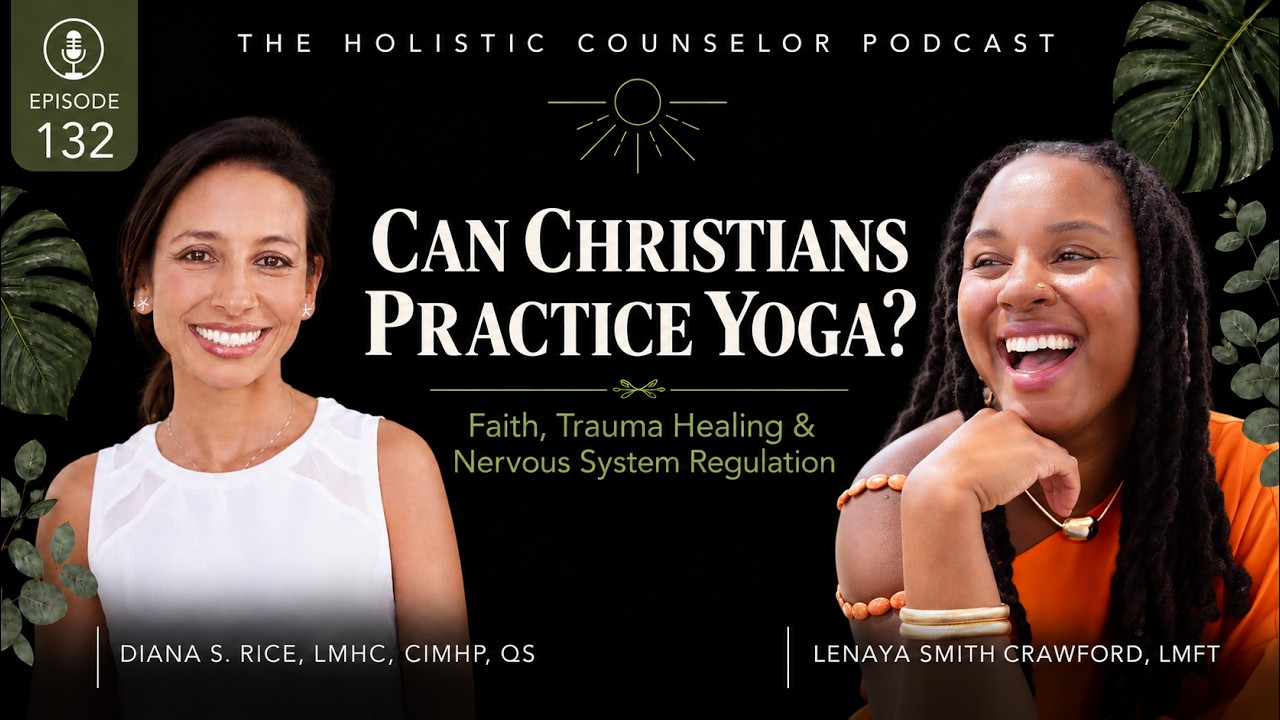
Episode 132
Can Christians Do Yoga? Trauma-Informed Yoga, Breathwork & Nervous System Regulation
with LeNaya Smith Crawford, LMFT
Hosted by Diana S. Rice, LMHC, CIMHP, QS
Can Christians practice yoga without compromising their faith? Can breathwork help regulate the nervous system after trauma? And how can we tell when holistic practices are helpful, spiritually meaningful, or potentially harmful? In Episode 132 of The Holistic…
Listen to the Episode
Press play when you’re ready.
Educational content only; this podcast is not therapy, diagnosis, or medical care.
About This Conversation
Show notes
Jump to a section
Can Christians practice yoga without compromising their faith? Can breathwork help regulate the nervous system after trauma? And how can we tell when holistic practices are helpful, spiritually meaningful, or potentially harmful?
In Episode 132 of The Holistic Counselor Podcast, host Diana S. Rice, LMHC, CIMHP, QS welcomes LeNaya Smith Crawford, LMFT, a trauma-informed yoga and breathwork teacher, meditation teacher, sound healer, educator, speaker, and founder of The Holistic Therapist.
Raised by two Christian pastors, LeNaya shares how faith, clinical training, and personal healing shaped her mind-body-spirit approach. Together, they explore yoga and Christianity, spiritual discernment, trauma responses, nervous system regulation, cultural identity, and ethical holistic care. They also consider why the body may continue reacting even after trauma has been understood through talk therapy.
IN THIS EPISODE
- Can Christians practice yoga while remaining rooted in their faith?
- Yoga as movement, philosophy, and spiritual practice
- Trauma-informed yoga, hypervigilance, and the nervous system
- Why stillness or meditation may bring difficult sensations or memories to the surface
- Breathwork for stress, including LeNaya's four-count inhale and four-count exhale
- Why activating breathing techniques and breath holds aren't right for everyone
- Energy, EFT tapping, essential oils, and sound healing
- Clinical training, informed consent, cultural awareness, and scope of practice
- Decolonizing mental health, identity, and community
- Therapist burnout, self-care, and finding harmony rather than perfect balance
A PRACTICAL TAKEAWAY: FIVE LAYERS OF HEALING
LeNaya invites listeners to assess five areas of life:
- Physical: Sleep, movement, nutrition, and health.
- Energetic: Tension, grounding, and what restores or depletes you.
- Mental/emotional: Thoughts, feelings, therapy, and coping tools.
- Spiritual: Faith, connection with God, and spiritual nourishment.
- Communal: Relationships, belonging, culture, and authentic connection.
The goal is greater awareness and harmony, not perfection. Even five minutes of consistent self-care can matter.
ABOUT LENAYA
LeNaya Smith Crawford, LMFT, is a licensed marriage and family therapist with over a decade of experience in mental health, wellness, and leadership. Her Science & Soul approach integrates clinical knowledge, spirituality, culture, and community. She founded The Holistic Therapist, Kaleidoscope Therapy and Holistic Wellness, and Seviin Yoga and Yoga School. Her work has appeared in The New York Times, HuffPost, Essence, and Bravo TV.
CONNECT WITH LENAYA
Website: https://www.lenayasmithcrawford.com/
The Holistic Therapist Academy: https://www.lenayasmithcrawford.com/theholistictherapist
Workshops, retreats, and conference: https://linktr.ee/LeNayaSmithCrawford
Instagram: @lenayascrawford
RESOURCES MENTIONED
Breathly (guided breathing): https://breathly.app/
Wim Hof Method (breathing and safety): https://www.wimhofmethod.com/breathing-exercises
Dr. Jennifer Mullan / Decolonizing Therapy: https://drjennifermullan.com/
EMDR International Association: https://www.emdria.org/
FAITH & SCRIPTURE
Themes include Psalm 46:10, Psalm 139:14, Genesis 2:7, the Ten Commandments, spiritual discernment, and the difference between worshiping a healing practice and worshiping the Healer.
LENAYA'S CLOSING MESSAGE
You are worthy of nourishing all of who you are and pursuing the vision God has given you. Caring for yourself shouldn't become an afterthought while helping others heal.
ABOUT THE PODCAST
Hosted by Diana S. Rice, LMHC, CIMHP, QS, The Holistic Counselor Podcast explores faith, science, psychology, culture, and holistic mental health.
https://www.theholisticcounselor.com/
EDUCATIONAL DISCLAIMER
This episode is for educational purposes only, not a substitute for individualized medical, psychological, psychiatric, or spiritual care. Yoga, breathwork, meditation, and other practices affect people differently and may be inappropriate for some trauma histories or health conditions. Consult a qualified professional when needed.
Episode transcript
Read the full transcript Close transcript
Automatically generated from YouTube captions. Names and wording may contain errors; listen to the episode for the original conversation.
Hello, hello there, fearfully and wonderfully made human. It's me, Diana, your host from the Holistic Counselor podcast. As I prepared for today's conversation, I kept coming back to one question. When did we learn to divide ourselves into so many pieces? We take our thoughts to therapy, our bodies somewhere else, our spiritual questions somewhere else, and sometimes our culture, community, and lived experience never fully make it into the room at all.
Today's guest has built much of her work around challenging that fragmentation. Lana, did I say it right? Lana Smith Crawford is a licensed marriage and family therapist, speaker, educator, traumainformed yoga and breath work teacher, meditation teacher, and sound healer whose work explores holistic mental health, trauma healing, nervous system regulation, embodiment, spirituality, and whole person wellness.
What makes her perspective especially interesting is that this is not only professional for her. Raised by two pastors, Lana has also wrestled personally with questions about faith, healing, yoga, spirituality, and how to hold clinical science alongside practices that may come from a very different traditions that we're used to here in the Western world.
So today, I'm not looking for neat answers. I'm interested in the tension. What belongs together? What needs discernment? What helps? What can cause harm? And what might healing look like when we stop treating people as disconnected parts and begin seeing the whole human being?
So, girl, thanks for being here. Yes, thank you for having me. That was such a beautiful intro introduction. Thank you. Oh, yeah. So, I want to know I always want to know like how did you get to this point in your life?
like how did you become a therapist and you know was it something like some people say they inherited it because you know mom and dad and you know they're the or because they grew up kind of like me where it wasn't a healed area or situation and you're trying to figure stuff out why people are behaving that way and you're like there has to be a better way.
What's your story? I think it's a little bit of both. You know, being raised by two pastors, the idea of healing and integration was something that I grew up in. But I think curiosity for people's lived experience was something that also came naturally.
My mom always tells this story that, you know, in middle school and even in high school, I'd be on the phone with my friends giving advice and she'd come in and say, "What are y'all talking about?" And I would say, "Mom, this is confidential.
I'm helping them through something." [laughter] Wow. And you know, from that curiosity, I kind of always knew that at least the way that I wanted to hold space for folks was through a therapeutic lens. And so I knew, you know, going into college, grad school, I wanted to be a therapist.
Wow. Um, but I wanted to be a therapist in a more expansive way, if that makes sense. Mhm. And so not only just attuning to, you know, the thoughts and the emotions that come up, but how do we start to bring in that mind, body, spirit approach that I grew up understanding that was necessary for us to be fully connected to God, but also self-actualized.
So I think a little bit of both. Yeah. No, for real.
And and that makes sense because as a therapist or a counselor like you know it was peer counseling for me in middle school when I was like teach get being taught the psychology at you know in seventh grade by pure counseling you know my teacher and then understanding like okay these things make logical sense right that you know the talk therapy it's it's helpful it's beneficial for some and for others it's still like now you got
a little more guilt because you have the talk therapy but your body is still reacting and responding to things and And let's throw in faith in there for a little bit.
And if you're raising So when two pastors, it was the Christian faith, correct? I just don't want to assume anything. Yes. Yes. Yeah. And so you're you're gathering stories and and ideas and stuff and and the thing is like I I think this was the number one thing I wanted to have a conversation with you about was because in so many different denominations of Christianity, yoga, the word yoga.
Okay. And this is why I'm like that was question number two, girlfriend. So, [laughter] so to me that's one of that's a polarizing um modality I want to say. You know, some Christians believe it's inseparable from another religion. Yeah. New age spirituality or even spiritual danger.
I've seen it. I've seen people coming out of the new age and then they're like stay away from kundalini and all the yoga. But then I also have I worked at yoga joint when I was working at alternative high schools like um during the summer for a season and they had nothing spiritual whatsoever.
It was more of like exercise, you know, it's like, okay, we're going in, we're teaching you breath work, we're teaching you the thing. And they were able. So, I've always questioned that, too, studying different philosophies, different religions, and everything like that. I am a disciple of Jesus Christ and I have done deep dives because I have seen so much different.
And as a therapist, because you're a therapist, too, so you must see that. How do you how do you you know how do you believe that yoga can be spiritually do you believe it could be spiritually neutral like what are your thoughts and how do you as a pastor's daughter bring that peace inside of understanding what yoga actually is.
Yes. Yeah. Thank you for that question. So a lot of the folks that come into my programs or want to learn from me wrestle with this as well. They grew up Christian. that grew up Catholic and they get to this place where they feel like they have to abandon their religion because they have interest in other practices or have found healing within these practices, right?
And so I teach this twofold, right? depending on where you are in your spiritual or faith journey. The first thing is these practices, specifically yoga that you're asking about. These are researchbased researchbacked, excuse me, practices that can help your clients heal whatever mental health and healing agency that they're navigating, right?
Yoga has been proven to reduce symptoms of trauma, anxiety, can even help with depression, so on and so forth. So, I think that it's important to understand that there's science that backs up these practices, especially when we're talking about integrating it into the therapy room, right?
So, there's research, there's evidence, and it can truly align with your clients um treatment goals, right? The second thing that I think is important is that we can't label what's spiritual for our clients and our communities. And I think that's where the disconnect happens, right?
Could someone go to a yoga class or practice yoga and never have a spiritual experience? I think so. Right. But can someone go to a yoga class and have a spiritual experience that also deepens their relationship with God and expands their appreciation and love and devotion for Yeshua or Jesus or Christ?
Yes, absolutely. And I think that it really is about what do you label as spiritual but also your intention, right? So, two of those things. I think I love to use my dad as an example of the yoga practice. So, I'm still a believer.
I'm still I'm still a believer of Christ, right? And I'm still a follower of Christ. And the women and the therapists that I teach, they also deepen their relationship with Christ, but it requires an openness to a lot of the things that traditionally have been deemed demonic.
Mhm. It requires uh an unlearning and an education, if you will, to see what resonates and what doesn't. I'm also not someone that says you have to practice yoga. If you're going to, you know, be in this integrative space, you've got to practice yoga, right?
Um and so going back to my dad, yoga is not really his thing. They respect the things that I do. We've had lots of conversations, you know. Um, one of the workshops I actually teach is how scriptures align with the yoga philosophy. Wow.
Um, in the yamas and nyamas because you know yoga is a philosophy. It's a way of life. It's a religion. Does yoga have roots and connection to Hinduism? Absolutely. But yoga as a practice is a philosophy. I feel like I want to go in two different directions here. [laughter] Well, well, we can't go to both, honestly, because I think the more we explain and and give that information for anyone listening because like I said, we're all like spectrums of human, right?
Like we're we're being sanctified every day and in in our mind, body, and spirit. And when one of them is off, the rest will go off as well. So, when you So, I like that. I like to understand the science and I also like to go to what you you were about to go to two different places.
Let's pick one and then go to the other one. Yes. I'll I'll go with um yoga as the philosophy. Right. So understanding the philosophy, it's a beautiful philosophy. They have this eight-limmed path uh devised in two pieces, the yamas and the nyamas. And when you start to look at this philosophy, you can start to align the philosophy with the ten commandments.
A lot of the things that are in the ten commandments are in this breakdown of the yama and the nyamas. Right? when we start to break down each of the philosophical pieces of yoga, there are scriptures that align with these philosophical pieces. And so this is a workshop that I I teach right now in the academy.
I'm thinking about taking it outside of the academy as well. And I think that this is part of the the learning and unlearning, right? If we understand that this philosophy actually aligns with a lot of what Jesus was teaching, maybe we can have the openness and be able to receive the power of these practices and how it ultimately allows us to align that mind, body, and spirit that like we were talking about.
You know, I think one of the aspects that tends to come up within our faith is that we rely too heavily on spirituality and neglect our mental and emotional well-being, neglect our bodies. Maybe we get to a piece where we start to understand our me, our mind, our thoughts and our emotions and our behaviors are necessary, right?
Therapy is necessary. But then you got to start bringing in the body, right? Right. So I think that when we can understand yoga specifically as a philosophy that brings in that integration and that aligns with the teachings of Christ, we can decide whether or not it's something we resonate with or not.
Yeah. Oh no. And then so that's the philosophy part and you were going with the SC I want to know about this. Well, there was something else you were going through too as well, but I know the science is really important.
I I like to talk about that as well because to me calming being still and knowing God exists that to me when I was doing yoga at yoga joint and I've t I've done other classes and I guess it depends on who you are because I'm very spiritually in tune to things so I have to be careful because I have gotten to know myself well enough right and I also understand like when someone's this is what
I want to get to and every philosophy you have leadership that could become a narcissistic system where they're utilizing that philosophy to control and hurt people no matter right it is no matter what it is so I think that is the situation that I have seen a lot in the years I've been on this earth is that is going first it's fear because it's going against your thought process because everybody wants to be in this tight
you know because they don't want to live in the gray they want black and white thinking because it helps them stay sane.
But then when they get challenged, it's just fear. And then until they get educated enough to understand and then they become responsible for themselves. Mhm. Right. And that understanding to me yoga helped me a lot. Like when I say a lot because I had a lot of anxiety and I would self-medicate with marijuana back in the day a young but yoga when I started doing yoga and then it gave me the same high.
I hate to say that high but it calms you down but it but you know it's like running. Yeah. Like when you run and you get that it it just right. It's just having the understanding of like what's in the intention of the heart.
So what's the science behind it? Absolutely. So there's lots of science uh when it comes to the practice of yoga, but right now I think everyone's talking about nervous system regulation. Everyone has, you know, discovered that we have a nervous system and it controls our fear response or our calm response, which I think is great, right?
You know, most people are understanding that. Um and so yoga is one of the practices that helps to regulate the nervous system by moving us into that parasympathetic response, right? So moving us into that rest and digest. Yoga is also a practice that can help to strengthen the vagus nerve with veagal toning.
And we know that when our vagus nerve is strengthened or we have strong veagal tone, it's easier for us to move from that unsafe parasympathetic response into the parasympathetic response. So there's that aspect as well. Um, and more specifically, yoga has also been proven to reduce activity in the amygdala.
And so the amygdala, similar to the nervous system, is constantly scanning the room for danger, right? Am I safe? Am I unsafe? And so when you think about hypervigilance and our clients who've experienced trauma, they're constantly scanning. Their amydala is like firing at a million miles a minute, right?
Yeah. And so the practice of yoga has been proven to slow down the amygdala, right? Create spaciousness so that we're not hypervigilant and constantly scanning the room, right? We can slow down. We can notice safety and not be hypervigilant and kind of soften into the moment.
Um, so there's some science. Uh, also yoga has been proven to help with things like impulse control um and emotional reactivity as well. I'm blanking on the part of the brain. Um, I'm thinking I think it's the hippocampus and the prefrontal cortex. Um, but it's been proven to help with impulse control and emotional, you know, regulation as well.
So, all of these things are great benefits to the practice, right? All of these things can really help us on our journey of healing anxiety, healing trauma, healing aspects of depression, and whatever else you might be navigating. Yeah.
And when you're talking about that, I remember when I was working at the alternative schools in Broward, well, one of the alternative schools in Broward and we created a a trauma informed yoga club because in alternative schools, most of the the students there are coming from hardcore ACEs, adverse childhood experiences and and childhood trauma. and to calm them down or they just came out of juvie some of them and so they joined and then they realized like wow this is a tool.
Yeah. But the thing I guess it's like I've heard a lot of people in in faith in Christian faith just say this is Hinduism or and this is from Satan. It's a trick from Satan. And I'm just like have you even tried it?
How if you're so strong to me I'm strong in my faith in Jesus Christ. maybe somebody that is new and then they're searching for everything right that so it's like I just want to know do you have any resources or anything that the listener can find or you're going to create because you said something about it's in your school or uh your Yes.
So in the holistic therapist academy I have a workshop where we talk about this but I definitely want to expand it outside of that because I think this is a really important conversation and to your point foundation matters intention matters. Anything could be used for good.
Anything can be used for evil. Right. I think that we have to remember that evil does exist. I think sometimes we get into this space where we think that everything spiritual anything any practice like it's all good. know, right? Evil and then there's, you know, there there there's right, right?
There's um there's two sides to the coin. And so, can someone come into a yoga practice and it lead them astray and they over there doing, you know, in darkness? Absolutely. But can yoga also be a practice that connects us deeper to God and allows us the space to be still and know that he is God?
Absolutely. So foundation and your faith is is imperative on this journey, right? And to your point, I think that a lot of times the folks who were in that quote unquote world like the yoga and all the other things and then come to Christ and like oh you know it's demonic, leave it alone.
That's because they didn't have a foundation. God was not was not their foundation, right? have their foundation and they've you know utilized their practices. I guarantee I mean not guarantee let me right their experience would be different.
So I think that's also a part of the conversation what is your foundation right don't have a foundation you could easily end up in darkness but if you have a foundation you'll start to realize that it actually connects you deeper to God and allows you to again really appreciate the teachings of Christ.
No. And I and what I've noticed in my own walk and being like I didn't come to Christ until I didn't grow up in the church, right? And I was into the new age big time and I was but it's understanding that all good things come from God.
The attention of your heart is super important of you know being responsible going why do I believe the things that I do? Where am I getting the information and what is what is truth? Right. And to me going in understanding like I love Jesus Christ.
There's not going to be any other spiritual guide. I' I've messed with those. But at the same time, I'm like, "Wait a minute. This is the same thing I felt with acupuncture at first until I realized, wow, how beneficial it was for me because I had talk about when you were saying hypervigilant and your scanning.
I'm still at 54 years old, girlfriend. I am still having to now go, oh, I have to go back to do my breath work. I got to go do my cat cow. You know, they're tools. They're helpful, right? It's a modality and it's it's up to us to to go slowly to understand why we're making the choices we're making because it's a community as well.
I mean, there are yoga cults out there. Like, come on. And there's Christian cults. So, it is separating that. So I want to and and I have to be honest too when I was doing yoga Lana I want the listener to understand if you come from a trauma background what can happen when you are that still flashbacks could come up because that's what happened to me.
Oh wow. And so I had to go get EMDR after that and I realized and I but I recognized it wasn't the yoga or some demon. Yeah. It was my body finally in the parasympathetic going it's time now to deal with this so it doesn't stay in your body.
Yes. And thank you for sharing that. And to that point, this is why I believe that we have to understand that these practices are not a one-sizefits-all. One of the things that I teach in my academy is understanding which yoga postures, which breath work practices, which meditation practices work best for those who are navigating trauma versus versus anxiety versus depression, right?
Because there are certain sequences and poses you would never put someone who is experienced trauma in. There are certain breath work practices that you would not do with someone who is experiencing depression versus anxiety. And so understanding the nuances of these practices and how to apply them clinically and ethically, I think that's also a part of the conversation because yes, can these be beautiful practices?
Absolutely. But when we don't, you know, approach it from that clinical lens and having that clinical discernment, we can do harm. Yeah. Yeah. So tell me more about your your workshops and your your your schooling. what's what's it called again? So, um I have an academy called the holistic academy, but also it's it's its own thing, right?
So, this is where I teach and train therapists and mental health professionals and helping professionals on how to ethically integrate and confidently facilitate ancient healing unconventional practices like trauma-informed yoga, breath work, meditation, sound healing, so on and so forth. and how to create a holistic centered practice.
So, we walk you through the science. We walk you through how trauma impacts your clients, not just mentally and emotionally and physically, but what does it look like spiritually and energetically? What does it look like to actually facilitate these practices in the therapy room?
How do you set up your sessions? How do you make sure that you're integrating ethically? How do you make sure you're documenting? How do you make sure you're aligning it with your clinical theory? and then bringing it all together to create your holi create or refine your holistic centered practice.
So that's really at the heart of the holistic therapist. But we also have an annual conference where you can come and be in community and learn from other voices who are integrating holistic and ancient healing practices into their work. And also we have popup ces and workshops where you can learn about a particular topic.
So, let's say you're interested in, you know, um, energy healing or yoga or breath work or how your faith may align with these practices. We also offer, you know, oneoff CES and workshops as well. So, if you're interested in taking this integrative and holistic approach, we've got something for you.
Wow.
So I want to know now we're going to go through each one because to me that's really important for people to understand what that means because a lot of these words that we're talking about Tik Tok has made it like really famous or it's like the thing like you know what you said regulation and poly bagel and and still many people don't know what that actually means like what do you mean the Vegas nerves and I'm
like oh my good okay here we go because that's what I love to do is teach whoever is listening and and we also have people from all over the world listening to this podcast too, learning.
And so to me, let's go with breath work because I I know, think about it, if you really think biblically, what was the first action that God did to a human? Breathe life. But why is it important? I know this that breath work has really I'm going to it has helped me so much. and um understanding that it's given me control because usually people with anxiety feel so out of control.
So this is why they become hate to say OCD or they have to control something. So they try to control the relationship or they try to control their environment or they you know but breath work really taught me to calm down. Yes. Be still and I'm okay.
I had to remind those other parts of me going you're okay. You're you're safe now. Yes. Yes. Thank you so much for sharing that. You know, and one of the beautiful things about breath work is is its accessibility, right? As long as you are alive and don't need help breathing, your breath is accessible to you.
You don't need to learn anything or have any tools, you just bring your breath, right? And so breath work, similar to the other practices we talked about, is a very easeful way for us to get into that parasympathetic response, right? Right. So remember your parasympathetic response is the area of the nervous system that allows you to feel safe.
It allows you to soften. It allows you to remind yourself like you were saying that you're safe and it's okay and you can softly land here, right? And when we start to integrate breath work, it's one of those practices that not all the time, but a lot of times you can feel its effects almost immediately, right?
Especially when you're in a safe container, right? And so breath work is essentially a conscious controlling of our breath that has therapeutic effects. Right? So many times when we think about breath work, we think about deep breath in, deep breath out, beautiful, wonderful, we love that.
But understanding that that conscious control of breath is really what allows us to have um that therapeutic effect, that calming factor, that safety, that soft place to land.
M um and when if you're thinking like okay uh breath work how do where do I start right what do I do I think the most easeful way that you can start with breath breath work is one of my favorite foundational breath work practices which is called even breaths and it's a simple inhale through the nose for a count of four and exhale through the mouth for a count of four simple four inhales or count of
four for your inhale count of four for your exhale and that's a really great place to start to assess where you are with your breathing because a lot of times folks are starting with four, seven, eight breaths and I'm like practicing breath work for you or box breathing and I'm like this is a lot or box breathing which I don't think is really that effective.
That hold can be triggering, but a nice simple inhale for four, exhale for four for several rounds can be a really great introductory breath work practice. And then as you decide and as you notice how it feels for you, the next thing that I would try is an extended exhale.
When you have an extended exhale, it actually s signals to your nervous system that hey, we're safe. Like we can activate that parasympathetic response. We can get into safety a lot quicker when we can have an extended exhale, right? And so maybe it's inhale for four, exhale for six.
Maybe it's take a deep breath in and take a longer breath out. You know, we don't have to over complicate breath work. We just have to be intentional so we can experience its healing power. Yeah. I use the app Breathley. Have you ever heard of Breathley?
Because it's free. Because when I worked in these schools like you know and and a lot of my clients, they didn't have much.
So I was always trying to dig for free things to give them and to teach them and for you know so breathly that's an app and it's free and I use it uh every morning of course Wimhof breathing was the thing for me during co that my husband and I would just sit in there and listen to that YouTube video of of him breathing you know teaching us how to brea and you got to be care
right you got to be careful because people like oh I could do this and then they come back to me and they're like I couldn't even make it two minutes and they feel guilt and I'm like no no no okay that's fine Fine.
This is normal. We're teaching. Stop, you know, stop being so mean to yourself. Yeah. And understand like not every breath work practice, like I was saying before, is for everybody. Exactly. People were they people still love box breathing and like there's so many other more helpful breath work practices, right?
Yes. If you engage in a practice and it doesn't resonate, let's find another practice. You know, there's so much out there. There's so many tools and we're so unique. We're so fearfully and wonderfully made that it's like trying to find what actually you're needing at that moment because right now you might not need breath work or yoga but then later you might want to try yoga or you know by and the other things we're about to talk about too.
So back to breath work too there there's people that actually are trained and they go to um to hospitals and everything and they'll do like one hour session of breath work. I did it once. They invited me as a clinician, Lana.
I felt like I I hate to say like I was tripping on acid, [laughter] but after it it was Yeah. the things that came up because it wasn't like calming down the way they were. [panting and gasps] Do you do that kind of breath work too?
So again, it depends, right? Depends what the client is navigating. So, you know, if an activating breath work practice like that would be helpful for someone who needs to activate, but if someone already activated in that sympathetic, that might, you know, trigger them even more.
So, it just depends on what the client is is navigated navigating. Have I tried that particular breath work for myself? Yes. And in last year's conference, um I'm blanking on the name. I think it was circle breathing. It wasn't necessarily, but it was Oh. inhaling through the mouth, inhaling through the mouth, exhaling through the mouth for this circular breath and also brought up a lot, right?
So, I believe um that breath work is one of those practices that activates our energetic layer. Now, we haven't gotten to like my how I define holistic, but energy is one of the layers. And you know, when we're engaging in breath work practices, like you said, sometimes it's not the calming down.
Sometimes things come up energetically, right? And I'm sure in that breath work practice you were probably tingling. You were probably like I know it went by so quick and we were laying in chairs with something on our face. Yeah. And then all of a sudden what came up?
We discussed it after because it was a bunch of clinicians where it was a b and I'm like all right I'm cur I'm a curious that's who I am. Like my husband's like you're you're that cat that curiosity hopefully doesn't kill the cat but curiosity.
We need curiosity. Right. Well, anyway, I was at It's a Small World or Peter Pan ride in Disney. It was just and I was seeing all the lights and the things that were coming up and I'm going, "What was that about?" while someone else was sobbing.
And when I say sobbing, I'm going, "Oh my goodness." Like, wow. And it it just felt so different and unique. And it was helpful though. It was It was helpful.
So I want to go now to energy because that word creates a lot of tension in the faith space as well and also in the science world depending on who you are because you know you say energy oh you're woo woo I mean everything is energy right go back to the go back to the you know everything is energy right this is how why you get electrocuted when you're on a carpet with you know and and
why we need a heart you know when you go check your heart you have an electrical thing to go on and so on and so on.
So yeah, and you know, we're made from the earth according to the scripture that I believe, right? So that's energy. Yes, absolutely. And you know, I think yes, I think sometimes when folks hear the word energy, they can be like, girl, what are you talking about?
But I think we have to bring it back down, right?
I think a lot of times too we're in this space where there are practitioners who have a lot of flowery flowery language and sometimes you're like girl what are you saying right so energy everything is energy right and you know think about the moments where you're in a room and there are two people not getting along and you can feel that tension okay what's that saying you can cut the tension with a knife that is energy
You come into someone's presence and there you can't help but smile and just their sense of joy comes over you.
That's energy. You know what I'm saying? You're sitting across from a client, right? And you're starting to, you know, uh maybe having some sensations based off what your client is bringing to you. Counter transference. Transference that is energy, right? And so when we talk about energy, it's both what's happening inside but also the energy around us, right?
And so I think you know there are many practices that help us move energy up and through breath work being one of them. Um and so bringing breath work back to yoga philosophy and yoga philosophy there's this thing called pranayyama which essentially means like life force energy right and pranayyama is also directly ti directly tied to breath.
If are we alive if we're not breathing life force energy right so even that simple connection you start to understand okay they're not talking about or even in yourself we're talking about life yes energy I mean and if you go into real science with their biology like the biology of belief or or going under a microscope and seeing you know protons neutrons elect I mean let's go back to second third grade science explanation of energy you know so it just depends on you how you're explaining it, but everything is energy, right?
From the cells in our body to what we experience outside, it's all energetic. Um, and you just have to decide how you are going to attune to your energy. Are you going to integrate breath work? You know, are you going to, you know, EFT tapping, which is a very helpful practice.
It's also based in energy psychology, right? And so it's not woo woo. And I I actually hate the term woo. It's not woo woo. Oh, I bet because you probably hear that a lot. You see a crystal like people like look at my crystal and they're like, "Oh, do you believe in the energy of that?"
And I'm like, "No, not really. I got them when I was a rock, whatever in North Carolina with my" And so when I look at it, I'm like, "That's such a pretty rock." And it it depends on how you your choices of how you're seeing things.
I think if somebody wants to believe in that, then okay, I'm not going to sit there and and hate on you or judge you for it. Yes. I mean, it's it's your perspective. And I think, you know, when it comes to things like crystals, right?
It's also I like to use um essential oils as an me too, right? Essential oils bring about certain feelings, certain energy, right? We are not praying to the essential oil. We are not thinking the essential oil is God, but we know that if we put lavender in our diffuser, we're going to have a sense of calm.
If we put in um some citrus, right, we're gonna it's going to elevate the energy. So, I think it's similar um to that as well. And I think that that's a big distinction for the faith community. We are not believing that these things are God.
We believe God created all these things and that there are different aspects and properties that we can choose to use or not use. Well, and and if you really think about it, crystals are named in the Bible. Yes, they are. So are essential oils.
Yes, they are. So are breath. Come on. You know, so so is, you know, uh um I would hope I think I don't know, maybe I need to research more. But movement, I know diet like the Daniel diet, what you put in your system matters.
And so it's not that we're I know I don't worship these things. I don't worship the healing. I worship the healer. And he and he and he gives us what we're needing if we ask if we are still enough to ask. But I think we're so scared in the Western world because we're also taught these things.
So, we're going to go into a whole into a different question that I have for you because and this word because I know we only have like 15 minutes left, but I wanted to get this with to you because when I was researching you, there was something called decolonizing mental health.
Yes. And that word I have seen trigger so many people. Uh well, not us, not us bipac people. Okay. [laughter] Okay. It it could be the second like you know I'm married to a white man and we've had 30 something years and for those years I've had to teach him a lot because he wasn't raised knowing these things.
Yeah. And it's it's okay that he didn't. It's it's good though that he's chosen to open his mind and his heart. That part that openness. Yes.
I mean so decolonization at its core is moving away from a colonial point of view right so colonization created this hierarchal approach to healing colonization also created this hierarchal approach to identity right colonization says white white is you know we're white we're here they're at the top of the the totem pole then everybody else comes under so this idea of one way of being one way of healing one identity is directly core correlated to colonization and decolonization is saying that we don't just approach life from one lens, we approach it from a holistic lens.
It requires us to bring our full self into not only the healing journey but into spaces, right? um into into our work and not feeling the need to code switch, not feeling the need to assimilate, not feeling the need to be anything other than who God created us to be to be worthy of being in the space, right?
And I think Dr. Jen Mullen does a really great job of talking about the root cause of of root cause or root wound of colonization. And it's essentially a disconnection. We were disconnected from our land. We're disconnected from our communities. We're disconnected from joy.
We're disconnected from just being human, right? And so when we talk about decolonizing, we're making this connection again. We're connecting our identity, our different types of healing, our culture. We're reconnecting and reclaiming those pieces of of who we are. So, it's nothing to be scared of.
It's essentially saying, listen, the colonists came in and demonized everything and everyone and said that their way was the right way, and decolonization says that we were all beautifully and wonderfully made. How can we bring all aspects of who we are into every space that we're in and more specifically into our healing journey?
Yeah. And and that's beautifully said. I think what I'm I'm at a place though is how do we move forward in this space in time where the algorithm is purposely splitting us up on purpose to keep us, you know what I mean? To keep us disconnected.
Yeah. In order for us to stay in fear. How do we build bridges? Especially us as clinicians. Yeah. So then uh red, yellow, black and white, they are precious in our site. It actually really means something. I think this was the beauty of me growing up in New York and growing up in Broward County, Florida.
Like I really appreciate even though there's so much stuff going on in both places, but it was just the way I saw all the all the people around me because I got the blessing to see all those things. But I still see the separation and the misunderstandings on on both sides of the spectrum.
And it's like how do we build a bridge to have that understanding especially in mental health because we have to witness the anger at times, right?
and and then also have the understanding that we're not blaming a one certain group of people constantly because I' I've heard the other side L I'm telling you I've had not debates sort of but it's how do you like we need more communication and more conversation of hey can you just listen for a second and understand where we're coming from that part it's that openness I think we've been coming you know coming to that point throughout this conversation.
It requires a level of openness, right? It requires a level of I'm open to hearing your perspective. I'm also open open to um sharing mine. So, I think it's openness has to be at the foundation, but also an understanding of what systems have done.
Like we can't ignore the systems that built the western world in the country that we're in. We can't ignore it, right? things are the way that they are because of the systems that are in place. And so there has to be a level of openness on the other side to say, hey, you may not directly be responsible for what we're, you know, what folks are experiencing, but the systems in place do impact marginalized communities in different ways.
And I think both sides need to be open to naming that, but also actively working towards healing that, right? And so we can't heal anything that we aren't able to look like. You can't heal what you can't feel. So if we ignore the systems, we're not going to move forward, right?
If we ignore the fact that we're more alike than we are different, we can't move forward. So it's both of those pieces coming together with the foundation of of openness. Yeah. I mean, and we're called if we're disciples of Jesus to be peacemakers.
Come on. We are. you can't, you know, you can't, you know, be a peacemaker if you're not open to listening but also speaking up, right? So, I I agree 100%. And and learning how to because this is something I think our training has taught us for decades, sounds like for you, too, is do we listen to understand or do we listen to respond?
And that is a foundational skill that we all need as humans. Period. Right. Let's that skill is so important. I think a lot of us listen to respond and if we listen to understand I think a lot of healing especially around this particular topic of decolonization we can move the needle forward a little more.
Yeah. All right. So now that we went from oh yoga and breath work and peace into something that now has probably um agitated or you know woke up parts of us that are like oh no I need to calm down now now that you have me thinking like certain ways.
How you know holistic and wholeness in real life like you describe holistic healing as integrating the physical energetic mental emotional spiritual and communal layers of a person. So for the listener who is successful on paper but feels exhausted spiritually disconnected or estranged from their own body, what might returning to wholeness look like in everyday life?
So any any tools or anything you're thinking about as I asked you that question for the listener right now that's like, you know, I'm feeling something. I just don't know what to do with it. Where do I go? How do I do this?
Where do I start? Yes, such a beautiful question. And I think we start with assessment. Assessing where you are. And so taking that model and assessing how am I doing physically? Like how am I caring for myself? How how am I moving my body?
What am I putting in my body? How's my sleep? Then we move to the energetic layer. How am I caring for myself energetically? How am I moving the energy up and through? But also attuning to the energy around me. So think things like breath work, right?
Um then the mental emotional layer. How am I dealing with my thoughts and my emotions? How is that impacting my behavior? Um, how is that impacting my, you know, my relationships, which we'll get to the communal layer, right? But how am I attuning to my emotions and my thoughts?
And what tools do I have for that? Is it journaling? Is it therapy? Is it coaching? Is it affirmations? Then thinking about spiritually, how am I connecting with God? How am I connecting with source? How am I connecting and deepening my connection with God?
You know, what are the tools that are helping me do that? Is it, you know, going to church? Is it meditating? Is it reading scripture? Is it, you know, going for a walk in nature? What are these practices that are going to help me?
And then your our community layer or communal layer. How are my relationships? How am I getting into community? Have I noticed that I'm actually isolating more than being in community? How am I bringing my identity to to my work? Right? How or you know my my practice as well?
So, I would start with an assessment of those five layers and see how you're caring for yourself and if you need some tools that will attune to those particular layers, right? So, I would start there for sure and in an assessment to see where I might need to lean more into.
And so, after that assessment, if you realize like I really have been leaning into my spirituality, but I'm noticing that my disconnection from my body. Well, what are some practices that might help you connect with your body? Yoga is one of my favorite, but maybe it's Pilates, maybe it's walking, you know, maybe it's Tai Chi, Chiang, right?
Maybe it's riding a bike. But after that assessment, you'll be able to see where do I really need to lean more into and find more more harmony. Because what I find is that we might be really good in in an area or two and we think because we're really good in that area or two, we've got it.
But like you said, I'm lit up by the work that I'm doing, but I feel exhausted. I feel super connected to God, but I'm disconnected from my body. And so really understanding that if we have tools in each of those layers, we bring it together, we'll start to realize a sense of harmony as a you know, balance is relative, but harmony, I think, is what we're really searching and and looking for.
Yeah, for sure. I I I mean, I when I with an assessment, I even ask my clients like, "What?" Like, "How are you pooping?" Like, right? Yeah. Sleeping. When was the last time you got blood work done? Yes. Absolutely.
When was the last time you were actually outside, you know, and and and and coming up slowly because this is the thing is like tool by tool or whatever and then remembering that you have it because what happens is you start feeling good and then you start neglecting yourself again.
Yes. Consistency. So I want to know what is your like morning ritual look like? Because I think that's important when someone is hearing two clinical professionals, right? And then it's like how does the clinician stay in harmony? Yes. By doing your work. Now I'm a big believer.
Don't I feel like we as therapists, we were taught to do therapy without even having to be in therapy. Like you know, it wasn't always required. But we've got to do our work. We have to do our work. And you know, a big part of being a holistic therapist, in my opinion, is utilizing the same practices that you integrate into the therapy room with yourself and spending time with yourself.
Um, I've gotten to a space where there's no particular morning routine. Um, because it depends on the season of life that you're in. Yes. Exactly. mom. And so before motherhood, I would have a, you know, daily 60 to 90 minute practice and it was juicy and it was amazing and I incorporated the yoga, the breath work, the affirmation, the reading of the scriptures, the journaling, all the things.
But in this season of motherhood, I can give myself that once a week. But a lot of times it's what do I need in this moment? So a lot of times it's going out on my lai, closing my eyes, taking a couple of deep breaths, right?
thanking God that I'm alive, feeling the sun on my skin. Sometimes it's drinking my tea slowly, you know, reading an affirmation to myself. But I think that as long as you can give yourself at least five minutes consistently, I'm not saying five minutes here or there, y'all, because that will never work, but five minutes consistently each day, I think really makes a difference.
And I, you know, as someone who's gone from like practice every day to really having to embody and live that five minute a day consistently, I can tell you it actually does work. Yeah. If you can give yourself that space, but this is also why it's important to do that assessment because after that assessment, it's like uh feeling a little off energetically.
So I'm my five minute practice for this week is going to be breath work, right? I'm feeling a little off, you know, physically. My consistent practice is going to be some gentle movement of the neck, maybe some hip openers, right? I'm feeling depleted spiritually.
My consistent practice is going to be, you know, sitting with sitting with the word, maybe journaling, reflecting, whatever. So, I think that's also why it's important to have that assessment so that you know, okay, girl, I got 15 minutes. What do I need to do?
Use that assessment and then not scroll. Not scroll. And if you're going to have to go get that dopamine hit on your phone, like go bloom scrolling, create your AI or your uh your uh, you know, to bloom for you, not doom you.
Because this is the thing like we we get too much information or too much stuff inside of us, especially in this culture where, you know, it's a it's a beautiful culture. I love it. I love I mean, I'm very happy that I'm an American.
Okay. At the same time, I also have taken the step back going, "Oh my gosh, if we all keep continuing this, we're all going to be just burnt out little robots on the on the hamster wheel." Apart, right? And it so for you to like understand you're here at this season, it's not about perfection, people.
It's not about perfection. It's about taking the step back to respond in wisdom and not react in emotion and and find out because you know what I just heard L and I'm sure you probably heard this before but I think it was Dr.
McFillin or somebody said emotion think about it's energy and motion. Yeah. [laughter] Yes. Absolutely. You know, and I think it's important that we also understand as helping professionals that we are worthy of the time it takes to nourish our mind, body, and souls.
We are worthy of taking that time. So much of our profession asks us to give. But what are you giving back to yourself and understanding that that has to be a part of the equation? It can't be an afterthought. It has to be in the midst of you doing the work that God has called you to do.
A part of that work is also caring for yourself. Yeah. Without the guilt or shame. Period. Drop the mic, you know. So, how how can someone work with you? Yes. So, I primarily work with therapists in helping professionals who are ready to take this holistic approach.
They're wanting to learn how to integrate these ancient healing practices while also doing it confidently and ethically and not abandoning their faith or clinical skills. Right. Love that. And so you can work with me through the holistic therapist, through the academy, through joining the annual conference, or through joining a monthly CE or workshop event.
Um, so that's primarily how you can work with me if you are a an ambitious woman who heals and leads. I love helping women therapists and leaders expand their business and creating sustainable businesses that can hold you in each season of your life. businesses that don't abandon who God called you to be and businesses that don't abandon your need for self-care.
And so, if you're wanting to grow or create this business ecosystem that feels as good as it looks on paper, I love to to work with with women through my masterminds and business coaching um as well and through retreats as well. So, all the ways to connect with me, but you can join my free Facebook group, the holistic.
You can also follow me on socials, Lana S. Crawford. Um, and we can connect that way too. Wonderful. So, anybody around the world can work with you. Absolutely. And I've worked with folks all over, right? All over. So, if you want to be in person, you can join me on retreat or at the conference or if you want to join me virtually, we have the masterminds, the business coaching, the academy, and the the virtual workshops and seeds.
So the conference is it in the same place every year or is it you do you travel around the country? Travel. Yes. So it is a retreat styled conference. Last year we were in Atlanta. This year we're actually in Boone, North Carolina at Art of Living Retreat Center.
Have you been? Uh Boon. I've been to Boone. Yeah, I have. I have. Yeah. Western Carolina is just amazing. Yes. And we'll be there in October where the air is crisp and the mountains and all the things. And so yeah, this is a traveling conference.
It is a retreat style conference. It's the ability to care for yourself while you learn these integrated to bring to your your clients and your communities because we can't forget the human behind the healer. We've got to heal. We've got to soften as we also learn these clinical skills.
And next year we're going to Sedona. Oh, Arizona. Wow. For 2027. For 2027, we'll be in Sedona. Uh, I'll be sure to share information. You can join the state. Maybe. I've always wanted to go to Sedona. I hear some amazing things. Actually, I was supposed to go to Sedona, Arizona for my 20th wedding anniversary and then COVID hit.
Oh, cuz it was 2020. Yeah. [laughter] Wait, was it tw my No, it was 20. No, whatever. I got married in 1995, but we were going to an anniversary and we had it all planned out and then all of a sudden everything got shut down.
So, I'm like, "Yeah, we're in we're not going there." We went into our tiki hut and had dinner. Listen, you know, we had we had to we had to pivot. Yeah. [laughter] And that's the thing of having to understand that we're fluid. Like, you have to we're vapor in the wind like Ecclesiastes says.
Like you have to it understand like if if you're too like this is the thing I learned about yoga as well is that the more I hate to say loose but the more flexible you are in the body the more flexible you will be in your mind.
Yes. Yes. Right. So the lessons you learn the lessons on the mat and you take them off the mat. Right. Yeah. And the more you try to fight against the tension the more the more difficult it becomes when open you lean in. Right.
Can you uh name your website so then people will know how to reach you? Yes. Lanamithcwford.com. Okay. Wonderful. All the information there. That's wonderful. And before we go, is there anything you want to say to the audience? Maybe a book that helped you or a quote or a Bible verse that you love?
Oh man. Honestly, I really think it's the understanding that you're worthy of the time it takes to nourish all of you, you know, and I think there's many books and scriptures and, you know, poems and affirmations that align with that. But I think again, we forget that you are worthy.
You are worthy. You are worthy. Are worthy of the vision that God gave you. You are worthy of working in the way that feels most aligned. And more importantly, you are worthy of taking care of yourself as you help your clients and communities. kill him.
Yeah, you need to put that oxygen mask on yourself before you try to put it on other people. There's a reason they say that, right? Exactly. Because the plane's going down, people. No, I'm just kidding. Sorry. Sorry, guys. Sorry, Len. This is getting to know my sense of humor. [laughter] All right.
So, I thank you so much. And for all those that made it this far with us, please do not forget to trust in the Lord. Guard your heart and renew your mind. Bye. [music] And now for the disclaimer to make sure you understand that you are responsible for you.
The content provided on the holistic counselor podcast is for entertainment,formational purposes only and is not [music] intended as a substitute for professional medical advice, diagnosis, or treatment. Always seek the advice of your physician or other qualified [music] mental health provider with any questions you may have regarding a medical or mental condition.
Never disregard [music] professional medical advice or delay seeking it because of something you have heard on this podcast. The views expressed on this podcast are my personal opinions [music] and do not represent the views of any professional organizations with which I am affiliated. [music] Call your doctor, 911, or 988 immediately if you have a medical emergency.
The Holistic Counselor podcast does not recommend or endorse any specific tests, physicians, products, procedures, opinions, or other information that may be mentioned on the podcast. [music] Reliance on any information provided by the holistic counselor podcast, guests appearing on the podcast at the invitation of the holistic counselor podcast or other listeners to the podcast is solely at your [music] own risk.
Confidentiality notice. If you engage with the holistic counselor podcast by commenting or posting and are a client, please be aware [music] that you may be revealing information that could compromise your confidentiality. Please remember that disclosing your identity or personal details can be linked to your clinical material.
As a therapist, I am bound by confidentiality and will not respond to any disclosures of this type on this podcast. I am committed to upholding the ethics and confidentiality of the therapeutic relationship which extends to all forms [music] of communication in accordance with the laws and professional guidelines that govern mental health professionals.
I want you to know that your privacy is of [music] utmost importance and you are responsible for protecting it when interacting on [music] this platform or any other public forum. Thank you.