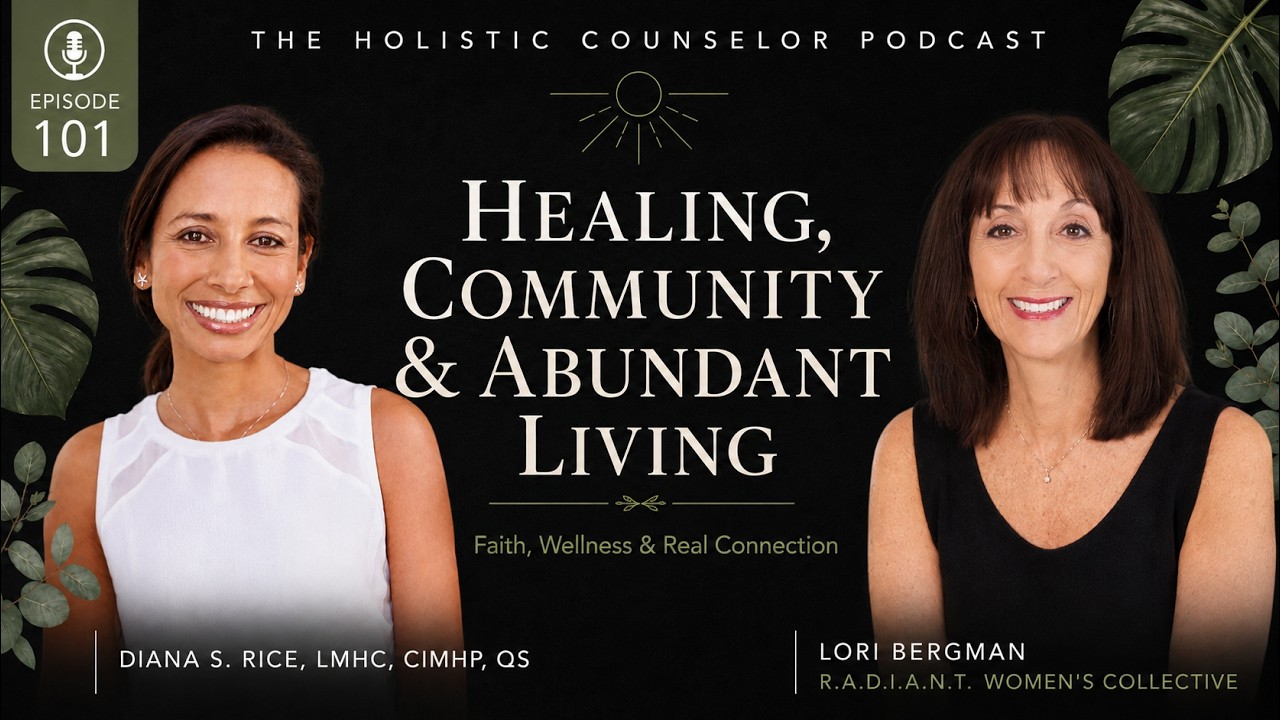
Episode 61
Overcoming Fear of Success, Burnout, and Money Mindset Blocks as a Faith-Based Therapist or Coach
with Laura Long, LMFT, MBA
Hosted by Diana S. Rice, LMHC, CIMHP, QS
In today's soul-stirring episode of The Holistic Counselor Podcast, host Diana S. Rice, LMHC, CIMHP, CTP, QS, sits down with her business coach, the dynamic Laura Long, LMFT, MBA. Together, they dive deep into topics that most entrepreneurs quietly wrestle…

Listen to the Episode
Press play when you’re ready.
Educational content only; this podcast is not therapy, diagnosis, or medical care.
About This Conversation
Show notes
Jump to a section
In today's soul-stirring episode of The Holistic Counselor Podcast, host Diana S. Rice, LMHC, CIMHP, CTP, QS, sits down with her business coach, the dynamic Laura Long, LMFT, MBA. Together, they dive deep into topics that most entrepreneurs quietly wrestle with: the fear of success, financial mindset struggles (especially for faith-filled women), burnout recovery, and what it really takes to sustain a practice without losing your mind—or your mission.
You'll hear raw truths, lots of laughter (and maybe a tear or two), and real-life tools you can start using today. Whether you're a therapist, a coach, a ministry leader, or a creative entrepreneur, this episode is packed with wisdom bombs you won't want to miss.
Featured Guests
Diana S. Rice, LMHC, CIMHP, CTP, QS Founder of Through the Valley Therapy and Transformed Mind Consulting and Coaching
Laura Long, LMFT, MBA Therapist, Consultant, Speaker, and Creator of Your Badass Therapy Practice Learn more about Laura Long here
Key Topics Covered
- Why fear of success (not failure) is often what keeps us stuck
- Why faith-filled women often struggle with charging what they're worth
- Burnout vs. Compassion Fatigue: Knowing the difference could save your career (and your sanity)
- Practical ways to heal from burnout without adding "one more thing" to your to-do list
- How entrepreneurship and surrender actually go together (hint: hold the reins loosely)
- The unique power of community for counselors, coaches, and creatives
Powerful Quotes from This Episode
"Fear of success is what happens when we realize success means more responsibility—and more energy spent." — Diana S. Rice
"If this thing works, it might change who I am. That's scarier than failing." — Laura Long
"Your value was given by God. It's not tied to your rates, your degrees, or your productivity." — Laura Long
"Sacrifice? There's only one sacrificial lamb—and it's not you." — Diana S. Rice
"God often leads in steps, not leaps. Start small. Surrender." — Laura Long
"Burnout didn't happen overnight, and healing won't either." — Laura Long
Resources Mentioned
- Wise Practice Podcast Episode 114 with Laura Long: Listen here
- Journey to the Heart by Melody Beattie – a devotional favorite for seasons of burnout
- Bible — always the ultimate resource for healing, direction, and truth
- Wise Practice Summit (original link no longer available)— Join Diana and Laura this October!
Practical Takeaways
- If you're facing burnout, start small: sit outside, listen to a bird, breathe, cry if needed.
- Separate your personal worth from your business pricing. You are priceless.
- Focus on one thing at a time. Spreading yourself too thin doesn't make you more valuable—it makes you crispy.
- You're not meant to do life (or business) alone. Find community—even if it's just one safe person right now.
- Remember: rest is productive.
Connect with Us
Diana S. Rice, LMHC, CIMHP, CTP, QS
- Website: Through the Valley Therapy
- Coaching: Transformed Mind Consulting and Coaching
- Instagram: @throughthevalleytherapy | @transformedmindcc
Laura Long, LMFT, MBA
- Website: Laura Long
- Coaching: Wise Practice Consulting
Help Us Grow
If today's episode encouraged you, please leave a review, subscribe, and share it with a friend! Your support helps more hearts find hope and healing.
Episode transcript
Read the full transcript Close transcript
Automatically generated from YouTube captions. Names and wording may contain errors; listen to the episode for the original conversation.
Welcome back, fearfully and wonderfully made friends. I'm so glad you're here today. And I pray that wherever you are listening from, you are reminded that you were created on purpose for a purpose. If you're new to the Holistic Counselor Podcast, make sure you go back and check out previous episodes where we dive into the beautiful intersection of faith, science, mental health, and holistic living.
And if you find today's conversation helpful, please take a moment to leave a review and share this episode with a friend. It truly helps us reach more hearts who need encouragement and support. Today's episode is especially meaningful to me because I'm sharing part of my own growth journey as a private practice owner and introducing you to someone who has played a significant role in that journey.
I first discovered Laura Long during a season when I felt completely stuck in my solo private practice. I had been grinding alone, wearing all the hats. And honestly, I was exhausted, questioning whether I could keep through the Valley therapy open or if it was time to walk away.
In October, I attended the Wise Practice Summit, and it became a real turning point for me. Shortly after, I heard Whitney Owens, the founder of Wise Practice, mention Laura's name, which led me to episode 114 of the Wise Practice podcast. In that episode, Laura spoke about the fear of success, and her words stopped me in my tracks.
Something deep inside me stirred. A few days later, I reached out to Laura and that decision opened the door to a whole new chapter of clarity, courage, and growth. Laura Long, LMFT with an MBA, is a therapist with a thriving private practice based in Greenville, South Carolina.
She's also a clinical supervisor, adjunct faculty instructor, and an accomplished business consultant in the mental health space. Laura has built a million-doll consulting business where she helps therapists and entrepreneurs break through mental barriers, increased their earning potential, and create work that truly matters with the people they are called to serve.
She's an engaging speaker, a trusted mentor, and when she's not working, you'll often find her tending her garden or playing piano. Whether you're an intern just starting out, a therapist considering private practice, or someone simply curious about what re what it really takes to build a sustainable business in this field, today's conversation is for you.
Today, we're diving deep into faith, finances, and the fear of success. The real conversations that don't just build businesses, but build boldness and freedom. So, wherever you are, take a deep breath, settle in, and get ready for a raw, practical, and hopefilled conversation with my business coach, Laura Long.
All right, girlfriend. How you doing? That was quite an intro. Woo! I'm like, who wrote that? Oh, wait. I did. Thanks for having me. Yeah. Thanks for being here. So, we're going to start with the moment that changed everything for me. All right.
Um, episode 114 of the Wise Practice podcast, if anybody's interested, with Whitney Owens. It released on December 31st, 2024. And you said something about the fear of success. And that really hit home. I felt a conviction like I never had before. And I was just like, "Oh my gosh."
Can you unpack what you meant by that and why it shows up right when we're on the edge of breakthrough? Yeah. Well, first we probably need to talk about what always comes up first is the fear of failure. And I think that that, you know, I talked about it on the podcast episode with Whitney.
It's something that often comes up in my business consulting, also the classes that I teach, this fear of failure. What if I put something out into the world and it's rejected by the world? Or the people that I'm trying to help really don't want it and I've spent all this time and energy and money pouring myself into this idea or this business and it doesn't take off.
But what we often don't talk about is the fear of success, which basically means what happens if this thing that I've poured so much into actually does work out and then I'm on the hook for it, right?
and then I have to change or something about me changes or what if the bar that right now might feel like it's on the floor but what if the bar begins to raise and expectations and pressure are both placed on me and I'm not able to show up that would be a true failure it's actually success it's that fear that what if who I am fundamentally changes as a result of this thing working that I so desperately want to work.
Right? And I think what happens is that we subconsciously will begin to pull away and we won't show up. And it and it sort of reinforces this belief that maybe what I have isn't even good enough to put out there. But it's really our fear of success that's holding us back more often than it's our fear of failure in my opinion.
Yeah. No, Laura, that makes sense. Oh, sorry guys. I got a new doggy. His name is Bear and you're going to probably hear him. I'm excited. Adorable. A anyway. Um, so with the fear of success, I know when it when you were talking about it with Whitney, it really it really was just like, whoa, that that makes more sense than the fear of failure because I try new things all the time.
I'm a creative. And Laura, as you've gotten to know me, we've been working together now for what, a couple of months now, I would say. about two two three months. Yeah. Um I I think it was the fear of success for me is like if I succeed that's more responsibility.
Yes. It's more responsibility and more responsibility means more energy being spent. And what if I can't maintain that? Exactly. Exactly. And and also it's like no one ever trained us as therapists of business ownership anyway of this situation and the fear of success like to me was like yeah that's the problem.
It wasn't the fear of failure cuz I create a lot of new things all the time and I go at it. But this through the valley therapy cuz this is what I've come like you know Laura's really good guys like when I say really good like first of all most of you that have heard me or if you know me personally my personality is pretty strong and uh that's what my family says anyway.
But she was able to really like every time my creative brain would go off into the to the rabbit hole or the tangent, she was able to be like, "Girl, no, come back." In a very respectful, gentle way. And that's when I knew, okay, she can work with me.
She's not going to take things personal, and she she allows me to be me, the true me, you know, and at some of our sessions, it's just like, girl, and she goes, "Nope, just do it. Say it. Go ahead. Be bra." Anyway, um so I wanted to in introduce that part of how I got to know Laura and what the fear of success was.
Um so you you've worked with therapists and coaches, creatives, Christian entrepreneurs across the globe. All right. Why do you think so many faithfilled women struggle with money, especially when it comes to charging what they're worth or growing beyond the therapy room? And I'm going to be real honest.
Right before, this is weird. I forgot that this is a question. Right before we came on the show, I had my hour coaching session with her. And this was probably our fifth, is it our fifth coaching session? And all of a sudden, I'm still having to deal with what was taught in me to me, what I picked up.
It's actually narratives that we pick up in life. So again with the question of like why do you think so many faithfilled women struggle with money? I think that this is such a huge question because we also to address some of the cultural implications of charging.
Um, first of all, being women, being women in a helping profession for some of us who uh may identify with being people of color or other marginalized groups that have been on the receiving end of systemic oppression. There's a lot to unpack with that.
What I would say is that as a person of faith, as a woman of faith, and as an entrepreneur, it can be so difficult to um kind of separate our sense of worth and who we are from what we do for our jobs.
And that's something that we had sort of talked about in the last hour is saying, "Okay, well, if the value of what you're providing is x number of dollars, that has nothing to do it has no bearing on your value as a person because your value as a person is priceless and was handed to you by our our Lord and Savior.
So we need to start to separate our value and who we think of ourselves as believers, as women, as entrepreneurs, separate that out from the product or service that we are providing. Yeah. And ultimately I think if we can do that then the price of what we are charging for any service or product it becomes a lot more of an objective decision.
We can just look at numbers. We can only look at okay these this is what I need to charge in order to support my livelihood so that I can continue doing this important work and not experience burnout. Yeah. But we can do that much more objectively if we separate our value as people because that value is priceless.
It is inherent. It is handed to us by the Lord. Yeah. That is not something whether I charge $200 an hour or $2,000 an hour. My value on this planet remains the same. Yeah.
And it and it's to me staying in the humili humility of how God made us because honestly I've met some people Laura let me tell you some coaches and therapists who are like oh no I'm $400 and then it's you know what I mean and it's the I hate to say the the full of themselves kind of thing and it's un and I think that's that's the thing being a woman who who's trying to you know
let the last be first and the first be last and and following the Lord, but we're also our own CEO.
It's such a balance. Like Laura has helped me a lot to to really unpack certain um thought processes that I thought I dealt with in therapy, but I never came in, you know, I'm they don't teach us how to be business owners or private practice owners.
It really honestly what I've come to understand is many of the schooling that we go through is an insurance modeledbased teaching right let's diagnose let's give the you know here we go and here's the insurance and here's the code and and stuff like that and um and then my you know how I I hate to say how I was raised as a therapist but it was most of us go into schools or into um different realms.
I mean, where we do our internships and stuff that it shouldn't be, you know, you're helping you're helping people. It should be free. Oh, right. Yeah. You you you shouldn't charge anything for helping someone else. And yet, what about how much we had to pay for our education, for our supervision, for our client contact hours after graduate school, to pay to take the licensing exam, all those things that we also had to pay.
And now we have overhead too. Um, I do think that a lot of therapists and also, you know, therapists who are women, who are believers, we want to come from a place of service. That's part of why we wanted to become therapists in the first place.
That service doesn't mean self-sacrifice to the point of burnout, right? I mean, even Jesus set boundaries. Yeah. Um, you know, and we are called to serve as believers, but we are not called to serve everyone. Stewardship means knowing your limits and yet still being able to make an impact.
Uh but one thing that I often hear from therapists who are believers is they'll talk about you know money and the and the mindset around that and who am I to even charge this much and and wealth and I need to stay poor.
Well, scripture doesn't condemn wealth. It warns against idolizing it. So I believe that you can honor God and build a thriving business at the same time. Yeah. Well, I mean, and Laura taught me, I mean, I listen a lot a lot of podcasts and and what Laura really is working with me about is understanding that if I charge a higher fee, then that means I will have, you know, you know, she does, she helped me do a budget.
She helped me figure out what I need to do, how many clients, so I'm not burnt out in order to be able to have more freedom not to more freedom to actually be with family and also to give back to my community for free, you know, and these are the things that, you know, you don't really think about because you're wanting to serve, serve, serve.
And another thing that came to me while I've been working with Laura is understanding that I I want to help. I want to help my people. Laura and I have talked about that a lot. But I also need to understand that sacrifice, the word sacrifice, we are taught that like we need to be but guess what?
There's only one sacrificial lamb and that's Jesus Christ. And I cannot be Jesus to the human. I can try my best to act like him. That's why he came to show us the way. Right, Laura? But it's like some of us because we are in these helping fields, that's what happens.
We end up thinking like, "Oh, I got to save him. I got to save him. Oh, no matter what. Oh, I'm going to stay up for hours at a time."
Or, you know, I'm going to be with my client for 50 minutes, but I'm going to spend another hour doing more work for that client because we kind of touched on that too a little. and and Laura really knows how to not discipline me but well discipline you know if we're going back to the roots of the Bible I mean discipline means to teach yes Jesus had disciples you know he taught so discipline doesn't necessarily mean
punishment I'm practicing I'm helping you to practice some amount of self-discipline perhaps yeah I mean she's giving me concepts that I've never heard of or I've never I've heard of them but I've never put into practice it's the accountability I think from day one I'm like, "Laura, I know me.
I know how it is. I can learn learn." And it's uh analysis paralysis, right? But Laura is my accountability. She's like, "All right, girl. I mean, this is this is where we're at." And then she knows how to come back to where I was after I go into these rabbit holes.
And she gets me out of the rabbit hole and go, "Okay, focus, focus." Right. So, what practical tools or mindset shifts have helped your clients move forward move from burnout or invisibility to clarity and confidence?
Now, when I was thinking about my answer to this question, I was curious if you thought it would be more helpful to talk or to speak to other therapists or those that I've served in a more consulting realm or actual clients because I do offer in my therapy practice, you know, burnout recovery strategies.
So, I feel like those are they're similar or there are some similarities, but there are also some stark differences, too, depending on who's listening to this episode. Oh, I honestly think that I have both. I have, you know, regular humans that are just searching for help with burnout.
I because I deal with a lot of women that are burnout and, you know, girl, I was burned out and not burn, you know, burnout. Let's talk about burnout.
Yeah. for a second because people I saw burnout when I was doing that conference that I was telling you about through my other company you know so with burnout it's like what does that actually mean and how do you help people with burnout so there is compassion fatigue which as therapists I would imagine you and I both have had our fair share of experiencing uh you know when you have so much empathy and you spend day
in and day out with people hearing their stories and some stories are extremely traumatic without proper supervision or case consultation or just colleague support. we can experience this uh it it feels somewhat similar to burnout but it's but compassion fatigue for me is a little bit more like I am just so I call it crispy like I just feel so crispy I don't have anything left in my in my cup to give to other people because
it's been a full week of just hearing these horrible horrible stories and and sitting with people in that um to me compassion fatigue it can last a a long time.
But personally, in my experience, it's been more shortterm. I had a really really rough week or even a rough month. Um, when I was working at agencies, yeah, I would extend and and take maybe several weeks of me having these feelings um where I really don't have the empathy, but to me, it felt more like um maybe an apathy of sorts.
Yeah. Just that I was so crispy. I had nothing left to give. I had used up everything that I had. So that is for you know most people who are in prof uh professions where they're helping others whether it's nurses, counselors, members of the clergy, they can experience compassion fatigue.
To me that's slightly different from burnout. I don't know if we're just like splicing words here but for me burnout is more of an extended period of emotional exhaustion. uh feeling numb, even cynical, completely disconnected from the work and from the people that we used to be excited to serve.
And also in addition to that, having this significant reduced feeling of accomplishment in our lives. Yeah. It's it's hard to get out of bed. It's hard to um even want to do the things that maybe we know give us joy, things that are outside of our profession.
So for me being an avid gardener, if I'm going through a period of burnout, I'm not even looking forward to going out and spending time in my garden. So things that don't even have to do with my profession, I'm dreading and avoiding. So to me, burnout is much more serious, much more insidious than compassion fatigue, which for me is a little bit more easily identifiable within myself.
I can clearly see that I have not done a lot of self-care over a period of time. I've been having some really heavy sessions. I've not sought supervision or any sort of consultation and I'm starting to feel a bit isolated. So, that to me is is easier to get out of because I know that the antidote is connection, right?
I need to I need to call a friend, whether it's another therapist. I need to reach out to my old supervisor. Um maybe I need to listen to some podcasts. Maybe I just need to get out in some fresh air and do some garden work.
Like, I just need to get my hands dirty. Um going to the gym, spending really quality time with my family. These are all things that over time, you know, they do have a cumulative effect and can help me work through any sort of compassion fatigue.
Burnout, on the other hand, the recovery process I have experienced and also have helped others through can take a lot longer. Yes. And it sometimes does require a bit of a backup and punt mentality. Yeah. Sometimes it requires us to spend a season doing something completely different or exploring other interests.
Uh so it's not so easy as just you know we'll go get a massage and you know take a long weekend. So that's those are techniques that maybe can assist with compassion fatigue but not so much with burnout because by the time someone is experiencing true burnout they don't even have the the energy to do some of the most basic self-care things that would have helped them if it was compassion fatigue.
So really walking through this with a professional would be very helpful. I would say, you know, to anyone who's in that space of feeling really burned out. We're talking beyond crispy, right? This is I'm having trouble even going to meetings that I know are important.
Um doing things that that bring me joy that aren't even related to my profession. I cannot bring myself to do it. I'm cynical. Um I'm resentful of of my clients or customers, people I work with. I'm really snappy and irritable. These are all potential signs of burnout.
And so, what I would say, your first call needs to be to a clinician who can help you. Yeah. Um, a therapist who maybe specializes in burnout recovery. Um, someone who works with either if you're an entrepreneur or if you're someone in a helping field or um, a medical profession.
Finding a therapist who is highly skilled and trained such as yourself in working with people and me. I'm in Florida. She's in South Carolina. in South Carolina. Um, and so working with that person, part of the reason why it's so helpful to have a therapist outside of the fact that we just have knowledge and skills and training and background and all that is that we have no skin in the game.
So, what I might tell you to do might be different from what your loved one might tell you to do. Because your loved one maybe wants to make sure that you stay in the profession that you've worked so hard for, that you're helping to support the family.
But what if your burnout recovery plan includes you taking a season off or um even being able to take, you know, an extended period of time away, but needing to be creative in coming up with solutions possibly to generate revenue in the meantime.
You know, if we're going to take a sabbatical, what are we going to do toelves and our families? Um, and so being able to think through different solutions and alternatives, it's going to require someone who can be creative with you, but who also isn't going to benefit or not from whatever decision that you make.
So, I think that that separation can really help you as a client to be a lot more honest about what's going on with you without worrying that you're dumping all of this on a loved one or your spouse or something like that, right?
I mean because that those pressures you might not want to put more you know you feel like a burden at that point too with burnout you're like it's it's the weirdest thing that happens it's like so many emotions and thoughts that come together in like a tornado.
Well, yeah. And I think if I can speak to uh being a woman, a woman of faith who may also be experiencing burnout, I think there's a huge amount guilt that comes from that. There's a comparison that, you know, who am I to even feel this way when I have all these other things going well in my life.
You know, I don't deserve to even feel burned out. Um, you know, if it's someone who is caregiving for small children and they're experiencing burnout, they might look at themselves and say, "Well, at least my children are healthy. Who am I to complain?"
Right?
or they're comparing themselves like because I've had that conversation with you Laura because if like I'm second generation here and you have immigrant parents that might have put it on you saying trauma you guys have no clue you're a spoiled American you're a spoiled American and so if you're raised in that mentality oh my gosh I'm but I'm feeling these things I'm feeling these things but then you feel the guilt and the shame of like oh
my goodness no you're right like they had it really bad over in their third world country And so it's it's so many different layers.
So many different layers. And and that's the thing. Whoever is listening and you're starting if this is resonating with you, it is going layer by layer and understanding you're not alone. No matter what, you're not alone. And and there are practical tools and things.
Do you have any favorite like books or podcasts or resources that you like recommend over and over when you're dealing with a client? Yeah. What I found is that often giving clients more to do when they're in a season of burnout can exacerbate burnout.
Okay. So although it would be easy for me to say, "Yeah, read these, you know, two books and they'll change your life." U first of all, I don't think any single book except the Bible's going to change your life. But second of all, uh it's just giving you more busy work.
It's more things that you need to do that you'll probably avoid and then feel guilt and shame having avoided those things. Um for me it's more about just getting centered and getting reggrounded. So that might just look like getting a new devotional. It might look like um so Melody Bey wrote a book called Journey to the Heart.
It is so good. It's more of a spiritual uh devotional than a religious one per se. And you it doesn't have a year attached to it. you can start at any date and um every single time I open that book and I read the corresponding date uh what her entry is for that date.
It is so lifegiving. It it her way of giving me a newfound perspective on things of validating where I'm at uh of giving myself compassion and love where I am is so great. So, I actually read a devotional every morning and I read Melody Bey's Journey to the Heart, which is also a devotional of sorts.
It's just somewhat separate. Um, but I say if someone can just go back to basics. Yeah. What is one thing, you know, taking a baby step? One thing that you would like to do for yourself today that maybe you've let fall out, something you used to derive joy from, but how can we make it so small of of a new thing that you're adding that it doesn't feel like a 100 pound weight, right?
Yeah. Because some of us we go in especially if we're high functioning typea uh yeah hello yeah me too hot me kettle where we realize like it's so much and and I mean it's a gift it's a gift to be like Martha but I think it is also understanding we must be Mary we must become like Mary at the yeah And that's what it's the small step to me.
I tell people, when was the last time you just sat and listened to a bird, like what? Or look for a butterfly or a bug? And they're like, that isn't I'm not four years old. I'm out of preschool. I got I got bills to pay.
I got And I'm like, that's part of what you need to do. And I'm going to hold you accountable next time. I mean, and and it's the smallest, tiniest thing. Yes. Being out in nature make it's wonders. Now, none of these things that you and I talk about today are going to be overnight fixes, but neither is burnout.
Burnout didn't happen overnight. So, why would we expect, you know, in our American way to just do one thing and it fixes all of it? Yeah, that's one thing I realize, Laura, when I work with a lot of women from different countries when they come to America and they hire me and they feel they're like, "This country, this is all it is.
It's about work, work, work, work, work, work, work, work." And I'm like, I know it is it, but when you're raised in it, like, you know, I was raised in New York. That's all I I mean, New York by a single immigrant mom.
It's it's a a fast pace. And then I was moving to the country. Florida to me was the country. Wow. Back in 1982. It was, you know, there were alligators in the woods and I'm like, what's that? Yeah. So, you know, rest can feel that's it.
Yeah. Rest can feel unproductive. Especially if we have conditioned ourselves and have allowed ourselves to be conditioned by a society or a working environment that only rewards hard work. That's it. The guilt of I never was a napper. The only time I've napped maybe three times in my life.
All right. And that was because I was really super sick. Mhm. Well, doesn't that go to show though that your body needs the rest? And it was forced. Your physical and your mental, emotional, and spiritual are all interconnected. You got to listen to all parts of you.
And that's how God made us. So, you know, as someone who's now my business coach, what stood out to you when we started working together? You're fire, girl. You have such a blazing fire under you at all times. I know. and then it could consume me and then I'm crispy.
Um, no. So, more seriously, I would say from the moment we first met just for a a basic consultation, just to get to know one another, I could see this passion that you have to serve women. And maybe there was a little bit of a hesitation because you have worked with men and have really enjoyed that and you're like, I don't want to limit myself because I really love working with men.
But when we actually just peel back the onion layers of who we love serving, it's some version of ourselves from years ago. And so when you talk about some of these people that you have served and the ideas, the creative ideas that you have to do more, whether it's podcast episodes or writing on your blog or teaching a seminar or a workshop, you are always coming from this place of service because you want people to change their lives.
And when you hired me, it wasn't because you're like, "Oh, I just want to make a million dollars." Which also would be fine, by the way, if that was your goal. He's working on that with me. So is so is my husband. Yeah.
If anything for you, it's the opposite. It's like, how do I serve more people? How do I make myself more available without the burnout, without becoming crispy? So, I think that that's something that really stood out to me from the very beginning is that you wanted to figure out what is the most creative way that I can clone myself and and do it quickly.
Like you have this sense of urgency about you in wanting to help other people and wanting people to experience what true healing is for them. Yeah. And you can't really you can't buy that. You know, that's not something I can really teach if if someone doesn't already have that fire within them.
Wow. Wow. I never heard someone describe me like that, but thank you. All right. No. Yeah. I mean, and that's the thing. I think Laura and I kind of have the same personality in a way cuz she's a fiery creative as well. And and like I said, when I came and I, you know, said some things to just test her and she was like, "Oh, no.
Here." And then she snatched it right back and was able to go back at it. And I'm like, "Okay." And then she's got so much wisdom that I'm like, "Oh, I'm so hungry." And she also knows when I start going, "What about this?
What about that? What about this?" And then I It's called the zooies. I zoom like this new dog. He zooms. He zooms everywhere. She's just able to really um get back to All right. No, here's what we stated. Let's get back to this.
And that's exactly what I need. Um, so let's let's talk about, you know, you're going to be the keynote speaker at the Wise Practice Summit in October, correct? Is this in October? Yes. Why is that event so impactful, especially for Christian therapists or those walking the line between clinical work and their calling?
Yeah. Well, I used this word earlier and it's coming back to me, but really it's about connection because whether it's compassion fatigue, the comparison trap, feeling really isolated in private practice, feeling like, "Oh my gosh, what am I even doing with my business because I never learned this?
I never got this training in grad school, like what am I even doing?"
having a group of people who are not necessarily like-minded because I think there's so much value in diversity but having this one thing the the idea that we are all on a faith journey whether we practice openly as Christian counselors or whether faith is something that we hold inside but maybe we still practice from a place of integrity we may or may not just say outwardly that we are Christian-based either way when you get a group of clinicians all together with that same common thread who are very diverse in other ways.
That level of connection is so intimate and there's so much more depth to it than simply getting a group of clinicians together or clinicians who are in private practice. When you add that faith element, it really opens up the door to have some pretty difficult conversations.
Yeah. That are so meaningful and so deep. Yeah. And that's why I love that summit. Yeah. I mean, I went to the my first one this past October and that's when that guy Neil Samui or I don't know how to say his last name.
How do you say it? I don't know how to say it either. Okay. Well, he was I still go back to that. I mean, I think my listeners have heard me talk about this wise practice summit and and what happened there and how that shifted everything for me and and the it wasn't it was just a conviction.
It was it was a conviction that came over me at that point after he spoke and I'm like, "Oh my goodness, it's true." Like through the valley therapy, you know, God gave me that God gives us these things, right? And through him in our weakness, he's strong and it's and that's the recal what was the word we were using earlier?
Regroup. Recalibrate. Yes. Recalibrate. All the re words. All the Yeah. Recalibrate into the why. and the why we do this, why is this important? What is like my mission statement and my vision statement? I think I have one for every company, right? Yeah.
Um, so this summit though it's like what's compared to other conferences, there's so many out there. What is really different about this one? I would say because everyone who comes to this summit is even if they aren't necessarily faith-based, they're willing to integrate and have those conversations around faith and it's it's not something that we shy away from.
So things like how to have a profitable practice, there are plenty of conferences and workshops that a therapist could attend to learn how to have a profitable practice. That's not new.
But when you add that element of faith in there, then we can go much deeper and talk about well what does the Bible say or why does why does one feel guilty when we start talking about charging our rates and how do we deal with that internal dissonance that might exist as believers when we are wanting to be profitable and also serve.
So, it does allow and opens up the the floor to have really um integral conversations around how do we operate a practice in a way that still aligns with who we are as believers um or as people that are just questioning their faith?
How do we how do we navigate this very intimate thing of being a therapist in private practice who gets in there with clients and has really hard conversations? How can we create a space that feels even if it doesn't always feel safe, we feel like we can be brave in those conversations?
So, whenever I've been to the summit and we're just having maybe there's um a break during a workshop or at lunch or at breakfast, clinicians are coming together and having really hard conversations and they just feel so much more robust and meaningful than simply what is the next big marketing strategy or what's the trendy thing to do to, you know, build your practice or, you know, how do I do SEO?
like all of those things which are valid and and important things to discuss, but when we can do it under the umbrella of integrating our faith, whatever that looks like, and hearing other people's stories, that connection you feel leaving that I mean is similar to the connection that you felt and we can be convicted when we hear things at these conferences, but it allows us an open platform to discuss them with other people there, knowing that we're not going to be shamed for what our beliefs are or aren't.
Yeah. But it's a more open exploration of faith. Yeah. It's all different denominations. This is what I love. It's not just like one denomination. And it it just and and understanding psych. That's what I love. It's theology and psychology all mixed together and and and respecting where each human being that attends is at. you know, and it wasn't overly, you know, because I've gone through Christian conference, like women of faith conferences and stuff like that.
That's one thing.
But this it it's hard for us um therapists cuz you know I don't know if you've had this happen Laura in your you know um time as a therapist but you have a lot of churches out there um who say what we do especially with psychology right or being licensed it goes against the word I mean I know I've had that experience of people saying those things as well and to me I'm like wait all good
things come from above and just because we might have studied Freud or or other you know modalities and philosophies doesn't mean that it's we take these things but we still take I think the thought captive to Christ.
So, how how do you how have you dealt with that or have you dealt with things like that before where, you know, it's like I'm trying to break stigma in the churches because there's a lot of people in those four walls that are suffering with mental health issues, but they're saying you're not having enough faith.
You're being, you know, have enough prayer. You see what I mean? They don't get into the anxiety and depression or the actual clinical diagnosis. It's such a balancing act for us, you know. What say you? Yeah. What say you? Well, I think you know being able to speak to it with a client.
So, if I have a therapy client coming in and they are a person of faith, allowing them to share what's happened for them and how that impacted them without necessarily inserting my my thoughts or opinions yet. Um, but really being being a place for them to just share in any way how they may have experienced injury or trauma from their church and then offering them that that clear support and validation if it's helpful for them.
Even opening up the Bible and seeing, okay, what does it actually say about that? Because your pastor may have said that taking medication is is of Satan is evil. Well, let's see where where it might say that. It doesn't. just sneak peek. It doesn't say that.
Um and so sometimes just speaking truth to them. Other times it really is just being a place for them to be able to share where you know there is a little bit of what we call in our field a power differential between a therapist and a client.
So the the client may defer to something that the therapist may say even if the client disagrees with it because there's this sense of of power that the therapist holds. And so I'm very aware of that power differential. And when I'm meeting with a client who might be sharing some of these really awful experiences or even traumatic experiences they've had with a faith-based institution, I try to come from a one-down position.
You know, I am not the the keeper of all knowledge when it comes to the Bible or Christianity or any faith for that matter. And so I really try to honor the fact that even though this is a space where there might be that power differential and maybe they're looking to me for answers, sometimes just sitting with them in that space and not trying to be u the person who has all the answers.
Exactly. But validating their emotional experience and understanding that their their experience as a person, their lived experience I will never understand too. And so that's something that I think, you know, I'm able to at least try to model humility and try to model what Jesus would do in those situations.
Um, just being coming from a place of openness and love. Yes. Yes. Yeah. The unconditional positive regard, which we are taught, you know, but not everyone understands, practices that right.
And and you're spot on. like we're I feel when we are in front of the client is to sit with them like you said and give them the space the space to really get to know themselves in a very safe place you know online or in person like it's just about listening and trying to understand their why of what was happening or what is happening because the answers are inside of of our clients I mean, Laura, like you, you know, you're a guide.
You're, you know, to me a guru, but you're in what you do, but I know that word. Somebody's gonna come after me on that one. But that's all right. That's all right. We get it. Hey, it's the attention of my heart. It is like, what's the attention of my heart?
I'm just being funny. Anyway, but it's true, though. She she's got this wisdom that was given to her that she worked hard for and now I am seeking that wisdom so she can help me become a better therapist and a better guess what I might go into the coaching full-time or the cons and she's helping me with all those things and this is why I hired her and I pay her the big bucks because she's worth it.
She is and so and that's the thing she's starting to help me understand that I'm worth it too. Yeah, I'm worth it, too. And that's See, I'm about to cry. Yeah, because I have to still do therapy with my therapist. Laura's my business coach, not my therapist.
But it is, you know, and and for somebody that's listening and saying, "Well, I can't afford any of this stuff. I can't I can't afford I can't afford a therapist. I can't afford a business coach. I can't afford anything at all." What would you say to them?
Well, they're here right now, so they're they're getting value from this. And part of why you and I both charge the rates that we do in our practices is to enable us to spend this hour together and give so much value. Now, I I didn't hold anything back today, but neither you nor I are getting paid for this time, right?
and we were able to generously give our time because our our financial needs are being met elsewhere. And if we charged little to nothing for therapy, we would be spread so thin that we wouldn't be having this conversation. No, you're right. So for those who truly are in a position where therapy feels so far away for them, so far away from their grasp, I would say thank God for people like you.
Thanks. who are putting this knowledge out and not expecting a dime and you're not holding anything back either. So there is still so much to learn, so much to to gain even from from free tools out there. Yeah. And by you continuing to explore yourself as a Christian woman, as an entrepreneur, as a therapist, wearing all these different hats, you will eventually get to a place where you also have so much time and energy and resources to give back.
Yeah. But in order to do that, you have to come from this place of understanding the value of the services that you provide and the years and even decades of hard hard work that it took to get you here. Yeah. And there's value there.
Yeah, there is.
I mean, but see, those are the narratives that I've had to work through um not only with Laura, but with my own personal therapists and on my own. like I do pick up tools in between even though I am a therapist trying to give uh information out or challenge you know CBT cognitive behavioral therapy challenging people and their thought process and stuff it's like we're all responsible for ourselves so we we have to choose even to
do the one baby step that Laura was talking about earlier you know um well I go ahead if I could say one more thing to that just it really demonstrates the added value that you are then able to offer to your clients because you do so much of your own work in your own time.
You pay for your own therapy. You pay for your own business consulting, right? And you're you are learning yourself so much about how to be a better entrepreneur, a better believer, a better wife, etc. And you're then able to dispel that knowledge to those who work with you, right?
And that's so valuable as well, the fact that you do so much outside of therapy to continue learning. Yeah. I I mean, I think it's important for all of us because that's the stuck feeling that many that are in survival mode, right? If you think about all the many of the clients that I know I work with feel stuck.
That's why they they hire us in crisis, right? They feel stuck and they're in survival mode. They're exhausted, undercharging, and unsure if they should keep going. You know, what would you say to a woman who's about to give up on her business or worse, herself?
Well, if she is a spiritual person or someone of faith, I think the first place she needs to go is within and to have some some quiet reflection time and not just like 10 minutes. Um, but you know, when I was experiencing burnout and having a lot of thoughts about what I should do with my next steps, I went on a silent retreat.
I spent it was just a full day. It wasn't a whole weekend or a week, but it was an entire day where I spoke to nobody. I was in the middle of the mountains. I had a little tent that was set up for me and all I did was journal and pray that whole day.
And I cried. I cried a lot. Yeah. Um, and from there I did get so much clarity and it wasn't necessarily the answer or answers that I wanted. What I wanted was to just keep going and have it be fine, right? But it ended up I had to dismantle a lot of things, a lot of relationships, um, an entire business.
Like there was a lot that I had to do to unravel that. And now I'm here on the other side of it saying, "Oh, I'm so glad that happened." And I'm so glad it happened in the timing that it did because God's timing is perfect.
Amen. Amen. So looking backwards, the timing was great. At the time it didn't feel that way. So I would say to a person or to a woman who's battling anything like that to take some time and quiet reflection. um if they have someone they trust who's maybe a clergy or a member of the clergy or a therapist um just someone to sit with them in this really dark spot that they might find themselves in.
But the answer, like you pointed out a few minutes ago, the answer is most likely already within them somewhere. It's not going to come from just, you know, talking it out with your best friend over coffee. They're going to give you a lot of ideas, right?
But that might just be more confusing. Yeah. I think going out in nature, like you said, just sitting on a park bench. Yeah. And crying. Yeah. People think Yes. People think crying. To me, it's actually your system regulating. It is. And then being in nature, this is what God has created.
All of this, especially if it's created by God, like like you know, not man-made, but like you go into a park or a beach or wherever it is, your backyard and sitting still because many of us, especially in a westernized culture, do not know how to sit still and breathe.
No. And breath was the first thing that God gave us. It all makes sense if you really look at Genesis therapeutically. It right. It really That's mind-blowing. Yeah. Yeah, it is mind-blowing when you sit still and and whatever comes up for you, that is where you have to work on.
Yeah. And that's that's where the clarity can come in, right? It's the surrender. What what was the word you just used? Not untangling. Um was it untangling? No. Maybe. Sounds good. I'll take it. No, but dismantle. Dismantle. This is it.
Like you're dismantling things, thought processes that are trying to get your attention. this is why you feel stuck or this is why the tension in your body and you have to surrender and surrendering means opening up both hands and just understanding that that God is the one in control.
We try to listen us type A we try that is why we get so stuck in things or whatever or if we've had our own childhood trauma or we come from a space that that was very painful, right? We have to work through that pain.
You got to feel it to heal it and then move forward and learn from it because you're going to keep doing the same thing over and over because you haven't learned the lesson yet for yourself. So true. We will just, you know, take control and white knuckle our way through something.
But what you're saying about surrendering, you know, God often leads us in steps, not leaps. So we have to start from a place of surrender and obedience knowing and trusting and having faith that the clarity will come. But we have to let go of the res.
Yeah, that's hard. That's hard when we're so used to um holding on really really really tight and like to me now I'm just picturing me on a horse with the res really really tight and going as fast as I can. Thinking that once we let go that's when everything falls apart.
So we have to hold on really tight. That's where we start to feel the burnout. Yes. Yes. Is holding on that tightly. And so, but I think Laura was just talking about the dark night of the soul. Um, and I know I've experienced it as well.
And in that, now when I look back at that, I'm grateful for it because that is what taught me how to now be still and be okay with the stillness because I didn't like being still before.
I once read that, you know, people like you and I when we get into those spaces, it's almost like you have you're in the car and you've got radio on, the AC on high, you've got people talking in the back, and it's just there's so much noise, but we become accustomed to the noise of our own minds.
And once we shut all that down, you know, once we turn off the proverbial radio and once we turn off the AC and there's no one in the car, it can be extremely disorienting to be in that silence because we have become so used to putting noise in our day-to-day lives.
We doom scroll, we distract ourselves, we watch TV, we do anything we can to silence what's happening in our in our minds. But if we actually can get rid of all of the distractions and go out in nature or be silent, take some time to pray or meditate, it's very uh like I said disorienting.
It can just it can create a lot of stress at first because we have become used to just making it louder so I don't have to hear it or feel it or feel it, right? And then when we're quiet, that's start to receive a little bit and sometimes they're just very gentle nudges towards something.
But that's where clarity, you know, the seeds of clarity come in those little gentle nudges. We just have to receive them and and have faith that whatever those nudges are are coming from God and ask that he make it known to us that these steps are ones that he wants us to take.
Yes. Yes. Not Yes. It is sitting still. And that's the thing for people that are in high levels of stress in their careers or even motherhood. I I work with stay-at-home moms where they feel like they're not accomplishing anything. And we have to reframe that because that's one of the hardest jobs is to be a mom, right?
And and to take and to take care. And it's just, you know, it's it I'm going to just say the cliche thing of putting the oxygen mask. the plane's going down, put the oxygen mask on yourself first. It is, you know, the word self-care.
We've were taught that that's selfish. Or if we take time for ourselves, it is, you know, no, we have things to do. We have to take care of, you know, other people all the time. And it's okay to take care of you. It's okay to be still and breathe.
You know, a lot of the things I I'm pretty sure you too, Laura, but I know the things that I try to help my clients with, they're free. Yeah. I mean, you don't have to pay much money. You're far for free. You're priceless.
Uh your therapy is not free. But you know what it Yeah. But it's like the the this tool set or the things the steps that we give clients, they have to start understanding. It's getting back to to just that stillness and that understand.
This is probably why you love gardening and so do I. Gardening is just to me one of the most amazing things. And I have clients are like, "Oh, I kill plants all the time." I'm like, "So do I." It's it's just understanding like it's a living thing, you know, and they're resilient, too.
And they are. And so are we. And we learn to be resilient. And we teach that. That's I know you teach that. And I know I teach that too that we teach our clients how to be resilient because resilient because that's important especially the way the world's going right now.
Yeah. A lot of my clients actually are resilient already. They just never realized it. So sometimes it requires me to point out all the times in their life. Yeah. Where they they learned and practiced resiliency and it gives them this newfound appreciation for where they've come.
Yeah. Wow. That's wonderful. All right. So, one one more question about being an entrepreneur, just because I have you here and and maybe someone else will want to know this. You know, you've helped people launch million-dollar brands and people just trying to make their first 500 bucks.
What's something you wish every heart-led entrepreneur would stop doing and something that they should start doing immediately? O, I think they should stop trying to do too many things at the same time. That probably doesn't surprise you. She She got me on that one.
But that wasn't to you. That was to all of them. I know. I know. But that's what that's one of the things that that I realize like, okay, yeah, you're right. Cuz I you all right. Yeah. And remember, you're a heart-ledd entrepreneur seeks to be of service and who seeks to help.
If that is your goal as a heartled entrepreneur, then the way to that is to focus, laser focus on one thing at a time. Yeah. It's not to spread yourself so thin that you're running yourself ragged doing all of the things, but none of them are gaining any traction and no one's, you know, there's no eyes or ears on anything that you're putting out into the world and you're frustrated and you're starting to get crispy.
That's not the way for a heart entrepreneur to serve. The way to serve is to do what they do well and to focus on one thing at a time and getting that really really good and solid. Yeah. So that it frees up a disproportionate amount of time, energy, money, resources to help other people who need it, who may not be able to get that help.
Yeah.
And you're doing that. you are doing that that's because I have you if I didn't have this is why I hired you because I realized like I needed the accountability and that's it that's it too like being in a solo practice is hard and there's many of us that come out of of being either in a group or in community mental health and we're wanting to do this this solo private practice and we don't know where to start or how to start and to And it costs money.
Like I'm not going to lie, it costs. But I realized like this is I was going to pay either way. I was either going to be really burnt out and lose everything or I'm going to pay Lord to really help me when we meet and get me focused.
And she is like she did that one thing at a time. Every time I'm like, I want to do this, this, this, this, this. And she's like, all right, girl. Nope. Let's go back. Because we need each other. We We're human beings. We're meant to be in community.
We're not, no matter where you are, entrepreneur, not entrepreneur, therapist, not therapist, whatever it is, you're doing fine, you're not doing fine. We still need community. Yeah, we do. We're social creatures. Yes, we we are. So, to close out, what's your hope or prayer for the woman listening right now?
I hope, just to piggyback off of what you were just saying, I hope that the woman listening here can find community somewhere, even if that's with one other person. If she's feeling beaten down, lonely, even if she's surrounded by a bunch of people and a huge family, but just feels so isolated, I hope that she can take one step today to build a community.
Yeah. And that can be a therapist. It could be a friend that she's lost touch with. It could be inviting someone to church with her. But yeah, building that that community is the absolute first step. Yeah, I agree for her. Yeah, for sure.
It's building that command. Some people are like, I don't know how. Well, you know what? There's Eventbrite. Find something that you like, photography, your cooking, I or something like that. Or go to your, you know, every sun, if you don't go to church, find a church.
Go to different churches. Please make it Bible believing church, not a cult. and sorry love that disclaimer. Yeah. Or or you know like there's so many volunteer opportunities just a place but you're not meant to do this life alone. Whoever is listening you are not meant to do this life alone.
So um is there any final words? Anything else you want to say before we say goodbye? No, I just want to thank you for having me and this conversation. It really it re-energized me as well. So, I do hope that others listening gained something from it, but I just wanted to tell you, Diana, that I have gained something from this conversation, and I appreciate the time.
Oh, Laura, I can't wait to meet you in person hopefully. I mean, I'm going to the Wise Practice Summit. So, and you're the keynote. I am the keynote. I know. I'm so excited. All right. For everyone that's listening, don't forget to trust in the Lord, guard your heart, and renew your mind.
Bye. And now for the disclaimer to make sure you understand that you are responsible for you. The content provided on the holistic counselor podcast is for entertainment,formational purposes only and is not intended as a substitute for professional medical advice, diagnosis, or treatment. Always seek the advice of your physician or other qualified mental health provider with any questions you may have regarding a medical or mental condition.
Never disregard professional medical advice or delay seeking it because of something you have heard on this podcast. The views expressed on this podcast are my personal opinions and do not represent the views of any professional organizations with which I am affiliated. Call your doctor, 911, or 988 immediately if you have a medical emergency.
The Holistic Counselor podcast does not recommend or endorse any specific tests, physicians, products, procedures, opinions, or other information that may be mentioned on the podcast. Reliance on any information provided by the holistic counselor podcast, guests appearing on the podcast at the invitation of the holistic counselor podcast or other listeners to the podcast is solely at your own risk.
Confidentiality notice. If you engage with the holistic counselor podcast by commenting or posting and are a client, please be aware that you may be revealing information that could compromise your confidentiality. Please remember that disclosing your identity or personal details can be linked to your clinical material.
As a therapist, I am bound by confidentiality and will not respond to any disclosures of this type on this podcast. I am committed to upholding the ethics and confidentiality of the therapeutic relationship which extends to all forms of communication in accordance with the laws and professional guidelines that govern mental health professionals.
I want you to know that your privacy is of utmost importance and you are responsible for protecting it when interacting on this platform or any other public forum. Thank you.