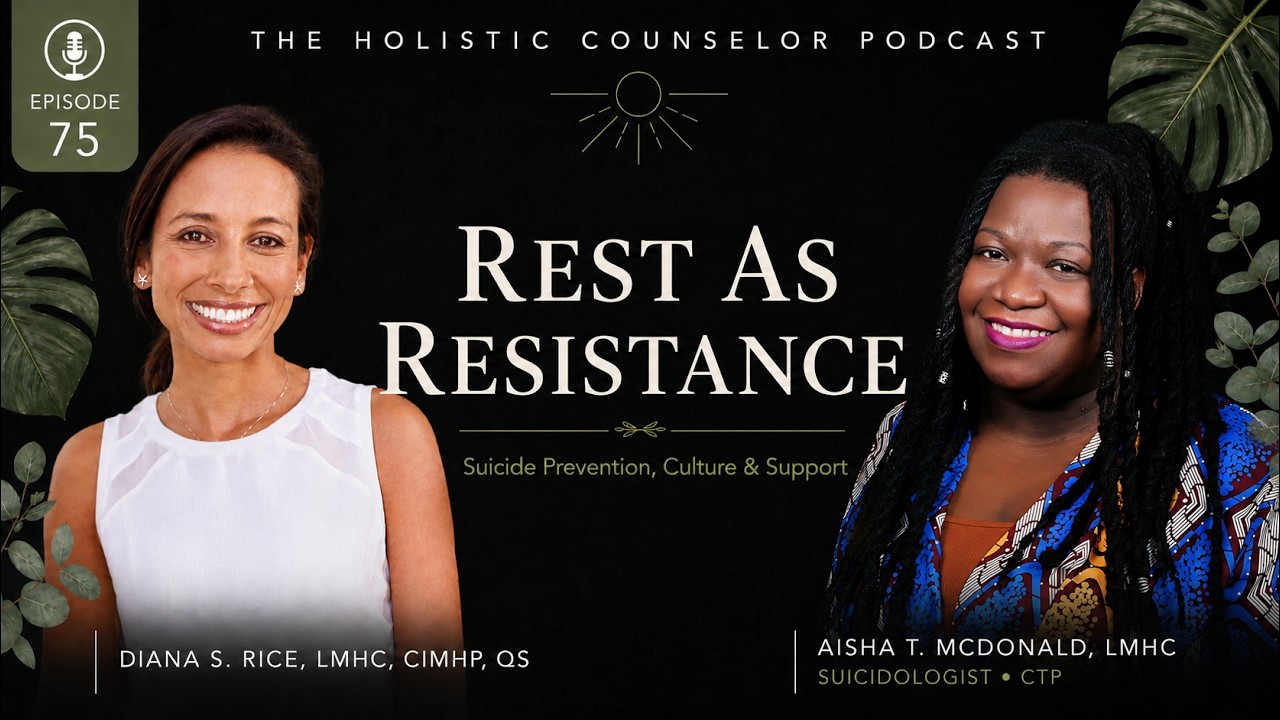
Episode 75
Suicide Prevention & Cultural Identity | Rest as Resistance
with Aisha T. McDonald, LMHC, Suicidologist, CTP
Hosted by Diana S. Rice, LMHC, CIMHP, QS
In Episode 75 of The Holistic Counselor Podcast, Diana S. Rice, LMHC, CIMHP, CTP, QS (Through the Valley Therapy & Transformed Mind Consulting and Coaching) sits down with Aisha T. McDonald, LMHC, Suicidologist, CTP, to explore suicide prevention, cultural…
Listen to the Episode
Press play when you’re ready.
Educational content only; this podcast is not therapy, diagnosis, or medical care.
About This Conversation
Show notes
Jump to a section
In Episode 75 of The Holistic Counselor Podcast, Diana S. Rice, LMHC, CIMHP, CTP, QS (Through the Valley Therapy & Transformed Mind Consulting and Coaching) sits down with Aisha T. McDonald, LMHC, Suicidologist, CTP, to explore suicide prevention, cultural identity, and rest as resistance. Learn crisis warning signs, immediate next steps, free resources, and empathy‑driven strategies to challenge mental health stigma.
Content Warning: This episode discusses suicide, trauma, and mental illness. Please prioritize your well‑being—pause or skip if needed.
Episode Overview
In this deeply insightful conversation, host Diana S. Rice, LMHC, CIMHP, CTP, QS (Through the Valley Therapy & Transformed Mind Consulting and Coaching) and Aisha T. McDonald, LMHC, Suicidologist, CTP (Director of Training Initiatives, United Way of Broward County) cover:
- Suicide Prevention — warning signs, the role of a suicidologist, Florida's Baker Act, etc
- Cultural Identity — reclaiming "Hotep" (Afro‑holistic consciousness), navigating multi‑faith households, raising multi‑ethnic children
- Rest as Resistance — micro‑breaks, breathwork, grounding techniques inspired by The Nap Ministry
- Challenging Stigma — practical scripts, fact‑based compassion in faith and diverse communities
- Actionable Support Steps — how clinicians, caregivers, educators, and friends can intervene effectively
Key Topics Discussed
- "Hotep" Defined: Afro‑centric philosophy of holistic wellness, ancestral pride, multi‑faith unity.
- Suicidology 101: Training in psychological autopsies; crisis intervention best practices.
- Legal Frameworks: Baker Act (FL) vs. California's 5150 and other state involuntary holds.
- Mental Health Stigma: Debunking "weakness" myths; brain = organ.
- Rest as Resistance: Scheduling 5–10 min daily for breathwork, sun grounding, or power naps.
- Support Scripts & Tools: "Hey [Name], I've noticed you've been off—can we talk?"
Warning Signs Someone May Be in Crisis
- Talking about wanting to die or kill themselves
- Withdrawing from loved ones or favorite activities
- Insomnia or sleeping too much
- Reckless or risk‑taking behaviors
- Expressing hopelessness, worthlessness, or being a burden
- Sudden mood swings or uncharacteristic calmness
- Giving away prized possessions
What to Do Next
- Reach Out by Name
"Hey [Name], I've noticed you seem really down. I'm here to listen."
- Stay with Them
-
If actively suicidal, remain present and call 988 immediately.
-
- Share Credible Resources
-
988 Lifeline Warning Signs → https://988lifeline.org/en/warning-signs/
- NAMI: Warning Signs & Symptoms → https://www.nami.org/About‑Mental‑Illness/Warning‑Signs‑and‑Symptoms
-
- Encourage Professional Help
-
Offer to locate a therapist or accompany them to crisis services.
-
- Follow Up
"Just checking in—how are you doing since we talked?"
Resources & Links
- Crisis & Helplines
-
988 Suicide & Crisis Lifeline → Call/text 988 | https://988lifeline.org
- NAMI (National Alliance on Mental Illness) → https://www.nami.org
- 211 Community Resource Hotline → Dial 211 or https://www.211.org
-
- United Way of Broward County
-
Main site → https://www.unitedwaybroward.org
- Behavioral Health & Drug Prevention Commission → https://www.drugfreebroward.org
- Be Healthy Broward initiative → https://www.drugfreebroward.org/be-healthy-broward
-
- Self‑Care & Rest
-
The Nap Ministry (Tricia Hersey) → https://thenapministry.com
- Rest Is Resistance: A Manifesto → https://thenapministry.com/book
-
- Clinician Referrals
-
Anika T. McDonald, LCSW (neurodiversity, LGBTQ+, youth) via Alma → https://www.helloalma.com
-
Contact Info
Aisha T. McDonald, LMHC, Suicidologist, CTP
- LinkedIn → https://www.linkedin.com/in/aisha-mcdonald-lmhc
- Email → lyfevoyage@gmail.com
Host & Guest Bios
Diana S. Rice, LMHC, CIMHP, CTP, QS Founder of Through the Valley Therapy & Transformed Mind Consulting and Coaching. Licensed Mental Health Counselor, Certified Integrative Mental Health Professional, and Qualified Supervisor.
Aisha T. McDonald, LMHC, Suicidologist, CTP, Certified Trauma Professional Director of Training Initiatives at United Way of Broward County; national speaker, DEI consultant, and trauma expert who has trained thousands in Mental Health First Aid and crisis intervention.
Practical Takeaways
- Mental Health is Health: Treat your brain like any other organ—get help early.
- Connection Heals: Routine check‑ins can prevent crises.
- Rest Empowers: Guard 5–10 min daily for breathing or grounding exercises.
- Fact‑Based Compassion: Counter stigma with clear information and empathy.
Call to Action
- Share this episode with someone who needs it.
- Tag us on Instagram @theholisticounselorpodcast .
- Interested in MHFA training or speaking? Connect with Aisha on LinkedIn.
- You're Not Alone: Reach out—988, NAMI, 211, or a trusted friend.
Support This Work
Each episode takes 3–5 hours to create with care, prayer, and trauma-informed preparation. If you want to support this work and help keep the podcast sponsor-free, you can do so by visiting the merch store. Your purchase helps us continue offering Christ-centered, holistic mental-health conversations to listeners around the world. https://theholisticcounselorpodcast.printful.me/
Episode transcript
Read the full transcript Close transcript
Automatically generated from YouTube captions. Names and wording may contain errors; listen to the episode for the original conversation.
Hello there fearfully and wonderfully made human. I'm your host Diana, a licensed mental health counselor, a certified integrative mental health professional, and the founder of Through the Valley Therapy and Transform Mind Consulting and Coaching. and welcome to the holistic counselor podcast where I try my best to intersect faith, science, and whole person wellness.
Before we begin, a gentle content disclaimer. In today's conversation, we will probably be discussing topics related to suicide, trauma, and mental illness. If that feels heavy right now, please take care of yourself as you listen. There's no shame in pausing or coming back later.
And remember, healing is possible and help is real. So now, let me tell you why I'm honored in having today's guest here. I met Aisha T. Macdonald through United Way of Broward County, where she serves as the director of training initiatives. I was invited to speak at one of their past events and Aisha was my point of contact.
We decided to get on a video call and I knew she wasn't just coordinating training. She was living this work from the inside out. Aisha is a licensed mental health counselor, suicideologist, and certified trauma expert. She's trained thousands through mental health first aid, facilitates crisis intervention team trainings for law enforcement, and serves as a national speaker and DEI consultant.
She's also a beautiful black Caribbean woman, mother of a to a new neurode divergent child, a slam poet, and someone who brings lived experience and clinical expertise into every room she enters. Today's conversation will explore what it means to live in between cultures, raise children with emotional and neurological differences, and hold space in systems that don't always make space for us.
It's about belonging, advocacy, exhaustion, healing, and everything we're often too afraid to name out loud. Whether you're a clinician, a caregiver, educator, or someone who's been carrying invisible burdens, this episode was made for you. Aisha, thanks for being here.
Thank you for having me. I have never heard an introduction that combines so many of my worlds into one just piece. I um I usually feel awkward listening to people explain who I am and what I do and um I was listening to you and I was like, "Oh, I do do that.
Oh, that's interesting." So, thank you for that introduction.
Yes, of course. Well, I try to uh when I have guests when I invite guests in, you know, just to allow the listener to understand that, you know, like we're called experts in things, but our it's like we're humans first. Absolutely
right. And we just have a story and our own journeys that and experiences that we have gathered and we are choosing to help the other humans to with what we've gathered because we have seen the darkness or we have seen um valleys, you know, through the valley therapy.
Hello. Or we've seen things and we're not we don't want to be stuck in them. So we have chosen to really work hard to gather information to pass the baton to other human beings. So absolutely on that note, you wear many hats.
You
you know therapist, trainer, mom, poet, advocate. I could probably keep going on and on and on. Can you share what first pulled you into this work and how your personal story has shaped your professional mission? I think for me one of the things that has always driven me um into doing the work that I do is the concept of how can I help others.
Um I grew up with a mother who was always helping everybody else. Um to the extent that my sister and I would joke that you know how some people bring home three animals for pets, my mother would bring home three people.
Oh wow. like our house was never empty. There was always somebody there. And then when she was in the work space, she was the guidance counselor. She was the support. She was the advocate for everyone in need. And so it's interesting because now we say that, you know, I come from a family of clinicians.
My mother is a doctoral level marriage and family therapist. Um my sister is a social worker. And here I am as a mental health counselor. Um, and my father is absolutely upset because he's like, why didn't anybody want to be an engineer like me?
And I was like, first of all, hate math. And there's a lot of that in your career. Um, but it often time feels like I had no choice.
Um, but to be of service to others because that's what I grew up seeing around me. Um, and then even with my dad, like I described both my parents as they were Hotep parents before Hotep was a thing or wait what
a hotep. It's those people that are just like have this social activism and consciousness, right?
Oh my Okay, so uh she's about to teach me something new. I love this.
But I mean, growing up, my parents were always advocating. My dad was an activist um marching in streets about you know just social issues that were happening in South Africa in Rwanda in all parts of the world and my mother was there supporting individuals on an interpersonal level and I grew up and it was kind of like a well I have no other choice right
um this is all that I've seen and all that I've known so how can I be of service and I think the personal mission that drives me has always been in my small parts of the world, in the limited capacity that I have.
How can I be sure to leave the world a better place than I came inside?
Yeah. No, that's that's wonderful. But I I'm still kind of want to know the word you just used. Did you say hoep?
Hotep? Let me see if I can figure out a description for a hotel because I feel like in recent times it sometimes get mangled and not
I've never heard of it though
did I like sleep is that a class I mean like I've never heard the word where have I been
so for me and this is my personal definition it is by no means the all-encompassing description um
has always been a level of consciousness that goes beyond like euroentric ideals and the socialization that we've been kind of made to conform to. And so when I describe my parents as like they were hot, we
grew up in um a very holistic mindset.
Um there was an afroconciousness that we were obligated to make sure that we learned. Um, even growing up in our household, my parents were two different religions. Um, my father was Rastafarian or Ethiopian Orthodox to be specific, um, in his beliefs and my mother was Christian, but they were so non-denominational that we had, um, we had Jewish friends and we would go to Shabbat dinner, um, every Friday.
And then at one point we lived with a Muslim family and I would see Mr. Muhammad doing his prayers five times a day. And so there was this real concept of, you know, everyone has a shared belief.
Yeah.
Um, and I I remember the first time I saw a picture of like white Jesus. I was like, who's that? Because in my house, Jesus was black with blocks and he had some nice abs. I was like, he's cute.
And those beautiful blue eyes and that pointy nose. And he was very Okay, I'm sorry.
I know this because my I am you know I am a disciple of Christ so I don't want to be disrespectful and we have a lot of Christian listeners but it's true we need to challenge that feeling for me I saw my parents concept of Jesus was based on like geographical location racial background what ethnicity existed in those times in historic days and like I was five years old being told this and I was like oh okay
yeah listen Aisha I I want to I want to talk about this a little more because I I want to challenge the listener as well be it's like where do they come like their view of their faith right because denomination you're talking about something that's super important that I talk about with other guests cuz I remember being in a Catholic church in New York City and a nun telling me you put that guy up there and
I'm like I have no idea who this white man is because I'm living in a very Caribbean Hispanic background. around and so I just want to make, you know, make sure that we just take a step in understanding of what it is like we're talking about in a respectful way, right?
And so, you know, like to me, I'm about to go after I hang up with you, go into the rabbit hole of Hotep. I'm telling you right now,
just like I said, as there are things that have negatively impact um the concept of the word, but the true and honest meaning it for me and with the way my parents raised us was um pride in your culture, pride in your ethnic background, okay?
pride in the um ancestors that came before us um and the ways in which we are able to navigate the world with respect and honor to what the mother earth has given us um while being conscious of what we're taking into our body um and how that impacts our physical health but also our emotional and mental health.
Yeah. Um, and to this day, you know, I pretty much have to keep in mind like what were the ways and actually like responding to the good that I had in my childhood and how am I implementing that in the way I'm raising my own kids um to be proud of their ethnic backgrounds um especially being multithnic kids with two different um parents in and so
and what do you mean by that? So, I um I'm black. I don't know if you've noticed,
but for your listeners who may not um be watching and maybe just listening, um I identify as a black Caribbean woman. Um but my children's father, my husband, um he is a Latino man with both African and indigenous ancestry. So,
just like me,
growing up kids with Yeah. two different. And it's interesting because I say that we come from two different ethnicities, but we're both island people and the islands have so many shared commonalities.
It does. It does. Well, half I mean, I'm half Caribbean, so half island. The other
half raised in a half island household. I So many of what I went through, you probably went through, too.
Yeah. And and and you know, it's a good point, too. I would love to talk about this because even if it is on the like it's like trying to find the com you know the common things but also keeping the individual um culture as well because
exactly
I had South American right South American mother Caribbean father married a southern white um and and then I was from New York so it's two different cultures from New York northeast east than the south.
And okay, so you see and then I raised my son to have a very open mind because it was just like I had to continually challenge his thoughts as a kid and now like
I get it like he's like no mom like I see things in a whole different it's not very narrowminded.
Yes. But it's important that we talk about this Aisha because this is what's missing now. We are so in a tick- tocked brain and we believe that that is the truth and we have and we're raising younger generations to believe whatever the um the social media goes into the rabbit holes that it goes naturally into because that's how they programmed it.
And then here we are with this high influx of suicide rates, mental illness, judgments, cyber bullying, things that you have to work. I mean, because you're a mental health first aid provider, and I know when I took the class, and I don't know, I don't know if you were the one that came in or not to teach the school that I was working for or not, but I want to talk about that.
I want to talk about the mental health first aid and the suicide prevention because man, you you've trained thousands of humans. Brower County, I I love it and I'm already ready to move out of it in a way because it is a lot.
It's uh you know, I love it because it's very diverse. So, can you speak on the mental health first aid being in Broward County and like what we're just talking about? I just want to transition to that a little bit because this is the situation. we don't have enough conversations like we're having right now and automatically people um get defensive
defensive judgmental um and it's out of fear. fear of the unknown. Really?
Yes. Now, go ahead, girl. Like, tell me about this.
I think when it comes to diversity and mental health and concepts that folks weren't necessarily open to or made aware of previously, um there's kind of like a shutdown. People feel comforted in the known. And when I am used to being in this like pigeon hole sense of identity, why would I want to go beyond that?
Because learning new things or dealing with change or dealing with others who are different for me brings about uncertainties, right? Um part of me teaching mental health first aid, especially here in South Florida. Um, and I've taught it I've taught it throughout Florida and I've taught other trainings throughout the country, but I come back home to South Florida because of the diverse groups of people um that I'm around.
Broward County is the actual like statistically most diverse county in all of Florida.
Really?
Um, we have
Yeah, I guess you're right. Like I'm thinking
we are Yeah.
Oh, we're actually what was um we used to be called a majority minority um community because there are more people of diverse backgrounds than people of European white backgrounds living here. Um and but one of the things for me is that like just go into any room and you are for sure not going to be in a monolith.
You're going to be around so many different backgrounds. So many even even the island folks like I love to be all I'm an island folk. I'm an island folk and I go into rooms and there's like three, four, five different islands all at one time
and ones that I've never heard of until I met them.
It's absolutely I learned of a new island last week which is like um Sabo.
Okay. Where is that?
I don't even know if I'm pronouncing it right. It's one of the lesser Antilles. It's really really tiny. It's an island made up of like 5,000 people. And I was like, that was my high school.
That's high school, but you're just constantly learning new things. And so for a lot of people, being exposed to new things is overwhelming and challenging. And when we bring the concept of mental health into it, this is a field that has been stigmatized in regular social settings for so long.
And then so many of us come from backgrounds and cultures that don't talk about mental illness. We don't talk about emotional well-being. We don't talk about those things. We suck it up and we pull through. And so going into spaces and bringing the concepts of mental well-being and mental health into the communities that I have served has been such a fulfilling um thing to do because I've gotten the opportunity to challenge those stigmatizing thoughts.
How how do you challenge
conversation? How um
how do you do it without them shutting down and going off on you?
Oh gosh, no. That's happened. I know
that for sure has happened. I
definitely had some um I call them lively debates.
I love that
in some of these rooms. But here's here's here's one of the ways that like I approach it. I can only tell you facts,
okay?
I'm going to give you the facts and I'm going to give you this information. Um take from it what you will. Use it how you want to. You can refute it as much as you want to. I'm not here to force you to subscribe to my ideals.
I'm only here to present the facts.
And upon presenting those facts, it's going to do one of two things. It's either going to challenge the way that you thought and make you willing to open up your mind, or it's going to make you dig in and hold on to those thoughts.
But what you can never do in the future is say you didn't know.
Oh, now you know. And you can either choose to act and do differently or you can choose to hold on to what you know and what you've always done. That's still a choice.
Yeah. And why do you think people hold on so tightly? Like I know you you kind of touched on it, but it's just like I want to have that conversation a little because as two therapists like we see why people hold on, right?
But I think if a listener who has no clue, who's actually wanting to learn or who's now being a little challenged in their faith or belief or like, "Oh no, here we go with the freaking DEI crap." I've heard that. I've heard that.
Okay, I know you have.
I've heard that to my face.
Oh, okay. And then listen for us because we are professional practitioners and we have a better understanding like why first of all why do people get so caught up in that kind of dynamic? number one. And then number two, how do we help them get out of it?
So, the first thing for me that comes up when I have these conversations with people that are digging in and holding on tightly um is trying to understand that they're doing this from a place of emotional safety.
Oh. Um
I've never heard it that way. Go girl. Trust me, this is this is my Buddhist philosophy is trying to be more open-minded and not bring forth my personal biases and impose those on them because I'm not going to lie. Sometimes I want to be like, "Stop being dumb."
Right?
But
or what's wrong with you?
Like what's wrong? Why don't you understand? the many times I have like gone home and like whisper yelled to my husband about like critical thinking or lack thereof, right? But to their faith and in the interactions and conversations, I have to remind myself that it is safe for people
to hold on to what they've known. Um like a child with a blanket or a stuffy, this gives me safety because I know it.
Yeah. and I'm used to it and it's what has worked for me.
Um, beyond that, I've also been able to learn to understand that for some people it comes from a place of superiority.
What do you mean by that superiority? I'm automatically I'm thinking of like communal narcissist, but
you're you're getting too clinical. We're not going to
I know. I'm sorry everyone.
I know. I'm so sorry. Um, I think for me it's a sense of as human beings I consider us to be apex predators. Um, we're at the top of the food chain despite the savagery that exists in the will the wild, right? Human beings have somehow been able to learn skills and use tools and make advancements to keep ourselves at the top or as much as we'd like to think we're at the top.
Um, but with that we also want to be at the top even when it relates to each other.
Um, and there's a sense of superiority that drives a lot of individuals into wanting to feel better than
Yeah.
I am better than you. I am better than you in this. That's why
or at least I'm not like them.
Or at least I'm not like them. And that's what drives like the fan base of sports games and you know so many different aspects of life is my team is better. We are better. Me and my sister have a college rivalry that is just I went to University of Florida.
I'm
Gator Gator. My sister is a seol that went to FSU.
Oh, that is a big rivalry here in Florida. By the way, I'm an owl and a shark.
You know what? I'll take it. I'll take you.
And I don't care about sports. So,
you don't care about My sister doesn't either, but her arguments still drive it. And it's it's it's good-hearted in nature. We both got
great educations um from the choices we made. But human beings in general, we like to feel as if we're better than somebody in some way. Um and so that drives a lot of it, too.
And it's tribal. I mean, if you really go back into history and understanding science, right, we live in we we have to we have to be in tribes. I mean, mammals have to live so we can protect together. Yes.
But we want to stay with within our path. And then when it comes to like the concepts of mental health that have been so stigmatized throughout history in so many different cultural aspects and social aspects, they're one of the hugest. I do an activity when I teach mental health first aid where I make them break into small groups and one of the questions that I give them.
The prompt is to write on a note a post-it just something small the first words that come to your mind when you hear the words mental health. Then I go through with them and I make them give me all words that they came up with on their list and then I write it in columns whether they think those words are stigmatizing or not stigmatizing.
I wish we could do that right now. Like honestly,
let's just have the just have the listeners like tune in and do this, right? Yeah,
but repeatedly my list for the stigmatizing words is this long and I am lucky if I get one or two words in non-stigmatizing and you hear words like weak and I'm just like why is it weak to have a mental illness when this is literally uh something that's impacting our bodies outside of our control?
And then I remind them a lot of when we finally like come wrapping up that I asked them about mental health not about mental illness.
Yeah.
And even though I worded it
as a health issue instead of giving me words like exercise and diet and nutrition and sleep like they do when we talk about physical health, they gave me all the negatives.
Yeah. And because these concepts have been so negatively inclined in our society, people don't want to feel like they're that.
Yeah. Because they can't listen like when you break your arm, you see the broken arm. If you have diabetes, you have the insulin shot. If you have other things like, you know what I mean? Like there's and
they can't see this invisible.
They can't see this invisible illness. And to me, I I always thought about this when I first heard it. The word illness starts with I and the word wellness starts with we.
Oh,
and this is so important for us to understand how we need to isolate.
Yeah. Well, we isolate and it turns but that Okay, I'm going to go now into
your your part of you that's the suicideologist. Am I saying that right? Suicideologist. Okay. What does that mean?
I I really need to understand like because I have I think I trained under one and he was the from Nova Southeastern University and I forgot his name so I'm not going to even try to mention it but what what does that mean um for the audience for someone that's never heard the word what do you do and how's like what let's just go into that like for a little bit because when we do talk about mental wellness right I mean wellness we all want to be well and and and mental al illness people.
It's so stigmatized still especially in our community and especially in churches of different denominations. Okay. And that is something why I created this podcast. This is why a year ago God put it on my heart after so much prayer to just move forward and I'm like okay and here I am.
Like so I really want people to understand cuz it's it's a scary thing and and it's also a judged thing and it's a it's it's a feared thing and I think and it's turning younger.
I mean com I never in my whole lifetime heard you know 8-year-olds nine year olds ever. It was like very um not common. But when I'm hearing kids today saying that they want to kill themselves and parents calling me going, "Can you help?"
You know, and I'm like, "Oh my gosh." And I have grandkids and we have And you have kids that age. We were we talked about that before, you know, 8-year-olds, sevenyear-olds. Suicideologist, what is it? What do you do? So the very simplistic explanation for what a suicideologist is is it's somebody who works in the field of suicide who has either done research um done training and education or worked directly with individuals um who are experiencing those thoughts and behaviors.
How I got here was I did a training. I um I did a training and the trainer at the time had their credentials up on the screen and I said, "Hey, how you got that? What's that? I'd like that." Um and so we had a conversation and um I was actively in the training to allow me to um become that.
But then I started working um outside of my regular day job with United Way. I started working for the American Association of Suicideology um doing very intensive trainings on psychological autopsy um so death suicide death investigations. Um I currently teach um uh suicide considerations for special populations.
That is really goes into like the unique needs and issues that are impacting different groups and different identities. Um but really and truly what brought me here um was both personal and professional. Um, professionally, when I was in my academic program and for my masters, we had to do our practicum slashin internship and I was working a full-time 40-hour job.
So, I couldn't take time off work to go work for free for a practicum somewhere else. So I was like find I said to the professor I was like find me somewhere that has nighttime hours and weekend hours and I will do the 20 hours that I need per week in the evening and on the weekends.
I worked seven days a week at that time because I was like I have to get these hours done and the only place that had those hours that would allow me to come in um after I finished working was the psych unit on a hospital.
Wow. So,
where was that?
I asked where it was.
Yes. Yes. Yes. Broward General Hospital.
Okay, here we go. Because we just talked about our county, so we know like that meant you had very diversity of mental illnesses in that hospital
and we saw everything. Um, and my internship was supposed to be 12 months. I enjoyed the work so much. I stayed working at that facility for about 18 months. Um, I asked them, I was like, "Can I come back? Can I keep doing this?"
And they're like, "Wow,
yeah. They were not refusing free labor, right?" Um,
but working with individuals that were experiencing suicidal thoughts and had attempted suicide um, really shaped how I move forward in the trajectory of my career and who I wanted to work for. Um later on, many many years later, I ended up being the Baker coordinator at another um facility.
So I was the one that was in charge um of all the involuntary hospitalizations that were coming through the facility at that time.
Can you for my listener that doesn't know what you mean by bake because people have no idea. They're like bake what? Baker Act.
So Baker Act is the Florida specific word. It's called different things in different states. In California, it's a 5150 because that's the code um that's used by law enforcement. In Ohio, it's called a pink slip because they actually write that pink paper.
But it's different names all over, but what it really is is an involuntary hospitalization for anyone who is experiencing thoughts of harm to themselves or to others. um they are taken into custody um whether through being committed by a law enforcement officer who can have observed or been told that they're a risk of harm or by a licensed clinician or physician who can document a history um of any type of mental illness and these considerations of them um being a risk of harm to themselves or to anybody else.
And through that commitment, they're taken to a hospital where they are placed in a hold for examination for up to 72 hours. Sometimes it doesn't last as long depending on their ability to stabilize. Um, sometimes it lasts longer because they need more intensive help and services.
Um, but that was my first job. That was my first job in this field as a clinician working at my internship. Um, personally in my life, I have been impacted by suicide loss. Um, as a young teen, I lost an uncle to suicide.
Oh man.
Back home on an island that didn't really understand what this was. Um, and throughout the years, I've had other family members that have experienced suicidal thoughts and suicidal feelings. Um, and I think what drove me to working in the field of suicide primarily was I never want any other family to have to feel how we felt.
Yeah, it's a it's a it's a tragic loss.
It is a tragic loss.
At the time I was in Catholic school and I
Oh gosh. Please don't tell me that you heard
Oh gosh.
Keep going to hell.
Before my uncle even died. Before my uncle even died, I was maybe 12 years old and I remember Sister Mary Katherine and it's one of those core memories that just stuck with you. Um, Sister Mary Katherine had an allgrade assembly. So, it was me and all the other 12 year olds that were in my grade at the time and she called us into the assembly area.
Um, nobody else was allowed. The teachers stood on the outskirts and I went to a very strict Catholic school on the grounds of a convent. when we were there in our full all-white uniforms, seated um and she came on the microphone and said, "If you kill yourself, you'll go to hell."
Oh, no. No.
No other sin as bad as this. You can't get forgiven. You can if you murder someone, you can ask for forgiveness while you're waiting for the death penalty. But if you kill yourself, you don't have time to ask for forgiveness. You go straight to hell.
And that stuck with me.
Yeah. I don't get it. I'm not even Catholic anymore. Um, and that just stuck with me as a core memory um, in so many ways that I think people don't understand because I looking back at it now, my thought on it is imagine having these feelings and being afraid to speak about it because somebody has already damned you to hell from having feelings of pain and hurt.
And when I I' I've done mental health first aid and trauma trainings for churches and for faith leaders. And one of the things that I try to bring more awareness to is that the two things are not exclusive. It's not church or faith or religion over here and then mental health over here.
Like the same way if somebody in my family had been diagnosed with cancer.
Yeah.
I I would welcome prayers. I would welcome somebody laying hands on them and I would also take them to an oncologist to get some help.
Yeah.
And so the same with mental illness. I do welcome the religious beliefs that can be of strength to a person because faith gives people hope and keeps them alive. Right.
Yes. Yes. Believing in somebody bigger than ourselves, having control over our struggles. My gosh, can that be a relief for so many people to feel
and community again
and community support other individuals that can be there for you. But we can do both. We can pray and go to therapy.
Yeah. Um because God if if you do if you are of the belief in a higher power then it would be so essential for us to believe that this higher power created the means for people to get help from each other
and what are therapists but the means for people to get emotional.
Exactly. and and and what is the mis like I think it's the lack of education or it is what I we were talking about earlier the the the power and control situation
okay the or you know the human being being trained in a certain way to control the children or control the human or control or the leader you know it goes into like a cultish and I'm not saying the Catholic church is cultish at all I know many many beautiful Catholic people so
right but but Aisha when it comes the suicide like and I just want to share a little bit about my story. I was this this situation didn't come it was stored in my brain for a very long time until I was about 47 years old.
But it was about my father, my Puerto Rican father uh my my older halfsister and I walked home from a Catholic school. We were in New York and um we found him overdosed. He didn't die though. like thank I think back but I but because of how much empathy I have I could picture if he did you know look it still affects me
so
yeah but but to me this is important this is why this conversation needs to be had because there's so many freaking people suffering in the church okay and there's so many people suffering in our cultures because they either they either blame the devil
and I'm sitting there like are you freaking kidding me no like you're
but it's what they That's exactly
it's what they've always been told,
right? So, how do we help that? Like Aisha, like let's spend some time really helping the listener if someone's in our culture, you know, someone that's from the Caribbean or or or they're like, "Oh, let me just listen to this because now I'm willing to listen to somebody that loves Jesus and that that knows therapy, right, and science and we're trying to bring things together or a higher power, right?
How do we help that person that's suffering right now? How do we help that person that doesn't know what to do? How do we help that person because now we're it's cognitive dissonance like we're challenging the thought, you know, like what what would you say?
I'll use I'll use um a recent class that I taught. I teach at the police academy and um and I'm honored that you shared about your father and what you experienced and went through because that's not in no shape or form easy. Um and when I do these trainings, a lot of these personal experiences do come up for people.
And so there I was at the police academy and I don't know if anybody here um is knowledgeable about the policemies but that's a whole culture within itself. Identities beyond that they leave that at the door. This is their identity now. And
it's a fraternity. It's like a frat like a military. It's like oh I get it.
And the majority of my classes are male. Um I'll have two maybe three women in a class. um of 30 people. So the majority are men. So there's so many different factors that they bring into this room. They bring their ethnic and cultural beliefs.
They bring the police mindsets um that they're already they're in the academy. I get there like maybe two weeks before graduation. So it's already been ingrained in them for months. um they bring the masculinity and the concepts that they've been socialized to believe as men and who we are and what we do and the machismo um of it all.
And
I have to be the black female at the front of the room challenging some of these beliefs um that are so ingrained in them, right? And um absolutely enjoy it. Never a dull moment.
Never. Never a dull moment. The conversation, the dean walked in on me um the other day in like mid conversation and I was like, "Hold on, Dean." And then I remembered who he was. I was like, "Oh my god, I'm so sorry." Because I was so into um what had come up, but somebody brought up a point, one of the gentlemen in the class, he brought up a point where he was like, "But isn't it weak to have a mental illness?"
And I said, "How is it weak?" It's and so I asked him I was like what organ does mental health impact in your body and of course like multiple people were like oh your brain your brain your brain and I was like yes your brain and
what does your brain control less people but they were like oh everything and I was like yes so your brain impacts every like can you function correctly if your brain isn't working the way that it should be in a typical sense And of course they were like, "No, they" and they're they're going along with me.
And I was like, "So why would getting help for a brain illness
be considered a weakness?" And I challenged him back and I said, "I actually think it's weak to not get help when you know you need it."
And he glitched. Like and I was like it is a weakness of your soul to know that you are in a state where you need support. You need the village of other people.
Yeah.
You need the help of a professional and to hold on to remaining in that abyss rather than using the ladder that you need to get out because you're like, well, I I'm a man. I shouldn't use ladders like
right
um and so I think when it comes to so much of what we have been trained or socialized to believe whether because of our cultural backgrounds whether because of our religious faith whether because of the gender identities in the boxes that we're made to conform to. um thinking about our overall well-being, right?
And how interconnected our physical health is with our mental health and our emotional health and expecting to be able to get up every single day and function. Right.
Right. Yeah.
When there's a part of the system that is
Yeah. calling out, it's screaming, it's yelling, it's it's it's trying to get your attention. That's what I say. Because it's a holistic we're holistic beings and we ignore it sometimes or we have these thoughts and we get scared of the thoughts so we keep ignoring it more and more but these are things
and it just gets worse and worse and worse.
Yes. Yes.
And then even thinking about the social support that we get around us, right? Because people are more likely to have successful recovery from illnesses mental or physical related when they have social support of other beings. As human beings we are social beings. We're we said earlier that we're pack animals.
We are created to be in connection with each other,
right?
Just the nature and the even the introverts, even the biggest introverts of us. We may not want to be in connection to other human beings, but we get ourselves pets.
We get other creatures to connect to or we have that one extroverted friend that forces us to think.
I'm that one extroverted friend. make us do things and take things out of our um comfort zones, right? But
when we think about mental illness and this is one of the cycles that I tell people is often time hard to for people to grasp is that the worse your mental health gets, the more isolated you become.
Yes, it's true. It's true.
But the more isolated you are, the worse your mental health will get.
Yeah. It's such a terrible cycle. And so even just forcing yourself, I told um I told my husband a couple days ago um to go to the gym even when you don't feel like going to the gym because he was like, "I'm lazy.
I don't want to do it right now." And I was like, "Behavior activation. Make yourself do the thing that you know will make you feel better even if in this current mood you don't feel like that." Yes. and he was going with my sister and her partner and they were going all in a group and I was like the behavior activation of being in remaining in connection to others even when you don't want to or feel like it right
but also not just putting the onus on the person going through the illness but putting the onus on the support system and village around them because how many times do we see people that have isolated and withdrawn from us and we leave them alone.
Yeah. This is to me one of the biggest symptoms of somebody going through emotional suffering is when they no longer have interest in the things that and activities they used to and when they're withdrawing from you completely in ways that they never used to.
And so many times because we don't want to deal with their problems, we just go,
"Oh, well, I'll wait for them to come back."
Or they're being dramatic or you're a teenager with the hormones or
I don't know what to say. I don't say anything. And I'm like, "No, that's when we need to check in, especially on your strong friends that seem like they have it all together."
Yes. Yeah. I mean, there's a whole I I saw that um picture. I think they had Kirk No, not Kirk, Robin Williams. I mean, they had a whole bunch of pe the the famous chef, all these people that like are
Anthony Bourdain, Robin Williams, Kurt Cobain, um Kate Spade, DJ Twitch.
Yes. Yes. So, you have all these uh and I think it was another like a a beautiful beauty queen person, too.
Oh, the Miss America, Chris. Yes. And so then you think about it like, wait, they had it all together, but
why why
they seem to
to seem to Yeah. And I know because I've I've suffered with brain illness. I call it brain illness because you're right. Or I had to go get a psychoeducational coach because this is how I deal with my my very like police or firefighter men or military men because I had to learn to to train in with a with different verbiage.
So then it gets more accepted and then after I they accept it then I'm like, "Yeah, well that's mental illness." You know, like I have to present them with facts.
Yes. static,
the logical brain, not the emotional, the logical stuff.
You have to, it's so black and white in the thinking. And that's not just for them, but so many people have these like they need to see proof. Yes. And mental illness is something where like I can't show you lab work as proof,
right? Right. Well, you can in some cases because I've had I've had clients who like a 19-year-old boy who had low testosterone, but nobody expected a 19-year-old boy to have low testosterone and he tried to kill himself. You see where I'm getting at?
But after we found out the blood work, it was like that is why he had
that impacts his mood stability.
Everything every Exactly. Or the black the the black box on the psych meds that they might give a young person.
Okay. that people don't read that pamphlet all the way through
and then they okay and I'm not putting down meds because I know we we need we need holistically to come together with certain things because I'm not that person either that I'm going to be like anti- this anti that it is under how do like to me helping the human like especially listening that doesn't know we have a psych degree we've have experience we are hired to help people get through some stuff but how does the average listener that has no clue Where would they start, Aisha, as a suicideologist?
Like where what do you say to a person or at the mental health first aid classes now they're done with the class? Like what do you say to them? What's the next steps?
Pay attention. Um I think one of the most important things is thinking beyond ourselves. We live in a very individualistic culture. um which is a dichotomy for me because I come from a collectivism type of background and I'm now placed in a social setting that is very individualistic.
How many of us know the names of our neighbors um
you know we pass them every single day. We have no clue what's going on um behind the doors of others lives. Um, but even for those that are close to you, one of the things that I stress that is important is to pay attention to behavior changes in the people around us.
Um, behavior changes in any capacity because there's so many times where um, people are going through things and we don't take the time to consider beyond ourselves. Um, I had a coworker a few weeks ago in a meeting um, poke me in the arm in the meeting and said, "You don't seem like yourself.
You're not perky today." And my instant thought was, "I'm not here to perform and make jokes for people all the time." What she didn't know was that I actually had been going through a period of very severe depression. Um, and as somebody who I'm not just a clinician, I've been impacted personally by two mental health diagnoses myself.
I have good days and I have bad days. And sometimes the bad days get really bad, but I still I I present well. Um, I am able to function. Um, so who would know? But the fact and this this coworker was not a friend.
It is strictly a co-orker relationship. We don't have personal conversations. We don't have a relationship beyond our two offices being next to each other. Um but the fact that she noticed that I was having a bad day and took the time to ask.
Yeah. And of course, my in my depressive state, my initial reaction was defensiveness because I don't know her well enough to want her to know that I'm not going I'm not well. Um, but it I I breathed it in and I was like, well, thank God she noticed because I was sitting in a room with how many dozens of people and nobody else did,
right?
Nobody Nobody realized I wasn't cracking jokes. Nobody realized I wasn't asking questions. Nobody realized I was sitting in silence for so long. And so it's just
because you're always the strong one. You're the one who's the helper and then
I'm the one of everybody comes to to ask right
the questions. Right. And they were still coming and they were still asking and I was still giving feedback
like I usually do until this one person poked me and cracked
that facade a little bit. And so pay attention to people around us. Another important thing that I want people to notice is that um there's so many physical symptoms that are actually caused by mental health issues.
Yeah.
The back pain, the headaches,
stomach issues, the gastrointestinal difficulties, our body is breaking down because our brain is in pain. Yes.
And when the brain isn't functioning right, none of the rest of you can function right. And we're popping tums like all we have is a little heartburn and indigestion when really and truly it's because of the worries and the stress and the
I mean we Yeah, I think we're in a collect. I'm actually when I hang up with you, I have to prepare for the one o'clock that I'm doing for Texas. um moderating a a grief panel with some of our South Florida grief experts.
And so, you know, we're in a collective after 2020, a collective grief that people don't know. And this is why people are popping off in airplanes and there's more road rage and more suicides and everything. And this is why I really feel like we got to learn how to take the step back and pause
and reconnect to higher power creator
each other
my each other uh to me my beliefs you know my spiritual text
breath work right like if someone's listening right now Asisha because I know I could probably talk to you for another hour
I know
it's okay bring me back we'll have a whole other conversation Seriously, like I mean what what and they're the ones suffering? You know, we we were talking about people that might not have the brain illness or the depression or the suicide ideations. Where can they get help?
What where where would you suggest them to start like to go to? Like what would be the first few things that somebody that actually might be listening and saying, "No, I am sad. Oh, I have isolated. Oh, I'm not doing the same things that I used to love to garden.
I don't want to garden. I used to go out on Friday nights. I don't go out on Friday nights anymore. I really am starting to think about these things like if my life would be better um if I wasn't here. You know, I've heard this numerous times when I worked with some clients who who are suicidal.
What What would you suggest?
I think for me the first suggestion I ever want to make um the clinician in me is always like go to therapy first off. Um but I I had to take a step back and um learn and understand that not everybody is there yet.
Yep. Exactly. Or can afford it.
Or can afford it or has access to it.
Exactly.
And so one of the first things that I tell people is to talk to somebody. Just talk to somebody. Find somebody in your life that you trust, whoever that person is, and that you feel comfortable opening up to, because there are people who will shut you down and make you close back in
or do the opposite and right away go boom boom boom boom boom and baker you,
right? Um, and so who is that trusted person in your life that you can speak to? I have I have cultivated in my own personal life trusted adults and that has taken me years because I was first diagnosed when I was 19 years old and I shut down.
I didn't speak about it the first time. I told someone about my illness. The response was, "What do you have to be depressed about?" And I was like, "Oh my gosh,
okay. Well, I'll never talk about it again." And for like seven years, I never spoke to anybody in my life. I was semi-aggorophobic and lost friends left and right who thought I just didn't want to hang out with them anymore,
right? Because they took it personal.
Truly, I couldn't I couldn't leave my house, right?
Um I had one friend who would throw rocks at my bedroom window. Um, I lived on the first floor of a building, so I don't know why she would throw rocks, but she would throw rocks and force me to let her into my house, into my dark room, into my dark corner, and she would just sit on my bed and just talk to me.
And not about anything I was going through, about just random things, but she forced me to remain connected to her in ways that was difficult for me, but was
lifesaving because she showed up every single day. So find somebody that you can talk to, whether it's a partner or a spouse, whether it's a parent. God knows my mother is getting all the phone calls.
The hotline, the hotline, the 98 line leader.
Yes.
Right. And so, but if there isn't anyone in your personal life, yes, use the resources that we have access to. So, in every community, there's access to 211. And then for mental health related crises, there's 988s and that 988 number is saving lives.
Those people are trained to respond to crisis. Um, and then for people who may not have the diagnosis themselves, but you're living with a family member or a loved one or a friend, there's NAMI, which is the National Alliance on Mental Illness that is there to support the supporters.
Yeah. They're there for the people who make up the village to give us more psycho education. Um, but from a basic level, I tell people this all the time. And this is in relation to so many things that you feel uncertain about or may not know or may not understand.
Google it. Use Google and use Google and click on credible sources
and not just random people's blogs or Twitter account,
right? Because that's easy. It's easy to just watch a Tik Tok and say, "Oh, I researched it." I had somebody who told me that they had done intensive research about a subject that I was trained in. And I was like, "What? What is your research?"
And they're like, "Well, I watch some YouTube videos." And I was like,
"No,
but what's the resource?
What's your research?"
Yeah.
And they're like, "YouTube?" And I was like, "No, no." While these are quick ways to learn and I'm not negating their impact,
delve a little bit deeper into information for yourself
because there's so much access. We live in such an advanced technological world. There's access to
information now that when people are ignorant of things, I'm tempted to think it's willful ignorance
because
I think so. I mean, it's so hard because I grew up in some some people in my culture, they were just so they just had so much trauma that them themselves that that's the part that that got so hard that that's what got them through, right?
The work, the everything. And then you don't know what trauma is. You're please go to my country or go to this place or you have
it's like a comparison. It's like a competition of trauma is
worse, right? And that to me I'm like okay that's the lack of empathy, compassion and education. And so think about that Aisha. If we were able to get more education on with compassion and with empathy. It's not a bad thing to have empathy.
I it's not it's trying to listen to understand instead of to respond, right? It's trying to understand the human being, no matter what they look like on the outside, that within themselves, it's a whole picture. And like we were discussing earlier, right? It's the biology, the psychology, and the theology.
I know I repeat myself for my listeners that listen to every episode. I think I get I get that in every time because we have to understand ourselves first and why are we reacting or or responding to certain things because we have to become responsible for ourselves.
Agreed.
Right. So Aisha, like you know before we wrap this up because like yeah I have to get ready for this next thing but um is there anything you want to say or any resources or any books or anything that's coming to mind that you would want to share with the audience and do you still work with I mean because I know you're super busy so do you still take clients on and if you do like how do people find you etc etc.
H um gosh I have so many thoughts. Um, one, I no longer take on clients only because I am a stereotypical Jamaican and I have like four or five jobs that I do and I hate it. I hate that the stereotype is right.
Um, but I am
with United Way directing and facilitating trainings. I teach for the association of suicideology. I do some instructor work for FAU and then I do random things. So, I just don't have the time and capacity. Um, but I come from a family of clinicians.
Have you heard? So, my mother does private clients. Um, my sister works in the school district, but she also takes um private clients. Um,
okay. And so when I can't serve a need, they are my first referrals, okay, that I make because I know their style and I know their capabilities and training.
Yeah. And you trust them. So, do you have uh what's the name of their companies or something? Cuz I'm going to put all this in the show notes. That's why.
No problem. My um my mother right now, her name is Barbara Paris Amore. Um and she takes private pay clients on a sliding scale. My sister, her name is Anika McDonald, same last name as myself and the first name is Anika. She takes clients through Alma, A L M A.
Um, and you can find her and she has a wonderful, very descriptive list of like what she works with and how. She focuses a lot on neurodyiversity, on LGBTQ issues, on racial identity issues, and she works with a lot of youth because they're going through so much. so much
and she's skilled with that. Um, for my own self, I do a lot of speaking engagements and educational awareness. I may not be doing the one- on-one work in counseling anymore, but I try to at least be able to spread mental health awareness and education on a larger scale.
So,
so, how can we do, excuse me, mental health first aid with you?
Well, they can just email me. Um, people who are interested, I can be emailed at it's my first name, middle initial, and last name. Aisha, A I S H A, the correct way. Um, but Aisha C. Macdonald at Gmail is how I usually connect to people and see and I I tell people like, hey, you got a stage, a podium, or a screen, I'm there.
Like, I will come and speak to anybody about anything even beyond mental health first. I teach on trauma, on well-being, on self-care, which I think is so important.
Yeah. Does United Way of Broward have like a resource page or something that I can
They do. We have um our commission on behavioral health and drug prevention. Oh, wonderful.
Um you can check us out. You can go on the unitedwaybroward.org website to find more information about the work we do or you can go directly to our commission website which is drugfreebroward.org work and that has a list of resources. It has the work groups.
It has the initiatives that um the agency leads in building mental health awareness and substance use prevention um in our community, in our region in so many different ways. And so we try to make sure that we are spreading that awareness. We have a new initiative that's called Be Healthy Broward. really
the promotion of mental health awareness throughout the entire county in so many different ways. And that was um
that is cheered by a judge, the judge who pioneered mental health courts in the entire United States. Um Judge Ginger Learner Ren, she pioneered Be Healthy Broward. Um
Ginger, what's her name?
Learner Ren.
Well, you know why I'm writing her name now. I'm going to see if she'll come on my podcast. Oh, no. Reach out to me. I'll connect you to her. I'll give you
Oh, I would love to talk about that world. I mean, nationwide because to me, this is what we need. We need more resources out there because honestly, sometimes what happens is people really don't know all the resources
at all. They think they're so alone because to me, okay, so in my in the belief system, I really believe there's evil out there and the evil one wants to steal, kill, and destroy each one of us, especially the relationship within ourselves. And so to me, like if we get to come out and and speak about it, that takes that gives you your power back and and makes that go away like a little by little.
I really think so. So to me, like to get as many people on here that are professionals that understand and then give the human the resource, then now they have choices. Now they realize they're not alone.
Agreed.
Right. Like us sharing our story like Aisha, I had no clue. I had no clue that you suffered and wrestle. I like to call it wrestling because it is a wrestle. We wrestle because I wrestle too. This morning I had to put on my Alpha Stem which is a is a device that was used uh five years ago on me.
Instead of me taking a medication, I I do this device to help me with my anxiety. Okay? And anxiety and depression are symptoms. It's my body saying, "Hello, Diana. Take take a deep breath and calm down and maybe
slow down
and slow down or figure whatever is happening so you don't keep going going ignoring ignoring ignoring." And then you implode.
Absolutely.
So, anything else you would like to say before we say goodbye?
I think for me, I want to leave us with, we talked about so many things and so many different topics um today. And I think what I always want to leave people a reminder of, and this has been my I like to give myself like a motto for the year, like what am I going to live for for this year?
And my birthday was last week, Thursday. Um,
congratulations birthday.
Thank you. I'm in the final year of my 30s and um
Oh, that's a big deal.
It's been a learning experience for sure. This decade was a lot.
That's how 40 was for me.
Somebody told me that. Somebody was like, "Well, wait till your 40s." And I was like,
"Yeah." Oh, no. Yeah. 50 was like a what?
It it it's just been there's been so many challenges. There's been global traumas. There's been personal traumas. Yeah.
Um, and one of the things that I ask I have all my different girl group chats, right, with my different girlfriends that are my guides. They're my guides through this life. Um, my sisters in like almost everyone's time. But I always ask them like, "What is one thing that you think I should challenge myself for this upcoming year?"
Um, and the majority of them are like, "You need to practice better self-care. You take care of everybody else. How are you taking care of your own self? And so my motto that I really wanted to subscribe to this year was to rest.
Um you heard me and my stereotype of having five jobs, right?
That's us. That's our actually that's our minority community. Honestly, Aisha, I don't care if you're Caribbean or South American or
you know what I mean?
Go go go.
Yeah.
All the time.
Especially as women. And it no offense.
No, no, no. But it's true. And we feel a sense of we're not being productive if we aren't doing something all the time.
Yeah. You could sleep. Oh, no. What was it? I had my
You can sleep when you're dead.
Yes. And that's how I've literally been told this by accident now. Like I realized with my inter stopping the intergenerational trauma that I have to now.
I'm so sorry, honey. I'm so sorry that I said that to you. I have to make it.
Um I I don't have to jump out of bed the moment I wake up in the morning because I need to be doing housework and chores and taking care of the kids. I can pause. I can pause. I can breathe. I follow an account that's called the nap ministry.
It was created by Trisha Hersy.
Um and boy has this like really expanded my thoughts beyond that sense of overproductivity. and uh
she has written books on this but her concept is really around rest as resistance
and she has this quote that I live by that I have like
just a con even my um out of office emails
like you get an out of office email from me while I'm on PTO I will have a quote in there about I am taking time to intentionally rest do not expect me to be responding to your emails while I'm on PTU.
But for the quote that resonates with me for this year has always been, we must believe that we are worthy of rest.
Wow.
We are driving ourselves to points of exhaustion. And when we're exhausted, we can't fight back against the powers and the struggles that be. And so, how are we taking the time to breathe in between the moments and allow ourselves to rest? And I challenge you as you leave this conversation today to go into a much more intensively difficult one later on.
Take some time to breathe. Even if it's two minutes.
Yeah.
To calm your body, regulate yourself and know that this work that we are doing is important. It is meaningful. It is challenging. But we cannot pour into others when we haven't taken the time to restore and regulate our own selves.
Yes. Thank you, Isisha, for reminding me and holding me accountable. Thank you for being a great
a great telling everybody else what to do, but we don't do it.
Oh, yeah. No, and I need that. And I need that. I need I need and I do have a handful. And Aisha, I really appreciate you coming on. Honestly, this is great. And I'm hoping to have you in the future for other things we didn't even touch, right?
And and that any way I could serve the United Way as well, like as a speaker or talk or moderate. I love moderating more than speaking, honestly.
I'll remember that for future.
I I I appreciate that. Uh I mean, I just feel more comfortable. But I guess also understanding that it's okay to be uncomfortable because that might be the situation as well. We get uncomfortable and then we're like, "Oh no, what's wrong with me?"
And it's like, no, you're human. It's okay to be uncomfortable. And it's okay to think thoughts and feels and understand that we are all having a human experience together honestly. Right. And so on on that note, um I just want to remind the listener, especially if you're a believer in Christ like me, to trust in the Lord, to guard your heart, and to renew your mind, okay?
You're not alone. I'm going to leave a whole bunch of um stuff in the show notes in case you're seeking help. And yes family links, I'll find them and put them in there. and I just really care about you. Um, I think we both do, Aisha and us, and and this is why I do what I do.
All right, then. Thank you, girlfriend.
Thank you. Thanks so much for having me. I have appreciated this conversation so much.
Well, it's a good start to the to the morning.
Yeah. And I hope that we can um connect after this, too.
Absolutely.
All right. All right, everybody. Um, hang in there and um, like I said, I know I'm overwhelmed right now in a way and I want to be honest. So, it's important to be honest. And so, go take care of yourself and go rest.
I'm going to take Aisha's advice right now before I go click on into another Zoom and go and go outside, go barefooted in the sunshine and do breath work for 10 minutes.
Good.
And maybe cry and maybe cry. Oh, crying is cathartic. It's the best way to cleanse your insight.
Amen. Amen. All right, girl. Thank you so much. Have a good one.
And now for the disclaimer to make sure you understand that you are responsible for you. The content provided on the Holistic Counselor Podcast is for entertainment,formational purposes only and is not intended as a substitute for professional medical advice, diagnosis, or treatment. Always seek the advice of your physician or other qualified mental health provider with any questions you may have regarding a medical or mental condition.
Never disregard professional medical advice or delay seeking it because of something you have heard on this podcast. The views expressed on this podcast are my personal opinions and do not represent the views of any professional organizations with which I am affiliated. Call your doctor, 911, or 988 immediately if you have a medical emergency.
The Holistic Counselor podcast does not recommend or endorse any specific tests, physicians, products, procedures, opinions, or other information that may be mentioned on the podcast. Reliance on any information provided by the holistic counselor podcast, guests appearing on the podcast at the invitation of the holistic counselor podcast or other listeners to the podcast is solely at your own risk.
Confidentiality notice. If you engage with the holistic counselor podcast by commenting or posting and are a client, please be aware that you may be revealing information that could compromise your confidentiality. Please remember that disclosing your identity or personal details can be linked to your clinical material.
As a therapist, I am bound by confidentiality and will not respond to any disclosures of this type on this podcast. I am committed to upholding the ethics and confidentiality of the therapeutic relationship which extends to all forms of communication in accordance with the laws and professional guidelines that govern mental health professionals.
I want you to know that your privacy is of utmost importance and you are responsible for protecting it when interacting on this platform or any other public forum. Thank you.