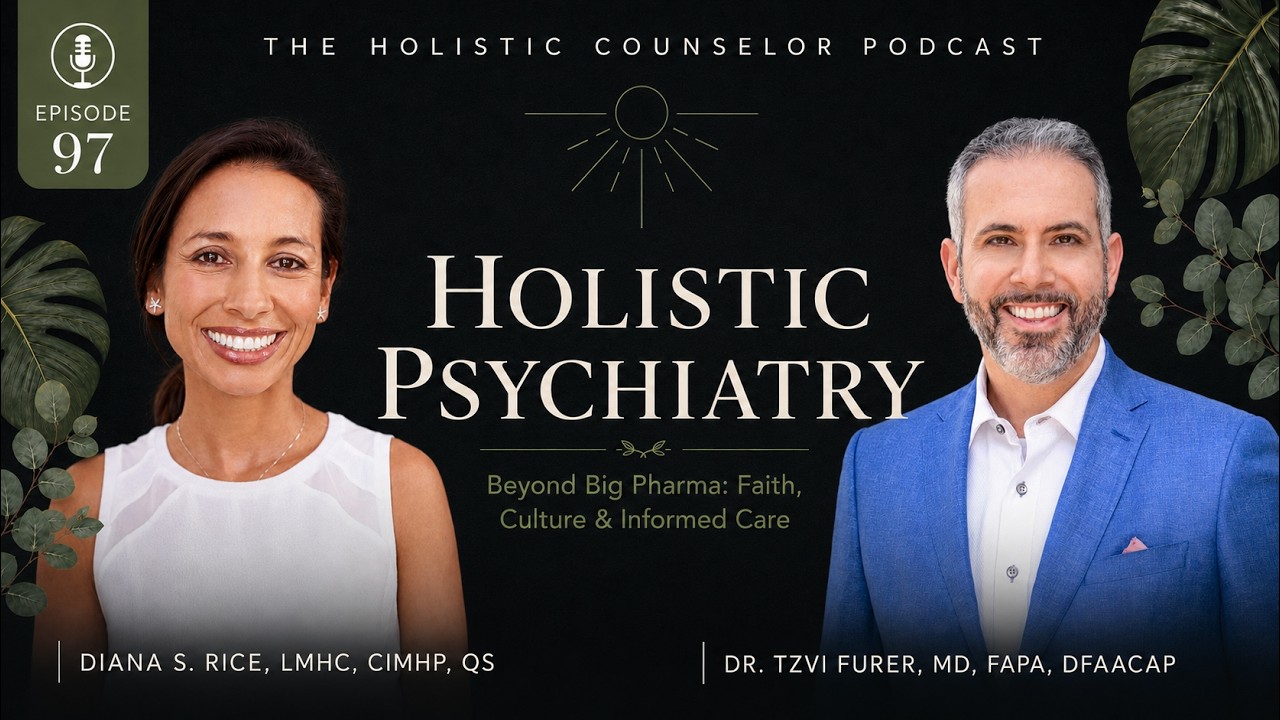
Episode 97
Holistic Psychiatry Beyond Big Pharma: Faith, Culture & Informed Care
with Dr. Tzvi Furer
Hosted by Diana S. Rice, LMHC, CIMHP, QS
In this powerful episode, Diana S. Rice, LMHC, CIMHP sits down with Dr. Tzvi Furer, MD, FAPA, DFAACAP, a dual-board-certified Child, Adolescent, and Adult Psychiatrist and founder of Palm Tree Psychiatry. Together, they break down myths about psychiatry,…
Listen to the Episode
Press play when you’re ready.
Educational content only; this podcast is not therapy, diagnosis, or medical care.
About This Conversation
Show notes
Jump to a section
In this powerful episode, Diana S. Rice, LMHC, CIMHP sits down with Dr. Tzvi Furer, MD, FAPA, DFAACAP, a dual-board-certified Child, Adolescent, and Adult Psychiatrist and founder of Palm Tree Psychiatry. Together, they break down myths about psychiatry, explore the importance of deprescribing and informed consent, and discuss how cultural competence and compassion must guide mental-health care.
Dr. Furer shares his journey from training at NYU Langone Health / Bellevue Hospital to building a concierge practice that goes beyond the 15-minute "med check." His approach combines psychotherapy, medication management, medical root-cause testing, and narrative medicine—helping patients feel truly seen, not labeled.
Diana and Dr. Furer dive into:
- The difference between psychiatry, psychology, and therapy
- What "go low and go slow" prescribing really means
- Why faith, biology, and psychology belong in the same conversation
- How to advocate for yourself in a rushed or insurance-limited system
- The role of storytelling and narrative medicine in healing
- Root-cause assessment, labs, and integrative collaboration with therapists
- Practical advice for those who can't afford concierge care but still need hope
If you've ever felt disillusioned by medication-only psychiatry or you're craving a faith-informed, science-based approach to mental health, this episode will challenge your perspective and leave you encouraged.
Referenced Resources & Links
Connect with Dr. Tzvi Furer & Palm Tree Psychiatry:
Website: palmtreepsychiatry.com
Alternate: palmtreepsych.com Facebook: facebook.com/palmtreepsychiatry
Instagram: @palmtreepsychiatry X: x.com/palmtreepsych
Threads: threads.com/@palmtreepsychiatry
LinkedIn: linkedin.com/in/palmtreepsychiatry
Books & Mentions
- The Body Keeps the Score – Dr. Bessel van der Kolk
- Cognitive Therapy: Basics and Beyond – Judith S. Beck, PhD
- Love's Executioner – Irvin Yalom, MD
- The Man Who Mistook His Wife for a Hat – Oliver Sacks
- The 5 Second Rule – Mel Robbins
Related Episodes on The Holistic Counselor Podcast:
- Ep. 11 – Unveiling Cultural Competence with Dorothy Chatelier-Orelus, APRN
- Ep. 18 – Radical Truths in Mental Health with Dr. Roger McFillin
- Ep. 20 – From Pills to Purpose with Dr. Nina Joy Mena
- Ep. 67 – Psychiatric Deprescribing & Women's Mental Health with Dr. Amy O'Donnell
Episode Highlights Time Topic
- 03:00 Dr. Furer's journey from NYU Langone to Palm Tree Psychiatry
- 08:00 Cultural competence and working with diverse communities
- 13:00 Psychiatry vs. psychology vs. therapy explained
- 18:00 "Go low and go slow" – rethinking medication management
- 19:00 Root-cause care and medical workups in mental health
- 24:00 What concierge psychiatry really means
- 27:00 Narrative medicine and the power of story
- 32:00 Deprescribing and self-advocacy in the system
- 39:00 Practical books and tools for hope and healing
- 44:00 Final encouragement: take your mental health seriously
About the Host
Diana S. Rice, LMHC, CIMHP is the founder of Through the Valley Therapy and Transformed Mind Consulting & Coaching. As host of The Holistic Counselor Podcast, Diana bridges faith, neuroscience, and whole-person healing through authentic, stigma-breaking conversations with experts and advocates.
Join the Movement
If this episode encouraged you, please rate, review, and share it with a friend or colleague. Your support helps others find faith-integrated, evidence-based mental-health content that brings hope and healing.
Follow Diana on: Instagram | @theholisticcounselorpodcast
Episode transcript
Read the full transcript Close transcript
Automatically generated from YouTube captions. Names and wording may contain errors; listen to the episode for the original conversation.
Hello there, fearfully and wonderfully made human. Welcome back to the Holistic Counselor Podcast, where faith, science, and whole person healing meet. I'm your host, Diana S. Rice, licensed mental health counselor and certified integrative mental health professional. This podcast exists to break stigma, bring honest and informed conversations about mental health, and remind you that you are not alone and that there is hope.
Over the past few years, we've been building a bigger story, one that blends biology, psychology, and theology to explore what true healing really looks like. And if you're especially interested in the world of psychiatry, these previous episodes dive deep into that space. Episode 11, Unveiling Cultural Competence with Dr.
Dorothy Chattelier Orelis. Episode 18, Radical Truths and Mental Health with Dr. Roger McFillan. Episode 20, From Pills to Purpose with Dr. Nina Joy Mina. Episode 67, Psychiatric Depresescribing and Women's Mental Health with Dr. Amy O'Donnell. If conversations like these speak to you, take a moment to rate, review, and share this podcast.
It helps others find quality stigma-free mental health content, and it lets me keep bringing you thoughtful faith integrated discussions. Now, speaking of thoughtful discussions, today's guest is someone I've seen at several South Florida clinical events, and I finally had a chance to connect with him.
And honestly, he's a breath of fresh air. Dr. Svi Furer is a dual board certified child, adolescent, and adult psychiatrist and the founder of Palm Tree Psychiatry with offices in Jupiter and Boca Raton and teleaalth services across Florida, New York, and Connecticut. What stood out right away was his integrative human approach to psychiatry.
He doesn't just prescribe and move on. He blends psychotherapy, medication management, lifestyle, and compassion in a way that honors the whole person. Today, we're diving into what it truly means to practice holistic psychiatry in a field that's often misunderstood. So, take a deep breath, [snorts] settle in, and get ready for a conversation that may challenge what you thought you knew about psychiatry and hopefully leave you feeling informed, encouraged, and seen.
Dr. Furer, thank you so much for joining me today. I'm so excited.
Oh my goodness. Thank you so much for the kind introduction and uh I I I really love the way you sort of summed up sort of the work that I do and honestly it's always been a pleasure seeing you around a number of events in the South Florida area as well and I think it's always just such a pleasure to just see all the great work that's being done in the region and uh yeah I I think that sort of spreads out even further than that.
Yeah, for sure. So I want to know I always ask my guests this question is like how did you get to to be at this point right? I mean, you did your training at NYU Belleview. How did that shape your practice today?
I'd say I'd say quite a bit as well. So, yeah. So, I think, you know, by sort of the NYU Belleview of it all, I'm a New York transplant. I sort of had um I had moved over from New York a couple of years ago, settled very nicely to the South Florida area, but I'm very lucky to have gotten the training that I got uh first in Brooklyn um at Sunni Downstate and Kings County um hospital center as well as later on at NYU and Belleview.
And honestly, it allowed me to with with both sites really allowed me to sort of really integrate a lot of work. I'm really thankful for the training that I got in both general and child and adolescent psychiatry because it wasn't just limited to one site or one location.
It allowed me to really see the work that's being done in a lot of different modalities. And in addition to also seeing just the different disciplines and different fields of psychiatry, it allowed me to gain a very fresh lens in terms of just multi- interdisciplinary work with other disciplines and working alongside with uh with therapists, with social workers, with other individuals, with counselors, interventionists, music therapists, everything you could sort of imagine.
And so it kind of really got the wheels going for it. And I knew it really allowed me very early on to kind of realize that the work that I was doing was much more than reaching for the prescription pad or reaching for a medication.
It was really in figuring out kind of the needs that were there really looking at individuals from a biocschosocial model which was ingrained in me from a from a young trainee I was going to say and uh really allowed me to sort of uh practice in a way that I'm finding more and more I guess others don't practice in that way but it just really I'm thankful and I you know I hope that my patients are thankful as well for the work that I do.
Yeah. Well, how did you get into psychiatry? Because listen, when you were younger, I mean, did you know like were you 12 years old and say when I grow up I want to be a psychiatrist? Like what made you go into psychiatry when you could have went into so many different Our field is very vast like you said.
Yeah. Yeah. No, absolutely. So, I'm one of those folks that knew from a very young age I wanted to be a doctor. So, I knew I wanted to be a doctor, just a medical doctor from a very young age, probably about four years, four years of age.
And I think my parents were very much like, you know, he'll grow out of it. Never did. Um, so I I was there. Everybody knew me among my classmates in high school and so forth. It was just like, oh, you know, it's he's going to be a doctor.
And um, I always had a passion for working with children. So, I actually thought that I wanted to be a pediatrician uh, for a little while growing up. And it wasn't until I got into upper level high school. I did like a pre-ol program at Johns Hopkins one summer.
Um, I started taking some psychology classes and I started to realize that actually my interest was really, you know, besides working with people and besides the medical field, it was really working with sort of the way that people function, the way people think, processes, you know, different things of that nature, just the the human condition.
And I really went in sort of, you know, full hog, I'd say, in terms of college. I went to college at upstate uh at Bingmpington University and I uh wound up having my undergraduate degree in psychobiology because it wound up being the degree that allowed me to take all my premed classes and then at the same time I was like, "Oh, I got to take philosophy.
I got to take uh computer programming classes. I got to take other things and the psychology classes that I really longed for." And to me, it sort of clicked at that point. And so by the time I was applying to medical school, I think I was pretty well aware.
I was like, "Hey, I want to go into psychiatry." And I I I got to be honest, you know, I went into medical school, you know, loved a lot of what I saw, have a lot of respect for a lot of other disciplines, but I got to say, I felt the most happiest when I was in psychiatry on the floors, um, doing the work that I was doing.
And the moment that I sort of hit my general psychiatry rotation and everything went well there, um, I actually rotated through a unit in Northern Virginia and loved it so much. Everybody there knew I wanted to go into psychiatry. Uh, I went immediately to my adviser and I loaded up every elective in psychiatry that I could think of and child psychiatry specifically, uh, sort of merging my interests.
And so I wound up being very lucky to do a lot of electives in sort of the New York area, other places like that. And really, I think it's one of these things where sort of just sort of the the passion grew from there.
But I've just always been interested in sort of psychiatry and interested in sort of the field. And honestly, probably the reason you've seen me around a lot of events is I just love being around different places where other people just feel as passionately about mental health.
Yeah. And and I want to understand your the cultural competency part because that's really really important. Dr. Fra the things I saw as a clinician right right from the get-go when I first graduated I was in alternative schools and what I and I think that's and I know that's a long time ago.
So hopefully the training of psychiatry has opened up more. But it was very very conventional insurance-based where they they saw the symptom here's the prescription and that's all they cared about me being like a case manager is that's all they didn't they they were forgetting the human they were forgetting the kid they were for I got so angry because I'm like uh this person's from this culture and you're not understanding that's what they do in their culture.
How how did you learn like you serve incredibly diverse communities? I mean New York City. I know I'm from New York too by the way. Dr.
Yeah. And and across Florida and connect. So how do you make sure you your care is culturally competent whether it's understanding their faith, family systems or cultural norms around mental health?
Yeah, it's it's a wonderful question and I think it's you know definitely something that is I think so important and gets lost in the shuffle and I think definitely is something that does not you know often sort of spoken about as the the first priority right um I'm very lucky in that when I got my training so when I began my psychiatry training specifically at Sunni downstate in Brooklyn u there you know it was a very
multicultural center as you said New York City being that later on Belleview was kind of the same way as well and NYU do um the training that I got really instilled in me sort of the idea cultural competence and so that was something I remember we actually received a couple of lectures on and we actually were able to talk about it and we were actually able to talk about it I'm very thankful for my mentors and
supervisors who kind of spoke to me about different conditions and would speak to me and say look it's really important talk to somebody about their background where do they come from understand about it and it uh we really did actually a lot of work in terms of what's I believe first popped up in like the DSM4 later expanded in DSM5 um sort of about the culturally rebound syndromes and so knowing more about those syndromes that are
specific to certain cultures right and so knowing about sort of what's happening right so it's knowing about things like the evil eye or knowing different things about um you know atakeis nervios just knowing about sort of just different things that relate to sort of different cultures really allowed me to understand what was happening and to take a step back and I actually it allowed me to gain a lot of flexibility as a clinician because I feel
like you know unfortunately a lot of people go through training and they go well here are the questions here's the HPI here's a review of symptoms here's all these other things and allowed me to actually create a really broader interview that actually is kind of like e even sort of more pleasant for me I get to know the person and what's happening there and what I found the more that I practice that and the more I
asked about you know gently trying to figure out about their culture, if their religion, if they're comfortable about it, even sort of all of those things.
What I found was that people opened up and started telling me things that they wouldn't tell their other providers or they wouldn't tell their primary care folks. Sometimes I even had it where they wouldn't even tell their therapists of years and they said, "Well, you know, I never felt comfortable enough with them to talk about it."
So to me it's something where you know when I you know at my practice now at Palm Tree Psychiatry I practice a really sort of you know 360 evaluation and sort of a really comprehensive um evaluation of sort of just trying to figure out what sort of makes a person tick and what's going on there and it just is that something that is normal to their family structure?
Is it something that they even view as a problem?
because it's something where you know I'm not going to sort of prescribe and say oh well this is a problem if they they don't view that it's a problem and I'm trying to understand it I guess within that lens and trying to understand that you know besides even sort of culturally just also developmentally and sort of from where they come from from where people have gone that and I'm very lucky too you know sort of knowing
that my my family were sort of immigrants I think knowing that and understanding sort of the culture that sort of came from understanding the lens that allows us sort be able to capture that somebody is coming from because maybe they're integrating into the country.
Maybe because they're trying to figure out what's going on and maybe understanding if what they may not even view as a concern is putting it in a lens that allows to go, hey, you know, life could be better. And it allows me actually from there to prescribe the correct treatments.
Right.
You mentioned that I'm sort of more of sort of like a integrative holistic provider and look I certainly prescribe medications but it allows me to kind of meet people halfway and understand hey maybe you're a better candidate for therapy right now maybe you're a candidate for some complimentary treatments maybe you are somebody where we've got to talk about the process and that's why I always say that when somebody comes to me for an evaluation they're not
walking out with a prescription necessarily they're coming out with a plan they're coming up with a guidelines and they're coming up with an idea a of sort of just building a connection and maybe having themselves finally heard for the first time.
Wow, Dr. Fur, that's amazing. Like I I love that. Okay, so let's just go through how someone comes to you, right? Because to me, I mean, I had to go to a psychiatrist a couple of times back in the back in 2020 when a lot of stuff was happening, right?
Thank goodness I kind of found someone that was holistic. If I would have known you, I would have went to you. But
no, thank you. But but it was like I know that those that I do work with as a therapist and they have to have their psych because I can't do what you do right that I think let let's tell the audience a little because you know what a lot of people don't really understand the difference like some people want to call me Dr.
Rice just be and I'm like no I'm not a doctor I'm not I have a I have a master's degree but I want people to understand what the difference between psychiatry psychology and then and then us as therapists can you explain that
a thousand% no very comfortable talking about this as well so when I describe the role of it I think people talk about the general people talk about the general field of psychology psychiatry and it blends a lot in together right we're talking about concepts that go all the way back you know centuries that sort of go back to you know the big names in the field Carl Carl Jung, Sigman Freud, folks, individuals like that talking nowadays
when we talk about providers, you know, I think when most folks think of uh sort of therapy, you know, the most basic sort of foundation, right, of therapy and people call counseling as well, we're talking about having somebody, right, that's an objective third party to talk to to be able to sort of talk through the aspects of your life and to be able to sort of and be able to do that, right, in a therapeutic holding
environment that allows somebody to sort of really blossom and allow us to do that, right?
Because this is the same reason that you can't go to a friend, a partner, a parent, colleague, right? Because objectively speaking, everybody's going to be connected. And you know, I think there is that misconception, right? That I go to therapy, they're going I'm going to get get advice.
And it's not always that case, right? Sometimes, but not always. uh as a psychiatrist what that means for me is that I a a psychiatrist by the definition is somebody that is a medical provider. So they are some they are physician they graduated medical school.
So at very least right four years of medical training medical school and then from there they undergo what's known as sort of a residency and a residency is sort of changed over time uh for psychiatry specifically and residencies vary by medical specialty. Uh a psychiatry residency is about four years in length.
Um there's about four years that's there gives a lot of time for sort of diversity and a lot of times to be able to sort of explore a lot of options. Uh from there I did a two-year fellowship in there. So my residency was in general psychiatry.
Learned about kind of a little bit of everything. And then from there I further specialized for two years specifically within child and adolescent psychiatry. Uh so I specifically again very broad lot of settings inpatient outpatient in the field lot of settings like that.
Um I am board certified which means that I sort of you know at at sort of the head of these organizations are uh certifying medical boards. I took the exams I passed them. I am sort of certified and so as psychiatrist that allows me the ability to do not only therapy which I do sometimes but also prescribe medications.
And so that is something I do because of my medical training. I am very well aware and equipped when appropriate. I'm always a fan of sort of go low, go slow, lowest effective dose possible with medications and that could be for a variety of conditions, right?
Depression, anxiety, ADHD, trauma.
I could talk for hours all of them, right? I know it's a big thing as well. Uh but speaking you know sort of a broadly about it is I know psychiatrists sometimes get a little bit sort of conflated with sort of other therapists.
Again I'm a hugely in awe of those who provide therapy as well. So like I said I do that. So a medication management session looks different. Might be somebody that comes in for 30 minutes 45 minutes. Hey how's the medications going? Check in etc. etc.
Um, a therapist is somebody that's going to sit and typically sessions are 45 minutes, an hour, maybe longer than that.
Wow.
An opportunity to sort of be able to sort of explore and be able to sort of try to figure out sort of those things. So, um, there are people that sort of specifically individualize and specialize in in therapy. Uh, those that can be sort of counselors, those could be psychologists, those are folks that get um, PhDs and go to graduate school.
Um, and there, you know, they could be licensed social workers. So the field's broadened quite a bit and actually in a lot of ways I'm excited about that because that's allowed a lot of access, right? Because I as we're as we know, right, mental health rates of various conditions have gone up.
People need help and I'm just glad that people are getting the help that they need.
I agree. I agree. I love what you just said. Go low and go slow. I have never ever in my 50some years in my life have heard that come from an MD. I love that Dr. fur and that's so important too because I think I mean I know you pro you definitely know the the book the body keeps the score right I learned so much from that book and from that psychiat he's a psychiatrist correct Dr.
And and I I just realized like yeah, if we were able to do that, but it's like it's a hard thing because it's like taking the time to sit with a human being because they're so uniquely made, right?
And and so how do you now let's talk about this integrative approach because do you ask like hey now we need to go get your blood work done so we know because if it's a a mineral deficiency or testosterone I mean I had a 19-year-old who was really super depressed and thank goodness that I pushed to go get the blood work done and it turned out that that's what it was.
We could have the psychiatrist could have prescribed a whole bunch of different medication and put them into that road. What what do you say about that Dr. Fear?
I you know to me that's something I feel like it's a story that I've heard before. It's something that I've experienced myself and it's something where I'm very thankful also for you know not only the training I got but for the way that I practice right now is that I am a big believer in terms of a medical workup as well.
So, you know, part of um part of the initial evaluation for my practice is going to be a discussion about medical backgrounds, medical history, allergies, sort of those sorts of conditions. And we're going to figure out, right, is there any medical conditions that could be contributing to causes or things like that.
But in addition, I'm a huge believer in things like blood work and assessment and lab values and being able to assess for those things. And the truth of the matter is that I've been in that situation too where I've had folks that have come in with profound symptoms of depression, anxiety, and I said, "Look, maybe we should go get something tested."
I remember years ago I was in training. I had one individual that looked like, you know, some of the most prominent symptoms of depression I've ever seen in my life. And I said, "Look, you need to go for blood work ASAP." And what came back was a thyroid level that was so abnormal, I've not seen a level since as well.
And look, I I I'm not going to sugarcoat it as well and say, "Oh, that that's it. That solved everything." But it was a huge factor once their thyroid was under control and we actually were able to control symptoms with a very low dose of medicine.
But it's the horror story that you hear in the other side, right? Is that what if, you know, we had gone months, maybe years trying to titrate a medication, trying to figure out, didn't get to the right dose, didn't figure out other things, and then suddenly we were in that position.
So to me, I'm always thankful. I mean, I always say to patients, look, I'm not hoping for bad outcomes or anything like that, but I think that when we search for things like blood work and lab work, I think sometimes a good thing if we're able to find a medical cause and able to treat that and able to get to the bottom of it because to me, I feel like that is able to sort of encounter and we're able to sort of achieve it.
I think and I've seen some success and I have some people where, you know, we find medical conditions that greatly alleviate things. One of the things I could mention, right, is like I'm a big believer um in assessing for sleep, which is something people really don't talk much about.
And I could probably talk for hours about that as well. And I'm always struck by a case of I was seeing um maybe an eight or nineyear-old some years ago and I remember they had very prominent symptoms of ADHD, attention deficit hyperactivity disorder of the hyperactive type.
Parents were mentioning that it was very difficult to control some elements of the behavior. was starting to interfere in school and I began to ask about their I started describing that not only was the child snoring but gasping at night and having difficulties and you know just so everybody's aware that could be a big big sign of what we sort of known as sort of sleep apnnea specifically obstructive sleep apnea so I told the family that
it was pretty much an urgency that they had to go get a sleep evaluation a sleep study and go assess it they found very prominent symptoms of it they immediately went for a surgery and the symptoms improved so much that he went off of the medication and he was able to sort of be completely off of it and so it's something that is discussed in the literature and so I think getting back to your original point
I think just the medical assessment piece is so important so you know even though sometimes patients will feel like it's a sidetrack and they want to talk about what's happening in their lives and believe me I'm interested it's so so important to get to the medical piece and it just to me it's so frustrating when people go into systems right where and this is part of why I set up sort of my practice as like a
concierge style.
It allows me to give extra time, extra flexibility, extra availability for folks as well. And I think with that allows me the opportunity to do extra assessments and I have, you know, a network of medical professionals of people that I could consult with and work with.
And to me, I think that means the world, right, in terms of being able to get people in right away to sort of assess sort of what's happening and often relieve symptoms in a way that look, I'm a big believer in medications as well as therapy, but the medical piece is so so important and I I worry gets neglected in a 15-minute med check in some clinics or gets assessed when somebody is rush rush rushed along.
Yeah.
I mean that's what I see a lot of or I have seen a lot of is that um symptom management instead of root cause instead of getting to the root causes of things and this is this is where I want to ask is okay first of all conc urge care I remember watching a show and I forgot what the show was about it was very entertaining though I think it was on Netflix of the doctor and
then I don't know I forgot the name of it but anyway I was look I'm like wait they just go from do you travel from place to place I What do you mean by that concierge care like what does that really mean?
Absolutely. So concierge is you know it's a concept that I think that you know it doesn't mean one thing concretely and I think different practices may have slightly different structures as well. Concierge to me means sort of a mindset and approach of being able to go up and beyond for the patients and families that I work with.
So what concierge means to me is that I'm able to sort of provide a lot more attentive services. I'm able to be there a lot more comprehensive care uh and a lot more care coordination that might be done in a clinic where somebody is being rushed along with 15-inute appointments, 30 minute appointments, seen every 3 months, those kinds of things.
And it's one of these things where you know it's a longer discussion where sometimes those are the burdens that are by insurance. Those are things that are mandated by different things. And so it's why I I personally practice out of network in terms of being able to sort of provide extended level of care, being able to provide the the treatment that I feel is necessary often with that, right?
I worked in a hospital system before. I previously when I was in, you know, New York, I used to run an adolescent inpatient unit. And you know often sometimes we be limited by insurance in terms of medication treatments, in terms of hospital length of stay, in terms of ability to provide and often have to to provide discharge and after care in situations where we could have used more time.
My practice allows me to really sit there and I often will, you know, sit with families for extended periods of times. They know that concierge care means that they could reach me around the clock. They could reach me after hours. I'm very available via a secure portal.
I've offered late hour appointments. I've offered weekend appointments. I have done, you know, I I have offered inhome visits before. So I feel like sort of there is a sort of a level of care that I think allows me to sort of go outside the limits of sort of the current medical system and especially with mental health where we talk about aspects like mental health parody and different things right where in unfortunately insurance is not recognizing the the full extent of some of those needs.
My practice allows me to practice care where I feel that that is the level that people need and it allows me to get results and allows me to sort of get that feedback from people about things that things are working and that they are happy with the care that they've received.
Okay. And so does that mean just private pay then?
So yes yes I am a private pay. My practice does offer super bills for reimbursement. So some are able to
get reimbursement for services. Uh but that does mean private pay. Um. Yes.
Okay. All right. And so I want to know now about your you taught courses. You taught courses on sleep, uh narrative medicine, and even love, right? So why why is storytelling such a powerful part of psychiatry? And how do you weave narrative into your patient care?
And what does that mean?
Oh my goodness. I I love I love this question so much. I had such a blast teaching and I actually was just recently at a child psychiatry conference and got to connect with some old colleagues as well and I was literally telling them I said you know maybe maybe one of the things I miss from New York was the ability to teach as well.
It was such a privilege being able to do that. Uh so I taught several courses at New York University undergraduate um courses um and allowed me to really get in there. So, I designed courses, everything from, you know, midterms to grading myself to final exams and everything like that.
Um, and I loved all the courses that I taught. Um, the narrative medicine one really, I'd say, really stuck out to me because it really became kind of my project and I really crafted it from the ground up. Um, it allowed me an opportunity to kind of really talk about the stories that are being told.
And I I'm a big fan of uh film, media, television, and allowed me to incorporate a lot of those things into class. And so I really enjoyed being able to talk about kind of the intersection of mental health and pop culture to be honest.
And it really allowed me to sort of be able to connect with what was happening uh with narrative medicine.
You know we are very lucky to be in mental health in a field where unfortunately right like I think you know we other medical specialties as much as I respect them you know it's all about what's the blood tests what's the exam show what's the imaging show and it's kind of more concrete we're very blessed to be in one of the fields that we get to hear somebody's story we're we're we're blessed enough to be able
to hear their story to be able to hear where they come from and I was very inspired from when I was early on in my medical training by um the books of um famous neurologist Oliver Saxs.
Um the man who mistook his wife for a hat was still one of my favorite books I've ever read. And to me it was a profound ability to talk about somebody's story not just about what they were experiencing but so vividly that you were able to see them and almost see them sort of come off the page as well.
Um so I really do believe in mental health that you know it's a unfortunate thing that where can occur that somebody could have these symptoms right and they get labeled into a diagnosis and one thing that I would always I don't want to say preach but I would always say to talk a lot about to the to the annoyance of my students sometimes is that folks are not defined by their disorder.
So to me it was a big point of frustration in clinical work or otherwise what folks would say oh you know uh this person's a bipolar this person is a schizophrenic and I would often stop them and say no this is an individual that is experiencing bipolar disorder this is an individual with schizophrenia because unfortunately right sort of the system tends to boil it down a little bit too succinctly and that's it and unfortunately this is this is what gets lab and somebody gets labeled by the symptoms that they're experiencing.
And I think by being able to teach at such a level to undergraduates, it really allowed people to sort of bring in kind of early life understanding and be able to do that. And we would get individuals that were going into the humanities.
I remember I had people that were going into film making, people that were going into medicine or anything else you could really imagine. And I remember getting a lot of feedback that people were really impacted by it. And we used to kind of break it up by having pretty much a class devoted to a condition.
Again, probably it's impossible to talk about everything, but it really allowed us to kind of explore a lot of things and lenses of just what was happening around us. And I think, you know, my my my hope was always that people walked away with a better understanding of mental health, of it just not being something that's a boilerplate topic or a point of frustration is that there's there's a lot of conversation that's there.
And I think really allowed me to even as much as my medical training really allowed me to sort of craft my idea of like what medicine should look like and to be in a place that's very um client or person centered to be able to hear somebody's individual story and not just assume what's happening paternalistically.
Yes. I mean because some of us we get so trained. I remember being in undergrad and that you know the DSM is the Bible for me. They kept saying that the DSM is the Bible. But I'm like, okay, you're giving us boundaries. I get why we have to
label, but I don't understand, you know, the noibo effect, right? You get the label and all of a sudden something happens inside the human, some humans, not all because I don't want to I don't want to, you know, generalize, but that's important that that narrative therapy.
Why aren't you teaching that to us, Dr. Pure? You could actually create a CEU for us and do this for us. I would pay money to come and and learn what you just talked about.
I I I I would I would love to. I I think you're kind of inspiring.
That's after we record. We could create a I'm serious because I know there the FOMO, the Federal Mental Health Council Association is looking for people to teach. I'd rather do it live, honestly, because I'm so over, you know, being online all the time.
I think I think we had that conversation. Like that's why we love to go live to these things, too. It's just
Yeah. No, you need you need the break from the day, right? you need to be eatings, maybe grab the occasional snack or something being a tele health provider. Okay, so listen, I know that there's going to be listeners, especially my listeners, that are going to be like, "All right, Diana, that's great and dandy.
He sounds like the a great wonderful psychiatrist, but I can't afford him. All right, I can't afford him."
What would you say to someone like that?
Because I'm I'm thinking of people that I personally know that are going to say that to me. and and and what would what would you you know like encourage them because I know it's really important for them to learn to be an advocate of themselves because some of them are in community mental health they are seeing psychiatrists they they feel like they're stuck like they're stuck forever taking this prescription like like when I talk about well
have you talked to your psychiatrist about deprescribing you know that's a word that's often not used with psychiatry at all but I do work with women that might have started at 13 years old 14 years old on anti-depressants for example and now they're 25 26 and they want to have babies and they don't want to take those medications.
So like how do you put those safeguards into place and and have and maybe help the person advocate for themselves you know like what what do you say?
Absolutely. I think these are all wonderful points as well and I very much understand and I think you know when I speak with people about sort of the services that I provide.
I understand that sort of you know unfortunately right that I it's access wise I understand you know financial wise and people just may not be ready for sort of that level of commitment and I completely understand that and I'm somebody having been trained in sort of the community health system and being able to do that I completely get that and what I would say is that getting any care is better than no care and I think
that unfortunately right unfortunately sometimes this winds up becoming a barrier where people just go well you know I can't afford this or I don't want to spend at the time I don't want to be able to do that and unfortunately what could be resolved quickly winds up taking you know years and things sort of prolong and sort of conditions sort of worsen as well.
What I would sort of say as well is that you know if you are in a position right where you're with a provider I say one there's always that position to sort of you know change it around. I say there's always the position to sort of you know ask questions ask questions about your condition.
I think you're always entitled to know what you're being treated for, what you're being diagnosed with, and understand what the treatment plan is. And so when even when I worked in community health clinics, very much the practice was every 3 months, we're going to do what's formerly known as a treatment plan.
So we're going to come up with goals and be able to do that. If you are in a place that's not discussing your overall treatments, and I always sort of joke and say they're not trying to get you out the door, they're not trying to get you better.
It's worth asking those questions. Say, "Hey, what's there?"
And you know to your point about deprescribing whenever I prescribe an anti-depressant part of my conversation is always look this is not a lifelong medication and we talk about the sort of exit the the sort of offramps of like hey we're going to take this and I I typically say 6 months to a year then we may reevaluate and I have taken people on lower medication lower medication doses I've taken people off of medications directly And I'm also not going to sugarcoat it as well.
Some people do tremendously well and sometimes I never hear from them again. All the best. Sometimes people come back and say, "Hey, my symptoms got worse or hey, I this has started coming back." And so we have the conversation about it instead of as well.
I'm always interested in, you know, I understand that, you know, my practice is private pay. I understand it's a concierge style. I understand that that format may not be sort of the best and the most appropriate for everybody. But what I do say is that um I always want to work with folks that want to make the commitment with folks that sort of want to get better and I want to have folks that 100% are ready to sort of get better.
And so I I think so too and I you know if I were to do an evaluation with somebody where it was found to be that they were like well I'm not sure if I want to do that. I'll give them resources. And even within you know our South Florida community I know individuals that take insurance.
I know folks that are more accessible. I know folks that, you know, charge more than I do. You know, it it's a wide range of it and it sort of depends on sort of what people are looking for. And so I'm always about the best fit.
So I'll say this about me. It's like, hey, I may not be the best fit. That's great. Like I think I want to get you there and I I know for a fact that the literature shows that the best the best progress is going to be by folks that feel connected with their therapist, their psychiatrist, their any treatment provider and be able to sort of be able to do that.
So that to me is sort of the the way for access. But you know, if I were to give sort of any advice to sort of the listeners, it's that your treatment is very much your ability. You should never feel in the dark about what's happening.
I to me the scariest thing is when somebody gets put on multiple medications, doesn't understand what they're taking. It doesn't understand what the plan is. So I think it's worth questions. And you know, and I and I hate to put it out there, as much as there are wonderful providers out there.
If you're ever questioning it, you know, sometimes I do even second opinion evaluations. It's one-time evaluations just to say, "Hey, I'm looking at this. I'll provide you a letter. I'll say this is going well, this is not." I I think those are, you know, those are very opportun just to understand what's happening.
Uh, one more point as I sort of think of it is just, you know, plea, you know, allow the opportunity for open communication. I think the best treatment results will happen when if you're seeing a psychiatrist or you're seeing a therapist, allow them to talk to each other, allow them to communicate.
And I often find the best results are going to be where that's happening. And I I've often in cases where I, you know, part of my practice, right, is I'm super collaborative. I talk with therapists all the time, probably to the point of annoying them.
I I I would say that really I have found things out about medication treatments, about things that I didn't come from the patients directly because of hesitation or because of maybe being scared. And we're able to have much more open conversations and people get better.
And I'd rather find out sooner than later that something's going wrong.
Yeah. Yeah. I mean I I we're in the helping field and we want to help the person to become productive citizens of our village our society right and that's so important so as we wind down Dr.
If you're is there any like books or resources or p anything that you can leave the listeners with that maybe just help them to if they're like struggling right now with anxiety or depression or ADA or ADHD like any kind of practical tools that you can um share with us that you know of.
Yeah, I mean I think it's it's a great question. You know I'm I'm a big fan of sort of some self-help books and some things like that. I think some I think a lot of stuff that came for example like I'm just a big believer in cognitive behavioral therapy.
So a lot of stuff that comes from like Aaron and Judith Beck I just happen to sort of side with as well. I think there's a lot of like pop culture things that have sort of popped up. I've look I've been prone to reading a Mel Robbins book or two and I feel like those are really solid as well and a lot of good advice there.
Uh yeah, I mean it's I would say it really varies by the condition, but I think you know trying to really be open-minded and not everything has to be kind of a cut and dry medical textbook kind of thing. I think there are some great narratives about people's individual stories and you know I know this from when I taught my narrative medicine class is that if I go back to the syllabus of that class, a lot of it was actually not medically based books.
So a lot of it was like just talking about conditions like when we were talking about bipolar disorder and borderline personality disorder you know we would talk about uh this book when we would talk about you know uh major depressive disorder we would talk about you know another book so we would there would be a lot of different conditions and a lot of things to talk about you know elements that are out there and I think
there are a lot of great voices out there one of the things that I'm just most thankful for is that mental health is getting more and more into the conversation.
I'm sure you can attest to this. And so more people feel open about it. And I love the creativity that's out there. And it does it's not it doesn't even have to be, you know, this medical novel anymore. It could be a graphic novel.
It could be a podcast. It could be set of lots of lot lots of things to that extent. And whatever way is getting there.
Uh I think that you know for better or for worse you know there's more conversations happening on social media places like Tik Tok and Instagram and there's a lot of information to wade through and I think a lot of it correct and again we could probably talk for another hour about all of that but truly the conversation is out there and so I think it's worth vetting sources and figuring that out.
But I I'm more than happy to always send to you if you would like specific resources if you want to you know put put it in the show notes or something like that. that I could find things for you.
Yeah, whatever. I mean, that's that that's what I usually do. This is why I did uh create this podcast, Dr. Pure, because you know what? You're one person. I'm one person. We could see maybe I know my bandwidth. I cannot see more than a certain amount of humans in the week.
And you know, this is why I love this format and that understand. And I love like for you to teach. I mean, you're hitting more than one person at a time. you're hitting a group of human beings to give them knowledge and wisdom and encouragement on how to become healthier uh holistically and that's why to me these conversations are super super important.
So where can someone find you if they want to work with you?
Absolutely. Uh so I am on the worldwide web. Uh you can find my practice at uh www.pom palm palm mtree t ree psychiatry p s y c h i a t r y.com uh for fun I also bought the domain palmtree psych.com so in case you wanted just to take off a couple of letters as well uh I am becoming increasingly more active on places like Facebook Instagram uh haven't quite made the Tik Tok journey yet but maybe one day
I won't touch Tik Tok I've saw what did I worked at alternative high schools for most of my career Dr. and I saw what was happening and I'm just like, "Oh, this is why there's such an influx of anxiety and depression, right? The symptoms and we're trying to get them better."
But you I'm teaching people to curate now because there's no way we're going to get curating is such an important because there are important conversations that are happening.
Again, I will come across something that's like, "Oh, that's great. It allows me to I'll I'll integrate it and bring it into therapy and it allows me feel like things are fresh, you know what I mean?" as well. Um, I've been trying to, you know, I also sort of write the occasional blog or two on my own website on LinkedIn.
So, again, trying to get my voice more out there, maybe teaching some courses in the future, but we we'll see about that.
I want that narrative therapy that to me because I'm very into the creative sphere of things. Um, do you work what's the youngest you work with and the oldest you work with?
Absolutely. So, I currently say the youngest I work with is about three years of age. So, again, doesn't pop up that often, but I'll work with the little little ones. Uh, and I work all the way up to I say somewhere between 60 to 65.
I mean, I do work with older individuals. Uh, I just always give the caveat that I just don't have that certification for older individuals. And so, I do have some real trusted colleagues that if they're happen to be, you know, um, more comfortable with that or sort of want to work with that.
But I'd say firmly within the age range of kind of 3 to 60ish is sort of definitely sort of uh in my wheelhouse and happy to help out and work, you know, well with individuals, with families and and and sort of just the structure as well.
Oh, all right. Wonderful. Is there anything you'd like to say to the audience before we say goodbye?
Um I would like to say that I really appreciate the opportunity first of, you know, first and foremost. I really had a wonderful time talking with you. Um, and you know, I I think just to the audience, I would say, you know, take your mental health seriously.
Uh, take it as seriously as your physical health. And, you know, don't don't put things off. I think, you know, those things kind of it you'd be surprised how quickly things snowball. I think we found this out during the pandemic, right? How quickly these sort of things snowball.
So, you know, don't hesitate to sort of reach out to get help. And it's it's a real sign of strength, I would say, sort of if anything. And uh I could only I could only say positive things about those to sort of you know be able to do that.
But you know wish the listeners the best and honestly thank you so much for the opportunity to speak today.
Yes Dr. Fer and listener thank you if you've made it through the end of this episode with us and remember to please always trust in the Lord. Guard your heart and renew your mind. Bye. And now for the disclaimer to make sure you understand that you are responsible for you.
The content provided on the holistic counselor podcast is for entertainment,formational purposes only and is not intended as a substitute for professional medical advice, diagnosis or treatment. Always seek the advice of your physician or other qualified mental health provider with any questions you may have regarding a medical or mental condition.
Never disregard professional medical advice or delay seeking it because of something you have heard on this podcast. The views expressed on this podcast are my personal opinions and do not represent the views of any professional organizations with which I am affiliated. Call your doctor, 911, or 988 immediately if you have a medical emergency.
The Holistic Counselor podcast does not recommend or endorse any specific tests, physicians, products, procedures, opinions, or other information that may be mentioned on the podcast. Reliance on any information provided by the Holistic Counselor Podcast, guests appearing on the podcast at the invitation of the Holistic Counselor Podcast or other listeners to the podcast is solely at your own risk.
Confidentiality notice. If you engage with the holistic counselor podcast by commenting or posting and are a client, please be aware that you may be revealing information that could compromise your confidentiality. Please remember that disclosing your identity or personal details can be linked to your clinical material.
As a therapist, I am bound by confidentiality and will not respond to any disclosures of this type on this podcast. I am committed to upholding the ethics and confidentiality of the therapeutic relationship which extends to all forms of communication in accordance with the laws and professional guidelines that govern mental health professionals.
I want you to know that your privacy is of utmost importance and you are responsible for protecting it when interacting on this platform or any other public forum. Thank you.