Episode 81
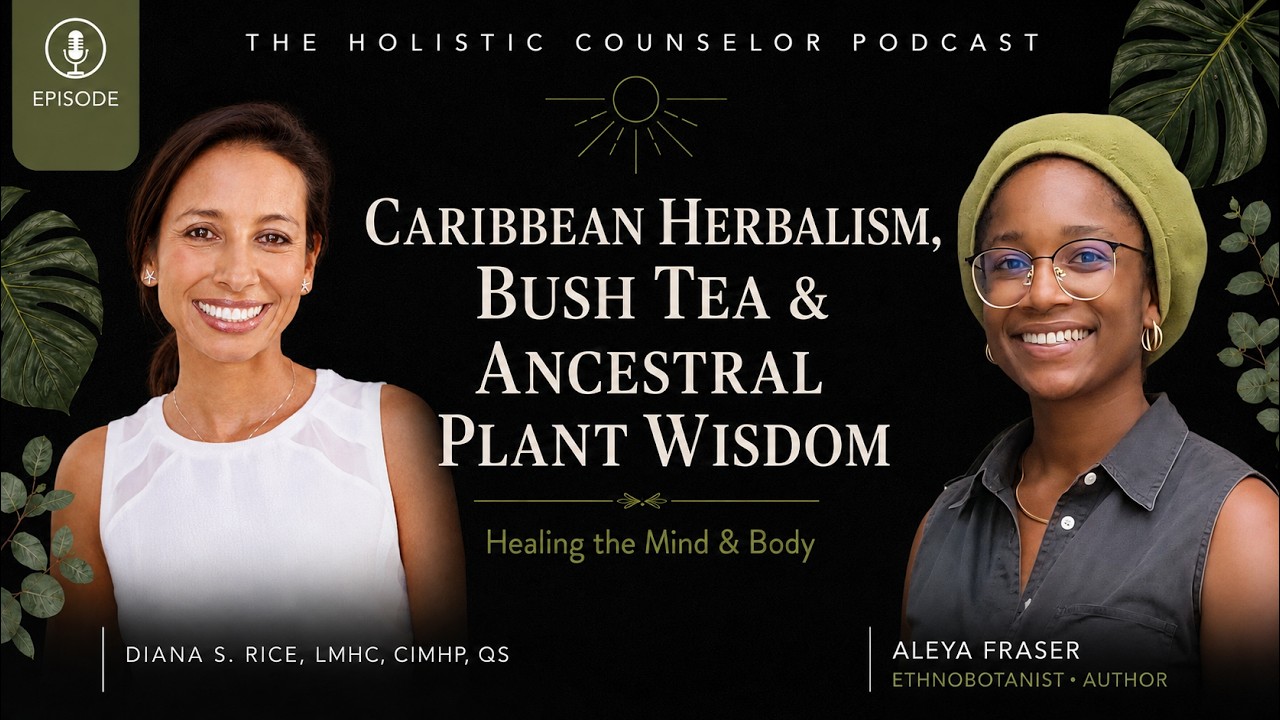
How An Ethnobotanist Uses Caribbean Herbalism, Bush Tea & Ancestral Plant Wisdom to Heal the Mind and Body
with Aleya Fraser
Hosted by Diana S. Rice, LMHC, CIMHP, QS
In this soul-stirring episode of The Holistic Counselor Podcast, host Diana S. Rice, LMHC, CIMHP speaks with Aleya Fraser, ethnobotanist, land steward, and author of Caribbean Herbalism: Traditional Knowledge and Modern Herbal Healing. Together, they explore…
Listen to the Episode
Press play when you’re ready.
Educational content only; this podcast is not therapy, diagnosis, or medical care.
About This Conversation
Show notes
Jump to a section
In this soul-stirring episode of The Holistic Counselor Podcast, host Diana S. Rice, LMHC, CIMHP speaks with Aleya Fraser, ethnobotanist, land steward, and author of Caribbean Herbalism: Traditional Knowledge and Modern Herbal Healing. Together, they explore how ancestral plant wisdom, nervous system regulation, and spiritual healing intersect through ritual, relationship with the land, and divine design.
If you've ever felt disconnected from your body, your roots, or your spiritual rhythm—this conversation is for you.
What You'll Learn in This Episode
- What Caribbean herbalism is and how it honors African, Indigenous, and Southeast Asian wisdom
- Why "weeds" like dandelion, bee balm, and purslane are medicine for your mind and liver
- The truth behind bush tea, bush baths, and their emotional and somatic healing powers
- Why journaling, ritual, and forest bathing matter in trauma recovery
- The myth of "woo" medicine and how Western science is catching up
- How to ethically explore ancestral herbal practices—even if you weren't raised in that culture
- The difference between plant fads and real, rooted, land-based knowledge
- How slowing down and connecting with plants can transform your mental health
Featured Guest: Aleya Fraser
Ethnobotanist | Author | Cacao Grower | Storyteller
Aleya blends a formal background in physiology and neurobiology with ancestral plant wisdom passed down from elders. She co-manages Panorama Cacao, a bean-to-bar chocolate farm in Trinidad & Tobago, and leads immersive botanical experiences that reconnect people to the land—and to themselves.
Her work was deeply shaped by her mentor Francis Morain, an ethnobotanical elder who taught her how to preserve, document, and honor traditional plant knowledge.
Resources & Links Mentioned
Aleya's Book
Caribbean Herbalism: Traditional Knowledge and Modern Herbal Healing → Buy on Amazon → Find at Barnes & Noble → Ask your local indie bookstore to order it!
Connect with Aleya Fraser
- Website: caribbeanherbalism.com
- Instagram: @naturaleya
- Substack: naturaleya.substack.com
Her site features plant photos, cacao farm tours, and invitations to join her for botanical excursions in the rainforest of Trinidad.
Practical Tools & Takeaways
- Bush Tea = fresh herbal infusions made with plants like mint, dandelion, lemongrass, or rosemary
- Bush Bath = traditional herbal bath + prayer + somatic ritual for full-body healing
- Forest Bathing = Japanese practice (shinrin-yoku) of slow, mindful nature immersion
- Plant Journal = track how your body responds to herbs over time
- Kitchen Herbs You Can Start With: basil, thyme, oregano, rosemary, lemon balm
Favorite Quotes
Diana's Drop-the-Mic Quotes
- "Do you have ADD, or do you have a nature deficit disorder?"
- "Weeds are just misunderstood flowers."
- "You can't just Google something real quick, or believe everything ChatGPT says."
Aleya's Drop-the-Mic Quotes
- "Western medicine is built upon traditional knowledge, and you can't forsake one for the other."
- "Books are important. Slow down."
- "Faith, respect, and slow observation—that's how you build a relationship with a plant, it's not just a product."
For Therapists & Healers
- Learn how to ethically integrate herbalism into your practice
- Avoid TikTok-level advice—study with elders, not just influencers
- Respect cultural roots and the ethnobotanical context of healing plants
- Explore how decolonizing mental health can create deeper transformation
Faith & Neurobiology—Together
Diana and Aleya reflect on what it means to live at the intersection of:
- Scripture + Soil
- Genesis + Gut Health
- Spirit-led Healing + Scientific Curiosity
- The Nervous System + Native Plants
Support This Work Each episode takes 3–5 hours to prepare, research, record, and produce with care, intentionality, and trauma-informed planning. If this podcast has encouraged you, supported your growth, or offered meaningful insight, one way to help keep it independent and ad-free is by visiting the merch store. Your purchase helps sustain thoughtful, holistic conversations on mental, emotional, relational, and spiritual well-being for listeners around the world.
Explore the collection: https://theholisticcounselorpodcast.printful.me/
If this episode helped you, please take a moment to leave a review or share it with someone who might benefit. Reviews are one of the most impactful ways to help others discover the show.
Stay Connected with Diana
→ Website: throughthevalleytherapy.com → YouTube Playlist: The Holistic Counselor Podcast
Episode transcript
Read the full transcript Close transcript
Automatically generated from YouTube captions. Names and wording may contain errors; listen to the episode for the original conversation.
fearfully and wonderfully made human. You're listening to the holistic counselor podcast where we explore the intersection of faith, mental health, and whole person healing. I'm your host Diana, licensed mental health counselor and integrative practitioner who believes that true healing flows from the one who designed us, body, mind, and soul.
Whether you're navigating trauma, reconstructing your faith, or simply curious about how emotional healing and spiritual truth meet, this space is for you. Today's guest found her way to me through a list sent by Pacific and Court. I was scrolling through the names when I saw her book and just felt it in my gut.
This is someone I need to talk to. As someone with Caribbean and Colombian roots and a family line full of herbalist and wisdom keepers, Aaliyah Frasier's work hit home for me. Aaliyah is an ethnobbotonist, land steward and writer currently living in the northern range of Trinidad and Tobago or Tobago.
Tomato tomato. She and her husband run a citrus and cocoa estate, a beantoar chocolate company called Panorama Cacao, and host botanical or botanical excursions for travelers. Her background blends a degree in physiology and neurobiology with ancestral herbal wisdom passed down through elders and lived landbased experience.
In this episode, I'm really hoping that we will explore how reconnecting with the land, our roots, and our nervous system can become a pathway to real healing. This is one of those conversations that I'm hoping bridges science, soul, and story. and I'm so honored to have her here.
Aaliyah, welcome to the Holistic Counselor podcast.
Thank you so much. I'm honored to be here as well and look forward to diving deep.
Alrighty. So, let's just go at it. First of all, can you tell the audience the name of your book and what got you to, you know, to write you to write that the book on herbalism and why do you believe that kind of ancestral wisdom is important for mental and emotional health today?
Yeah. Yeah. My book is called Caribbean herbalism and the tagline is traditional knowledge and modern herbal healing. So it's bridging you know the traditional knowledge that I've collected over the years sitting with elders along with my research into the science and the research about these plants and how that I call it western medicine is catching up with traditional knowledge because everything cooperates each other.
Um, but yeah, it's a, you know, it's good to see that it's catching up. And I I grew up uh in Baltimore City and Baltimore County, but my family is from Trinidad and Tobago. So, as an adult, I went back there, but along that journey, um, yeah, I say it's a lifelong journey that brought me to writing this book because I grew up being out in nature.
I loved connecting with nature. Um, and then when I went to college, I went to college to be a doctor. I studied physiology and neurobiology, took my MCAT, I was premed, was working in hospitals, but then I started farming and God took me in a whole another direction and said, "Look, food is medicine.
Um, I have, you know, herbs for the service of mankind, you know, let's let's go about it this this other direction." And it felt after that, you know, when you listen to spirit, everything flows up um really fast. So, I was farming on the Eastern Shore of Maryland on Harriet Tubman's ancestral lands.
And that's when I really started connecting with plants as as herbs and medicine because I'm sitting there weeding plants and picking, you know, weeding our sweet potatoes and I'm pulling up purse lane and I'm pulling up um, you know, wild mints and just all different things that I felt like I should be using this stuff too. and I started to research them and really realized that you know I'm surrounded by medicine and started documenting this and
writing more about it researching more and that was kind of the beginning of my journey and then when I moved to Trinidad um that's when the the you know the ethnobbatney and working with plants as medicine kind of like blew up because I started learning about my grandmother's history with plants and you know like you said your family has um a history with herbalism and healing.
So once you connect with those stories, you're like, "Okay, I really know I'm on the right path."
And I I met an ethnobbotnist elder um named Francis Morian who took me under his wing and we used to go interview people um for his writings and I would be the person holding the recorder um helping him transcribe and yeah and yeah the ball just kept rolling and my now my husband and I we live basically in the rainforest surrounded by many of these herbs that are studied by western medicine you know they say 25% of pharmaceuticals originated in the Amazon rainforest.
So we are surrounded by those and um because I have such a strong connection with nature and I like to connect people to that. I do that with you know inerson events whether when I was in the eastern shore of Maryland and also when I'm in Trinidad but I find that writing is like this long lasting way to reach more people.
So that really inspired my book cuz I wanted, you know, I just felt like I had all this information inside of me that needed a a place to go.
Well, I mean, yeah, listen, Aliyah, like Aliyah, I have the the Spanish comes out if you hear aliyah. Yeah,
listen. Um, it makes so much sense because that is something that I realized too for so long, especially when in my So, if you went into the Western and you saw what was happening in the hospital, it's not I don't want to put doctors down because they're being taught certain things, right?
And I bet you that's what you saw that the certain things and you start questioning about well what about things that from our bloodline from other places that have not been studied or understood or not
here I'm going to use the C word colonized
and and stuff like that. And I'm trying to build a bridge especially with this podcast for people to have that understanding it's not about this blame game that we're so caught up in like it's your fault your fault your fault your fault. Okay, we're here now and now we have choices to make.
Right.
Agreed. I agree.
And so as we make these choices, what are we going to do to to implement healing? And we every person listening, every person that that watches it, we all have responsibility,
okay? And we have choices to either fall for the the terrible fear narrative of like this is the only way, this is the narrow way, this is how it is. Or are we going to sit still with creator great spirit to me Jesus Christ?
Okay. Then and nature of what he created in the book of Genesis.
Yeah.
Right. So you tell me like like you were saying. Okay. First of all, ethnobbotnist. I swear. I mean, I'm I'm a I'm a little bit of a nerd of understanding and I love to learn more and more, but ethnobbotonist, I know ethno means like people.
No.
Yeah. Yeah.
Okay. No. No. And botist is plants.
Uhhuh.
So, tell me more about that. Like you were on your way to med school. You went and took the M. And I know how hard that is because I have um a daughter-in-law who is right now becoming an anesthesiologist. I can't even. and my son is becoming a CRNA.
Okay. Okay. Yeah.
Yeah. So, they're in that field. And I also know my personal experience with
psychiatry and and I don't want to say psychology because they're not the medicine part of it
but and my own personal Aaliyah my own personal health situations
and I had thyroid issues and then I found a holistic integrative uh doctor and you know a lot of people think it's all woowoo
right it's it's woowoo it's some people think it's demonic Oh, she's a witch. You would be uh, you know, put on a steak if you were doing the things with the herbs and the And I'm like, and I still, my husband, he's an American man, a white American man.
So, when he first met me, he's like,
"This is witchy." But now, 31 years later, he's like, "Wow, your stuff makes sense." Like,
you know, you having all the herbs in the backyard and and he does come from um a line of where they had a garden because they were real poor.
Yeah. Yeah. Exactly. And we all have it in our lineage somewhere.
Yeah. And so they had to, you know, do a lot of vegetables and stuff like that because it was cheap. They couldn't have meat. Meat was like a a treat.
Yeah. Yeah.
So I want to know is like, you know, how your e Well, first of all, ethnobbotnist. And you talked about a man earlier.
Mhm. and I never heard of him and that you learned and he must have been your mentor and like what was the shift or the change for you where you were just like because I know it probably had to be something uncomfortable inside your system going a minute huh huh and you started questioning but then when you questioned what happened with you because I I can talk about what happened with me.
Yeah. Yeah. Well um you were exactly right with ethno meaning people and bi plants. So it's the study of people and plants throughout history. Um, and it's different from just herbalism, you know, where you're just studying what plants do. Like I I like to know about plants, not just for their medicinal uses for humans, but their uses for dye, their uses for fiber, their uses for building um pollinators, everything.
So, that's one part of it. And for me, it was also health um issues that I was going through. And I was go looking at um I was going to buy things from GNC or just you know online and God said no like you need to be growing these things or at least uh building a relationship with them.
And that's not going to be the case for everybody. I always tell people we all are getting different instructions and that's okay. But for me, um, that was what was feeling uncomfortable in me, like trying to heal myself with a pill, bottle, herb.
Like, of course, if I go to the doctor and they give me a pill, I expect a disconnection, but if I'm using a herb that grows from the earth that I can grow myself, I wanted to have that personal connection with it.
And um and then learning how elders and ancestors use these things that validated it for me because like the main reason our these traditions and plants are considered woowoo isn't of course isn't because it is it's just because of um lack of research um you know the context of how we use them being stripped away.
I find that you know if you just say dandelion root is good for XYZ without understanding how an elder prepared it or how much of it they use like yeah it's not going to work as well. So I wanted to know that context and that's what I got from studying uh the books and also studying under elders.
Yeah.
Yeah. So, so you you named two things already where people actually and this is where it gets me so very frustrated.
We have the suburbs, right? And I and and this is an argument I have with my husband all the time because you you know, you might live in a homeowner association or you have the lawn, okay? And so you have Roundup and all the pesticides, fungicides, herbicides, and they're killing dandelion roots and pcelain.
You name two weeds that I know about where I'm like, those are edible. And and people are like, whoa. Like they think I have some kind of magic because I know this. But I'm telling you, I'm like, well, you can know this, too.
You can understand that whatever land even in the in the cities. I I know that like in New York City there are people that have their herb um garden or their um
up on top of the roofs and stuff. So like people are like I can't do this. I can't do this. But I'm like but that's how we all started before the concrete jungle, right?
Yeah. Yeah. And I find I've I've looked at it in my parents' neighborhood cuz they live in the suburbs. Like I find there's even less u herbs in the suburbs than the city somehow because of everyone spraying their lawns. So like there's just no biodiversity whereas in the city you still have just these wild things growing out of cracks and like you can still find and see these plants but um yeah nothing like getting into nature outside of the city and outside of the suburbs too.
Yeah.
Yeah. Yeah. But but so let's talk about that a little more um
of what you've learned or know or what you see because honestly I want to help people to understand better. I want them to be feel empowered that they can take the one plant, the one rosemary plant that could grow, right? Or the one, you know, it doesn't have to be this perfect lawn.
Okay. I I live in South Florida. I don't know if you've ever been to South Florida.
Yep. Yep. Yep. Currently from Fort Lauderdale and Miami.
Really? Do you have family there? Yeah. Yeah, I come visit a year.
Oh, wait. Well, that once a year. Please please can reach out so we could come and and have a cup of tea or the bush tea because that's another thing. All right. I'm like bush tea. I'm like I'm a I'm a tea snob.
Anyone that knows me personally, they know I'm a tea snob.
But like let's go have coffee. I'm like no, I'll have tea
and it has to be good tea.
All right. So So let's go to the bush tea right now because this is how my brain flows. Okay.
Uh um what is that? Like I read that somewhere and I'm like the bush tea? What do you mean bush tea? What? And then I started going into the that that rabbit hole people know I like to go into. But please explain it since you're the one that really knows and studies it.
Yeah. Bush is just a a Caribbean way of saying herbs. So like a herbal tea, but not in a package. Yeah. Not in a package. It's it's the tea that you're going out into the bush or your yard picking in the morning and drinking.
So
I I I think of bush tea as like that whole process of picking it fresh, brewing it. Um, wow.
And brewing the fresh herbs. So when you go in your yard and pick some mint and make a tea of it, that's a bush tea.
Really? Oh my gosh. So listen people, I've been a bush tear. What do we call ourselves that a bushw woman? He's a bushw woman.
Oh my gosh, that's awesome. Oh, my husband's going to love this when I tell him that. And it's about reclaiming the because like that word has can have negative connotations like bush you know backwards negative like people moving forward people leave the bush and go to the cities but to me the bush is where we start it's you know so going back to it and reclaiming those words is important.
Look at that like look at the host just had a aha moment in front of everybody. That's awesome. How did I not know this? This is what happens. Your brain can only take so much information or or when you need to to find the information, right?
It it shows up
and it clicks. Yeah.
And it clicks. Okay. So, let's talk about that because if if
you understand the do you understand the different regions too and what might grow there? Did you learn that as well as
Oh, okay.
the different regions of the world or you mean different regions of the Caribbean?
So, for example, right now a listener is in Ohio. Mhm.
Yeah. And they're like a bush tea. What is this? What are these Caribbean brown girls talking about? Like black girl, brown girls talking about, right? And they're from Ohio and they're not from the Caribbean. Okay.
And they're like, "Bush, but I want to try it. I want to check it out. I want to be able to to to get with nature and and and make my own bush tea."
What would you suggest? like is there something that you know of that like that grew in Baltimore or wherever and then I know in South Florida we're kind of like uh the Caribbean so I know
a lot of the same things.
Yeah. So tell me like some recipes or whatever it is that you know
interesting enough right now I'm on sbatical in Virginia.
So I've been uh surround you know connecting with this nature again that I grew up in like this type of these plants and one plant that I've been drinking in the mornings is um be balm and that grows wild in a different in Ohio to Maryland you know a lot of different places and it has a minty uh oregano flavor people can use it as seasoning as well so that would be something like it's growing outside my front door in Virginia so I go pick it, make tea out of it.
That's
And people have no clue that that's what that is, right?
Uhhuh. Well, a lot of people just grow B bomb as an ornamental. Yeah. And
it is it's very medicinal as well. And calms the nervous system, calms the gut.
Um, another, you know, dandelion is something if you trust your neighborhood, you can dig up dandelion root and boil it
and eat the flowers
and eat the flowers, make a tea out of the leaves or the root, and that would be a bush tea.
Um if you that's those are things that are growing wild but if you in your garden have mint growing if you have oregano thyme um the I mean lemon balm you know any of these sage rosemary even basil y all of the herbs that you can eat in your in your food you can make a tea of as well and um yeah I just encourage people to play with them use you know taste it taste it
to make different ratios to see what tastes good and and you know for me building that relationship is journaling and noticing the effects.
Like people get really frustrated with bush medicine or herbal medicine because they want it to work fast like a silver bullet just like maybe a pill does. But if you're not building it into a daily uh routine or rhythm or ritual, if you're not praying, if you're not intentional with it, I don't I find you're not going to have the same effects.
And um that's what I try to talk to people about in the book and in real life like aren't they're not um magic bullets even though they are amazing. Um
well let's let's go to the journaling and the ritual and the rhythm because to me Aaliyah
I that's when you have to be still and I think that's what's missing in our culture our society we are in such a fastpaced 247 uh information overload and the young people I don't know how old you are but but I I worked with adolescence for about two decades
and and we see it not only in adolescence. I have a lot of 25 to 35 year olds coming to me now because they're like the first generation to be raised on social media.
Yeah.
And it's become that's their their ritual. They wake up right away. Guess what? Guess what's waking them up? The little rectangle. And then they go straight to the rectangle. And then every notification and they purposely made every notification red on purpose because they studied it.
They had psychologists. A lot of people don't know these things. This is what I do in therapy now a lot.
You have to get people away from their phones and out of that. Yeah.
Yeah. It's And I don't want to say detox and get rid of it because this is where we're at. We're at chat GPT. We're we're at this information um overload, but we don't have to let it get on us. I remember Prince
talking about he was getting an award for the Yahoo. I don't know. You know, right, right? And he and he was sitting there going, "Hey, the internet is here. Do not let the internet get on you. You're the one who needs to get on the you or something like that.
I don't know. I'm butchering that. I'll try to find the clip and put it in the show notes. But
but basically, we're trying to now take that pause and become more like Mary in the Bible. That's what I because I am a faith-based uh counselor. And I kind of tell him like, "We are so Martha. We're doing the work. We're doing the work for for for our religion or for our faith or whatever."
And look and look, but then we're still so burnt out.
You know, we have all this medication and all this stuff, but we're still have an influx of anxiety and depression and suicide rates going through the roof.
Aaliyah, what you just mentioned about the journaling, the ritual, the taking the step back and connecting. This is something that I was reading about in Japanese um therapy where it's shinyu, right? Forest bathing.
Oh, yeah. Yeah. I've heard of forest bathe. And yeah, that's just what we do.
Exactly. It is taking the time to to understand
that God's creation is all around us. Even in in the urban Manhattan cracks of the sidewalk,
it is there. It is growing. It is for us. That's why it's made. So saying all that, let's talk about mental health and that slowing down and breathing and like tell me like what what you do maybe or like how you do it or what you teach.
Yeah. Yeah. Um definitely forest bathing. I don't I haven't used those terms, but I I always tell people whenever I'm feeling a little upset or anxious, my husband's like, "Go for a walk in the forest, please." And I'm like, you know, you can resist it because we always resist our healing, but then once you do it, you feel better.
Um,
and I find that another thing that's been important for my mental health is like a lot of us are feeling disconnected, disassociated, and when you do ground yourself in nature, you come back into your body. You have to be present. You have no choice.
Especially where I live where there's spiders, there's poisonous snakes. Like I can't be walking through the forest thinking about a million other things. I have to be present or on my phone. Exactly. I have to be extremely present. Um and then the other piece that's really affecting our mental health is like I we feel powerless today.
We're looking at the news. We see so many things going and we're like what can I do? And I find like when I'm able to, you know, even the smallest thing I I tell people start with aloe. Like everyone can remember using aloe to treat their own bug bite or their own burn or sunburn.
And that's power like that that really empowers you to know that you do have control in your life to help yourself to heal yourself. So um connect um associate with nature and you know and empower ourselves by using that at least one or two herbs in your daily life or in your weekly life that that you know work and that can can help you.
I think people get a little uh not confused but you know it it's hard to think when you're trying to like cure cancer or like you know those aren't the things that we should be focused on. It's really like we can cure our sore throat using honey and and lemon and we can you know make our bug bites feel better using aloe and then as you do those things more you you you keep upping the ante and learning more and more.
Yeah.
Exactly. I I know during co I was make and I had doctors living across the street from me and they were you know we all remember co I mean I think actually we're even though it's 5 years out we are still um having the effect of that what happened there especially the young kids that you were forced you know and trying to
especially mental health more than physical health I'm sure
yeah I think it's all of it you have long co people that got it and have long co people that had had um you Whatever you believe, the shot or no shot, whatever, vax or novax, whatever it is, we're here. Like, we can't go back and be trying to change it and get all that anger because anger, what's anger do to the system?
It's okay to be angry, but it's what you do with the anger. Are you letting it out? Like, go outside and scream in the forest if you need to or journal it out.
So, I would make uh these my husband's a beekeeper.
Oh, so does mine. That's
Oh, no. When you and your man come, we're going out to dinner. Uh-uh. Uhuh. To a nice natural, holistic, organic place that hopefully I can find. If not, I'll try cooking. See, that's the thing. Cooking in me, I do. So, anyway, I made these things with the raw garlic, raw honey,
okay?
Um, pure turmeric, organic turmeric, and I would make it into shots, and I would I would bring them over to the doctor, and they were just like, "Whatever this is, just keep it." and they would come over. Do you have any more? Because it's it's not only healing the cells like we have like you you studied neurobiology you said and physiology you understand
the the big fancy words of ATP or whatever or the energy but that's just energy in our cells like
the hundred trillion I don't even know if that's the right number of cells in our body and God gave us
what we need to heal
and he also gave us wisdom and we have evolved to a place where we have wisdom as well because I'm not going to throw all westernized stuff out the window either.
Yeah. Yeah.
Okay. It is how do it's integrative. We
it's all made to the benefit. I think it's just
the heart of the humans using it. If they're using it for their own selfish greed or are they actually using it to truly help the human? Exactly. Exactly. Yeah.
I see western medicine built upon traditional knowledge and you can't forsake one for the other and like you said with is your intention like the pharmaceutical industries they don't always have the best intentions but as humans you have to study study both like you have to study the pharmaceuticals and the herbs to know how they really can interact with your system.
Yeah.
Yeah. So so there's other Okay. So, we got into the bush tea and I'm so like still going, "Whoa, I'm going to make some now cuz I I'm I'm looking at my lemongrass right out here.
I have lemongrass and moringa."
And people have no idea like they have these huge trees and the seed pods are falling and stuff. And I'll never forget it was uh my neighbor who is from Trinidad. He he took a pod out, opened up the seed, and asked me to chew it.
And I'm like, I don't trust that. But I love this guy, right? He's such a sweet old man. And I chewed the seed of the moringa.
And then he's like, "Now drink a glass of water."
It blew my mind.
Your taste buds. Yeah.
Yeah. Minga is magic. Yeah.
I was just like, "Wait, that's right here. Trees all over the place." And people don't know. Hibiscus.
Mhm.
Like we think these are all ornamental. And I do say, you know, and we got to be careful though because sometimes, you know, somebody could be allergic to something. So,
and you can overdose it. Minga, I was in Cuba chewing moringa seeds for a long Yeah. I was just going too hard with it because I often do that to see the effects and it lowered my blood pressure. Like I was almost lethargic and I was like, "Oh, okay.
This is strong medicine." So, again, you do have to balance balance our enthusiasm with the fact that these are actual medicine, too. Yeah.
Well, I think it's also like you said earlier, being connected with the plant that makes you slow down to actually understand your body and listen to it.
And that's what's missing too. We have gone to a place where we put our power into so many other humans. We believing the hype.
Now I'm singing public enemy in my brain.
Believe the hype. That's how you That's how you know I'm a I'm a girl from the 80s.
Love it. Love it.
So, like, you know, to me, it's like bringing it back to the here and now of what we can do. I mean, I'm not going to sit there and say, "Hey, everybody, go outside your yard and get that dandelion." That the dandelion that we think is a weed that we're trying to kill all the time is actually good for your liver.
But be careful eating a bunch of them because guess what? We don't know what it will do. But at the same time,
why don't you look? I always say that to my husband. I'm like, that's not a weed. That's just a misunderstood flower.
A weed is only an unwanted plant by a certain person. Yes. It's nothing's universally a weed.
Right. So, so let's talk about like how can therapists and healers integrate traditional plant wisdom, especially from cultures they weren't raised in
into mental health care.
Yeah, that's a good question. I I think nowadays, especially with um plant medicine, especially the psychotropic type plant medicine getting more pop popular like Iowa,
tobacco ceremonies, cacao ceremonies. I think it's important not to just like extract those things and and just um without honoring the context and the people like like the ethnobbotney of it. I think a lot of people just use them now in therapy which is great but if you are divorcing it from the historical context you're not going to get the same type of healing.
Um I think you as therapists or holistic counselors who want to use these things more just definitely um talking to indigenous people, talking to elders, herbalists, teachers, um like we said, not believing the hype, not believing the memes on Tik Tok, um really taking that extra step to read a book, talk to an elder.
Um, I think when you're in using herbs in your practice too, it's important to like ethically source those things. Um, know who's growing them just so that you and your patient can have uh more of a connection to these plants. Um, yeah. So, it just means going beyond the the workshops or the hype um and building authentic relationships.
Yeah.
Right. and going beyond just googling something real quick or believing everything Chat GPT says.
Mhm.
Cuz like you know you can all of a sudden boom get in and it's like all right I'll make this tea and it's like you know 3 oz of this and 2 ounces of that and it's just like and then the next thing you know you're like not feeling well.
Yeah. My cousin read my in my book I talk about neem being a powerful herb that you're not it's workful. was antifungal, all the things, the science research. But she was like, "Oh my goodness, I've been drinking it every day as contraception." And I was like, "Yeah, girl, no, don't do that."
She's like, "But someone said on TikTok." And um I was like, "Yeah, no." So this again, books are important. Slow down. And um
yeah,
books are important. And and that is the thing. We are in a a space where you have pop therapy, pop everything like that's tick tock tick tock, you know, we have we're tick tockrained and uh and how do we move away from that?
And I don't want to put that down either because some people listen some people come to me and say I heard this on Tik Tok now I want to hire you as the therapist to help me through. So it's so we have to learn to integrate and balance and get the people to sit still with creator with the Lord and just breathe nature like get back to the nature.
That's what's missing. Sometimes people don't like when I say do you have ADD or do you have a a nature deficit disorder?
Yeah.
Right. Is it
I've never seen a child with ADD in the forest. I've never seen it big.
Maybe in a classroom sitting down, but yeah.
And it's it is and that it's such a such a hard place for me to say because I'm a licensed therapist, so I got to be care I got to be careful.
But it's just understanding that
any kind of label given to you. It's trying to find and be curious observer of the why that label and what's happening holistically right what food are you eating what happened to you in childhood right what what um medications are you taking what what everything it's like what are you watching how are you using your five senses
right and so being able to really understand Like some people don't like the out the door. They they think it's weird.
I had a neighbor once who had a big banana tree as an ornamental. Bananas grew.
Wow.
And they were getting ripe. And so I went over there and I said, "What are you going to do with those?" And he's like, "Do with them?" This is how you know some cultures like they don't understand that because we're they're born and raised generation after generation.
Where do bananas come from? The grocery store, of course. Like That's not from that tree in my backyard.
Yeah. He's like, "That's kind of gross. There were spiders on there and everything." So, I took the bananas. He gave them to me. I'm like, "All right, thanks."
I made I made um banana bread.
Nice. Nice.
Mhm. With with some cacao nibs.
Okay. Okay.
Right. Right. I gave I said, "Here's a loaf for you." Not He did not put two and two together. Ate the whole thing.
And then I finally said I go, "Those were made out of the bananas from your dog. He was just like he did. You know that dissonance that happens to people when they're like challenged in their brain and you can
glitching a little bit. Yeah.
I love that. I'm glitching. Oh my god. So let's go to the misunderstanding of of maybe you know the western medicine overlooks you know but
but the powerful mental health benefits I mean we already named them you know journaling sitting there
you know Aaliyah what I really love to do because I live in a place where there's not a lot of I'm kind of jelly right now of you living living where you're living like when you said I could sip and go in there and But it's it's trying to figure out when you go out there.
I do turn off my phone
so I don't get bothered, but I take pictures of nature. I spend at least two hours
in a a little park that's by my house,
okay? an arburetum and or even in my backyard and I'll zoom in and I'll take pictures of the herb, the flower because guess what's so beautiful about going to the same park all the time in nature
the seasons and the the flowers, the seeds, the fruits. Yes. I I when I taught some people about ginger um not ginger a puhi I don't know how to say that but when you squeeze it and you put it in your air the smell ginger
yes people are like that's here and I'm like yes that's here that's here all around you
all around you so why why do you think western medicine overlooks these things or how else well tell me about your book like what else are you teaching in that book? Yeah, I mean I'm I'm naming probably around 40 different plants and talking about the traditional knowledge and my personal accounts with them as well as the research.
And then I also share about the background and history. So indigenous, European, African, and Southeast Asian all have huge influences on Caribbean herbalism because of the triangular trades. Um, and then lastly, I I have a few interviews in there and I talk about bush baths and bush teas and tonics and
Okay, let's go to bush bath now.
Oh, yeah. Yeah, bush bath is is part of mental health for sure. Yeah.
Well, tell me about that. What do you mean? If I Okay. No, tell me what you mean because after we hang up or this evening after my hard day at work, I'm I'm going to try cuz I do Epsom salt baths.
Yeah, exactly. I was going to say similar to like bush tea being just a herbal tea. In western uh terminology, a bush bath would be, you know, a herbal a herbal bath or epsom salt bath with your lavender and things in it. But in the Caribbean, there's just a stronger tradition of using these healing plants in the water.
And so they're making a a strong strong tea or decoction with things like sarasi, which is bitter melon. They use a lot of bitter herbs usually and interestingly enough we know bitter herbs are good for the liver and blood cleansing. So there's this like um detoxing that happens when you're in the bath.
Um there's also a somatic experience because when you're getting a bush bath, they're beating you with the herb. So you're feeling it on your body, you're smelling um you're getting all these sensations. And then lastly, um a a true bush bash bush bath involves prayers.
So, you're getting prayer, you're getting um you're getting herbal healing, and you're getting this somatic experience allin one. And uh I I've known I've seen it in my family like one of my uncles suffered with drug addiction, and like it's almost a last resort.
They're like, "We need to give him a bush bath." And one of my other um older aunts um she was that that was her thing. And she gave him one. and we can definitely say he was he was on the right path for a while after that, you know, they're um they're pretty intense.
But on the other side, on the gentle side, you know, for my daughter, I give her a bush bath when she has a fever. Like I'll bathe her in lemongrass, which in Trinidad we call fever grass, and that's more gentle. It's a way for for me, it's a way to get herbs to a baby because they're not going to drink it, but your skin is your biggest organ, so you're still going to absorb some of it.
And um yeah, so
and that and many people don't understand that their skin is the biggest organ. They don't. And this is and they're not. And we have so many endocrine disruptors. And us women, I mean, there's so many women that are suffering with Hashimoto's or um PCOS or or or a lot of hormonal things.
And we're not understanding that
the the Glade plugin and then you got the lotions with a hundred different ingredients in it. and we don't even know what they mean. And then we're eating stuff and then we're going to Starbucks getting our pumpkin latte which is coming the season will be coming up soon.
And and then all that sugar and I mean it's just we we are not understanding how how the commercialism has affected us to a point of making us thinking that we need these things when God gave us things before TV was even existed.
Exactly. Exactly. you know, and the I want to talk about the skin a little bit more because that's something that uh back I would say about 30 something years ago or more just when you just said the whole uh bush path thing I remember I guess it was it was my Puerto Rican grandma.
Uhhuh.
You know, people know she was a Santaoria medium.
Okay. Okay.
Yeah. And so I remember being sick and sitting there and she was just doing her thing and I'm sitting there going it it's scary. It You know what it was though? Now that I'm disentangling trauma from faith.
Yeah. Yeah.
Disentangling my true ancestral wisdom bloodline with
horror. I don't know.
I don't know how else to explain it.
I I still long. It is a longing inside of me that that wants to connect with my ancestors because I do know like I did the DNA test. It says that I'm 25% Native American Indian.
Yeah.
Right. And I I respect the cultures,
all of them,
because you're right, the Caribbean people, when I looked at that, I'm like, "What? This?" And I'm like, "This is my husband thinks it's they just
do a like a lot like a a machine where they're like, "Okay, we got another sucker here. Just send them that and make them think that that's what they are."
Oh, yeah. I'm like, "No, look at me. Look at us. Look at the Caribbean people." Right? We we
fully fully mixed.
So, tell me about that a little more. Tell me about how you what you learned in your experiences of studying ethnob botany and and
the how trauma probably travels into intergenerational, but also healing does. Like, what else can you tell us about that? Yeah, because I've been um like I I'm live in Trinidad, but right now I'm on a sbatical in Virginia at a rare book library.
And these are books from the 1600s through the 1800s that are firsthand accounts of the explorers, we call them colonizers, that came over to the Caribbean and um are documenting this knowledge like botney was the the thing a botnist was the thing to be back then because you were bringing plants and people around the world.
So they were really trying to study that. And when I'm reading these accounts, there is so much trauma in it. But as a descendant um with diff multiple lineages in me, it's just like I just feel like I'd still have to read this, reclaim this knowledge because these are the only firsthand accounts because the Europeans were the ones using written language to describe things and and and um encode them.
Um, but what I find fascinating, yeah, in these accounts is that they're talking about the indigenous knowledge, like how they stole it or how they threatened to get it. Like I love the story of arrowroot. Um, that's a the arrow root, we know we we know it as a powder now.
Um, a starch, arrowroot starch, but it it also was an antidote to poison. So the Native Americans would make poisonous arrows out of cassava, which we know is also as yuka. Yeah.
Bitter bitter. There's bitter yuka and sweet yuka. And the bitter one, you know, you have to process to get the poison out. So they would make these arrows hurt, you know, kill Europeans while they're in warfare. And they threatened a Native American saying like, "We're going to hit you with your own arrow if you don't tell us the antidote."
So that's how they found out that arrow arrow root is an antidote. Um and then on the other hand they're same in the same book they're talking about African knowledge of how to grow indigo and how people use different plants from Africa that they were bringing over.
Um and so I just find it amazing that in the same breath they're calling them heathens but they're writing whole books based on their knowledge.
And so we we have to reclaim it and we have to learn it for ourselves and and make our own connections with it because yeah there is trauma there but there is also healing there and um yeah it's just important and and just like today back then the health health system wasn't made for people from the global south so they had to grow their own things. the Africans and the Native Americans bonded together to teach each
other um about the plants because Africans would come over and say like, "Oh, that looks kind of like what I had over there.
Does it do the same thing?" So, they were doing this experimenting way before um before science was catching up with everything. So, I just find it all fascinating and and necessary for us to be uncovering because the you know, there's no going back to the past.
I don't romanticize it. I think um especially if you're a Christian and build upon faith, you you can integrate this ancestral knowledge into what we we or you know as truth today. So um but we have to have these conversations and study groups or something because it is it's hard to really reconcile and I I'm I'm with you with like I want to do that but also I want to do do it this way.
Um so yeah. Yeah.
No, that's it. It's bringing science and faith and and ancestral wisdom. That's how and respect. I think that's what's missing is is respect
nowadays because everybody's living in fear.
And you have a choice to either live in fear or faith.
And I have faith that God,
what God said in Genesis is real.
Okay? And I have faith he made us male and female, right? He created us and that he made us from the ground and that's why we need these herbs and minerals and I I mean when you when you think of it scientifically in that manner
it's like whoa right
and how do we treat brothers and sisters or humans or actually living things?
Yeah.
To me because God made all the living things.
Yeah. interconnected out of, you know, when you really look into the science, protons, neutrons, electrons, like right all all things are made of this, you know, and how do we respect it and still keep the mystery and awe of it because that's what it is. disrespect because what what I see is when the human becomes so 100% this is the only way they have now taken the mystery of who God is and and the awe and now you are God like that
exactly
no right and and then and then the disrespect it's fear that's what it is it's false evidence appearing real where people when they're in fear or they're in that greed mind or that um pride,
you know, the sin of pride and it's all about, okay, it's about me and my my people, right? And I think that's it. That's it. Being from the Caribbean and the way I was raised in New York and down here in South Florida and what I've seen and experience and God's called us, us holistic healers to be peacemakers and bridges.
Yeah. Yep. Yep. I definitely resonate.
So, I am Listen, Aaliyah, I think I probably could talk to you for another year.
I'm serious. Like I it's it's it's I get lit up when I find people that understand holistic approaches with a respect and awe for creator and understands mental, physical and science. Like that love of like I'm like where in Virginia are you like
I'll send you a link to the to the place. They do have residencies so you can apply if you want. Well, honestly, my my son just moved there.
Oh, okay.
So, after we cuz I don't want to He's very private. My son's very private, so he gets even mad that I mentioned son. So, it's like um so tell me how people can find you and what are you up to nowadays and you know if if they want to contact you, read your book or go to Trinidad and go on one of your explorations.
Yeah, for sure. Um, my website is easy to remember, caribbean herbalism.com. And on there you'll find pictures of all the plants in the book because I wasn't able to put pictures in the book. You'll find um information about our cacao farm and um ways to come visit and you'll also see my writings.
So, if you don't buy the book, I also have a substack that I update at least monthly with um you know, my musings. I call them botanical musings. And on Instagram and Facebook, you can find me, Natural Leah. That's where you'll get more up todate what I'm doing.
I like to share my stories about what I'm learning in a library and, you know, take y'all along on the journey with me. And if you want to visit Trinidad, please do reach out on any of those platforms. And um we do curate experiences for people.
And you we can we have we live near a river so often times people want to walk to the river learn about the plants along the way and how they work and you know we're tasting we're touching we're dying ourselves with ruku and anato and then um at the
which I've seen in food that's an ingredient
exactly
it is it's in cheese of all things they use with the color cheese a lot but um also medic all the other things and then at the And uh my husband is the chocolier and the beekeeper. So we um always offer chocolate. And cacao is one of the from if we're talking mental health, got to talk a little bit about cacao, too.
But that's a whole another story.
It's got those anandine and the bliss chemicals and you know,
it's there to help with depression. I I heard about that too. See, we could sit here for another hour.
But you know what?
Yeah. Uhhuh. I'll drop all that in the show notes. And I'm just thinking right now that honey, if you're listening to this, I think I know where we're going to go for vacation.
Yeah. No, come on down.
Oh, no. I'm serious. Cuz that's the kind of thing I like. I don't like to just go to a place that's all touristy. You know what I mean? I want to I want that what you just said, honestly.
And I'll give you good pointers on places to stay and other things, too. But um Yeah.
Oh, Leah, I love that. This was so wonderful. Is there anything else you want to say before we say goodbye?
Uh, no. I think we covered a whole lot. I really appreciate your questions and enthusiasm and yeah, and the book you can find it on all the major platforms, Amazon, Barnes & Noble, Target. Um, and definitely if you go to your local bookstore, that's the best, and ask them to order it for you, they'd be able to do it.
So, yeah.
How exciting. I am so I'm getting it. That's going to be on my next for sure. For sure. Well, Aaliyah, thank you so much for joining us here and remember listener to trust in the Lord, guard your heart, and renew your mind. Bye.
Amen.
And now for the disclaimer to make sure you understand that you are responsible for you. The content provided on the Holistic Counselor Podcast is for entertainment,formational purposes only and is not intended as a substitute for professional medical advice, diagnosis, or treatment. Always seek the advice of your physician or other qualified mental health provider with any questions you may have regarding a medical or mental condition.
Never disregard professional medical advice or delay seeking it because of something you have heard on this podcast. The views expressed on this podcast are my personal opinions and do not represent the views of any professional organizations with which I am affiliated. Call your doctor, 911, or 988 immediately if you have a medical emergency.
The Holistic Counselor podcast does not recommend or endorse any specific tests, physicians products, procedures, opinions, or other information that may be mentioned on the podcast. Reliance on any information provided by the holistic counselor podcast, guests appearing on the podcast at the invitation of the holistic counselor podcast or other listeners to the podcast is solely at your own risk.
Confidentiality notice. If you engage with the holistic counselor podcast by commenting or posting and are a client, please be aware that you may be revealing information that could compromise your confidentiality. Please remember that disclosing your identity or personal details can be linked to your clinical material.
As a therapist, I am bound by confidentiality and will not respond to any disclosures of this type on this podcast. I am committed to upholding the ethics and confidentiality of the therapeutic relationship which extends to all forms of communication in accordance with the laws and professional guidelines that govern mental health professionals.
I want you to know that your privacy is of utmost importance and you are responsible for protecting it when interacting on this platform or any other public forum. Thank you.