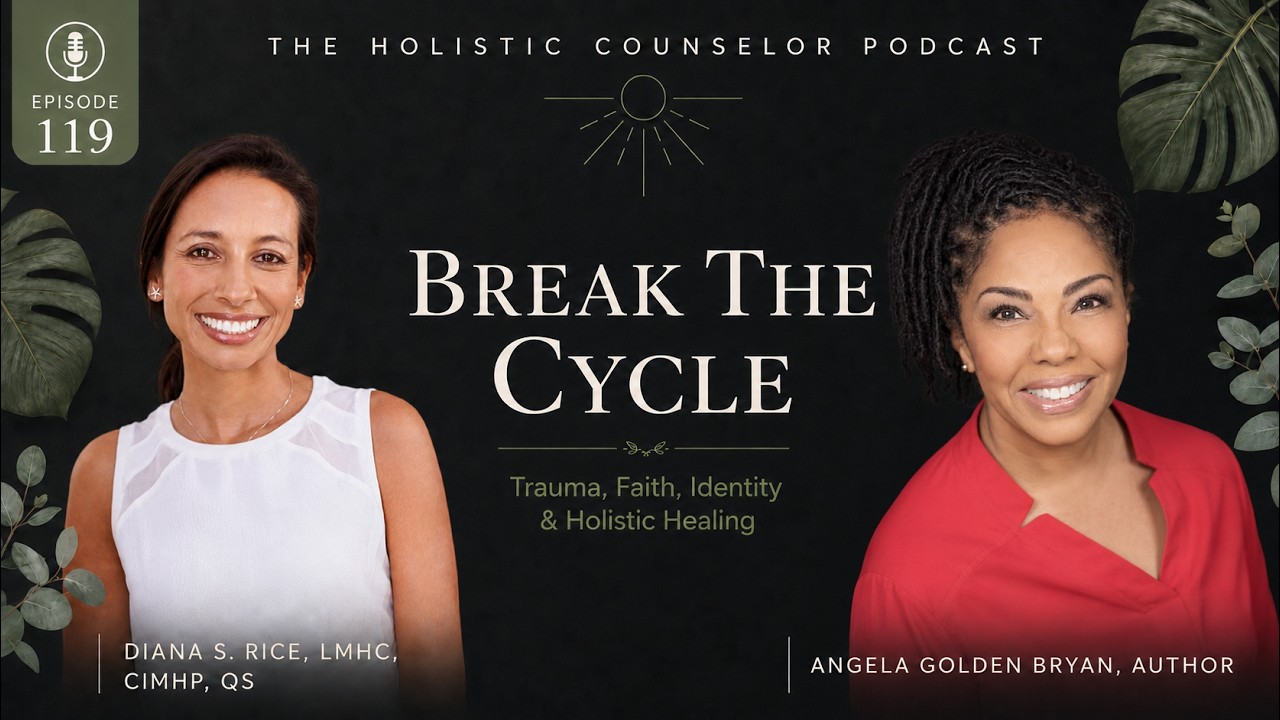
Episode 119
Breaking Generational Trauma, Faith, Identity & Holistic Healing
with Author & Storyteller Angela Golden Bryan
Hosted by Diana S. Rice, LMHC, CIMHP, QS
What happens when storytelling, faith, cultural identity, and holistic wellness come together in one honest conversation? In this powerful episode of The Holistic Counselor Podcast, host Diana S. Rice sits down with Angela Golden Bryan — Amazon bestselling…
Listen to the Episode
Press play when you’re ready.
Educational content only; this podcast is not therapy, diagnosis, or medical care.
About This Conversation
Show notes
Jump to a section
What happens when storytelling, faith, cultural identity, and holistic wellness come together in one honest conversation?
In this powerful episode of The Holistic Counselor Podcast, host Diana S. Rice sits down with Angela Golden Bryan — Amazon bestselling author, filmmaker, speaker, wellness advocate, and founder of Fireburn Heritage — for a deeply authentic conversation about generational trauma, healing, identity, emotional wellness, storytelling, church hurt, holistic health, and breaking unhealthy cycles.
Diana and Angela first met years ago during a completely different season of life while both working in the entertainment and acting world. Now reunited through purpose-driven work, the two explore how our stories, belief systems, family histories, faith experiences, and even the lies we internalize can shape our emotional, mental, physical, and spiritual health.
Angela shares the powerful history behind the 1878 Fireburn Revolt in St. Croix, U.S. Virgin Islands, including the deeply personal discovery that her own great-great-grandmother survived the historical uprising. Together, Diana and Angela discuss how intergenerational trauma, cultural identity, forgiveness, nervous system survival patterns, and community impact the healing journey.
This episode also dives into:
- Generational and intergenerational trauma
- Identity confusion and cultural belonging
- Faith and mental health stigma in Christian and BIPOC communities
- Church hurt and spiritual bypassing
- Anxiety, burnout, depression, and emotional exhaustion
- The connection between storytelling and healing
- How lies and limiting beliefs shape mental health
- Holistic wellness and mind-body-spirit healing
- Healthy community, accountability, and emotional support
- Nervous system regulation and lifestyle healing practices
- Nutrition, sleep, movement, and sustainable habit change
- Why healing requires both truth and compassion
Angela also opens up about her own health journey that inspired her newest book, Treasure Your Temple, and how holistic wellness, nutrition, faith, and intentional community became part of her healing process.
About Angela Golden Bryan
Angela Golden Bryan is an Amazon bestselling author, filmmaker, speaker, certified life coach with the John Maxwell Team, and founder of Fireburn Heritage, a nonprofit organization dedicated to preserving and amplifying untold Caribbean stories while contributing to cultural identity, legacy, and generational transformation.
She holds master's degrees in Counseling Psychology and Practical Theology and is also a certified holistic health practitioner through Hippocrates Wellness with specialized training in plant-based nutrition and whole-person wellness.
Her work focuses on helping individuals break generational patterns, reclaim identity, strengthen faith, and pursue healing across mind, body, and spirit through storytelling, education, wellness advocacy, and cultural preservation.
Resources & Links Mentioned
Angela Golden Bryan
- Fireburn Heritage Website
- Angela Golden Bryan LinkedIn
- Angela Golden Bryan Instagram
- Fireburn Heritage Instagram
- Fireburn Heritage Facebook
- Treasure Your Temple on Amazon
Resources Mentioned During the Episode
Connect with Diana S. Rice
- Through the Valley Therapy
- Transform Mind Consulting & Coaching
- The Holistic Counselor Podcast YouTube Playlist
If this episode encouraged you, helped you feel seen, or gave you practical tools for healing, please take a moment to follow, review, and share The Holistic Counselor Podcast with someone who may need it today. Your reviews and shares truly help us continue breaking mental health stigma and reaching more people with conversations centered on faith, science, storytelling, and holistic healing.
You can also support the podcast and grab merch here: The Holistic Counselor Podcast Merch Store
Episode transcript
Read the full transcript Close transcript
Automatically generated from YouTube captions. Names and wording may contain errors; listen to the episode for the original conversation.
Hello there, fearfully and wonderfully made human. Welcome back to the Holistic Counselor Podcast, where I hope faith, science, and holistic healing intersect. I'm your host, Diana S. Rice, licensed mental health counselor, integrative mental health professional, and founder of Through the Valley Therapy and Transform Mind Consulting and Coaching.
Today's guest is especially meaningful to me because her her and I actually met many years ago during a completely different season of life when we were both involved in the entertain entertainment and acting world. And I think there's something deeply beautiful about how life unfolds.
Sometimes the people we meet in one chapter may reappear in another with more wisdom, deeper purpose, healed wounds, and stories that can now help others. In a world where so many people are struggling silently with anxiety, burnout, identity confusion, generational trauma, emotional exhaustion, spiritual disconnection, and the pressure to appear fine while hurting internally.
Conversations rooted in authenticity, healing, faith, culture, and purpose matter deeply. Today, I'm honored to welcome Angela Golden Bryan to the podcast. Angela is an Amazon best-selling author, filmmaker, speaker, certified life coach with the John Maxwell team, and founder of Fireburn Heritage, a nonprofit organization dedicated to preserving and ampl amplifying untold Caribbean stories while contributing to cultural identity, legacy, and generational transformation.
She holds a master's degree in counseling psychology and practical theology and is also a certified holistic health practitioner through hypo hypocrates hypocratic oath. I was about to say hypocrates wellness with specialized training in plant-based nutrition and whole person wellness. Angela's work focuses on helping individuals break generational patterns, reclaim identity, steward their health, strengthen their faith, and pursue healing across mind, body, and spirit through storytelling, education, wellness, advocacy, and her newest book, Treasure Your Temple.
She continues empowering others toward transformation, purpose, resilience, and hope. Girl, I'm so glad to see you.
Hey, thanks for having me.
So great to be here.
All right, so take us back to, you know, what first led you into storytelling and how did your personal and family history shape the world work that you do today?
Wow. Well, that that's a great question. And as as so many things with life, it just was growing up in in the Caribbean and and also with my mom's side, Buffalo, New York, Mississippi, it seemed like whenever we would go to any type of family event, there were stories.
And as kids, we didn't sit down and think, "Wow, it's story time. They're telling stories." But that's what was happening. And usually it was the funny uncle, but it was still a story. And those were ways that we got to know other family members.
We got to know the family member telling the story. We also got to know a little bit about our neighbors, a little bit about the history. And it was really, I didn't call it that at the time, but it was really oral tradition, which was so big way back when, you know, it's how genealogies were passed down, how information, survival information was passed down,
right? But so often now it's it's about the the entertainment. Oh, you know what happened? But it's storytelling. Yeah.
Growing up hearing stories.
I mean, even the the Bible was written like that. If you think about it, even I mean, Jesus would talk about like the, you know, the the rabbis and the and the Pharisees and the Sadducees telling, you know, coming in and telling the traditions of the cultures and all cultures like Native American cultures.
Can I ask you what what Caribbean are you?
Oh, yes, sure. So, I grew up on the island of St. Croy, US Virgin Islands.
Oh, wow. I've never had I didn't know that. St. Croy. Okay, cool.
Pranian, as we say, we're prusian.
Really?
Yeah. And so much of of what I do now still has a taste of the islands in it because it was just so influential. the food, the culture, the memories, the colors, just everything. And and so if people look at my work,
yeah,
you'll often see some of the material in the book cover, which is called Madras, or you'll see a tropical fruit, but I try to tie in my island roots where whenever I can. It's almost like um what do you call those those puzzles when you go looking for something?
Uh
yeah, like scavenger hunt.
Yeah. Yeah. Really? Okay. I want to know Nessie now. I want to go into St. Croy. I think I might have been there. I think I might have been there as um on a cruise one time.
So tell do you guys speak a different language too or No,
it is English.
Okay.
But for some with an unaccustomed ear, it might not sound like English. Let's put it that way.
I remember having
What did you just say?
Yeah. like like uh people from Curacel I think it was they were called. They spoke like they had their own lang. I mean many islands and many like tribes and cultures have their own kind of like PWA in Jamaica or something like that.
Right.
Wow. So yes they're Spanish. They're Dutch. They're
Yeah.
I forgot that. Pepper butchering it.
Yes.
Yes. To me.
Uhhuh. Well, I mean, we we should know more than one language. I mean, I was born here. Were you born there?
No, I was actually born on a military brace base. My uh parents met in the military. While my mother was cleaning my father's teeth. What a way to meet someone, right?
Hey, listen. It happens. I met my husband while I was a preschool teacher and the ball went out of the thing. A kid kicked it out and hit him while he was doing concrete work,
you know, at the at the church I was working at. Anyway, all right. So, when you discovered your connection to the Fireburn revolt, can you explain what that is and what did that reveal to you about how trauma can be passed down through generations because that's something that we I we talk about on this podcast a lot of gener generational intergenerational trauma.
Absolutely. Yes. So the the fireburn was a historical event that happened in which is now the US Virgin Islands. In the 1800s it was the Danish West Indies. And so in 1878 it was post emancipation. The people had been enslaved. However, they were now called laborers because they were being paid, right?
They were being paid, let's just say maybe 10 cents a day, but then they were being charged 30 cents a day, something absurd. So they they would never make a decent living. The conditions were horrible. They could still be beaten, raped, abused. Um they had to get permission if they were to go from one plantation to the next.
So for all intents and purposes, they were not free. And during this this historical event called the fireburn, these four women rose up as queens. And half the island was burned down.
Wow.
And I never encouraged people to go about creating change this way. But because they had tried and they had spoken and they had asked and year after year after year they were ignored. They couldn't take it anymore. And this is what happened. So some this was October 1st 1878 and that is called the fireburn and because of that event labor laws were changed.
It was a a painful way for change to happen but change did come and so as I I I have a short documentary on it. Uh, one of the things that I found during the storytelling, what interested me in the fireburn was that my ancestors, my great great grandmother was also a part of this.
And her job was to take her younger brother and sister and hide them in a ditch with garbage and dirt while people were being killed and the town was being set on fire and to hide in fear until things subsided. And it's a it's a story of desperation.
It's a story of resilience. It's a story of change. And it's also a story that not all heroes are going to be the ones wielding a sword or a torch. Some of it is that nurturing. It's protecting. It's like sometimes it's hiding.
And it's it's just um it's a powerful powerful story. And that's the the fireb burn. So give you a break if you wanted to ask a question because I could just jump into the ne the next part.
Well, no. Uh so is that why you named your um the nonprofit Fireburn Heritage?
Yes. Yes, it is.
Okay. It is such a the fireburn is such a pivotal part of the Virgin Islands history and yet it's one that seems to be slowly disappearing and I do believe that the younger generation needs to understand where we've come from
so that this does not happen again by another name or so that the history cannot be erased. And I believe out of these events, it's important that healing comes. That it's it's not a way of saying, "Well, oh yeah, well, I'm going to go down burn down some more sugarcane fields and light things on fire."
No, it's how can we use this as a launching pad for healing, for communication, for what needs to take place. And I've already forgotten your question.
No, you answered it. the Fireburn Heritage and the nonprofit organization like the reason why well and it makes sense what you're saying right now because especially now like think about what's going on now. It's sometimes like you hear rumors of, you know, through the media and everything there's a rumbling going on and there might be some kind of revolution happening and we have to and and young people are scared.
Angela, we're a little bit um older, right? So, a little wiser. Yeah. Just a little bit. I mean, I think are you what are you millennial? Gen X.
Yeah. Oh my god. Believe it or not, I am a baby boomer.
No, you're not. Yeah. Okay. I'm on the cusp, you know. So, okay. Since we can talk, we can identify as anything. You know what? I identify as like Gen Z. Okay.
Well, I I Yeah. And when people ask me that when I used to work at the alternative high schools and they're like, well, you know, Miss Rice, what do you you know, and I'm like, I'm a human. This is why I say hello there fearfully wonderfully made human because I have to I have to focus on trying to help people and for for when we get
identity matters. So this is where we're going to go into now. Let's do it. Let's go there.
Yeah. It truly matters. It does like and and I think what's missing because everybody likes to be heard
but not everybody knows how to listen actively listen.
They listen to respond. They don't listen to understand.
Okay. And we need to talk like what you just said. We need to talk about these painful moments of history. I have him too. I'm half Well, a lot has happened which that's another episode. But I'm half Caribbean and half Colombian. My family comes from those you know I was the only one born here
and but then being born here in America there was this whole like at home you were one thing. So identity confusion happened and I think that's why it was so important that with my faith and my identity in Christ was like the number one thing that grounded me a long time ago in in the year 2000.
And so when we're talking about like okay like the fireburn revolt and how trauma can be passed and then understanding history and cultural identity. How does that help someone heal without them getting stuck in either a victim mentality or in so much pain?
Because I' I've seen it. I've had to sit in a safe container with humans that have a lot of pain because of what's happened. And there's people too in my field that aren't culturally competent. And I'm actually trying to teach people how to be culturally competent.
Yes. I I I think a big part of it is when we look at something as traumatic as a fireburn which can really if you want [clears throat] symbolize trauma in other aspects of one's life. This is it happened to a group of people whereas a lot of people experience trauma individually.
What is the the main thing that needs to take place and it is forgiveness. It is in in in the case of the fireburn is taking a look at it and saying these were my ancestors and the perpetrators are no longer alive. They may have they obviously they have descendants as well.
But how can we as as human beings as you say how can we come together and learn from that? And a lot of it uh the the idea may be foreign to some people, but to forgive for our ancestors, to forgive the the people who perpetrated that because forgiveness goes through generations because I believe the consequences of the lack of forgiveness can go through generational bloodlines.
So, let's reverse it. And even though my grand my great great grandmother who was on the scene of the fire burn, I wasn't able to speak to her. I don't know what her heart was like, but I can stand in her place and I can say I forgive.
And what what is it that I'm forgiving? the the treatment of of being treated less than human, the the the the lies that were told, the insults, the the rape, the just I forgive. And someone listening may say, "Yeah, it's easy for you.
It didn't really happen to you." But that's a part of my DNA. It's a part of my makeup. And if not I, who then? So, I believe a part of the the healing first comes there needs to be awareness.
Yeah. Because without first being aware, I cannot be aware of something. So the awareness that there there is potentially some angst and something that needs to be forgiven and to take that action to seek to understand the times. We live in a completely different time even though some of the the colonialism and the ideas may still exist.
Yes.
And how can I be the change today? So those are some things that I believe having open honest communication discussions um telling the stories and even with little kids. So what can we do differently because I I have a children's book too. I wrote an adult book for about the fireburn.
And as an actress, I used to love going into third grades and reading to the kids. And with the success of the adult book, I said, "But kids, they really need to know this." And so I wrote a children's book. And what I did is I I created the story, not created, I retold the story of the fireburn, but then I brought in and I showed it how it was equivalent to bullying. that
the laborers were the bullies and the I'm sorry the land owners were the bullies and the laborers were were the victims and how can that change and I I made it very real for them. So that's even a question that we can go into the schools and to little children what we what could we do today?
How was this wrong? And have conversations that are that are healing,
right? Yeah. I mean, I think that's I it's happening now with uh I see a movement honestly in Christian spaces. I think there's a whole I mean if you even look up the hashtag exeangelicals
Yeah. or um Yeah. There's a lot of religious trauma and people understanding waking up from like what happened in the '9s. And I think those are more in the white spaces of the churches of the conservative uh movement. And I and the reason I know this because I I started getting a lot of clients because they know I'm a Christian counselor, but then they were angry and they were like deconstructing their faith and and you see what I'm saying?
And but they're seeing but so there's a movement in different cultures with
that what you're talking about like power and control over other humans.
Yes.
And how do we move forward because like you said it talking about it with respect because what I come to find out the minute you said the word colonialism I have a lot of white friends and the second they hear that and I'm married to a white man.
Okay. And so but I've we've done work together. We've gone to therapy. We've had conversations. We've been together over 30 years. And we have to he has to realize like I'm not when I talk like that.
Why are you getting defensive? That's what we need to figure out. Why are you being why what's going on in your system?
Yes. I love it. Yes. And those are those are honest simple questions. And what's going on with you that you would get angry at that? and does this shut me now because oh I don't want to offend anyone even with my work with the fireburn
initially I I I was just super careful and I'm still careful to a certain degree because I don't want to be misunderstood as being some I'm going to burn everything down. I hate anyone that doesn't have any melanin you like that's not me.
I'm in a space of
let's know what happened. let's heal from it. And I understand not everyone is going to be in agreement, but I was just that was one of my concerns is is that I would be misunderstood. And I at the end of the day, I I have to let that go because that's a part of a control issue.
And I am not able to control anyone else's perception of me. Uh I I'm not going to I have to let go of trying to preempt anything. It's like overexlain myself. But it it was a concern doing this type of work to for people to understand my heart.
Right. No, but this is what we need, Angela, is are people like you that are willing to talk about these situations without coming I it to me I know we need people to have that fire inside of them,
right? In order for change. I mean, we've seen it historically. Like anyone listening, if you're really young and you're not into history, try to understand history, right? And and no matter what melanin you have
from, you know, honestly, to me, there's no black or white. If you really look at black and you look, no, everyone's just a shade of brown.
Exactly.
You know, everyone's just a shade. And and it's just to understand like when you feel something that anger why why are you and that you need to move through that heal to heal it in order to actually move forward with the lessons to share and leave behind the legacy.
Yes. Oh my gosh. Yes. Yes. And so I'm sorry. Go ahead.
No, go ahead, Angela.
I was just going to say in so much of it so much of life is more spiritual than people realize. And so often when there's a a gut reaction or a if you want to call it a a negative reaction or one of those reactions that don't necessarily lead to positive feelings
results, right?
There is a stronghold of fear, shame, and control all coming together to quote unquote protect the image of the person, protect the person's feelings, protect the lies that they've lived with. So fear, shame, and control, they come together and it's like, I'm I'm going to protect you.
So let me push back by being defensive, by being angry, by being sarcastic, by shutting down. And so many of those emotions are geared to protect the lies that maybe they served a purpose at one time. Maybe they did. To protect my land,
you know, protect my rights, to protect my money, to protect my prestige, my name, my honor. Who knows what it is,
right?
But the but they're all lies.
Yeah. Well, it is. We're all raised in a village
with narratives from birth. And to me, what I help clients do is to disentangle what truly is from God
and being present in his presence and what the truth is with what lies were told since you were young and how do you want to move forward with it? Because I bet I know on on on um sets, I don't know about you, but I know that I saw a lot of unhealed humans.
It made them great actors, some of them, you know, like with narcissistic traits and stuff like that or whatever, but I also saw a lot of like, oh my gosh, are you in therapy? And I didn't ask those questions. You could just tell like
and and that was all storytelling.
But a lot of people are suffering in those field like look at Hollywood. Look at look at other spaces that are in entertainment and stuff like that or music like the the one that overdoses but they they make these beautiful songs from their pain and we all resonate with that.
Right. So I want to know from your p perspective how do the stories we believe about ourselves shape our emotional and mental well-being?
Wow. that our stories, whether they are fictitious or based in reality, are real to us. And I love how Dr. Caroline Leaf, I just love her, you know, she she is a Christian first and then she is a scientist.
And I love how she she shows us so clearly that our thoughts are things. So if the story that I have been told, the narrative that I've been told is that you are only loved when you're performing, when you're doing well, when you're bringing home A's.
And and I believe that no one may have even said that. It could have been me as a hyper sensitive kid. I bring home an A and mom is smiling. Yay, look at that. Woohoo. Here's a green lollipop. you know, and then I bring home a B and it's, oh, okay, why didn't you get an A?
Then I bring home a C is,
you're grounded, don't bring home an F. But in my little kid mind, it said, "Mommy only loves me when I'm bringing home A's." And lies, I've found, are not content to stay in one area. They love to spread. So now is it not just my grades?
It has to be in every area of my life. When I'm performing well, when I'm making people smile, when I'm happy, when I have no problems, when you can say, "Angela, how are you doing?" Fine. And I'm fine.
I'm no problem. That's when I am loved. And so that becomes a problem because now I am living a lie. And lies are feeding grounds for disease.
I believe I just made that up in my head. But but lies they they feed the mental illness. They feed anxiety. They feed the trauma
and they keep us stuck.
Yeah. So, I got on a a tangent again and I forgot the question.
You're doing wonderful. No, and this is what I love is that you
I'm glad I can be real here. Thank you.
Yes, Angela. It's It's about being real. Be people are sick. Listen, I Well, I maybe it's just my clients that come to me, but the young people that I know are just Gen Z's are just like seeking truth. They're tired. they, you know, they're they grew up with like everything edited.
They grew up with everything and and now with AI coming on and and I want to say like I'm not against AI because it's like the calculator. It's a tool or the cell the smartphone. It's a tool. It is though having to learn to connect back to creation from the creator
and and nature and
like you know when you just say like lies create disease in the in you know or disease
it's also understand like think about this I remember a long time ago when I heard this where it says wellness right the beginning of wellness the word it's we we need to be together
I love it
illness is when you're isolated on your own
wow Wow. And one thing I realized too, and I tell a lot of people that listen to my rantings in this podcast,
Satan's job, the evil's job is steal, kill, and destroy.
That's it.
That's his resume. That's his job.
That's all, right? Steal, kill, and res. And steal, kill, and destroy every every relationship.
Especially the relationship within yourself.
Yes. Yes.
Okay. So, let's talk. Okay, enough doom and gloom, man.
The earlier we can do it, the better. Yes.
Hey, I was getting ready to get in there. Yes.
And then we turn it around and look at how God how good and great is. Yes,
he's able.
It is. He is. He's able. If we're connected and and people are angry, too, though, because remember, they're coming from church hurt. Some of them are religious trauma. Some people I I don't know like there's something going on where a lot of pastors are being caught doing some naughty stuff and there's no accountability.
Yeah.
In in spaces and it's not just in Christianity. It's
any high control religion
or any high control group cuz cults
can you know if the leader has no accountability or they're just with a bunch of yes humans
you know that's the problem. And so, you know, but then, you know, I hate Christians because they're all hypocrites, you know, right?
They're all hypocrites. Yeah. It's like,
so, you know, when it comes to faith and mental health and we're, you know, how do we help people understand how to integrate this in a healthy way? because I know there's people that want nothing to do like with psychology or holistic wellness because it's it's very woowoo and new age or something like that.
You know, what do you say? Well, for me, I have to especially be careful because I did grow up uh in the occult and new age, and I I did a whole lot of the um the healing modalities that were not scientifically based and were clearly uh taught against in the Bible, but I didn't read the Bible.
So, I think for for one thing is knowing the word of God is first and foremost. What does that mean? And the accountability and is something God can heal in any way. He He doesn't need a tool. He doesn't need a modality. He doesn't need He doesn't need any of it.
He doesn't need counseling. He He doesn't need He doesn't. But sometimes he chooses to use it.
And so I think for the Christian is to understand that we must not put God in a box and that just as a person may need to go to the ER because they've been in an accident or they may need to go to the hospital because they have some type of physical ailment to understand that the mind has illnesses and disease as well that needs to be healed and that to separate our mind from our body is is just not a godly thing to do.
That's right.
Because so many people are Christians are shamed if they if they have mental illness, if they have anxiety, if they have depression because you should not have that,
right?
If you are a Christian, your faith should be enough.
You should pray harder. You should you should that you get should all over, right? Should should.
Yes. and and to understand that our minds are in need of healing as well. We need spiritual health as well. So I think what happens is when when people want to separate who we are as human beings, your let's put your physical self over here.
Let's put your spiritual self over here. Let's put your emotion your your whatever instead of understanding no we we are one and that's the holistic and since we are holistic beings what do we are spirit first living in a physical body having a physical temporary experience this is temporary
y
so how do we integrate it with the understanding that what I take in is going to affect my body
what I see and what I hear is going to affect my body and my spirit and that we're all connected. I think that's the biggest thing for for Christians to understand with the whole mental health is that we need to release the stigma.
We need to let it go. And sometimes there is a chemical deficiency. It doesn't mean that it's a faith problem,
right?
To stop shaming Christians who need help.
Yeah. No, you're right on, Angela. What you just said is, you know, stop spiritual bypassing human beings and saying, "Oh, you need to just pray more or you don't have enough faith
because you're you're spot on." I had I had a client a long time ago who was 19 years old, very very depressed young man, and you know, Christian, and they were shaming him, and it was just so much stuff. And he and the thing is his testosterone level was low.
Yep. Testosterone is huge when it comes to energy, depression, and yeah, anxiety.
But at a 19-year-old, you know, his that's unheard of. But that's why so that's why I'm I'm very holistic and I'm like, when was the last time you got blood work done to check out all your organs and everything? When was you know what was happening then?
And and just different modalities that I have learned and things that have helped me. And not everything that helped me is going to help you. is just being still with the Lord and really praying and understanding, right? So, you talk about uh caring for the whole person, mind, body, and spirit, right?
I love that. So, what are some simple ways someone can begin taking care of their temple without feeling overwhelmed?
Wow. Keep it simple and sustainable. I find that so often when people realize, "Oh my gosh, I need to do something." They're like, "I'm going to the gym 10 days a week," you know, okay? And I'm being silly here because there are only seven days, but they they do something like over the top.
I'm going to exercise 10 hours a day and or or or they may look at someone who has the the body that they want and ask that person, "What do you do?" and you come to find out the person is eating, you know, 10 cans of tuna fish and nothing else a day and they're in the gym for six hours and it's like, I got to do that.
But to be realistic,
to make it fun, to move the body, do something that is fun, maybe running is not for you. How about walking? How about a trampoline? But to give yourself permission to experiment.
Yes. And with that experiment, they're they're I I I love calling it an experiment because then it's not like I've failed. It's like this experiment has led me to the conclusion that I don't like running. I didn't fail. I just found out some new information.
So find out what movements do you like? I would definitely say stretch. Make sure you're drinking water. If you don't like plain water, throw some lemon in there. Throw some fruit, cucumbers, make it fun. I'm I'm a big proponent of making it fun and sustainable and start with small steps because sustainability and continuity.
Those are so much more important than this big huge aggressive thing. I'm going to do this and then it lasts for one week and you can't do it anymore.
Yeah. No, you're right on the lifestyle. It's understand it's like not a diet or anything like that. It's a lifestyle change. I think it's like 90 days for you to really have a lifestyle change,
you know, to turn it in from a habit to a li and and then like what you're saying um to me the habit stacking, right? Like
I had to learn these things like because I wasn't taught that my So let's talk we're going to go back a little with the intergenerational thing, right? If if you're raised in survival mode area and you're surviving like the whole neighborhood is just surviving.
Yeah.
Okay. So, you're not taught how to just stop and be in your parasympathetic nervous system, right? To rest and digest. You're taught survival, which means whatever it takes to survive. That's what I had to do. I had to forgive my own, not other people's ancestors, what they did to my people.
But I also had to forgive my own people.
Yeah.
For what happened in my system because, you know, they didn't know. I had to go through and heal my inner child and and be like, Lord, you know what I mean? It's like understanding like taking that and it's uncomfortable. Most people don't want to feel uncomfortable.
No, it's uncomfortable being uncomfortable, isn't it?
So,
which leads to what am I going to do to numb those feelings? Wow, I think I'll have some Cheetos. I think food. Um,
alcohol, shopping,
shopping, spending money.
Yeah.
Yeah. All kinds of stuff.
So, how do we help the listener, Angela, since we're both It's awesome that you understand this work, you know, and that, you know, if someone's feeling stuck right now, emotionally, spiritually, or mentally, just what's one step they can take toward healing?
Yeah.
Another one. I mean, I know I said kind of said that before that with the temple, with the food and understanding what you're putting in your system, but really like what's another, you know, if they're stuck emotionally or spiritually.
I'd say another thing is you mentioned it uh briefly earlier with community there. There is so much trauma in the world. So much. And I I love the word community because there's that sense of come unity.
We were created to be in relationship. And so many people have fallen victim to the schemes of the enemy, which is how do I get you isolated? Well, I get you isolated because I'm going to make sure that you are offended by every single person that opens their mouth.
So, you take the bait of Satan, right? you become offended.
Um, I'm going to make sure that you feel less than by everyone else because you compare yourselves to them. So now your joy is robbed and I'm just going to take you out of the game so that you can go hide because now you're filled with shame.
You're filled with guilt. You're you're filled with offense. And that's the perfect place to become depressed and anxious. So I would say to combat that is to know firsthand that those are all tactics of the enemy and to find good healthy community.
What does good healthy community look like when so many of us have been raised in dysfunctional families and to a certain degree may still be living in it. And I I have found that there's um there's a group and it's a Christian group.
Celebrate recovery is amazing and it's in many many churches for people who feel like they have no community. Maybe they feel like they it's not a substitute for good counseling. It really is a good Christian counseling.
However, it is a place. It's a resource
because it's it's a place where people can go to talk about their hurts, their habits, their hang-ups, and to understand that they are not the only ones suffering.
Some people I find they create their own communities and I've seen Facebook groups let's support one another and and they'll have the guidelines no negative language here we we'll pray for one another we'll we will uh share u me happy things so I've seen people create their own spaces not everyone is able to do that they're not in a space uh another thing that I recommend that people do is understand that in life, there will be trials.
I'm I'm not a pessimistic person, but that's just that's biblical.
There will be trials. So, with that in mind, how do you prepare yourself ahead of time? And most people have a smartphone. And I would say when you're good and you're strong in your own voice, you get your smartphone, you get the recorder out, and you record your voice.
Praying for yourself. You record your voice saying the opposite of all the lies that you know that you're prone to believe. You record scripture on it because in the past I have had days where I have been at such a low where I've not been able to even pray for myself and someone's like, "Well, you should have called me."
No. You don't get it.
Yeah.
But could I have hit play on my phone?
Yeah.
Yeah.
If I had had it there ahead of time. So I would say to prevention, plan ahead. Join a group. Get one person that you know that you trust and you all can hold each other accountable. You can pray for one another.
And you have to be intentional about it. So often people will just expect that this is going to happen, but there's a level of intentionality that is involved in creating the story that you want to live. Mhm. Yeah. Yeah. I mean, it when someone's depressed, they don't have the energy to do anything.
They don't Their body's hurting, their heart's hurting. I mean, there's people with grief, with broken heart syndrome. I mean, so like what she said, celebrate rec there's grace alliance, there's grief share, there's um there's divorce care because some people in the church are getting divorced and they and that guilt and shame that they carry because God hates divorce and then but they're being abused.
So like that's a whole other podcast episode, but you know what I mean? That's why it's trying to find the community. I love that. Come to unity. I love I never heard that girl. I see you taught me something new. I love that.
Okay. So, let's now you know for those that resonated with this conversation, can you share about your book or books? Name all your books and tell me how to get them and and what resources uh you offer.
Yeah, absolutely. So, my latest book is Treasure Your Temple. And all of my books can be found on Amazon.
Okay.
Or um my uh my nonprofit's website. It's probably easier to just go to Amazon and and you know books by Angela Golden Brian. But my latest one, Treasure Your Temple, was actually birthed out of community. Uh over 20 years ago, I was having some health issues.
I mean, my my skin looked horrible. My eyes were always red. I was bloated. And I I I literally felt like my colon was going to fall out of me. Now, how does that feel? There's a heaviness.
It feels like constantly having to defecate defecate but going to the bathroom and nothing's coming out but there's a heaviness of pushing and I could tell that that the you know the alopathic doctors just thought that you're you're fine you're fine and I started feeling almost uh uh like a hypochondric but I knew that something was wrong with me and finally um I went to a holistic doctor and you know looked at my tongue my eyes
and everything like that and he said, "Your colon is severely impacted, and if you don't start cleansing it now, you're going to have even more problems.
For one, you're going to start having severe back pains." And I was like, "Cleanse my colon? What does that mean? What do you" And he says, "I'd like you to start a a raw vegetarian diet." And I'm like, "Raww vegetarian? What does that mean?"
And he says, and he explained to me, you know, you're eating raw vegetables and and fruits. you're drinking lots of whole green um um drinks. And he says, "And I'd like you to start doing a series of colonics." I'm like, "Whoa, what's a colonic?"
You know, and he explained that it's um irrigation where water is inserted into the intestines and um and it just cleans the the whole colon, not just the rectum, which which is what an enema does. It it the the colonic cleanses the entire length, which you know is probably taller than I am.
And so I took his his advice seriously and I started these things and immediately I started feeling better my skin cleared up my eyes cleared up I started looking younger and my sk just amazing and so uh I be that's when I I said you know what I I want to learn because eating a salad every day is really boring you know what can I what other things can I do
and so I I went to a raw shelf chef school I I became a raw chef Um,
I didn't know that. I would have put that in your bio.
I I probably should have told you that. Became a raw chef. Wow. And um, I did the training out at Hypocrates Health Institute in West Palm Beach. I flew out to Puerto Rico and I did an Wigmore. And I mean, I was like in it.
And I just I absolutely loved it. And I found that I was the weird pe person wherever I would go, you know, I'm I'm carting my my my lunch kit with my my juices and my foods and everything like that.
A lot of work. Yeah.
You know, it's it is a lot of work. And I knew that whenever I go to a church event, because that's mostly what I do is church events that I would not be able to find the food that I needed because it's just I'm not even going to get into it.
But
the sad diet, the standard standard American diet.
Yeah. Sad. very sad. Amen.
So, the question that I was asked is, "Angela, do you believe that God already knows the time and hour of your death?" I'm like, "Yes, I do. God knows everything. He knows it." And I was asked, "Well, then why do you even eat that way?"
And I thought, I was like, "Well, I believe that God already knows how old I will be when I die, but the body that I have when I die, that's up to me. I can get to the age, I'm gonna say 100. Let's just say I can get to the age of a 100 in a decrepit, painfilled, diseased body, barely hanging in with no energy, or I can get there vibrant and healthy to the best of my ability.
He says, "Oh, I never thought of it." And so, just through the years, I I I hadn't found many people who who really embraced that. And so our church, the church that I go to really, it's a church composed of connect groups, little groups where you you have some kind of interest and you get together.
And I said, I wonder if any any of the women would be interested in learning this. And so I created a connect group and I decided I would call it treasure your temple based off of 1 Corinthians 6:19. Hey, do you not know that your body is a temple of the Holy Spirit?
You are not your own. you are you we were paid for with you bought with a price and so the women came out and I would go in my kitchen and I would demonstrate different recipes and they'd make a financial contribution and we would eat people would take food home that's how much I prepared and they loved it and I would also prepare a devotional.
So, say for instance, if the topic of food was antiparasitic foods, we're going to talk about pumpkin seeds. We're going to talk about garlic and onions. And then I would take them into the living room and then I would talk about spiritual par parasites and how do we get rid of those greed, anger, control, and so it became a holistic
environment. And we would pray and we would talk and we would laugh and we would cry
and I would give them the resources. I would give them the recipes. I would give them the devotionals and one day I looked at and I was like, "Hey ladies, this is starting to look like a book." I said, "This is starting to look like a book.
This is a book." And that's how the book treasure your temple was born. It was birthed out of community. It was birthed out of serving and joy. And out of the 20 years that I had been practicing and and not always consistently, please.
And I do eat meat. I'm no longer ve I'm no longer a vegetarian. I ate lots of vegetables though.
Nothing like this book had ever been born, but it was within community. And so I I love the whole idea of community. We're stronger together.
Yes.
There's synergy when we come together and through that the treasure of temple was born.
I also have uh roots and resilience which is just a lot you know a lot of stories and the spiritual significance. I believe that God God is everywhere and he speaks through us through anything if we're listening.
And so through the years, I've just seen the wisdom that he's shown me through my children, through ordinary circumstances, through nature. And so that's Roots and Resilience. Uh I have a couple of children's books as well because I I love teaching the children as well.
Yeah.
Um what uh what else? um a documentary film and then one that I did at a 48 hour film festival that was like, "Okay, I don't even know where that film is." But [gasps] yeah,
I remember that 48, right?
That was That's that 48 hours of no sleep.
Yes.
And strangers coming together to try to create a film. Those were fun. Those were fun.
I think I wouldn't mind doing it again now that now that I I have more purpose. And you talk about the identity now that I I I'm walking strongly in my identity as a child of the most high king and filled with the purpose of sharing that.
I I wouldn't mind doing another one.
Well, if you know, listen, I'll help you produce it and I have a home that you could come and and we could figure that out. I'm telling you right now, oh my god, you're getting me all excited. Look at that. He's all like,
maybe we should do it
and make the story for healing. Like to me cuz I'm like you're on the other side of the county, but I'm thinking like I wonder if we can set up something where we would like put a poster together and you come and do what you just did with those women and I would host it here.
I would love that.
Oh my god. Okay, we'll talk after. Oh my gosh, I would absolutely love that
because that that I have another uh colleague who does that too like with her she calls them hot girl walks and she she just gets people together. She does a devotional. somewhere in Broward or Day County. And then it's really nice though because she knows that's what she likes to do to bring people together to get them to understand like, hey, accountability is what we need.
Yes,
you're right about the Facebook groups and everything, but to me, I'm like, get off the flipping phone and computer and go meet people in person. Find out like what you actually like.
Take a photography class. take a go on Eventbrite and go find something that is for you to be out where humans are there because I don't mind you know it's great look at I I do a podcast online I I'm a therapy a therapist online but I also Angela but I also know the difference between being I mean think about our ancestors what were they doing they were hunting during the day getting going by the fire at night together in the community in their clan or tribe depending where you are back then from the world.
But, you know, it's just understanding we need to get back to that because
absolutely
we continue to believe what's happening. The AI, the dark web, the the the things that are just coming too fast. We're not meant to hold the whole entire world problems in our hand like that.
Absolutely. It it there comes a point it's just too much. And this goes even to the sleep. I was going to mention
sleep as one of the things, but I didn't even mention it because I said
that's an entire category on itself. First of all, we need to get back outside
and start sweating and getting some vitamin D so that by the time the sun sets and we're back inside, we are tired enough to go to sleep. Yeah.
But so much of us, so many of us, we, especially the younger generation, they've grown up in AC.
Mhm.
With electronics in front of them.
Yep.
And they don't know what it's like to be tired at the end of the day. And so there's this vicious cycle staying up all night, going to bed at 7 o'clock in the morning, you know, it's it's just a vicious cycle. But there needs to be some way, how do we hit that reset button?
and just start do some healthy some healthy um habits.
Yeah.
And meeting people face to face. I love that you said that. Absolutely. Because trust me, I was telling someone at church, I was like, honestly,
I mean, co horrible, horrible. I'm not trying to make it sound like it wasn't horrible. I said, 'But honestly, I kind of enjoyed sitting on my with my laptop on my counter with my cup of coffee in my pajamas going to church. [clears throat]
So true. So true. Yeah. I guess there, see, that's the thing. We could see the silver lining. And also understand Ecclesiastes. That's my favorite book of the Bible, by the way, Angela, is Ecclesiastes. just because it's so grounding for me understanding like
uh there's a time for everything under heaven
and God's in control and I because you know for us that are grew up with the perfectionism like you talked to in the beginning of this uh of conversation and and having oh we're fine and all the like we have to hold ourselves up to a standard but it's just like understanding that the Lord's in control.
He is
and and we only have today. Yes. Yes.
We only have everyone has the same 24 hours a day.
I know.
And what are you choosing to do with it? And
habits like this to to be a curious observer of yourself and take a step back and breathe.
Yes. Absolutely.
That's so important. I love that. To be an observer.
Oh man.
Yeah. Angela. Oh my god. Okay. So, I could sit here and talk to you for another hour, two, three hours.
Same here. My gosh. I love it. has gone. Oh my gosh, how did that happen?
So, is there anything you would like to uh say to the audience before we say goodbye?
Wow. Just be encouraged. Be encouraged that if if God has placed a desire on your heart, there's a reason for that. But most importantly, you need to know God first. M yes
through his son Jesus Christ.
Amen.
To accept him and that's how you hear God's voice walking with him, reading his word.
Yeah.
Coming together with with other others who believe. And I'd say, you know, just make that a priority because as you said, tomorrow is not promised.
Nope.
Yesterday's already gone.
Exactly. and to make lives our life decisions from the perspective of eternity
because that's what lasts.
Yeah, I love that. And we're going to end right there. Thank you so much for coming on. And listener, please do not forget to trust in the Lord, guard your heart, and renew your mind. Bye.
Bye.
Bye. Thank you. And now for the disclaimer to make sure you understand that you are responsible for you. The content provided on the holistic counselor podcast is for entertainment,formational purposes only and is not intended as a substitute for professional medical advice, diagnosis, or treatment.
Always seek the advice of your physician or other qualified mental health provider with any questions you may have regarding a medical or mental condition. Never disregard professional medical advice or delay seeking it because of something you have heard on this podcast. The views expressed on this podcast are my personal opinions and do not represent the views of any professional organizations with which I am affiliated.
Call your doctor, 911, or 988 immediately if you have a medical emergency. The holistic counselor podcast does not recommend or endorse any specific tests, physicians, products, procedures, opinions, or other information that may be mentioned on the podcast. Reliance on any information provided by the holistic counselor podcast, guests appearing on the podcast at the invitation of the holistic counselor podcast or other listeners to the podcast is solely at your own risk.
Confidentiality notice. If you engage with the holistic counselor podcast by commenting or posting and are a client, please be aware that you may be revealing information that could compromise your confidentiality. Please remember that disclosing your identity or personal details can be linked to your clinical material.
As a therapist, I am bound by confidentiality and will not respond to any disclosures of this type on this podcast. I am committed to upholding the ethics and confidentiality of the therapeutic relationship which extends to all forms of communication in accordance with the laws and professional guidelines that govern mental health professionals.
I want you to know that your privacy is of utmost importance and you are responsible for protecting it when interacting on this platform or any other public forum. Thank you.