
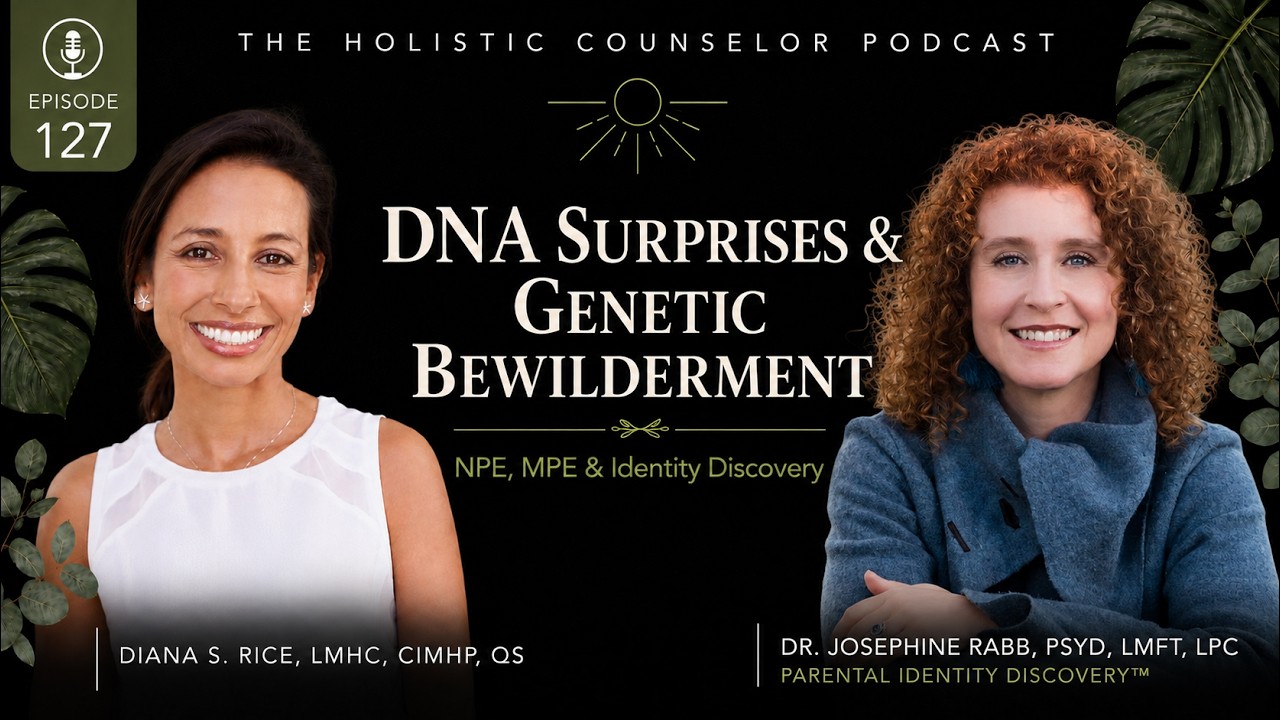
Episode 127
DNA Surprises, NPE/MPE, and Genetic Bewilderment
with Dr. Josephine Rabb
Hosted by Diana S. Rice, LMHC, CIMHP, QS
What happens when a DNA test changes the story you have believed about yourself your entire life? In this deeply personal and professionally rich episode of The Holistic Counselor Podcast, Diana S. Rice, LMHC, CIMHP, sits down with Dr. Josephine Rabb, PsyD,…
Listen to the Episode
Press play when you’re ready.
Educational content only; this podcast is not therapy, diagnosis, or medical care.
About This Conversation
Show notes
What happens when a DNA test changes the story you have believed about yourself your entire life?
In this deeply personal and professionally rich episode of The Holistic Counselor Podcast, Diana S. Rice, LMHC, CIMHP, sits down with Dr. Josephine Rabb, PsyD, LMFT, LPC, a therapist, researcher, professor, speaker, and pioneer in the field of Parental Identity Discovery™.
Together, Diana and Dr. Rabb explore the emotional, relational, cultural, and clinical impact of unexpected DNA discoveries, including NPE, MPE, misattributed parentage, donor conception, late-discovery adoption, family secrets, genetic mirroring, identity trauma, ambiguous loss, and genetic bewilderment.
Diana also shares part of her own recent discovery that, at 54 years old, she learned she is an NPE/MPE. This conversation is for anyone who has received unexpected DNA results, loves someone walking through this kind of discovery, or works clinically with people navigating identity, grief, trauma, family rupture, and belonging.
In this episode, we talk about:-
What NPE and MPE mean, and why "misattributed parentage experience" is often a more inclusive term
-
How a DNA test can disrupt identity, family history, culture, ethnicity, and belonging
-
Why "the person who raised you is still your parent" can feel dismissive, even when it is said with good intentions
-
Genetic bewilderment and the grief of not knowing where you come from
-
Genetic mirroring and the relief of seeing yourself in biological relatives
-
The impact of family secrets, rejection, silence, and delayed truth
-
Why newly discovered relatives may need time to process the shock
-
How boundaries matter on all sides of an unexpected DNA discovery
-
Dr. Rabb's Parental Identity Discovery™ framework
-
Why clinicians need to understand identity, grief, trauma, family systems, adoption research, and ambiguous loss
-
How EMDR, CBT, attachment work, IFS-informed language, narrative work, and family therapy may support healing
-
Why connection, community, and support groups can be essential after an NPE/MPE discovery
"Dad is still your dad, the guy who raised you is still your dad. And that is true, in a lot of ways. And yet, it's one of the more dismissive comments made."
"You have genetic mirroring at that moment. Genetic mirroring, and that's where that sigh of relief comes from, is I see where I belong now."
Exact quotes from Diana:"Who are you if the story you've believed about yourself your entire life suddenly changes."
"Instead of reacting in emotion, I want to respond in wisdom."
Resources mentioned in this episode:Dr. Josephine Rabb's website https://www.jkrabb.com/
Parental Identity Discovery™ / Dr. Rabb's areas of expertise https://www.jkrabb.com/areas-of-expertise
Dr. Rabb's professional development and Parental Identity Discovery™ training information https://www.jkrabb.com/professional-development
Dr. Rabb's resources page https://www.jkrabb.com/resources-1
Sex, Lies & The Truth podcast https://www.sexliesandthetruth.com/
NPE Guide https://www.npeguide.com/
NPE Guide: Guide page https://www.npeguide.com/guide
NPE Network https://www.npenetwork.org/
Netflix documentary: Our Father https://www.netflix.com/title/81227735
CDC: Adverse Childhood Experiences / ACEs https://www.cdc.gov/aces/about/index.html
EMDR International Association / EMDRIA https://www.emdria.org/
Internal Family Systems Institute https://ifs-institute.com/
Closing reflection:An unexpected DNA discovery can shake more than a family tree. It can shake a person's sense of identity, belonging, culture, story, and safety.
But as this episode reminds us, healing does not have to happen in isolation. There is language for this. There are clinicians learning how to help. There are support groups, resources, and people who understand.
And for those walking through this tender and disorienting road: you are not strange, you are not alone, and your story still matters.
Please remember: trust in the Lord, guard your heart, and renew your mind.
Episode transcript
Read the full transcript Close transcript
Automatically generated from YouTube captions. Names and wording may contain errors; listen to the episode for the original conversation.
Hello, hello there fearfully and wonderfully made human and welcome back to the holistic counselor podcast where we explore the intersection of biology, psychology, theology and the lived human experience so we can better understand ourselves. elves, strengthen our relationships, and move toward healing. I'm your host, Diana Rice, licensed mental health counselor, certified integrative mental health professional, and founder of Through the Valley Therapy, and Transform Mind Consulting and Coaching.
I want to begin today's episode with a question. Who are you if the story you've believed about yourself entire life suddenly changes? Not because you changed, not because your memories changed, but because a simple DNA test revealed that one of your biological parents isn't who you thought they were. [cough and clears throat] I know this personally because this past April at 54 years old, I discovered that I am an NP, a non-prernnity event, also known as a misattributed parentage experience.
Since then, I have been trying to make sense of a new biological relatives, unexpected family connections, grief, identity disruption, belonging, and something many people have never heard of before, genetic bewilderment. And in the middle of my own processing, I found the work of today's guest.
Joining me today is Dr. Jodie Clugman Rab. Did I say that right?
Actually, I'm going to correct you. I had a name change and I'll explain why.
Oh, we're going to get in there for sure. A licensed
Go ahead.
Dr. Josephine Rab now.
Okay. Dr. Josephine Rab, a licensed marriage and family therapist, researcher, educator, speaker, and nationally recognized voice in the world of DNA discoveries, identity trauma, unexpected parentage, and genetic bewilderment. Through her lived experience in clinical work, Dr. Rab developed Parental Identity Discovery, a framework that helps individuals, families, and mental health professionals better understand and support those navigating non-prernnity events, misattributed parentage, donor conception, adoption, and other DNA surprises.
She's also the co-host of Sex Lies and the Truth, a podcast with Christina Brian Fitzgibbons, where a therapist and gen g I can never say that word now that it's in my life.
Genealogologist. Uh-huh.
Yes. Investigator share real stories of shocking DNA revelations, including paternity fraud, NPEs, donor conception, and adoption discoveries. I have personally learned so much from that podcast as I've been walking through my own journey. Whether you're an NPE yourself, have experience in unexpected DNA discovery, love someone walking this journey, or you're a helping professional wanting to provide more compassionate, traumainformed care.
I pray that this conversation will leave you feeling more informed, more understood, and more hopeful. And Dr. Rab, thank you so much for being here.
Thank you for having me. I'm thrilled to be here. All right. So, let's start because I love starting with the person that I'm talking to story, right? And so, even before we discuss your professional work, can you take us back to the moment you discovered that you were an NPE and what happened and how did that discovery ultimately shape both your life and your career?
Of course, and honestly, my professional career wouldn't be anything nearly what it is now unless I had this discovery. So, um, it's kind of intertwined now. So, I was raised in a as a single only child of a formerly what she likes to call recovering Catholic Italian heritage mother and a um, reformed Jewish father.
They met and had a colorful story in the early to mid70s in Marin County, California. So, you know, it's kind of at the end of the summer of love. It never really ended for a lot of people in the region and uh there was a lot of sexual exploration.
And it turned out my mom was pretty miserably married to her second husband.
And that fellow we know now had some PTSD from spending two tours in Vietnam, but it was not diagnosed when he came back. So their marriage had crumbled, but because it was her second marriage and she was from a Roman Catholic Italian family, she was not planning on divorcing.
And that makes sense to me. He had decided, I'm going to make the best of a pretty bad situation. And so that meant starting to have multiple marital affairs. And he was doing the same thing on his side. She ended up having multiple affairs and claimed she knew right away that I was one of the affairs product.
Mhm.
Told me when I was 12 that
this is the real story. The guy on your birth certificate who happened to be my husband at the time is really not your father. The man I had had weekly Saturday visits with for 12 years. uh and thought was my father. Not your father.
Your stepfather is really your biological father. He was one of the affair partners and he was the one that she picked. I was great. I actually like my stepfather. He was a wonderful father. He was he was the right man. If you had to choose somebody to be a dad, he was the man.
Uh he was wonderful in all the ways.
The guy on my birth certificate, not so much. And as you might expect with undiagnosed PTSD, he had a lot of trouble.
Yeah.
So I said, "Great, let's let's be done with this guy." I took a DNA test and it was the very first I think it was the first year that they were uh being used for forensic purposes to help prove paternity and things like that.
So it disproved that the man on my birth certificate was my biological father.
Mhm.
Fine. live the rest of my life having changed my name because my stepfather formally adopted me to make it legal that he was my father. So my name went from Jod White Pearson to Jod Leisa Clugman.
Okay.
And everything was great. He unfortunately had a massive heart attack and died when I was 22. And in the process of that, I became much more interested in learning about his side of the family. There was never any discussion, even between my father and I, about what his side of the family was like, family history, etc.
It just never came up. And we were always talking about my mom's side of the family, big Italian family. There's lots of discussion about heritage. And I always thought that's kind of strange. that I'm missing an entire element. So I set out to find more more information and my grandmother wouldn't talk to me about it.
In fact, after he died, that side of the family became more distant.
And they didn't actively say, "We don't want you in our lives." But their actions said it,
right?
So I purchased a 23 andme test with the funds that I inherited from my grandmother when she passed. She didn't like me very much and she gave me $200. And at the time the 23 and me tests were about like 160 something like that.
So it was like all right well if I can't get any information from her I guess I'm going to get it this way. And it told me that I was 50% Scottish and 50% Italian. And I think there was a part of my brain that did not want to register what that meant because I just looked at it quizzically and thought I don't really understand how that's possible.
There's a lot of Frasers showing up in my you are related to column and I thought well that's really different. I I'll have to pay some attention to that at some point. But I had two small kids.
That's it girl. I'm sorry for interrupting but that's what you're talking about. I'm like this is what I'm going through at this moment.
Yeah. I think it was just too much.
Yeah.
You still had to function
comput. Yeah. I still had to parent and I had a private practice and I was trying to be,
you know, a coherent person.
Yes.
And it literally took [clears throat] two years. Two years before it dawned on me like a snap of the finger. Oh, 50% of that has to mean a like a firstdegree relative. Not great at math. I am a great therapist. I am not good at math.
I feel you.
And I looked at my husband and I said, "How long ago did you figure this out?" And he just kind of looked at me and he's like, "I wasn't sure I should say anything."
And he's like, "I'm not even sure it's true."
I said, "I I know it in my bones." So I tell somebody who is doing her own search for her own family, but not from a an MPE perspective. She just wanted to learn more about family history and she had already found an investigative genealogologist.
So, she put me in touch with Christina.
Oh, okay.
Who's my podcast host?
Yeah.
And I sheepishly tell her, "I'm not even sure that this is correct." And I just want somebody to tell me what does this really mean? And without missing a beat, because Christina, she doesn't screw around. She's like, "Yeah, not your dad. And I wonder if your mom is your mom."
And I was like, "Hold on. Uh, I don't think I can handle that."
Turns out my mom is my mom.
Okay, keep us hanging, girls. They keep us.
Um, but we did find that Tim Mloud, the source of the Scottish heritage, was my biological father. She found him in less than two weeks. And uh, in 2017 2016, I met him. knocked on his door because he wouldn't he refused to answer my phone call or my registered mail letter.
And I was like, I can't go the rest of my life without knowing who my dad is. So, at the time, I said to myself, I only need medical information and I and I need to know how this came about. I need to know the progression and if I get nothing else, that's fine.
But I ended up wanting a whole lot more. So, knocked on his door. He pretended he wasn't him. This is by nature of who he is. He's a very secretive fellow and uh he was very hard to to get photos with. He was no blueprint online, no social media presence, nothing.
We found one photo of him in high school. And that's what I showed him after he turned me away the first time. I went back a little bit later that morning and said, "This is you, right? This is your high school yearbook photo.
I know you know my mom. I know you know who I am. And he said, "Okay, come in." And we had a three-hour conversation that by the end of he had asked me, "What do you want out of all of this?" And remember, I had said, "I only want the medical information and to know how I came to be."
And by the end, I was like, "Yeah, I'd like a relationship with you if possible." And that led to my half brother that I didn't even know I had. And as a only child,
yes,
I had a dream growing up of always having a sibling, but especially an older brother.
I also came with a sister-in-law, a nephew, two first cousins, an aunt, an uncle that I didn't get to meet before he passed away, but a kind of a built-in family, and it it has been a really nice journey since then.
Wow. So, I have since learned that my mom when she took her DNA test, she's actually Jewish and didn't know it. So, there's Jewish history now on my maternal side. That was kind of a surprise to everybody. But in the process of all of this, I started to feel, you know, that identity confusion that you mentioned in the intro.
Um, that that started to go away the the more I did my own processing in my own therapy, but also the the more I started working with people uh professionally. I I just understood this so differently. And a lot of them were thinking, I'm going to change my name.
And the whole time I thought, I don't think I'm going to change my name. And then I did. I changed my name. I decided I had regretted hyphenating my married name and my maiden name many many years ago. And I really regretted ever doing that.
So I thought I'm probably going to get I'm going to eliminate the the maiden name. It just it's too much. It's a mouthful. Nobody knows how to pronounce it. None of my students can say it correctly. And uh it's like I think I'm good just with my married name as part of my identity now.
And then I incorporated
um my biological maiden name as a middle name
because that felt right now.
And my mom, even though she named me Jodie, she called me Josephine my entire life. And when she was happy, I was Josephine.
When she was acting out, I was Jodie. So I decided to go with Josephine.
I love that. Oh, no. This makes much sense. Yeah. and and that identity that identity shift, the confusion. I I think I'm still in genetic bewilderment. Thank goodness. Like I found your your stuff and then I also found that NPE guide. I found Yeah.
And and what's so weird is I was off Facebook for a long time for a few years. And after doing a 40-day Lent thing, I went back on Facebook and I'm like, I don't want to go back on this stuff. Now I see why
because I was able to go into some of these NPE Facebook group and sit quietly and watch and learn and and cry and go through it not feeling alone.
Yes.
Because when you're hit and what you were saying Dr. Rab what you just said about like you're sitting with this and you have to continue. You have to move forward. You have to and it's beautiful how the brain or that part because I I practice IFS too.
That part of me has has to still keep it together to do this podcast so I'm not balling at you, you know, crying and being like, "Girl, you get it. You get it."
Well, you're used to it just from being a therapist. We have to compartmentalize our own stuff
no matter what. Um, and I do a lot of work with first responders and talk about compartmentalizing. I think,
yes,
you know, it's part of the job and it it's part of ours as well. And then when you go through a trauma
whatever your job is you start compartmentalizing for the sake of having some normaly throughout the day.
Yeah. It's in a now it's like catching different situations happening like when I
can I share this a pizza story with you real quick just because I think people can learn from this story because it's so fresh.
Um my grandkids are in the pool with my husband everybody and I'm like all right I don't go in the pool. I don't like pools. So, I'm like, I'm going to go get the pizza. So, I go to a pizza shop and I go pick up the pizza.
They say my name.
They say Diane and I'm like, "No, it's Diana." And I said it like with my attitude like I have. And the guy I could tell he's Spanish. This is the first time I just found out what happened. And then I go pick up the pizza and then he's like, "Oh, you speak Spanish."
So, we're speaking Spanish together. I'm excited when I find someone that I could practice my Spanish with. And then he asked where I'm from. Yeah. How do you answer that?
Yeah. So, that is exactly where it hit me, the grief part of the genetic bewilderment. And I want you to talk on that because after I grabbed the pizza and I said, you know, he didn't see me break down. I went into my car and that was the first time I literally broke down because of the news about everything.
Like, I'm not Puerto Rican anymore. What is that? 54 years. because I've been so proud to be a New Rican
and then boom, I'm Cuban. What? Huh? Huh? And then some people, of course, they don't have the understanding and they try to make you, well, it's all Caribbean. It's all the same thing. Like someone telling you you're you're Irish instead of Scottish or English.
You know what I mean? It would be the same. How do you handle that with your clients? Like what is it that you've learned since you're now at this place? Because I'm brand new in this.
I know. And I can hear it in your voice. And it will change. It will get better. It changes as time does, but it changes with the more information you get and the more practice you have. So, what I'll say for your listener's benefit is that it's easy to dismiss the person's pain in front of you mostly because you don't know what to say.
You want to make them feel better and you're uncomfortable with pain, right? We all do it. We all end up saying, "Dad is still your dad. The guy who raised you is still your dad." And that is true in a lot of ways.
And yet, it's one of the more dismissive comments made along the same lines as doesn't matter where you're from nationally, right? It's still the same region, blah blah blah. You're still Spanish speaking, you're still this, you're still that. Okay. So, if I go back to Puerto Rico and I don't feel like I fit in anymore, I feel like an impostor, what am I supposed to do with that?
Right? If you're telling me it doesn't matter, what do I do with that feeling? What do I do when people in Puerto Rico say, "Oh, you're not from here anymore. You don't have this background. You're Cuban. I guess you should go to Cuba."
That's what my grandmother said to me when I got married. And I said, "It's Passover, Grandma. I'd like to do one night with um my family and one night with Ben's family, my husband." She said, "Why? You're married to him now. You You go with his family.
You don't come with us anymore." And she was completely rejecting. So, she knew that I wasn't her granddaughter. And it turns out my stepdad who adopted me also knew.
Wow. And my mom just picked the wrong father because there were so many partners.
She picked the wrong one with quotes that I'm saying. Your listeners might not see that part only because it wasn't the genetic match, but he was the right father in all the other ways.
Mhm.
But what am I supposed to do now to walk the line of I thought I was Jewish and then I wasn't? And that was heartbreaking to feel like I don't belong to this group anymore. And in terms of identity formation, that first starts by what groups we affiliate with.
And the very first group we affiliate with is our family of origin.
And whatever they come with, it's an automatic membership into those other groups, ancestral, and otherwise, religious, cultural, and otherwise. So there are cultural traditions that are distinct amongst every group on the planet. And even though they might share some of the same languages and some of the same histories on some level, doesn't mean all the cultures are the same.
So Puerto Rican culture and the Cuban culture are going to be different.
And there's also the added element for you that, well, I don't fully belong over here and I don't fully belong over here. Which one will have me? Which one will claim me? There's part of that in Jewish culture, right? If I'm not a conservative Orthodox Jew, I'm not Jewish.
If I didn't come from a Jewish mother, I'm not Jewish. Reformed Judaism does not believe that.
They're accepting of however you come, you come. And it turns out because my mom tested with Jewish ancestry that I'm more Jewish now than I was when I started this whole endeavor. So, it was a wild journey, but that matters to people.
It does. that matters to the groups that you affiliate with in a lot of ways.
No, it does. It it matters to a play and it's just and this is the thing too that I'm realizing like I have family from the birth certificate like I that that guide I'm telling you that NPE guide with the vocabulary
very helpful
so helpful to have vocabulary. This is why I love IFS because parts gives you vocabulary of what is happening. This is what I'm trying to get people to understand because I don't know if you know a little bit about my podcast. I'm trying to break stigma in the BIPO community and in churches just because Okay,
you have your work cut out for you.
I do. I do. And and so right now though, understanding like identity because this is about identity and and narrative stories that were raised and put in you. whatever village raised who, you know, you were raised by a village. I was raised by a village.
And that understanding right now, what I'm sitting in, every time I hear genetic bewilderment, I'm like, "Huh?" Like, you know, when you get the aha moments, like you didn't know what you didn't know until you knew it, and you're like, "Oh, now what do I do with this?"
Right? So, I I also have seen some stories out there that are like, "Whoa, this is not as bad as mine." Like, you know, and I don't want to compare.
Yeah. Some of them are heartbreaking.
Some of them I'm like this is worse than the news on on on channel you know on whatever channel because they're people are being so raw of of the pain that they're go or how they found out or just and people don't realize this especially therapists because I had a conversation with other clinicians and they're like what are you talking about and that is why I'm like ah all right Lord is this what you want me
to do I'm I'm going to start letting people know because we have to understand because sometimes what happens in our field, we think we've arrived like you know like we've arrived with all this wisdom and knowledge and now here we're helping everybody else but I'm going
yeah there's still things to learn.
Thank you.
Yeah.
Thank you.
Look, I'm going to validate the 3,000 hours that it takes us to get our license. We have gone through something and it has taken significant time and expense to get there. And as a professor in the field, I see it every semester with the anxiety of my students.
But um yeah, there's always things to learn. It it's not just why we have continuing ed units. It's why we get wiser as we get older. Our lived experience is meaningful.
Yes.
Genetic bewilderment for me started before before I even didn't know who I was. It looked for me like why don't I look like anybody on my dad's side of the family? I don't look like any of them. I am the only redhead on both sides of my family.
Okay, fine. You know, that's sometimes that happens. There is a, you know, genealogical explanation for that on a genetic level. Fine. Uh, recessive genes, right? It can skip generations and then finally as it meets another gene, recessive gene on the other side, now it will express itself.
I I mean there's ways that you talk yourself into believing something. So why don't I look like anybody? I have no mannerisms like them. I have no facial features, no body features. I was looking down to the thumbs like, okay, does my thumb match my grandmother's?
Kind of. Okay. I was looking for anything I could get. And then when I stopped trying because they were very rejecting of me afterwards, I started to feel better. I started to feel, God, I'm putting so much effort into trying to belong to a group that doesn't want me.
Um, there was sadness involved in that. And I finally had to go through the sadness of that. I walked that journey and it was successful grieving. But when I found the new one, it made so much sense. I had gone on a trip to Scotland with my husband.
I think it was 201 13 or maybe it was even 14. And I looked at him when we got there and I said, "I feel so comfortable here.
I don't know what it is about.
I found my people. I found my
and I had no idea. This was before I knew any kind of result from my DNA test." what
I had had a strange interest in Scottish culture and I would say largely British, not knowing really the distinction at the time and uh it just didn't make sense to me. I just thought, okay, I I I've always loved history. I'm a student of history.
Maybe that's why. Oh, no. This was something on a biological DNA level that was speaking to me, that was saying, I know you don't know who you are. I know you don't understand why you don't feel like you belong to this side of the family, but here you belong.
But I just had no context to understand what that meant at the time.
And then it all came crashing down like a big waterfall once I really understood what the DNA results meant. And there was a relief most I I was somewhere in my 40s when I found all this out. And I went through some 40 odd years not really understanding myself.
And even though this was an incredibly painful journey to go through,
I'm so thankful I went through it because I actually understand myself now. I feel comfortable in my own skin, which I may have gotten to anyway, but um only because people, women especially in their midlife after they go through menopause, seem to get there.
But I got there a little earlier.
Mhm.
And I feel like I have a very great foundation to go into the second half of my life with. I know myself now. And because I was relying on EMDR at the time and just all the research I could possibly get my hands on for identity, uh that was helpful and I started marketing how am I going to help people out in the world with this.
Yeah.
Uh [clears throat] that started to help me feel better. like I I get what these people are going through in a way that I still can't understand for people who are going through terminal illnesses, right? That I don't have this experience myself.
I can relate on an empathic human level. I'm going to normalize whatever you're going through, but this I get.
Yeah. And it's it's been helpful to explain not only to other MPEs, but to other clinicians, here's why this matters,
right?
And I was just in Norway doing a a family therapy conference and I gave a presentation on my research. And I I enjoy doing this for so many reasons, but one of them is to watch their faces change throughout the presentation as I'm speaking. not just on the statistics but on all the meaning behind it.
People start to get it after you explain it in a certain way.
Right.
No, seriously, you're a translator. It's so important because listen, some of us uh I feel it within our field is like some people talk to other clinicians, right? And they forget the layman, the the just a regular person that might have a ninth grade reading level and that's okay. and you're able to translate things, but also we're we're people of story.
We're human beings worldwide. We have a connection and but we also have our tribes and I and I I just want to just touch on that because how you described when you went to Scotland and you felt that piece what was happening. This all started in 2020 for me when my what who I thought was my biological halfsister asked me to do DNA after my Puerto Rican aunt passed and then I was like why why but you know 2020 come on worldwide PTSD.
So it was like all right well anyway so here we are. So you do the test like you said earlier you do it and then you see it and you see some strange like connections and you're like yeah I don't got time for this.
Boom boom boom and you're doing life doing life. Well, this past year is why I started I was up in the mountains. I was relaxing a little. I was like curious and then I'm like, "Let me go look." So, I started doing my private eye investigative work.
I find the person who was the closest to me and they're all have the same last name. Girl, I get that. So, I'm sitting there, but they're all younger. Like, I'm like, "Wait, who?" So, I start because Instagram, social media. So, I just started doing I find and I'm going to cry because every time I talk, I'm sorry.
I find
Don't be sorry. You should be crying because it's normal.
I already love you. All right. Anyway, so this kid, he's not a kid. It's his graduation high school picture
and and and it's a senior. He has no clue. Like I haven't talked to him anything, but I find the whole family. I literally found the whole family through this one picture. So you all better be careful what you put out there first of all, you young,
right? Well, anyway, I take the picture and I send it to my son and he's like, "Who's that? He looks exactly like you." I'm like, "That's your first cousin." And that's how I dropped the bomb on my poor son. So, sorry, River.
Well, that was tactful. He's like, "What?" He goes, "This is so cool." Like, because I was raised sort of like my mom's only child. My mom's my mom's Colombian and I'm her only child, but I have this halfsister on the Puerto R certificate.
And talking about names, the S always stood for Santiago for my whole life. Diana S. Rice, Santiago, right? This is why I'm like, uh, you know, it's a glitching. It's like, uh, you're glitching out in the in the computer framework of your brain.
Do I have no right to claim Santiago? Yeah. I feel like I like when people ask me now I'm trying different ways of how to to speak without lying because I don't want to say I'm half Puerto Rican half Colombian like some people in my Puerto Rican family that kind of know a little bit.
I haven't that's another thing. How do you talk to other people in your own family when you finally get the knowledge?
Do you tell them because you don't want to disrupt the whole world. Your your your world has just gotten into an identity hurricane.
Yes. I don't want to be have shrapnels hitting everyone else that I love because I grew up loving some of these humans.
Yeah.
So, what do you do?
So, this is how I I work this out with clients as part of the parental identity discovery curriculum.
Uh I decided there are ways to work with this discovery. We already have all the tools to do this. It's just they're in disperate fields. They're in disperate orientations within our field. So, I decided to combine them. And I said, "Here's what worked for me.
I'm going to manipulate this a little bit and see does this work for most people that are going to come through my practice with this discovery." And it seems to. So, it's a kind of combination of [clears throat] some attachment work, some CBT, cognitive behavioral therapy.
Um, you know, probably over time I'll include a little bit more IFS, [snorts] but uh, you know, EMDR is the other big piece. And then if you are not a practitioner of EMDR because you know frankly it's an expensive proposition to
there's another part of my curriculum that addresses that akin to a kind of psychological first aid.
So on the CBT end of things I do something called an if then action plan. So it's a lot like a flowchart. And I'm a big fan of helping people get things out on paper or a screen alternatively to help make it concrete because if it lives in your mind's eye, it's abstract.
And the longer it lives there, the more distorted it gets.
You can change that by putting it down on paper and making it concrete. You have to see it for what it is. Your brain starts to understand it differently. Mhm.
So we go through a whole if then flowchart diagram about if I choose this option option A what are all the possible outcomes that can come of this if this then that and if this then that until it's logical conclusion and you do that for each option you might have two you might have three or four it depends really on your scenario and those can include things like how are you going to handle the next year of milestones your birthday, holidays of any sort, religious holidays, graduations, what have you.
Think about how you're going to feel about being in the room. You have your family's cultural traditions, expectations, etc., attitudes, all the things that go along with culture and belonging. Some people end up feeling, okay, I tried really hard and I did feel like I could relate a little bit, but I felt like the outsider on some level and I couldn't get rid of that.
And other people just sit in the corner and kind of fester with I don't belong here anymore. I'm a fraud. Uh if they knew, they wouldn't accept me. And for some people, that's true.
And it's easy for us as friends or even other relatives to say, "Oh, no, that won't ever happen. Please don't ever say that to anybody because you don't know how their family is going to respond.
Exactly.
I had a brand new family that I didn't know anything about who welcomed me with open arms. The people I grew up with shut the door
the moment I told my aunt I was searching for my real father. She changed
and she said some hurtful things that I will never be able to forget. Um and I've gone through plenty of therapy. So the the notion that you might not feel like you belong there anymore is real and it's going to take some time to sort out.
And that if then action plan is a way to make sense of can I live with the secret? That's really what you're ultimately asking. Who do I want to tell this to? And under what circumstances can I absolutely not pretend? Mhm.
Cuz there's some way, somewhere in your life, you have to live authentically.
Yes.
Where I think that becomes a toxic stress and you might as well have a very high ACES score at that point.
And I already have a high A score. Dr. And let's explain a little to the audience if they don't know what ACES is. Would you explain it a little please?
Adverse childhood experiences. It it was a Kaiser uh foundation study. Um I think they were under way when I was going through my graduate program. I graduated in 2001 and I it was a longitudinal study mostly with the intent of figuring out how to prevent uh prevent preventable medical issues, right?
Such as diabetes and um uh hypertension and things like this that have long-term health issues and uh chronic health issues. It also has the benefit of being very helpful in the mental health field.
Yes.
Uh that wasn't part of their intention and how they studied it. But uh the benefit is if we know that you have multiple traumas and multiple adverse experiences growing up. We understand how that translates into long-term health as well. Just in the same way that we understand that people with ADHD actually have a shorter life expectancy because of how they engage in their disorder.
So not knowing where you come from and having to pretend that you come from there still belong or you get outright rejected that's another adverse experience. To be rejected from your tribe is a very upsetting and traumatic experience.
Yes. All of this starts to um make your daily life kind of impossible. We're going to start to see other chronic issues coming up. Mood disorders. We're going to see somatic complaints. We're going to see lots of interpersonal problems. So, what I counsel people with is decide what you can live with and what you absolutely can't.
What's your hard no? Mhm.
And then we can work around how to have some boundaries with that hard no uh with the other family members and we can work around what's the fallout, right? We you have a safe place to do that with your therapist,
but we have to get to that place where you understand what you're choosing.
I I have not seen people farewell who have chosen to hide it
and remain hidden. They have a chronic stress and chronic mood disorder that um really starts to erode their functioning and their quality of life that inevitably either it tumbles out in a very hurtful way or it's discovered anyway because as soon as you tell one person, you have no control over that information.
So if you've told one person in your family and you think you've sworn them to secrecy,
I think not. I think you have to be prepared for it to come out one way or the other.
Yeah.
The thing that I'm really enjoying about the work that I'm doing with the MPE population is that they're bringing their families in now.
Wow. So, you do family therapy, not just individual.
Yes.
Okay.
Yes. So, I'm working with them and their parents or them and their siblings.
Wow. And this is the part that I think is the most rewarding because you can have the most lasting uh change by setting up a way for these two perspectives to talk to each other.
Because they get very defensive.
Yeah. Either side.
Well, I mean it's it's a it's fear is is just that like you know false evidence appearing real, right? It's like I think because I've done so much work because I had an high A score, my childhood PTSD, all this stuff, right? I've never honestly felt like I belong.
And I started looking at your slides right before I hopped on here and then I saw that one slide where it said uh 40ome percent got relief and the other percentage I forgot what it was. Do you remember? Do you know what I'm talking about?
Yeah. So this was my first study on the effects of the discovery, this kind of DNA surprise discovery, MPE discovery on identity. I really wanted to understand the impact that it had on identity and create a scientific explanation for people that kept saying, "I don't understand why you don't understand who you are.
You're still who you are. I still see you as you." And I'm like,
"Yes, exactly. That's what I've been hearing there
for I know." Oh, good. Tell it girl, tell it.
Yeah.
Uh, so I I was able to explain that by saying of my respondents, I had a 123 respondents in my study. I thought I was going to get 20 and I ended up getting dozens and dozens more. Um, 40% ended up feeling relief because they came into this with my experience going, I don't understand why I don't belong.
And they felt better. Thank God I understand.
Yeah.
And the other side said, I didn't want this.
I didn't have this question about myself before. They did feel like they belonged.
Their family experience made it possible for them to feel like they belonged. Whatever was unique in their situation, it was positive going in and negative coming out. But it was the inverse for people like me. So the burden kept going for that second group.
Yeah. the burden lessened for those of us who finally got some answers. And then also consequently, the more information people in an MPE discovery get, the better they fare, the better they adjust.
Okay,
so that means I felt like I adjusted great because not only did I have a name, but I got to meet him. I got all the background. I got the medical history and it just kept going. I got to meet family. They were receptive. they were accepting.
I feel like I have a connection to these people now. So, I kept getting more and more information and more and more help. Some people never even get past the discovery stage.
They never get a name.
Wow.
So, imagine knowing this but knowing nothing else about it.
Yeah. Yeah. Now I know that I have this discovery and that I don't belong fully to the side of the family except for the fact that I grew up with these people and they've come to my life events. I've gone to theirs. So there's some connection there, but I don't share the genetic history.
Yeah.
And I'll never know why. I'll never know what my surname is. I'll never know how they came to this country. Imagine never knowing that. That's terrifying.
Well, I'm already crying and that didn't happen to me. But the empathy that I had, I'm wondering if that's from this this dude that's now my biological father side of the family because it wasn't from my mom's side.
Yeah. Right. So, the the more information you get, the better you will adjust.
Yeah. Okay. Right. Makes sense. But I what what when when you're talking about that the other part that made me just tear up. I'm just imagining the adoption people that I worked with in alternative high school, those that have been adopted and they'll never know or just things like that.
Like
Yeah.
Yeah. So, how do you I mean EMDR works wonders. I've done EMDR not for this but for other things. So, I get I'm not an EMDR practitioner though because you're right. It costs a lot of money. um you know NC and CBT, IFS, DBT, I mean all the things that we have learned.
Thank goodness. I I think for me and it I want to know if this happened with you after I saw that picture. I wanted I was looking at a bunch of different pictures from different relatives and I'm so grateful that one relative um answered my Instagram.
Yes.
And we talked for two hours on the phone. You're right. I was so excited. I was so ready to to create a a family reunion. I was so My husband's looking at me going, "You don't know that." You know, he's like going, "Calm down."
He's hearing me talk and I'm excited. I'm c I'm like, you know why? Because I looked at these pictures and we all looked alike. I finally felt at home. You have genetic mirroring at that moment. [sighs]
Genetic mirroring. And that's where that sigh of relief comes from is I see where I belong now.
Now, but the thing is I have five siblings for someone five four brother older brothers and a sister that um we have found out that this sister is outside of the union of the four brothers. So it was
my biological father was married. I mean see and this is the thing I don't want to talk too much. I'm not giving away who it is, but it's still like this is private stuff, too.
So, two brothers know about me, two brothers don't. Um, and can't I cannot believe this. One brother, the oldest one that I look the most alike, lives 20 minutes away from me here. And we were and we were all born in Staten Island, New York.
So, this is both surprising and not surprising, right? And so in the donor conceived community, you'll hear these stories and the concern for these stories more so because if they don't know who their siblings are and the chances are they have all grown up in near proximity to one another, the dating pool becomes problematic. if they don't know who who each other is, especially with these more kind of Celicia stories where the siblings are numbering in the '9s.
Um because and that the background to that is a whole another podcast if you've not seen the movie Our Father on Netflix.
I have.
I recommend it to your
blew my mind,
right? And and that's some of the stories I saw. Yeah. And you don't because I've heard about the sperm donor story of like, you know, you're 19, 20 years old donating your sperm for money and you don't realize this and the next thing you know,
it's not a donation. You get paid for it.
Right. Oh, true, true, true, true.
Yeah.
You're so right. Nonetheless, it's the the adoption community is the foundation for which we are now looking at how to frame, conceptualize, and treat the entire MPE network because they've done the the largest amount of the the research is already there waiting for us to just apply it to our situation.
We all come onto the highway from different uh on-ramps, but we still have the same journey once we get there,
right?
So, yeah, the it's necessary to know in that community who your siblings are because you you might end up dating them. That has not been unheard of.
When I found my father, he was living 40 minutes away from me and for decades. Wow. And and I've grieved the parts like the would a could a should of thing, you know, like the whole of like
you're 20 minutes away, dude.
I'm you don't know me. I'm I'm I think I'm okay person to hang out with. I would love to have a connection now. And and then I have, you know, you know, people going,
you know, he's 60. Why would he even bother? Like, you know, I like why would he start? He doesn't know who you are. So, it's just
right. So, it's just trying to figure out how to move on from this one day at a time.
Yeah. Let me offer another suggestion to the listeners. If this is happening to you and you're the family on the other end of the line that's receiving the phone calls or the letters from the people like us, from the MPEs,
be gentle. If you know you don't want connection, that's fine. You have a right to say, "I don't want this." But be kind about it.
Yeah.
You have a right to say, "I'm confused and I need some time to think about this." Absolutely. The the challenge is that the MPE people like ourselves, like you and me, we've had more time to adjust to the discovery. By the time we contact the new family, they are in the same position we were when we first discovered it.
So it is reasonable for them to have time to catch up. And then I would suggest to those of us that are like the MPs like you and me, take that need and that boundary to your own therapy.
Yes.
And discuss what it means to you to have a a boundary put on by somebody whose family even though you don't know them.
Right.
Right. It feels like a major rejection when they start with their own boundaries. And everybody in everybody in the world has a right to boundaries. Everybody in this situation has a right to boundaries that feel necessary for them. But we need to engage them kindly.
And some people need to hear them more than once. And so you might need to reiterate them. And then if it feels rejecting, bring that to a trusted therapeutic relationship.
I agree 100% because that's what I have to continue to do is to and this is why I think I reached out because I'm like, okay, new information, new wound, you know, new
new opportunities for wounding.
Yeah. And that's and that's too because I I guess I'm a person that's always trying to uh put myself in other people's shoes. This is what the therapeutic alliance is, right? And empathy, right? So, I'm trying to figure out going, "Oh, yeah." You know, I might be a reminder of the pain that that six-year-old boy recognized when daddy was out too much, you know, and I it's just
I mean, I have no idea. Yeah, that's my that's mind reading, but at the same time, it's just me trying to take a step back because instead of reacting in emotion, I want to respond in wisdom.
That's great. And so it's just having that understanding of like the why. This is this is why you know the internal family the parts the the the challenging the thoughts and me doing my own work. So
as we close down close out this episode I just want to know like what would you say to clinicians because that's what I was surprised when I even said I was this is brand new for me. NPE what is this? What do you mean?
And then I started reading your stuff and the parental identity discovery um framework that you created and like the future of this because now I'm thinking the science is getting better of understanding like you now know who's the father side and the mother side and all the things that we're looking for like
groups and where they come from ancest.
Yeah. When I was like
detailed
something Morgan center Morgans and
Morgans. Yeah. Who knew that you needed to know what that meant? Yeah.
[gasps]
Yeah. So, for clinicians, I would say
I have a little bit of frustration with this because this was how it first came to me from other uh NPEs discovering this, saying, "I'm reluctant to even tell you because I've had other therapists diminish my experience." And to that, I'd say, "God, how dare you?
How dare you as clinicians diminish any client's experience that comes to you?" Our training involves meeting clients where they are and understanding that the human experience is wild and varied and you are not going to have gone through everything that every single one of your clients is going to bring to you.
But does that mean you can't empathize? That you can't provide a safe container? You absolutely cannot bring your bias and prejudice into the room. And if you are, then you need to refer out. M.
So, do I feel like you need to be an MP yourself in order to treat other MPEs? No, I do not. Because I can treat other clients that come in for a variety of things. I'm not a police officer, but I treat plenty of law enforcement and fire service, even though I don't do that job, mostly because I have another relative who is retired law enforcement.
So, I understand the relationship there, but I haven't gone through it personally. Um, don't dismiss. Ask them, "What does this mean to you? What is the meaning behind this?" And you will probably need to educate yourself on identity. Yeah,
I am a professor in the same field that I work in, but I'm actually a professor in the same department that I went through for my graduate program. And we had absolutely no education on identity other than Eric Ericson's stages of development and the one mention of identity that comes in one of those stages.
That was it.
And now that I look back on a 20 plus career in private practice as a therapist and I can see how many times I missed connecting with clients but missed the larger picture because I didn't understand how identity was playing a role because now as soon as I bring that in to people who are retiring to people who have lost a loved one and I say has this changed your identity in any way and they go
oh my god I didn't even think of that and I think back to all the the clients that I missed that with before.
So, you will need to educate yourself as a clinician on what identity means.
Yeah.
And all the ways that it shows up. And to do that, I would do some adoption research because identity and research
with adoption kind of go hand in hand. But even if you do a single search on identity, you're going to find a lot. I would um ask people around who have gone through it, what did you need the most? It it might be unique and individual from person to person because we're all not the same people, but
you might see some commonalities, right? It's the the trifecta of the identity, the grief, and the trauma are the big ones. But what did they particularly need from that? Right?
They they might have needed somebody just to say this feels enormous and how are you dealing with this and can I be the person that you come to when you want to get away from it and you don't want to talk about it like tap on me I will be that person for you ask them what they need and then see if you can incorporate that into how you work with your clients and say maybe I need to do more exploration around the meaning that might be more narrative work.
Yeah.
Maybe it's more parts work. Maybe there's more training here for you.
Right. Now, do you have CUS that you have like anywhere that people could
or us clinicians?
I do. Yes. I don't run it regularly.
Okay. But um I do a three-hour training program on the parental identity discovery and how to work with these clients and their
Oh, I would love to. Yeah, that'll be a CEU that I actually need and probably helps me personally along with like if if I ever get clients from
that walk of life because I've had so because you know what it sounds like too to me when I'm when I'm doing because I
I do a cus and I teach about second um generation and one and a half generations because that's where I come from. That's my personal, you know, I just literally did one on Friday for the Brazilian mental health professionals
and they didn't realize like, oh, my kids, cuz some of them are first generation. They don't understand what their their kids are going through being born here, but you're not your parents aren't. Anyway, that's a whole different identity thing. But it is,
but [clears throat] you're talking about ambiguous loss.
Yes.
Ambiguous loss, which is a loss that's just not traditionally recognized, right? We understand that if you're going to get diagnosed with cancer, we understand that loss. If you lose a spouse, we understand that loss,
but this doesn't happen to everyone. So, not everybody gets why it feels like a loss. So, it's ambiguous. And it's the same with the third culture kids we refer to that way where they've got multiple cultures and they don't feel like they belong to any single one.
Yeah. Oh, yeah. We could sit here and talk about a whole bunch of different things that I really appreciate. Any final words or resources or books or anything before we say goodbye?
Oh, there's so many. Um, if you are discovering this about yourself, definitely go on to Facebook. I don't love Facebook anymore and I really don't go on very often.
I know. But the only reason I do are for resources like um the MPE networks that are there because all the groups are on Facebook and like you mentioned you can specifically join them and not participate. It is helpful enough just to observe and feel like oh there are other people out there experiencing this.
I'm not so strange. So uh reach out and find connection because that's how you're going to heal. That's how it's going to get better.
Yeah. Don't do this alone. Don't do it alone.
No, there isn't. But people get embarrassed or they or scared or
pushed by their family to keep it a secret.
Oh, yeah. Well, I'm 54. Tell me. You're right about that thing about being over 50. It's like you're uh your estrogen level goes down. So, that that's a little more of like, you know what? I've done I've done it. I'm I'm tired and I'm just going to speak my truth.
But for those that didn't that that are find like like the stories on the on the Facebook group and stuff, you're right. And then the I'm going to put all this in the show notes. The what you're talking about your website, the NPE guy.
Anything that I found that has been useful for me, I'm going to put that on. Um and is your CEU, how do we find out for the clinicians that are listening? Um
it'll be on my website when it finally when I finally decide when I'll do it.
Okay.
I usually do it once a year. Okay. Oh, so it's not one that you can do on your own, like you download it and pay for it and do on your own.
Three hour webinar. Yeah.
Okay. No, that's that's good. No, we need we need this. I I know I need it. I can't say we need it, but I know some clinicians do because the second I said NPE, they're like, "What are you talking about?" And I'm like, "That means we need to know this stuff."
Maybe that warrants a little explanation because NPE, non-paternal event,
is what it was referred to initially. And that refers to a specific subset of people who have discovered that their parent is not their parent, but particularly their father because it's paternal. It doesn't explain the changes in maternity, right? And there's plenty of that.
Yeah.
It also is confusing. And when I first discovered this and my husband heard the term, he took offense. He's like, you know, even if I didn't raise the kid, it I was required to be there. There was a male present. So, he took offense to that. and a group of us kind of came together and started referred to it referring to it as misattributed parentage experience.
It's more inclusive.
Okay,
it is a little bit more obvious of what it means without having to ask. Right. It's misattributed parentage and it can be either side of the of the chromosome, right? Male or female.
Yeah. Okay. All right. So, I'm changing then. I'm chang. See, I'm growing and learning right in real time. people NPE to MPE.
I'm I'm just going to let people know because if you've listened long enough, you know, the one thing that has kept me sane, Dr. Rob, is my faith. And it's not the religion. It is my identity in Jesus Christ and how I stay focused.
So, I don't go crazy in this in this world. Honestly, that every time I feel all these feels, I go back to my prayer and and back to just like, oh, wait a minute. I'm fearfully and wonderfully made. And so anyway, I really appreciate your time.
Thank you so much for coming on. And for anyone that's listening, please do not forget, trust in the Lord, guard your heart, and renew your mind. Bye. And now for the disclaimer to make sure you understand that you are responsible for you. The content provided on the Holistic Counselor Podcast is for entertainment, informational purposes only, and is not intended as a substitute for professional medical advice, diagnosis, or treatment.
Always seek the advice of your physician or other qualified mental health provider with any questions you may have regarding a medical or mental condition. Never disregard professional medical advice or delay seeking it because of something you have heard on this podcast. The views expressed on this podcast are my personal opinions and do not represent the views of any professional organizations with which I am affiliated.
Call your doctor, 911, or 988 immediately if you have a medical emergency. The Holistic Counselor podcast does not recommend or endorse any specific tests, physicians, products, procedures, opinions, or other information that may be mentioned on the podcast. reliance on any information provided by the holistic counselor podcast, guests appearing on the podcast at the invitation of the holistic counselor podcast or other listeners to the podcast is solely at your own risk.
Confidentiality notice. If you engage with the holistic counselor podcast by commenting or posting and are a client, please be aware that you may be revealing information that could compromise your confidentiality. Please remember that disclosing your identity or personal details can be linked to your clinical material.
As a therapist, I am bound by confidentiality and will not respond to any disclosures of this type on this podcast. I am committed to upholding the ethics and confidentiality of the therapeutic relationship which extends to all forms of communication in accordance with the laws and professional guidelines that govern mental health professionals.
I want you to know that your privacy is of utmost importance and you are responsible for protecting it when interacting on this platform or any other public forum. Thank you.


