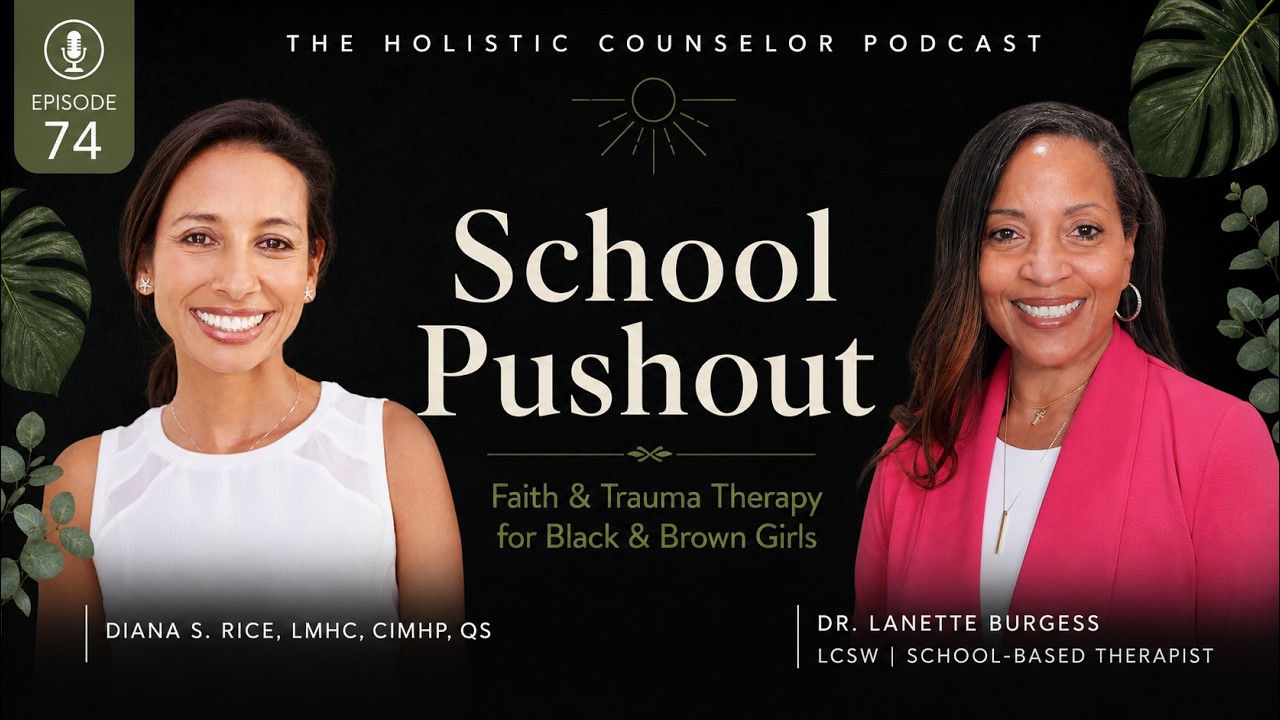
Episode 74
Why Black and Brown Girls Are Being Pushed Out of Schools—And How Faith, Trauma Therapy & Awareness Can Change That
with Dr. LaNette Burgess
Hosted by Diana S. Rice, LMHC, CIMHP, QS
In this powerful episode, Diana sits down with Dr. LaNette Burgess—licensed clinical social worker, school-based therapist, and expert in adolescent mental health—to unpack the unseen struggles of Black and Brown girls navigating school systems, trauma, and…
Listen to the Episode
Press play when you’re ready.
Educational content only; this podcast is not therapy, diagnosis, or medical care.
About This Conversation
Show notes
Jump to a section
In this powerful episode, Diana sits down with Dr. LaNette Burgess—licensed clinical social worker, school-based therapist, and expert in adolescent mental health—to unpack the unseen struggles of Black and Brown girls navigating school systems, trauma, and cultural expectations.
Dr. Burgess shares her journey from witnessing mental illness in a childhood friend's family to becoming a fierce advocate for girls often labeled as "loud," "disruptive," or "aggressive" without acknowledgment of their pain. Together, they explore how bias, adultification, and the myth of the "strong Black woman" fuel cycles of burnout, especially for high-achieving women in faith-based and underserved communities.
They also dive deep into the spiritual and clinical realities of healing, rest, identity, and how to offer real support—whether you're a parent, therapist, teacher, or someone trying to break generational cycles.
Quotes to Remember
"You can only give out of your overflow. If your cup is empty, that's your cue to be still." — Dr. LaNette Burgess
"Many Black and Brown girls are being punished for having a body, not for breaking a rule." — Dr. LaNette Burgess
"We think perfection will lead to peace, but sometimes doing everything 'right' still leaves us feeling lost." — Dr. LaNette Burgess
"I say 'fearfully and wonderfully made' every episode because Psalm 139:14 reminds us of our worth—no matter how the world treats us." — Diana S. Rice
Tools & Resources Mentioned
- Documentary: Pushout: The Criminalization of Black Girls in Schools by Dr. Monique W. Morris
- Tool: Anger Iceberg Worksheet – Free download to explore what's beneath anger
- Study Referenced: Georgetown Law's "Girlhood Interrupted" – The Adultification of Black Girls
- Scripture: Psalm 139:14 and Genesis 16 – "El Roi: The God Who Sees Me"
- Therapy Concept: Adultification Bias, Trauma Responses in Schools, "Martha Syndrome" in Christian Women
Connect with Dr. LaNette Burgess
- Website: embracetherapyinfaith.clientsecure.me
- Email: embracetherapyinfaith@gmail.com
- Licenses: FL, NY, NH, TX
- Accepts major insurance | Offers virtual sessions
- Also on Psychology Today & Alma
Connect with Diana
- Website: throughthevalleytherapy.com
- Instagram: @theholisticcounselorpodcast | @throughthevalleytherapy
Final Word
If you've ever felt unseen, overwhelmed, or stuck in high-functioning survival mode—this episode will speak to your soul. Remember, rest is not laziness. Asking for help is not weakness. And healing begins with awareness.
Listen now, share it with someone who needs this conversation, and subscribe so you don't miss next week's episode.
Support This Work
Each episode takes 3–5 hours to create with care, prayer, and trauma-informed preparation. If you want to support this work and help keep the podcast sponsor-free, you can do so by visiting the merch store. Your purchase helps us continue offering Christ-centered, holistic mental-health conversations to listeners around the world. https://theholisticcounselorpodcast.printful.me/
Episode transcript
Read the full transcript Close transcript
Automatically generated from YouTube captions. Names and wording may contain errors; listen to the episode for the original conversation.
Welcome fearfully and wonderfully made human. I'm your host Diana Rice from Through the Valley Therapy and Transform Mind Consulting and Coaching. If you're new here, I say that phrase every episode as a reminder of your value because it comes straight from Psalm 139:14, which says, "I praise you because I am fearfully and wonderfully made.
Your works are wonderful. I know that full well." Whether you share my Christian faith or not, I say it because I believe every person is created with intention, worth, and dignity. And here on the Holistic Counselor Podcast, we hold space for healing that integrates the mind, body, and soul with room for both science, and spirituality.
Today's episode is one I couldn't wait to bring to you. I met Dr. Lynette Burgess at the United Way conference that I spoke at where she led a session titled Anchored in Hope, the role of Christianity in Healing the Mind. Her insight, presence, and heart for under underserved communities, especially black and brown adolescent girls, was so impactful.
I knew this conversation needed to be shared with you. Dr. Burgess is a licensed clinical social worker and PhD in psychological counseling. She brings over 25 years of experience in education and mental health with a focus on helping high achieving women, teens, and families navigate trauma, burnout, and identity through a culturally sensitive and faithinformed lens.
So whether you're here seeking clarity, encouragement, or practical tools for your healing journey, this episode will speak to you. I hope. Welcome, Lynette, to the show.
Thank you.
Thank. All right. So, of course, I always like to start with the guest story. What led you to become a therapist and how did your faith and cultural identity shape the work you do today?
Ah, yeah. Um I think that there were a couple of things. Um I think my own kind of mental health struggles as a adolescent and um a teenager certainly played a role in that. I definitely struggled with self-esteem um image issues, you know, that led to some depression and anxiety.
And so I think definitely struggling with that uh kind of led me to that trajectory. But I think more than that was a friend's mom who struggled with mental health uh issues. And I was just so fascinated and kind of curious and like where the other kids would kind of make fun of her and I knew that my friend was embarrassed and my friend treated her kind of mean I would say.
Um but I knew it was because she was like ashamed. like her mom would just kind of like walk around the neighborhood and would be talking to herself and would kind of just stop in the middle of the street and be like looking up and it just fascinated me so much.
I was more I had a lot of compassion for her but I also wanted to know what she was thinking like what is going on and so from there I just like psychology was just it for me. I I came out of high school knowing that um at the time I thought I wanted to be a psychologist cuz that's all I knew.
Like I didn't know about any of the other um disciplines. But so yeah, I think it was her mom that kind of
peaked curiosity.
That's it. It's curiosity and you're right on that's happened to me too like or Dr. Burgess. Dr.
Burgette is fine.
Well, it's just you worked hard for that. So to me, I want to respect it, you know, but but I get it. Like that's exactly I remember too middle school. Um just a lot of things I could go back all the way to elementary school with with stuff.
But you're right, like things were happening in my own family and you know wondering why why this the question why constantly like why would someone say that or why would someone do that or why am I feeling this way or why am I highly sensitive and people telling me to stop being a crybaby
you know it was right and so that compassion that led you to go into the psychological route like you know you started focusing more and more on black adolescent girls in education,
right? Um what were the invisible struggles that you saw? Because I know you're from New York, right?
I am. So, actually, um I when I started when I got out of graduate school with my MSW, I went right into working in a school in a school system in New York. Um it was kind of like a different school system. It wasn't New York City school system, but the school was designed to basically take students that New York City basically said they can't service anymore.
That
alter alternative high schools, like alternative schools, like
like an alternative school, these students their behavior or their social and emotional psychiatric issues were just too severe, right? And so we would take referrals and we would um see if they would be a good fit. And at the time I I didn't have like any interests either way, like whether it was boys or girls, it it didn't matter to me.
Um, but I I definitely worked at a lot of different capacities in that school. And one of the things was doing intakes. So I would do the the intakes for the school. And I started to just get curious about first like all of the referrals were like 90% were black or brown students, right?
And these are students that are coming from all over New York City, every neighborhood, every burrow and Long Island. So what's happening? Why are they all black and brown? And then for the girls, the girls population was a lot lower. And we know that boys get referred to special education or I think in Florida called it exceptional students um at a higher rate than than girls.
But what was so interesting to me was that the girls were seen as such a major problem. Some of those classes, the classes were like 12, 12 students, one teacher, one assistant, and yet there were only probably some classes had two girls in them.
Like the referral for girls were were pretty low. They had two classes, some had none, two girls, but the staff were always like, "The girls, the girls, the girls." Even the principal like came to me one day and was like, "You got to do something."
And I was like, "Do what?" And he's like, "I don't know, but I'm tired of hearing people complain and they're saying, you know, that the girls are a problem." And then it kind of tuned me into just listening. And yeah, the staff were like, "The girls are disruptive, the girls are loud, the girls are provocative, the girls are all these things."
And I'm saying, "Two girls in your class. like how could they totally destroy your class? And so I started doing like little I don't know what to do. Okay, I'll do like a little girls group. And that kind of just grew over time and with me listening to their stories and hearing the trauma and understanding why they're showing up the way they are and how these are trauma responses and not necessarily behavior and out of malice.
You know, these are these are survival. This is for their survival. Um, it just God just put it on my heart that like, yeah, these girls need they need somebody. They need they need someone to listen. They need someone to care. They need someone to understand.
And so it just grew. It grew from small groups to just really specific programming for girls um in that school. Um, and I did that for over 20 years. Like just
wow.
And and connecting with different organizations in the community to bring them in. Um, and it just became a passion and on my heart. So, when I relocated to Florida, um, wasn't sure exactly, you know, how that would play out in the school system um, when I came in, but I happened to come across a documentary just, you know, I I say happen stance, but nothing is
No. Right. What was it called?
It was called Push Out.
Okay. And it's by um she Monique Monnique Smalls with a Culver. I've seen Smalls of Cverson. But it was all about the disparities in education across the country for black and brown girls. And when I seen that documentary, it just was like, oh my gosh, this is like a thing.
This is not like the school I was in, the school system I was in. this is an issue across all states and in all schools. Um, and so it just really resonated with me and I was glad that I found that resource and it just validated some of the stories that I heard and things that the girls were saying cuz this is girls in other states and other parts of the country.
Um,
so so let's go there for a second because what was the disparity that you were seeing along state line, you know, across state lines? What were the things that you're like, oh, you know, the aha moments of that documentary or your research? Yeah.
So, one of the things that the research, you know, just basically is blatant is that girls, uh, black and brown girls are referred at much much higher rates to, um, being suspended, being expelled, uh, to law enforcement, and there for things that other girls are not getting referred to.
Other girls are getting phone calls. Other girls are getting detention. Other girls are getting, you know, spoken to. Uh but black and brown girls, the treatment is so much harsher and so much more severe, which creates this push out, right? So the more that you are expelling girls, the more that you're you're suspending them, the more that you are any contact with law enforcement is never a good thing.
And it shouldn't be done when it's for a dress code violation or it's because of their a bad attitude. Like that's not a reason to refer somebody to SRO, right?
Yeah.
And so the more that, you know, uh I started to notice that, oh yeah, these girls are um they're getting this harsh treatment. But I I couldn't understand why. And then I came across another study and this study was done by Georgetown University and this study spoke to a phenomenon called adultification and I don't know if you're familiar with that.
I kind of Yeah. Let's let's tell our audience though.
Yeah. So adultification is a phenomenon that specifically is seen with dealing with black girls and that's where adults view the girls as being older than what they are. Right? And so you're looking at an 8-year-old but you're not seeing an 8-year-old. You're looking at a 12-y old, you're not seeing a 12-y old.
You're looking at a 15y old and you're not seeing a 15y old. And the problem and the danger with that is if you remove who they really are and the age that they really are, then you're removing the nurturing that you would give to that student.
You're removing the care, the compassion. You're removing the safety because you're looking at a 8-year-old, you think she's older, and so you're not addressing her and engaging her as a 8-year-old little girl, right? So, she's not allowed to make the mistakes that an 8-year-old would make cuz you don't see her as an 8-year-old.
And this study just revealed that this happens time and time again. And black girls and brown girls say that they're often told, "You should know better," or, "You shouldn't be acting like that." Um, they're often told things like, "You're being too loud. you're being too aggressive.
You're um just the way they present is seen as always a behavior, always a problem. And um
and then you put wait and then you have that and then you put on top the unhealed humans raising them, right? and in that situation where it's like they don't have the mindset or the tool set to have good communication skills or you know so then it becomes like what's wrong with you?
I mean, I've I've seen it time and time again within my community and at the school system because I've worked, right? It's like like and it's just like so much hypervigilance
and these and these young girls sometimes are passing puberty at like nine they have women bodies like that's another thing. Well, that is that's actually another thing that came out in in my research is that so a lot of times black and brown girls are referred to disciplinary actions because of dress codes, right?
But here's the thing. When we are doing a dress code violation, I'm all for you need to come to school appropriate,
but we have to be sure that if I am saying to Samantha that what she has on is inappropriate, then I got to be saying to Diana, it's inappropriate. And what happens is that with black and brown girls, because they could tend to be shaped differently, they're shaped, they're fuller, they have fuller figures, that it's not actually the clothes that you are deeming as inappropriate, it's the body.
And so if you and I come to school dressed the same, we're being twinsies, and I'm the one who's getting sent and you need to go change and you got to go put on something, and I'm looking at Diana, my friend, and we have on the exact same thing cuz we bought it together, then what?
In fact, I'm hearing is that my body is inappropriate.
That's not okay.
Yeah. And I saw that so many times, Lynette. And I mean, I I think that's why I have people say I have some kind of masculine energy because I was always this tiny little thing.
I'm still trying to pass puberty honestly because I was and I am grateful because what I did see what I did see is these other girls being and I'm going you know it was confusing as a little girl looking at that going and then it did something like oh okay well I have no boobs no butt.
It's like all right but a girl that does this is how they get treated.
Mhm.
And I would get really like uncomfortable and angry about that and I'm like wait that's no fair. And I remember so how many times I had to say that's not fair in my head. I couldn't say it out loud because I didn't want to get reprimanded or beat down or whatever it is.
But I'm sitting there going, "Wait, what?" And so in your research, like I mean this makes sense with with with what I'm now like you're putting it in words where I'm like, "Oh yeah, you're giving me aha moments in the midst of our conversation."
Like, "Wow, I did not know that." Um, so what else with your research? You know, you you're what was the name of your dissertation?
So my dissertation was creating safe spaces for black girls in education.
Oh wow. Okay. Wow.
And so what I did was I developed a curriculum basically like a a webinar or a workshop um for staff for students uh not for students for staff for for teachers for mental health staff for admin um anybody in the school system um to just kind of educate them on working with black girls um some of the you know the trauma responses that we see right because I think we do a good job of helping staff um understand and look for, you know, things that are like for depression, right?
If a student comes in a classroom and they're disengaged or their head is down or they look disheveled, you know, you should say something, you should alert somebody. But there are so many nuances that we are not educating staff on, right? And so not all students show up the same way if they're depressed.
No. And one of the things that I found in my research with black and brown girls is that a lot of times irritability shows up and that's a key fact of depression.
Yeah.
But it's viewed as destructive. It's viewed as just a bad attitude. It's viewed as just trying. It's almost like intentionally they're trying to be disrespectful.
Right? And what I notice is that a lot of times um happens more with men but sometimes it happens with women is that when the students up here
the staff go here because the staff are not even able to regulate their own emotions.
Exactly. And they're protecting themselves and
match that energy and that is
exactly.
No, I saw it. I mean I mean I worked at the alternative high schools. I that's what they would bring me. I was a crisis intervention counselor and they would be like, "Let's deescalate, Miss Rice. Miss Rice, you know what? The what? We need to deescalate.
And it's like teaching the staff how not to take it personal.
Okay. How how to recognize your own stuff. And I And I get it because if you feel like you're being pushed into a corner,
Absolutely.
and and you have a high adverse childhood experience score, right? and you're hypervigilant already going into the school.
Mhm.
And you're not feeling safe. And let alone not only that, but then the way schools are that bright light, the the walls coming in on you, not enough nature and breath and and healthy foods. So, you're like on, you are hypervigilant. You're on.
Your brain's on fire and all it's trying to do is survive and protect itself.
Okay. And so, so tell me about what your curriculum is about. But I'm curious like are you still using it? How can I help you get it out there more? Because honestly, we need,
you know, with with what we're dealing with now, you know, um it's it's a little challenging to be honest. It's it's challenging. Um I was able to present um a couple of times already, which I was so grateful for, and the feedback was phenomenal.
So, I'm really happy and excited about that. Um yeah, it definitely it's it's geared towards schools, but actually with my chair um when I was doing uh my doctoral program, they were like, "You can tweak this for for for churches. You can tweak this for so many other different even mental health staff who, you know, they're not aware that when a student is referred to them um for a behavior issue, right, a girl that that irritability, you better be looking at depression.
You like don't look for sad and down and not hanging out. You look for that prickly everything bothers them, everything is a problem, everything. Because that's that's depression. That's the problem. Do you do you because I know what one tool that I loved and that was free because that's another thing.
If we're working with some of these populations, they do not have the money and resources to send them to a, you know, a nice $250 place to, you know, uh, to get the the therapy or horse therapy or equin. I mean, stuff like that.
Like, you know, it is what it is. And I'm not putting that down either because you know we're all here to try to help the human being no matter where you're coming from and no matter what color God made you. So So for that the anger iceberg from and if if not I'm going to put that in the show notes people so you'll have at least one tool to to print out but it's called the anger iceberg and I that tool to me when
is that the one where you see underneath like
Yes. And I would just have them highlight or I would read to them because some of them couldn't read. And that's another frustration that I that I saw, Lynette, like like in the middle school when I used to work in um for Friends of Children and they would put me into all the North Broward County schools as a therap I had clients in every one of those schools.
I realized I'll never forget when this 13-year-old boy was like, I rather be known as a gang member than because he couldn't read
than stupid. And that shifted my entire perspective to a place where I was like, "Oh my gosh, I learned so much with with these students." Like, this is why I love these teenagers so much. No matter what they they've they've thrown stuff at me.
They call me FNB. I mean, they call me all these names. But I I think it was the Lord honestly that protected me and put me in those spaces and places. So now here we are
with the understanding and I can actually speak about it and with love to teach others because how many times have I heard well they just got a chip on their shoulder
I'm like yeah well if you understood what's happening in their science wise in their brain and body you know if their foods are not healthy foods because they can't afford the health I mean I could go into a rabbit hole with you right now.
Yeah. And here's the thing, right? I I don't think for the most part staff go into education with the intent of of triggering and retraumatizing, right? They're not doing this,
but it's happening. And so we have to be aware of how can we push uh our relationships with these students forward because we know that the number one factor in uh a child's success is connectedness to the school.
Yes. I said that before we went on. Remember I said it was even though Brower County Schools some people have a lot of bad things to say. I have to say my experience was where I felt the safest.
Right. Exactly. So imagine what everything that was going on with you in your home and then coming and having to spend seven hours in a place that you didn't feel safe and didn't feel connected.
Oh no, you're going to get me to cry now.
Yeah. And I'm I'm That's That's what we want. We want our students to come in and feel safe and feel connected and feel loved on. Right. Because when they walk out of those doors, we have no idea what's going on.
And they're being fed. I mean, and not fed, just with food. Fed,
right.
Right. With love, with with spirit, with with um protection. And it is it's something. Oh my gosh. Whoa. Sorry, guys. Um
Absolutely.
Yeah. Like I'm glad my empathy is not totally gone. No, you you lived it and you and then you came back and you were there and you saw it again. But you know, a lot of for a lot of students and again I'll just talk about the girls like they're coming into a building and not only do they not feel connected, but sometimes physically they're not safe.
Their bodies are not safe.
Right.
Right. How many girls are getting groped walking through the hallways and that's under the carpet? That's like not me. It's not a big deal.
Boys will be boys.
Boys will be boys. And and even some of the girls like, you know, in their home, they're kind of told like just, you know, change your route to the class or just, you know, try and get through or just, you know, push through, right?
That's what girls are taught.
So, especially us black and brown girls are taught not only at home, hey, toughen up, push through. This is life. This is this is how it is,
right? We don't have the luxury to, you know, be wallowing and and and talking about all this feeling stuff. It's like, no, like you got a job to do. You got to finish school. You got to, you know, get an education. You you and it's this push push push.
And it's not terrible, but it has to be kind of counteracted with
love and compassion and listening. As adults, we do such a bad job of listening because we want to immediately, you know, show them something different or give them a different perspective or tell them why what they're feeling is not that's not right and she didn't mean that and well, this is what they're trying to do and just or we direct the conversation back to their academics, right?
A student comes to you about a breakup. In some way in that conversation, you're talking to them now about their math grade. Why?
Well, the thing is too though, that's one thing I realized being in the school system, um, you know, guidance counselors that I've met and spoken with many or social workers too because I'm mc, right? So, I the reason I was able to work in the school system was because of all my internship and everything was in a school like they placed me in the school.
So, I was able to like have the dual thing. But what I realize is they go in to want to do the counseling like we do in private practice. They want to be there with the student and then they realize no it's more about the red tape and the okay 5 seconds or the 10 minutes you got elementary school I hear is a little different because you you know but what middle and then high school forget it because you have one counselor for how many students?
Yeah. and they're not able to do and and and they get burnt out because it's more about their grades passing scheduling um you know and so that's a frustrating part. I think things shifted after the Parkland shooting in Florida I don't know if the whole country but I can only speak to my county.
Um you ca when did you come to the Ber County school system?
I started in I started the week we shut down. I started that Monday and schools closed Friday. So that was what 2020. That was March of 2020.
Wow.
Yep. I started Monday and Friday I got a a email saying, "Don't come Monday. We're not sure what we're doing." And Yeah.
Yeah. And that's the thing. I don't think anybody was sure what we were uh that was what anybody was doing. I think we were all we were all guinea pigs in world and that's the other thing these students are coming out of a pandemic
a pandemic where they didn't go to school for a year a year and a half
and got addicted to the to the devices
all right I mean not that they weren't addicted before but this that situ and trying to find truth and going into the social I mean there's so much but you know we could sit here and talk about all the issues and problems but I think we're going to shift the the the conversation now to go into the hope the tools because if a teacher's listening or a guidance counselor or a parent or even a student,
right? Like what what is it that you like how do you start with that? Like if you're going into a group or with your curriculum, what what's the first thing to get people to understand and give them that hope?
So the first thing is always just awareness, right? and being open to accepting things about yourself. Right? So when we're talking about biases and how we look the there's nothing a bias is something that your brain does kind of automatically. So when we're teaching people about being aware of your biases, sometimes they take it very like they get defensive like like I don't do that.
Our brain does it automatically. And if you keep denying that your brain is putting students in certain categories as soon as you see them, then you're not going to be aware enough to kind of work through that. So the first thing is awareness, right?
And it happens to all of us. If I had a bad experience with a particular student and then another student comes in front of me who kind of my brain says that's the same student,
I'm going to probably engage with that student in the same way. So just being aware that our brain does that automatically. And the more that we're aware of, the more that we can kind of counteract that and see everybody as an individual,
right?
Um trying to slow down when you can. Like you said, everything is very fast-paced and it's about this, this, and this when you can slow down. Um, and try and build those connections.
How Let's let's let's give them a couple of tools because I know you know how to teach that. like how do we get our clients to slow down or or our students that we work for? I mean to me like I work for them in a way because they you know it's first of all they're hiring me to do something right and so what what's what are one or two things that you actually help your your teenage girls to slow down with?
Yeah. So, I actually started um we started doing some groups in um in the high school that I'm based out of. And it's it was a great experience. This was actually the first year that we started doing them.
And the first thing that we do is that we invite them in, right, to see if they're interested in being part of this kind of uh we didn't really even name it. we said like a girls group but like what do you want it to be kind of thing and so to me that was very important for them to take ownership to tell me like I know what kind of topics I want to do but what
do you think you need help with what do you think what are you struggling with and so that's how we started we started with hey um let's come up with a bunch of things that you guys want us as myself and another social worker what do you want us to kind of help you with what do you need support in what do you need guidance in?
And they would give us they gave us a couple of things and then we said, "Oh, well, would you like to learn about uh you know, problem solving? Would you like to learn about managing stress?" Oh, yeah. Yeah. Yeah. We're really stressed out.
And people don't realize how they think that, you know, cuz we're teenagers, we don't have stress. And these kids are stressed.
Yes. And very intelligent. Like they That's what
very self-aware. teenagers are that's why I love working with them. They're so aware.
Um and so I think that's one of the first things that I would say is to collaborate.
Get them to kind of join in on
what you're trying to do as opposed to us just implementing something, right?
We need to do this or we're going to do this and we don't get their feedback and we don't get their input and so they don't get connected to it because it's something that we came up with. So cooperation I think is very really really important.
What I'm hearing as you're speaking and talking about what you do it's to me it's it's respect
you because that's what's missing a lot with teenagers. They don't feel respected. And of course and then now they're like getting big. They become stronger than the older people, right? And they're just like, you know what? I'm tired. Like I go from trusting the adults to realizing these adults are like got they're a mess themselves and they're telling us what to do.
I mean these and so it's like a respect. So the collaboration I hear is like you're teaching them to be respectful to themselves and to each other and that and that they are worth something that they count.
You count. You matter. I see.
Right. Um, another thing I would say, especially with black and brown girls, is it's okay to ask for help because black women, black girls, they're they're not they're not raised they're not socialized to ask for help. They're raised to help.
We especially if you're a Christian, you're raised, right, to be the hands and the feet of Jesus. You're raised to do all the things and jump in and be all the things. And you don't you don't ask for help because you are helping.
You're you're helping. So teaching the girls that you can ask for help. You're allowed to ask for help. You don't have to figure this out on your own. And even if it's something that you that other people think is not important, it's silly, right?
A relationship, a friendship. I think it's important. I think you breaking up with a friendship or you having a fight with a friend because that's
it hurts,
right? And it's going to impact your functioning,
right? and and your education, right? So, we're we're really concerned about educ education. So, we got to address the things that matter to them and that kind of creates barriers for them, right?
Yeah. Yeah. No, I I remember where some student I'll never Okay, this this student I'm not going to name boy or girl, but he was Oh, now I just said it. He But he was a a young black man, but he was known in the streets as one of the biggest uh gang members and drug dealer, right?
And so the thing is like I gave him a safe space and he would come in sometimes in my office and would sometimes pass out and he was in juvie in and out in juvie since third grade and we haven't even touched that pipeline yet.
But uh yeah uh but anyway, long story short, it's it's I gave him respect enough and because I I didn't go in there with his thick folder of stuff because that's another thing that happens in our systems is that the folders passed on to passed on. they already have um a belief whoever gets the folder and and and it's understand like no to me to me it was my Christian faith that's like no you're everything's wiped
clean right now with me I right and I want to know you what would like what led so the respect and the understanding and and and also you got to check your own fear as an adult working with young people
that you know what that came up a lot with with girls and even in the documentary that they kind of laughed and they were like oh yeah some of the teachers are afraid of us and they would laugh because it was weird to them like why are you scared of me
and so you know when you operate out of fear right
exactly
not going to be a good connection or relation
no and so that fear I think we need to talk about that that false evidence appearing Right. I know. I could tell that you're teaching girls and everybody around you that um it's like you got to face everything in rise. I love I don't know who taught me that a long long time ago, but I say it all the time.
So, it's not my quote people. I'm not taking ownership, but I use it. Yeah. Face you either. It's either false evidence appearing real and that's how you act or you face everything in rise. And to me, like you were just talking about like the pressure on black and brown girls and how we're taught to uh be helpers and not ask for help.
I was like, "Oo, that and it's right because it is taught in many of our cultures that asking for help is a form of weakness and we can't be weak because the world's going to get us and the white man's going to bring us down."
And I remember all that too. And you know and I and I have to say now that I said that like no I don't think that way because I did the work I educated myself and understand that human beings dis no matter where they're coming from I try to look at the intention of the heart.
Okay. So be saying that because sometimes my white friends or my husband who's white will be like honey why you you know it's bad enough people think that I'm like and I'm like no because they are not let them get to know you but anyway because I want to break stigma in all avenues.
So with fear and all that you were just saying and in the churches sometimes what happens we become Martha.
Mhm.
Okay. And and many people don't I I had to do and I still do work with therapy because I have that that type a Martha
somebody was talking about that didn't know me. They're like, "You have a lot of masculine energy." And I'm like, "Oo, I know where that's coming from." But it isn't, it is, you know, it is a lot to how we were raised. Like, toughen up.
You got to be tough in this world. Like, don't let nobody don't let nobody, you know,
right,
mess with you,
right?
And so, I've had to learn to balance that. And I know you know what I'm talking about.
Yeah, definitely. you know, with with and that that whole like kind of like Martha syndrome. It's like always doing, always needing to be busy, always needing to it's like the striving of, you know, more degrees and and you're in all the ministries and you're just doing all the things.
And unfortunately, that leads to burnout. That leads to exhaustion. Not only physically, mentally, spiritually, you just you can end up so broken because I've been pouring and pouring and pouring. And no one's ever taught you that you can only give out of your overflow.
You can't if your cup is not there, then that's a time for you to pull back. That's a time for you to say, "Wait a minute." Right? Um I need to be still. And I think that we undervalue stillness and we undervalue solitude.
Um because you need to be out there, you need to be doing, you need to be busy is like connected to some kind of value and worth. If you're booked and busy, you're you're somehow more valuable than someone who's not. Um and productivity, right?
If you are productive,
that means that you're constantly moving, right? That's taught that if you're sitting still and you're you're
chillaxing, you're not being productive.
You're lazy,
right? But rest. Rest is biblical. Rest, you know, if you want to go that route or if you just want to go strictly clinical,
rest is one of the most important things I talk to my clients about because if your sleeping is not where it needs to be, your your everything else is off.
Yep.
Everything else is going to be um impacted by poor sleep.
Right. And and now that you're saying sleep, this is what comes to me with the rest and the sleep. I've I've learned as well from my clients that sometimes they are in Martha mode or overproductivity. Not only because they're taught that because in the stillness all the feelings and emotion and past trauma start coming up and they're trying to push it down and push it down.
So guess what? How am I going to push it down? I'm going to work work work. If not, I'm going to drink drink drink. If not, I'm going to do this this this. And and honestly, we have to get to that place to let it come out
and heal it. Get it out of the sub. And that's why sleep is important because guess what? It's still And if you're not having good sleep, that must be your body trying to tell you something and you must listen to it.
Right. Right. It's like we I heard a a doctor and she's she specializes in sleep and she said that um how we get it wrong like we work our sleep around our day, right? How many hours we get depends on what we have to do and how much we have to get done and it has to be the opposite.
We have to set our sleep and how much you need, how much you require and then everything else goes around that. So I require more sleep than most people. I require 8 to nine and most people think that's a lot nine hours but I have to get everything that's why remember I told you at that United Way conference I didn't sleep and I was I was not good
well man I need to go to another one of your workshops when you are because I was impressed that's why you're here
I still have like I still have bad feelings about it because I know that I didn't show up um the way that I wanted to and so that that, you know, that's my own work having to release that because things don't always go as planned.
No, exactly. And honestly, I think that's a lesson for the Martha part of you because you did show up and we have to remember because we are women of faith. Um, we're only vessels and the Lord used. Okay? Because I saw I didn't know you, Lynette.
I did I know I did not know who you are. I just mentioned I I I went up to you after you you were done. I would have never known. I would have never known. And you know what I love is that you just share that vulnerability.
So for whoever is listening and understand this is a strong woman who had a strong presentation and she just was vulnerable and that's something to be taught as well, especially in our black and brown community.
Yeah.
Right. So before we end our episode together, I don't want it to end and I know we probably could talk about a thousand other things. Um, I just want to give you time to talk to the audience and whatever is coming up in your heart.
If it's Bible verses, it's encouragement, just how, what, where, I don't know, whatever is coming up for you, like what would you say to a woman listening right now who feels invisible, overwhelmed, or like she's doing everything right, but still feels really lost?
Yeah. Yeah. I think that that's that's misleading. That idea that I'm I'm going to do everything right, that perfectionism and that that somehow is going to be connected to peace or joy. You can do everything right. You can check all the boxes and not experience joy, not experience peace, not experience clarity.
Right? So, so that's one thing that we have to get to the root of perfectionism, get to the root of people pleasing, right? And that might mean going back and doing some psychoanalytic work to where that started and and how that develop, right?
Because those things develop. Those things are either you learn or you you're taught that or you adapt that because of a response to your environment. And so I learned that I need to perfection is a way to keep me safe or people pleasing by fawn, you know, always saying yes and being agreeable.
I I'm able to keep safe and I keep the smoke off of me in the heat. And so now I'm 40 and I'm still doing that and it's not me, right? And so now I'm finding myself feeling like what is this all about?
I mean
um when I hear someone saying that they're los when I experienced feeling like unseen or lost, I love going to the story of Hagar in Genesis because she ran off, you know, she escaped. I believe it was Sarah who was treating her really poorly and need and she ran like into the wilderness and then God spoke to her and she actually refers to God as the God who sees me. she I believe it's pronounced Elro Hei.
She calls him um the God who sees me. And it was so profound the first time I came across that and it was so like divinely driven for me to see it right at a time where I was feeling unseen. And the thing that stickked out to me with that story is that not only did God tell her that he sees her, but he sent her back.
So he didn't remove her from the situation. So sometimes when we're in these seasons of our lives, we just want to be out of it.
Yeah.
We have to remember that there's purpose in them all. Wilderness seasons we all hate, right? Purpose in them.
Pruning season we hate. We feel like things are being pulled away from us.
Um growth seasons, even a growth season where you're being stretched to do certain things or show up in certain ways that feel like oh so uncomfortable. I think just anchoring in it and knowing that this season is not for nothing. This is a season that God has you in for a purpose for something to come, right?
He's either stretching you or he's pulling things away from you or he has you separated in this wilderness by yourself. And that's a time to anchor and do this, right? Go this way
and not look this way.
That's it. time that we have to go this way because that's that's just me and God in the sea.
Yeah.
Right. Um so yeah, I I would just say just know that God does see you. Keep keep anchoring, keep hope.
Yeah.
It's being in the word, right? And and to me it's it's really important to understand who you are,
especially in Christ. like even if you're not a Christian like learn because what happens is many people see Christianity through the lens of the person claiming the name
right
and what I tell my clients who come that are curious or learning to disentangle their faith because of a lot of religious trauma
is to understand that's why I always start with Psalm 139 which I quoted in the beginning right it's yes all the way to the end because at the very end of Psalm 139 N it says, "Search my heart, oh God, and know my anxious thoughts."
Okay? And and being still. And when those things come up, people, this is where you write it out, journal it out, find a therapist that understands. I mean, so let's talk about that, Lynette. Are you seeing clients now?
I do. I do see clients. I have a small a small practice. I see clients only virtually uh here in Florida and Texas, New York, and New Hampshire.
Oh my god. Okay. Wait, we need to name all those license because if there's a listener is like, I want to work with Lynette. All right. So, you said Florida.
Yeah. New Hampshire.
New Hampshire.
New York and Texas.
Okay.
See clients virtually.
Okay.
And I do accept um an amazing insurance. Um
I love that. So, she accepts insurance. Can she Can they find this on your website?
Come on. Yeah. Embrace Therapy and Faith is the name of my company. Um I'm on Psychology Today. You can find me through Alma and I work with uh girls um from the ages of 13 and older.
Good to know.
Yeah. If they can, you know, if they can navigate a virtual sessions for some some even some adults, virtual is not. So, if you if you um are able to do virtual and you think that it works for you and it you don't it doesn't necessarily have to be Christian.
I have, you know, clients who um are not Christian and still we still talk about identity and we still talk about separating what you do from who you are.
Oh, I love that.
When you entangle what you do with who you are,
Yeah. that that becomes a problem. That Yeah. Right. So there's a lot of things we can work through and doesn't necessarily I mean my world view is a Christian worldview. I
Yeah, mine too.
Never, you know, I never but it's not imposed.
No.
And unless
it's it's if you want it like I know with me um you know people come and and I'm like do you want a faith component or not? If not if you want if you want the science part of my brain I'll do that.
You know like I know that's our training. It's like I I'm not coming in as a person that's going to, you know, that's that's the thing that when they're disentangling that's like, well, I was told I'm going to hell and I'm like, well, where did you find that?
Because to me, it's about asking questions, not telling them what to do.
Yeah. And even and even when you're not, right? Even when you're doing just a clinical and secular, those are questions that you're going to ask. Who who told you that? Where did you learn that? Right. when they tell you things that just are not in alignment and and maybe untrue, you want them to kind of figure out where'd you learn that or who told you that from, right?
Because it's all about reflecting and and recognizing like certain patterns and attachments and where these things come from so that you can show up different.
That's it. Yeah. And learn that, you know, how to reframe. I mean, this is what you know, this is the tools that we have spent years and years and years and years sharpening in order to help the human that comes to us. So, well, Lynette, thank you so much for coming here.
I love this conversation with you. It's because I feel like we're sisters.
We definitely are.
Wait, wait. From the same mister.
Yes, I'm corny. I'm very corny.
They are. And it was it's it's I'm so I'm just so honored that God um allowed us to connect and um I definitely feel like it was an answered prayer cuz I was looking for community and you introduced me to a community um that I love.
Yeah. Good. Good. I can't wait to like hang out in person. So anytime there's something I always send it to the group and and she's talking about the Christian mental health professionals that we have here in um Bratwell in South Florida. And I think actually we have people from Georgia and everything.
It's just a growing community which I love a lot. I've learned a lot from them. Anyway, Lynette, you have a great day. And for my listeners, please, please, please remember to trust in the Lord, guard your heart, and renew your mind. Bye. And now for the disclaimer to make sure you understand that you are responsible for you.
The content provided on the holistic counselor podcast is for entertainment,formational purposes only and is not intended as a substitute for professional medical advice, diagnosis, or treatment. Always seek the advice of your physician or other qualified mental health provider with any questions you may have regarding a medical or mental condition.
Never disregard professional medical advice or delay seeking it because of something you have heard on this podcast. The views expressed on this podcast are my personal opinions and do not represent the views of any professional organizations with which I am affiliated. Call your doctor, 911, or 988 immediately if you have a medical emergency.
The Holistic Counselor podcast does not recommend or endorse any specific tests, physicians, products, procedures, opinions, or other information that may be mentioned on the podcast. Reliance on any information provided by the Holistic Counselor Podcast, guests appearing on the podcast at the invitation of the Holistic Counselor Podcast or other listeners to the podcast is solely at your own risk.
Confidentiality notice. If you engage with the holistic counselor podcast by commenting or posting and are a client, please be aware that you may be revealing information that could compromise your confidentiality. Please remember that disclosing your identity or personal details can be linked to your clinical material.
As a therapist, I am bound by confidentiality and will not respond to any disclosures of this type on this podcast. I am committed to upholding the ethics and confidentiality of the therapeutic relationship which extends to all forms of communication in accordance with the laws and professional guidelines that govern mental health professionals.
I want you to know that your privacy is of utmost importance and you are responsible for protecting it when interacting on this platform or any other public forum. Thank you.