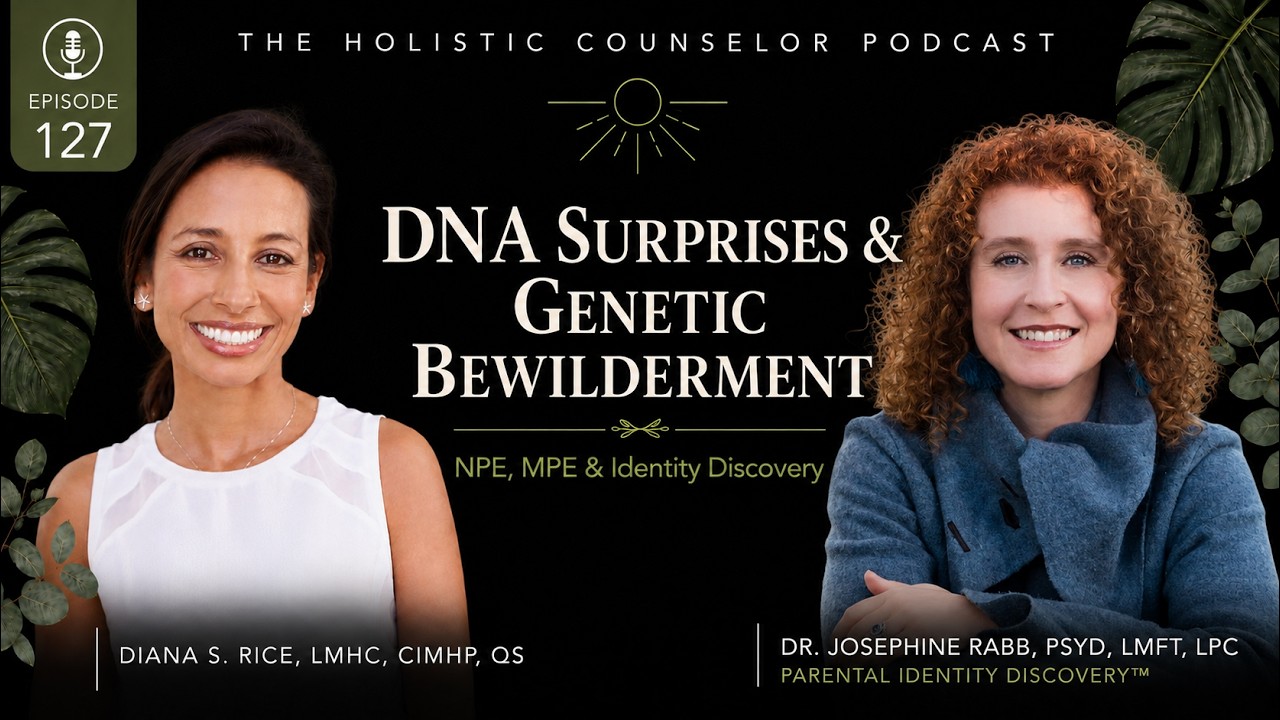
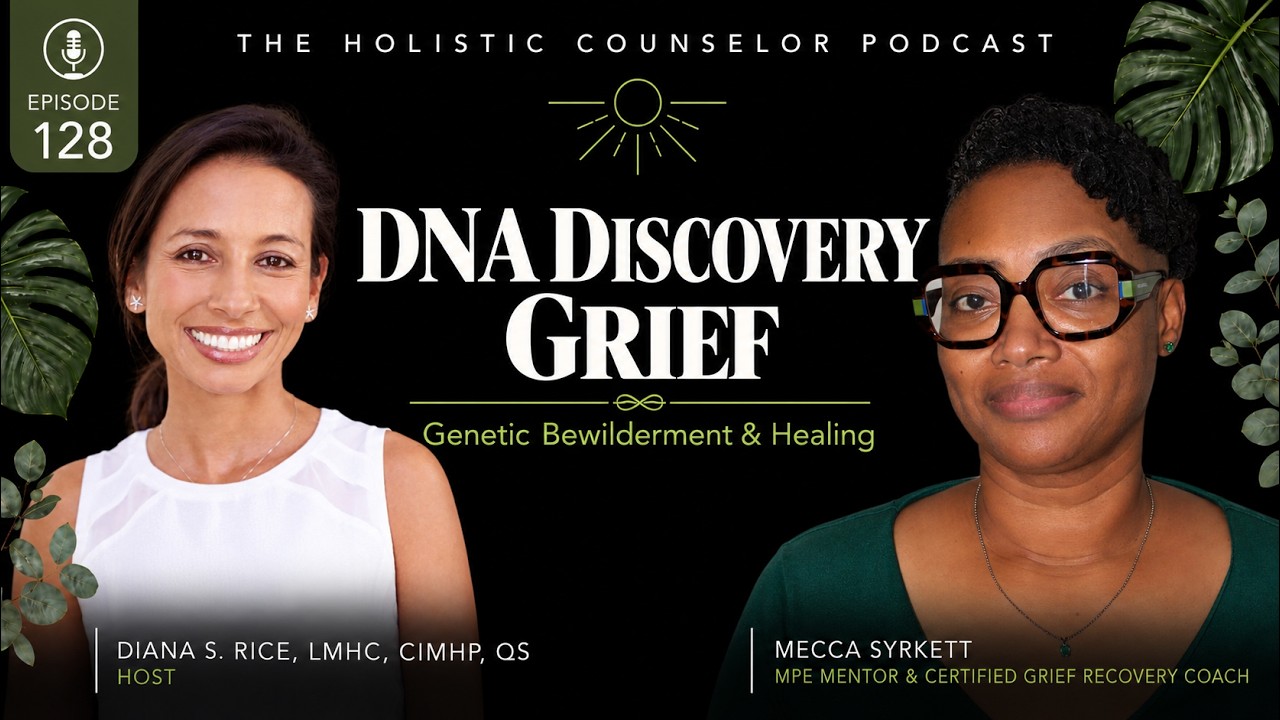
Episode 128
NPE/MPE DNA Discovery Grief, Genetic Bewilderment & Healing
with Mecca Syrkett, MPE Mentor & Certified Grief Recovery Coach
Hosted by Diana S. Rice, LMHC, CIMHP, QS
Mecca Syrkett joins Diana S. Rice to discuss grief, identity, family secrets, and finding support after an unexpected DNA or misattributed parentage discovery.
Listen to the Episode
Press play when you’re ready.
Educational content only; this podcast is not therapy, diagnosis, or medical care.
About This Conversation
Show notes
Jump to a section
What happens when a DNA test changes the story you believed about who you are?
In this deeply personal and powerful episode of The Holistic Counselor Podcast, host Diana S. Rice, LMHC, CIMHP, sits down with Mecca Syrkett—mental health advocate, MPE mentor, certified grief recovery coach, and founder of Aya Grief Education & Coaching—for an honest conversation about NPE discoveries, MPE discoveries, misattributed parentage experiences, unexpected DNA results, genetic bewilderment, identity, grief, family secrets, belonging, heritage, and healing.
Mecca shares her own story of discovering through DNA testing that the father who raised her was not her biological father, and how that revelation reshaped her understanding of family, ancestry, grief, and identity. Diana also reflects on her own recent MPE discovery and the emotional "glitch" that can happen when even a simple question like "Where are you from?" no longer feels simple.
Together, Diana and Mecca explore why an NPE or MPE discovery is not "just information," but can feel like a life-altering grief experience. They discuss the shock of seeing unfamiliar close relatives in DNA results, the longing for genetic mirroring, the pain of unanswered questions, the role of family secrets, the grief of lost heritage, and why so many people feel alone after a DNA surprise.
This conversation also highlights the importance of MPE-informed support, active listening, online community, grief education, nervous system awareness, faith, and learning how to build a new narrative when the old story no longer fits.
If you or someone you love has discovered unexpected parentage through Ancestry, 23andMe, or another DNA test, this episode offers language, validation, compassion, and hope.
Topics discussed
- NPE and MPE discoveries
- Misattributed parentage experiences
- Unexpected DNA results and family secrets
- Genetic bewilderment and identity confusion
- DNA testing through Ancestry and 23andMe
- Grief after learning a parent is not your biological parent
- Late discovery adoptee experiences
- Disenfranchised grief and complex grief
- The emotional impact of "Where are you from?"
- Genetic mirroring and seeing yourself in biological relatives
- How loved ones can respond with compassion
- Why active listening matters after a DNA surprise
- Finding community and support after an NPE/MPE discovery
- Faith, identity, belonging, and healing when your story changes
Connect with Mecca Syrkett
Aya Grief Education & Coaching
Website: https://www.ayagrief.com
Facebook: https://www.facebook.com/profile.php?id=61586551186971 Email: coachmecca@ayagrief.com
NPE/MPE support groups & community resources
NPE Only: After the Discovery https://www.facebook.com/groups/NPEOnlyAftertheDiscovery
This NPE Life https://www.facebook.com/groups/thisnpelife
This MPE Life https://www.facebook.com/groups/thismpelife
NPE Network https://www.npenetwork.org
Right to Know https://righttoknow.us
MPE Counseling / Professional Directory https://www.mpecounseling.org
Watershed DNA Resource List https://www.watersheddna.com/resources
DNA Surprises Resource List https://dnasurprises.com/community/
DNAngels https://www.dnangels.org
NPE stories & podcast resources
NPE Stories with Lily Wood https://npestories.com
DNA Surprises Podcast https://dnasurprises.com
Watershed DNA / DNA Clarity and Support https://www.watersheddna.com
Books & recommended reading
NPE* A Story Guide for Unexpected DNA Discoveries by Leeanne R. Hay https://www.leeannerhay.com
Inheritance: A Memoir of Genealogy, Paternity, and Love by Dani Shapiro https://danishapiro.com/books/inheritance/
The Lost Family: How DNA Testing Is Upending Who We Are by Libby Copeland https://libbycopeland.com/the-lost-family-2/
DNA Guide for Adoptees by Brianne Kirkpatrick https://www.watersheddna.com/books
More DNA discovery books and resources https://www.watersheddna.com/resources
Crisis & support resources
If this conversation brings up overwhelming grief, trauma, sexual violence, abuse, or thoughts of self-harm, please reach out for support now.
988 Suicide & Crisis Lifeline Call or text 988 https://988lifeline.org
RAINN National Sexual Assault Hotline https://rainn.org
National Domestic Violence Hotline https://www.thehotline.org
Connect with Diana S. Rice
The Holistic Counselor Podcast https://www.throughthevalleytherapy.com
Through the Valley Therapy https://www.throughthevalleytherapy.com
Transformed Mind Consulting & Coaching https://www.transformedmindcc.com
Listen to the podcast: https://pod.link/1732149496
Disclaimer:
This podcast is for educational and informational purposes only and does not replace therapy, medical care, crisis care, or professional mental health treatment. If you are in immediate danger or experiencing a medical or mental health emergency, call 911 or go to your nearest emergency room.
Episode transcript
Read the full transcript Close transcript
Automatically generated from YouTube captions. Names and wording may contain errors; listen to the episode for the original conversation.
Hello hello hello there fearfully and wonderfully made human to the holistic counselor podcast. I'm your host, Diana Rice, licensed mental health counselor, certified integrative mental health professional, and founder of Through the Valley Therapy, and Transform Mind Consulting and Coaching. Today's episode is deeply personal, layered, and incredibly tender.
We are opening up a vital conversation around NPE discoveries, MPE discoveries, misattributed parentage experiences, unexpected DNA results, identity, heritage, belonging, and the profound grief that can follow. If you listened to the last episode, you know I recently began sharing part of my own unexpected MPE story.
Back in April of this year, the story I was told about who I am suddenly changed without my permission. Today, I am still walking through what many in the NPE MP community describe as genetic bewilderment. I am learning how to ne navigate the sudden shift in my identity, my culture, my family story, and even the simple question, "Hey, where are you from?"
As a Christian, I keep coming back to the truth that my deepest identity is anchored in Jesus Christ. But even with all that faith, even with professional tools and even as a therapist, this is still heavy complex grief. That is why I am so honored to welcome our guest, Mecca Circuit.
Mecca is a mental health advocate, MPE mentor, certified grief recovery coach, and the founder of YA grief education and coaching. Having walked through her own misattributed parentage discovery, Mecca now helps create the kind of safe space, language, support, and resources that so many people need when a DNA discovery changes the story they thought they knew.
Mecca, thank you for being here. Yes, thank you for having me. This is such an honor. So for listeners who are new to this language, right, what is misattributed parentage experience or MPE and why can an unexpected DNA discovery feel like so much more than a family secret?
Yeah. So, a misattributed parentage um experience is an umbrella term for the revelation that one or both of your parents are not biologically related to you. And so, this could cover donor conceived individuals, individuals that are late discovery adopes like myself. um or individuals that have that non-paternal event.
The popularity of these over-the-counter or direct to consumer DNA tests has really shed so much light and there's just been an explosion of these occurrences for individuals. I think the the data that I saw recently was somewhere um up to 10 million people are experiencing a just result other than what they may have expected.
Um, and so this is absolutely something that so many of us can relate to personally that we never thought we would be able to, but also something that because there's just a a stigma attached to a non-prernnal event or a misattributed parenting um parentage event that We really need to talk so much more with people about this so that it's really not the, you know, the mory punchline that it often can be for people that are uncomfortable.
That's it. The the word uncomfortable because, you know, I noticed that sometimes, you know, how I said because of the way I look, people ask me all the time since I was a little girl, like, where are you from? Where are you from?
So, I always was taught, you know, not taught, but I created like it was fun. It was fun to me to see where people thought I was from. And I have a list going on and everything like that. And then it was just easy for me to say, "Oh, my mom's from Colombia.
My dad's from Puerto Rico. And I was born in New York." You know, it was just something. And I was, you know, for 54 years, I was super proud of that, right? And not that I'm not proud of that. It's just now with this genetic bewilderment, girl, let me tell you. every time.
Now it's more of like I have to take a step back and go, um, do I drop this bomb on this stranger? What are you? And do I lie? I I think I have more difficulty discussing it with people that have known me for an extended period of time than with strangers.
There's an ease to explaining to a complete stranger like, "Oh, hey, this is what happened." I remember saying to my gynecologist, she said, "Oh, any changes?" And I said, "Oh, girl." And she just was so astounded. Yes. And her response was one that I wish I could replicate for all of us.
She took a really deep breath, but she said, "How are you?" And that was all that I needed in that moment. And really all that someone that doesn't know how to respond, those are the words. Those are the best words that someone could possibly ask.
How are you? The answer may be I don't know. You know the answer may be I am spinning the answer may be I'm okay today but yes this is um it's such a complex as you said and tumultuous experience it is you know and it really does impact the smallest response to questions that people may ask you know where your people from.
Um, yeah, it really is, you know, it it's it's a lifealtering experience. It is. For sure. It is. And and you're you're right on like that where your people from, right? It's like, okay, so, you know, cuz I'm so open. anyone that has listened to the first 127 episodes, they'll get to know my personality and realizing now that I'm Cuban, right?
That my biological father is Cuban. And I literally, like right now, if you're watching on YouTube, there's this little flag thing right there where my finger is. And this past week, I have been going, do I buy a new flag, a Cuban flag, and leave the Puerto Rican flag, and do I put it there?
Do I take the Puerto Rican flag out and and put the Cuban there? But then I feel like a fake because I'm I'm not I don't know that heritage that well cuz I didn't grow up with it. Then I'm like, "Oh my goodness, no, I can't have the Puerto Rican flag in there because I'm not really Puerto Rican."
It is um I don't know. That's genetic bewilderment that for me ident not identity because I I am rooted in you know my faith but it is absolutely it is now when I'm out there because people ask me almost every if I get in the public people look at me and they're trying to figure out what I am and I don't mind it.
I'm not that sensitive where it's like why do you want to know? It's more of like oh I get to see the human being and they're cur and I I'm a curious person so I want to know like where do they think I'm from?
That's the thing like how how can loved ones, you know, that's the thing too is like how can loved ones, therapists, coaches, pastors, and support people respond better when someone says, "I took a DNA test and now I do not know who I am in the same way anymore."
Yeah, I I think that's such a great question. I I think first and foremost, educate themselves. go and read. There are absolutely articles, there are books, um there are resources that we can tap into to be more supportive to our loved ones when they encounter these experiences.
But also become an active listener. You don't always have to have a response. You can offer to listen. You can offer to be a support person by being present. Can offer to engage with your loved one in some physical activity. I think we're we're people that tend to want to have something positive to say.
And often with grievers in general, some of the feedback or some of the commentary that's shared is not always helpful. Exactly. Is not always helpful. So, give someone a hug. Um, hold their hand. Tell them that you're unsure of what it is that they're feeling. it's not something that you're familiar with, but that you'll stand with them.
I think that beginning there and letting them guide what that help looks like is key. I love that. Yeah, Mega. Like, there's something that I utilize a lot that I try to teach people and when I used to do family therapy or couples therapy, I only do individual now, but it's like, do you need a hug?
Do you need to be heard? Or do you need help? Yes. Right. It's those things that that when you're walking through this stuff because I I realize too what I'm learning in the last months of this happening when I drop the It's like that's the thing too for somebody like me.
It's like I go and network. I'm a I'm a very outgoing person and then people ask that question and now I'm glitching. Mecca, I'm glitching. Like honestly I I'm like because I used to it. Right. And then I realized the person that whoever I say this to it all of a sudden be they're uncomfortable.
So that and then it becomes about themselves. They're trying to connect but at that moment it's not what I needed. I needed them to to listen. Yeah. Active listening that that is so key. And Mecca, it takes time to learn how to do that really well because most most people listen to respond not to understand.
Absolutely. Absolutely. And I think as individuals that is a skill that like you said that we all should strive to um develop. It is so common that when an individual even shares a pain, an experience that may be a challenge that someone in showing that they're empathetic, they'll counter with something that they experienced as well.
And I'm not saying that that's a negative because I do understand the root of it. Yeah. But what I'll say is that it's not always received in the way that they may think it will be. And I know for myself, I like you, um, I remember after my discovery just calling a a couple of friends and saying, "I got these DNA tests back, the results, and my dad is not my biological dad." and people that knew him and my relationship to him.
I would say even my best friend who I love dearly, I knew that it was as shocking to her as it was to me. And she struggled with what to say, but she was really devoted to being a support person to me. Yeah. and she kept at it.
She kept reaching back to see how I was. Awesome, you know. Um, so it it's excuse me, it's absolutely key to just be present for someone and to continue to let them know that you're there, you know. Yes. If you care about that human that has said that to you, right, and you have a relationship, I think it is the most important to educate yourself and try to understand.
That's with anything that's that can cause grief, right? Someone gets attacked on the street and it's someone you love and you're like, oh, or cancer or you see what I mean?
And that's the that's when someone's there's so many different kinds of grief because I think our culture and society always thinks of Kubler Ross and the five stages and yes and that's death right that's death to think that now to me how I saw it was oh it's the death of Diana Rice Santiago Rice that's what the S is for do I drop the S but it's the not the death of her it's the death of what I thought yes right and and so that's the thing.
It's like having to have a new normal, having to learn how to process in a healthy way because when pain overrides everything, anger cuz I could I could imagine the anger to me. It was more of like what like I'm I'm in shock.
It's it is Kubler Ross's thing like I'm not in denial cuz it's happening. Are you I think I might be in acceptance already just because honestly it sounds like you had a very strong relationship with your birth certificate father. Yes. Right. I didn't I honestly Father's Day it came and went this year and I just got up and I'm like honey I I have two daddies and I never really had a relationship with either one.
I know that's not funny but it this is how I humor helps me. Same. Same. So before we move on, I I know like I'm a little curious and and I just don't want to whatever you feel comfortable with. I really want to know your story.
My Yeah, absolutely. Yeah. So my my 50th birthday was May of what is this? 2023. And so I remember saying to my sister and so my sister is absolutely my person. I think you know wombmate, soulmate, all of the things. Um my number one support person.
Um I remember saying to her for 50 I want to reach out to everyone that has known me for the entire 50 years. So many of our aunts and uncles and you know family members have passed but there are still a significant number of people living.
And so you know I just had this plan in my head. This is what I'm going to do. Um, and as a person that loves history, I've always had a um desire to know as much as I could about our family lines. And so a genealogologist as well, just doing the research as we got into the pandemic.
Um, and just being homebound, I decided, okay, I have the time and the opportunity for a lot more research. So, let me dive back into this. And just like anything else, the more you engage with something, the more you'll see particular ads in your algorithm.
And so the direct to consumer ads were everywhere and the prices were dropping. I remember when they first, you know, became a thing and they were, you know, pretty expensive, like $129. I remember I think Yeah. or something like that.
I think I think the first time I saw like ancestry I think there was maybe like 300 and I said ah you know I'm not giving these people my genetic information anyway but it just was it was an expense that really wasn't worth it you know as well.
So, I continued to see these ads and I really had what I what I say to my sister was an insatiable desire to know and I went ahead and got a test. My results, they were supposed to come back on a Friday. They came back on a Wednesday that fell on the exact day, six months before I was to turn 50.
So 49 and a half exactly, I get these results. And my mother knew her father but did not know much about his family. And so that was also a part of my motivation that I would um you know find out more for her.
She she passed in 2014 and so not having her to ask questions about what she did know said okay I'll go and do some research. Um, and so the the test that I did initially was ancestry. And so for individuals that have or haven't done that one, you can agree to get the genetic matches from people that are related to you.
It's not a given. So I did go ahead and do that. And I received the results at work. Um, at the time I was still working in the office and so I get the text message and I had been talking about this test and getting the results with my children and my sister.
Um, I'm a mom of five so we've got a group chat. Everyone's in there and you know we're back and forth and I said, "Oh, the results are in." you know. So, I went to the ethnicity breakdowns screenshots. I'm sending it to everyone.
We're making jokes. We're joking about reparations. Who we getting these reparations from? So, as the day goes on, I finally go to these genetic matches, the people matches. Yeah. My first match was my niece and that was the only name under close family that was familiar to me.
The others were initials or like weird screen names and they were close families because I want people to understand this this part.
I'm sorry to interrupt you, but I want them to understand 23 andme and ancestry.com and all that because to me I I took 23 and me a long time ago just because I was curious about ancestry.com I took it and then you forget about it and little by little like oh now I'm curious and then and it depends on who's ever taken the test on that on the other side of the world or whoever because to me I would go back and I'm like, "Oh, there's there's nothing there."
Like, "Oh, okay. It makes sense. My people come from, you know, Puerto Rico and Colombia, so they're not maybe taking these tests yet." Absolutely. Right. What you just said, though, you went back on and you're like close family and that is like a a not a punch in the stomach.
How How did you feel when you first saw these names and you're like, "Uh, I call it glitching. My brain glitches. It's like I think that I think that's like the perfect word. I absolutely was taken aback. Yeah, I definitely glitched. I knew for certain that one of my younger sisters had tested some maybe two years prior and she wasn't there in my list.
Yes. Yes. And so Wow. I really think because I was at work, I closed everything and I said to myself, "Okay, whatever it is, this is not the time. This is not the place." So once I got home or by the time I got home, one of the close family matches that was just it was just an odd screen name had reached out to me.
Oh wow. And said, "Hey cousin, I would love to know how we're related." And I said, "I would love to know also, you know, like who are you?" And it began from there. Um and and honestly my initial reaction I really feel that my my brain was trying to protect my heart of course and I initially thought this must be because my mother's father was not her father just because we had such such little information.
Um, but as I began to talk to this gentleman and we exchanged I mean dozens of messages, I very very quickly realized, oh, this is not about grandpa. This is this is about me. Wow. Yeah. Wow. Did you see pictures?
Because I think that's the thing because like you said like I know I'm skeptical about a lot of things because just of where I grew up and how I am and the things I know and you know my experiences on this earth for 54 years and uh that I was like this could be you know this could be just the company trying to get money or whatever like oh this could be a scammer this could be this.
But when I kept looking at the close relatives and then I did the research because I'm I'm a person that's able to go I should have been a private investigator, not a therapist. But anyway, I saw I started finding information and I lined it up with the people because there was like six close relatives that I never heard of before in Mecca.
And I saw when I and I'm this is where I'm going to cry. When I saw the one picture of my nephew right there, I'm like, "Oh my gosh, these all these people look like me." I felt there was something I to these strangers, it's something like I don't know if it's genetic tribalism.
I have no idea. I'm still learning the science, too. But Mecca, when I saw them, I'm like, I I I look like them. You're seeing yourself. It's the I I think there's a word I saw on one of the NPE guides like the mirroring or something.
Yes. I It's not coming to me either. But I know for adopes when they have gone their entire lives not knowing and then finally seeing someone who resembles them. where you may be the only person in your family with the complexion that you have or the color hair, you know, um particular features.
And it is it's very I I I remember saying to my sister that I felt unmed. It really made me feel as if I were detached. Um, and it's it's such a difficult sensation. Yes. To describe to Oh my goodness. Yeah. This is why I'm crying, people, cuz I feel understood.
Listen, I'm I'm I'm with you. I'm with you. I mean, it's so destabilizing. Um, and you asked if I saw pictures. this cousin. He didn't have a lot of he didn't have a lot of contemporary pictures. He had some some pictures of ancestors.
But as we started to connect the dots, he he I believe he introduced the question to me. Is it possible that your father and he I mean he was very very gracious. You know I understand that a father is not defined by biology and this is someone that has been in your life your entire life.
And I don't want to take anything away from that relationship, but I would like to ask, is it possible that he is not your biological father? And I really had to sit with the question. Yeah. Because the reality was I had already had the thought. the the test really was just that match point where I got that um confirmation.
Maybe I remember years ago applying for a passport and I had in New York State very often they would issue a short form birth certificate and so I had my short form birth certificate for years had never seen my long form birth certificate and when I sent my documents off they wrote back sent me the documents back and said, "No, we need the long form birth certificate."
And I said, "Oh, I don't know that I've ever seen it." And I remember writing to New York Vital Statistics, ordering it, getting it, having the envelope, and this had to be I mean, numerous years before this test. I remember getting the envelope and having this wave of anxiety about what I would see when I looked at the birth certificate.
I don't know that I really understood what that anxiety was until I got these test results because somewhere along the line I had subconsciously heard or picked up on something. It was somewhere.
It wasn't a conscious Yeah. wasn't a conscious like something in your childhood maybe like somebody said something some grandpa or whatever in passing or even parents talking to each other or there yeah I hear a lot about that when I'm reading but I also understand it because I not that well I'm trying to disentangle still because of the emotional neglect and just the way I grew up in a in a complex situation was it that or was it because deep down inside you kind your your cells your genetic cells know something.
I don't know. Like I'm still trying to figure that out too. It it's really fascinating. It's really fascinating. And I didn't necessarily see anyone that stood out as looking like me, per se, but I remember seeing my biological father's mother's birthday on a document. and her birthday is the day that my oldest son is born as well.
And I was so astounded by that. In my family, we have numerous people who share birthdays. And it's there's so many of them. Wow. That it's kind of like, oh, that's what happens in our family. But then to have that happen with this ancestor that I had no knowledge of, it really struck me.
Um, it was very moving. I remember saying to the first cousin like, "That's my son's birthday." He had no no context to even understand where I was coming from. Um, but yeah, these are this they're so complex. the the trauma that ensues, you know, the questions about your identity.
And, you know, I wanted to say too about genetic bewilderment being a a a descendant of enslaved Africans in this country. Um that is a concept that is so familiar. We have experienced the dissipation of so many family units through enslavement. Yeah. And many of us that are interested in this geneal genealogical work are striving to put pieces together and just the not knowing is such a there there's a uh just an understanding that you may not be able to go further back with records.
You know, 1870 census may be as far as you can go. Um, and so there was also a a great deal of sadness about the fact that this information had been obscured from me by my parents. So they knew. So they both knew.
And that's See, that's another form of having to grieve. Yes. a a betray, you know, the word betrayal, and I don't want to put any I don't want to put my mom or dad's under the adversity, whatever. You know, I don't want to put anyone under the bus.
It's just, you know, it it's like, oh my gosh, you've trusted these situations for so long, the humans around you, the village that raised you, and then all of a sudden everything comes crashing down and all those emotions that come, shock, anger, shame, betrayal, right?
there was some relief to me. I'm like, "Oh my gosh, I do belong to a family." Like, even though I did belong to this other family, you know, it's just it's so weird. It's so weird, Mecca, because it's like, how do like is this new family going to want to have something with me or not?
Do I even want to go in in the Pandora box open? Do I want to go in there? Because what if what if these people are more unhealthy than the ones I was raised by? Absolutely. Absolutely. And I firmly believe you have to name the things to heal the things.
Amen, girl. Amen. And so betrayal, I really had to sit with that to say to myself, you know, we have this historical denial of knowledge of who we are. Mhm. How then do I heal a betrayal at the hands of my parents? Yeah.
You know, it was it it and and it's ongoing. Yes. You know, it's ongoing. Um but yes, the the emotions, the myriad of emotions, you know. Um, and I really think that these emotions come in waves. Yes, they do. That's the way that I like to explain them.
Yeah. And you got to learn to surf them. You got to learn to surf those waves. If those waves come to surf, that's right. You will drown.
So, you better figure out what your surfboard is, your boogie board, whatever it is that you need because, and this is where I think it's so important to have this conversation because anyone that's listening, they might have just found this episode because they just found out and they were researching or absolutely it could be a loved one that's like, "Oh my goodness, this will be great for my friend that just found out and I don't know how to help them."
Yeah. Yeah. And and so, how do you help?
because you created your whole ya um grief and uh sorry ya grief education and coaching right out of this experience am I correct absolutely that's correct I want to go into that I want to go into like how do you help now because this is the beauty of of someone that really deeply understands the situation has done their work that's still processing because honestly it's Not that you or I have we might have experience and we might have expertise now, but it's like every human being is their own thumbrint.
This is why I start the podcast, you know, hello there fearfully and wonderfully made.
I need them to understand that they're made for a purpose even when the purpose sometimes hurts a lot because this is painful but at the same time I'm like all right because of how I my faith and how I see the world I sit back and I'm like what am I learning from this help me to process it in a healthy way what am I needing at this moment because sometimes people spin out mega Okay, they spin out in very unhealthy ways because that's all they've ever known.
This is what I'm I'm talking about. Like we can be we could be angry I could be angry at my mom and hate her and love her. Yes, it's an and it's not or and then you process and surf the wave. How do you help?
Like say somebody's listening right now and right when they're done they're going to message you and be like I need I need help. What do you do? Yeah. first witnessed the grief. I like you, I'm a person that believes in helping self. I knew right away that I needed to find someone.
Um, I have had, you know, experiences where I've worked with practitioners and, you know, maybe it's not the best fit and then I move on and I try to find someone else. And at the moment of this discovery, I was in that space where I had ended a therapeutic relationship but had not yet found someone.
And so I immediately said, "Okay, I need to find someone to talk to." Exactly. I don't want to spend I don't want to crash out. I want to find a healthy way to ground myself. Um, and not to fall into the thinking that you can very easily adopt that you are your experience.
I knew I wasn't this experience, right? And because I had such a strong sense of self and just a pride in who I have become as a woman through the adversities of my life. You know, your parents give you the foundation, but then you do the work, right?
And so I I sought someone out, older uh black man, and he said, "I have no idea what this is, but I'm willing to learn, and I'm willing to sit with you." And he was exactly what I needed in that moment. he was able to through his therapeutic expertise, he was able to still assist me as we both learned about what it was that I needed.
And by virtue of that, I knew that I would love to be someone that would be a resource for people. Um it's it's so and I think I speak to everyone you know that I talk to about this. This is such an emerging field of understanding for people.
Yes. Um and because of that the grief is what we call disenfranchised grief or complex grief. Mhm. You're trying to explain to people who have no understanding of what you're going through, how you're feeling, why you may react the way that you react.
You know, and just as important as being culturally competent is when you're working with someone, being MP informed, yes, is critical. is critical. It is. And this is why I'm doing these episodes now because I'm literally going through it and at the same time I I this is why I had Dr.
Rab. I don't know if you know who Dr. Jose Okay. She came on. She's the episode before you and then you and now I'm trying to get Lily Stories or NPE whatever there's podcast. I had no idea. Right.
And so to me when I first found out I just put something in a networking group of a hundred therapists and I said hey does anyone in search of a therapist that and they're like what is that and I right there that's when I knew oh no I need to go into a deep deep rabbit hole find out as much the NPE guide helped me because I don't know who who created that one but I think
it's Lily whatever I'm going to put everything in the show notes that we talk about anyway but it was just the voc vocabulary.
Once I got that vocabulary, I was like, "Oh my goodness. Oh my yes, that's it." And that was helpful. And then I went and researched and but that's who I am. And not everybody has our brains like that, right? And I think this is why it's so important because somebody's going to find this either that is helping someone curious about it or they're going through it.
Yeah. I I do you know of any other I don't know resources for this situation or because it's emerging because now I'm thinking like oh I'm going to create a CU a continue education unit to to train other clinicians because you're right this is emerging the more because back in the day if you really think about it you know back in the 50s something happened and they got sent away came back we don't know anything exactly Okay.
The DNA thing I what I noticed is it was all younger people that were my close relative. It wasn't my siblings. It wasn't my anybody older than me. It was I the youngest one was 19 years old. The one that looks the most like me.
Wow. Yeah. So, I really think that that those that are they're just searching for truth, right? They're searching for truth now. like the next generations are wanting to belong. They wanting to find out more things. And what you said earlier too, I think it's important it just like you it's hard like you said 1865 cuz now I'm thinking you're black American, correct?
Yes.
Yes. because I do know the different cultures too like you know there's there's black Caribbean there's you know I had to right to me my stuff don't go back because my mom is raised in the c in the country of her country like country there's no records records you know stuff like that so I couldn't find anything anyway Puerto Rico you know US territory I you know yeah I couldn't and now that I'm half Cuban I'm
just grateful that the niece that I finally connected with who I what I loved about her, Mecca, we had a conversation.
I could tell she's very um she she's very thoughtful. I'm calling to have this conversation because I think it's important for you to know your medical history. Like she was very matter of fact, gave me that and I'm I'm more of a emotional like, oh my goodness, can we have a can we have a family reunion?
I'll host it. And my husband's sitting there looking at me going, "What? You don't know these? You see what I'm getting at?" And there and you know, she was like, "No, let's slow down." And we're taking it. So, this is the other thing is that like I'm excited.
I'm but then at the same time, thank goodness I have human beings that slow me down because yes, it is. It is like, oh my goodness, I'm finally finding my my posi, my tribe, my clan. I don't care what you call it, but it's like and it's like they might not ever want to have anything to do with me.
And honestly, I think because we grew up in a certain time, we kind of romanticize the happy ending. You know, thank you, Disney. Thanks. Exactly. It's all going to work out. It'll be beautiful. You know, I I immediately, and I don't know if you've seen this movie, but there's a movie with Denzel Washington called Antoine Fischer and the young man.
Yes. And I immediately thought, oh my goodness, like is this what's going to happen? And that is not what happened. Is absolutely not even close to what happened. Now, thankfully, I come from a very loving family. That's wonderful. I I definitely My first thought was I don't want to hurt anyone.
Yes. Yes. And it was a little bit of a relief that these other family members, biological family members were not open. Although I prefaced every communication with them that I was not interested in intruding. Exactly. that I really just wanted information, but the way that I was received really just told me, and I think you mentioned this earlier, like you don't know what you're getting on the other side.
Exactly. And as we hear often, sometimes rejection is protection. And I I I received that. I said, "Okay, I have the information." And quite frankly, the people that I was interested in knowing more about had all passed away. Wow. And so there were not any, you know, biological father had passed.
My mother passed in October of 2014 and then after getting this information discovered that my bio dad passed 3 months before she did in 2014. And so there really were, you know, there were not people left that I had this desire to connect with.
Um, and I I am thankful for that. I think for individuals that really want to connect and are rejected, I can I can only imagine how painful that is as well. Yeah. Um, especially when you're younger. I think the difference is you're right.
It's you and I have already had life experiences. We've had to work through other things besides this. We've had to live in in our beautiful country though as black and brown women, as women, you know, there's so many layers. So, you know, so we've we've had to to create a really great like tools shed, right, of things that we know that help us to stay sane in an insane world.
I think what happens now is like the younger people that find these things out or even the the the stories that behind what they find out because some of the things I'm reading I'm like I it pierce that's why I can't handle being on it too much because it pierces the soul to a because I'm very empathetic as a therapist, right?
And and so it's like oh my gosh I can imagine I can imagine finding out that it was your mom that was raped. It's very And you're a product of rape. I I baldled like a baby when I first read that because you don't think about these things.
You're like, "Oh my gosh, how can I how can I create how can we create something that will be beneficial for the community we are part of now?" Right. Right. I I initially I sought out a therapist that I could work with and then I researched for a an online support group.
I found that Facebook um had numerous communities. Yes, I immediately connected with one. Um, as time went on, I was asked to be a moderator in that community. I think that those communities are critical. Yes. Whether you're newly discovering this information or if you have been sitting with it alone, it's imperative for you to have community.
Um, one of my favorite social media uh people, Dr. Raquel Martin, I I heard her say, "Healing happens in community." And I so believe that we we really have to find our people. Find people that understand our plight. Yes. People that will listen without judgment.
Um, and being an MP mentor was also something that I really felt was healing for me to be able to relate to someone in their moment of need, hold their hand and say, "Not only am I with you, but I understand. I've been there.
I am there." Yeah. And I'm and I'm surviving. Like that's the thing because when you're hit with something like that, you think it's the end. Your body is reacting. You're responding to a lot of different things and then you're overwhelmed. I mean, that's what nervous breakdowns are.
That is when the overwhelm, the grief, that grief where you think, "Oh my gosh, there is no other hope or purpose." And this is what I have to get people to understand like no, like take that step. Yeah, you're allowed to feel all those feels, but understand you're not alone, right?
And and what you said about community, this is something I learned a while ago and I like to say is that if you think of the word illness, any kind of illness, it's I or by yourself illness. But when you think of wellness, it's we wellness, right?
The we in front of it. And this is this right now this whole conversation, Mecca, has really helped me. Like thank you for letting me save, you know, 150 to 200 bucks to go to a therapist. No, I'm just kidding. Thanks for free coaching.
Thank you. Thank you for even Thank you for providing a platform for this discussion. This is so needed. We need so many more of these conversations. We need to have additional conversations.
Um, I I say to some of the people that I've met in this community, you know, we are now a part of this group of, you know, individuals, this club that we didn't know, you know, that we would ever be a part of and didn't want to be a part of or that we needed, but we needed it.
We needed it. Yeah, I noticed that you were speaking and I think you guys created um I don't know if it's a workshop or um you a day of do you guys meet together in person too or how does this work? Cuz I I you know like I said I got so much information but I'm I think you were speaking online and like a webinar someone put together for people to come and listen right am I wrong?
So there are quite a few different groups that have um online support groups and they're really kind of fragmented. Okay. In our group, so the group that I am um a part of MPE only, we do have additional resources. Okay. We have uh lists of all the acronyms because now you're learning all of these new terms that are blowing your mind.
Yeah. Um but we do have resources where you can find individuals that are in your state that may be in your area, you know. And I I I I think that we really need to have more of that one onone. Well, not even oneonone, but the in-person meeting.
I know that so many of us are scattered to the wind. Yeah. Um but there are retreats. Yeah. Um, I can't think offhand of, you know, there are a couple of different organizations and I'll I'll reach back out with some of that. Um but if you are interested, you know, I'm sure that we can and I and I've been talking to some of my clients about this, but um just getting together pods of individuals in different places.
Um but yes, yeah, there there are absolutely resources available. Yeah. So, how does someone work with you then? What what is it? How do they get in touch with you if they're listening now and they're like, I want to work with Mecca. Maybe she'll coach me or give me resources.
You know, how do they contact you? So, I am on Facebook. I do also have a website. The website is iagrief.com. A ya grief.com all one word. Um, my email is coachmechgmail.com. Um, I'm right now working in one-on-one sessions, but I am developing some group work as well that I think would be very beneficial to this community.
Um and just as a person who has walked this, I am absolutely open to anyone that just wants to reach out and you know say I I don't have someone um every relationship won't be a working relationship. Some of these relationships will be determined based on what that individual is able to do.
Um I think so much about the grief and the turmoil that these economic times have brought to so many people. And then you add this layer of MPE trauma. Um, and so I I'm absolutely here for anyone. I am someone that is willing to share resources or guide you to whatever it is that you think you may need in that moment.
And I would I'm I would love to also, you know, be a thought partner with anyone that would be interested in coaching as well. I love that. Okay. So, I'll put all that in the show her her website in the show notes.
So, you know, I I want to talk to you a lot more because there's so much more to explore here and and for you to understand it. this is what's beautiful cuz honestly like my therapist I don't think gets it like cuz because she's not and it's not saying that she like a person can't understand it if they get the information and education they need you don't have to go through it but if like you're a
therapist I really suggest you try to find continuing education on this because this is very this is very different like I know like I'm a therapist and I'm going okay where where's this information so people that come because it's going to come.
I'm telling like you said it's an emerging it's more and more and more people are realizing this. Every time I talk to someone, someone's like, "Oh, I know someone. I know someone." You know, and it's just like here. It's here. And it's gonna it's coming.
And it's just realizing like, "Okay, it seems like truth is being is hungered for and and at the same time, it's being brought up to the surface to a in a way where I'm like, whoa." And yeah, how do we take care of each other in a healthy way?
Because we all have to live on this earth right now. We do. We do. And I I I remember going through this grief coaching certification and they asked us to write about who we are and I I said I am a late discovery adoptee and a dispeller of family secrets.
We have to pull the veil back on so many of these secrets that are keeping us ill. Yes. And not only in the family girl, we can start talking about churches. We could talk about politics. We could talk about school system. I mean, we could talk about a lot of systems.
Yes. But right now, we'll just talk about NPE. Yeah. Yeah. But the time the time that that time for revelation Yeah. is now. Exactly. So, is there any final words, quotes, anything, resources before we say goodbye? Yes. So I have three books that I would love to recommend.
Uh Bel Hooks, all about love. She talks about self love and love of community, love and bereiement. Um Louise Haye and David David Kesler's you can heal your heart which is specifically about grief and the uh healing process. And then one of my perennial favorites, Dr.
Iana Vanzant until today, which is like a daily devotional. Um something that can give you a good word on a daily basis. Yeah. Um and just to buoy your spirit. Um so those are those are definitely three that I that I would recommend.
I love that. And I love how you said buoy your spirit because we were talking about waves. Yes. Yes. I love it. All right, everybody. If you made it this far with us, thank you so much. And just please remember to trust in the Lord, guard your heart, and renew your mind.
Bye. And now for the disclaimer to make sure you understand that you are responsible for you. The content provided on the holistic counselor podcast is for entertainment,formational purposes only and is not intended as a substitute for professional medical advice, diagnosis, or treatment. Always seek the advice of your physician or other qualified mental health provider with any questions you may have regarding a medical or mental condition.
Never disregard professional medical advice or delay seeking it because of something you have heard on this podcast. The views expressed on this podcast are my personal opinions and do not represent the views of any professional organizations with which I am affiliated. Call your doctor, 911, or 988 immediately if you have a medical emergency.
The Holistic Counselor podcast does not recommend or endorse any specific tests, physicians, products, procedures, opinions, or other information that may be mentioned on the podcast. Reliance on any information provided by the Holistic Counselor Podcast, guests appearing on the podcast at the invitation of the Holistic Counselor Podcast or other listeners to the podcast is solely at your own risk.
Confidentiality notice. If you engage with the holistic counselor podcast by commenting or posting and are a client, please be aware that you may be revealing information that could compromise your confidentiality. Please remember that disclosing your identity or personal details can be linked to your clinical material.
As a therapist, I am bound by confidentiality and will not respond to any disclosures of this type on this podcast. I am committed to upholding the ethics and confidentiality of the therapeutic relationship which extends to all forms of communication in accordance with the laws and professional guidelines that govern mental health professionals.
I want you to know that your privacy is of utmost importance and you are responsible for protecting it when interacting on this platform or any other public forum. Thank you.