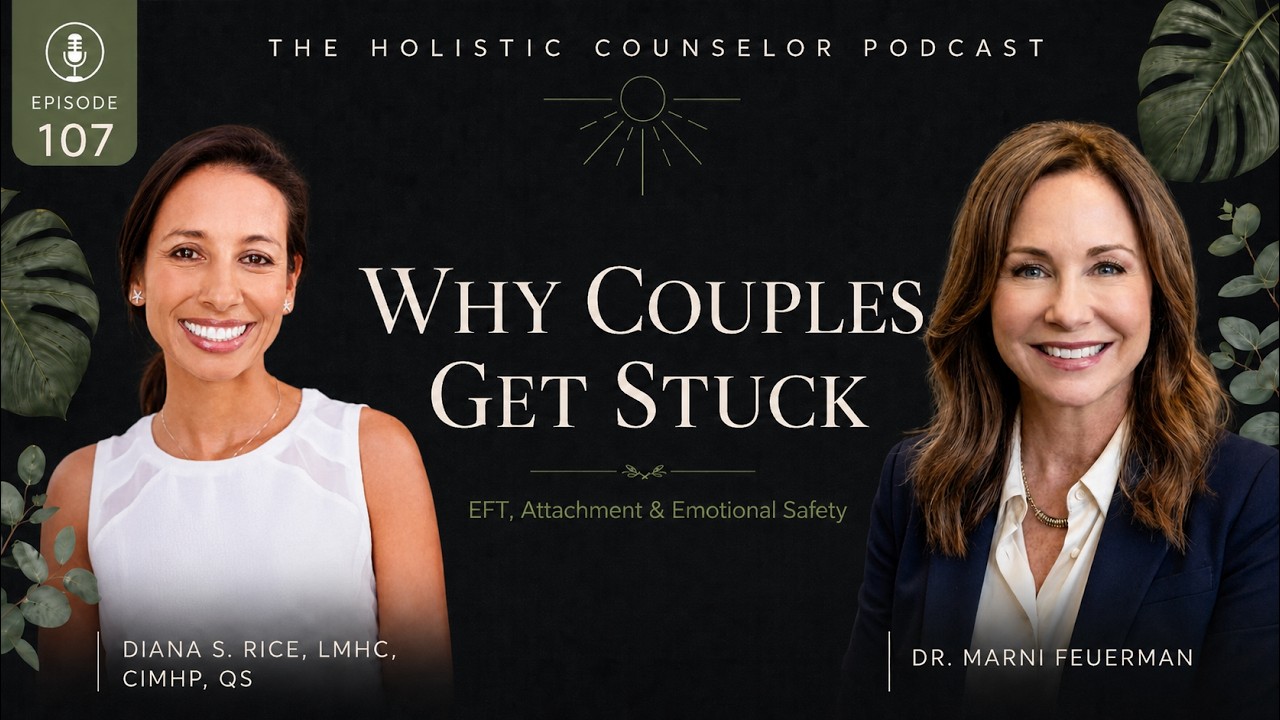
Episode 107
Emotionally Focused Therapy (EFT): Attachment, Cycles, and How Couples Heal
with Dr. Marni Feuerman
Hosted by Diana S. Rice, LMHC, CIMHP, QS
In this episode of The Holistic Counselor Podcast, Diana S. Rice sits down with relationship expert Dr. Marni Feuerman for a deep, practical conversation about Emotionally Focused Therapy (EFT)—what it is, how it works, and why it has become one of the most…
Listen to the Episode
Press play when you’re ready.
Educational content only; this podcast is not therapy, diagnosis, or medical care.
About This Conversation
Show notes
Jump to a section
In this episode of The Holistic Counselor Podcast, Diana S. Rice sits down with relationship expert Dr. Marni Feuerman for a deep, practical conversation about Emotionally Focused Therapy (EFT)—what it is, how it works, and why it has become one of the most researched and effective approaches to couples therapy today.
Many people confuse EFT with tapping techniques, but Emotionally Focused Therapy is a structured, evidence-based talk therapy grounded in attachment science, emotional regulation, and interpersonal neurobiology. Dr. Feuerman breaks down the origins of EFT, how it helps couples move out of painful cycles, and why most relationship conflicts are not really about money, chores, or sex—but about emotional safety, connection, and whether we matter to one another.
This conversation is especially helpful for:
- Couples feeling stuck in the same arguments
- Therapists wanting a clear explanation of EFT in practice
- Individuals curious about attachment patterns and emotional responsiveness
- Faith communities and cultures where therapy still carries stigma
Listeners will hopefully walk away with hope, clarity, and practical, EFT-informed tools they can begin using right away.
What You'll Learn in This Episode
- What Emotionally Focused Therapy (EFT) is—and how it differs from EFT tapping
- Who developed EFT and why attachment science matters in adult relationships
- Why couples often fight about surface issues instead of the real emotional pain underneath
- How negative interaction cycles become the "common enemy" in relationships
- What therapists mean by tracking and mapping patterns
- Why EFT focuses on emotional safety before problem-solving
- How EFT is used with couples, individuals, and families
- The difference between emotions and feelings, and why that distinction matters
- Simple, EFT-inspired shifts anyone can practice—even outside of therapy
- A message of hope for couples who feel disconnected or discouraged
Guest Bio: Dr. Marni Feuerman
Dr. Marni Feuerman is a psychotherapist based in South Florida with nearly 30 years of experience in the mental health field. She holds a master's degree in social work and a doctorate in clinical psychology, with specialized training in Emotionally Focused Therapy (EFT) and couples work.
Dr. Feuerman is a clinical supervisor, author, and a widely respected voice on relationships. Her work has been featured in major outlets including Verywell Mind, HuffPost, and The Gottman Institute. She previously served as the marriage expert content writer for About.com and continues to educate the public through media, writing, and clinical practice.
She is also the author of Ghosted & Breadcrumbed: Stop Falling for Unavailable Men and Get Smart About Healthy Relationships, a self-help book designed to help women recognize unhealthy relationship patterns and move toward more secure, emotionally available connections.
Resources Mentioned in This Episode
- Book: Ghosted & Breadcrumbed: Stop Falling for Unavailable Men and Get Smart About Healthy Relationships https://a.co/d/08WLFnfP
-
Article by Dr. Marni Feuerman on EFT (Verywell Mind): https://www.verywellmind.com/emotionally-focused-therapy-for-distressed-couples-2303813
- Book: Hold Me Tight by Sue Johnson https://www.amazon.com/dp/031611300X
- Attachment Theory (general overview): https://www.simplypsychology.org/attachment.html
- The ARE Model (Accessible, Responsive, Engaged) – based on EFT principles Explained in Hold Me Tight and EFT literature
Key Takeaways
- Most relationship conflict is rooted in attachment fears, not surface disagreements
- EFT helps couples externalize the problem by identifying the cycle, not blaming each other
- Emotional safety must come before communication strategies
- Change is possible—even when couples feel far apart
- Learning how to pause, soften, and respond differently can begin rewiring relational patterns
About the Host
Diana S. Rice, LMHC, CIMHP is a licensed mental health counselor, consultant, and host of The Holistic Counselor Podcast. Through Through the Valley Therapy and Transform Mind Consulting & Coaching, Diana integrates faith, brain science, trauma-informed care, and whole-person healing to help individuals and communities grow with clarity and compassion.
Support the Podcast
This podcast is independent and ad-free. Each episode takes 3–5 hours to research, record, and produce with care.
If this conversation supported you:
- Leave a review on Apple Podcasts or Spotify
- Explore the merch store to support this work
Merch Store: https://theholisticcounselorpodcast.printful.me/
Trust in the Lord. Guard your heart. Renew your mind
Episode transcript
Read the full transcript Close transcript
Automatically generated from YouTube captions. Names and wording may contain errors; listen to the episode for the original conversation.
Hello there fearfully and wonderfully made human. Welcome back to the Holistic Counselor podcast where we explore the intersection of faith, science, relationships, and whole person healing. I'm Diana Rust Diana Rust uh really? I need some rest. Diana S. Rice, licensed mental health counselor, founder of Through the Valley Therapy, and Transform Mind Consulting and Coaching, and your host.
And I'm really glad you're here today. For those of you who've been listening for a while, thank you. This podcast is completely independent, no sponsors, and each episode takes about 3 to 5 hours to prepare, record, and produce with care. So, if this show has supported you, one way to help it to keep it going is by leaving a review or check out the merch link in the show notes.
Now, on to my guest. I met today's guest, Dr. Marni Feuerman, at a local networking event, and we had one of those conversations that reminded me why I love connecting with other clinicians. We started talking about her work, and I remember thinking, "Okay, wait, pause."
I didn't want her to tell me everything right there because I wanted to bring that curiosity into this space so we could all learn together. Today, we're talking about emotionally focused therapy, EFT, a powerful evidence-based approach to understanding attachment, emotional safety, and connection in relationships.
This is actually the first time we're doing a focused conversation on this EFT, and I'm looking forward to it. Dr. Feuerman is a psychotherapist based in South Florida with specialized training in couples therapy. She's a clinical supervisor, author, and a widely respected voice on relationships, sharing her expertise through outlets like Verywell Mind, HuffPost, The Gottman Institute, and her own writing.
She's also the author of Ghosted and Breadcrumbed: Stop Falling for Unavailable Men and and Get Smart About Healthy Relationships, which helps women recognize unhealthy relationship patterns and move toward more secure connection. Marni or Dr. Feuerman, thank you for being here. Thank you so much, Diana.
I'm so excited for this conversation. Yeah, me too. I love learning new things, and you know, even though, you know, we try to learn everything we can through experience and and our schooling, but, you know, then that's that's why we have niches. And so, I'm really excited to learn about yours.
So, but before we dive in there, can you just tell me a little about who you are, your work, and what led you to emotionally focused therapy? Yeah, sure. So, as you said, I'm a licensed therapist. I have a private practice in Boca Raton, Florida, and I've been in the field a really long time.
It's been like almost 30 years, I realized. So, um you know, starting out in a more general way, you know, first job out of graduate school, working at on a psychiatric unit, and then eventually primary health care. So, getting a good really good foundation, and then got married myself, had kids, and just developed an interest in marriage and family therapy from there.
So, eventually went into private practice, and just learned a lot more about working with couples and also working what's called systemically, which I know is like a clinical word, but just basically means how relationships impact each other, how these dynamics and you know, how people relate to each other and all of that.
So, that's what systems are about. And so, I just kind of honed that skill a little bit more, and then a colleague and friend actually got me interested in emotionally focused therapy cuz she was just describing it to me, and I hadn't really heard of it before, and so I decided to take some training in it, and I just felt like it made so much sense to me.
It just felt really organic. It felt like the right fit. It's like a map for love and relationships. So, it gives therapists just that, you know, clear way of working with people and how people impact each other. And it has a very high success rate, which really impressed me, and there's a lot of research.
I think it's the most researched form of couples therapy, and there's a lot of outcome studies. So, that means that they looked at people that went through a course of emotionally focused therapy, and um they found that there was a very high like something like 70%.
So, that's really really high, as you know, for you know, for this kind of work. Yes. Yeah, so that was that appealed to me, and that also that changes stuck with people. So, when they made changes, they made gains, they didn't just lose it once they walked out the door.
Right. So, I feel like the changes people make go beyond surface level as well. It's like deep first order type change. Okay. And this is for couples. Well, yes. Well, this is this is another little element here is that it started out being an being an approach just for couples.
Okay. But eventually, and I would say this was maybe within the last 10 or 12 years or or so, so it's pretty recent, where it's been expanded for families and also for individuals. Oh, okay. So, now have couples, individuals, families. We have all of those sections of it, and I've learned all of it.
So, because again, it it was it's a natural segue into these other um modalities. Yeah. So, can I ask um cuz you're Dr. Feuerman, what's your degree in? Yeah, so I have a master's in social work, and then I also have a doctorate in clinical psychology, which I got a little later on in life.
Yeah. Um so, that was kind of nice in that all of my course work, I could just continue on the path of learning more about how to help couples. Yeah. And I think that's the difference, too, of like social work, marriage family therapy, and LMHC, mental health counseling, because those approaches are different.
Social work, of course, it's social, like seeing the systems out there. MFTs, you know, it's marriage family, they focus on that. And with me, it was more individual, like what's in the psyche, psychoanalytical, like, you know, things like that. Even though they're all all all are under in Florida under the same board.
And we, you know, and that's to me why it's important to have these conversations because honestly, I'm already thinking of people like that ask me for I'm like, "No, I don't do couples." But now that I know like, "Okay, let me know about more about this emotionally focused therapy."
Because if I if it's something that goes, "Oh, yeah, my clients will actually like that or or want to know more about that." So, tell me because honestly, my whole time I thought EFT was that tapping. So, please explain the differences. This is a frustration, I think, with EFT tappers and EFT emotionally focused therapists.
There's like a little battle. Um so, it's kind of funny, but they're so so different. So, EFT tapping is called, and I don't know a tremendous amount of about EFT tapping, but what I do know is it's called emotional freedom technique. It's like a tool that is taught to someone that where they're tapping certain acupuncture points Yes. to relieve stress, anxiety, trauma.
I know it's it it works in a lot of different capacities. So, it's kind of like a specific tool. Right. It's very very different than emotionally focused therapy, which is a talk therapy that's based on the science of bonding. And it and it's very relationship focused, and it's about the connection between people and about negative interactive cycles or patterns, and it's also grounded in attachment theory, which I know is you know, something that a lot of people are now, you know, learning about.
A lot of the lay public
book Attached.
Yeah, the book Attached. And and people are, you know, with TikTok and Gen Z and millennials having so much more information. I have no idea how old you are, and I'm not going to ask you, but I'm really honest about me, and it's just like we had none of that.
Right, we didn't have any of It was Freud. It was Freud, and that was about it. Psychoanalytical and CBT came into the forefront and stuff, and then what how I learned. But I'm really curious more about emotionally focused therapy, like who invented it?
Where is it from? Is it from USA? Is it from Europe? Where I mean, tell me all about it. Yeah, so um it was started by a a Dr. Sue Johnson, a phenomenal psychologist. She's from She was born in England, but she was I I guess raised in Canada.
So, it it came out of Canada where she established emotionally focused therapy. And at first, she did it with another gentleman named Les Greenberg. Um they did a lot of work together to kind of discover um you know, how emotions drive behavior, motivate, how we interpret things.
Emotion is the foundation of it, hence it's called emotionally focused therapy. So, she broke off a little bit from him and did because I think it was more individual stuff and she was very interested in couples and in romantic relationships. And of course, way back then, she got no funding for her research, right?
Cuz they were like, "You want to study love? I mean, she got laughed out of places. So, um but she is such she was she's so brilliant in in you know, in my opinion and just learning certainly her method. She has since passed away, I think about a year or two ago, unfortunately, but there's a lot of people to carry on her fantastic work and there's more and more research and more and more developments in it and all of that.
So, she was interested to know what was going on with couples. They'd be sitting in her office and as you know, as couples do, fighting and you know, having a difficult time and being in distress and and she really tried to pinpoint what was going on, what was happening with them.
What was um creating some of these negative communication patterns as she would call it. She noticed that some people would pursue and when one would pursue, one might withdraw. And when one would withdraw, what would the other partner do? And she was always just mapping these things out.
And then she also realized that early childhood attachment patterns that are formed by interactions with caregivers would establish what we call an internal working model or a template for how we believe people are going to show up for us. And whether or not we can trust them and that this would get very reactivated in adult romantic relationships.
So, these early patterns really inform how you view intimacy, trust, conflict and that a lot of our it's also about the biological survival strategy that's really wired in. Uh where we we you know, we're wired for connection. We want we need people, right?
We need a just like a toddler needs like a secure base. They need to be able to go play and look back and see mom is there, you know, and it let lets them feel more independent in the world. We also want to know that our partners are there for us.
Right. And um and it's just how our our different emotions are activating, right? And that emotions are kind of the change agent or what we're looking at to understand people's moves in these different patterns and in these different interactions. And that's the heart of what EFT is about.
Wow. You know, a lot of couples think they're fighting over like money. I mean, this is what you hear, too. Money, communication, chores, uh you know, sex. You know, but from an EFT perspective, what are couples actually fighting about underneath that's the surface?
What do you what do Yeah, so according to what Dr. Sue Johnson had, you know, developed and research, she realized that what people are really fighting about is whether or not they feel like they matter to their partner and that they're enough and that they're worthy.
So, after a lot of work and a lot of tracking, often it gets drilled down to people's what we call attachment fears. Right? Because usually the dishes just become a non-issue or the air conditioning or where they're going to go on vacation, all those things kind of become non-issues if you know you are safe and secure in your relationship.
So, you have to look at it almost like a protest of disconnection um gets ends up in some of these very topical issues, which some of them are definitely important things, right? Like we have the top list that you just described, you know, sex and finances and in-laws and you know, things like that.
So, it's not that those issues aren't important, but we're looking for what is the pattern between the couple that keeps them from effectively discussing that issue. So, whereas some approaches might give tips, you know, like, "Hey, let's create a chore chart. You guys will stop fighting."
Right. Even for for a few for like, you know, a month. Right? And then
Exactly. It might work for a month, but we want to get to the core issue. What is creating perhaps a sense of insecurity, you know, in this relationship and that I I like to use the phrase like low-hanging fruit a lot. You know, like the dishes were the low that was just like the low-hanging fruit to fight over.
Um but it we we have to figure out what's getting activated under the surface and often we find that we can trace it back to these early attachment patterns that we just spoke about. Mhm. So, is it like cuz I'm thinking I've I've gone to a couples therapy with my husband.
And in different modalities, too. And I've been married for 30-something years and and that's the thing. It's like things happen and you need that third party to come in and say, "Here's a new tool." Or, "Hey, this is what's actually happening." I never went I wish I would've went to EFT.
Maybe I will. Hey Jim, if you're listening, guess what? Because to me, no matter what, like even if we're getting along at the moment or at the time, things happen. It's a roller coaster ride being in a relationship with anybody.
Yes. Right? Right? Even with yourself. Everyone has a cycle. I mean, if you think about it, who's the one in the relationship that tends to bring things up more? Who's the one that avoids the conflict? Who like they're it it's when it gets highly distressed that they can't figure out how to get out of the cycle is where a therapist like an EFT therapist we come in because sometimes cycles are really complex and complicated and people don't send clear messages and signals to each other.
And there's other things happening, too. So, I like that you're saying that you go deep into patterns Yes. and mapping. So, that's what I want to understand because I know many different modalities have different protocols or like like say EMDR has these, you know, the 10 questions and they're trained in certain ways of doing this or Gottman.
You know, you have that kind or CBT or you know, because people that are listening that have no idea about therapy or they're just learning and we we know the the language because we're in it. I want to understand like if someone were to come see you, what what is the protocol?
What is it that you do differently than say anyone else that's just doing talk therapy? Mhm. Good question. So, there is a general protocol, we'll call it. Um there is certainly some some structure, but I would call it very um fluid and very semi-structured because of the the information that I'm being given um is of course always different for every couple, you know, and and somebody's internal emotional world, right?
We all have our own, right? It's very complicated. So, it's kind of like I'm I heard this recently. I'm like, "This is what it is." It's like we collect the dots and then we connect the dots. Oh, wow. I love that. Wait, we got to say We got to say that again.
And and Did you make that up or you heard it from
I didn't. I heard that, but I'm like, "I'm stealing that."
Yes. I love that.
the dots and connect the dots. So, I want to understand what is setting off a particular set of reactions, right? So, in EFT, some of the structured elements might be what's the story you're telling yourself about that. When you saw the look on your wife's face, you know, what what did you say to yourself?
What meaning did you make of that? And then what did you notice? You felt I you said you know, again, they'll say that they're always telling me stories and they're always giving me examples and that to me is just a launching point, but let's say the husband says, um "Well, when she gave me that look, right away, it was like I'm kind of dumb and I don't know what I'm talking about here."
Mhm. Oh, wow. So, you told yourself you're dumb. And is that when you you know, you just told me that that's when your your voice raised and you kind of yelled back at her? Yeah, then I yelled back and then when you yelled back, what happened?
Oh, I noticed she just stormed off. All right. Now I'm starting to get some sense of their pattern and they might tell me something very similar whether they're talking about the groceries or whatever that again, the topic, Yeah. but I'm just tracking and mapping some of that pattern and I do want to know, you know, the meaning that they made, what what is their protection, so what do they do that is usually a reactive piece that kind of comes out, a behavior.
Right. What is the emotion underneath it?
And then I'm helping them the the shift and talk about it with each other as well, but I'm very specific about what I'm having people turn and talk to each other about and that we call an enactment, meaning that rather than just talk to me, I'm then having them turn and talk to each other uh because I'm kind of extrapolating some more information, some more details, some more emotions, but if they just talk to me, they're not going to learn then how to talk to each other when this comes up.
Wow. Yeah. And so, that's an experiential portion of EFT. Mhm. Um which again helps people learn it in their bones and remember it. It gets down more into the muscle memory.
So, some approaches are much more cognitive and they're just talking, you know, and they're talking to you and of course their partner's hearing it, but it's a whole different thing that gets um activated as well when you turn and you look into your partner's eyes and you're saying something softly like, "Hey, you know, I suddenly thought felt like I was really stupid there and that you didn't trust me anymore when you said XYZ or whatever, you know."
So, they're turning, they're sharing, they're talking and I'm certainly processing through the enactment um to, you know, again, it's like slow gradual It sounds like neuro- like you're there facilitating neuroplasticity where you're putting new new uh neurons together, you know, whatever fires together wires together.
So, to me that's really important how you're doing that cuz I know when I went to the I did couples therapy and family therapy back in the day for a minute and then I realized yeah, I'm not I'm I'm better one-on-one and I I don't want to be a referee.
So, so how do you deal with that because that is something that many people are confused like, "Okay, I need to go We need to go see a therapist because automatically both people come in want to be right." Yes. And they And then they're using you to be like after they leave and I hear these stories from other colleagues or people that have gone to therapy or they ask me questions and that's it.
They're like, "Oh, the therapist said you did this." And they Or they utilize us to be like, you know what I mean, the scapegoat of things. How do you handle the those intense situations? That's probably one of my favorite parts about doing EFT is we don't have to blame anybody.
I mean, yes, there's certainly a few very rare exceptions, which I know we don't necessarily have time to go over, but in a vast majority of the cases, you know, when people are coming in saying, "We just can't communicate or we don't communicate well."
And what's great about EFT is it really removes the blame because we look at that pattern or that cycle as the common enemy. And we we want to shift, you know, people's perspectives to that so that they realize that, "Hey, this cycle is doing this to us.
The cycle is making us disconnected or reactive or lonely or right?" Because we had 10 different back-and-forth moves or, you know, triggers, right? And so, [clears throat] I'm helping to track and reflect that and eventually when people start to internalize that side of it, they can calm that pattern down when they start to do that.
So, one of the very first, I guess, initial goals in um I'd say the first phase of EFT treatment is the de-escalation as we call it, the de-escalation of that negative cycle. So, we can start to calm that cycle down and they can start to take more this aerial view to see it as the pattern and that they can externalize it, they can blame that.
There's no reason to blame each other. Blaming each other is going to do nothing but activate the negative pattern that they're trying to get a hold of. Mhm. Do you How do you handle cuz this is what's coming to me like I'm thinking of couples a lot of different couples uh situations that I've heard in the past.
Like, how do you deal with someone that's cheated or someone that's a narcissist or, you know, because sometimes you get couples come in and there's situations where I'm sure as a therapist you're like,
[clears throat]
"Okay, this is a situation that, you know, how do you handle that with EFT?" Yeah, so those are very real complications that we often see um So, I again, I mean, if I just completely blame one person, I'm not looking at things systemically.
I wouldn't no way, shape, or form blame you know, someone who was cheated on or if, you know, um the recipient of really terrible abusive behavior or whatever. I'm not, you know, certainly going to um help help that person assert themselves and have a voice and all of that and be supportive of that person.
But I also want to get a much broader understanding of what is activating that type behavior. If somebody is cheating, you know, or drinking or whatever it is, they have some type of an addiction um or they get so activated that they're screaming names at their partner.
Um I want to I want to look at what is going on with that person. Again, their emotional world. Is there trauma that it's activating? Um it's going to fuel if anything a really, really strong negative cycle, right? A very activated, highly distressed negative cycle, but still a cycle, still a pattern.
So, by tracking that, it helps somebody own and see their move in the pattern. Okay, I know when I scream and I call you a name, it doesn't get me what I want. It It has you moving away from me. I'm really wanting to be heard and understood, but when I act this way, the opposite happens.
So, think about if I'm able to to track that and point that out and help people see that, then they have to find another way to communicate and they have to do it in a way that creates safety. So, emotional safety is all always the first order of business.
So, if I, you know, I can't create that, we're not going to get through the end of a, you know, happily ever after. We're not going to get there. We're not going to get through without creating a tremendous amount of emotional safety and so I'm always wanting to do that.
And in some cases we know are very triaged in the beginning. You know, someone coming in right after an affair discovery. That's very different, right? Than you know, just launching into like, "Oh, let's just look at your communication pattern." You know, like obviously there's something I have to front-load first to create some much more safety and stabilization.
But eventually, we're going to get to probably more of the traditional work of EFT. But I still have a great framework. Like even when I'm dealing with some of those really challenging, you know, complications like you just mentioned. Um and I I got to see, I got to evaluate, right?
So, like every every form of therapy, individual, couples, families, whatever it is, you know, we're always starting with a thorough assessment. Right. And it's the same thing with EFT couples therapy. So, my first session is with the couple together and then I always do one individual session that's part of the assessment process.
Okay. So I can get for each Okay, cuz I was wondering about that. Yeah, how you
assessing for safety. Right. Um I want to get a lot of context about what people are bringing into the session with their partner. Um you know, family stuff, past romantic history, I'm learning about attachment. You know, who did they go to when they needed help or were in trouble?
Were either parent available to them? Was one parent uh and you know, and had it had an addiction issue? Like, what's going on that then, you know, that you're bringing into this relationship and it really helps me a lot and then if I'm thinking that one person or they need some other service or one person may need some other kind of treatment before engaging in the couples therapy, I'm making sure I'm assessing and making an appropriate recommendation for that.
Um because there are, you know, a handful of contraindications to any couples therapy. So, I'm making sure that the couple is, you know, certainly aligned in their goals and that we're able to just hit the ground running and do some work. Okay. And I was wondering, too, is comes together and then you're you're doing the couples therapy, if the individual needs like individual therapy, do they both do it with you or do you go outside and say, "Hey, listen, I think you need to do both."
Like be with me as couples therapy and do your own individual stuff with someone else? Do you
That does happen, particularly with some complex type cases. Um I always see what I can do in the couples work, but at any point, I might be referring them to individual therapy as well concurrently. It just, you know, it depends, it depends, it depends, right?
So, assessment can occur all along the way just as I'm learning about people. Sometimes people come in and they're not ready to talk at all about something really traumatic that happened to them. But yet, oh, session 10 or 12, wow, we just hit on something that I'm learning that is, you know, really preventing this person from being emotionally accessible to their partner and maybe they do need to work that that particular issue out in individual therapy.
So, I absolutely can make that recommendation. I would say as a general rule, I I really don't want to do both, but there's been, I would say, some very rare circumstances where I might have one or two sessions individually to tease something out and that's of course with both partners consenting to that.
But for the most part, I really try to avoid that. I look at the relationship as my client and I want to keep it that way and I don't want to do anything that's going to undermine that. Yeah, for sure. And And for the audience because guess what?
Many people confuse emotions with feelings. Right. Right. Feel Yeah. Let's Let's explain that a little too because you know there you know I'm feeling this. I'm feeling sad. Well, sadness an emotion. Like how do you you know there's the feelings wheel which I I worked with alternative at alternative high schools with teenagers most of my career.
So that's you know that's the language I speak. And so but people get that confused a lot with feelings wheel and the emotions. Can you explain that a little bit? Absolutely. So think of emotions as way more broadly. Um and there are I think six or seven core emotions and and the and everything else falls under the umbrella of those core emotions.
And when I say emotion, I'm not just talking about like feeling is a component naming the actual feeling but that it also has a very physical physiological component to it. It has a meaning making component to it. It also can draw on some of our um his historic experiences are kind of painted in it.
So look at it like it's multi-faceted is emotion. Feeling are usually I try to think of one word. So whereas anger could be more of an emotion I mean it could be a feeling too but let's say anger has an intensity to it and inside I feel wronged something's unfair right?
So it's got a thought component. But if I want to break it down and I want to get granular about it um the more descriptive we can be about what we're feeling the more we're able to communicate. So maybe I wasn't in a rage right?
But maybe I was frustrated. Maybe I was irritated. Um maybe I was upset. So those are all feeling words that might be under an umbrella of something like anger. Um both are important. I don't think people need to necessarily know so much technical info because I kind of feel like that's our job a lot right?
When we're sitting across from a client right? Our job is to help them articulate their inner worlds and their emotional experiences and their you know and the why of what why they're doing what they're doing why they're behaving maybe in ways that push people away or whatever it is.
So I feel like that's a bit more on us but it but the more people can learn about feelings and emotions and all that stuff it's all really helpful. It's all good stuff. It is. It is. And so I just want to go into a little bit now that I realize that you wrote some books.
Or is it So tell me about that? Yeah.
Okay. So that that title's the whole title. That's the whole title. I know it's a mouthful. It's the whole title of one book that I wrote. Tell me about it.
Um so that came out of you know I do have a lot of freelance writing on various websites and one um a couple of articles that got a lot of attention a lot of shares and views and all of that uh was based on women who were in relationships with men who were unavailable even um uh sometimes they're affair partners so they're choosing like ultimately unavailable man you know.
Um and also relationships where there was emotional abuse. And so I thought what could I write for women to really help them make better choices and get healthier in their relationships particularly when they're repeating patterns throughout their life where they're choosing um men who I'm calling unavailable right?
They're they're mostly unavailable sometimes they're physically unavailable but they're putting up barriers to intimacy. And so I wrote the book for women who find themselves in those types of situations. Like what's it about? What's going on? Um to look at themselves especially too not just blame the men right?
If you just blame them that's not doing all of the work right? Like you're making a decision it may even be unconscious. Why are you drawn to somebody who can't meet your emotional needs right? Doesn't make for a really rewarding and thriving relationship.
So um the book is geared towards women in those circumstances. Is it like a workbook? Is it like a workbook?
It's not a workbook. Um it is a self-help book. I I am in the midst of trying to develop a workbook as well. So um to kind of make it just even a little more um you know skill set oriented to help guide women through this.
And is it it does it have EFT in it? You know what I mean? Like is it like some of the Absolutely.
Okay. Grounded in a lot of EFT. I also draw from some other methods as well other approaches. I it's I would call it integrative but the foundation of it is definitely emotionally focused therapy interpersonal neurobiology attachment science all of that good stuff that we have um you know to really help us Right. understand love understand these choices understand what we're doing.
So yes it is grounded in that absolutely. Can it help someone prevent to say someone that's young and dating and they're looking or you know is it just for women or could a young guy that's starting to date learn from it too? I do I it's funny because I think a handful of men have read it and have gotten stuff out of it.
Okay. Um I did make it more for women but I would say you know it's for anybody who wants to understand themselves better. Okay. Maybe as prevention so I do think people would get a lot out of it for that. Um or if they let's say been in one relationship their whole life and it was a really bad relationship and they've just got out or they just got divorced.
Um so it's generally for single or divorced women cuz I feel like you know if if somebody's married that to me is like a different circumstance. I don't want to mess with Yeah. No we make a decision about your marriage that requires expert help you know for sure.
But for people who are single and trying to make choices and decisions about who to let in their life um particularly in a romantic way and you know and make healthier choices. So or they already know because let's say they had a really disastrous family situation and they're like I'm starting to date and I want to be really careful.
I could see it being very good for that woman as well. Oh good. I think I might have to get a few copies for some people. I know. Oh okay. Um And so say there's somebody listening now and um and they they're not in couples therapy.
Um this podcast I I try to create it to break stigma in churches and in the black and brown community. And [clears throat] because many people you know there's such a stigma still in those spaces and couples therapy right now cuz many uh in some high control religions and stuff it's like no matter what this is how it is.
Like you got to just live or there's such a pattern of like I'm over you and that's it and you're this is how it should be or um I mean I could we could I could probably sit here and name a whole bunch of different situations but I I want to know like someone that might be listening um are there simple EFT inspired shifts like emotional attune attunement or responsiveness that people can start practicing today?
Like things that that they might be able to understanding to have a better relationship. I mean I I know I just named like hardcore abusive relationships but there's people that are just don't know honestly and they want to know and they're just don't know where to start.
So like what would you say to them? Yeah so um you kind of also just mentioned something that I think is also good to say which is that EFT really is a very culturally sensitive model and we want to understand people's experience and their history and and what they bring into the relationship how they face the world right?
And we know people have been sometimes like you're describing maybe not maybe not treated well not treated well by by the world and groups of people and all of this stuff. So I really like that we're so respectful of you know your world view and what you're bringing in and what's happened to you.
So I just want to say that part of it. Um I I would say one acronym that Dr. Sue Johnson wrote in like a book that's geared more towards a lay audience that I think it's great to read it's called Hold Me Tight.
Okay. In case anybody's interested and it's based on EFT. It's really excellent self-help book for couples and she uses the acronym ARE. So ARE stands for available I'm sorry accessible responsive and engaged right? So are you accessible to your partner? Available might be a good word too.
Can they find you? Can they reach you? Are you there for them? Okay. Responsive meaning what are you going to come when you hear the call? Um are you going to be there for them when maybe they're not doing well or they're having you know something's wrong and engaged emotionally engaged.
Are you showing up in a more emotionally stable place, but also you're able to express your emotions in a more um primary way. In other words, not secondary is often reactive, right? So, in a more primary help heartfelt way. So, people can remember the acronym ARE, and that can be really helpful.
And then the other thing I think I would encourage people to do is when you find you're in a distressed place with your partner, pause for a moment and ask yourself, is this a typical cycle? Is this a typical pattern we're getting into?
You know, is it Yeah, every time I yell, my partner leaves. Oh, wow, that's a pattern. You know, the pattern's starting. Like, maybe pause to kind of take again that aerial view. You know, is this the Is this just a pattern we're getting into?
Can I slow it down right here? Maybe I can start over again. I came in hot and I yelled. I'm going to come in and I'm going to just soften my voice a little bit. One little thing that, you know, to maybe try to stop this pattern from happening.
So, those two things, ARE and pausing. I would If I were going to give little tips to people, that might help them a bit. Yeah, it is. It's becoming a curious observer of yourself. Mhm. And and being okay with taking that pause. I always practice the 30-second pause with every client of mine.
Like, I teach them that right away because many come in with high you know, it's like high emotion or it's activation or hyper-vigilance. And they've been living in a survival mode for so long and they picked up these stories like you were saying.
And And so, how important it is to just take that step back, you know, react you know, it's either reacting in emotion or responding in wisdom. And it's teaching your system how to respond in wisdom. And that's what Dr. Foerman does, and that's what I try to help do.
And so, as we close out, um I would love for you to just, you know, what message of hope would you want anyone that's listening to walk away with? Yeah, so a couple of things. One is that you change is very very possible.
I want people to have that hope and believe in that. Even in really cases where people are like, we are just so far apart and we don't agree on anything or you know, they start to feel really really hopeless. And I have definitely seen couples find their way back to each other with using the EFT approach, and I would encourage people to try it.
You're going to learn not just a lot about your partner, but a lot about yourself. Uh which I think is also crucial. Um I also want people to know that we have a lot more science about love and about relationships than we have long ago, and it's continuing to evolve.
Uh which I which I think is great. So, I think it's being taken much more seriously as a science. And we know that our relationships are critical to our happiness and our survival. So, when they're not going well, not much else is going well, right?
You think about your most important relationships. So, we have some really good information about how to help people when they're in these circumstances with the ones that they love, and I would encourage people to uh seek it out and take advantage of it.
Um and so, that would be my mes- message of hope to people out there. Uh thank you so much, Dr. Foerman or Marni. Yes, Marni is fine. Thank you for being here. And uh for all those that are listening, her book is called Ghosted and Breadcrumbed: Stop Falling for Unavailable Men and Get Smart About Healthy Relationships.
All the resources we talked about will be in the show notes. And please do not forget to trust in the Lord, guard your heart, and renew your mind. Bye. And now for the disclaimer to make sure you understand that you are responsible for you.
The content provided on the Holistic Counselor podcast is for entertainment and informational purposes only and is not intended as a substitute for professional medical advice, diagnosis, or treatment. Always seek the advice of your physician or other qualified mental health provider with any questions you may have regarding a medical or mental condition.
Never disregard professional medical advice or delay seeking it because of something you have heard on this podcast. The views expressed on this podcast are my personal opinions and
do not represent the views of any professional organizations with which I am affiliated. Call your doctor, 911, or 988 immediately if you have a medical emergency. The Holistic Counselor podcast does not recommend or endorse any specific tests, physicians, products, procedures, opinions, or other information that may be mentioned on the podcast.
Reliance on any information provided by the Holistic Counselor podcast, guests appearing on the podcast at the invitation of the Holistic Counselor podcast or other listeners to the podcast, is solely at your own risk.
information that could compromise your confidentiality. Please remember that disclosing your identity or personal details can be linked to your clinical material. As a therapist, I am bound by confidentiality and will not respond to any disclosures of this type on this podcast. I am committed to upholding the ethics and confidentiality of the therapeutic relationship, which extends to all forms of communication in accordance with the laws and professional guidelines that govern mental health professionals.
I want you to know that your privacy is of utmost importance, and you are responsible for protecting it when interacting on this platform or any other public forum. Thank you.