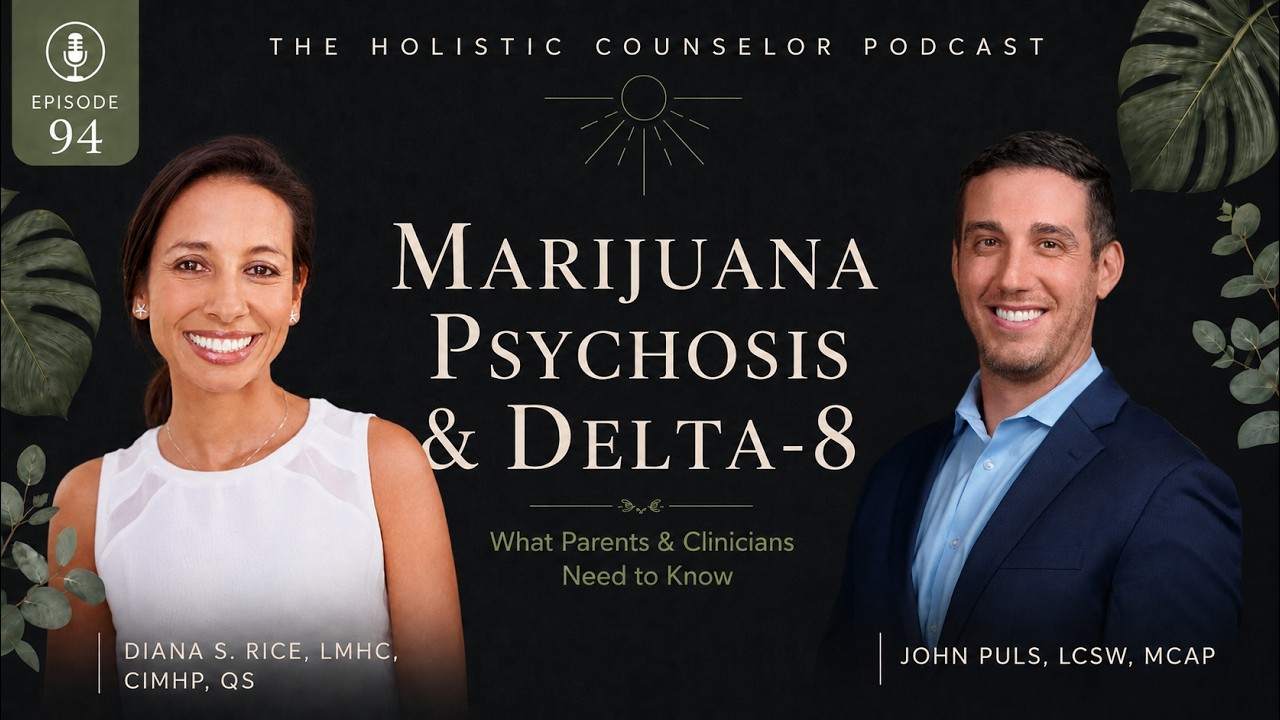
Episode 94
Marijuana Psychosis, Delta‑8, and Teen Mental Health — What Parents and Clinicians Need to Know
with John Puls, LCSW, MCAP
Hosted by Diana S. Rice, LMHC, CIMHP, QS
Marijuana today is not the same as it was decades ago. In this critical episode, Diana S. Rice, LMHC, CIMHP, CTP, QS, sits down with John Puls, LCSW, MCAP—addiction expert, professor, and co‑founder of Full Life Comprehensive Care—to unpack the rising crisis…
Listen to the Episode
Press play when you’re ready.
Educational content only; this podcast is not therapy, diagnosis, or medical care.
About This Conversation
Show notes
Jump to a section
Marijuana today is not the same as it was decades ago. In this critical episode, Diana S. Rice, LMHC, CIMHP, CTP, QS, sits down with John Puls, LCSW, MCAP—addiction expert, professor, and co‑founder of Full Life Comprehensive Care—to unpack the rising crisis of THC‑induced psychosis in teens and young adults.
Drawing from both professional and personal experience, Diana shares her journey from teenage marijuana use in Broward County to her later trial with medical marijuana—and how it affected her mental health. Together, they break down the difference between traditional cannabis and today's lab‑altered THC concentrates, including Delta‑8, dabs, vapes, and edibles.
Whether you're a parent, clinician, teacher, or someone navigating your own recovery, this episode offers essential education, compassion, and real‑world tools to protect the next generation.
Listen Now
- Apple Podcasts: https://podcasts.apple.com/us/podcast/the-holistic-counselor/id1732149496
- YouTube: https://www.youtube.com/watch?v=ssTwH8qi9uw
- Spotify: https://open.spotify.com/show/6TesqwMwiVYTeS0Ns9nMLo?si=a2588b2f57ef4b0e
About the Guest – John Puls, LCSW, MCAP
John Puls is a Licensed Clinical Social Worker and Master's Certified Addiction Professional. He is the Co‑Founder and COO of Full Life Comprehensive Care in South Florida, an adjunct professor at Florida Atlantic University, and an expert witness for legal cases involving substance use, addiction facilities, and mental health.
Specialties include:
- Substance use disorders & co‑occurring mental health disorders
- Cognitive Behavioral Therapy (CBT) & Motivational Interviewing
- Family Systems Therapy & Trauma‑Informed Care
- Forensic reviews & expert witness consulting
Learn more at https://full-life-comprehensive-care.com/
What We Discuss
- Diana's personal story: from early marijuana use to medical THC and recovery
- The difference between old‑school cannabis and today's high‑potency THC products
- What cannabis‑induced psychosis looks like and why it's often misdiagnosed as schizophrenia
- How vaping and concentrates drastically raise risk for teens
- The neurological impact of THC on the developing brain
- How clinicians can respond even if they don't specialize in substance use
- Educating parents, teachers, and communities without shame or fear
- Preventing clinician burnout while working with complex cases
- The role of early prevention and informed consent in schools and homes
- Practical tools and resources for healing, regulation, and resilience
Mentioned Resources & References
- Full Life Comprehensive Care – https://full-life-comprehensive-care.com/
- Every Brain Matters – https://everybrainmatters.org/
- Johnny's Ambassadors – https://johnnysambassadors.org/
- SAMHSA (Marijuana & Mental Health) – https://www.samhsa.gov/marijuana
- CDC Marijuana Health Advisory – https://www.cdc.gov/marijuana/health-effects/index.html
- Florida Department of Health – Medical Marijuana Program – https://www.flhealthsource.gov/mqa/medical-marijuana/ (original link no longer available)https://knowthefactsmmj.com/
- National Institute on Drug Abuse – Cannabis Research –https://nida.nih.gov/research-topics/cannabis-marijuanahttps://nida.nih.gov/search/cannabis%20?sort=_score&language=en
- Episode 88 with Mark Astor
Key Quotes
"Some of these kids get Baker Acted and come out with a schizophrenia diagnosis—but what they're really experiencing is a substance‑induced psychotic episode." — John Puls
"I tried medical marijuana thinking I was doing something holistic—and instead, I became more anxious, detached, and dysregulated." — Diana S. Rice, LMHC
"Parents don't realize—Delta‑8 isn't your backyard weed. These are ultra‑processed, ultra‑potent THC chemicals. One hit can alter a developing brain." — John Puls
Connect with John Puls
- Website: https://full-life-comprehensive-care.com/
- LinkedIn: https://www.linkedin.com/in/john-puls-800261123/
- Instagram: https://www.instagram.com/full_life_cc/
Related Episodes
Subscribe & Share
If you found this episode helpful:
- Leave a review on Apple Podcasts
- Share it with a parent, educator, or fellow clinician
- Follow and tag: #throughthevalleytherapy #theholisticcounselorpodcast #transformedmindcc
Podcast Mission
The Holistic Counselor Podcast bridges faith, science, and holistic healing—challenging stigma, equipping listeners with tools for growth, and encouraging trauma‑informed conversations across diverse communities.
Episode transcript
Read the full transcript Close transcript
Automatically generated from YouTube captions. Names and wording may contain errors; listen to the episode for the original conversation.
Hello there, fearfully and wonderfully made humans. Welcome back to the Holistic Counselor Podcast, where faith, science, and holistic healing intersect. I'm your host Diana from Through the Valley Therapy and Transform Mind Consulting and Coaching. Today's episode is one I've been holding in my heart for a while.
We're diving into a topic that's becoming increasingly urgent for parents, therapists, teachers, and really anyone who cares about mental health in the next generation. I'm honored to welcome John Ples to the show. John is a licensed clinical social worker, M's level certified addiction professional, and expert witness who's been working in the trenches of substance use and co-occurring disorders for over a decade.
He's the co-founder and COO of full life comprehensive care here in South Florida. He's also an adjunct professor at FAU and a fierce advocate for systems level change, especially when it comes to addiction treatment, community care, and traumainformed mental health. I first met John at a legal training in VOCHA.
Actually, I think I met you before that because we run in the same circles. So, but I I remember you speaking alongside Mark Aster and and Mark Aster I interviewed on episode 88. I've also attended his fulllife events in Fort Lauderdale. And let me tell you, John's heart for this work is undeniable.
His expertise and boots on the ground experience are exactly what we need right now. So, why are we talking about marijuana and psychosis today? Well, let me take you back. I used to work with teens and while I don't anymore because those cases became incredibly heavy, what I was starting to see during that season shook me.
More and more adolescence were being bakered. They were misdiagnosed with schizophrenia or bipolar disorder. But the real culprit, cannabis induced psychosis. And not the old school weed from the 80s. We're talking about labal altered high potency THC, Delta 8, vapes, edibles, and medical marijuana cartridges.
Products that look sleek and harmless, but are hijacking the developing teenage brain and triggering mental health spirals no one saw coming. I say this not just as a clinician, but someone who's been there. Listen, I smoked pot and a lot of it in in the 80s, okay?
And in 2020, and I stopped for a while, and in 2020, during a high stress season, I gave medical marijuana a shot, thinking it might help. At first, it did, but then it wrecked me. Anxiety, disassociation, physical symptoms I couldn't explain. And that was me as a grown woman with a regulated nervous system and tools.
So, imagine what this is doing to 13year-olds, 15year-olds, and 17year-olds. And this is why I asked John to come on the show because too many clinicians, including me, at one point, parents and community leaders still think this is just 1900's weeds from the 1900s.
But what's on the market in this day and age is not the same plant. And the mental health consequences, particularly for teens, are so real. So, if you're a clinician seeing this in your practice, if you're a parent wondering what's happening to your kid, and if you're a community leader trying to understand how to respond, this episode is for you.
John, thank you so much for being here with me.
Thank you for having me, Diana.
All right. So, let's start with you and your story and uh you know, after hearing my introduction.
Yeah.
What's what's going on? What are you seeing? What's happening? How did you end up here at full um full life comprehensive? And what are you seeing without throwing anyone under the bus? AB:
Absolutely. Of course. So, I started my career actually working um at a Baker Act receiving facility. So, crisis stabilization unit. That was my first job in the field. So, people that are coming in in crisis. And I also at the time was doing some case management for a lot of folks um that had been through various Baker Act receiving facilities.
And that is when I encountered my first case that I was aware of of cannabis induced psychosis. And so I remember I was working with a young man um who had come down to South Florida for treatment which is a very frequent occurrence.
And I was speaking to the psychiatrist and he explained that although he had a diagnosis of schizophrenia that it was brought about by cannabis in this particular case because of course you know there's essentially a couple outcomes that can happen when somebody has cannabis induced psychosis whether it's an adolescent or young adult.
They can either return to a baseline. So after an initial psychotic episode um give it 12 hours, 24 hours, 48 hours, they return to a baseline and it's more or less as if nothing happened. It can be very traumatic obviously, but they go back to a normal state.
Um and then there are other cases where the psychosis can persist and sometimes uh the individual will still go back to a baseline maybe after let's say two three months. And then there are cases um unfortunately where I've seen people have and develop what's called a persistent psychotic disorder.
So something like schizophrenia. And this is what happened to that young man. And I'll be totally honest. When I first heard the psychiatrist explaining it, I didn't believe him.
Exactly.
Right. And because in my mind, I'm like, well, that's not the pot that I consumed. Right.
Like I don't know anybody that experienced psychosis when I was, you know, uh using cannabis um in like, you know, early 2000s. and um you know I was in high school and and so it didn't really make a lot of sense to me and so again candidly I didn't really believe him and then I started looking up the research speaking to him more and really seeing the intense struggle about this and then and then more and
more I started seeing cases and you know I I tend to have a bit of a you know obsessive personality so when I when I see something that's like interesting and I can't understand it like I want to research it more and then all of a sudden I started seeing all these families and all these cases that have been impacted by it um due to the cannabis of you know this era.
Yeah. Yeah. John like and I think a lot of people still don't understand that because I worked with some Listen I mean back in the 1900s Yeah. I'm that old. Uh yeah like I remember like it was the THC. I mean because that's what it is.
It's the THC and many people don't know.
And so you have like say the the hippie parents that smoked pot back then and now they're oh yeah what's one one joint smoking with my par well first of all it's illegal but you know what I mean by that right we live in a society that you know alcohol and marijuana are seen as let's have fun and party and I I mean I remember in high school and stuff like that but they're not noticing that
the stuff that's coming out of these uh dispensaries are so strong and what I'm seeing too is they're smoking the the you know the the the cartridges and and taking in hardcore THC like 90% because back in the day it was like 4% or something.
Then they're playing video games all night long. Many of them. I'm not saying all it it's just like a perfect hurricane.
Yeah, it really is. It really is perfect hurricane. And I want to talk about the um THC percentages for a moment. Right. Please.
Yeah. because so a lot of the earlier research so they did a lot of research um in the 90s about um medical marijuana that's when it was first became popular it was first legalized um for medical use in California and a few other states basically the what states do across the country is they first legalize for medical and then there's an eventual push to legalize it for recreational right
and so the research they did
um in the purported health benefits and mental health benefits of cannabis the THC percentage was between 2 to 5%. Right.
And so that was what all the research was based on was that lowd dose THC.
And so to your point nowadays you would be hardressed to even find uh any type of cannabis that has 2 to 5% THC whether it's in a medical recreational dispensary or frankly even bought illicitly. You're not going to find that. That's not what is being sold.
And so, and it actually,
so the concentrates, which are the cartridges, um, is, you know, it's essentially oil that's being vaporized. And those percentages can actually be all the way up to 99% THC.
Oh my gosh. Wow.
And, and in particular, when it gets that high, people are often using what are called dabs, which are it's essentially like like almost like hardened oil that you need a specialized device to use really
um called the dab rig. And so when it's that concentrated, that's when you're seeing those really severe adverse effects. And and I think what's the most tragic is that the real adverse effects you see in adolescence and young adults. I appreciate the experience you shared about when you decided to look into medical cannabis in in 2020.
And while adults right let's say over the age of 30 certainly do experience adverse effects and they you know cannabis induced psychosis can absolutely happen um you know into you know adulthood middleage um older adults but it's much less common where we see most people having this type of psychotic break are really adolescences and young adults.
Yeah. I mean yeah because let's talk about that a little. Well, first of all, you're teaching me something because even though I worked with, you know, even even though I worked with teenagers for when I came back to being a therapist. Okay, so I came back to being a therapist in 2018.
So I worked as a as an adolescent uh counselor in schools
and then I stopped around 2012 and then came back in 2018. And so when I came back in 2018, all those years, so much stuff happened and I was still learning about what was happening, you know, even though I had my own kids and my own teenagers and my own teenager and stuff, but I don't know it all.
You know, you have to be like, I'm not in the substance use world, okay? That's not the kind of therapist I am. This is why I go to you guys' stuff all the time. That's why you see me at every sing Well, first of all, I want to get out of this office.
Second of all, I need I love to learn. I'm like you John like when I interested I go into these rabbit holes and I want to know the real science behind it.
I want to understand it so I in case someone comes to me I can help them right because like to me I'm going to be like no go to John go to John if if parents come to me or you know our community that we have together here in South Florida but the the the marijuana that okay you said dabs and you explained it a little.
Can you explain it? Because this podcast actually uh many people in churches and in the BIPO community, black, indigenous people of color, I have parents that listen. I have many people from all walks of life that might not even know any of this, right?
They don't know any about this and they're just thinking, "Oh, no." Some of them might be like, "Oh, no. That's just, you know, they're possessed by the devil." Okay? Or something like that. Or they're just like, "No, not my kid." You know, like he would never touch drugs.
Yeah.
Okay. So, can you explain a little more about all these um like the cartridges, Delta 8, all those things, whatever you know, can you please explain it to my audience? Like it's the first time you've ever heard of this?
Yeah. Yeah. Absolutely. So, so the first thing I want to break down is um really the the difference between medical and recreational, right? So the first thing I want to say is that medical cannabis does not mean safe, right? So it's the same product whether it's medical or recreational.
And basically what you have is a combination of what most adolescence and adults call flour, right? So that's that would be the traditional we'll call it marijuana classic, right? So that's the typical the dried buds that you put in a bong, roll in a joint, whatever it may be.
And typically the flower is lower dose THC but not low dose, right? So, you're still going to have a THC percentage with the traditional cannabis flour of anywhere from like 40 to 60%. Um, maybe on the lower end 20%, which is still very high historically.
And then you have the cartridges. Now, the cartridges are, you know, basically the size of a thumb drive. Very easy to conceal. Um, the odor that's uh eliminated from those devices is much less than flowers. So, you know, a lot of adolescents prefer that because you can more easily conceal it.
And then we have a then the edibles obviously which have different and those can be, you know, brownies, um, cupcakes, gummy worms, whatever it may be. They can basically be put into anything. And and what I'm seeing a really high amount of use of are what are called the concentrates.
So that is the dabs. It's often referred to as like shatter or butter. And it almost looks like glass. Um, and it's what it is is it's concentrated THC that cannot be smoked in a normal way, right? So, let's say, you know, you can't put it into a bong.
You can't roll it into a joint. You have to use a specialized device called a dab rig. Okay.
And basically involves like heating up a piece of metal, melting it a little bit, and then smoking it.
And then
it's like crack from the 80s.
Yes, it is. And And it's funny that you mentioned that. So, um, I do a lot of crisis intervention work and I've actually seen this being used and it doesn't look like any cannabis. Like if you picture somebody using cannabis, you don't picture this at all.
Okay.
And um and so it's very very concerning um because of the concentrates. And then so you know then so that that's basically a general overview. Then we have delta 8.
Yeah.
Um and delta 10 and THCA. Right. And all these are are derivatives of hemp. So quick distinction. So in 2018 there was what was called uh the 2018 farm bill. Okay? And that basically fully legalized hemp for production. Now if now traditionally hemp if it's a hemp or what's called CBD product, right, which is very commonly used, it should be less than 0.5% THC.
Okay? So if it's less than 0.5% THC, for the most part, it's really not psychoactive. Meaning you're not going to get any type of into intoxicating effects. But with delta 8, delta 10, and THCA, they've been able to derive it from hemp while still having the psychoactive effects of THC.
So, so what that created is essentially a loophole. So Florida is actually a perfect example to explain this loophole. So, we are legal currently, although there's been a big push to legalize for recreational. We are currently only legal for medical, which means loosely that you have to see a medical doctor.
You have to be over the age of 18 and you have to get, you know, a card or prescription.
I had a license,
right? A license, right? And I'm sure if you I'm sure if you're familiar with the uh the process to get that license, right? It's not exactly very sophisticated, right? Well, honestly though, I I want to say something because I do I do and this is where we're going to have to really talk about this
because it's not going away. All right, and and us becoming tea totallers or abolitionists. I I get it.
More things are coming.
Okay, this is, you know, we got fentanyl crisis. We have so many different situations. And to me, I know with medical marijuana, if it's done responsibly, I guess I haven't really met someone yet, but my doctor was uh adamant not to do it.
And I said, "Well, I don't want to take a prescription pill." And this is why for my anxiety, she's like, "Well, I can." And she goes, "I don't feel like, you know, do you know what I mean?" Because this is the thing. It was just because I'm a very much of a naturalist.
And to me, I was thinking marijuana grown from the plant. I wanna I'd rather do that than go on um benzo for example.
Sure.
Right. But then but we have to let the audience know that anything could be an addiction.
Right. Oh, absolutely. And and I want to say that there are plenty of adults who responsibly use medical cannabis and experience little to no adverse effects. That is absolutely true. And I and I don't want anything I'm saying today to be in conflict with any of that.
So I I completely agree. I just think it's um it's important to know that
the adverse effects we really see with young people, right? And and that's for a whole host of reasons that we can get into, but to kind of put a bow on the delta 8, right? So there's, you know, the medical recreational, but so delta 8 falls into a loophole.
Delta 8, Delta 10, THCAC. So, it doesn't need to be regulated by a medical marijuana dispensary. It can be sold [clears throat] completely legally. Right.
I see them all over the place.
Right. Oh, yeah. And if you go down to the Keys, for example, I mean, they have entire stores that are just Delta 8, uh, Delta 10, THCA stores. And now there have been some states that have made, uh, that illegal. The issue obviously is it's completely unregulated.
So, you really don't know what you're getting at all. Um, and so that's but that's essentially like the breakdown of all of it, the different types of products.
Yeah, thank you for that because you just you just learned me. You just taught me a lot. And that's why I mean I I like I said like I I get a lot of information from all these CEUs. Even though I don't need them all, I just go because I want to be up todate with everything just in case somebody comes in and I'm like, "Okay, I can't help you, but here is somebody that can."
I you know I don't want to have this like fear in case there's parents like oh my gosh oh my god you know because I know I'm a parent I have I have four kids and I have six grandchildren and I get it and and this is what my biggest my it's not fear that I have I want to educate it's informed consent it is understanding because this is how I raised all my kids right because
it is not about sheltering them it's about filtering them to have an understanding Here are the choices that are going to happen in middle school.
Here are the stuff that can happen in high school without taking away all their innocence. Age appropriate, right? But because I know what I've seen and I you're you're in it. You're I mean I remember we were supposed to record and you're like, "No, I have a crisis, Diana.
We have to redo this." I'm like, "I understand completely. I was hoping when 12 o'clock I'm like, "Oh, is he coming today?" And I'm so grateful for you being here because many of you that I I know personally are in it. You are in the trenches.
How do we prevent? Because it's not about taking it all. Honestly, how are you going to take this stuff? We're not. Every every it seems like every generation has their crisis of of drug addiction and alcohol and every any addiction, honestly. How do we help now the next generation?
John.
Yeah, that's a great question, especially considering, you're absolutely right, this isn't going anywhere. In fact, um it's probably going to be uh continue to be legalized in, you know, kind of greater scale and and and more and more access. And so, prevention is huge.
And I've actually had the privilege of speaking at a lot of local high schools. And I remember the first time I was asked to speak uh I was reluctant because my assumption was that the school wanted me to come in and do DARE 2.0 I know, right?
And and it's not effective, right? So, I mean, we we know this based on research, DARE is not an effective um
for those that don't know what DARE is, can you explain it a little?
Yeah. Yeah, sure. So, there's this big campaign um that I recall very specifically in high school that was basically like dare to resist drugs, right? So, they would do these skits um like involving drug dealers and police. So, it was mainly a law enforcement thing, which is interesting.
So they really wouldn't have clinicians that would facilitate any of this. It was mostly like law enforcement and school officials. And they would try to dare kids to resist drugs and violence, right? That was the idea. And you know, it's a good idea in theory, but the methods that they used were mostly to try to scare kids into not using.
And they would use these like this extreme hyperbole, these crazy scenarios, and these things that ultimately weren't true. And kids could see through it, and they knew it wasn't genuine. And so when I was first asked to speak, I said, 'Look, I'm happy I'm happy to speak, right?
You know, like I I'm happy to speak to the students, but what I won't do is come in with any type of like scary straight method. I'm going to like give like comprehensive education and speak to them honestly. And what I found is that
kids really were really interested when I took that approach, right? I wasn't talking down to them, wasn't talking at them, wasn't criticizing them, wasn't trying to scare them. It was more just like, hey, like these are the facts. These are the outcomes. These are what people use.
And and I think that's much more beneficial. Look,
I think many people for for years have viewed some type of experimentation with substances almost as a right of passage, a normal part of maturation and moving into adulthood. And and perhaps that's true, but the risks of that are different today.
And so I think that to your point of informed consent, my goal when I do a lot of these talks or these presentations because I do I do a combination of both like professional like CE events and then also more community based presentations for like parents and families uh through NAMI and stuff like that.
And so so my goal is always to educate, right? It's not it's just kind of like lay the facts down and you know for families and and people and and kids as well adolescence to observe. so that they can make informed decisions because if you don't know, you don't know,
right?
And and even, you know, from like a harm reduction standpoint, right? When the the feedback that I've gotten from high school kids is they've said, "Hey, you know, one of the things I really took away from what you said is I'm going to stay away from the dabs, the concentrates.
I'm going to be really mindful at what percentage THC I'm using because that's really where we see the adverse effects. It's not necessarily that like um you know lowd dose cannabis is is harmless but it's much less harmful than the high potency cannabis that are that's used more frequently today.
Yeah. Okay. So, how like and I hate to say it this way, but like how old do you think a parent like say my kids are listening, right? Because I have grandkids and um because to me I'm always like from birth you start all conversations from birth and they're like uh yeah, no that's that's not happening.
But I think it's just because of, you know, how I am and and my past experience because honestly, let's talk about this a little bit. I mean, you say you remember when you were an adolescence. I remember when I was a a teenager here in Broward and how I started smoking marijuana.
Like, I come from a background that uh I felt safer at school than at home.
Okay. And I had a lot of anxiety and I'm in middle school. I want to be accepted. And guess what? Someone said, "Here, try this." And I was I'm still curious person, but I utilize my curiosity in a better, healthier way now, you know?
But this is what we see, right? A right of passage, a right of like, and no one ever talked to me. The DARE stuff, I would look at that going, "What?" You know, like, "Are you kidding?" Like, "Here's your brain. Here's your brain on drugs.
Any question?" Do you remember the fried egg commercial?
Oh, yeah. Of course. I actually use that video in the presentation on presentations I do, right? To show like what not to do in terms of education and prevention.
Yeah.
Okay. I mean, and I was never even though I had anxiety and I was fearful of some things, that never scared me because what marijuana did to my system made me feel so flipping good,
right?
Okay.
Yeah.
I had no tools set. I had no, you know, I didn't know about health and wellness and exit. They don't teach this stuff at school. like they should, right? Can you imagine if schools were taught of fitness, finances, food?
Yeah. Oh, it'd be incredible. Yeah.
Right.
So, let's talk now what's happening now and what you're seeing in in the future of of prevention. like if you were able to really shift and change things to help these young people to understand because who knows maybe there's a teenager listening right now and they're smoking and and I I actually work with adult um I have a few adults that are smoking medical marijuana and they want to quit and so we are utilizing different methods in order because like just like alcohol does something for a person, right?
How do we how do we prevent it? What do you think would be helpful? And and what age should a parent start talking about this stuff? What do you think?
Yeah. So, what I always recommend I mean, so obviously age appropriate discussions, but I think that where we really see B, it's based on research, the most frequent introduction to these types of substances is generally junior high, so sixth, seventh grade. So that's typically like the age is that I recommend having more like serious and direct like honest conversations.
And the first thing is kids are really smart. Yeah, they are, right?
You know, so don't come in with like any type of like crazy like scenarios. Just like be honest.
And the truth is even if they're not using at sixth, seventh, eighth grade, they probably know some people that are, right? And so they're going to be exposed to it. Yes.
And and so what I always like to say is that like look in terms of like educating that that's the age group for sure and what I would love to see is more schools implement more comprehensive education around these substances but I think that they're so concerned like there's this fear that if you talk to kids about it then that's going to peique their interest and they're going to do it.
Yeah. C it's the same with sex like sex drugs and rock and roll. Do you talk about any of those things? You think you're going into all these different wormholes.
Yeah. Well, I mean, I think the real fear, too, is like and and parents feel this way in schools, too, is that if you talk about it, that's going to influence them to do it. But that's not really there's no evidence to suggest that, right?
So, there's no there's no correlation between, you know, they they give a sex ed, you know, class presentation, then bunch of kids go have sex, right? There's no there's no correlation between that. And and it's the same thing with substance use.
So I think the first thing is we have to remove this fear we have of having the discussion right it's okay to talk about it it's okay to talk about it at that age and then you know having people come in and give honest education and and resources for them to understand what the risks are you know and generally and again the feedback that I've gotten is that and from adolescence themselves is I wish I would have known
right I wish I wish I would have known that I could have a psychotic break, I could end up in the hospital, that I could have a panic attack. Um, you know, uh, there's something that's been happening a lot, too. It's called cannabonoid hyper emmesis syndrome.
Yes.
Um,
please explain that. Yeah.
Yeah. Absolutely. So, cannabonoid hypermesis syndrome essentially, it doesn't happen to everyone. Um, but the kids will often call it greening out, right? That's what they say, like always greening out.
And basically what'll happen is they have you know profuse vomiting and extreme stomach pain um to the point of and it's typically only during intoxication or or immediately following and then what ends up happening is you know they have these persistent stomach problems and they don't realize that it's directly linked to the cannabis use so they go to uh GI specialists they go to the emergency room and now doctors are getting a little bit better with it but they didn't used to screen for cannabonoid hypermesis syndrome.
So they didn't used to ask like hey are you you know using any high potency cannabis products by chance because this is the side effect and I remember a kid I was working with and he was convinced that the cannabis was the only thing that was helping his nausea and his vomiting and his GI issues.
Think about it. Yeah.
Yeah. And for some people it does.
Yes. Like cancer patients like I know cancer p and I'm like yes like that is that's what I mean like this is medicinal like it's a plant. I get it, but there's plants all over. And just because it's
it's just so frustrating to me because I mean people were like, "Well, cocaine's a plant, too." And I'm like, "Yeah, I get it." Like, and then indigenous people would utilize certain things and you have herbalists out there and I I understand the world, right?
I I my my family doesn't come from America, so like they taught me different things in different places. But they also said like it isn't about doing it every freaking day overdoing it and why are you doing it that
right? Why why is it and you're right like marijuana and nausea would go together.
Yeah. Absolutely. And and so again, yeah, I mean, I think there is um and and most um medicinal effects, responsible use of cannabis, which there's a number of different reasons, but that happens, you know, after the age of 30. Not to say that like, you know, no one should ever use prior to that,
but the reality is your brain's fully developed. You've hope hopefully developed some coping skills
and some other ways to regulate your nervous system. You're not necessarily using cannabis as a coping skill like you were using it in high school, right? Yes.
Um and and and to be fair, for some people it it does alleviate some emotional distress and and nervous system problems, but really the issue is like trying to find a balance between okay, yes, this can be responsibly used, but how and when?
because for most adolescents and young adults, it's very hard to see where that line is, especially if they don't have the education surrounding it. So to me, I'm hearing that education would be like the number one um resource, like the number one thing for and I agree because I I have to say my my four my four kids, they they're pretty well adjusted and I remember I was we were very open because of my past, right?
And what I learned. I mean, I'm an educator or a therapist, so you learn these skills and tools. And I also remember I didn't have that. So, I wanted to give that like I I had brochures and and and my youngest son's just like, "Mom, enough with the brochures."
Cuz I had a brochure for every drug,
you know, the free brochures you get from SAMA or whatever. Uh and absolutely. And so I would read through it with him and he's just like, you know, okay, people make choices and addiction is real. And I kept telling him, I kept telling like, you have addiction in your family. you have addiction like grandpa was this, you know, I'm this, you know, and and you have to be careful.
It's your choice now.
Absolutely. And then and giving them the power to have that choice. And I think what's so important to
for anyone listening to understand is that,
you know, giving people education allows them to make the choice, whatever that is. but also is somebody does not need to have an addiction or a substance use disorder to develop the adverse effects from cannabis.
True.
Right. And so, you know, and because I I see this happen a lot where, you know, the young man of the case I was describing, the first case I experienced, he would not have met criteria for a substance use disorder, right? Wow. He he was all he was doing was he was doing some like experimentation and one day used a really high potency product and went into a psychotic break um and didn't come out of it, you know, and had to be treated with antisycchotic medication.
So that may be an extreme example, but I think it's important again just from an education standpoint to understand the risks associated with it. This is not solely an issue that impacts people that would meet criteria for a traditional addiction.
Wow. So, say that someone's listening right now and they're like, "Yeah, I I I'm I'm doing it. I'm I'm, you know, and I'm addicted and I don't know how to get out of this spiral or I don't know I don't I want to know how what else can I do?
What's the, you know, what do you do right at um in your practice because this is let's talk about your practice a little so people understand you what you exactly do and and you know go ahead and explain what full life comprehensive care is.
Sure. Yeah. I'll I'll explain what it is and then I'll go back to the question if like somebody's listening and feels like hey this is me. So, um, when when my partner Brian Pagan and I, a business partner, founded Full Life, um, we had both worked in, uh, various residential impatient mental health facilities for many years.
And what we saw was a real gap in care for people discharging from treatment. You know, there's traditional outpatient treatment is you go to a therapist, you go to a psychiatrist, maybe an intensive outpatient, but um, you have to be self-motivated to go. you have to be stable enough to go and it's up to you to show up.
And what we saw was that a lot of people that had more severe and persistent mental health issues, addiction problems, really didn't have the skill set to even manage their own outpatient care, which was the expectation upon discharge. And so we do we do a lot of case management.
And what that looks like is it's based off of what's called assertive community treatment. So it's a targeted case management model where we go to the client in the community. Okay?
Right. So, so we provide the wraparound services, make sure they're getting to their appointments, they're taking their medication, they're getting to their therapists. We help them find jobs to get some purpose. We help them with budgeting. We we take them to different support groups in the area and help them develop like uh, you know, some type of recovery community.
And recovery, I use that term generally to be in both addiction and mental health. And so, some type of community as well as purpose through some type of vocation. and um and then maintaining their uh outpatient obligations like psychiatry and therapy.
So, we're kind of like a boots on the ground team to help facilitate the afterare team and um and then we have a team of outpatient therapists and then also which was unfortunately one of the reasons I had to cancel um uh the last podcast was we do a lot of crisis intervention work.
So, what ends up happening is a lot of families, they're in crisis, you know, they don't know what to do. They call mobile crisis, they call the police, um, you know, maybe they call an outpatient therapist and therapist is like, "Whoa, this is like, you know, um, I'm an outpatient therapist.
Like, I can't I can't help you with this." And so, what we can kind of step in is like navigate and triage uh the crisis um to help the person get to the right level of care. And um and we we tend to work with a lot of people that one would consider higher risk whether that be that risk due to be addiction or mental health psychosis.
Um but to your question earlier when you had mentioned about like so someone's listening to this and they say you know this really sounds like me I'm you know using every day I'm experiencing some negative effects. I think the first thing to understand um because this is a kind of misnomer that's talked about a lot where people say well you can't withdraw from cannabis right but that's actually not true
right no I I know I'm I I
I withdrew
you know and it may not look like u you it may not have the severe withdrawal effects from like alcohol use or benzoazipines where there's like seizure and and cardiac failure risks but the withdrawal effects can look like agitation, low appetite, weight loss, insomnia, anxiety, panic attacks.
Um some people even report getting hot and cold sweats like after they're stopping. So I think the first thing to know is that it's going to be, you know, it's not going to be an easy process.
I think it's really important that they find somebody to work with um that is familiar with this. um find that you know whether it's a therapist, psychiatrist, combination of the two that is willing to work with someone as they're trying to get off this because I mean what it was always hard is like there will be some you know therapists or psychiatrists in the area and I understand staying within your expertise.
I think that's really important but they'll say like oh you know I'm not going to work with you until you stop stop smoking and I'm like well like let's meet the person where they're at a little bit. If you're willing to work with somebody that has this issue know that they it may be a little bit of a process.
So, first thing is to find somebody that's really competent in working with that. And then, you know, you essentially want to try to, you know, implement some harm reduction at first, right? If you're not, you know, some people are like, they show up and they're like, look, I'm stopping completely.
I'm going cold turkey. Help me navigate this. And I say, great, we'll we'll try and work through it. Other people are not ready to go full boore like that. And so, what this can look like is, you know, maybe they stop the concentrates.
So they no longer use the cartridges and the dabs. They go to like more like traditional products. They try and limit the frequency that they use throughout the day. So kind of standard harm reduction techniques surrounding cannabis. Um and then and really to try and build off so what is motivating you to want to stop or reduce.
So build off of that motivational. So kind of classic motivational interviewing, you know, figure out what is it? Is it that you know you want to be more present with your family? you want to be more productive at work. You're experiencing some adverse effects that you don't like.
Whatever it is that's causing you to say, I want to make a change, build off that and use that to really start to taper off and eventually stop.
Okay. Is there um when you do these talks at high schools, are there resources you leave behind? Is there like websites or books or I I mean I don't know or that you give the families that you work with like what what practical tips or res I know with me now what helps me so much I have to have um bre breath work every morning and prayer and journaling and just being alone in nature.
I mean, there's certain things that I do now, especially breath work, like breathing and stretching and and just being connected with nature. That's what's helped me a lot with my anxiety now that I don't touch marijuana anymore, you know? And I still have people in my life and my friends like I grew up with like that we hung out and they they still do it, you know.
But to me, it's just like I I I guess I'm in a place where I'm like I don't want to be enslaved to things,
right? Because it does it becomes such a priority. It's an idol. It becomes an idol. And because I'm a woman of faith, so it's like, okay, why? And I had to go there with my therapist to get to the core of when did I start?
Why did I start? How how you know, how has it shifted? And where do you want to go? like you said, building off motivational interviewing and what what resources do you give your clients? Like what is it that you do without giving them everything because you know you want to be hired, but but it's also like you're only one person, John, and I'm sure you're busy.
So, so am I. And this is why I'm I have you on this podcast and why this podcast exists because not everybody could afford therapy. Not everybody can work with us, but everybody can do one positive thing for themsel.
Oh, yeah. Absolutely. And and I think so, a couple thing points I wanted to make. The first is that I think you're incredibly right that, you know, getting to the core of what the cannabis or substance that you're using was doing for you, not just to you.
Right? So, like what was your reason for using like what you know, what were you coping with? Incredibly important. And as far as resources are concerned, so there's there's several like totally free re resources about this um that really has like tons of information, education, free support groups for families.
Um it it's really incredible. So the the first one is called Every Brain Matters.
Oh wow.
Um and it was uh founded by this woman, Aubrey Adams, who's absolutely incredible. She does a ton of advocacy work. Um she had her family, she's very open about this. It's all on the website and everything, but she had her family torn apart um from cannabis.
Uh both her son and her husband um experienced some really adverse effects um then cannabis induced psychosis. And so she leads a ton of like you know there's tons of educational resources. She does groups all for free um you know they take donations.
They're nonprofit. And then uh there's a similar group uh called Johnny's Ambassadors and that is really more geared towards um cannabis induced psychosis specifically where they offer um tons of resources, support groups for family members and loved ones and you know because and if you think about it right these are these are not like necessarily small organizations but small membership.
So this is just it go it speaks to how widespread this issue is that there are like two organizations that I'm aware of and there's there's certainly more that really exist solely to provide families and people impacted with the resources um and education to really help them navigate this.
So I can't say and again they're two nonprofits and I've you know done some collaborative work with them in the past and and they're both excellent. Are they out of Florida or just national?
They're national. So, um I believe Aubryy's out of Colorado and
and I I think um I forget where Johnny's Ambassadors is out of, but all of it's you know, it's all done virtual.
Okay.
You know, the support groups and everything like that. And so, yeah, I can't say enough great things about the organizations.
Well, thank you for that. I'm going to reach out and see if somebody wants to come on the show to talk about their their nonprofits and and also yeah, I'll put that in I'll research and put it in the show notes. Well, before we end up saying goodbye, John, is there anything else like how are you taking clients?
So, for my individual case load, I am not. Um, but you know, but my and that that could change, but currently um I'm full with I got a lot going on. Um, but we have several therapists in the practice that also specialize in the issues that are supervised by me um that can absolutely work with someone with the types of problems that we've been discussing.
Okay. And so do you do online therapy throughout Florida?
Yeah, so it's online virtual throughout Florida. And then as I mentioned um you know the case management is more uh localized to Palm Beach County and Broward County. Okay. and um the crisis intervention work where we you know jump uh into the crisis so to speak um you know that can be anywhere in Florida as well.
Okay, good to know. And I'll put your um website on in the show notes as well. Well, I really appreciate your time on this subject. This is, you know, we could have probably talked about a hundred other things, but you know, because I wanted to bring up Baker Act and and the CEU I took with you and Mark, but Mark actually touched on it when I interviewed him.
So, I really wanted um people to understand marijuana psychosis and what's happening and that's a real thing and you know um many people don't take it as serious and and I and I get it like legalizing it. It's going to I have a feeling it's going to eventually happen here uh recreationally.
But the thing is like you couldn't make it illegal. People are still going to get it. I mean it it it's like yeah to me it's education and understanding and learning and giving people different tools right um to to be able to cope because most people I think start doing drugs honestly due to maybe like the top three things would be uh what curiosity um lessen pain and what else I mean Yeah.
So it you're right. It's it's curiosity less in pain and it's boredom.
Yes. That's it. That's in boredom.
Yeah. I mean that's I mean and less in physical emotional you know pain. I mean absolutely that's that's one of the primary reasons for sure.
Yeah. And I mean and addiction goes across all different kinds too. So it is it is is like John and I as as therapists and clinicians, we're just trying to first do no harm and second to give out the tools to help the human so they have a good life in a healthy way, right?
And so I really appreciate you coming on. Is there anything you would like to say to the audience um before we say goodbye?
Um no, I mean thank you for having me. I think we uh we really did cover everything and um always happy to answer any more questions. So, thanks so much for having me.
Ah, John, thank you for coming on and remember dear human, trust in the Lord, guard your heart and renew your mind. Bye. And now for the disclaimer to make sure you understand that you are responsible for you. The content provided on the Holistic Counselor podcast is for entertainment,formational purposes only and is not intended as a substitute for professional medical advice, diagnosis, or treatment.
Always seek the advice of your physician or other qualified mental health provider with any questions you may have regarding a medical or mental condition. Never disregard professional medical advice or delay seeking it because of something you have heard on this podcast. The views expressed on this podcast are my personal opinions and do not represent the views of any professional organizations with which I am affiliated.
Call your doctor, 911, or 988 immediately if you have a medical emergency. The holistic counselor podcast does not recommend or endorse any specific tests, physicians, products, procedures, opinions, or other information that may be mentioned on the podcast. Reliance on any information provided by the holistic counselor podcast, guests appearing on the podcast at the invitation of the holistic counselor podcast or other listeners to the podcast is solely at your own risk.
Confidentiality notice. If you engage with the holistic counselor podcast by commenting or posting and are a client, please be aware that you may be revealing information that could compromise your confidentiality. Please remember that disclosing your identity or personal details can be linked to your clinical material.
As a therapist, I am bound by confidentiality and will not respond to any disclosures of this type on this podcast. I am committed to upholding the ethics and confidentiality of the therapeutic relationship which extends to all forms of communication in accordance with the laws and professional guidelines that govern mental health professionals.
I want you to know that your privacy is of utmost importance and you are responsible for protecting it when interacting on this platform or any other public forum. Thank you.