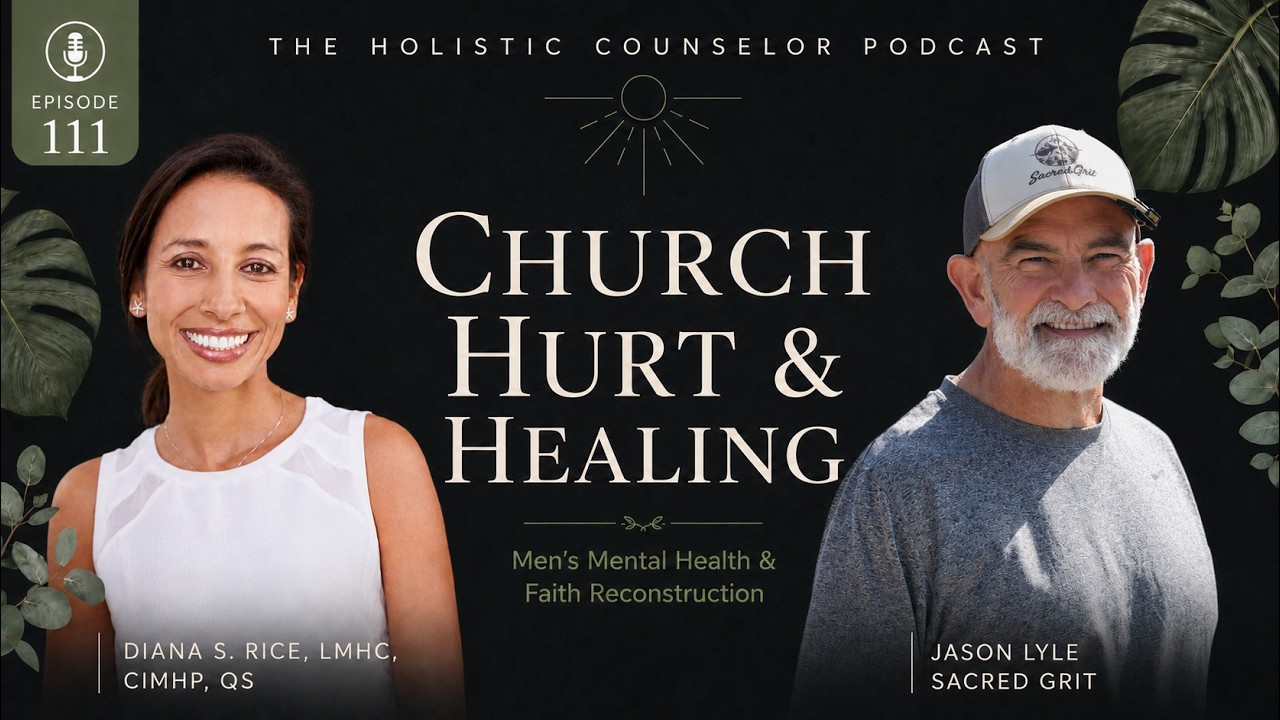
Episode 111
Men's Mental Health, Church Hurt, and Nervous System Healing
with Sacred Grit's Spiritual Coach, Jason Lyle
Hosted by Diana S. Rice, LMHC, CIMHP, QS
Hello there, fearfully and wonderfully made human. In this episode of The Holistic Counselor Podcast, host Diana S. Rice, LMHC, CIMHP sits down with Jason Lyle, founder of Sacred Grit, spiritual coach, and host of The Sacred Grit Podcast, for an honest and…
Listen to the Episode
Press play when you’re ready.
Educational content only; this podcast is not therapy, diagnosis, or medical care.
About This Conversation
Show notes
Jump to a section
Hello there, fearfully and wonderfully made human.
In this episode of The Holistic Counselor Podcast, host Diana S. Rice, LMHC, CIMHP sits down with Jason Lyle, founder of Sacred Grit, spiritual coach, and host of The Sacred Grit Podcast, for an honest and thought-provoking conversation about men's mental health, addiction recovery, church hurt, nervous system regulation, and faith reconstruction.
Jason shares parts of his personal story—from growing up in the Southern Baptist church, to becoming a pastor, to navigating addiction, shame, and ultimately stepping away from traditional ministry. Through that journey, he began exploring how nervous system regulation, breathwork, cold exposure, meditation, and embodied practices can help people create space between emotional triggers and destructive behaviors.
Together, Diana and Jason discuss why so many people today are wrestling with faith deconstruction, religious trauma, pornography addiction, and identity confusion, and why healing often requires both personal responsibility and compassionate support.
They also explore the connection between neuroplasticity, nervous system regulation, spiritual formation, and behavioral change, along with the importance of building a supportive team that may include therapists, recovery communities, coaches, and healthy relationships.
This episode may resonate with listeners searching for:
- men's mental health and addiction recovery
- healing from church hurt or religious trauma
- nervous system regulation and emotional resilience
- faith reconstruction and spiritual growth
- pornography addiction and shame recovery
- breathwork, cold exposure, and mind-body healing practices
As always, the goal of this podcast is to create space for honest conversations that help people grow in clarity, responsibility, compassion, and hope.
In This Episode We Discuss
- Jason's story: from pastor to men's coach
- Growing up in church and early exposure to pornography
- Purity culture and the impact of shame on identity
- Faith deconstruction and reconstructing spiritual beliefs
- Nervous system regulation and trauma responses
- The amygdala, prefrontal cortex, and impulse control
- Breathwork, cold plunging, and discomfort training
- Addiction recovery and behavioral patterns
- The role of discipline, accountability, and daily practice
- Why healing is rarely a quick fix
Quotable Moments
"Dysregulation is an attempt to soothe a trauma." — Jason Lyle
"When your feet touch the floor in the morning, take five minutes and do one thing that makes you feel radically loved by yourself." — Jason Lyle
"They still want to keep their faith… they still want to love the Lord and be in the Word, and it's like disentangling." — Diana S. Rice
"The goal of this podcast is not to give quick fixes, but to create space for honest conversations that help people grow in clarity, responsibility, compassion, and hope." — Diana S. Rice
Connect with Jason Lyle
Sacred Grit Website https://thesacredgrit.com
Sacred Grit Podcast https://podcasts.apple.com/us/podcast/sacred-grit-daily-nervous-system-tools-and-spiritual/id1611084095
Coaching and Retreat Information https://thesacredgrit.com/explore-coaching
Contact Jason https://thesacredgrit.com/contact
Adventures in Recovery (AIR) https://www.recoveryadventures.org
Books and Resources Mentioned
Dopamine Nation – Dr. Anna Lembke https://www.annalembke.com/dopamine-nation
Widen the Window – Dr. Elizabeth Stanley https://elizabeth-stanley.com/books-publications/widen-the-window/
The Body Keeps the Score – Dr. Bessel van der Kolk https://www.besselvanderkolk.com/resources/the-body-keeps-the-score
Waking the Tiger: Healing Trauma – Dr. Peter Levine https://www.northatlanticbooks.com/shop/waking-the-tiger-healing-trauma/
The Ragamuffin Gospel – Brennan Manning https://www.brennanmanning.com/books/the-ragamuffin-gospel
The Cosmic Christ – Richard Rohr https://cac.org/books/the-universal-christ/
The Sin of Certainty – Peter Enns https://peteenns.com/books/the-sin-of-certainty/
Internal Family Systems (IFS) – Dr. Richard Schwartz https://ifs-institute.com
Support The Holistic Counselor Podcast
If this conversation encouraged or challenged you in a meaningful way, please consider supporting the podcast.
- Leave a review on Apple Podcasts or Spotify
- Share this episode with someone who may benefit • Explore podcast merch and resources
The Holistic Counselor Podcast Merch and Support https://theholisticcounselorpodcast.com
Disclaimer
The Holistic Counselor Podcast is intended for educational and informational purposes only and does not replace professional mental health treatment, medical advice, diagnosis, or therapy.
Jason Lyle is a coach and spiritual mentor and is not a licensed therapist. If you are struggling with addiction, trauma, or thoughts of self-harm, please seek support from a qualified mental health professional.
In the United States, you can contact the 988 Suicide & Crisis Lifeline by calling or texting 988.
Episode transcript
Read the full transcript Close transcript
Automatically generated from YouTube captions. Names and wording may contain errors; listen to the episode for the original conversation.
Hello hello there fearfully and wonderfully made human and welcome back to the Holistic Counselor Podcast where faith psychology and holistic healing intersect. I'm your host Diana S. Rice, licensed mental health counselor from Through the Valley Therapy and Transform Mind Consulting and Coaching. And I'm so grateful you're here joining us for another meaningful conversation about mental health, faith, identity, and the journey toward whole person healing.
On this podcast, we explore the questions many people are quietly wrestling with today. Things like healing from shame, navigating church hurt, rebuilding faith after painful experiences, understanding the nervous system, overcoming addiction, and learning how our choices, habits, and relationships shape our mental and spiritual well-being.
Today's conversation is one I think many listeners, especially men and the people who love them, will find both honest and thought-provoking. Joining me today is Jason Lyall. Jason equips men to master their inner world when life feels out of control. A former pastor turned men's coach, he now works with fathers and men who want to break destructive cycles, rebuild their faith, and develop resilience through embodied practices that help train the nervous system, and strengthen personal discipline.
He leads Sacred Grit Retreats and hosts the Sacred Grit podcast where he explores themes around addiction recovery, responsibility, faith, reconstruction, masculinity, and the inner work required to rebuild life after hitting rock bottom. In today's conversation, I hope to explore Jason's story from ministry to men's coaching along with deeper questions many people are searching for right now.
Why are so many men struggling with shame, addiction, and identity? What role does the nervous system play in impulse control and emotional regulation? How do practices like breath work, cold exposure, and discipline affect the brain and body? And how can someone reconnect with Christ when their relationship with church has been complicated or really painful?
As always, the goal of this podcast is not to give quick fixes, but to create space for honest conversations that help people grow in clarity, responsibility, compassion, and hope. And if you find conversations like this helpful, one of the best ways you can support the show is by leaving a review, sharing the episode with someone who might benefit, or checking out the podcast resources resources and merch linked in the show notes.
It truly helps the message reach more people who are searching for healing. On that note, Jason, thanks for being here.
Yeah. Thank you for having me. I'm excited to be on.
Yeah, man. Okay. That voice. I I just have to mention the voice. Like I seriously, you never did uh voiceovers or anything like that.
No, no, never did voiceovers. I'm releasing my book. Uh I think it's going to come out like the end of April. And the name of the book is Sacred Grit. And it's kind of a memoir, like a short memoir. I tell people I wrote it so that guys could read it.
You know, most guys read like two sentence paragraphs are huge for most men. And so I wrote it really short and I was doing the or getting ready to do the audio book and somebody said, "Are you going to hire somebody or you going to do it yourself?"
I'm like, "No, man. I'm going to do it myself." Like I uh I I sometimes hear myself on a podcast. I'm like, "That I don't even recognize it." But uh yeah, I I get a little bit about my voice and uh you know, it's it's southern and uh I guess it's deep from what I understand.
So
it is it's like that that country singer I remember on American Isle way back uh back then when he had that deep voice and he would come out and we're all like, "Oh my gosh." So Southern Where are you from? Southern
Georgia. Yeah, born and raised in Georgia. How about you?
I was born in New York. I was raised in New York until I was 12 and then I came to South Florida. So I'm in South Florida now.
Oh, nice. Okay.
I had a New York I had a New Rican accent and it got beat out of me when I moved to South Florida back in the 80s and so I worked really really hard to talk like this.
I like it. I like it. You're doing good.
Thanks, man. All right, so let's get to the nitty-gritty because listen, I have a lot of listeners or and clients that are reconstructing their faith or deconstructing fully.
And that is something that I'm seeing more and more because if you research me, you know, it's I'm a Christian counselor, but I realize in the five years that I've had or almost six years, yeah, this will be the sixth year. um that I've had this private practice that they come in feeling safe because they're wanting to they know that I'm a Christian, but then I realized there's 45,000 flavors of Christianity out in this world and people don't realize that.
So they may come in with assumptions already
of like I'm there like I believe the way they do exactly right. And I do have a very I I've studied a lot and I continue to study because honestly I I don't know everything and I will never know everything. And my faith is is my own and I am a disciple of Jesus Christ.
You were a pastor. That's why I have you on the show because I don't get very many pastors that want to come on and have a real conversation because I will challenge the thoughts too.
Right. So, you know, I want to know if someone's searching why I left church but still love God, you know, walk us through your story. What happened internally and externally that led you from pastoring a church to building sacred grit and adventures in recovery?
Uh, yeah. So, that's a that's a big story. So, we'll just kind of we'll back it up and kind of start from the beginning, but we'll move through pretty quickly and that way we could give your your listeners a 30,000 ft view that we can hone down into the present moment.
So, the thing and I I'll just start by saying I think it was Socrates who is accredited with saying I'm the wisest man who ever lived because I claim to know nothing. And I think there's a a lot to be learned in that statement.
You know, we can study and learn and know, but at the end of the day, the God that created the heavens and the earth, the God that some call the universal energy, Christians call it Yahweh or or the Lord or, you know, Christ, that is much larger than our ability to wrap some sort of academic exercise around it.
So while we can know things about I don't know that we can ever fully know with our prefrontal cortex but we can certainly know with our autonomic nervous system and our lyic system and we'll get around to that here in just a little bit.
So I was born June 5th 1971 to Martha Joyce West. She was 15 years old. She had been she got pregnant by um Junior Ferguson is what they called him and he was 23 and nowhere to be found. And she was uh in high school and went to a home for unwed mothers to have me and then put me up for adoption immediately at birth.
And I two weeks later I was adopted by Bobby and Levandile who became my parents and who raised me. And over the course of the years, I mean, to me, I was just a normal kid. I mean, I just did normal kid things.
But as I got a little bit older, a few things started to show up. One was just this unbelievable infatuation with friends and friendships and needing connection. Uh, you know, and my parents, you know, just always needing to know they were there and, uh, an unbelievable capacity to talk.
Loved to talk. Um, still do to this day. I talk all the time, but there was also a spiritual curiosity. So, uh, December the 8th, 1979, I was 8 years old. I went down the aisle and got saved is what we called it back then.
I think they still do to this day. And I don't know that I still agree with the mode by which that happens in the church. But I do know for a fact that um there was something larger than me going on that day.
I remember the feeling very distinctly. I mean, I'm 54 years old, but I remember the day like it was yesterday. And right after that, I read the Bible all the way through for the first time at 8 years old. Um, I spent time with it.
My grandmother gave me a copy of the Living Bible. I don't know if anybody remembers that. Not the New Living Translation, but the actual living Bible. Uh, and it's where a dude translated the Bible from King James English into regular everyday languish English right in the subway of New York.
Actually, he did it on the way home from work every day. And uh so I read it all the way through. I became very spiritually curious and was spiritually curious and remained spiritually curious. So that's kind of a thread that's ran throughout my life um for a long time.
I found pornography the first time when I was 10 years old in my uncle's plumbing shop. And I've I work with men who are addicted and I've heard a lot of men talk about the first time they ever took a drink of alcohol and they'll say, "Oh my god."
And it was just like all of the sudden everything in me calmed down and for the first time the voices in my head slowed. And that's what I felt like the first time I ever saw pornography. Well, I grew up in a Southern Baptist church, so pornography and sexuality and spirituality just did not mix.
Like you
I mean, we were actually told that God curses men who masturbate. I mean, I had a youth counselor used a verse in the Bible about a man named Onan to shame us all over masturbation. So it it was uh it was it immediately forced my sexuality into a hiding place.
I really wasn't allowed to talk about it.
So right after that, I mean, I just got infatuated with girls and relationships and I had to have a girlfriend. I had to have a relationship. Well, this, you know, kind of kept going, manifest itself, and I ultimately got married at 19 years old.
Um, you know, I'm in love. I'm I just need this person in my life. And uh you know throughout that uh had multiple affairs. I mean I could just never be satisfied. I had needed to have more. And in 2003 four I started a church.
2003 I went to um seminary. 2004 I was 33 years old. I started a church and we called it the open range church. It meant in a barn on Tuesday nights. And we ran the horses out. I had 12 horses. We ran horses out.
We brought people in and then we took the people out and ran the horses in. And the reason why I did that was just like to this day I wanted to give men a spiritual platform. I felt like men were just kind of being left out of church in general.
Now, you know, inside of me, things had calmed, but I think looking back on that, I thought, well, if I'll just give my life over to God, then I'll quit having all of these behaviors. Well, of course, that didn't work. and and so you know and and being a pastor with a sex addiction is bound to be a recipe for disaster.
So I made it 13 years and in 2017 an affair came out and to be clear with your audience I never had affairs with people in my church. I just for some reason that was this line that I had.
Oh good. Well, at least you had a line, Jason, because listen, honestly, like I do because of what I do as a therapist, you know, and what I research, that is something that I see now happening in the Protestant movement more than anything.
Like all these people, not all these people, but a lot of pastors who
are falling left and right. I mean, Robbie, Zachcharias, I mean, just all this stuff is coming to it's like boiling up. everything is boiling up in in churches,
you know, and your story right now, like I'm like, "Oh my gosh, I have so many questions now." Like,
like, okay, you were raised Southern Baptist, and I don't want to put Southern Baptist down either because every denomination has people wolves and shepherds closing. That's how I say it.
Sure.
Okay. So, every denomination, every religion,
every new age, too. I mean, like, I've seen it. I've seen it.
Yeah. Beer yoga, same thing.
Right. Right. And so to me, you had a line. I love that you had a line. Even though, you know, you sex addiction when you talked about seeing porn the first time at 10 years old. The first time I saw it was nine.
Yeah.
In New York City. Like, you know, it's just like my mom is a single immigrant mom working uh full-time. You know, I can't blame my mom. I'm not going to be that victim, right? Because that's the thing. We can take our story because I think that's why we're vibing is because I'm like, "Okay, you get it.
I get it. We're both Gen Xers. We both have like that commercial that everybody uh at our age uh range wa watch like it's 10 o'clock. Do you know where your children are? Do you remember that commercial?
Yeah, the Wayne Williams years. Yeah, for sure.
Anyway, but your experience is in the South, right, as a white male in that culture. My experience is in the Northeast as a Latina immigrant, first, you know, generation single immigrant mom. And here we are. This is where I'm amazed.
I'm amazed right now, Jason, because like your story and I'm sorry I just because this is how I vibe and do is like I just start thinking questions that pornography and what I hear a lot from my clients, okay, men and women that come to me, what you just nailed is the purity culture vibe that many churches have done
to the to people high control religion. That's what I say. And I I I have to walk, you know, because I know what the word says, but then I'm like, wait, it doesn't say exactly that. That's the leadership that has utilized the word to control or to that guilt and shame.
The purity culture and the deconstruction that I'm seeing, Jason, like so much. And I want and they still want to keep their faith. You know what I mean? They still want to love the Lord and be in the word. And it's like disentangling.
That's what I call it. not deconstruct or disentangling,
you know. How did you you I'm still like with the pastor thing. Where'd you go to seminary?
Uh New Orleans Baptist Theological Seminary is where I studied theology and then I studied uh international community development at Oxford University. So the two degrees I have, one is about, you know, theology and the other is about application of said theology. So yeah, have a little bit of but in Oxford's pretty liberal, New Orleans not so much.
So I had a pretty good balance of theological understanding before I by the time I got done.
Yeah. And then the the whole Southern Baptist thing because I'm listening to your accent. My husband is from the South. He's a Southern Baptist preachers kid.
No. Nice.
He's the old Yeah. Well, I don't know.
He's really jacked up.
He is the oldest of the five boys and he was like the they you know what I mean? They they kind He he was like the one that ever I mean he married me like
Yeah.
And I'm his second wife. So
back to the addiction part because that is another thing that I'm seeing not only in the males
you know people think that that whole porn addiction there's some females out there too.
Sure.
And that shame and that getting married really really young because of the purity culture like oh because you're horny as a teenager. I'm just going to say it like it is. It's like okay. And so now you're thinking, I got to get married.
I got to get married. I got to get married because I'm horny. And then they get married at 18, 19, 20 years old. And by 26, 27, their brain's finally fully developed. And now they're either some some, not all, because some do work out.
I want to say that. I want to say, but some end up being like abused, raped in marriage, using the word of God. Like the word of God saying your body is mine. Now, I've heard it all in the last six years and I'm learning from these clients more and more and I'm reading books and I'm trying to keep my faith with, you know what I mean?
Because I'm just like,
sure,
God, like what is this? And I have to be reminded like, okay, humans, we all have the two wolves that we feed.
Well, the thing about the the thing about the purity culture and I mean by the time I broke out of of all this and I mean I lost my job and just directly went right back into the Bible and Thomas Burton and Richard Roar and all these you know um who's the dude who wrote the Ragam Muffin Gospel um I can't remember his name off the top of my he was a monk as well Catholic monk
oh Brennan Manning that's it so I started going into all these different works about grace and forgiveness and love and could God be bigger than our structures and I mean I just kind of started and I went into 12step programs you know I was told you're a sex addict and so I go into 12step programs and I just remember thinking man it's like I this just doesn't feel right I mean I not that I I thought
it was wrong I didn't at all but all the structure of it just still felt like somebody was constantly telling me that there's this way that if you just believe then you'll be right.
And I as for me I I started I saw I left the church. I started working on a farm trying to kind of get my life built back together. Still married. Um we're trying to fight through, you know, finding each other in a room that's on fire.
You know, there's smoke everywhere, but we're just kind of barely surviving. And
that rocks on for three more years. I had another affair at a job I had gotten. Lost that job and that took me to a place that brought me to where I am today. So I I after I lost that job, I went to work for a wilderness therapy program as a field guide.
Wow.
And so we were seven days in the woods, seven days off and working with kids. Most a lot of them have been adopted, strangely enough. And one night we come in off shift and they say, "Hey, you guys have a training tonight." And I was like, "Ah, man."
I mean, I've been in the woods for seven days and I smell like I've been in the woods for seven days. I've not had real food for seven days. Like, I just want to get out of here. But, okay. So, we go in this training and there's eight or nine of us in there and this guy named Rob Jent walks in.
And he's just this big jovial dude and he's like, "Have you guys ever noticed that, you know, our clients will have these just irrational behaviors, but they can't seem to regulate themselves? Like they'll just run away in the middle of 44,000 acres." I'm like, "Yeah, I have noticed that."
And he starts teaching us about the nervous system. And he says the reason why that is is because once the amygdala or the fight orflight system gets stimulated it takes over and they don't have access to the rational brain to the prefrontal cortex
and he goes into this old whole explanation around the science of it. And then he says uh is anybody in here adopted? And I said yeah I am. And he said well Jason I want to ask you something. He said if I told you that I love you and I want what's best for you what is the first word that comes to mind?
And I said And he said, "Exactly." He said, "Because you're living in the space of love and acceptance. You're living from a place of survival." And he said, "Survival is don't believe that because if you believe that, you're going to get hurt and that's going to threaten your survival because the first person that was supposed to love you gave you away."
I like, "That's pretty profound." You know, it's like this dude's reading my mail. So, a few weeks go by, a few months go by and my kids, you know, that time their adults had spouses of their own, still do. Um, but they found out and it was just a very, very hard time uh for your kids to find out.
And they knew about the one when I lost the church, but then they found out about this one and it was just really bad. And so I was laying on my left side in my bed in the middle of the afternoon planning my suicide and I had it all planned out.
It was very logical. It wasn't like a a woe is me thing. It was like just if you think about a dog that just keeps biting people and eventually it just has to be put down. That's that's how I felt.
And so I had the plan knew what I was going to do and I thought you know this guy Rob Jent let me just reach out to him before I do this and you know see what he says. So, I shot him an email and I mean I had nothing to lose, right?
I just kind of vomited it all out all on an email and he responds immediately. Now, this is a chief clinical officer of a national mental health company. I mean, he's based out of Arizona. He's, you know, no reason to respond to little old Jason Lyall, but he immediately responds.
He goes, "Yeah, Jason, I remember you." And he said, "Uh, let's let's have a call." So he booked a Zoom call and got on Zoom a couple days later and he introduced me to nervous system regulation. He started teaching me how to train my prefrontal cortex to communicate with my lyic system and how to let my lyic system communicate with my prefrontal cortex.
And he gave me some tools, cold water, breath work. Um he gave me some books, Dopamine Nation, Widen Your Window, Body Keeps the Score. I mean just all these Peter Lavine's book I could chase the tiger or something like I can't remember the name of it but
so I started reading but here's the big thing that happened I came home I had had that Zoom meeting at my wife's office cuz I we didn't have good internet we had like DSL at home we lived out so far out in the middle of nowhere and I came home from that meeting and filled the bathtub up with water poured in a bag of ice I brought home got all the ice out of the refrigerator and stood there with my clothes off going, "Well, I mean, I'm either going to do this or I'm not."
And so I got in and of course when I got in, every alarm in my body went off. But Rob had told me, he said, "When you get in, your lyic system is going to fire off and the prefrontal cortex is going to go offline."
He said, "But give it about 20 seconds and that it'll come back online." And sure enough, at about 20 or 30 seconds, it did. And there was like the only way I know how to describe it, the way that I try to explain it to people is it was like all of the sudden, all of the theology, all of the psychology, all of the, you know, recovery work, all the things that my therapist had said, all of the things my sponsors had said became very real.
It was as if all that information that had been stored up in my prefrontal cortex and the only word I know to use downloaded into my body. And so the next morning I got up and went out on the front porch and did a few yoga poses that I knew and started doing the breath work is tumo breath work made popular by Wimhof, but it's thousands of years old.
Did the breath work and just continued to connect that prefrontal cortex to the amydala. And I thought this is absolutely freaking amazing. Like I I don't even know. I mean I would find myself doing things like cuz I was a terrible liar. I would just lie for just know just to make people like me more.
Just lie. It's adopted kid thing. Most of them that I know do that.
And I would find myself about to lie and I'll go what am I doing? Like I don't need to lie. Or I would lie and I look at the person go you know what I was about to tell you a lie. Hang on a minute.
Let me change that. And I'm like what in the hell is that? because I have never had the ability to pause like that. And so then I started sharing it with other people. So my I have a my my best friend um he grew up in abusive foster home.
He was punished with food. Um just all kind of trauma from that and he started experiencing the exact same thing. He say dude this is unbelievable. And then I started sharing it with people who were struggling with addiction. And so uh his name is Chuck.
Chuck and I started Adventures in Recovery and we started taking guys on backpacking trips and I mean we're just going out in the woods for four or five days and teaching them how to breathe, how to get in cold water. I started integrating yoga and meditation and we started seeing people go, "Oh my god, this is unbelievable."
But a huge turning point in this, which is really where sacred g grit came from. I had a guy who uh Chuck knew and he had lost his son to a tragic death, a UTV accident. The UTV rolled over on him, killed him, and his wife, he and his wife weren't there, but they saw the aftermath and he just couldn't get his life back together.
I mean, he owns a law practice that has four locations and
just a successful man, but I mean, he was just coming apart. And at the time, his son had been dead for I want to say two years, but he was still just could not get life back together. And so I told Chuck, I said, "Well, let's let's go hiking with him."
And so we take him and another guy who had lost a son out on a hiking trip. And you know, as we go in, he's just telling me how bad it is and, you know, how hard life is and you know, his marriage is falling apart and he's on medication and he can't make it through a work day without coming undone.
And so I taught him cold water, immersion, breath work, yoga, and meditation. And to this day, I I tell people this story. He's one of my best friends now. He was just up here. I live in the mountains of Georgia. He's about two hours away.
He came up. We did this ridiculously difficult hike a couple weeks ago. We've been friends for three years now. But he sent me a text on the way home from that hiking trip. He said, "I don't know what you did to me, but all I want to do is go home and put my life back together."
Wow.
So he started on this track of learning nervous system regulation. But the thing that I learned, I'm going somewhere with all this. I know I'm talking a lot. I told you I did. Remember?
And that's okay, Jason. I'm I I would I if I didn't like what you were saying, I would cut you off.
When that nervous system opens, there's opportunity.
And that opportunity is that I can take the information that I have and integrate it into my actions. But if I don't have access to the information, then I'm not going to change my actions. So, I also encourage therapy. I encourage 12step programs, but I also encourage I coach guys, but my coaching is mainly around nervous system regulation and theology.
Like there's mo I deal with a lot of guys that have some terrible theology. And so, you know, a lot of people say, "I don't believe in God." And I'll say, "Well, tell me what God you believe in or you don't believe in because chances I don't believe in that God either, you know, so let's talk about that."
So, I have a lot of guys that are struggling through their spiritual life.
Yeah. And so that has turned into sacred grit which sacred grit is you know at the very it's a it's an ecosystem right there's the podcast which I give away everything for free anybody can listen to my episodes of podcast every yeah everything I got right it's not
and some episodes and I made a dollar
I think I'm 112 and I'm not holding anything back
and then I do coaching one-on-one coaching uh I'm about to create a nervous system 101 school course that people can access and pay a onetime fee and they'll get 10 mo or 10 video five modules,
okay?
Teaching these practices, uh, do the coaching, do retreats, and writing books. So, I'm doing everything I can to get the information out there because it changed my life. Yes. Now, the way that I reconstructed my faith
was learning how to just simply be in the present moment. Amen.
Because
Diana, here's what I come to realize. What happened is memories at best and they are not even necessarily dependable,
right?
What is going to happen is a fantasy at best. I can lay all manner of plans, but I could all change in the blink of an eye. The only place the only place where I have control is right here. And here's the thing about right here.
People say, "Yeah, but God is omnipresent. God's omnisient. God's omnipotent maybe. So, I would not argue God's sovereignty with anybody. But here's what I can tell you. I'm not I'm not omnipotent. I'm not omnisient. And I'm not omnipresent. I am right here, right now.
And so, I started reading the Bible again. And I run across some verses that Jesus said. He tells Nicodemus, he says, "If you really want to see the kingdom of heaven, you must be born again." And we turn that into come down the aisle, say a prayer that you repeat after the pastor.
That's more like a Harry Potter movie than it is a spiritual moment. And then guess what? When you die, you get to go to heaven. So the show between now and then, you just tolerate. But that's not what Jesus meant. Jesus meant to see the kingdom of heaven.
You have to come into each present moment as if you are seeing it for the very first time. That is being born again moment after moment after moment. I'm removing what I think is real so that I can stand at this moment with exactly what is real.
Then I run across another line in the Bible that for years Jesus says, "I'm going, but I'm going to send the Holy Spirit, the pariclete, the helper." The word pariclete in the Greek literally means to come alongside and help. That's if you think about a pair of cleats in soccer, they're meant to help you dig in.
So this pariclete means I'm going to come alongside you and help you. It does not remove your responsibility. It just gives you help in your responsibility. And then I started to realize the word responsibility actually means your ability to respond. I'm like, "Holy now we're just talking about decisions."
One more and then I'm going to I'm going to stop.
Oh my gosh, Jason. No, keep going. This is amazing. I'm like,
so I'm sitting with a client in a Waffle House on a random Tuesday night going through step work. And for his step work, he had to figure, he did not grow up Christian, no kind of faith-based, nothing. Didn't grow up with any framework.
So, he's trying to figure out who his higher power is. And he's writing, we're talking, he's writing, he's talking. Then he takes a sip of his coffee and he goes, "I've got it." I'm like, "Okay." He goes, "I know what my higher power is."
I was like, "All right, tell me what it is." He goes, "My higher power is my next decision because that's what's deciding what my future looks like." I said, "You are exactly right. That is nothing could be closer to the absolute truth than a relationship to God means I step into each moment as if it's brand new.
I access the pariclete which is the Holy Spirit and I make a decision that is most loving back to myself and that creates the future that I will have. And it reminds me of Paul in Romans 12:es 1 through3. Therefore, don't be conformed any longer to the patterns of this world.
Well, the patterns of this world are, well, uh, Jason, uh, you are a man. Uh, you live in Georgia. You are straight. You are whatever label you put. Those are just patterns. That doesn't mean that's what I am. It's a pattern. And Paul says we should stop conforming to patterns, which are thoughts and ideas that we've been taught.
He but he says this instead be transformed changed by doing what? Making your mind new. Same thing as Jesus talked about being born again. We're going to make our mind new. We're going to try to forget what it is that we believe to be true so that we can sit with what is truth.
And then he says then you can know what God's perfect will is. Well, Diana, I come to realize that's because God is not a thought and exercise in thinking. God is in being. God doesn't, you know, it's not like God speaks English or Chinese or Mandrian.
God speaks God language. And that's not speaking in tongues either. For those of you charismatic charismatics are about to go all crazy on me. That means that when I sit still, I have this thing called a vagus nerve. And that vagus nerve is something that God gave me.
And it runs from my brain all the way down to my root chakra. And it is taking in information. We now know that our stomachs have as many neurons as a cat's brain does. We have more than just one brain. We think with our body, we think with our mind, we think with our prana, our energy, our soul, our god self.
And when we just sit with that, when we are just able to stop in meditation, cold water, uh, yoga, breath work, we're able to just learn how I'm just letting go of what I think is real. So that what is real, the essence of God, can give me an uncction is what we called it in the Southern Baptist Church.
A feeling that is the helper going, hey, this is the direction you need to go. Sometimes that isn't a form of prayer and that I may come to that space going, I really would like an answer to this question. And sometimes I just need to shut myself up and just let God say what God needs to say because at the end of the day, I don't even know what to ask for if I were to ask him.
It's like I'm going to tell God what I need. Like, okay, like I don't even know how to begin to comprehend that. I can tell God what I want,
but if I have wants, that means I have attachments and it means I'm not being born again. So to be born again means I can just submit to this thing that is here right now and whatever it wants for my life, I could just go in that direction
in this present moment. Be still.
In this present moment. Yeah.
Be still. And that was hard for me to because you you hit so many things just in thinking. I worked I worked in alternative high schools most of my career before I started my private practice. So alternative high schools, but you're talking about what you saw in the wilderness, I saw in the urban wilderness.
Yeah.
Okay. And you and you're spot on because it's like and I remember these kids would come in and be like, I don't know why I do these things, but I keep doing it. And I'm just like, I do. It's survival. And what you're hitting I I want to hit all of that because pe my audience needs to understand that each of us have that prefrontal cortex, that vagus nerve, the the you know, I talk about probiotics.
I mean, I bring people from all walks of health on purpose, acupuncturists, chiropractic care, psychiatrists, just because sometimes what happens, and I saw this in the churches that I attended and the people that were leadership because I I was raised Catholic, by the way, Jason, I was raised Catholic, but at home, my grandma was practicing Santaoria,
okay? So, I saw a whole different kind of Caribbean thing going on. and and and and that, you know, we're I'm always asking questions. I'm always going, "Okay, what's this going on?" But you can't talk about it because, you know, that that's not American or whatever, you know.
So,
to me though, I know with my personal experience that I was, you know, people will say I had no self-control. If ADHD existed back in elementary school, I would have been um diagnosed with that because I was always very very hyper and my my brain was constantly like scattered.
I want to say like always asking questions and I would get
kindergarten and first grade the nuns would always with the ruler because they're like you have no self-control. You have no self-control. But no one bothered to try to understand that someone with their brain not fully developed, it was survival. It was it was me surviving.
So what you said about alcohol, let me tell you, marijuana was my thing. The second I took that first puff at 12 years old, it just made everything go away.
Yeah. Slows down the voices. Yeah.
Yeah. So I was in the voices, the anxiety, the hyperness, the you know and and that's the thing many people that I that I used to work with or even now maybe listening and you know it's like we could blame the the lack of resources, we could blame the government, we could blame our parents, we could blame ourselves, you know that shame and guilt.
I want to know though with your experience because cold plunge I did my first cold plunge over a year ago and that changed my whole life too.
Yeah,
because Jason I never I'm not I hate I I hate the cold weather. I'm in South Florida, right? I'm I'm a Caribbean girl, right? That's one thing. Number two, I was having a lot of situations happening because of mold. And you can listen to other episodes to understand my story, but I remember sitting at that cold plunge and my son was like, "Mom, just let's do it.
Let's do it." You know, you're here. You paid money to go in and let's do it. And I'm just like, "I don't think I can." But he really motivated me. And when I went in there, it shifted everything. I I gained the fear kind of went away of things.
I'm able to go back in the ocean and go boogie boarding now. I'm I was having so much fear and that was my brain that was being stuck. Right. Can you explain that more? I need to my audience to understand cold because I haven't been able to talk to someone about understanding the cold plunge.
All this this is a beautiful the discomfort like I I literally was able to go up to four minutes which is a flipping miracle for my bony butt. But it it does I haven't done it in a while, but I know what it did for me for that year and a half that got me better.
Like the sauna helped me a lot. The cold plunging, the the breath work. I did a one-hour breath work and it felt it that shifted me too. So I need people to understand, especially the Christians that are listening because I've had people say this is new age.
You know what I mean? the judgment that you get from a bunch of different denominations
or this is not godly or you know these are the patterns of the world you're supposed to renew your mind and they're so stuck in their um flavor of denomination I don't know how else
well they're stuck in their certainty that's the sad part about where they are there they're the uh Peter ends wrote a book called the sin of certainty and it is our certainty that makes us feel good because if we can go well I know this is the way it works then we feel good but we don't know how it works because if there is a way for me to understand God then that makes me God because
I understand God right so there's got to be a way for me to submit myself to you know people say well you're you're agnost you're agnostic I'm like maybe because I mean I can't know but I can know just not here I can know here so here's the thing and I want to start this with a caveat got to your listeners cuz I want to get as much of this in as I can before we they
start checking out on us.
There is no magic peel to healing yourself. There is none. So cold water, you're not going to go, "Oh, let me get in a cold punch and tomorrow I'll be better." That's horshit. There is no magic peel. So nervous system regulation is just like if someone decided they're going to run a marathon tomorrow.
They're going to get up tomorrow morning and they're going to start running whatever their limits are. They might run a mile, they might run two miles, they might run three miles. Or if someone decided tomorrow they want to become an Olympic weightlifter, they're not they're not going to start by deadlifting 450 pounds.
They're going to start wherever they are and they're going to start working toward this goal. Nervous system regulation is the exact same way. So without going into too much science, disysregulation is an attempt to soothe a trauma.
Paul in Romans chapter 7 said, "The things that I want to do is not what I do. It's the things that I don't want to do that I keep on doing." And he said, "Who will save this wretched man? Thanks be to Christ."
We think Christ is Jesus's last name. Paul would not have referred to Jesus as Christ. Christ was a cosmic understanding of this thread that runs through all people who are spiritual beings and this unbelievable divine energy. There's a great book by Richard Roar a Franciscan monk called the cosmic Christ.
You should read it. It is a great read. So we have these behaviors that we don't want to have but they are wired into us not as our enemy. They are literally trying to protect part of us. So the first thing that I try to tell people is you got to learn how to be gentle with yourself.
This thing that you've been calling your sin or your burden or whatever you've been calling it is actually you trying to love yourself. This doctrine of original sin is such horseshit for somebody to teach you that you were born a sinner and you are just the best you can do.
Your righteousness is filthy rags. All it gives is you an excuse to stay the way you are. Because you can always go, well, I'm just a sinner. First you got to do is erase that. That's got to go. Okay? And start asking yourself the question, what makes me imperfect in this moment?
Well, somebody might say, well, you don't know the things I've done. Yeah, but that's the things you've done. And they might say, well, you don't know the things I'm capable of. Well, that's the things you might do. But as you sit in this moment right here, right now, there's nothing stopping you from being absolutely sinless and perfect.
And if you say, "But I believe in the death, burial, and resurrection of Jesus Christ." Yay for you. So the death and burial and resurrection of Jesus Christ says that you have been made perfect. So freaking live that way. It means that you have been empowered by the Holy Spirit to live this life.
So if someone still says, "But Jason, I just can't." That's called nervous system dysregulation. Here's what happens. If you imagine my arm is our spine, kind of a big spine, but this arm spine and this is our brain sitting on top of the spine.
And inside here, my thumb, this is the amygdala. Uh I think it's the hippocampus as well. It is what makes up our lyic system. It is the very tiptop of the spinal column. It is the first thing that forms in your brain in uterero.
It's a reason why kid babies in uterero can respond. This part has developed. This here part on the front is called the preffrontal cortex. Down here we stay alive. Fight, flight, freeze or fall. This is what tells our eyes to blink, our heart to beat, our lungs to breathe.
This is where logic lives. This is where 1 plus 1 equals two. This is where if I touch the hot stove, it'll burn me. This is all about logic. This is all about survival. Now, here's what begins to happen. We start forming this prefrontal cortex as a child.
And it doesn't fully form till males are about 26, females about 23 or 24. As this starts to develop, there are things that this sends down here. Think about tying your shoes. If someone said, "I need to tie my shoes." You just never tie your shoes.
You don't go cross the laces, tuck it under, make a tree, and run around. You'll do all that because you through wrote memory, your mom sit down with you and set your one shoe with you and one shoe with her and showed you how over and over and over you tied your shoe until this process called mileelination happened.
You can Google mileelination. I'm not going to go into all that, but it's a gel-like cy substance that goes around two synapsis that creates hormone release 100 times faster than normal. Milination happened, sent that action down into the amygdala or into the lyic system.
Now you don't have to think to tie your shoe. You just tie your shoe. Anytime you have a repeated action that gives a dopamagenic response that becomes habitual, it leaves your prefrontal cortex and goes into your amydala because your body starts to believe that you are surviving because of that thing.
Okay. Now we get triggered. We have a trauma. We have a moment. We have stress. We have loneliness. We have anger. You name it. whatever that may be, that triggers this amygdala. This guy right here goes offline. It's called flipping your lid. It's a clinical term.
We no longer have access. Our prefrontal cortex is gone. So, think about uh you're walking down an alley in the middle of the night. You hear footsteps coming behind you and somebody's running towards you. You're not going, I wonder if I should run.
I wonder if I should be scared. No, you're scared shitless and you take off running. That's because this guy has no business in that space. This guy is who you want on the scene. Now,
if I have behaviors that I do not want, I can start to understand there. They've stored themselves down here. So, when I feel lonely, if every time I felt lonely, I masturbate, guess what I'm going to do? I'm going to masturbate. If I feel if I feel anxious and every time I feel anxious I have a glass of wine, guess what?
That's the tool that this guy has. This guy doesn't even have access to it anymore. He's offline. This guy's just going, I need to stay alive. And this is how I do it. All right, that's the basics of it. When I get into cold water,
I set this guy off immediately. I drop down into that ice water. Bam. Prefrontal cortex gone. Amydala goes, "Get out. What are you doing? You're gonna die. You can't live in here. You've lost your mind." But what you do is you start to breathe and breath connects our entire system.
Theos numas the breath of God in the beginning God breathed it into man according to the Bible the prana the energy according to yogic tradition we all theqi all religious traditions spiritual traditions believe that the breath is the energy we start to breathe and guess what starts to happen we take that prefrontal cortex under our own fruition and we go no no no I'm okay and 20 seconds is the magic number you get rational thought when rational thought comes online you get this massive dope dopamine release and you go, I am amazing.
I can sit with this discomfort and two minutes is the magic number. Some people stay three or four. Two minutes is plenty. All the studies I've read,
you get out and you're like, I am a spiritual badass because I just stayed with disregulation and I used my breath, my theos numas, and I thought I am just fine. You take the same thought process to the breath work, to the yoga.
I'm sitting with tension. I'm holding it till it it feels comfortable. I'm releasing the tension. Then we go to meditation. In meditation, we sit and thoughts come and we let them go. Thoughts come and we let them go. Guess what? We take every thought captive and make it obedient.
Right? It's what the Bible says.
Meditation teaches us how to feel and have a thought and go, "That's not me." And let that go. Cold water breath work yoga helps us sit with those triggers long enough. So what we're doing is we're creating space between feeling and action. And that space is thought.
I'm going I feel it and I go wait a minute. Uh I don't have to act on that. And I can stop the action before it controls me. But Diana, if people don't have an everyday practice, once again, just like if they were training for a marathon, it's I mean, I have a lot of guys get in
and the first time they get in, they feel amazing, like, "Oh my god, this is the most amazing thing I've ever experienced. I have found all the answers in the cold water."
Exactly.
But you have to continue to do it, right? And because it does feel good the first time you ever do it, but it's you're literally training your nervous system how to communicate with your brain. And I believe that when you train that nervous system how to communicate with the brain, you also access God.
Wow. Yeah. I mean, listen, the renewing of the mind and also neuroplasticity, it all comes together now. like people like the science people and the some of the faith people because some some people that are believers are so stuck in you're right what you said earlier about like if I think I know it all and I'm 100% sure then I have become God.
It's true. I always said that. I'm like, you're just putting God in a little beautiful box with a pretty little bow. And now and and and the reason why you're doing that is for certainty because of fear, false evidence appearing real. And that does stroke your own ego.
Because this is I work with both secular and Christians. And and that's the thing I'm like, okay, so with the secular, it's your ego and humility,
right? And then with with the Christians, it's your flesh and your spirit battling like and these are the things to learn. So with cold water, cold plunging and being taught to be comfortable in the discomfort that's that's so that's such a powerful moment and understanding the world is so much bigger than our westernized conventional insurance model um ways of thinking.
This is where we have to understand like why do we believe the things we believe
you know because sometimes what with some of my clients emptying the mind because I think what I've seen also in the new age yoga because I was part of that until I was 29 that's 29 is when I decided to be like that you know what you talked about at 8 years old that's what happened to me at 29 was that oh my god you know like it was just it's hard to explain it but it
happened And so then that's when I'm like, I'm going to follow Jesus Christ for the rest of my life, right?
But then I realized like, wait, everyone has an opinion on who he is and they all think they're right.
Yeah. I'm I'm sorry. Keep I interrupt.
No, no, no, no. I'm having a conversation.
I'm working on a I'm working on a book that's going to come out hopefully in the next three years called Neurotheology. The idea being that we can take everything we know about the nervous system, the brain, the prana, the energy, the vagus nerve, and we could take all that and we can start to take every single religious tradition.
You know, we act like we have some sort of new information. I hear people say neuropathways. It's neuropathways. I'm like, yeah, that's samcaras in yoga, 3,000 years old. They were talking about samcars, these grooves in your brain that that may help you duplicate predictable patterns.
We're not coming up with anything new. All this stuff is as as old as humanity is. But we have to shift our perspective. So neurotheology to me means that I am figuring out how God has wired me to interact with the world, not how I can wire God to interact with me.
It's like I have to be able to go this is the way that I was created through a process of creation and I have evolved to be this. But this does not mean that this is how I was meant to be. I mean in our culture if you get cold you turn the thermostat up.
If you get hot you turn the thermostat down. If you have to poop you go to your bathroom and get on a toilet. If you wash your hands you turn on the sink. If you want something to eat you go in the kitchen and cook it.
That is a very very new development in the history of humanity. Yeah. So to all these conveniences have created a brain that goes well I should just get what I want right now. And so if I want pornography I can pull out my phone.
If I want marijuana now I can just go down to the corner store. If I wantratom I can go getratom. If I want heroin I can order it on the dark web. I can get anything I want.
Right. And let's let's just go for the women a little because a lot of women listen. It's like if I want and I'm guilty and I have to deal with that too because sometimes when you're sitting still you realize, oh, this is the next thing to work on, right?
Uh Amazon.
Oh, one clip. 100% man. But listen, I have done I told my partner we got at the end of last year and I said, "You know what? For 2026, I'm doing nothing new 2026. I'm not buying a new pair of shoes, a new pair of pants, a new shirt, a new nothing.
I'm not buying anything new if it's not workrelated, right? So stuff that I have to have or just stuff that, you know, contact solution and stuff like that.
And it has been unbelievable how hard that was.
And but I just I made up my mind like I'm just not going to do it. But that is it. Amazon has given us a complete marketing framework on how to get people to just buy more simply through their dopamogenic release. Oh
yeah. Well, social media too like so I've been this is the first year that I'm taking Lent seriously like real seriously. And I know they're like Lent that's a Catholic thing. And I'm like people are like are you going back to being Catholic?
I'm like no what I'm doing is learning. And I am right now in the rabbit hole of the desert fathers and mothers.
Oh yeah.
The eclectica. I'm like I never even heard of her. Wait. And now I am that rabbit hole. And I'm like,
you know how what you're talking about thousands of year Well, this was Yeah. Thousands of years ago where they were in Egypt, Palestine, everything writing about the Bible and monks. And I'm like, wait a minute. Like we can still learn from each other from those that came before us.
And like we're in history right now. The world. Okay. Because I could sit here, Jason, and probably talk to you for two more hours. Honestly,
we do this again.
Yeah.
When your book comes out, when your book When your the sacred gr or your book comes out, we should.
Yeah.
Or no, the other one, the neotheology. I love that.
But I want to leave
our listeners with some really great encouragement, tools, understand anything that is coming up for you to share with them. Plus, how do they work with you? If they want to work with you, just something empowering. I don't care if it's practical tips and tools, books, whatever it is, because I really want them to feel like there's hope in this world.
Because right now, if they stop listening to us and turn on any news channel, the fear, the World War II coming on, the politics, Epstein files, all the things that are out there,
you know, I I want I want us to be agents of peace and love and what Jesus Christ told us to do.
All right, so check this out. They came to Jesus one day. This is what I'm going to leave your listeners with. And two things. They came to Jesus one day and they said, "Hey Jesus," and these were not morons. These were the educated elites of the day.
They said, "So tell us what is the greatest commandment?" He goes, "That's easy. Love the Lord your God with all your heart, soul, mind, and strength. Second is just like it. Love your neighbor as you love who?" Yourself. So what Jesus was saying is he was saying the way that you love yourself determines the way that you love your neighbor and that determines the way that you love your God.
M
so if we do not Diana start with ourselves if we do not start by loving ourselves and a lot of people will say that's narcissism. No it's not. It's actually quite the opposite. I had a seminary professor that said humility is not thinking less of yourself.
It's thinking of yourself less.
Well you don't have to think of yourself as much if you love yourself radically love yourself. So here's the perfect place to start. This is where I start every person I work with. And most people think I'm gonna tell them to get in a cold shower.
That's not where I'm gonna tell you to start. Here's what I'm g tell you to start. When your feet touch the floor in the morning, take five minutes and do one thing that makes you feel radically loved by yourself. That when you walk away from whatever that is that you did for those five minutes, you go, I feel like a better human because I did that.
It could be walking your dog. It could be praying. It could be reading your Bible. It could be making your bed. It could be a cold plunge. It could be five minutes of sun salutations. It could be meditation. It could be a million a cup of coffee on the back porch.
Anything that when you walk away from it, you're going, I am a better version of myself. Because if you start with self-love and move out from there, you will love your neighbor and you will love your God as a byproduct. It's like when you get off the airplane um or get on an airplane and that video comes on.
It says, "In the event the cabin loses pressure, the oxygen mask going to drop down from the bottom. Put your mask on first before assisting others." If you are dying from oxygen deprivation, you cannot help anyone. So if you are dying from love deprivation, guess the what?
The only person that can love you completely like you are is you because you are the only person that knows you. You are the only person that fully understands you and you are the only person that can fulfill you. You are you fearfully and wonderfully made.
And God, the God of the universe, lives inside of you. So when you decide to do something that is loving to yourself, you're deciding to let God love you. And if you'll start that one simple practice, you will see your life begin to change.
And that five minutes will turn into 10. and that 10 will turn to 15. And then maybe you go on the website thesacgrit.com and you book a consultation call and we get on the phone for free and I will help you design a practice for free.
I'm not going to charge you a dime to do that. I'm going to teach you how in one session to start a practice that will help you regulate your nervous system. Beyond that, if you want me to keep coaching you, which you will need it, all spiritual leadership, I I tell people all the time, I'm not a spiritual leader.
I'm a spiritual pointer. I'm just pointing to something that is already inside of you. I'm not telling you anything new. I'm asking you questions so that you can find what's already in you and bring it out of you. And you will start to see your life change 100%.
I have guys on methamphetamine. I have guys on heroin. I have guys on pornography. I have guys on alcohol. And I have not had a single person relapse while they were doing the practices every single day. And the ones that do relapse, when they call me, the first question I say is, "How long have you not been practicing?"
The average time is two weeks. They stop two weeks later. They relapse because they're still young in the practice. It doesn't mean that they won't ever get away from being able to do the practice or having do the practice. But it means in the early stages, we're very very vulnerable to relapse.
So I teach grace, forgiveness, self-love, radical sitting with yourself, loving yourself, and nervous system regulation. And through that, people like you, the therapists, the 12step programs, the folks that are much more qualified than I am, can step in and help people really wire those neuropathways in a way that'll bring about change.
Yeah, we all need a team. We do. I have I have a team. I have my therapist, my acupuncture, my chiropractor, my mass. And I know it all costs money. Like this is the thing people don't understand. I don't have money for this.
I don't have Well, hence our free podcast, right? But also it's having yourself become your advocate and accountability. Accountability is so important because God did not create us to be alone. We've been tribal since the beginning of time.
That's right. And we have to find healthy because some of us come from toxic backgrounds or you know and and just the boundaries and this is the thing like you work with Jason and then I mean I only can do therapy in the state of Florida but I you know what I mean but there's people out there and it's just having the understanding of that first step like you said.
I love that first five minutes. I do. I'm like, "Okay, let I give a list to my clients and I'm like, okay, out of this list of a hundred, I need you to pick two things that you're willing to do this week and then we'll talk about it next week without guilt or shame."
I'm also loving the internal family systems. I don't know if you know Dr. Richard Schwarz's work.
Richard Schwarz. Yeah.
Yeah. I love that too because this is the thing as you put it back together.
Yeah. And how we move forward. Like Jason, you have a gifting. Like to me, I'm like, "Dude, you should still have a church.
I would go I would love to go because honestly it's hard uh sometimes when I'm at a church and I'm like another concert and it's just so like it's like where is the acts the book of acts like the the real stuff where we're real with the grit like you know but I don't want but then I'm like oh now you're judging and I'm like oh gosh all right
well I mean I don't think it's not a I mean it's fine to judge who cares it's Like I mean I I just don't I think sometimes I look at a lot of churches and I'm like if you guys would just be honest about what you're doing.
You're putting on a big show and a big production to tell people your theology and your pastor's a good performer. Rock on. Charge a $50 door fee and be honest and say, "Hey, we don't have all the answers. We have our answer and this is what we're doing.
Pay $50 at the door." But stop taking advantage of people. Stop being some kind of a a magical guru that's going to help everybody fix it if they become Republican and vote for the right person. Just just be honest. I am I Jesus.
Reason why I'm a coach, reason why I'm not a pastor anymore. I am a spiritual coach. I am a nervous system regulation coach. I am more than happy to help you. I have an organization called Adventures in Recovery where we we call it Man Church.
We gather once a month. We do practices together. We rock climb together, mountain bike together, hike together. We have two Zoom meetings every month. One on the second Wednesday and one on the third Thursday. Anybody can join. Any man can join. Sorry. It's a It is a man's organization, but it is the church to me.
Yeah. And I pastor those men and it's free. That organization doesn't cost anybody anything to come and be a part of. But there is
no reason that we can't heal in the world that we live in nowadays. And if people say, "I can't afford it." Guess what? There are so many free resources. You just have to put your mind to it and get after it. And I have never let money stop me from helping somebody ever.
There has never been a time. I'll tell you what will stop me from helping somebody. Don't show up for an appointment that I did for free and don't put the work in. Those two things stop me. Other than that, if you're willing to put the work in and be a part, I am willing to work with you every single time.
Wow. Now, is your adventure, what was it again? Adventures in
Adventures in Recovery. We call it Air Georgia.
Air. Okay. Okay. So, there is no Air Florida or Air Colorado or Air
There's Air Tennessee and Chattanooga and then there's one in Georgia and we're working on one for North Carolina.
Where in North Carolina?
Uh, probably out of Asheville is the way it's looking right now.
I will be up Well, I'll talk after. Oh, I would love to you and my husband and me and and Okay, but that that's something not the listeners to to listen to. All right. Anyway, thank you so much. Everything will be in the show notes if you want to work with Jason.
I appreciate your time and listener, please, if you made it this far, do not forget to trust in the Lord. Guard your heart and renew your mind. Bye. And now for the disclaimer to make sure you understand that you are responsible for you.
The content provided on the Holistic Counselor Podcast is for entertainment,formational purposes only and is not intended as a substitute for professional medical advice, diagnosis, or treatment. Always seek the advice of your physician or other qualified mental health provider with any questions you may have regarding a medical or mental condition.
Never disregard professional medical advice or delay seeking it because of something you have heard on this podcast. The views expressed on this podcast are my personal opinions and do not represent the views of any professional organizations with which I am affiliated. Call your doctor, 911, or 988 immediately if you have a medical emergency.
The Holistic Counselor podcast does not recommend or endorse any specific tests, physicians products, procedures, opinions, or other information that may be mentioned on the podcast. Reliance on any information provided by the holistic counselor podcast, guests appearing on the podcast at the invitation of the holistic counselor podcast or other listeners to the podcast is solely at your own risk.
Confidentiality notice. If you engage with the holistic counselor podcast by commenting or posting and are a client, please be aware that you may be revealing information that could compromise your confidentiality. Please remember that disclosing your identity or personal details can be linked to your clinical material.
As a therapist, I am bound by confidentiality and will not respond to any disclosures of this type on this podcast. I am committed to upholding the ethics and confidentiality of the therapeutic relationship, which extends to all forms of communication in accordance with the laws and professional guidelines that govern mental health professionals.
I want you to know that your privacy is of utmost importance and you are responsible for protecting it when interacting on this platform or any other public forum. Thank you.