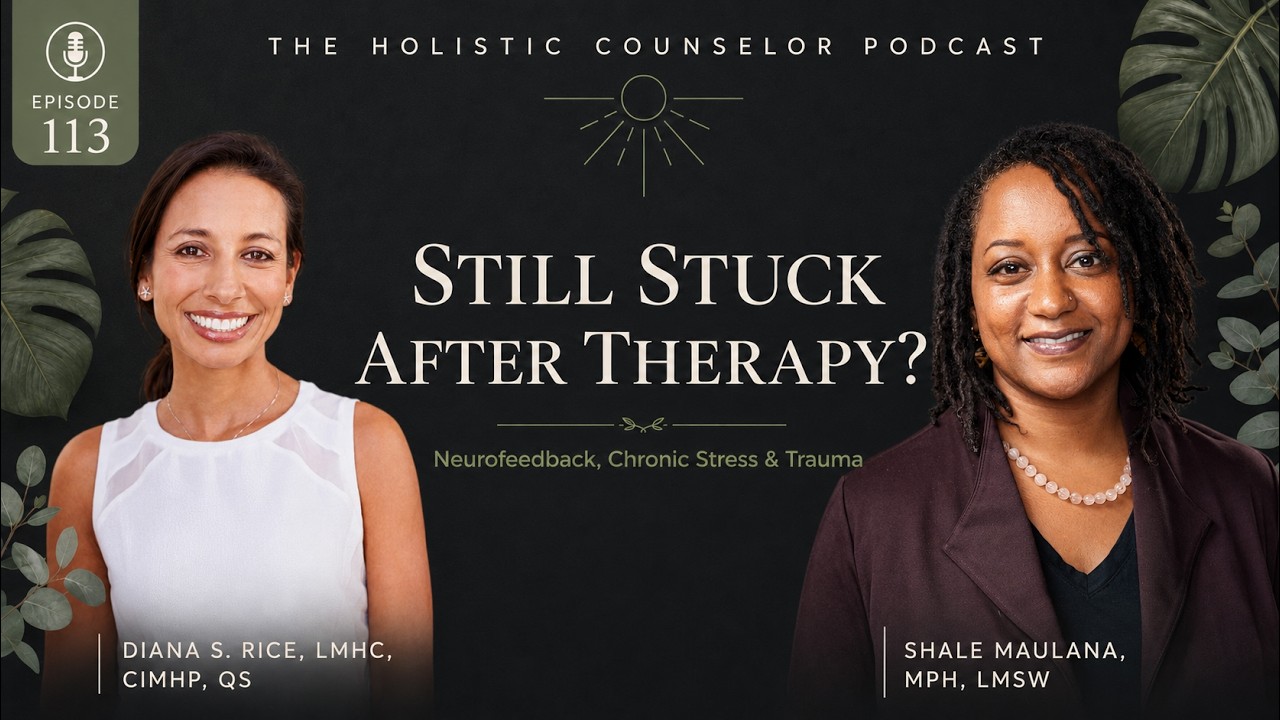
Episode 113
Why You Still Feel Stuck After Therapy: Neurofeedback, Chronic Stress & Trauma
with Shale Maulana, MPH, LMSW
Hosted by Diana S. Rice, LMHC, CIMHP, QS
Have you ever done therapy, read the books, prayed, journaled… and still felt stuck? Still anxious. Still overwhelmed. Still on edge in your own body. In this powerful episode of The Holistic Counselor Podcast, Diana S. Rice, LMHC, CIMHP, sits down with Shale…
Listen to the Episode
Press play when you’re ready.
Educational content only; this podcast is not therapy, diagnosis, or medical care.
About This Conversation
Show notes
Jump to a section
Have you ever done therapy, read the books, prayed, journaled… and still felt stuck?
Still anxious. Still overwhelmed. Still on edge in your own body.
In this powerful episode of The Holistic Counselor Podcast, Diana S. Rice, LMHC, CIMHP, sits down with Shale Maulana, MPH, LMSW, a Brooklyn-based therapist and public health professional, to explore a deeper question many people are quietly asking:
Why do I still feel this way even after doing "the work"?
This conversation goes beyond surface-level coping skills and gets into what's really happening in the brain and body when healing feels stuck.
Together, Diana and Shale break down:
- Chronic stress and nervous system dysregulation
- Why talk therapy alone is not always enough
- How trauma, environment, and lived experiences shape mental health
- What liberation-based therapy actually means (in simple terms)
- How neurofeedback (brain training) works and why it may help
- The impact of ACE scores (Adverse Childhood Experiences) on long-term health
- Real-life examples of how culture, environment, and stress affect mental health
- Practical tools to calm your nervous system and start healing
This episode is honest, real, and deeply educational — without being overwhelming.
Two Powerful Quotes from This Episode
Diana S. Rice: "We're not here to get political. We're here to get clear."
Shale Maulana: "You are not broken. Your nervous system is responding to things. These are adaptations, not failures."
What You'll Learn
- Why you can understand your patterns but still feel stuck
- The difference between chronic stress, trauma, and survival mode
- Signs your nervous system may be dysregulated (sleep issues, anxiety, hypervigilance)
- How public health connects to mental health and burnout
- Why your environment and lived experiences matter in healing
- How neurofeedback helps retrain the brain using neuroplasticity
- Why healing is not a quick fix — and what actually works long term
- Simple, science-based tools you can start using today
About Shale Maulana, MPH, LMSW
Shale Maulana, MPH, LMSW, is a liberation-based therapist specializing in trauma healing for marginalized communities and high achievers. She integrates neurofeedback, EMDR, somatic therapy, and clinical hypnotherapy to help clients regulate their nervous systems and break free from anxiety, trauma patterns, and chronic stress.
With a background in public health research, Shale brings a unique perspective that connects individual mental health struggles with larger patterns like chronic stress, environment, and lived experience.
She is based in Brooklyn, New York, and works with clients both locally and online.
Resources & Links
Connect with Shale Maulana: https://www.shalemaulana.com/ https://www.shalemaulana.com/speaking-and-media
Diana S. Rice & Services: https://www.throughthevalleytherapy.com/ https://www.transformedmindcc.com/
ACE (Adverse Childhood Experiences) Resources: https://www.cdc.gov/aces/about/index.html
https://www.cdc.gov/aces/communication-resources/index.html
https://www.traumainformedcare.chcs.org/resource/original-ace-questionnaire/
Free Breathing App (mentioned in episode): https://breathly.app/
https://apps.apple.com/us/app/breathly/id1454852966
https://play.google.com/store/apps/details?id=com.mmazzarolo.breathly
Why This Episode Matters
Too many people have been told they are the problem.
But what if your anxiety, burnout, or emotional overwhelm is not a failure…
…but a nervous system response to chronic stress, trauma, and lived experience?
This episode helps you understand:
You are not broken. You are responding.
And once you understand that — you can begin to heal differently.
Support the Podcast
If this episode helped you understand yourself better, please:
- Share it with someone who needs it
- Leave a written review on Apple Podcasts
- Follow and subscribe on your favorite platform
Your support helps more people find faith-based, science-informed, stigma-breaking mental health conversations.
https://theholisticcounselorpodcast.printful.me/
Disclaimer
This podcast is for educational and informational purposes only and is not a substitute for therapy, diagnosis, or medical advice. Please seek support from a licensed professional for your specific needs.
Closing Reminder
Trust in the Lord, guard your heart, and renew your mind.
Episode transcript
Read the full transcript Close transcript
Automatically generated from YouTube captions. Names and wording may contain errors; listen to the episode for the original conversation.
Hello there, fearfully and wonderfully made human. Welcome back to the Holistic Counselor podcast, where we get real about mental health, faith, and what it actually takes to heal, not just talk about healing. I'm your host, Diana S. Rice, licensed mental health counselor from Through the Valley Therapy and Transform Mind Consulting and Coaching.
Okay, let me start like this. Have you ever done therapy, like really done the work? Read the books, prayed the prayers, journaled, processed, showed up, and you're still like, "Why am I still stuck? Why am I still anxious? Why does my body still feel on edge?
Why do I understand my patterns, but I can't seem to change them?" Yeah, we're going there today, because what if insight isn't the whole story? What if some of what you're dealing with isn't just in your thoughts, but actually in how your brain and nervous system have been shaped over time?
And what if some of that has been influenced by things we don't always talk about well, like chronic stress, identity, environment, even cultural experiences? Now listen, don't get nervous on me. We're not here to get political. We're here to get clear. To understand what's actually happening in the body, so we can heal with truth and not confusion.
And today's guest brings a perspective we haven't really explored on the show in this way before. Joining me is Chalaine Molina, MPH, LMSW. That's Master of Public Health, meaning she looks at how stress and mental health patterns impact people, not just individually, but across communities, along with being a licensed therapist.
She's based in Brooklyn, New York, which I love being an original New Yorker. And she specializes in trauma, anxiety, and chronic stress, especially people who look like they've got it all together, but inside feel anything but. And what makes her work stand stand out is this.
She's not just doing talk therapy. She integrates neurofeedback, brain-based training, alongside approaches like EMDR and somatic therapy, meaning she's working not just with your story, but with how your brain is actually functioning. She also uses the term liberation-based therapy, which we're going to unpack today.
What it means, what it doesn't mean, and how concepts like chronic stress, identity, and lived experience can shape the nervous system over time. So, if you ever thought, "Why do I still feel the way even after doing all the work, and there has to be more than just talking about it?"
you're going to want to lean in onto this episode. Shalewa, welcome to the show.
Thank you, Tiyana. I'm very happy to be here and happy to share with your audience today.
Oh, thank you. So, you began your career in public health before even becoming a therapist. What did you see upstream about stress and mental health that led you into the clinical work?
Yeah, so so I started my career in public health and was very passionate about this work around social determinants of health. And what this means is essentially looking at what are the social conditions that determine the health outcomes people experience often in midlife and later in life.
I was really motivated and passionate as I said about doing this work. I had a career where I was working in the New York City Health Department in sort of this middle tier role where I was kind of like taking in this data from our community uh staff who are implementing programs and doing the work of working with the residents of how do we deliver individual level intervention?
How do we get people into health care? How do we get them to access the resources that we offer in the health department? Kind of translating that information into this upper level of management of the agency of like how can I put this in reports and forms that they can understand so they can determine what funding we need, what support we need in order to transform the lived experience of residents.
And my work was kind of in Central Brooklyn, which is a community of black and Latinx residents primarily and who have some of the worst health outcomes in New York City. So we're looking at why do folks in these communities have higher rates of conditions like diabetes, heart disease, psychiatric illness, and other prob- problems that are connected to chronic stress and pressure.
Mhm. And so well, I started my career with all this like fervor and passion and enthusiasm and I'm doing this work and writing all these reports and policy briefs, I started to feel over time like am I really making a difference here? And also I was noticing that you know, there there and there's a lot to this.
There's a lot about like how invested the agency was or wasn't in actually addressing these problems in the midst of like rapid gentrification happening in this neighborhoods, which meant like while maybe there were like fewer grocery stores, like now there's a Whole Foods and a fancy deli.
And it's like, "Okay, these resources are coming in, but who are they really for and who are they really being?" And like there's all this displacement happening. So
So I want to stop there because to me I I want people to understand what gentrification is because there's some people that don't understand that. I understand that cuz I've seen it around my area here in South Florida. Number one. Number two, every time you talked about our people, okay?
Um I that I think the ACE score, like that ACE it that like when I found that out, it was just like, "Why haven't we been taught this?" Like right? So maybe we could talk about both of those things before we go on.
Can you explain those things?
Absolutely. So gentrification is a process by which neighborhoods are kind of like going from being really low income, often it's like low income, high crime, low resource areas to where like kind of like unit by unit, building by building are being sold to developers and to folks with access to more income, often young white families who want to be able to buy in the city and kind of like take advantage of the low prices.
And what this leads to is like folks who were originally part of that community getting pushed out. And so you know, I don't want to like point blame at folks who just want somewhere to live, right? Because it's not really their fault. This is like a systemic trend and a systemic problem that's driven by so many forces that are bigger than any of us.
Yes. And and I want I want the audience to understand cuz I have people from all walks of life, shall I, that um that are listening, right? And and people from all over the world. It's not, you know, we're both therapists.
We are our hearts is to try to do what's right for the human that comes to us in a healthy way, but it's also we're trying to get people to understand because some people, I'm telling you, when I had this conversation, it the defense system comes up and then all of a sudden they're thinking I'm going political or even religious.
Okay, cuz there's so many concepts out there, as you know, in cultures, right? As if you studied. And so that's where we that's why I wanted people to understand gentrification, not to put more guilt and shame on humans, but to really get them to educated to understand like, oh, I didn't know that that's hurting someone.
Or I didn't know like it is such a it's complicated. It is. It's complicated.
Yes, absolutely. Absolutely. And these are forces, as I said, are like bigger than all of us, right? So I don't want to like point the finger at anyone or make anyone feel bad for where they chose to live or where maybe they had to live, where they could afford to live, right?
Right.
But, you know, the reason why a lot of these communities are poor to begin with has to do with redlining, which is like a whole other like whole other podcast we could do another day. But, you know, these are like social situations and social structures that have been created a long a long time ago that have caused these neighborhoods to be
Right.
um you know, existing with less access to the train lines and less access to fresh produce and good grocery stores and affordable um gyms and parks that are, you know, funded and paid for that have lighting and clean bathrooms and like these sorts of things that feel welcoming to families and single women and folks who want to enjoy them and enjoy fitness and outdoor activity, right?
And so
Safety. Like safety. Resources and safety. And I get it because listen, I grew up with a single immigrant mom. I came from that culture and now, you know, I'm grateful that I was able to, you know, the American dream, the beauty of that, working hard and everything.
But it was education that helped me understand these things. It was never me trying to blame other humans or become a victim of it. It is literally trying to figure out how to be the bridge for our people and others that have no clue or never under And I know I'm about to go off a tangent, but it's like an example here.
I'm in Broward County, Florida, right? Just 5 minutes from here is Palm Beach County, Boca Raton, Florida. I love my Boca people. But some of them have no flipping clue on what's going on in the inner city of Pompano Beach, per se.
Yeah.
Okay? It's kind of probably like, you know, picture Monopoly and you have Park Place and everything like that, but then when you cross you're the Baltic area, you see what I'm getting at? So I'm trying to get humans to understand that when they're listening that it is not mental health is affected.
Yes. Yes, completely. And like, um, our former Mayor de Blasio was talking about a tale of two cities of or you think it's like a tale of five cities, really, of like these different socioeconomic realities that people are living in in the same city.
We have some of the most affluent neighborhoods in the entire world right here, just a few miles away from some of the densest poverty in the entire country, co-occurring, like all in the same city. And these we see like as much as an 11-year gap in life expectancy in New York.
All right, so let's talk about ACE. Because that makes That makes sense now, like going into that area.
And so what I was feeling as I was moving through my public health career is like, is there a part of this equation that we're missing as we're looking at social determinants and what creates health for people? Is there something that we're not talking about about what it means to carry the stress in your body of navigating these conditions of housing, lifestyle, fitness, healthy eating, like all these different things we're working on and focusing on?
What about trauma? What about that lived experience? What about what we've inherited from our parents and grandparents that's living in our bodies and in our nervous systems that's not really being addressed?
And so these were some of the things that caused me to make a change and to decide I want to kind of like zoom in, like we were I'm in this real macro place of looking at ecosystems, but I want to kind of zoom in and work with individuals and better understand like what is going on in people's bodies, what's going on in people's lives and nervous systems that can and what can I learn that can
help folks transform and transcend from that experience of trauma and chronic stress into a reality in which they can thrive.
Mhm. Yeah, and so the ACE the ACEs, right? Because we both know what that means, but some people are like ACE or like I don't play poker or I don't have cards. But it's the adverse childhood experience test, and that to me, honestly, as a therapist, every client of mine has to fill that out.
Okay. Yes.
That's an assessment that I do right away.
Yes.
And people really like that's not a training that ever was I never even heard of it in my training. Have Did you?
I did learn about it in the public health context. There was a doctor who published a study about it, and we started doing work of thinking about how do we integrate this. But basically what ACEs shows is that if you have a certain number of certain adverse childhood experiences, your risk of developing chronic health conditions, including chronic mental health issues, increases kind of exponentially, right?
So, if your parents divorced, if you experienced violence in your home, if you witnessed a trauma, if you experienced a trauma in your body, if you had uh food insecurity, like these type of things are like traumatic events that many children experience in this country, right?
And so, the more of these that occur for you, and I think the earlier that it occurs, the worse that it is. But the early the more of these things that occur for you, the more likely it is you're going to have psychiatric illness, hypertension, heart disease, diabetes, all these other things that can result in premature mortality or a decrease in the quality of your life.
And so, it really helps to kind of connect these dots between the lived experiences of individuals and the health conditions that they have later on.
Mhm. And I will put that um ACEs test quiz in the show notes, but I want people to understand you take that and you see anything higher than a four, don't freak out and think that oh my gosh, I'm going to have diabetes, I'm going to have this, I'm going to have that.
No. It is just an assessment to get you to understand maybe that's why you're not feeling too well right now.
Yeah.
We're we're a mind, body, and spirit, right? And so it's it's something it's a signal. It's a signal. And that, you know, that's where I would go, oh my gosh, if I have something more than a four or five, maybe I should go get quality or professional help somewhere at a community mental health center or a therapist or what or or learn more about it because there are not everybody could afford therapy.
Exactly. Exactly. And it's like knowledge is power, right? Of like see it as information that can inform you in better taking care of yourself and dealing with your life.
Yeah. I mean, I know when I found out mine, like when I first took it and it was recent I would say in the last When did I learn about this? Maybe when I just got back to being whatever, but I saw my score and I'm like, god, this makes so much sense now why I have stomach all these things, right?
And then I was able to get the actual help I needed, not just the quick fixes that many many in our conventional westernized system are trained in. And I don't want to put
marketed to us.
Right?
Yes. Right. Right. All right, so let's get to liberation-based therapy. This is I'm playing language. Explain that to us, please.
Sure. Sure. So liberation-based therapy is recognizing that mental health struggles don't exist in a vacuum. And so conditions like anxiety, depression, or trauma, they are not individual problems. They are responses to conditions that occur because these systems were not designed for you to thrive, right?
So you may be navigating systemic oppression or marginalization or chronic stress that are causing these conditions to occur in you. And so, in terms of what this means in terms of your nervous system is like there might be kind of a hyper-vigilance that is there, a kind of a chronic survival mode that you're living in as you're managing constant threat and never feeling fully safe to relax.
And so, liberation-based therapy is about acknowledging and honoring the context in which these conditions are occurring in rather than kind of I think the more clinical approach is like just looking at this individual and what their symptoms are and how do we treat the symptoms?
It's like I want to look at what is going on around you that's causing you to feel this way.
Yeah.
I find that this is often depathologizing, right? Many of my clients have been in therapy before and sometimes for many years or even decades. And they're feeling like, "Well, I just have anxiety or I just have depression, right? That's what I've been told."
And what I the language I use is you are experiencing anxiety. You are experiencing depression and let's understand why you're responding that way. And what are some things we can shift to help you respond in a more adaptive way to the conditions that you are living in.
And as the individual begins to update, heal, and adapt, and change, there comes online a natural desire to advocate and shift the environment and experience for others, right? So, I usually see this pathway start to happen for my clients as they start feeling better and they start having more energy and are feeling motivated and grateful that they're like, "How do I make this better for other people like me and other folks going through similar things.
And hence why this podcast exist.
Yes.
I'm serious because like How do I say this gently without offending? Um It it's it many especially like I come from like the early 2000 training, right? Of the DSM. And when people never understood like I I challenged a lot of the professors where I'm like wait a minute because my mom isn't from this country, right?
And my dad's Puerto Rican. You know, that's a big debate back in the Super Bowl anyway. Times where it's like is Puerto I'm like yes, Puerto Rico is a US territory. But anyway, but you see where I'm getting at like I'm a woman of color.
Mhm.
And I'm a woman. So there's all these systems and layering, but it it's like no, you don't understand. I'm like wait, did you take into consideration like the whole family's from Haiti for example and that they see things in a different way spiritually, but now you're saying they're all schizophrenic not not all of them, but you see what I mean?
They were not taking the culture and I think that's what I'm hearing you say is that in the way you do therapy, you will because social work looks at the social and then you having this master's in public health like that really I could see like wow, you're seeing the big picture.
I want to know if if someone's coming to you, do you have a specific assessments and questions like a biopsychosocial that hits these these pain points or these parts for them to start understanding too because you know, you have people in our own black and brown community or how you said it.
What did you say? Latinx? I don't know. I'm like I'm a Gen X, so
I'm like what? So I'm old school in that manner, but you see what I mean? Like is it is there certain questions without because that's that's a a thing I know I have to balance, too, because it's not like I want to blame, and I don't want to get someone victimizing, "Oh, it's because I grew up in the hood, and this is why."
But I also want them to understand and respect their story in order for them to move forward.
Mhm.
How do you do that with liberation-based therapy?
Yeah, so I don't really have like a rigid questionnaire, but I think it's more kind of like How do I begin to first understand this individual? So, it's like, what does your life look like? What feels good about it? What feels hard about it?
And then, what's going on around you? Like, what is work like? What is family like? What are your personal relationships like? To get a sense of like, how are you navigating this experience? And then, we kind of like broaden out. What is the ecosystem around you?
In what ways is it supportive or not supportive?
Mhm.
marginalizing influences? And so, it's kind of like there's you, there's like you right here, but also what is this context? And can we pay attention to all of it, right? What's occurring in you, your mind, your body, your spirit, your heart, right? And what is also happening around you?
And then, with this full picture, we can start to figure out like, what is the plan that's going to make sense for you? How do we start to move you toward your thriving?
Yeah, that makes sense. I remember I had an African-American male, but he came to me because he realized that I worked in alternative high schools, and I did a lot of studying of understanding I'm not a black American male, but because I did the hard work of understanding that culture in a way what what happens or what they've heard and and the anger and the you know, that's the thing I think that some people don't understand or people in our field are not culturally competent.
They think they are. They think they are. And and they can understand, but sometimes I'm thinking can they truly 100% understand?
And that's
the thing. And that's the thing. It's like I think a lot of folks are not from our backgrounds and they haven't had much exposure to it, right? Like most white folks grow up in white communities, they work in white workplaces, and haven't had a lot of contact to really understand what's going on for people who are having these complex lived realities.
And so with good intent and good heart, they're coming in to say, "Okay, so you're experiencing discrimination at work. Have you tried taking some deep breaths and counting to five, right?" And if you're a black person or a BIPOC person going through this, that's going to feel really dismissive and flattening to
you. Of like and then and it's not that that's a wrong thing to say, right? Breath [clears throat] work will help you, right?
Right.
But it's like can you honor my experience? Can we just take some time? Can you validate the rage that I'm feeling about this? Can that
Without diagnosing me with oppositional defiant disorder? Oh, sorry. See, that's my alternative high school
therapist
Yes.
part of me.
Yeah. Don't pathologize how angry I am, right? Can my anger be an appropriate response to this reality?
Yeah.
Right?
No, and that's something I I was taught so well going into the inner cities here in in South Florida and realizing they weren't being listened to. They were being pathologized or criminalized or I mean all these ised and or you know, from all the isms.
And and it's just taking that step back, especially like right now I'm talking to other therapists that are listening that may not be from the BIPOC community, okay? And or anybody that's that has a helping, you know, it could be a pastor. It could be a teacher.
It could be, you know, it's not I'm If you're white, I'm not trying to hurt your feelings. Right? This is the thing that I get in sometimes not a debate, but maybe My husband's white, right? So, he's try He's been with me 30-something years and I had to teach him a lot cuz he comes from the sticks of North Carolina.
You see what I'm saying? That's a whole And honestly,
experience.
Some people are very poor there, too.
Yes. Yes, there's certainly overlap there.
Right. Okay, so I get it. It's not trying to make you feel bad for being who you are on the outside. It's It's All of us need to understand that every human has their own personal experience. So, let's not just put one big brush over.
Yeah. I think that's why the DSM annoys the freaking crap out of me. And I hope I don't lose my license for that one.
I am right there with you. Let's burn it for warmth because that's I think the best use of our DSMs right now.
It's so frustrating. And And I think that's another thing our culture see because I know the Caribbean families that I worked with, they did not They don't I was taught not to trust the system. And I'm in the system in a way and I still don't trust it.
So, there's a That's That's part of my hypervigilance.
Mhm.
You know?
But I think that's that's important to honor that and recognize that and see how we can leverage the system in a way that benefits the people that we serve, right? Like what are the tools that we can share and leverage that can support people rather than pathologize them or continue to harm them.
Yeah, right on. So, let's talk about now the tools. So, you know, there are real signs of nervous system dysregulation.
Yes, yes.
Real signs. You know, and the term get is getting used everywhere right now. Co-regulate, dysregulate, regulate, and there's people that are just learning this, right? Like probably listening to this episode and going, all right, I've heard this enough. I want to know, like what what are concrete everyday signs someone may be stuck in survival mode?
Maybe we need to explain what survival mode is and then the the the symptoms of it and maybe then go into how we can help.
Absolutely, absolutely. So, our nervous system has essentially two states. There's like sympathetic drive mode, which is that kind of like high cortisol, high adrenaline state of like I'm getting something done or even I'm running from a bear, right? I'm escaping danger or threat.
It's that like high activation of I'm trying to accomplish something. If you think about it as like ancient hunter-gatherer, I'm going on a hunt, right? I'm going to feed my family or I'm running from danger, right? There's kind of like that high activation state.
And then there is parasympathetic mode, which is I'm home, I'm safe, I'm resting, I can see everything that's around me, I'm calm, right? Rest, digest, and heal. And what happens in our modern lives as we experience all the stimulation and all this input and also all this pressure to perform, we can get into kind of a sympathetic dominance, which is sort of like this this chronic stress or chronic um uh sympathetic activation of you're constantly feeling this high adrenaline and high cortisol state.
And so what this can look like on the physical level, I think the first thing people will notice is sleep issues. Having a hard time falling asleep and having a hard time sleeping through the night. And so when your body is not able to kind of like shift gears and go into deep rest, this can side kind of like throw throw a lot of things off because when you sleep, this is where your brain is kind of like processing the emotional content of the day.
This is where learning integration happens and even some levels of trauma healing occur while you're in your deep REM cycles.
So if you're in this like slightly vigilant state where you're like asleep but not fully deeply asleep or you can't sleep and so you have a little bit of alcohol or a little bit of cannabis or a little bit of a sleeping pill to get to sleep, you're not going to get into that deep enough level of sleep where your brain's actually healing itself and making sense of the day so that you awaken feeling rested, healed, ready and like ready for the next day.
All right? And so this can like start to accumulate over time. This kind of like lack of sleep and difficulty with sleep. So that's kind of like the first thing that goes offline is sleep quality. I read a study one time that said that black people get the least amount of sleep of all racial groups in this country.
Wow.
So that's not enough.
I mean Listen. I want to just say like I could understand. I think I just think of like sometimes I had students come in and they were coming in for therapy but they literally passed out and I let them sleep.
And it's because they were in these inner cities where they were hearing gunshots and helicopters and they were and they saw their cousin died on the basketball court and many people don't have those experiences but many people do and that's where I was learning and I'm like, "Oh my goodness, this kid doesn't sleep at night because he's also out hanging out partying."
I mean it's a cultural thing as well and it's it's it's just and and you just get used to it. You just think this is how I remember when I you know, as a little girl in the '70s my my mom was working and I'm by myself on the streets waiting for her to come home.
At night, there's four locks. You see what I mean? Like I'd look back and I'm like we were poor as dirt but we had four locks and I'm sitting there like a latchkey child but I know now now after doing the hard work looking back that my system that anxious, oh she's just you know, no it's because my central nervous system was turned on and I'm still protect trying to protect myself.
I have to purposely do the tools that the therapist taught me in order to calm myself down with prayer, with uh meditation, with stretching, with telling my parts cuz I'm IFS too going, "You're here now. You're 54. You're not eight." Okay, so I want to now understand neurofeedback because I I did um brainspotting for some and EMDR.
So I've done both because of my stuff. So neurofeedback with traditional therapy. So for someone who doesn't even know what neurofeedback is,
Can you explain that?
I would love to. So I feel like neurofeedback is this really like under leveraged tool that I feel like can really make a a difference for people and as we've kind of explored already is like a lot of folks have done all this talk therapy, they understand their patterns, but they're still stuck in them.
So, they're still having symptoms, they're still having a hard time, and this can be because therapy is working on this psychological level of we're dealing with your thoughts and your emotions, and sometimes a dysregulation has impacted you at a neurological level, and this is the level that neurofeedback can meet you at.
And it's basically a brain learning program. It's utilizing technology to help your brain learn how to be more regulated. So, it is not buzzing or zapping your brain in any sort of way. It's not any kind of like electrical stimuli, but it's using sensors to gather data about where the electrical activity is happening in your brain in order to give it feedback, and the feedback is what your brain is learning from and learning to access more optimal patterns.
So, typically a neurofeedback I would begin with a QEEG, which is like a brain mapping assessment where we could look at what is going on in your brain. Where is there symmetry or dyssymmetry? What parts of your brain are lighting up in response to different kinds of stimuli, and get a sense of how these patterns connect with your symptoms.
I have a So, I want to know is this a machine? Like, what do you do? Is it like Do you put a Like, you know how I have headphones on? Is it something that you just put on? Or is it like tell Can you tell Share with us a little more about what it is because cuz I want to break the stigma of a fear of like, "I'm not getting, you know, oh no, now that's from the devil."
Like, you know, cuz I've heard some
Oh, I've heard some crazy stuff.
You guys have a lot of Like, stigmas and fears and stuff about these kinds of things, right? And it does look very like Star Trek. Um it's but there's like a headset that I use in the system that I work with. It's It's a Muse headset.
It kind of looks like this and you would put it on and there's like one single electrode that we would place at different locations on your head. And as I said, the headset and the electrode are really just there to gather data. It's just there to sense what is going on with your brain.
And with that understanding, we can then create a protocol, which is like a program for your brain to learn how to become more adaptive and functional. So, for example, if someone has ADHD symptoms, usually we'll see this in the brain map as too much theta activity occurring.
So, theta or delta. So, theta and delta are supposed to be active when you're sleeping or in deep states of meditation and rest. But if they are running on overdrive all day, which might be how your brain has adapted to a highly stressful environment of like I'm going to just run this slowing input so that I'm not feeling so overstimulated and threatened all the time, right?
But what this is What the experience of that is, I'm having a hard time focusing. I'm having a hard time paying attention. I might even fall asleep when I'm trying really hard to focus. So, like sometimes kids and I'm sure you've seen this working in the high school, like kids with ADHD are like, "I'm trying so hard to focus, but I'm like dozing off during the exam, right?
And I can't help it, right? I mean, but it's that slowing input occurring in the brain in response to stress and pressure. So, what we can do is create a system of rewards and inhibits in your personalized protocol that will teach your brain how to respond more appropriately to stress.
And slowly over time, you'll start to feel the symptoms shift.
So, with the actual machine or that headset is what you So, that's where you create the protocol and then what you're switching like tell me a little like are you switching it up and say, "Okay, let's do a little bit of more of this and a little bit of more of that."
How many sessions does I mean, I know that's hard to say, but I would think what like at least three sessions to maybe feel the difference? I'm not sure.
So, typically I have clients do So, this is a home-based system. So, they would have their own headset. They can do it at home on their own time. And they can stream their own content on their phone or tablet. And basically, it's like while you're watching Netflix or YouTube or Spotify, whatever it is you want to watch, you'll notice the screen getting brighter and the volume going up and the device vibrating when we are when your brain is doing the right thing.
So, when your brain is like following the program, you're getting this positive input in the form of these three forms of feedback, visual, auditory, and haptic.
Wow.
And over time And then when your brain's not doing it. So, if let's say you have ADHD and there's this um theta hyperdrive that we're talking about. If that's occurring, the screen becomes a little bit dimmer, the volume goes down, and your device is not vibrating at all.
So, over time your brain starts to get the message, "Oh, when I do this, I get this reward."
So, it's neuroplasticity.
Yeah, exactly. It's leveraging neuroplasticity to help your brain heal. And so, typically clients will do two to four sessions per week, 20 to 30 minutes each, on their own, at home, on their own time, with their own content and device. Usually they'll start to see results within 4 to 8 weeks.
Mhm.
Um usually I want to do neurofeedback for 6 weeks, sometimes longer, depends on the person and their brain and how much stress they're experiencing and all these other factors, but between like 6 months and 12 months, you can experience lasting change from neurofeedback, meaning you can stop doing neurofeedback and sustain the benefits from it.
So long as you're continuing to take care of your body and brain and manage your stress and get sleep at night and these other sorts of things.
Well, you got to do the things that because I think many people no matter where you're from, want the quick fix, the magic bullet, the TikTok instant, you know, it's like and to have that understanding like, no, you're going to have to do the work.
We might have the tools, a doctor might have the protocol or whatever, the the you know, your physical or uh your your strength trainer at the gym might have this, but it's like you're going to have to want the change and it's it's it's doing one thing, at least one thing, because you know, you have depression.
Like anxious people might have a little more energy because they're anxious, but anxiety and depression are signals. They're signals, and I know that I saw that you're holistic as well. What does that mean to you?
Um for me it's about we're not just going to throw an intervention at you, but we're also going to look at what is your diet, what is your lifestyle, and how can we work on all of these things together to ensure your best chance at success and thriving.
And so, neurofeedback is just like one of the many tools that I use and I see it as sort of like a pattern interrupt. It's like this is where we can like regulate your brain, get you back online, and while we're doing that, let's work on eating brain-healthy foods, avoiding the things that are going to disrupt your brain regulation, cutting back on substances and alcohol, which we have a lot of evidence to show disrupt mental health and brain health and brain regulation, right?
Making sure you're sleeping at night, making sure that you have healthy, positive relationships. It might mean the job that you have isn't working for you and your mental health long-term. Let's figure out how you can shift and navigate things there or maybe consider like changing jobs or changing roles, right?
Of like how do we tweak all these things not just with medication or not just talking about it, but like let's also look at these things that are amplifying or causing the challenges that you're having and shift them as well.
Mhm.
If you're having difficulty as a parent, it's like is there tools and skills that you need to better be able to thrive there, right? Is there support that your children need or that you need at home? It's like let's look at all of it and figure it out.
If you're in a difficult relationship, is it couples therapy? Maybe your partner needs some kind of support, too, right? It's like we're looking at all of it and not just kind of seeing this individual in a silo.
Yeah, no, for sure. I mean, I I understand there's crisis intervention out there where, you know, someone comes into a crisis and that's that I'm not anymore a crisis intervention therapist, but it is having that understanding, the responsibility for yourself, and the educational piece, too, because there's so many voices out there, Shelley.
Like honestly, there's so many and that's some people come in and it's just like, "Oh, I was told this, I was told that." And then they're on Chat Dr. Chat GPT or Dr. Google and you're you know, it's like uh we need to be still for a second and really figure out what is it that you actually need and then prioritize.
So, for that since you know, we've been on here for a little while now, I would love for you to just give some kind of practical tools. What are a few evidence-based practices listeners can begin using this week to regulate their nervous system and reduce chronic stress?
Absolutely. And before before I will I'm happy to share those, but I just want to say that I use Chat GPT and AI tools as well. I think they're helpful tools, but let's also remember that they don't have clinical judgment and it's not the same thing as working with someone, right?
Because it's the relational context that is often a big part of the healing of having someone really hold space for you and someone who has training and expertise who can say like who can look beyond what you're able to see cuz Chat GPT is only responding to what input you're giving it, right?
you trained it. Cuz it could be like stroking your ego or all of a sudden it could be sarcastic. And and I mean, I've heard some sad stuff that's happened with with Chat when with mental health. I mean, there's a actually a thing AI psychosis now.
I don't know if you saw that. I watched that and I'm like
And I can so see how it happens, right? Because it's like it's a tool, it's not an intelligent
Right.
person, right? It's not someone with clinical training who can really see
But when you're lonely
Right.
when you're a lonely human after the pandemic, what it's done to us, this this post-pandemic situation that many of us find ourselves still in that without community, and we've trained our brains into I don't you know, I could be by myself. I mean, we work I work from home.
I mean, so this is why I think before I came on, I'm like, I have to purposely leave my house, get dressed, and leave my house in order to be in community because if I don't do that, I can sit which I
My husband's like, "Uh are you talking to your boyfriend again?"
Because it is a it's like a calculator or the cell phone.
Uh-huh.
But we also need critical thinking skills.
Mhm. And a person, right? Because ChatGPT is not accountable. If it tells you something wrong, and even if you confront it, it's just like, "Oh, my bad." Yeah.
I'm sorry. Don't hate me.
But it's not like a person where it's like, "Okay, I need accountability from you of like, let's go through our rupture and repair cycle together where I can feel more trust at the end of it." Like, that's what ChatGPT can't quite give us.
And we are energetic beings. So, we do coregulate, regulate, or pick up I mean, people don't understand and I know it sounds woo-woo, and for my Christians, I'm not talking satanic stuff like devil new age stuff. This is how the God made us.
He created us with the mineral composition, and why you know, why do we need iron? Why do we need certain things, right? And the coregulation of you could I could feel right right now whoever's listening to this 49th minute or whatever, you feel our energy.
We're vibing. Me and Shalewa vibe. I could tell because our energies, right? And this is what happens in therapy, too, is that you coregulate, and you you know, the the the therapist that has the tools and the and has done their own work, hopefully, is able to go and de-escalate situations, because that's what you hire us for.
Exactly.
So, chat you begin chat GPT cannot do that for you. At all. It could give you some great quality tools, but when you're sitting there and you're hearing Chalet breathe and counting and the voice and right? That's calming. So, all right, now we could go into the regulations.
Yes, so let's go into regulation tools, right? And so, um there's a few that I think are really helpful and are great to just like have in your toolbox for moments where you are feeling tension or pressure or dysregulation. And one is your breath, right?
I think your breath is the easiest and fastest way to calm and like directly access your nervous system and calm it down. So, when we feel anxious and stressed, our breath becomes light and shallow, right? And that is something that we can manage with our conscious energy and intention of like I'm going to take a deeper breath and I'm going to slow it down.
And particularly doing a longer exhale than the inhale will go a long way to calm you down and help you get into a place where you can assess a situation and respond appropriate appropriately to it.
Mhm.
Another one I would like to share is havening. And this is using light touch and you can kind of gently stroke your arms in this downward motion. It almost feels like a hug and it's so soothing and calming. I teach this to people who have panic attacks and it can be really helpful to do this along with deep breathing and visualizing a calm or safe place for yourself.
If you can do these three things at the same time, you can transform how you're feeling in 5 minutes.
I never even heard of Havening. H A V E N I N G.
Yes, it is a neuroscience backed technique that I think is fabulous. It's fabulous. It's body-based. It's so calming. I do this to my son when like he's having a meltdown. I have a 4 and 1/2 year old, so
as you can imagine, there are meltdowns, there are tantrums, right? And this can go a long way. Just
Oh, I'm going to start doing this to myself a lot. Havening. I mean, I do like the tapping. I had someone with EFT tapping come on and then I did it with her and I and I do, you know, yeah, I try a lot of different things.
I need to try the neurofeedback. I think that would help me more. Like I'm always about trying new things because it's like I don't know everything. Nobody does.
Yeah. And we need and we need each other.
Absolutely. Absolutely. I find it really helpful for me as a therapist. I also do neurofeedback on myself, and I've noticed that it's helped to me be a lot more regulated in my work with clients and can sit with people sharing really raw material and really traumatic material, and I can sort of like hold the space of calm and regulation for them as they're moving through their emotional processing.
So, I think it's a great tool for therapists, and many of us often like have a hard time doing therapy ourselves because it's like we know all the tools and we're like, I don't want to I don't want to like
Yeah, because we're the helper. Yeah, why would we need help? And and that's what I tell my interns is or, you know, anyone coming into our field. It's just to me, it's like if you've never gone to therapy and you're a therapist, I would not go to that person.
Sorry. Like because either you think you know it all or you have not gone deep and your countertransference with a client's going to go haywire.
Completely. And we have to pour from a full cup, right?
Amen. Amen.
easily get depleted doing this work for people.
It is. Vicarious trauma is a real thing. Vicarious trauma is a real thing. Picking up people's energy is a real thing. And and us having to be responsible to do our own work in order The oxygen on our And And even as a mom, right?
You're a mom of a four. My baby's 27, but I get it. I was there. I mean, I remember. And it is. It's like we're we're in different seasons, too. You know, every season comes with its stuff. Right? It's people This is the thing I I tell some of my clients is like we're all chasing the healing, right?
But we You're going to have to accept that we might never get full healing on this side of heaven. Period. Exclamation mark. It's like And we only have today.
That's right.
This minute. This hour. Well, I don't even know if we have the rest of the hour. Who knows what can happen? A tornado could come hit me. I don't know. But it's like learning that we have this purpose and these signals, because that's what they are, are signals and what we going to do about it is you're not stuck.
Exactly.
You're not stuck. All right. So, for someone who does feel stuck, overwhelmed or unsure where to start with healing, what message of hope or encouragement would you want to leave them with?
I would love to say to anyone who's feeling stuck, you are not broken. Your nervous system is responding to things. These are adaptations and not failures. And that it's okay to have setbacks. If you're in a moment where you're feeling really disappointed or like, "Wow, I've really backslid."
Just know that healing is not linear and this might just be part of your process. And to go back to something we said before is like you don't have to do this alone and sometimes getting support and care is just the thing that you need in order to get well and get better.
It is not a sign of weakness. We all need support and care at different times in our lives.
Yes.
And it does take a lot of humility to admit that of like, "I can't fix this by myself." Right? But know that it's not because there's anything wrong with you. We all need support and care at different times in our lives including folks like Diana and myself.
Right? We also get support and care in order to be who we are and do what we do. Right?
Yeah.
Small shifts matter. So you don't need to overhaul your whole life tomorrow, but think about what is the small step you can take. What is the breath that you can take? What is the moment of noticing and presence that you can take? What is the small boundary that you can set and know that that matters too and that's an important start.
And the last thing I want to say here is that your body knows how to heal. Your mind knows how to heal. These are intrinsic human qualities. It's about creating the right conditions and bringing in the right inputs to enable what your system already knows how to do.
Mhm.
So don't ever feel like you're doomed or hopeless or that too much has happened. There is always possibility for healing. If you are still alive and you are still breathing, there is still room for you to heal. So, go out there, do what you can with yourself and your body, find the support that you need, find the tools that work for you, find therapists who are dynamic and flexible and innovative and willing to try different things.
And if the support isn't feeling right, go find other support, go find someone else, don't give up on yourself.
That's right.
give up on your journey and your process.
That's right. We all
deserve to heal. We all do.
Yeah. Yeah, we all have a story and um and there's a purpose for it. Even though some might suck worse than others. Sorry to say that, but it's but it is. It's just uh that's the human condition, right? And so it's now the question is what are you going to do with the information?
Just take the one small step. There is If somebody wants to work with you, Shalai, um are you taking clients and where can you where are you?
I am based in Brooklyn. If you are and I'm licensed in New York State, if you are outside of New York, I do offer therapeutic coaching and other services but so you know, just reach out to me. You can go to my website and book a consultation.
We can figure out how we can work together either through coaching or through therapy or through one of my retreats.
A retreat? Wait, where? What?
I don't have anything planned at the moment, but I have hosted a few retreats in the past and it's something that I really love to do of getting like really deep and immersive and like creating an experience for people. So
Love that. Well, if you ever come to South Florida, hit me up, okay?
I will for sure.
Everything will be in the show notes. I'm also going to put the Breathly app um that I love that's free because that's I'm all about trying to give free tools out for people because you know, a lot of people don't have money or the time, but you know, listen, you're going to pay either way, either for your illness or your wellness. so like you got choices here.
Anyway, anything you want to say before we say goodbye?
Um I just want to say that, you know, healing is your birthright, and know that um you can heal as much and as deeply as you want to and need to. You just got to commit to it and be willing to take those steps.
Yeah. And for you listeners that lasted all the way to this moment with us, please do not forget to trust in the Lord, guard your heart, and renew your mind. Bye.
Thank you so much.
And now for the disclaimer to make sure you understand that you are responsible for you. The content provided on The Holistic Counselor podcast is for entertainment informational purposes only and is not intended as a substitute for professional medical advice, diagnosis, or treatment. Always seek the advice of your physician or other qualified mental health provider with any questions you may have regarding a medical or mental condition.
Never disregard professional medical advice or delay seeking it because of something you have heard on this podcast. The views expressed on this podcast are my personal opinions and do not represent the views of any professional organizations with which I am affiliated. Call your doctor, 911, or 988 immediately if you have a medical emergency.
The Holistic Counselor podcast does not recommend or endorse any specific tests, physicians, products, procedures, opinions, or other information that may be mentioned on the podcast.
Reliance on any information provided by The Holistic Counselor podcast, guests appearing on the podcast at the invitation of The Holistic Counselor podcast, or other listeners to the podcast is solely at your own risk. Confidentiality notice. If you engage with The Holistic Counselor podcast by commenting or posting and are a client, please be aware that you may be revealing information that could compromise your confidentiality.
Please remember that disclosing your identity or personal details can be linked to your clinical material. As a therapist, I am bound by confidentiality and will not respond to any disclosures of this type on this podcast. I am committed to upholding the ethics and confidentiality of the therapeutic relationship, which extends to all forms of communication in accordance with the laws and professional guidelines that govern mental health professionals.
I want you to know that your privacy is of utmost importance and you are responsible for protecting it when interacting on this platform or any other public forum. Thank you.