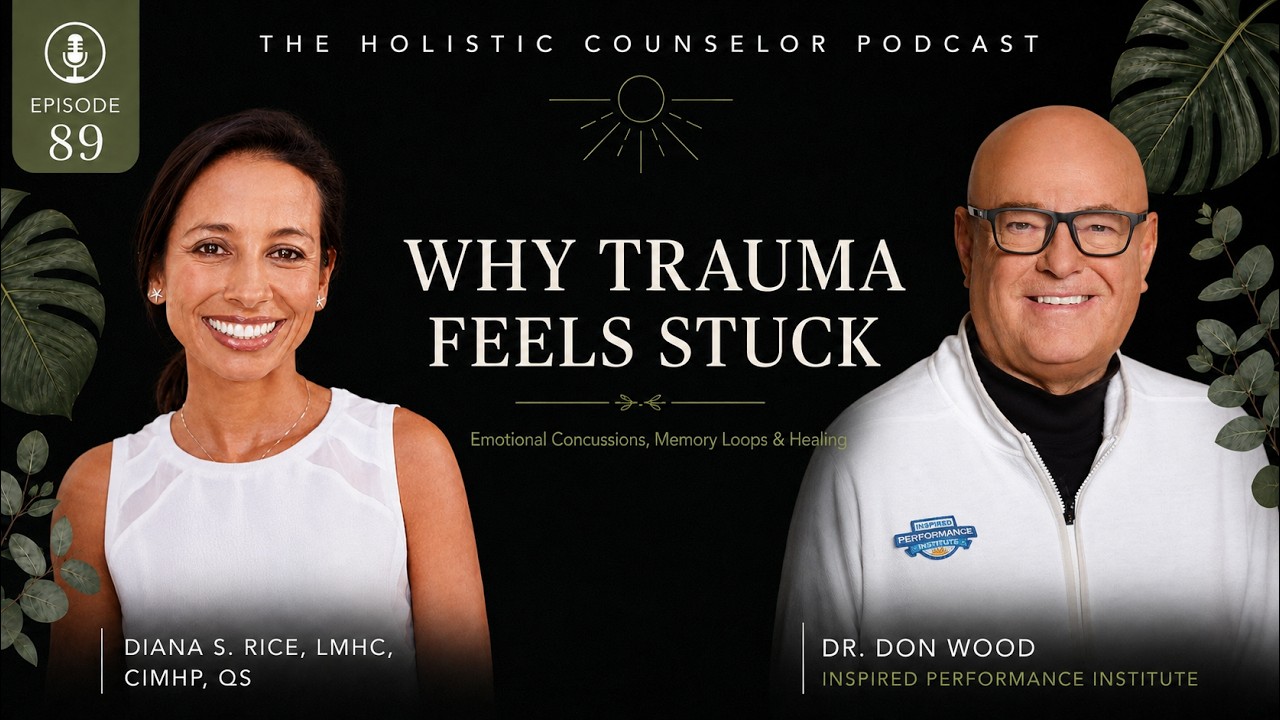
Episode 89
Don't Mess With My DNA: Dr. Don Wood on Emotional Concussions, Trauma Healing & Rebooting the Brain
Hosted by Diana S. Rice, LMHC, CIMHP, QS
On this New Year's Eve episode of The Holistic Counselor Podcast, Diana S. Rice, LMHC, CIMHP sits down with Dr. Don Wood, PhD, creator of the TIPP (Inspired Performance Program), to explore how unresolved trauma becomes a "high-definition" memory loop and how…
Listen to the Episode
Press play when you’re ready.
Educational content only; this podcast is not therapy, diagnosis, or medical care.
About This Conversation
Show notes
Jump to a section
On this New Year's Eve episode of The Holistic Counselor Podcast, Diana S. Rice, LMHC, CIMHP sits down with Dr. Don Wood, PhD, creator of the TIPP (Inspired Performance Program), to explore how unresolved trauma becomes a "high-definition" memory loop and how a 4–5 hour TIPP session plus 30 days of audio can reboot the brain for calm and performance. We unpack emotional concussions, the role of faith and culture in healing, and practical tools you can apply today—without shame. Perfect for clinicians, church leaders, and anyone seeking trauma-informed, integrative mental health.
Standout Quotes
- "There's nothing wrong with you. Anxiety, depression, addiction—those are symptoms, not your identity." — Dr. Don Wood
- "Trauma is stored in high definition. When we reset the resolution, the nervous system stops calling for action on old information." — Dr. Don Wood
- "We don't paint over rust—we sand it down, prime it, then paint." — Dr. Don Wood
- "God designed us to heal. The question is: what's interfering with the healing?" — Diana S. Rice
Resources Mentioned
- Inspired Performance Institute (IPI) – Home: https://www.inspiredperformanceinstitute.com/
- TIPP Digital (30-day program): https://www.inspiredperformanceinstitute.com/tipp-digital/
- About Dr. Wood / IPI: https://www.inspiredperformanceinstitute.com/about-us/
- In-Person & Zoom Sessions (Orlando): https://www.inspiredperformanceinstitute.com/in-person/
Books by Dr. Don Wood
- Emotional Concussions
- You Must Be Out of Your Mind
- Don't Mess With My DNA — new title (coming soon; watch IPI updates): https://www.inspiredperformanceinstitute.com/
Episodes & Articles Mentioned
- Kwik Brain w/ Dr. Don Wood (the interview that sent Diana down the rabbit hole): https://www.jimkwik.com/podcasts/kwik-brain-transforming-stressful-life-events-into-motivation-with-dr-don-wood/
- Brainz Magazine – Trauma & DNA (Executive Contributor, Dr. Wood): https://www.brainzmagazine.com/post/the-impact-of-trauma-on-dna-understanding-the-transgenerational-effects
- Brainz Magazine – Healing Trauma & Rebooting Biology (2025): https://www.brainzmagazine.com/post/healing-trauma-and-restoring-youth-with-a-therapy-that-reboots-your-biology
Connect with Dr. Don Wood
- Website & Programs: https://www.inspiredperformanceinstitute.com/
- TIPP Digital: https://www.inspiredperformanceinstitute.com/tipp-digital/
- In-Person / Zoom (Orlando): https://www.inspiredperformanceinstitute.com/in-person/
Connect with Diana
Diana S. Rice, LMHC, CIMHP, CTP, QS — Founder of Through the Valley Therapy & Transformed Mind Consulting & Coaching. Mission: Breaking mental-health stigma in Black/Brown communities and church spaces by bridging evidence-based therapy, holistic wellness, and faith.
Subscribe, rate, and share to help others find trauma-informed, faith-honoring care. Happy New Year!
Episode transcript
Read the full transcript Close transcript
Automatically generated from YouTube captions. Names and wording may contain errors; listen to the episode for the original conversation.
Hello there, fearfully and wonderfully made human. As we close out this year and step into a brand new one, I want to start by encouraging you. No matter what you've walked through in 2025, you are not broken. You are still here, still growing, and still becoming.
New Year's Eve is a perfect moment to release the weight of the past and open ourselves to the healing and possibilities ahead. Now, if you've worked with me or been under my training lately, you've probably heard me use the phrase emotional concussions. That powerful phrase is not mine because I always give credit to Dr.
Wood. It came from him, my guest today. And let me tell you, the first time I heard it, it stopped me in my tracks. Here's the backstory. One of my coaching clients from Transform Mind Consulting and Coaching mentioned the tip program to me.
That sent me down a rabbit hole and I ended up listening to Dr. Don Wood on the Jim Quick podcast, one of my favorites. From there, I knew I had to learn more and even better bring him to you. So today, I am so deeply honored to welcome Dr.
Don Wood, author, speaker, founder, and CEO of the Inspired Performance Institute and the creator of the patented tip method. Dr. Wood has helped thousands of people overcome the effects of stress, anxiety, depression, trauma, and addiction through his neurosciencebacked program that clears the impact of past traumatic events, rewires old thinking patterns, and prepares the mind for optimal performance.
He's the author of Emotional Concussions and You Must Be Out of Your Mind and has a brand new book, Don't Mess with My DNA. Get ready because this conversation is going to weave story, science, and practical tools you can start using right away.
What better way to step into a new year than with hope, clarity, and a reset for your mind. Dr. Wood, thank you so much for being here. Well, what a great introduction. That was awesome. I loved it. Very nice. Very nice. Well, I'm glad to be here.
Well, thank you. So, okay. So, I want people to know your story because when I heard your story, I was blown away and I'm like, everyone needs to hear this. And I'm so glad you said yes. And and you know, I had to go through your whole team of people before.
Um, so you know, you you shared that it began with your daughter's health struggles and and your wife's encouragement. So can you just take me back a little and and let me know uh or let my audience know what happened and what caused you to create what you have created?
Yeah, absolutely. I I was not even doing this. I was an entrepreneur and um when my uh daughter got diagnosed with Crohn's when she was 13, they told us, "Well, there's no cure for Crohn's. We don't know what causes Crohn's. She's going to have to manage this for the rest of her life.
And so we just, you know, my wife looked up different things and it was take her off of gluten, take her off of dairy, but they they ended up not doing really anything except take out 24 in of her intestines over four different operations.
Wow.
And um and so she struggled with that. Now, she's an actress. She moved out to Hollywood. She was doing great. She was on CSI Miami. She was on ER, Without a Trace, Lost. She was on a ton of stuff.
Really? What's her name?
Ashley Wood. You can you can check her out. You'll see.
I'll put her IMDb in the in the show notes.
She's in IMDb. Yep. And um so she was doing really well, but she had to cover up her Crohn's because if they knew she had Crohn's, they're not going to hire her cuz she could shut down the production of a TV show or a movie.
Wow. So, she really struggled with that, you know, for a lot of years. And then she uh she ended up losing her SAG insurance because she got sick and couldn't work for a bit. Moved up to Canada cuz we're dual citizens. We're Canadian and American.
And uh when she was up there, she got rushed to the hospital. She started coughing up blood.
Oh my goodness. and they had her in ICU for about two uh 3 and 1/2 weeks and came back with a second autoimmune called idiopathic pulmonary hemocerosis.
What?
Which is basically where the immune system just dumps the blood into the lungs. And again, they told us there's no cure for this. We don't know what causes it. She's going to have to manage this. We suggest she lives near a hospital because her lungs could fill up in 15 minutes.
And that's the start of the story because at that point I was adopted. So we didn't know my family history.
So my wife said to me, "This must be your fault. This must be coming from a genetic thing in your family." Even though my wife had dealt with trauma as a child, I I had none, but she had a traumatic childhood.
So she says, "If you don't figure this out, we're going to lose our daughter." So, I went back and uh got my PhD and started doing the research and I figured out what was causing it. And
what was your PhD in
clinical counseling psychology?
Okay. Yeah.
And so I had to figure it out. And what I did was I was able to through all the research and then just working with people and figuring it out, what I then understood was that unresolved trauma is creating inflammation. Inflammation is the response to trauma, whether it's physical or emotional.
So Diana, if you started punching me in the arm, my arm's going to swell up.
The purpose of that inflammation is to protect the system, not to hurt it. And the cells go into a cell danger response to become hardened and inflamed so nothing can penetrate the cell while it's under attack. So for my daughter, this is what the Crohn's was.
It was emotional trauma that we didn't know she had.
So once I figured that out, you know, we went to her and said like she had my life. She was growing up in my world, very loving family, very everything was really good,
but when she was six, she had dealt with sexual abuse that she never shared.
Oh my goodness.
And so that was the root cause.
Yeah.
So the inflammation was the Crohn's. And so they the cells stay in that cell danger response because as you know Diana the trauma keeps running and looping so it kept it in an active state of inflammation
once we resolve the trauma. The inflammation came down
and then the immune system comes back up.
Yeah. And and I get it because like I'm a I'm a certified integrated mental health professional with an ACE score. And for my audience that does not know what ACE is, adverse childhood experience, I have a six. So
my wife had the six
and so I get it and I have an autoimmune
and I know that. Yes. And I know it's all connect and that's why I was talking to your son before you came on the show and I wanted to come and and do all the things but at this moment it's not. But I I want to come up and and go through the program.
I that's a plan for for 2026 for me because I have done it all. I have done EMDR. I have done cognitive behavior I am a cognitive behavioral therapist.
I've I've done quite a few things with all the things that you can possibly do and I'm a woman of faith and this is a podcast of faith and so I understand the holistic approach what did you come up with like how did you help your because Crohn's disease like when I tell some of my clients like you know our system separates the human right Dr.
Dr. And so it sounds like your program puts it all together in a way of that whole science, the biology, psychology, and theology like I like to say.
That's it.
Right.
But in a way like so tell me about this tip program like what is it? I mean when I first heard it, you know, it was just like how do how have I not heard about this yet?
Right. Right. I get that a lot. And what we get a lot too is people saying this sounds too good to be true.
Exactly.
And uh and at times I get it. I get why it does.
And so I believe 80% of all the illnesses that we're dealing with are psychological based.
That [clears throat] 20% are physical.
Okay.
And um so we had another young lady come from the Bahamas. She had dealt with um some severe sexual abuse when she was three. She was taken out of the home. The parents that adopted her had been raising her since she was three, but she was continually having seizures, blacking out.
Um, and so she said, her mom said, "I want you to go see Dr. Wood. I heard about him." She said, "No, cuz every time I go to therapist, it gets worse and I get more blackouts, more seizures."
Wow.
And so she So the mom says, "Well, I'll go. I'll let you know how it goes." was the mom got some tremendous relief and then her daughter still refused to go and so then um her daughter was at the doctor's and the doctor diagnosed her with Crohn's and said so her mother says okay we're going to go see a Crohn's doctor in Orlando and you're going to see Dr. would.
And so anyway, she did. She came to see me. She went to the Crohn's doctor. They had her all set up for the battery of tests. She couldn't hold all the fluids down, so they had to cancel the appointment. They said, "We'll make another one in a few weeks, and you have to come back."
And so, she went back from uh the Bahamas area. So, she comes back to do the tests again weeks later. No Crohn's. after she went through your program.
Yeah.
Okay. Now, we got to know what what is this program, Dr.
So, I I have no idea how fast my daughter's Crohn's cleared up. It may have been fast. I don't know. It could have been longer. But this and they couldn't understand it. They had her come back again later, a few weeks later, and said, "We think we missed something.
We're going to retest you again." Because that made no sense to the doctors how Crohn's can go away.
Right? And so even my daughter's doctor, he said, "Oh, I think you must have been misdiagnosed. You couldn't have had Crohn's." And I said, "Well, you took out 24 in of her intestines." And I said, "There's all kinds of, you know, evidence she had Crohn's."
He goes, "But Crohn's doesn't go away."
He says, "So I said, well, one I I explained to him what I did."
He said to me, he goes, "Well, that's impossible. If that was true, you'd have a Nobel Prize." I says, "Then you tell me what Crohn's is. He goes, "Chro's is a lifelong disease with no cure." I said, "I disagree. Crohn's is just inflammation."
And the and the genes that regulate inflammation upregulate. So, and it's a defense mechanism. So, the genes that regulate inflammation go high. The genes that regulate your immune system go low.
So, it's a reallocation of resources. We need to be focused on survival, not on maintenance. And so that didn't make any sense to him. So I said once I resolved the trauma, her inflammation came down and her immune system came back up. It went back.
The body seeks homeostasis. The mind and body. And I said it couldn't get there because the trauma from when she was six was still running in the background. It's a glitch, just an error message that's running constantly. So what I did is after doing all the research, what I developed is basically it's a four to five hour process that I take you through.
The first couple of hours are all science and education. So I'm getting you to understand how your mind works, why you've been experiencing the things you've been experiencing, and that there's and what I loved about what you were talking about is you said you're not broken, right?
Which is so true. None of us are broken. God designed us to heal, right? What's interfering with the healing? So, it's trauma in in a lot of cases.
So, once we resolve the trauma, then the healing can take place. So, the idea behind it is to get the mind into optimal condition to heal and that's what I do during the four hours. So, I don't do any trauma work for the first two two and a half hours and then we'll get into three different events that you've had in your lifetime. and I only do three.
And so what I'm going to do is I'm going to take you through basically a minute twominute highlight reel of the traumatic event.
But at that point you're in an alpha brainwave state. The mind is very focused, very relaxed. That's when it starts doing its healing.
Now you can't do that in an hour.
Yeah. No. And I I understand that.
So I want because say that someone is listening to this for the first time and you're right it's too good to be true and I understand so what I'm I'm getting is the first couple of hours is you teaching psychoeducational training of like this is what's happening in your brain this is the understanding of how but how do you get them into the alpha wave and and and pretend it's a teenager listening right now that's like
13 that's like what do you mean alpha wave what is that and and what do you mean by that and how do you do do that?
Are you hypnotizing them? Are you what are you doing?
No. Yeah. So, it's not I study hypnosis, but hypnosis goes a lot deeper.
Hypnosis is more theta. So, we have four basically brainwave states. Beta, alpha, theta, delta.
So, beta is about 15 to 30 hertz or cycles per second. So, if you have a traumatic event, you're going to be in a high beta state.
So, alpha is between seven and 14 hertz. That's where the mind is super relaxed and super focused. It's what you you'll get into alpha when you start to watch TV, read a book, things like that. So, you naturally start to calm down because you're being told the story.
You're not engaging. So, that's why the two hours is all getting you to listen as I'm telling you the story of my daughter. I'm telling you the story of how our minds work, how our brains work. I tell you all kinds of stories.
That's getting the mind to go, "Wow, this is making sense."
Right?
Now I understand. Right? And once they get to that understanding, then we say, "Now, let's take a look at your experiences and show you how we can reset those for you." And at that point, when they're in an alpha brainwave state, the mind will just clear it up really fast.
So, so what do you do? You just keep asking questions. Do you put them, you know, like cuz to me it sounds a little bit like EMDR, right? I I
I studied EMDR. EMDR is good.
Um, it will work, but it takes longer. This is much faster.
So, EMDR basically, um, like I said, it will really work with a really good trained professional.
So, I've seen good and bad from it. So, if you don't have somebody who knows what they're doing, that can make it worse,
right? So, but if a really good professional does it, then it works,
right?
However, this is much quicker. So, I don't need to do any of that. So, the first like two, two and a half hours are science and education. The next hours we're going to work on trauma.
And like I said, we'll work on three different events. We'll reset those. And I don't even need you to tell me what the event is.
I don't even need to know anything about the event. Now, you're you're free to tell me if you want to.
Uhhuh. But you know a lot of people who have dealt with for example sexual abuse it's very difficult for them to sit and actually talk about it
right
so what I'll say is I don't need you to tell me anything about it I just need you to review about a minute to two minute highlight reel
and while they're doing that I'm getting their mind to start resetting it.
Wow.
And it takes it out a high. So when we have a traumatic event,
yeah,
you're going to be in a high beta brain wave state. So you're going to be very active. The mind is taking in tremendous amounts of information. So now this memory is stored in high definition because it's in high definition. It keeps activating the nervous system.
The mind keeps seeing it in real time. So it continues. So, I never like the word trigger because I said trigger to me sounds negative and violent. I don't believe our minds are negative and violent.
So, it's trying to get you into an activation. So, I talk about anytime you have an emotion, a feeling or a sensation, your mind is calling for an action. The purpose of fear is to escape a threat. The purpose of anger is to attack a threat.
So, if you think about something that happened to you 10 years ago and your heart starts beating in your chest, that's a glitch. Your mind is looking at old information in real time.
Yeah.
And it turns on your nervous system like it's supposed to, but it's old information. So, what I'm going to do, I'm going to take those three different events, get your mind to reset them, and and this is the way I sort of explain it.
So Diana, if I asked you what you ate for dinner last night, can you tell me what you ate for dinner?
Yes.
What did you have?
I had Lita. I made it the soup.
Okay. So when I asked you that, you saw pictures, right, of what you ate, maybe where you ate it, right?
And so people watching this, you'll see, right? Diana looked up, right, and you saw the pictures. That's how you recalled the memory of it,
right? This is what EMDR does, right? It uses that. So that eye movement
now last night wasn't threatening or disturbing. So it was stored as a fairly low resolution file,
right?
And a very like nonthreatening mode.
Yeah.
So but when you have a traumatic event, all your senses are heightened. Sight, smell, hearing.
So it records it in high definition.
Wow. So what I do with those three different events is when you're in that alpha brain wave state, I have you recall it
and it takes out a high beta into alpha, reprocesses it and restores it without the intensity.
Do you have to do this in person or can you do this online?
I did it Zoom. I do it Zoom. I also have an online version of it so you can do it in the privacy of your own home and just do it at home.
So without you being there? Yep. It's me taking you through it, but it's all videos.
Wow. All right.
My wife, who's my biggest fan, said to me, she goes, "I don't think that's going to work. That's not you." And I said, "I think it'll work, but we're proving it works."
Yeah. Well, I mean, let's let's talk about that of of the proving of it works because, you know, we're in the field where people want to know the science of things and how this compares to other approaches and, you know, just stuff like that.
Like what else? Cuz it it's a video format. I mean 30 days of audio like tell me more about it because it's something that you have to it's a tool that you have to pick up and actually utilize cuz honestly I've done DNRS you know what dynamic neural retrainings because of my situation.
So, I did that and it helped some, but that's why with your program and you being a clinical uh therapist and just everything I'm, you know, when I start digging deeper about your who you are and what I've what I found of your clinical work, I'm just like I want to get trained by this man like or learn some things or experience it because I still healing.
I think people don't understand they want that one shot or that that you know that it fixes it right away. But I think what's happening in our society now we have to have this understanding is that we're human beings with ups and downs with a range of emotion that God created us with.
And what's happened I think in our field it's like no we don't want to feel any any of the so-called negative things and we always want to be on this this high of happiness and that's not reality.
No. No it's not. But the idea is if you can calm the nervous system down you can regulate. And that's what most people don't know they can do. So they spend years trying to figure it out and then they'll use medications. is they'll use all kinds of different things to try to numb the pain, but if you don't get to the root cause, all you're really doing is painting over rust constantly, and the rust bubbles up.
Wow. I love how you put that.
So, what we do is we sand it down, prime it, and then paint it
with something new. And and you know, so you know how I said biology, psychology, and theology. like how does your system put that all together holistically to respect the
yeah so I basically talk about the science behind how the mind works and and I put it in terms of computer language because people can understand that
I said let's think of the brain the physical brain as the computer if I drop my computer I can expect it's going to get damaged and it may affect the way it operates right same thing with a physical concussion I said think of the mind as the software.
That's the programs running inside the computer. Now I could open up my computer. I can't see the software. I can't open up my brain and see my mind. But my mind are the programs that are running. So programs software are prone to glitches and error messages just the same way software in your computer is.
Trauma creates glitches and error messages. Your subconscious mind operates in the present. So everything for your subconscious is happening now. So when you have a highresolution memory stored, your mind's confusing that with something that's happening now and it's going to activate the nervous system and that's going to continue to go on until you take it out of high definition.
Okay? So once they have that understanding, then I say, "What I'm going to do is take you through a process to resolve it." And how we resolve it is we take it at a high depth. You're not going to forget it. We're not trying to eliminate it.
We're just trying to take out the intensity.
So people then afterwards can talk about their trauma without getting activated,
right?
And they're like, "How did you do that?" I had a US Army sniper. He had to shoot and kill a 12-year-old.
Oh my goodness. And so for eight years, he was just medicated at the VA. And I took him through the process and he didn't want to talk about it. And I said, "That's okay. We don't need to talk about it." He goes, "Well, what are we going to do?"
I said, "Well, we're going to fix it." He goes, "Well, how are we going to fix it if I don't talk about it?" I says, "Well, let me show you how we do that." By the time I was finished, he gave me a complete description of it.
And he said to me, he goes, "How did you do that? How did you stop? I can now talk about it without shaking and crying. He goes, "What did you do?" And I says,"I didn't do anything." I says, "For the last eight years, your mind's been trying to get you not to pull the trigger."
Wow.
Every time you recall that memory, your mind is calling for an action. What's the purpose of the anger and fear? To get you into an action. If you have an emotion when there's nothing happening, that's the glitch. So, you should not feel an emotion unless there's something that you can do.
And this is this is revolutionary to people because they assume that they have to live and manage and cope with their emotions and they say why would you have an emotion if nothing's happening.
Wow.
That doesn't make any sense. So you need to take it at a high depth so it stops calling for the action call. I actually talk about one of the things that's interesting is I say depression is actually a function of the brain not a dysfunction.
People will say, "Well, how does that work?"
Yeah.
Then I said, "So, let's assume, let's take this US Army sniper. He had all kinds of anger issues. He had all kinds of legal problems because he kept going out to bars and drinking and getting into fights." And so anyway, I said, "For eight years, your mind, every time you thought about that event, your mind was trying to get you not to pull the trigger.
But was that possible?" No. But your mind doesn't know that. But once we take it out of the high death into low death, you haven't forgotten it, but it's not turning your nervous system on. And so you don't need to do anything about it.
What can we do about what happened to us eight years ago? Nothing.
Nothing.
You can't run. You can't fight. That's the only reason we have emotions. God gave us emotions to protect us,
right? Yeah,
but it's it's glitching
and keeps calling us for an action that's not possible.
Oh man. So, let's go into the emotional concussion because honestly, I mean, I've been on this earth for 50some years and in psychology probably for about 40 of them, honestly, because I was a peer counselor in
in middle school. So, psychology was like I loved it. Yeah. Part of my life. So to me I'm like how I love it when something's revealed you know it's always learning something new so emotional when you said that and I'm going huh what and I know you wrote a book called emotional can you just explain that a little bit more because I know like I get it but I want my audience to really super understand that
yeah the reason I came up with emotional concussions is because I had a lot of people say to me oh well I've not had any trauma Right. And and I'm okay. And then they start discussing some of the things that had happened in their life.
And I was like, well, they may not see it as a trauma, but it's definitely something that emotionally concussed them.
So, I think of the physical brain, right? You get a concussion that's going to affect the system. So, and some things aren't necessarily the big T trauma. So it was a way to sort of give them an understanding of how those emotional concussions will show up in behaviors.
So you may end up being a procrastinator. You may blame everybody like that's what I here's 10 things that emotional concussions can create and that's what I share with them. And it could be that coach that told you you're not good enough, the teacher that told you, you know, you're stupid, right?
Jim Quick is a perfect example of it.
Oh my go Yes. I'm going to put his podcast in your episode with him into my show notes because Jim Quick I've been listening to for a long long time. So
yeah.
So yeah, Jim came to see me went through the program.
Yeah.
Right.
And he said um he loved it. And basically what the teacher said to him that really gave him the emotional concussion is she had asked him to read and he had trouble cuz he had injured his brain. He had a he had a physical concussion.
Yeah.
And so when he tried to read, he was struggling.
And so the kids started to laugh. And the teacher with all the best intentions said, "Don't laugh at Jim. Jim has a broken brain."
That made me cry when I first heard that.
He said, "When I heard that, I had my answer. That's why I'm struggling. I have a broken brain." That lasted throughout his life until he realized he didn't have a broken brain. You're not broken. Right. Once he discovered that, he was fine.
Yeah, man. Wow. Dr. Wood, it's amazing. So, t talk to me about your new book. I want to know more about that. I'm going to grab all your books and read them all. I'm telling you. So tell me about well um it's called don't mess with my DNA.
Yes.
Why?
So one of the things that I I looked at is that this unresolved trauma is actually affecting the way our DNA is read and transcribed. It's amazing. So the ASUS study talks about that you know. So the ASUS study is all about how DNA and they don't really talk about it but that's what I started to understand and I said I need physical evidence.
I want to show that we're actually changing the way the DNA is read and transcribed. So what we did is I've done the studies and the studies are in the book.
I took people through and I did a pre-DNA test on them and then I did a postDNA test after they finished the entire program. So what we found, which is fascinating, is that the genes that regulate inflammation are going to be higher. Now, if you've lived with that your entire life, you don't know it.
So then the genes that regulate your immune system are going to go lower. So what I showed is that once we resolve the trauma and then they've gone through the entire program, we were getting between 40 and 50% reduction in inflammation.
Wow.
The genes that regulate immune system were coming up between 50 and 100%. That's how much trauma is affecting our system. So, I've got the scientific. We published the study and we're continuing to add to the study to show I have 100% changes in every single person that goes through it, we can actually monitor it and see it.
Yeah.
So, Evan Carmichael, I don't know if you know who Evan Carmichael is, he's a big YouTube guy.
He's got about four and a half million subscribers. um his wife went through the program and then he said to me, "Let me go through the program." He goes, "I don't really have any trauma." He says, "But we'll take your whole process. We'll put it on my YouTube channel and I'll I'll publish it for you to to get more people to learn about what you do."
So, when he first sat down, he said to me, he goes, "Well, I really haven't had any trauma, so I don't know if I'm a great candidate for you." He said, "I don't know what you're going to see." And he says, 'I'm willing to do that DNA test for you.
He says, 'But I don't think you're going to see anything change because I don't really have trauma. So when he first sits down though, he says, "Now I have an aura ring." And he goes, "My aura ring tells me I'm stressed." He says, "But I don't feel stressed."
And if you met Evan, he's not a stressed out guy.
Mhm.
And so he says, "But my aura ring tells me I'm stressed. So either I don't know what stress is or my aura ring is wrong." Two hours in, if you watch the whole video is on his YouTube channel. Two hours in, he says to me,
"Now, what are you doing?" I said, "Why?" And he goes, "My aura rings tell me I'm in restore state now."
He goes, "It never tells me I'm in restore state." And I said, "That's what I'm telling you is by the time we get two hours in, now your mind is ready to do restoration." So I take him through, we identify no big tea traumas, some emotional concussions, right?
We clear those up. Um he then afterwards he does the second DNA test and I share the results on his program. We had a 52.6% reduction in inflammation.
Wow. an 113% increase in his CD4 tea cells and 123% increase in his um regulatory tea cells.
Wow.
He had no idea that that was actually happening. He's a high functioning, highly successful guy.
Sounds like my husband.
Yep. Yep.
No stress. Like he's when I when people meet, he's just that chill kind of guy and he's like, "No, I had a great childhood. I had a great this and a great that. Everything's copathetic. That's his favorite word.
Copathetic. Yeah. Yeah. I love that.
So, wow. Doc Dr. Wood, like honestly though, being a human being on this earth. I think we all have emotional concussions, no matter where we're coming from. You know, my show is about breaking stigma in churches and in the BIPO community, black, indigenous people of color.
And understanding this is why I utilize the ACE. Like if somebody if a client comes to me, I give them a lot of assessments before I can work with them because I need to know information,
right? And so um I know you work with a lot of athletes, correct?
Yes.
Yeah. Because sometimes I I'm trying to get people to understand that therapy is not just you having a severe mental illness and you're in a crisis and you're crazy. How do you break the stigma to many people out there in this field?
I mean, for for people that don't understand this field or they have these narrow-minded views of say like I don't know if you work with the church community or the faith-based community, but some of some of the faithbased communities really think like, oh, you're having this issue, you have depression, you're not praying enough, or it you're not doing enough things or it's the devil.
How do you deal with that?
Well, for example, when I was talking about depression, depression is a function of the brain.
What I talk about is if your mind keeps looping through some of this traumatic memory. So, your mind is using anger to get you into an action to stop it. Now, you don't know that. You feel the anger. So, you're experiencing the anger.
You don't know where the anger's coming from, but is your mind is looping through the old data? If you don't answer that call, how is your mind going to protect you?
It shuts down. Depression is the absence of emotion.
Yeah.
The emotion hasn't worked. So, your mind is actually trying to protect you and stop the pain by shutting down.
Wow.
And so, that's a function. That's not a dysfunction. And so, so when I talk to the athletes, what I talk to them about as well, and and I've talked to some like major league baseball players, golfers, people like that who will tell me in the locker room, they see all the dysfunction, they see the anxiety, they see the depression, they see the post-traumatic stress, but these guys are millionaires.
You see them, so you're assuming their life is perfect. I wish I had their life, but they've got all the same issues. People dealing with all the same things.
So, what I talk about is that this unresolved trauma actually affects the mitochondria, the energy, and the cell. When I get the trauma out, they actually perform better. That's why we called it the inspired performance program. Right?
Okay.
And so, I've got all kinds of examples. One of the most famous one is a gentleman Marco Chetto. I don't know if you saw him on our site. He's a double amputee. He's a marathon runner from Kenya and he lost both his legs to a suicide attempt.
Um he passed out in the snow. His cousin had committed suicide. He got so distraught that he attempted suicide. And so they built him prosthetics to walk on again and then built him blades to run on. So Marco um the people that made the prosthetics called me up and they said, "We've been training Marco and Marco seems to have plateaued.
He's not improving anymore. We think it's in his mind. So can you take him through your program and see if you can improve, you know, his performance." So Marco came through the program, nine days later runs in a marathon and took 15 seconds per mile off his time.
And I said to him, I said, "Marco, I didn't make you faster. You were always that fast. You didn't have access to that power that was running the trauma loop."
Wow.
A month later, he runs in the Boston Marathon, breaks the world record.
What?
Two months later, runs in the Chicago Marathon, breaks his own world record by another five minutes, and gets signed by Nike. He's now still the world's fastest man on prosthetics. Right? So I don't take credit for their success. They are that successful. They just don't have access to the power.
And so I've got all kinds of examples of that of people just breaking their own personal bests and they don't even know it. But that's how much trauma is affecting us. And if you don't get it resolved, you can have a very high performing person.
They think, "Oh, I've I've hit my maximum. I'm at my peak." Mhm.
They all have another gear.
Wow. I don't know why that's making me cry so hard.
That's why you're a great therapist, though.
Oh, it's too much empathy. Doctor, can you get rid of my empathy?
No, not for sure if we want to do that. But
I know. Oh my goodness. Wow. I'm not into sports, so I have no idea about that's why I'm like what? So, wow. That is
so lots of examples of that. um all kinds. Some of the things that you know I talk about with the athletes is just training them to stay present because that's the key. They've got to stay present.
So I've got uh I had one gentleman, he's not an athlete, but he he's actually a very good runner and so he's not a professional athlete. He went through the online program.
Okay.
And he said, "I just want to go through it because I want to learn about it." He has an addiction program. So, he went through it. Um, about two weeks later, I get a text message from him of a map, a Google map of the um a country club in Phoenix, Arizona with a red line through it.
And I'm like, why is he sending me this? And so, he calls me. He says, "Did you get my map?" And I said, "Yeah, what was that for?" He goes, "That's the route I run every morning." And he says, "And I would every morning or every evening?"
He says, "And last night I was running that with my girlfriend and she got mad at me and she says, "Why are you trying to race with me? We don't need to race." He goes, "I'm not racing. I'm running." She goes, "No, you're trying to beat me.
Like, why are you trying to beat me?" And he goes, "And I really wasn't." He says, "And I got back home and I took my last two weeks. I was making personal bests every day and didn't even know it."
Wow.
That's the mitochondria. That's the energy in their selves.
Yeah. And it's beautiful how God created us, right? And I think that's
brilliant thing.
Well, and what gets me and I try to have people reframe and understand because many people that come in crisis or trauma, they're like, "My body hates me." Or, "Why does God hate me?" Or, you know, it's the it's this, it's that. And I'm just like, "No, God created our bodies to love us." like all our cells, the trillions of cell, if that's the number, trillions of cells that that want to love you, let's teach them how to love them back.
So, yes.
So, for those, you know, for someone listening who may not have access to your program right away, right? What's one simple daily mindset shift or brain bas brainbased practice they can start using today?
One of the things that I talk about is I talk about the heckler, right? And so this is a heckler technique and it's really really effective and I use it I used it on one particular golfer one time and he loves it and because I said you're out there for four four and a half hours your mind's going to wander and negative thoughts can come in and so it's very easy for a negative thought to come in.
So what happens when that negative thought comes in you start to run with it.
So I said we have to break it. So what you do is anybody listening right now is write down three positive things that are going on in your life right now. So this could be you're going to be going on vacation. You're going to be going to visit somebody.
You've got a great you've got a graduation coming up. Whatever it is, write those three things down.
I'm doing it, by the way.
Okay, perfect. So you have those three things prepared. So the golfer that that I was working with, he writes them down on his card every round. And so the idea is is if a negative thought comes in while he's walking
and what he does is he closes his eyes and when he closes his eyes he slows his brain waves down. So that negative thought may have started to move him into a higher beta brainwave state which then starts running. It's like pulling a thread on a piece of material, right?
And once you start running with it, it's hard to stop. Mhm.
So, but as soon as he notices it, he closes his eyes. That initially starts to calm him down. Then he remembers one of those positive thoughts and then he starts focusing on that positive. Like for him, he has a new baby. He's going to be going to see his new baby and his wife after the tournament's over.
So he visualizes himself doing that and then he opens up his eyes and then um describes the first thing he sees that brings him back into the moment. And I said, "So what you've done now is you'll have trouble even remembering what the negative thought was because now you're focused on the positive."
Right?
So the reason I call it the heckler method is I says, "Think about a comedian. If a comedian's on stage and he's running his set and some heckler from the crowd yells out some statement, they're trying to throw him off, right? Trying to mess with them.
The best comedians have already prepared how they're going to handle that.
They're prepared for hecklers. They already have probably 20, 30, 50 lines they're going to come back with. And as soon as they do, they shut the heckler down. So, think of the negative thought as the heckler trying to interfere with your day. Shut them down.
Keep going on with your day.
Love that. Oh, wow. Thank you for that. Yeah. So, tell me about your other books.
So, the first book I wrote was called You Must Be Out of Your Mind. Wow.
And the idea is you got to be out of your mind, right?
And it discusses the whole program, how I developed the program and everything. So, it gives you that.
Then the second book was emotional concussions uh which talks about what happens and that sort of came as an evolution of not everybody thinks they have trauma so let's give them another way to describe it and which it could be very true it's not as big a because I hear people they'll come into and you probably hear this all the time but like I've worked with Boston Marathon bombing survivors the Vegas shooting victims people go I don't have you know anything like that.
Yeah I had parkland shooter victim from the school. Yeah, I'm right next door to Parkland. Deerfield Beach is right next door to Parkland.
Oh, right. Yep.
Yeah.
So, when people hear those stories, they almost feel embarrassed coming to see you because they're like, "Well, I don't, you know, I never had a shooting." Exactly.
Right. Or anything like that, but theirs is just as impactful,
you know, based on the way their mind works. So, that's the emotional concussions. And then the third one was really based on the fact I knew I was doing the DNA study. So, I set up that I'm going to show you how we can actually have physical evidence that we're changing the way your DNA is running.
That's a worldchanging study.
I know. I I'm going to So, it's out. The study is out in where?
I can send you the study. I can send you the study. It's in Brains magazine.
Okay.
Um but I can send you the study and we're continuing to add to it.
Yeah. Yeah. Yeah. So we have more and more people going through it
because I try to give as many resources to the listener as possible because like I said not not everybody can afford a private practice practitioner like me or come to you right away. Right. So I'm I'm you know it's it's about helping the human out with the gift that God has given us.
Absolutely. Yeah.
So
is there anything else you would like to say to the audience? any words of encouragement or um anything you'd like to offer says someone who feels defined by their trauma or emotional concussions or diagnosis and doesn't believe change is possible for them.
Well, what I'd like to encourage them is to go look at some of the testimonials on your on our site. Um Rebecca Gregory, uh she was four feet from the first bomb at the Boston Marathon. She ended up losing her left leg
uh from the bombing. And she said, "When I heard about what you did," she goes, "It sounds too good to be true." But she goes, "I was desperate because I have a terror nightmare every single night." Her whole testimonial is on our site.
Okay.
And she says, "I couldn't believe that you got rid of my post-traumatic stress that fast. It's gone."
Wow.
And she didn't think that was possible. I hear that all the time. So post-traumatic stress, anxiety, all of these things are symptoms of something.
Exactly.
Find out what's causing it,
resolve it, and the symptom goes away.
Yeah. And we
So, one of the things I say to everybody is there's nothing wrong with you. There's nothing wrong with your mind.
I love that. I love that. Dr. Wood, thank you so much for spending this time with me. I am I'm I'm so grateful and I really hope that I I'm going to make it happen from 2026 for me to come to your institute and go through the program because even though I've done a lot of therapeutic work
still I still have some things that come from like like I'm just going to share this real quick with you is at 47 years old I had a something that was I had no idea you know like trauma sometimes gets stored in the subconscious And then all of a sudden, boom, like this this whole wave of like, wait, what what is this?
And then I that's why I had to go to EMDR.
Oh, okay.
So that's the thing. Sometimes we store things and then you start feeling better and then bam, here now go take care of this thing, you know?
Yeah. You just don't know where it could come from. But if you get that resolved, it won't affect you, right?
And then you can lead the best life you can. And that's why I call it about performance because when you get that taken care of, right,
it resolves the issues that you've been dealing with subconsciously that you didn't even know. And people just live and manage and cope with it.
And there's some very, very successful people
like these professional athletes. It's incredible
how they've lived and manage and cope with it for so many years. And yet they're still the top in some of the tops in their fields.
Mhm.
But they have another gear.
Yes. Yes. I think this is so wonderful. Everything that we spoke about, I'm going to put in the show notes. I so appreciate your time. And when somebody wants to work with you, how do how do they find you? Where do where where are you located?
So, we're on all the different social uh media platforms, but if you go to our website, which is the inspired performanceinstitute.com,
right, then you can find out all about it.
Okay, I'll put that in the show notes, too. And you're if they want to work with you in person, where are they going to be traveling to?
Orlando.
Orlando. Oh, see, you're only a
Can you come and see us?
Yeah, I can probably get the Bright Line and and go on the Bright Line.
People come up on the Bright Line all the time. It's really easy. And the Bright Line's literally 10 minutes from our office.
Really?
Yeah.
All right. Oh, and one more thing. Do you train practitioners to get like a certification from the tip in you know perform like tell me a little more because I I work with interns and stuff like that too.
So we're working on a facilitator program and that's to have people uh the facilitators take them through the online program so they don't have to learn everything. They just need to learn how to facilitate it.
Okay.
And so that way it gets them going much quicker. So this is the the first year that we're really doing that. So, if that's something you're interested in, right, then let us know and we can get you the information on that.
All righty. All right. That's wonderful. Thank you so much. And you know what? I'm thinking like because I'm a creative, so my brain's already thinking about 2026. I'm going to come I'm going to we did this podcast, then I'll go up there and then we'll get on the podcast again to talk about my experience of how what happened or whatever.
I don't know. Something like that.
We'll see. We'll see what God has in store for us, right, Dr. Wood? because I'm not, you know, we we think as humans think we're in control, but honestly, it's about a surrendering every day going, "All right, Lord, what you going to do with me today?"
Exactly.
I love it.
All right, Dr.
Thank you for being here. And listener, please do not forget, trust in the Lord, guard your heart, and renew your mind. Bye. And now for the disclaimer to make sure you understand that you are responsible for you. The content provided on the Holistic Counselor podcast is for entertainment,formational purposes only and is not intended as a substitute for professional medical advice, diagnosis, or treatment.
Always seek the advice of your physician or other qualified mental health provider with any questions you may have regarding a medical or mental condition.
Never disregard professional medical advice or delay seeking it because of something you have heard on this podcast. The views expressed on this podcast are my personal opinions and do not represent the views of any professional organizations with which I am affiliated. Call your doctor, 911, or 988 immediately if you have a medical emergency.
The holistic counselor podcast does not recommend or endorse any specific tests, physicians, products, procedures, opinions, or other information that may be mentioned on the podcast. Reliance on any information provided by the holistic counselor podcast, guests appearing on the podcast at the invitation of the holistic counselor podcast or other listeners to the podcast is solely at your own risk.
Confidentiality notice. If you engage with the holistic counselor podcast by commenting or posting and are a client, please be aware that you may be revealing information that could compromise your confidentiality. Please remember that disclosing your identity or personal details can be linked to your clinical material.
As a therapist, I am bound by confidentiality and will not respond to any disclosures of this type on this podcast. I am committed to upholding the ethics and confidentiality of the therapeutic relationship which extends to all forms of communication in accordance with the laws and professional guidelines that govern mental health professionals.
I want you to know that your privacy is of utmost importance and you are responsible for protecting it when interacting on this platform or any other public forum. Thank you.