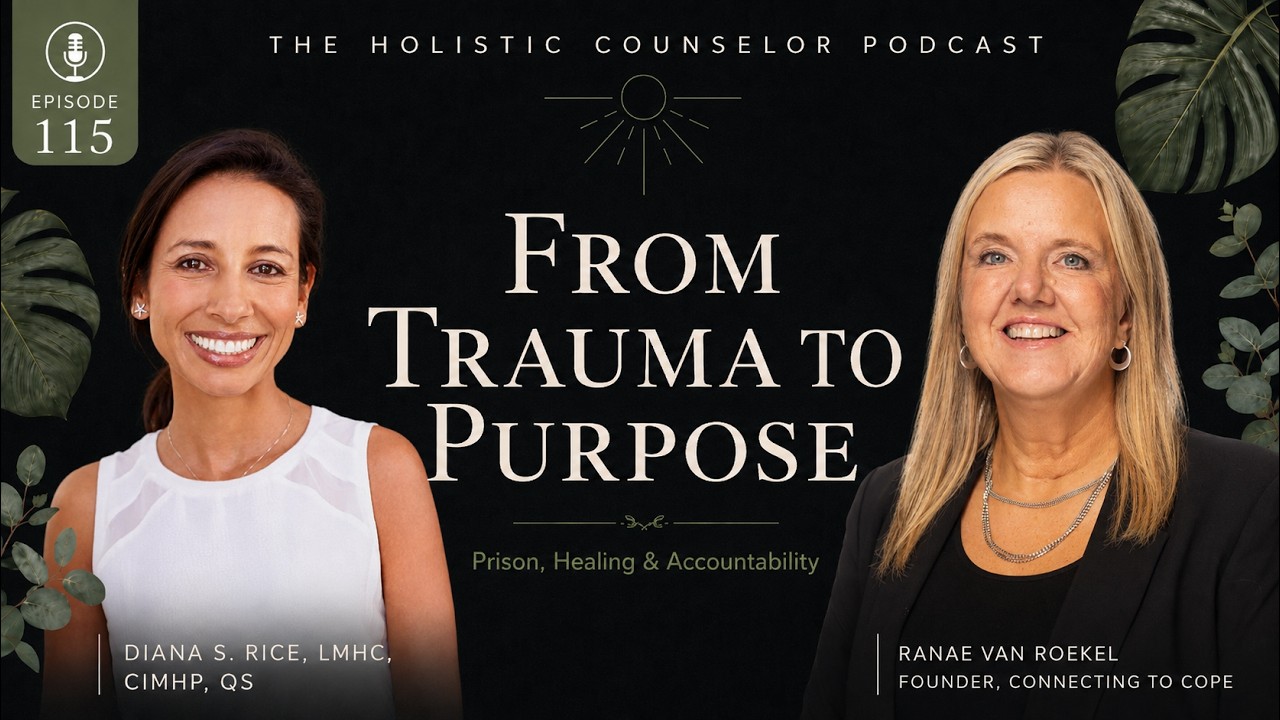
Episode 115
From Trauma to Prison to Purpose with Ranae Van Roekel | Founder of Connecting to Cope
with Ranae Van Roekel
Hosted by Diana S. Rice, LMHC, CIMHP, QS
What is the connection between trauma and incarceration? Can people truly change after prison? And how do you begin healing from trauma, shame, and past mistakes? In this episode of The Holistic Counselor Podcast, Diana S. Rice, LMHC, CIMHP, sits down with…
Listen to the Episode
Press play when you’re ready.
Educational content only; this podcast is not therapy, diagnosis, or medical care.
About This Conversation
Show notes
Jump to a section
What is the connection between trauma and incarceration? Can people truly change after prison? And how do you begin healing from trauma, shame, and past mistakes?
In this episode of The Holistic Counselor Podcast, Diana S. Rice, LMHC, CIMHP, sits down with Ranae Van Roekel, founder of Connecting to Cope, to explore the intersection of childhood trauma, emotional regulation, mental health, and the criminal justice system.
After serving 36 months in federal prison, Ranae shares her personal journey—from unresolved childhood sexual trauma and dissociation to accountability, therapy, and ultimately transforming her life into purpose-driven work helping others heal.
This trauma-informed conversation addresses what many people are actively searching for but rarely understand:
- The link between trauma and incarceration
- How unresolved trauma impacts behavior and coping patterns
- The psychological and emotional realities of life inside prison
- Rebuilding identity after shame, trauma, and poor choices
- Emotional regulation and coping skills for healing
- The role of therapy, including Cognitive Behavioral Therapy (CBT) and Eye Movement Desensitization and Reprocessing (EMDR)
- The importance of accountability, support, and connection in long-term transformation
- A trauma-informed perspective on justice and rehabilitation
This episode does not excuse harmful behavior. It helps listeners understand the "why" behind behavior so meaningful change can occur.
At its core, this conversation reinforces a powerful truth:
You are not the sum of your worst moments—and you are not beyond healing.
Topics Covered
- Trauma and the criminal justice system
- Healing after incarceration
- Emotional regulation and coping skills
- Childhood trauma and dissociation
- Rebuilding life after prison
- Shame, identity, and personal growth
- Trauma-informed care
- Faith, accountability, and second chances
Memorable Quotes
Diana S. Rice, LMHC: "We are not just the sum of our worst moments. And we are not beyond healing."
Ranae Van Roekel: "If you're not doing the work and going through it, you're not going to get better."
Resources Mentioned
Connecting to Cope – Ranae Van Roekel https://connectingtocope.com
Cognitive Behavioral Therapy (CBT) – Overview https://www.apa.org/ptsd-guideline/patients-and-families/cognitive-behavioral
Eye Movement Desensitization and Reprocessing (EMDR) International Association https://www.emdria.org
Internal Family Systems (IFS) – Dr. Richard Schwartz https://ifs-institute.com
Pet Partners (Animal-Assisted Therapy Information) https://www.petpartners.org
Who This Episode Is For
This episode is for individuals who are:
- Healing from trauma
- Navigating shame, regret, or identity struggles
- Supporting a loved one impacted by incarceration
- Mental health professionals and helping professionals
- Seeking a trauma-informed and faith-integrated approach to healing
Support the Podcast
Each episode of The Holistic Counselor Podcast takes approximately 3 to 5 hours to research, record, produce, and share.
If this podcast has encouraged you, helped you grow, or provided value, you can support the work and help keep these conversations going by checking out the merch store:
https://theholisticcounselorpodcast.printful.me/
Your support helps expand these conversations and continue breaking stigma around mental health, trauma, and faith.
Or share and leave a review!!
Disclaimer
This podcast is for educational and informational purposes only and is not a substitute for professional mental health, medical, or legal advice.
Listening to this podcast does not establish a therapist-client relationship with Diana S. Rice, LMHC, CIMHP, or any guests.
If you are experiencing a mental health crisis, please contact a licensed professional, call 911, or go to your nearest emergency room.
Always seek the advice of your physician or qualified mental health provider with any questions you may have regarding a medical or mental health condition.
Episode transcript
Read the full transcript Close transcript
Automatically generated from YouTube captions. Names and wording may contain errors; listen to the episode for the original conversation.
Hello there, fearfully and wonderfully made human. It's me, Diana from Through the Valley Therapy and Transform Mind Consulting and Coaching. Today's conversation might stretch you a little, in the best way, I hope. Because we're talking about something a lot of people are quietly trying to understand right now.
The connection between trauma and behavior, healing after incarceration, emotional regulation, and whether people can truly change. If you've been listening to this podcast, you know this isn't the first time we've had conversations around addiction, incarceration, and rebuilding life. Because at the core of what I believe, both clinically and personally, is this.
We are not just the sum of our worst moments, and we are not beyond healing. Now, let me be clear, crystal clear. This is not about excusing harm or ignoring accountability. This is about understanding the why behind behavior, so real transformation can actually happen.
Because when trauma goes unaddressed, it doesn't just disappear. It shows up in our relationships, our choices, our nervous system, sometimes even in ways that lead people into survival patterns, and that the world later punishes. And if you follow Jesus, even a little, you see this pattern over and over again.
He met people in their brokenness, told them the truth, and still offered them a way forward. And that's what today's conversation is about. A way forward. Today I am joined by Renee Van Rockel, founder of Connecting to Cope, a platform dedicated to helping people heal from trauma and build emotional resilience through self-awareness, self-advocacy, and connection.
After serving 36 months in federal prison, Renee made the decision to face her past, take responsibility, and transform her pain into purpose. Today, she speaks into trauma-informed justice, mental health, emotional regulation, and what it really takes to rebuild a life after everything falls apart.
She's a mother, a grandmother, a wife, and an advocate. And her story invites us to look deeper, to move from judgment to understanding, and to ask a better question. Not, "What's wrong with them?" but, "What happened and what's possible now?" So, whether you're someone trying to make sense of your own story, support someone you love, or simply become a more compassionate, emotionally aware human, this conversation is for you.
Thank you, Renee, for being here with me.
Uh thank you so much for having me, Diana. I'm excited to talk to you today.
Yeah. All right. So, to begin, I always like to the listeners to connect with the human behind the story. Can you just share a little about who you are, your background, and the journey that eventually led you from trauma and incarceration to the work you're doing today with Connecting to Cope?
You bet. Um so, as as Diana said earlier, I am a mother. I have two wonderful boys. I'm a grandmother, which is the best job in the whole entire world. Um I am a wife. I have a wonderful husband of 38 years who has stood by me through all of this.
Wow.
And I am also a felon. And that is not said lightly and it is not said that it is the whole being of who I am today. But it is definitely part of me and with that it led me to come to terms with my past trauma and to hopefully help others.
Um, I grew up in a small town in Southwest Minnesota. There's like 500 people, the kind of town where everybody knows what you're doing before you actually get home. Um, my my parents knew exactly where I was, what I was doing. You grew up with the same people, um, the same families basically that your parents did.
And, um, during that time, um, I I attended all of my high school and elementary years there. Um, I was physically and sexually abused. And it is something that I did not deal with. And it is something that stayed with me, something I continually shoved under the rug, something I had very unhealthy coping skills with and something that did lead me to some very poor choices.
Yeah, I mean, yeah, that's it sure does. Like as a therapist, I do know a quite a few of my clients, especially I worked at alternative high schools most of my career here in South Florida. So a lot of my uh, students that I worked with, this is things that happened to them and they weren't ready or they didn't know how or the resources.
Listen, yeah.
that's a big thing right there what you said, Diana. We'll get into that later, but
Yeah.
um, the resources are a huge problem.
Yeah. So looking back now and, you know, I don't want to re-traumatize you or if anyone's listening, this is hap- you know, this is this is the delicate part of being a podcast host and a therapist because I I it's first do no harm.
And and but looking back with awareness now, right? And how did unresolved childhood trauma shape your coping patterns and and your relationships that ultimately led you into the criminal justice system?
Um so again, unhealthy coping skills. Um you know, I there's so many things that led me to where I was, you know, but um I think really what I want to focus on today and focus with you and we can go different ways, too.
My conversations usually do get get brought different places. But are the unhealthy coping skills and the not dealing with something traumatic um like sexual trauma that is not dealt with. When you shove things under the rug um things like dissociation. And um I know dissociation can be a healthy coping skill for some.
It is not a healthy coping skill for me. Um I would lose entire days um because of dissociating. The person who was the main perpetrator in my sexual um violence, sexual attack, whatever we want to call it today, actually um became a member of my family.
Oh my gosh.
Um and so that was very difficult. So dissociation became my best friend. I would be at a family function and I would be like like, you know, I was basically watching the whole situation from the outside and seeing myself sitting at the table and wouldn't remember three quarters of what happened during the day.
And those are, as we know, very unhealthy things.
Mhm.
And the more I began doing that, the more it became a normal part of my life.
Right.
the the hiding things, the um because I was hiding that from everyone. So why not hide everything, right?
Yeah.
And again, you know, one poor choice became 10 poor choices. Um I also made some good choices along the way. Um you know, I I had a successful career. I had two wonderful sons. I got married Well, I got married. That was good.
Um, to a great guy. And so, those were healthy.
Yeah.
And I somehow kept the two things separate for a very long time. And that takes a lot of work.
Yes.
And so, after my poor choices and after I turned myself in for my crime, um, I decided why not take all that energy and put it into something healthy for not only myself, but hopefully for others as well. And that's where Connecting to Cope came in.
Wow. So, I mean, you said like unhealthy coping skills or tools, right? And I want to just have without going deep into exactly what happened.
Okay. It's just [clears throat] I think for a listener say, you know, we're here at our age and stage of life right now. Like, you know what I mean? Like, we've got We've gathered wisdom. We've gathered but there might be a listener out there that's young.
That's going, "Oh my gosh. Like, this woman gets it. Like, yeah, Uncle so-and-so or whatever." I don't want to blame all, you know, but you know what I mean? Like, I don't know what to do. I don't know where to go. I mean, the resources This is something that I saw in the in the alternative high school when I worked there was, you know, there was so many patterns in family systems.
And then the disassociation, you know, Dr. Richard Schwartz's work has helped me a lot understanding different parts of of human. I mean, even with my own complex PTSD. It is something that I see like how you said, like, I was able to disassociate.
I was able to still function, right? A part of you That manager came along and and function for you. You got married. You had kids. You had a career. I I've seen that, too, where some of the clients, you know, they leave high school and then they go to college and they and it just they they truck along, right?
And there's still parts of them in survival mode. Okay?
And and I think you know, that survival gives you energy at points.
Yeah.
You know, I can get past this, yeah.
Right. And it is and it's trying to get the person to understand that their brain was protecting them. Thank thank God that their brain was protect even though dissociation I've worked with those that were diagnosed with DID back in the day. This is I don't know.
Did you get any kind of mental counseling or therapy?
I I I most certainly did and I've I've been through therapy. I'm still in therapy all the time and I will forever be. I think it is so healthy and right now I mean, I hate to say my best friend but but truly is I have a great EMDR therapist that I'm working with.
And I also just go to a regular therapist to to talk. Not as often because of the EMDR but that's a whole thing too. But if if I were you know, we started this with if I were to talk to a young person or even an older person who has just suffered trauma for the first time.
Find someone to talk to and I and I know that that can be difficult because some of the actions that happened to us become shame in our own eyes. You think it's shame in others eyes. My items happened in the 70s. So in the 70s it was more that it was the woman's fault instead of the man's fault and I do not believe that.
Anybody out there who's listening today that is not what I believe so please do not take this out of context. But my mother who was born in the 30s, Um, was a late child. Um, said to me after my trauma, she said, um, "You know, keep this to yourself, basically."
And please don't tell anyone because they will think you are bad, not the people who did it to you. And so those words are the words that stuck with me while I was struggling. Please, anybody out there, do not think that this is your fault.
Or you're alone. Because that's the number one thing I hear is that I feel so alone in this and and you're not alone and and and that listen to me and I I'm sorry to interrupt you, but
No, no, no, I love conversations like this.
I'm thinking though, it's it's I'm trying to with this podcast break stigma in churches and in the BIPOC community, in the black indigenous people of color community. And it's because in churches, not all church, I don't I'm not stereotyping, but in some of the high controlling denominations, what you just said that your mom said in the '70s is what they're being told now in 2026.
Exactly, exactly. I
And and now you see you hear that that Latina New Yorker coming out right now. Like I'm like
Oh,
here she's coming, yep, you betcha. You betcha. And, you know, and that is something that I do try to address and people that I do try to talk to because being a a white girl from the Midwest, I had no awareness of what was going on in the rest of our world.
And so when I say prison helped me, it did help me. I I I started healing in prison. And that is a hard thing for you, maybe other people to realize. And, you know, I know that that's farther in our podcast, but also I met so many people and not just people who I mean, I didn't think of my other people as prisoners or inmates.
I thought of them as, you know, cohabitants and friends. And I people of so many different background diversities and I am thankful for that because I have some of the greatest friends and they see how I was raised and I see how they were raised and how their backgrounds are and how we do things and that we are all basically the same and we may have different color hair, different color skin, or different backgrounds.
I mean, even if your skin is the same color, you can be raised differently and think completely different than someone. And I am so thankful for that. There are so many things I'm thankful for that came out of this and that is one of the big ones along with my healing.
So, um yeah. But anyway, okay, what what what else do you want me to answer? I can get off on a tangent very easily, Diane.
And it's fine because this is what reality and rawness is about and that's why I don't like performative, uh, you know, A, B, C, and D. I want people to understand that you and I are two human beings with our own storyline, our own village that raised us, and what we're trying to do is that path forward to move forward in what we have learned.
You know, some people come in that like thinking that I have all the answers just because I went to college and I have a license and I've been doing this a long time. I don't because honestly, I feel that the Lord made each human being with their own their own unique DNA and thumb print.
At the same time, like you said, we're all human beings, made in his image.
Exactly.
So, to me, what I just heard you say is that due to this trauma, right? Because it's not only the trauma of sexual abuse, it's also the the the your freedom taken away.
Exactly, the culmination of all those things that happened earlier and then the poor choices. As I tell, you know, when I I to people, I say it is it was a culmination.
Right.
And it was yeah, a culmination of poor choices that led me to where I was and I am, you know, I think the word is regret, regretful for the people that I hurt and my you know, regretful to my family, but I'm also thankful that um my path was led to some of the people that I've got to meet through this.
Yeah.
And my mother-in-law says it well. Um she always tells me that How does she say it? She goes, "God tapped you on the shoulder many times, Renee, to try to get your attention and he finally kicked you in the butt." And um and that is so true.
And so I am very thankful for the forgiveness that I have from him and also for all the people I've met, so.
Yeah. So, a lot of people because listen television, America, I love my country, our country, you know, but you have like Orange Is the New Black and that show and
Oh, yes, I know. I know.
I don't know if you ever got that question, like is it like that? You know, not that I suggest you watch that because it's definitely not a Christian show, but the psychology in that show was just like, "Whoa, like okay." I just without going Yeah.
I could tell you it wasn't like that. Uh but she actually did a um so, if you read the book, the book is actually the the it's it's all based on a book that she wrote after she got out of um after she got out of being in prison.
Mhm.
And the book is much more truthful than the TV show.
Oh, okay.
Um of course they had to dramatize it for TV so people would want to watch it.
Yeah.
are some truths in that TV show. I've watched a season just because I wanted to um
curiosity
see Yeah. Yeah, I wanted I wanted to see the realism in it. I didn't watch it before I went, by the way. It came out right before I left and I thought I'm not reading this or not watching this. Um but there are some truths in that.
And you know, things the lines in a women's prison are very wavy. And I don't think there's any loyalty in a women's prison and you will see that in that show and in that book. Um from what I've learned and from the men that I've talked to that have been incarcerated, it is totally different if you are a in a male prison.
Um
[clears throat]
you are, you know, basically in a group or it is a prison gang. Um you are diversified. Um
It's like high school. I'm sorry to think about like when I when I
a high school thing and
It's it's clan. It's like I mean, we're made like that. That we're made to be in community.
Yep.
So what was the shift for you there? Because you you said earlier that prison became a turning point in your healing, right? What was the specific moment or realization where you began confronting the trauma you carried for so many years? Like what how how was that happening there?
So I had quite a long break between the time I turned myself into the government. Um and between and the time that I got sentenced and then the time that I was actually incarcerated. Um so in everything that I turned in cuz I gave them my computer.
I said, "This is what I'm doing. I know it's illegal. I can't look at myself in the mirror anymore." Um the day I did that um was my first life shift, Diana.
At that point, I knew um and now I can say this without, you know, breaking up or cracking up, but I woke up one morning and I was looking in the mirror and I thought I either have to end this and use my husband's gun in the closet or I have to come clean because I can't live looking over my shoulder anymore.
I cannot do this. This is not right. This is not morally right and I knew that the whole time. I lied to myself about the fact that it wasn't illegal um for a long time that I was just you know playing the game or whatever it was.
Mhm.
Um but that morning I was done and I took my computer and I went to my district attorney cuz I had no else nowhere else really to go and I had been I had served on a couple groups with him so I knew him and I went in and I told him what I did and I gave him my computer and he basically gave it back to me and said Renee, I don't know what you've done exactly but you definitely need to get yourself a lawyer and you need to find out what this is.
So that was my first turning point. And really the reason I did it Diana is for my kids. Um if I would have taken my life that day they would have never known the full story.
Oh.
They would have known just what came out afterwards and there was more to my quote unquote story than that.
Yeah.
And so I didn't do it for myself as much as I did it for them. I did not want them to live with that trauma.
Yeah.
And so that's that's where I was that day. My next turning point was uh probably about 3 months into prison when I realized I would be there for a lengthy time. And that
Can I ask you how did you deal with that psychology cuz I'm putting myself in your shoes right now and I feel the emotion. I'm sorry.
That's just who I am.
okay. It's okay. I I still feel it when I think about it and I was writing some things down the other day and I can I still lose it too when I when when I talk I can talk about it now
EMDR
I I answered
I know EMDR's amazing but I want to know just think about because listen if somebody's listening and they're about to go in or just they have a loved one or just you know like those first few months must have been like really scary like the psychology behind it that's what I'm saying cuz you're you went through it this is why I named my company through the valley therapy because people think they want to go over it under it around it like hey help me do
Well there there you you can't go over it or under it you need to go through it if you're going to get healthy I will tell everybody out there she named her company very well because if you're not doing the work and if you're not going through it you're not going to get better and
you survive like that's that's what I want to know is how'd you go from really unhealthy coping skills the dissociation the I don't know
Okay I'm going to back up a little bit before that
we're both on
I know I know I'm going to back up just a little bit so um between the time I turned myself in and I went through the whole process and we would be here for five hours if we talked about that but um I was forced to take some therapy and I had done some because I was like be before I turned myself in I'm thinking okay maybe I just need to get help but I was not
in it fully and I would pick therapists that um I can be very persuasive I'm a great salesperson um and so I picked therapists that I knew I could buffalo and I know now looking back it's like Renee no no no well my um the the person who was in charge of me from the federal government was a great man and he said Renee I am going to pick who you go to for therapy not you
cuz usually they give you like a list they're close to your house whatever but it was court mandated that I go through so he picked me and this lady was tough and she would not let me get by with anything and she's like, "You've been lying to yourself for how many years about this trauma and we're going to start talking about it today."
Well, I didn't. So, but the back of my In the back of my head I was like, she is so right. If I do not deal with this, I know my rug rug has a huge lump in the middle. In fact, the edges are up and everything is shoved under there.
And if I don't deal with this, I am never going to be the person I know I can be. And I will be the culmination of all the worst things that I've ever done if I don't get to who I really am. And so, that is when my head started and after that 3 months in is when I realized that I would be in And Are you Are you afraid the day you go in?
You are. You're kind of numb. Um I You turn yourself in um because I was obviously not a threat to anyone or threat to myself or a threat to, you know, um society. So, I turned myself in. Um my husband left me at the door and he was sobbing and I was not even crying.
Um because you're so numb and just so cold to all of it. And you go in and you get your first I I will tell everyone out there, get your first strip search and that is scary. Um a weird thing with me is I was never indicted.
I was never arrested.
What?
I was never in a I was never in a cell.
Mhm.
I was never handcuffed.
Wow.
So, I went in by turning myself in because I knew morally what was wrong. And I'm not praising myself for this, so don't think that I am. Because my guards always tease me, then why are you here?
Mhm.
You know? Um but I knew what I had done was so wrong. And so, the day I went in, I kind of kept lying to myself, "Oh, something will happen. They'll find out this is a mistake." Even the gal who wrote my PSR wanted me to appeal my conviction cuz she didn't think
What's a PSR?
Um so, that is a presentencing report.
Okay.
So, if anyone out there is dealing with it, it is what your loved one or what you or what anybody who goes through any type of incarceration or um you know, criminal activity, they will write what is called a PSR. And it is they they go back.
They do your whole background, and then they go into what you actually did, and they get psychological evaluations, um opinions,
Mhm.
different things. So, basically come up with who you are in this one report, and it's very important to you as you get into prison.
Mhm.
But anyway, um she she thought I would get an appeal, and I would get a lesser sentence, and I wouldn't be there cuz I got sentenced to 51 months, which was the very upwards of my um sentencing guidelines. So, anybody who is out there also who is in the federal prison systems, we have what is called a sentencing guidelines for each and every crime.
It is based on a number system. You get assigned a number according to what you did. Um I was charged with wire fraud. And so, then you are under that number of that that statute number.
Mhm.
And they look at that, and they say, "Okay, she did this, this, and this. She had this many people that she dealt with. She did this, and here's your number, and here's your sentencing guidelines." Things can be variant, um but at the end of the day, that is your golden number.
Mhm.
But anyway, I my judge, who I am now actually friends with, um he's no longer a judge. He is now a dean of students at a prestigious law school in our country um told me the reason he gave me that is because he knew in his heart I was a one and done.
And that if he gave me a lighter sentence that he thought I would go in and just not take care of myself. He knew I had to heal.
Yeah.
And so anyway, for those first 3 months I was lying to myself. Lying, lying, lying. I'm going to get out. It's going to be fine. I don't really have to get to know these people. Why are you doing all this work? I'm going home.
At 3 months I found out no one's going home anytime soon. And so that's the day I decided for the first time in my life I had one person to take care of. And that is me. There is one person who can control me and that's me.
And I started with the me situation that I am the only person who can heal me. Um you know, through the help of God, through the help of Jesus, through the help of wonderful therapists in the Federal Bureau of Prisons and I was
Well, that's I'd love to hear that because
They are there.
Okay, because that's
great great therapist who basically didn't let me get by with anything either. And I would come
Can you explain that a little more because like for people like with didn't let you get by anything just kept challenging your thoughts even when the emotions would come because some
I I will give you a a day because I remember it clearly. Um there was a few like shining moments in my therapy, but this was one of them. And um Her name was [clears throat] Miss Miss Richardson and little tiny gal, um itty-bitty.
She actually used to work with the um FBI in the behavioral unit unit division before she came to prisons. And she was tough. I mean, she may have been small, but she was mighty. And um she I came into my therapy session one day and we started out normally, have you talked to your family, Vin Rupal?
Cuz in prison I will tell you you do not have a first name, you have a number or a last name. They do not address you by your first name, it's too personal.
Mhm, wow.
how are you today? Have you talked to your family? All these things. Yep. And she goes, "Well, here's the deal. You're on my caseload and I'm glad you're on my caseload. But if you don't start telling me the truth and start dealing with what you know you have to deal with, I'm dropping you.
You can go to so-and-so or so-and-so and you know you don't like them and nobody likes them or they do like them because they let them come in and basically do crossword puzzles for the hour that they're supposed to be doing things or you can sit here and get better.
So, what is your choice?
Mhm.
I said, "Well, I want to get better." She goes, "Well, are you ready to do the work then?" And that is where I I walked out of that and that was my session for the day. She let me go. She said, "Go back, do something, whatever, go sit outside, I don't care what you do.
But think about this and I want the answer by our next session in 2 days."
Yeah.
I thought, "Do I want to get better? Do I really want to face this? Are these things I want to deal with?" And I thought, "Yes, I want to come out the other side a better person and at that point I was already thinking and making deals with someone you're never supposed to make deals with and that is God saying, "If you get me through this, if you hold my hand, I will do these things.
I will try to help other people." And I have kept my word so far
Mhm.
and he definitely kept his word on the deal we made and um it it that that is that was my turning point. So, for people out there, if you have loved ones in prison, there are people that are willing to help them and help you.
Mhm.
And so, please please know that. And if you're not in prison and if you have faced trauma, I always tell anyone I'm talking to, you don't have to go to prison to face your trauma. You just need to find someone you trust, someone who's going to hold you accountable, and you have to start holding yourself accountable, and that is the most important thing that I did.
Yeah, and and so let's go there for a second because many people that carry trauma or something has been done to them or they might have done something, right? Um how did you separate what I did or what was done to me from who you are?
You know, how did you begin rebuilding your identity? That would be something I would think because especially if this really super traumatic situation happened when you were I was I'm thinking as a child or a teenager, you know, right? And so all of sudden that's something that was done to you and then the things that you did, the poor choices, right?
And you said you make good choices too along the line. I mean, this is like the human condition at times like we right? But how did you separate that from because this is what I see when people come to me is like that it's all mixed up and jumbled.
Oh, of course it is and it still is. It's it's still mixed up and jumbled and I still have days where I have to remind myself, you know, who I am and that I am still going to make poor choices and that I can rectify them.
Um and that I try to make good choices. And so um okay, we'll get into that in a little bit, but but I think the question you asked was, you know, how did I deal with what happened to me, what I did, and who I am.
Is that is that is that basically what you wanted to know?
Yeah.
Okay. Okay. So that is where my therapist really came in that just like you are not the culmination of your worst choices, you are also not you are not only what has happened to you. I mean, you are a culmination of all thing all bad things that happened to you.
You are a culmination of good things, bad things, even days. Um you that that is who you are. You are a culmination of all those things. And that the only person, and this is what I got from Katerina, Dr. Richardson, um is that you are the only person who can control those choices.
Now, can I control that somebody did something to me? No. But I can control the reaction of how I come out of that situation. And that is really how I have started to live my live my life. I started in therapy with cognitive behavioral therapy.
That's really where I started, and that really helped me get to know who I was, what my moral background was, that I was not that girl who, you know, was a victim of sexual abuse, and that I was not bad. Cuz that word bad for my mother is really what stuck with me.
Yeah.
And it's one word. And I did not realize that until I went through CBT and through till I went through EMDR that that was a bad word for me. And so bad is a bad word for me. There I went. But anyway, um I I really learned that we are that that whole person, and that we change every day.
And I I want, you know, people who you talk to and if people who listen to this podcast to know that you're not going to be the same tomorrow as you are today. Something will happen today that changes you slightly for the better, for the worse, but you are the person in control of how you handle that.
And no matter what someone says to you about you, and I know this is difficult, um but you need to learn how to handle that. And you need to do the work to need to know how to handle that. And um
So, let's talk about the work.
The work, okay.
Emotional regulation is what you're talking about.
It is. It is. Emotional regulation and CBT, those are my friends. Um emotional interviewing, I did some of that. Um that really helped me. Um but I think what really got me over the hump
Mhm.
um is you know, daily journaling. Of course, that's a coping skill. It's a self-care skill as well. And EMDR. And if anyone out there has never done that, it is a process um where you take basically what you can't get over the top of and break it down to that core item that is holding you back.
And then you go through electronic stimulation. And the person who is doing that for you gives your gives you trigger words or trigger sentences, and you let your brain go to wherever it needs to go. And that gets you over the hump. And really, what comes out is what is holding you back.
Am I giving a good explanation of that for the common person?
Yeah, I think so. I mean, I have a lot of episodes on EMDR, so anyone listening can go back cuz I I I I interview EMDR specialists. And I also went through EMDR because of certain things in my life and I didn't realize.
And you're right. And I want to make people understand if they never understood EMDR, like when she says electrical shocks or whatever, it's not like this the stuff that we saw in the '60s or '70s. Yeah, you're like It's just I I did it with the hands and the light.
I had the things in my hands and then the light. And basically, the therapist will, you know, they have to do a because you want to find a really good EMDR specialist, not someone that's just like that, you know? It's someone like It took about three to three sessions to just get the 10 questions.
Exactly. And me, too. And I went through a basically basically an interview like I did when you started CBT or started therapy or when I went into prison. We went back to absolutely everything. So, if that is the road that you would like to choose, make sure that the person you choose is thorough.
But the person I believe this is hold you accountable.
Yes.
for your sessions. And but at the same time is also What word am I looking for? That is is also emotionally supportive because EMDR is really tough.
Yes.
It's the toughest therapy I have went through. And if they realize that you are really breaking down that day or if you are at a halting pattern or if there are different things they need to recognize that and give you a break. And mine is all those things.
And she's tough on me. You know, she makes sure that I I come into into therapy. And I keep saying being tough on you. I don't want you to go out and find the therapist who's the toughest on you in the whole world.
That isn't it.
Right.
I just needed Katerina is the most caring person I know, but she also doesn't let me get by with things when we speak.
It sounds like she was able to tune in and co-regulate and she she probably took care of her own crap cuz countertransference for us therapists is a real thing. I don't That's what I keep saying. Like
And she did have crap. Now now that we're I'd I'm out of prison, she told me her whole story and she I think as as a friend of mine said, we all have crap. It's just different crap. He used a different word, but I won't use that on here.
Yeah. It was the professionalism though that what I'm hearing is that it was about you. Because this is what I've seen in with because I'm a supervisor, too. And it's just trying to teach the therapists because I have interns that listen, is that you kind of have to deal with your own stuff, too, because some people get into many fields.
I mean, we could talk about prison guards. Like, some of them get into the field because they they have to feel like they're like the big guy or big girl, whatever, you know, or whatever. Like, there's so many different reasons people get into what they get into, but I'm trying to talk about the therapeutic process of EMDR because it is a sensitive, vulnerable situation.
Yes.
Right. And I don't want to scare people off, but I also want people to understand there is help out there because, you know, there's stereotypes, just like there are people will stereotype you or me for our situations.
Yep.
Right?
Yep. Yep.
And that's what I'm trying to break.
us, but that's the thing.
Exactly. Exactly. So, it's just trying to So, how do you do this? Let's talk about Connecting to Cope now.
Okay.
To me, this is, like, you know, you brought you told us some of your story, and her
website will be on the show notes and stuff, and I will also put a a website for EMDR so people can understand EMDR and find someone. But, Connecting to Cope, like, how was that born?
I kind of told you. You know, I I made the deal, right? And so, the funny story about Cope is
Mhm.
um Cope is my dog. Cope is a golden doodle, and you will see him. He takes center stage on my website, and I talk about him when I speak, and I talk about him to people that I'm coaching.
Mhm.
Um because he is kind of my support person, um even though he is four has four legs and four paws and some fur. Um you know, he never judges me. Um well, I shouldn't say that. If anyone out there has a doodle, you know doodles can judge.
They'll give you the judgment look and let you know when you're leaving the house too soon or something.
Or they didn't get their treat.
That's right, or they were fed at 5:05 instead of 7:00. It's a whole thing. But, anyway, for the most part, Cope is non-judgmental. Um and the story of getting Cope is kind of funny. So, when I started all of my therapy in prison, I really didn't know what coping skills were because I never went through therapy, right?
I had quit before I even let it get anywhere. I didn't understand self-care. I didn't understand healthy coping skills, non-health healthy coping skills, or coping skills in general. So, we spent a lot of time in my therapy talking about how to cope. How do you cope with what happened to you?
How do you cope with what you did? Because that's a trauma as well. Um it's a trauma for the people that I hurt, but it's also the hurt that I caused that has become a traumatic and a PTSD issue for me. Um and so how do I cope, right?
So, the word Cope kept coming up. Cope, Cope, Cope. And so, I had my dog name before I met him. I told my husband, I'm getting a dog when I get out of prison because I did some work with therapy dogs in prison, which was amazing, by the way.
Um and could be a whole 'nother story and I've talked about that just just that. But, I had my dog named. I said, "I'm getting a dog. I need a dog. He's going to be named Cope. It is going to be a male.
Unless I said I fall in love with a female at the at the breeder or whatever." Nope. Met Cope. We bonded immediately when he was like 7 weeks old. And he couldn't come home with me yet cuz the breeder that I I chose um didn't let their dogs go home until 10 weeks.
And so, I went and met him and I went and got to meet him. I was still on home arrest home home arrest after getting out of prison. And um I went and met him. He bonded to me. I bonded to him. I went and saw him once a week.
And when he finally came home with me, he was attached to my my constantly from a small puppy on and I to him. And so that is how Cope was born. And so when I was thinking of how I was going to keep my promise that I made in prison, um I knew I needed to come up with a business model or was I just going to go out to speak and not have a business model, you know, what was I going to do?
And I got together with some really great people, Jen being one of them that you met earlier, and we came up with Connecting to Cope. And so it's named after both coping skills and after my big buddy, um Cope. And what I do with Connecting to Cope is I coach.
I try to help people who are going into prison, into jail, families. I've Actually, um like where I live is a very judgmental area. And that's okay because it keeps me on my toes and and I've found the positives of it instead of the negatives.
But the weird thing is is that a lot of people who are there have come forward now like, "Oh, my son is now in prison." Or "Oh, my sister's in prison." Or "Oh, this. How do I deal with this? How do I help her?
How do I do that?" And so that's one of the things I do with Connecting to Cope. Um and that's kind of a coaching skill as well. Um you know, I speak about trauma, about speaking up with your trauma. You talked about helping in the alternative high schools where you are.
Um that is something that if I do speak to young people and I love to, I talk to them about if something has happened to you, if you think it is not right, you know, all the things we talk about, but find someone that you trust to speak to.
It doesn't have to be a therapist. It can be, you know, whoever. So, um that is something that I do. And I am also an advocate for um addressing trauma and education in the prison systems. Because so many people that are incarcerated have trauma.
It's like 90% of women and 80% of men, the numbers are are insane. Um and then the prison itself is a traumatic experience. So you have that PTSD issue after you get out of out of prison. You have to deal with that and a lot of times it is something that haunts you forever just like our trauma can if we don't take care of it.
Mhm.
Um it becomes a complex issue. And um so I talk about that and I also um deal with the fact that so many people come into prisons under educated and with no opportunities after prison because of the fact they were incarcerated, they have no education, and their whole life was around drugs or you know, crime and basically just getting by.
So those are things that that I based Connecting to Cop on. If that answers your question, that's a long answer, but
Yeah.
There's so many parts of it and
Okay.
I wish I could do it all, but I can't, so
No, and this is your lane. Like you see what I mean? Like I try to get people to understand this is going to probably be I forget the 100 and something episode, but I try to get to people to understand especially as we wind down that, you know, every one of us has a story and we have choices and we get to choose.
God gave us free will and and sometimes we're stuck in um this this I think we have to go through the cycle of healing, right? Cuz some of us I know at a time I was stuck in a victim mentality.
All right, and then you have to shift and change and grow and find out and get the information and the education or some people just stay stuck in doing the same thing over and over and then they're blaming everybody else instead of trying to take responsibility because that's what resilience is.
It's taking the responsibility. I want to know just because if someone's listening they're like I don't even know where to start, you know, how do how do I even what's this emotional regulation? What do you mean connecting to cope? Like you talk about tools.
Like what do you mean tools? Like like what what would be like
And that would have been me, you know.
Exactly. Like it was me before I became a therapist and went into early childhood education on purpose because I grew up in a very you know, tumultuous background of like a lot of unhealed humans with no resources surviving. You know, I look at it now and I could be at that space but there's people in it right now looking around anger, anger, anger, guilt, depression, anxiety and to me it's like these are all signals.
They're all signals in your body and your system. I want to know how do you share your wisdom now to help someone slow down and take that breath and go, okay, like here we are now. What are coping skills that you know, that you share or you know, without telling every you know, cuz we could be here for another two or three hours.
Oh, of course we could. There's so many things we could cover today. I'm enjoying this by the way. So God, what would be the first and and it's always hard to just say until I actually talk to the person and get a little bit of a feel but I think talking is probably your first step of coping and reaching out to someone.
So if someone has reached out to me, I know they've taken the first step. And so I just again do a little bit of interviewing, find out where they're at. Um different things. Um you know, if they open up about why they came then we deal with specific coping skills or specific activities that can be related to the things that they tell me.
So, it's hard for me to just go out and say do this, this, and this. But, I think All right, don't you agree kind of it's hard to know, but I think the the first thing you need to do as a person and it is a need is to realize that you can't do it all alone.
Yes, you are responsible for yourself. You are the only person that can make that call. You are the only person who can make the changes, but you need more things in your tool bag, we will call it tools since we are talking about tools, and one of those is someone you trust.
Yeah.
And to find a good person such as Diana, who you can talk to and open up to and start dealing with the pain even if you don't know exactly what the pain is.
Right.
And you know, that pain can come out in so many different ways as she said, anger, illness. Um poor choices. Um I think I was angry, too. Um I think I had anger, I had poor choices. Um And when those things and I started talking about them and I would spend entire hours, you know, sobbing
Yeah.
you know, about first the things that happened to me and then the things that I did to others. And I realized that that was just a culmination of everything over the years. And again, that you are not the worst thing you've ever done.
You know, you're a culmination of everything you've done.
Yeah.
Every feeling you've felt and everything you've done, though that's all who you are. And that you are responsible for that, good, bad, and otherwise. It is a great day when you do realize that. Does that mean you're healed? No. That means you have to keep doing the work and the work is [clears throat] therapy, coping skills, you know, finding a good tribe, as we talk about it, if you want to use that word, or a good village.
Um I don't want to insult anybody by using certain words, but just finding that No, I'm serious. I I've been there, so um just finding a good nucleus of people
that are healthy, because this is a like there's so much to go in here, too, because like you have family members, you have intergenerational trauma, you have a high ACE score, adverse childhood experience score, uh resources, you're in the Midwest, I'm in South Florida, these are different I think it's for whoever is to take a step back and be still and let what comes up come up, because, you know, this is
that. Thank you, Diana. That was awesome.
Right, Renee? Like it's just like and then make a choice of what to do and not make it where you want because to me, when I work with people that want to end their life, it's because the pain is so unbearable, and I've been there.
I have, too.
Right, you said earlier, and you just want the pain to end. And I'm telling you right now, that pain, that obstacle is the way. And and so it's just like hold on, you're not alone. I'm going to put the 988 and you know, you just, you know, if you're feeling this, and reach out to someone near you.
Psychology Today, you could tick all the things. If you have insurance, you don't have insurance, there's community mental health. There are resources out there. What I have come to find out is people don't know where to find them, or they're so like dissociated or disconnected, and the fear just makes them get stuck.
Yeah.
And fear is also seen as, you know, this is why people judge, I think, is because they're scared that they're going to lose something, you know? So the judge and it's like we can't change what other people think at all.
No. No. No.
At all.
Nor would you want to be responsible for that.
I Oh, I love that, Renee.
Yeah.
I don't want to be responsible for any other human being because when God takes me home, I'm responsible for what every single thing I did here, good or bad.
Yeah. And do I want to have people that are close to me and people that can hold me accountable and all those things? Yes. But at the end of the day, I'm responsible for me and that is really the mantra that I live by now and it helps so much and it might help someone out there, it might not.
But I am not responsible for anyone else's actions. And if they do something to me that I find unpleasant, unkind, how I react to them is on me. So, that's on me. So, you know, if you can find that that person has probably had a bad day today or something is probably troubling them or whatever, you know, someone said to me once, "Renee, the reason people point fingers at you is because they don't want them pointing at them."
Mhm.
I said, "That is true, but now it just makes me so sad because when something or someone does something, quote-unquote, bad, we'll use the bad word, I used to say, "Ugh, my goodness, how could they do that? What is going on? You know, da da da da."
Now I look at them, I said, "Oh my goodness, what happened to them that made them do that or allowed them to do that?" And so, now I look at the person as a whole and think, "Oh my goodness, what pain, what anger do they have that led them to this choice?"
And I think our world would be such a better place if we could all start putting a little bit of that into our mentality instead of why did they do that? Oh my goodness, that's horrible. Blah blah blah.
And it is horrible. Let me tell you, like we we have to acknowledge that there are human beings that do super horrible thing. I mean, just look at the news. Look at the media right now.
Oh, I know. And I And I do know that. I do know there is horrible things and you know, to other humans.
Yeah.
You know, and
It's But what are you doing? Like the Like what Like you are trying to do what what you can with the with the resources you have and the and the power that you have. And I hate to use the word power, but it it's just understanding like the responsibility that each one of us have.
Right? And And how are you cuz I I have people that are so focused on everything happening because we live in a society now that we have 24/7 in a little rectangle of media and that and what's happening in the people system. They don't take a step back to take a breather and going, "Okay, what's happening here right now from the inside out?"
It's always outside in.
Now, I was on a I was on a panel, um and it was a very very short panel thing, but we talked about the fact that mental health is so much more or mental illness is so much more prevalent now
Mhm.
than it was like in the 50s, 60s, 70s, back in the day. And I said, "I don't know if it's that much more prevalent or that we just have access to knowing that it is more prevalent and the things that happen in social media and so that does contribute, I know.
Obviously big contributor. But I think it's always been there. We just first shoved it under the rug and second, it's right in front of our face."
Yeah.
So, I want people to think about that, too. You know, that it's always been here. It's just
From the beginning of time. I mean, if if you're a Christian, just read the Bible.
I know. Most certainly, I know.
And And you get blown I get I I still get blown away like, "Lord, what? Huh? Are you kidding?"
Oh, I know. I know. My friend has a T-shirt that says, um you know, what is it? Peter was in prison.
Mhm.
Paul was I mean, you know, was
a womanizer.
David was a womanizer. Mary Magdalene was a prostitute or so or so they say.
Mhm.
Um you know, all the different things and the people that that Jesus hung out with were the people who needed to let other people see that we all make poor choices and nobody is up on a pedestal of not making poor choices. And that again, we'll go back to it.
You are a culmination of your choices. That is who you are and you were responsible for you at the end of the at the end of the day. And
Yeah.
that's that's just how we live our lives.
Yeah. And and it's never too late.
It's never
too late to rewire your brain, to figure out your parts, to challenge the thoughts DBT, and to go get EMDR. Um oh my gosh, it just EMDR, I want to say what it actually means. Uh movement desensitization reuptake. Okay.
I never know either. Eye movement
Yes. Desensitization
Desensitization
reuptake. Reuptake. Reprocessing.
Reprocessing. I was going to say repetitive, but it's reprocessing.
Yes.
Eye movement desensitization reprocessing.
Right. And I And so to me, I'm going to put the links to all that because this is where you start becoming a curious observer of yourself. Understanding you have different parts. This is what I say to some of my clients that that are that want to come in and they're Christians.
I'm like, we were taught Father, Son, Holy Spirit, three in one.
Yeah.
We're parts, too. If we're made in his image, we have these different parts that have started from birth. And you know, I'm a I'm a daughter. I'm a niece. I'm a I'm a granddaughter. I'm a mom. Like we we named all the parts, right?
But we also I know I have parts of me where I was an addict. I you know, I made some
And so was I. Not not to a substance, but to people pleasing. And so yeah.
And so, like and then you have the man, and this is why I love Dr. Richard Schwartz's work. And now, if you just any listener, if you just really start taking, like I said, take that step back and understand like all these things that have happened to this point of your life.
I don't care if you're 15 years old or 95 years old, you still can reprocess it and change it, and neuroplasticity is real, emotional regulation, learning how to rest and digest is real.
Yeah.
And so, I we could keep going on and on, but before we say goodbye, Renee, what would you like to say to the audience?
Well, first of all, at the very beginning of our podcast, you when when you were talking about me, we were talking about things and if you can really change. And I don't know. I I don't know if we change. What I like to think is that we learn to make better choices.
Mhm.
Which is a a form of change, I suppose, but we are who we are, and we learn to self-regulate either health in a healthy way or in an unhealthy way. And people like Diana, um I am not a trained professional, I'm a peer advocate.
I have take peer taken peer training, and I've lived the experience as Diana has as well. So, I can talk to you, I can give you
the same experience, Renee, and this is why you're here. This is why people need to understand what my pod This is why it's the Holistic Counselor podcast because you have created something beautiful through Connecting to Cope
Yep.
that will help, like you said, I have my Well, my experience is very different than yours. I cannot I mean, I could help with someone that has been incarcerated from the Midwest but I can't cuz I can only practice in the state of Florida.
But But you know what I mean? But But to me, like that somebody might feel more connected to you because you have been able to work this through and they're like, you know, from Ohio or something like that in the mid or wherever and they're like, oh my
California, I have like a lot of people from California, which is crazy, but
So, people from all over the world can work with you, correct?
Exactly. Exactly. I am not licensed, so I can work with anybody and I can speak anywhere. So, um I would be more than happy to do that. But I just encourage you that if you haven't started to do the work as we talked about.
We really never explained that, but we'd be here another 5 hours. Um but what you feel in your heart is right for making yourself I guess the word better or to start your journey to a healthy life. It is never too late. And I am living proof of that.
We can And And so is Diana. You You can make yourself better and you are the person again that has to do the work. And I hope you visit Connecting to Cope. Hope you take a look at Cope. He is just awesome and he'll make you smile if nothing else cuz he's a little crazy.
Um but um I I again, I hope you visit Connecting to Cope. If I'm in your area, I hope you, you know, look me up. And um I am just so thankful for getting to talk to Diana today. We could have went off on a hundred different tangents, a hundred different things to talk about, but I think we got through to you that you need to start.
You need to do the work. And you need to look at yourself as a whole person, not just the culmination of your bad items. So, that's what I'd like to tell people today.
All right, Renee. Thank you so much for being here. And listener, please do not forget to trust in the Lord, guard your heart, and renew your mind.
Bye. And now for the disclaimer to make sure you understand that you are responsible for you. The content provided on the Holistic Counselor podcast is for entertainment and informational purposes only and is not intended as a substitute for professional medical advice, diagnosis, or treatment.
Always seek the advice of your physician or other qualified mental health provider with any questions you may have regarding a medical or mental condition. Never disregard professional medical advice or delay seeking it because of something you have heard on this podcast. The views expressed on this podcast are my personal opinions and do not represent the views of any professional organizations with which I am affiliated.
Call your doctor, 911, or 988 immediately if you have a medical emergency. The Holistic Counselor podcast does not recommend or endorse any specific tests, physicians, products, procedures, opinions, or other information that may be mentioned on the podcast. Reliance on any information provided by the Holistic Counselor podcast,
guests appearing on the podcast at the invitation of the Holistic Counselor podcast, or other listeners to the podcast is solely at your own risk. Confidentiality notice. If you engage with the Holistic Counselor podcast by commenting or posting and are a client, please be aware that you may be revealing information that could compromise your confidentiality.
Please remember that disclosing your identity or personal details can be linked to your clinical material. As a therapist, I am bound by confidentiality and will not respond to any disclosures of this type on this podcast. I am committed to upholding the ethics and confidentiality of the therapeutic relationship, which extends to all forms of communication in accordance with the laws and professional guidelines that govern mental health professionals.
I want you to know that your privacy is of utmost importance and you are responsible for protecting it when interacting on this platform or any other public forum. Thank you.