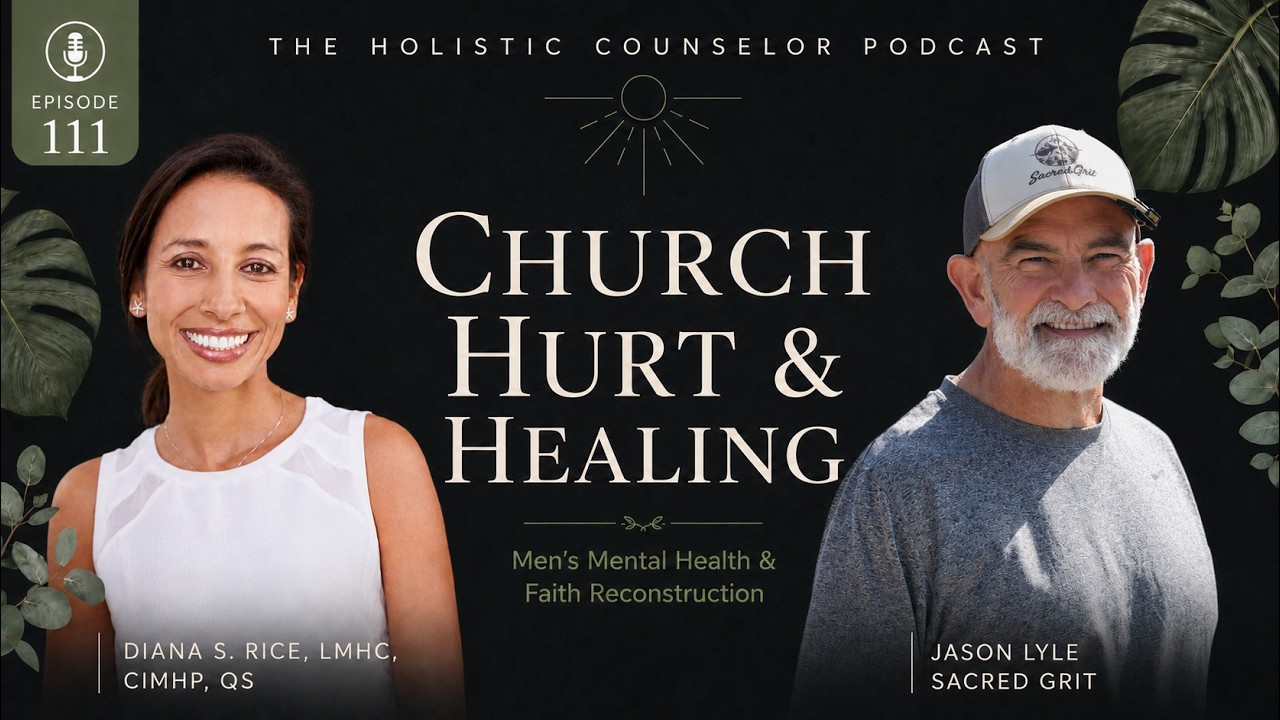
Episode 53
Faith-Based Trauma Healing: Rediscover Your Identity in Christ
with Kayla Roberts, LMHC, BCCC
Hosted by Diana S. Rice, LMHC, CIMHP, QS
Join host Diana S. Rice, LMHC, CIMHP, CTP, QS, as she welcomes special guest Kayla Roberts, LMHC, BCCC, a seasoned faith-based trauma therapist and EMDR specialist. Together, they explore practical ways to integrate faith and psychology for holistic healing,…
Listen to the Episode
Press play when you’re ready.
Educational content only; this podcast is not therapy, diagnosis, or medical care.
About This Conversation
Show notes
Jump to a section
Join host Diana S. Rice, LMHC, CIMHP, CTP, QS, as she welcomes special guest Kayla Roberts, LMHC, BCCC, a seasoned faith-based trauma therapist and EMDR specialist. Together, they explore practical ways to integrate faith and psychology for holistic healing, identity restoration, and spiritual freedom.
In this insightful conversation, Kayla Roberts shares how trauma impacts identity and how finding your true identity in Christ can unlock lasting mental wellness. Through proven therapeutic methods like Eye Movement Desensitization and Reprocessing (EMDR), Internal Family Systems (IFS), and attachment theory, learn how to address underlying trauma and overcome emotional and spiritual obstacles.
Discover key biblical truths to replace harmful lies about self-worth and practical faith-based strategies to deepen your healing journey.
Key Topics Explored in This Episode
- Integrating Faith and Psychology: Why faith and therapy are inseparable and how biblical principles align with psychological truths.
- Trauma and Identity: Understanding trauma's effect on identity formation and rediscovering your true self in Christ.
- Understanding EMDR Therapy: How Eye Movement Desensitization and Reprocessing can accelerate trauma healing and emotional regulation.
- Four Common Lies Affecting Identity:
- "I'm unlovable."
- "I'm stupid."
- "I'm defective."
- "I'm simply not good enough."
- Healing from Religious Trauma: How spiritual bypassing affects emotional health and strategies for overcoming church hurt.
- Multicultural Counseling Awareness: Recognizing how cultural backgrounds influence experiences of trauma, healing, and faith.
Bible Verses Mentioned
- Galatians 3:28 – "There is neither Jew nor Greek, there is neither slave nor free, there is no male and female, for you are all one in Christ Jesus." (ESV)
- John 1:1 – "In the beginning was the Word, and the Word was with God, and the Word was God." (ESV)
- Romans 5-7 – Discusses freedom from sin's power through Christ's sacrifice.
Practical Faith-Based Healing Steps
- Seek Safe and Loving Relationships: Build relationships with people who offer unconditional love, accountability, and reflect God's character.
- Identify and Challenge Fear: Recognize underlying fears that prevent emotional healing, and bravely confront them with God's truth.
- Embrace Your True Identity in Christ: Regularly affirm biblical truths about who God says you are.
Recommended Resources
- EMDR International Association (EMDRIA) – Learn more about Eye Movement Desensitization and Reprocessing therapy.
- "No Bad Parts" by Dr. Richard Schwartz – Introduction to Internal Family Systems (IFS) therapy.
- Bible Hub – Tool to explore original biblical Greek and Hebrew meanings.
- YouVersion Bible App – Free Bible reading plans and devotionals.
Connect with Kayla Roberts
- Website: Rivergate Family Resource Center
- Church Resources: Encounters Church
- Kayla's "Freedom from Trauma" 10-part series
- Identity and attachment theory teachings
About Kayla Roberts, LMHC, BCCC
Kayla Roberts is a Licensed Mental Health Counselor, Board Certified Christian Counselor, Certified EMDR Therapist, and passionate advocate for trauma-informed, faith-based healing. With over two decades of counseling experience, Kayla integrates clinical expertise with biblical wisdom to help clients reclaim their identity in Christ and experience lasting emotional freedom.
About Your Host Diana S. Rice, LMHC, CIMHP, CTP, QS
Diana S. Rice is a Licensed Mental Health Counselor, Certified Integrative Mental Health Professional, Certified Telehealth Professional, Qualified Supervisor, consultant, and host of The Holistic Counselor Podcast. She specializes in holistic wellness, mental health coaching, and spiritually-informed counseling through her private practice, Through the Valley Therapy.
Enjoyed this episode? Please subscribe, share, and leave an honest review to help others find transformative conversations at the intersection of faith and mental health.
Remember: Trust in the Lord, guard your heart, and renew your mind!
Episode transcript
Read the full transcript Close transcript
Automatically generated from YouTube captions. Names and wording may contain errors; listen to the episode for the original conversation.
Welcome fearfully and wonderfully made humans. I'm Diana S. Rice, licensed therapist, consultant, and host of the Holistic Counselor Podcast, where we explore the intersection of faith, mental health, and whole person healing. I'm also the founder of Through the Valley Therapy and Transform Mind Consulting and Coaching, where I help people navigate life's challenges with both clinical expertise and spiritual wisdom.
Today, I have the privilege of speaking with someone who embodies that same commitment to faith-based healing, Kayla Roberts. Kayla and I met through the Christian Mental Health Professionals of Broward, a group that has been an absolute lifeline for so many of us in the field.
If I'm remembering correctly, Kayla, I believe it was Tina Saunders who introduced me to the group. Yes, you remember correctly. And let me tell you what Kayla and Anna have built has grown far beyond a local network. This community now connects Christian licensed professionals from across the country, creating a space where faith and mental health intersect in powerful ways.
Kayla has been in this work since 2000. counseling in in human service organizations, churches, and addiction treatment centers before stepping into private practice in 2012. She holds a master's in mental health counseling from Nova Southeastern University. Go Sharks. Is a Broward certified Christian counselor, a certified EMDR therapist, and serves as a board member for the South Florida Association of Christian Counselors.
But beyond the credentials, what sets Kayla apart is her passion for helping people find their true identity in Christ. One that isn't defined by trauma, struggles, or past wounds, but by who God created them to be. She specializes in Christian counseling, trauma therapy, mood and anxiety disorders, identity issues, and addiction recovery, welcoming clients from all walks of life, and incorporating a multicultural lens into her work.
She has also led seminars on trauma, marriage, identity, and spiritual growth, equipping people with the tools to heal and thrive. Kayla Roberts, I am so honored to have you on this show. And let's start with this. What led you to become a faith-based trauma therapist?
And what was a defining moment in your journey where you knew this was your calling? Thank you, Diana, and thank you for having me. Such an honor to be here. Just really enjoy the work that you do. Um, what is my story? What led me to become a trauma uh therapist?
nothing in particular. And that's just the odd thing. There was no defining moment in my life or career that said, "Hey, become a trauma therapist." It was rather a culmination of lifetime experiences and me becoming upset about people who didn't like themselves and they they lived like hell on earth.
M so I would say u it was really compassion and love for people to find their true identity in Christ. We see way too many people that are broken Christians and non-Christians and I got angry at pain itself and you can call that a defining moment but uh I just don't like people being emotionally mentally tormented.
Wow. People were created to live free and to love themselves. That's why I'm here. Wow. Yeah. Tormented. That is a word. Let me tell you, there's a that's probably what we do most of no matter what diagnosis a patient or client, whatever you want to call them, um h you know, it's torment, right?
They wouldn't come to us. And and and I think there's a shift as well because I think people are starting to understand instead of waiting to be tormented or whatever, why don't we start learning how to prevent? Right?
So you know faith in therapy a lot of people have issues with that question or that statement or that understanding you know so they keep it in a separate world like you psychology some psychologists are like there is no room for theology and then theologians or some people in the church not everybody are like there is no room for psychology that's from the devil.
So, how do you bring that together in a way that truly helps clients heal? Well, I see faith and therapy as inseparable. Uh, they're intertwined and they go so well together. Why? Because faith informs how I do life on a daily basis. How do I make the choices that I make?
You cannot separate faith from life. Uh faith is pretty much the air we breathe if you think about it. Um everybody believes in something. Even an atheist has to exercise a lot of faith in the wrong direction. Sometimes I say, well, it requires a lot of faith to be an atheist.
So faith is all around us whether we like to admit it or not. It's like the air we breathe. So faith really uh informs how I think, how I view myself and my world. And therefore it informs uh my condition. How do I do life?
Why do I do the things I do? So for me faith in God really becomes this practical way of how I do life and that's where I start with a client. So it's very easy to infuse spirituality and faith into my counseling because it's the air we breathe.
Wow. Is that how you start? Do you do you talk about breath work or I mean tell me like say sometimes I have sometimes I have but I often tell my clients well tell me um why do you think the way you do?
Like where do you where is your faith? Like what do you believe in? Right? Because the why is more important than the what. The why is more important than the symptom that a client presents. And once I get to the why, game's over.
Yeah. Really? I mean, that is you question the why. And that I'm surprised nobody's Maybe you need to create that, Kayla. Like created like unless there is a book out there that I have not heard of yet, but you know, the why and it is it's a deep rooted question like why are we here, right?
Why do we do the things we do? Why do we do the things we do? Why do we say the things we say? Yeah, it all requires faith. Whether you have faith in the right or the wrong direction and let's just explore that together.
And I have yet to find a client not wanting to do that. Who doesn't want their freedom? Wow. Yeah. Wow. All right. So, let's go into what you do because I know you do EMDR. And for the audience that does not know what those initials mean, what is it?
EMDR stands for eye movement desensitization and reprocessing. Basically, it's a dual attention therapeutic uh way of helping the person look at what disturbs them from the lens of what happened that caused the disturbance and also what do you believe about yourself now? So, EMDR is is a perfect way to access traumatic memories. um our brain has memory networks and also traumatic state of being in our conscience.
It just um accesses that very fast with bilateral stimulations and at the same time it helps you to think for yourself and to apply whatever beliefs you have now and see how that works with uh the trauma or the anxiety or the depression you're dealing with. and you actually use everything that God has put inside of your brain to resolve the trauma.
And it's almost like AMDR is a perfect proof that your brain works the way God designed it to work. And you see the proof of the pudding is in the eating. So you see how you you people tell me EMDR helps me to understand why I think the way I think and why I do the things I do it.
EMDR is a fast way to access the underlying issues behind whatever pathology or mental health issue you're struggling with. So I just love it for that reason. Yeah. I did EMDR um back in right before COVID happened and I because I did not realize I had I mean I had it and you know it does not erase because people need to understand it's not like you're taking memories out of the brain.
It is right you know so it doesn't erase it it just desensitizes it. Exactly. So in other words it doesn't change what happened it changes your reaction to what happened. Exactly. And I want to give an example, Caleb, because this is how my experience was with EMDR.
I did not realize for 47 years of my life, I was always uh my system in my brain would turn on like, you know, it would disregulate because I would hear an ambulance. Never knew why. Never knew why I would start crying.
Never knew why. uh and it any ambulance I'd be driving and an ambulance goes by and I would go and then the next thing you know I did EMD oh and it turned out because of something that happened when I was 5 years old and I'm not going to go into the story but that's it and now I can hear an ambulance and I'm fine and I smile now not smile because I do have the memory
but I'm like oh my goodness my system's not activated anymore right and that to me that's when I became a believer yeah there you Yeah.
So, trauma shakes up identity, right? And so, how do you help people discover rediscover who they are in Christ when their past has made them feel lost, broken or unworthy? That is an excellent question. And so, this is what my years of experience have taught me.
I've done a lot of trauma therapy with my clients and also with people from the church. I've done pastoral counseling and care, you know, and I've discovered that there are four lies that people typically tell themselves about who they are that are at the core of emotional disturbance, sometimes mental uh mental health issues like anxiety, depression, relationship conflicts and so forth.
Throughout the years of of my experience, I've discovered these four lies we tell ourselves are the root issue behind a lot of this identity crisis. Now these four lies may be told in different verbiage in different way but at the core they're the same and I will tell you what these four issues are.
First lie I'm unlovable. Second lie I'm stupid. M third lie I'm defective fourth lie simply not good enough the fourth one is just the whole idea not enough and I have seen these lies I have hunt down and I discovered these lies time and time again whether it's a Christian or non-Christian and these words these lies these four lies I mentioned are extremely destructive in nature because they destroy destroy the very core of who God made us.
Now, these lies are in a in direct rebellion against God's declaration over us that we are created to be good like in the Garden of Eden, right? And this is very important because God speaks over us goodness, love, kindness, light, love. But those lies are diametrically opposite to what God says who we are.
So now when we attribute evil to us contrary to what God calls us to be, that creates a delusion that contains a destructive force behind it. And I've seen it time and time again in therapy. That distraction is activated by placing faith in these lies.
And those lies create a delusion about who we are. And now this is the what happened to Adam in the Garden of Eden. And that's important because Adam changed his mind about who he was and changed his mind about who God was. And that was the bait of Satan against him to buy into this whole delusion that whoever God made me to be, I'm not good enough and God's not for me.
As evidenced by what the serpent said, hey, did God's really not for you because he knew that you're going to be better than him. He knew you're going to be um like God's, but he was created in God's image anyway, right? But somehow the serpent polluted Adam's mind to think whatever he was, he wasn't enough.
So he searched for something that God had already given him, an identity, right? That he was enough. So then the rabbit hole goes down to where Adam becomes sin conscience conscious and as a result he hides and he runs from the same the very person that is his healer.
He hides and he's under this delusion all of a sudden I'm naked. I'm ashamed. So guilt and shame creeps in the world. same crap that happens all over again with every person that has emotional and mental torment about their identity. So, but here comes Jesus to restore all that.
Amen. Yes. And Jesus actually restored everything on the cross and he restores us into our original state to be good, to have love, peace, joy and righteousness, fruit of the Holy Spirit. Now Jesus is the last Adam who created the first Adam who restored everything the first Adam screwed up on.
And now we have a lot of faith and hope because the last Adam really is victorious. So we are just like the last Adam. And that in of itself changes the way we see ourselves, the way we see our world because the world doesn't have a sin problem.
Diana, the world has an identity problem. When Jesus came to take away the sin of the world, he did a lot more than just take the sin away the take away the sin of the world. He actually broke the power of sin over us.
Romans 5:6 and 7, right? He broke the power of sin over us, which means we don't have to sin anymore. I mean, does this mean we don't sin? Yeah, we do sin. Yeah. But we're not slaves to sin anymore. No. Right. Right. As Christ is, so we can be No, there's a freedom.
That's a, you know, we're going to be free. Free indeed. Right. So therefore, this is in a nutshell the whole identity issue. Wow. Yeah. I never listen, nobody's ever explained it that way to me. And it is it's like understanding why we need Jesus.
And and then when you become his disciple, that is the freedom and we have a better understanding of who we are and what this world's about and gives us faith that gives us hope that helps us to love because that's what the Lord says to do in the word, right?
Love one another. But even that is so amazing to me because the Bible says, "Love your neighbor like you love yourself." Yeah. And you have to love yourself. But guess what? I don't even have to drum up the strength to love myself because I was loved.
John the beloved disciple says about him. He describes himself in the gospel of John says John the disciple that Jesus loved. What made John so special and so close to Jesus is he knew how much he was loved. Wow. So I cannot afford to have a thought about myself that God doesn't have about me.
Yeah. And I cannot afford to look at my life in a way that God doesn't look at my life. So healing process is activated when I appraise my life the way God appraises my life. And I appraise my selfworth the way he appraises my selfworth.
And last time I checked the appraisal is pretty amazing. Yeah, for sure. I mean, we're God's masterpiece, right?
So, that being said, okay, because you know me, Kayla, I'm gonna ask this question. is how does a person, you know, listening and struggling with their mental health and go to church and listen to the word of God and pray and try to do everything and they're still feeling depressed and anxious. you know, is there, you know, what are the top three to five faith-based steps they can start taking today to move toward healing?
Because we could say all this to them, right? And we believe it and and I don't want to believe it into a place where I'm some narcissist and I'm like, "Yeah, I'm God's masterpiece, so my poop poop does not stink and I'm perfect."
Because that's the the situation sometimes that can I've seen it. I've seen it in churches and I've seen it where someone goes to a whole different level and I'm like, "Oh my goodness, you just became God. You are your own idol." But so you see what I mean?
Like someone's listening and they're just either they don't know the Lord at all or they are in the in the in the church and they are learning how to discern and really understand the reality of what the word says in context. What would you tell So the first step would be to uh find love within the context of relationship.
And it goes back to attachment theory as we know it in therapy. But guess what? And I've talked about it in our church before. Uh how does God love me? I'm not referring to what's being preached over the pulpit. I'm not even referring to your Bible study.
Let's just do get in your own skin and find out how does God love you and allow Jesus to manifest to you within the context of relationship. God has always been relational. Yeah. Right. Uh not theological. Theological is is actually a byproduct of relational.
And why I'm saying that is the first thing I would say is how are you loved in your life? Find a person that you can have a real relationship that believes in you, can hold you, and you can be safely attached to that mirrors your creator.
Right? Find that and that's that is a breeding ground for healing. Mhm. So a relationship that uh will encourage your journey and your relationship with God and that relationship needs to be non-judgmental unconditional positive regard and the person has to only have good thoughts about you.
Now it doesn't mean that they will not call you out if you do something stupid whatever right there accountability right I would say that the first step to healing is unrelentless love that says I will never let go of you no matter what okay so the danger to me would be that the hum the human being will become way too will put that human being on a pedestal yeah so how would and I understand the healing
are I get it because that is something that that is like some some of our clients that's who we become for them you know and so it's like how do you harmonize that because true love fosters emotional independency ah not codependency there we go rather interdependency which can lead to safe independency because the opposite could be true someone can say well I don't need anyone you know cuz they've been so hurt.
No, you need people. You need God. How do you safeguard against people putting on this pedestal? Show up as you are. And then um you can't lose yourself in a true loving relationship because a true loving relationship will foster you being yourself and there is no comparison.
In other words, you can't have an idol when true love comes in. Why? Because when Jesus shows up, you show up with him. I found out that in my relationship with the Lord, every time the Lord manifests in my life, I show up with him.
I always talk about him. He always talks about me and then I always talk about him. And this is beautiful romantic dance, intimate dance between me and the Lord. And it's I I lose myself in him and I find myself in him. There's no codependency there. there's a beautiful beautiful interdependency.
I'm found in him and um I don't lose myself. So it's like that kind of relationship that when when you allow yourself to be loved by someone like that, uh you emerge as the true you. You don't get lost, right? We become one.
I mean, this is what comes to my my mind right now is Galatians 3:28. You know, it's like there's no Jew, no Greek, no male, no female. We're all one in Christ Jesus. That's been my favorite verse since I got saved. Like since the That's awesome.
Yeah. And doesn't it make sense? Like absolutely one. Yeah. And it's also true because Galatians 3:11, it says, "As Christ is all in all, Christ is all in all." Yeah. Yeah. And so Galatians 1:15-20, we were created by him, through him, in him, and unto him.
I mean, get a load of that. I mean, it's just you you can't even wrap your mind around that. We were created in him, by him, through him, for him, unto him. Yeah. That's what it says in my Greek. Yeah. And I love it.
Okay. Yeah. We're going to go there for a second. Kayla, you're going to tell us. Well, unless you don't want to. Your your real name because I want to respect it. I love it. Let me see if I remember it. Can I say it?
Of course. Okay. Kyaki. Yes. I said it right. Yes. I love it. So, my beautiful soul sister here, Keryaki Roberts, that's her real name. She is pure pure Greek. And that's why she studied. She actually studies the word in Greek. So I I love that about I haven't I mean I barely try to study I mean I study every day but I'm well I'm not a theologian.
It's okay. It's called biblehub.com. Don't worry. All the ancient Greek is right there. You can just know people get intimidated by Greek and I get it. Um I studied three years of ancient Greek in high school. Um, so I read ancient Greek and so for me, biblical Greek is not that hard to read or understand, right?
I love that. So, so, um, I jokingly tell people, um, English is just a commentary. Of course, I'm biased to everyone. Yeah. Yeah. No, it's all good. It's all good. you know, as we talk about like understanding the word in context and you're like reading it in in the whole, you know, understanding of Greek.
It's Greek and Aramaic. No, Greek and and Aramaic. No, they're not the same. No, no, no. But I'm saying the Bible. The Bible was written in two or three languages. Correct. Correct me if I'm wrong. The Bible was written in The Old Testament was written in Hebrew.
Hebrew. Yes. And then the New Testament was written in Greek and that's it. Mhm. Yeah. Okay. See? Ooh. Ooh. Hey, you guys don't hold that against me, okay? I try my very, very best to read it in English and that's totally fine, you know.
No, I'm not a pastor or a priest or anything like that. You don't have to be actually. Amen. No, I have my personal relationship with Jesus Christ and I try my best to follow what he tells me to do. All right. So on that note, let's just talk about a little bit about some the things we see in churches because there's a big movement that I've seen with church hurt, religious trauma, etc., etc., in this country.
I mean, I I experience I think a lot of my clients come in and they either like grew up in church or they um come from a different lifestyle or whatever it is. And you know, you you had a lot of people come at them with the Bible darts.
That's what I call them. Been Bible darted. And so and and some people don't really understand. They just make assumptions. Like if I say I'm a Christian counselor, right away you get a uh some people are like, "Oh, like you're judging me." I'm like, "Well, you're judging me because I said I'm a Christian counselor."
Yeah. Exact, you know, and I also know my personal experiences in the past after I became a Christian, some of the things that I saw with leadership and I'm just like, wait, are you opening up the word that I'm reading or you care more about the bylaws instead of his laws, you know?
Um, and there was something that happened a lot that I also saw and hear from is like uh something called spiritual bypassing, right? It's just, you know, Christians hear things like just pray about it or let go and let God or you don't have enough faith.
What do you That's cold language. Yeah. So, what do you say about that? Uh, you always get to the heart of the matter.
When someone tells me something like, "I'll pray about it." oftent times that's code language for I don't want to do anything about it so I'm just going to put it on God's uh shoulders because you know to me many times praying about it well sometimes you know that means I don't really want to do anything about it so I'll just pray about it or let go and let God sometimes means I'm going to bypass my experiences
I'm going to pretend I don't have that diagnosis and I'm going to pretend I don't have that relational problem and I'm going to hide behind God.
To which I address by saying, "How's that working for you? Show me the fruit." Yeah. Right. What's the fruit of that? How is that working for you? And if it's not, why? So, you cannot tell me you have a really toxic relationship for the past 20 years because you're praying about it and because uh you're just trying to keep the peace and you're just letting go.
You're letting God. No, you're just hiding behind God. The question is, let's find the root issue here. Where's the fear? Behind every problem, there is a fear. So, I'm hunting down the fear. What's your fear? And guess what I say to to people right away?
It's okay. There's no judgment. Tell me the fear and there will be no judgment. It's okay to show up in your own skin. What are you afraid of? There will be no repercussions. There is no punishment. There is no judgment. There is only candidacy for healing.
So show up as you are. Right. Right? So spiritual bypassing has been happening for centuries and so people basically negate life experiences. They negate uh human feelings and human thoughts because of some superficial god idea that it's a god that they made up in their mind.
Oftentimes someone that says to me I'm an atheist. You know what the all many times they mean when they say that to me? I don't believe in the God that your church believes in. I don't believe in the God of modern Christianity for all the judgments and the spiritual bypassing they've done to me.
Sometimes I'll tell an atheist, "Yeah, that God that you don't believe in, I don't believe in him either." So, I found out people who say they're atheists, often times they really are not. They just don't believe in the God that we presented to them.
And it's a God that's really a jerk because we don't do a pretty good job in modeling his goodness and his love in churches across the board. Yeah. Yeah. I mean, I've heard cosmic child abuser. I've heard that. I've heard I mean there's people that have come out of different sect s ect of uh denominations that were really traumatized and abused.
And when I say traumatized denomination, Diana, huh? What's an ect? No, no. S ect a sect. I wanted to make sure that my listener heard the word sect and not sect. Okay.
Okay. cuz sometimes so when I speak I just want to make sure so that's what I meant like different sects see it came out again sect of sects of of different denominations because you know there's so many out there and there's so many wolves and sheep's clothing and to me that's why you know when I have clients that come in and they're just like yeah my youth pastor said that I should do AB and C and
this is how it is to be a woman example right and that and then the man is this ab you know and then they take a small part of the word to and that's the things that I try to help um many understand that are you part of a cult or are you part of an actual bibleelving in context denominational where you understand who who are they pointing to are they pointing to like the person on
the pulpit and the you know money and and power and if you just send me your money I will you know and say five prayers and then you're going to be as rich as me or or also I've seen um like I' I've heard quite a few pastors nowadays getting busted for sexual misconduct and things like that and you know a lot of people look at these leaders as you know that's that's a hard part cuz
you are a pastor and a pastor's wife.
That to me, you have a lot more responsibility than just a lay person like me, you know. How do you, you know, help clients like break free from that um pain in in that manner for that purpose? Because, you know, like I said, they come in with anxiety and depression from different things that have happened.
But when it comes to church hurt or religious abuse, like what do you say to a person that's experienced that? The first thing I'll say is uh God is God is not who God may not be who your church is representing him to be or your pastors or your pastor has preached in to be or the verses that were quoted to you.
And if your God isn't good, I have reason to question that God. So if if the God that the church preached about uh or talked about doesn't match the goodness of Jesus, I have reason to question it. If it doesn't match the heart, the goodness and the love of Jesus, I have question to believe the picture of God that's being portrayed.
Whether it is over the pulpit, whether it is in books or seminars, I have reason to question. Anything that doesn't look like Jesus, I have reason to question it. Yeah. So, and help set people free from guilt and condemnation for questioning that. Yeah.
Yeah. I mean, this is something I say a lot in my sessions with people that are wanting to work through that is that guilt and shame comes from the world. Conviction comes from God. And the only way to be convicted is if you're in the word trying to understand him and having what you were saying earlier, like having the relationship with Jesus, Jesus has the relationship with you.
And he he will make it clear, you know, because it's not about us becoming perfect uh in the world sense. the perfection of this world because then that means we look a certain way that means we have a lot of stuff you know and that's where people get confused and and our Lord our God is not a god of confusion at all and and I tell people about the conviction if the conviction doesn't look like the
conviction of a good father I have reason to question it exactly because many times the church has portrayed God as not a good father.
Like he can't, you know, he can't wait to drop the hammer on you and god forbid you're caught in a sin issue, right? He's going to really really uh let you have it. But often times we turn out to become more merciful and kinder parents to our children than we portray God to be to us.
Mhm. So I sometimes I tell church leaders or pastors, why don't you try that on you and see how it feels? Or try it on your child. If your child behave that like that, would you drop the hammer on on your child like that?
Often times these people say to me, "Oh, no. I'd be gracious and kind to my child. I'd be forgiven forgiving to my child." But when it comes to them disciplined people in the church, they drop the hammer. And I'm like, well, God is not as kind as you are.
Evidently, you are a kinder father than your heavenly father is to people, right? Try it on you and your child and see. Yeah. Are you kinder than the heavenly father? When God disciplines as a father, he disciplines as an enormously loving, gracious, and good father.
Yeah. Doesn't mean we're not going to have consequences people. Like that's the thing. It's like it's not like gonna Right. Consequences are unavoidable. Absolutely. You have con but even in those consequences is his love and mercy and kindness not there to embrace you.
Exactly. Even in the pain. In the pain. For real. And and he talks about it in the word. Right. Right. So we're not immune from pain. But guess what? His love sustains us. Yes. Yes. Yeah. And and and the more I see people or even myself get closer to the Lord, the more that I want to um try to do the right thing.
Why? You know, right? It's like I want to because I understand he made my body and all the cells in it.
So, I want to take care of it. my body is a temple or just certain things like that like I I want honestly the word and the relationship with Christ is the only thing that actually makes sense to my brain nowadays because this world is like what huh I feel sometimes I'm like wait am I living in a simulation because you know this is why I really feel um anxiety and depression has skyrocket you know through
the roof after isolation because isolation is a devil's tactic to keep us sure in you know isolate us from each other.
Um did he really you know that's like it's a it's it's a lie from the beginning of time. Did God really say that right? And so then you start doubting and then you're isolated and now you're doubting and then you're on social media or watching something constantly and it's the bombarded of 24/7 just watching and listening or whatever and then you get the dopamine hits and let's you know if you talk about the science of things and so here's what I found Diana.
Yeah. It's easy to do the right thing when you know how much you're loved. Wow. You don't have to try to hard to do the right thing. Yeah. Just get people to know how much they're loved. Doing the right thing comes like a second nature.
Yeah. So, yeah. I mean, and it's a lot of people react in emotion instead of responding in wisdom. And to me, getting wisdom is what the word talks about like get wisdom, right? I mean, Proverbs. So, throughout the whole the whole book of Proverbs, you know, and we have in this beautiful country because I'm sure How long have you been here?
Uh, since 93. Okay. So, you you came straight from Greece, right? Wow. All right. So then we're going to talk a little bit now about, you know, multicultural counseling because you have an understanding of that, especially because you come from a different culture and in this culture, we're very ethnosentric.
So yeah, you know what I mean? So we think and not everybody, but I I understand my own culture because I am American even though I look very different than what the stereotype of an American should look like. But it's it's I understand being an immigrant's daughter that I had the opportunity and the blessing to to know other cultures.
And how do cultural backgrounds shape the way people experience faith, trauma and healing? Um the cultural background provides the lens through which you perceive, you understand and you interpret your world really. Um, and you know, there's nothing wrong with having uh a background of understanding, right?
As long as you're open-minded and you're not uh really fearful. Fear is at the basis of um every bias and discrimination really. So we are afraid of differences as opposed to be struck with wonder and awe of differences, right? Uh from the moment I landed on this country, I've been around in, you know, international students, you know, um I make good friends with Africans, Asians, I mean, you name it, right?
Uh we have five passports in my home. Five passports. two of mine, two of my husband and one of my my son, right? So, um we represent different countries. So, what would what would it be like if we were not afraid of the unknown because we knew who we were?
We would explore it rather than discriminate and judge it. Whatever you judge, you do not understand. But when you observe, then you invite wisdom. Yeah. It's Yeah. I mean, and it it takes courage to observe, right? And you get that courage from love.
Yeah. And and education. Sure. Right. It's like educating ourselves in in in different cultures. Realizing that, you know, people come from all walks of life and all backgrounds, especially here in this country. This is what this country was. I mean, like I know that's my mom came for the American dream, you know, that she made it crystal clear I was a spoiled American.
Yeah.
Constantly. like you have no idea what drama is because you know you're you're a spoiled American and I mean you know that's for another but you know even the education has to be experiential it cannot be cerebral right right we say education I can tell you how to make spinach pie or you can come to my house and have the experience and the taste of it what would you rather would you rather me tell you about
it which will be or rather you know I can do a tutorial on it which is fine it works works.
It's cerebral. It works. Mhm. But the higher learn level learning is actually the experiential learning which is God has inviting us to be experiential learning learners. I mean I can learn about an African culture by studying reading it or even hearing someone. Well, I can just go have coffee with my friend from Kenya and see what it's like to talk with a Kenyan and see what it's like to feel around a Kenyan person.
I would have a second. Yeah. Oh, no. Me, too. But I think that's because you do come from a different culture and also like Greece is how big is it? The size of Texas. Uh, well, I would say about maybe half the size of Florida.
Okay. See what I mean? So then you got to experience different Everybody over there has different cultures. Italy, Greece, you know, and here though we have different cultures too in America. like you know the south has their personality, the northeast has their personality, California has their personality.
I think though with the multicultural like understanding because I I I think what happened Kayla, I don't know if you had this experience, but I had the experience when I first got into my master's program in mental health and the DSM and questioning the cultural thing and going, "Wait, huh?
Wait, no, what?" Like I kept asking question like, "Who wrote this? who wrote this? Are you taking into consideration like my, you know, maybe partial family that, you know, might practice Sanoria and stuff and they're hearing spirits, but they're really not schizophrenic like that.
That's just a that's just an example. And no, not my whole Puerto Rican family did not was Sanoria. Okay. So, I don't want people thinking that, but that's an example. Yeah. Sure. So, like how can we be more aware of these differences in counseling or better yet too because this is something I saw a lot working in the alternative schools with different especially Caribbean cultures is that they did not trust counseling and then we went into the churches and they really didn't trust counseling.
Yeah. I would say uh enter into your client's experience and um build a rapport there. What is it like to be you? What is it like to think like you? What is it like to feel what you're feeling? So people appreciate when you're willing to step into their journey to see what it's like to be in their shoes and to enter their experience.
That's where I start. Yeah. What would you say to those like in in pastors or churches or cultures like I like that don't trust therapists, you know what I mean? Like they don't trust the psychology of it or the counseling part or the clinical part of it.
What what would you or a person listening now that they feel certain things and they're wanting the help but their church or denomination or faith is like no you don't go to those things or the culture you know what I'm talking about right what how do you have anything to encourage them with or tools or yeah I would say explore the fear behind it right if if you hear a strict no don't go there.
Don't explore that. Find out what's the fear behind it. Right? So I invite so I I would invite those people to just explore the the fears and to establish safety. Right? Do you feel you're going to be contaminated if you go to counseling?
Do you feel you're going to be a bad Christian? Do you feel that you're crazy? Okay. Well, let's just explore that fear, right? And if I if I showed you a way to still be safe and explore that, if I showed you a way that could be beneficial, would you be willing to take the risk?
And if you don't believe me, how about you get to hear me out, you get to know me, and see if we can establish enough rapport and safety where I can invite you into an experience that could really break your fears. Would that be worth your time?
Yeah. Wow. Because nothing changes when nothing changes. If you just stay where you're at, then you're not going to gain anything from it. Yeah. No, really. So, as we start closing our our session, not our session, our conversation, sorry, I had I had clients all Yeah, I understand.
Um, is there any like tools or tips or books or resources besides of course the word of God, the Bible? She said Bible hub you version works too. Um sure. Is there any other things that you would love to tell the audience? Uh regarding trauma?
Yes. Um h uh well sometimes um IFS works, internal family systems works like no bad parts. Um you can explore that. Um I don't have any specific uh books on trauma that I would recommend other than uh explore what what is EMDR like?
Um what is internal family systems like? Um I love those. And so see if you can uh maybe um talk with with people that have been on that journey. Yeah. and have gone through to the other side of healing and see what their experiences have been.
Um so um don't you do uh workshops and and stuff like that too? Like you didn't you just have a workshop that you led? Yeah, I've done those you know. What are the different ones that you do for church? Like say a say a pastor is somewhere in South Florida and says, "Hey, I want I want to hire Kayla to come in for a day to do a workshop."
What would be like Right. So, I've done a 10-p part series on trauma, healing from trauma in our church. Uh, it's called Freedom from Trauma, and you can find that at our website, Encounters Church. Encounters with an s encountersurch.com. Okay. And, uh, I do a 10-p part series on trauma.
Uh, I talk about attachment styles and God. Wow. Uh, so I talk a lot about emotional healing uh, and our identity. Now I'm doing a series on identity in Christ. So um you know I I do that I do those teachings on those series.
So right can somebody like hire you out to do that or like you do it like as a group online or like right you know are you going to write a book? Yeah I've I've been writing a little bit. I have been writing a little bit and I wanted to write more on this issue of freedom from trauma and identity.
I love it. I'm just honing into some ideas that the Lord has put in my heart already. Perfect. Uh but yeah, uh issues of identity, freedom, emotional healing, attachment. Uh we have a lot of those on our church website. And when she's talking about attachment, you're talking about attachment theory.
Correct. Attachment theory. And how does that compare with our view of God and who is? Yeah. So, you're putting something cool together. Like, I love that because I I sometimes will work on IF and I'm not certified in IFS, but I've studied it enough where I can relate it relay it to a um a client and I'm actually having hopefully she's coming on.
Dr. Tori Olds, she has all the IFS YouTube videos that I learned from and she said she'll come on the show. So, I'm excited to talk all things IFS with her. But for you, like I'm I'm just thinking like if somebody wants to have you come into their church and not even their church, anything like that and attachment theory and God to come in, you know, that's where they'll find at your website.
The my website is um my practice is called uh uh Rivergate Family Resource Center. So, they can go to rivergatefrc.com and I have a form there if they want to fill out for me to speak at an event or they can go to our church website encountersurch.com and see some of the teachings that I've done on um trauma and freedom from trauma and also attachment.
Yeah. And uh identity. Good. Okay. I will put all that in the show notes. Is there any final words before we say goodbye? Uh, I would just want to just encourage people to know the heart of him who wrote the Bible versus just writing uh just reading words on on a page because the word the word is incarnate.
So the word is a person. It's not just mere uh words on a piece of paper. So if you find out the heart of the person that wrote the word, then you'll know the word. Wow. Isn't that John 1:1? Do I have that memorized?
John 1:1. The word in the beginning was the word and the word became flesh and we came to know him, right? Yeah. Yeah. That's great stuff. Well, Kayla, thank you so much for being on the Holistic Counselor podcast. My pleasure, Diana. and listener, please do not forget to trust the Lord.
Guard your heart and renew your mind. Bye. And now for the disclaimer to make sure you understand that you are responsible for you. The content provided on the Holistic Counselor podcast is for entertainmentformational purposes only and is not intended as a substitute for professional medical advice. diagnosis or treatment.
Always seek the advice of your physician or other qualified mental health provider with any questions you may have regarding a medical or mental condition. Never disregard professional medical advice or delay seeking it because of something you have heard on this podcast. The views expressed on this podcast are my personal opinions and do not represent the views of any professional organizations with which I am affiliated.
Call your doctor, 911, or 988 immediately if you have a medical emergency. The Holistic Counselor podcast does not recommend or endorse any specific tests, physicians, products, procedures, opinions, or other information that may be mentioned on the podcast. Reliance on any information provided by the holistic counselor podcast, guests appearing on the podcast at the invitation of the holistic counselor podcast or other listeners to the podcast is solely at your own risk.
Confidentiality notice. If you engage with the holistic counselor podcast by commenting or posting and are a client, please be aware that you may be revealing information that could compromise your confidentiality. Please remember that disclosing your identity or personal details can be linked to your clinical material.
As a therapist, I am bound by confidentiality and will not respond to any disclosures of this type on this podcast. I am committed to upholding the ethics and confidentiality of the therapeutic relationship which extends to all forms of communication in accordance with the laws and professional guidelines that govern mental health professionals.
I want you to know that your privacy is of utmost importance and you are responsible for protecting it when interacting on this platform or any other public forum. Thank you.