
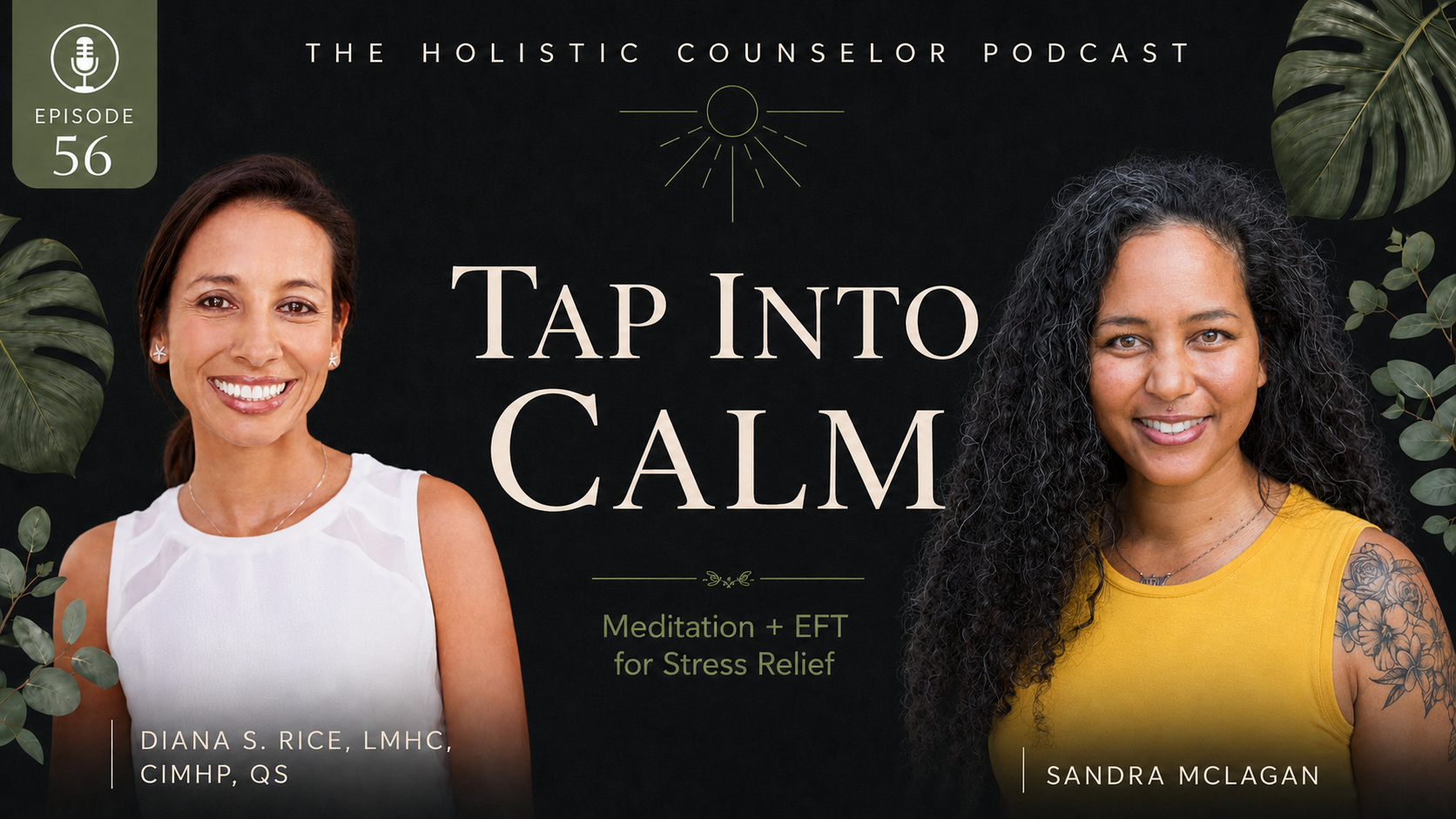
Episode 56
Breaking the Stigma: Christian Meditation, EFT & Nervous System Healing
with Sandra McLagan, RN from Christ Centered Tribe
Hosted by Diana S. Rice, LMHC, CIMHP, QS
In this deeply enriching episode, Diana is joined by Sandra McLagan, RN—a former nurse educator turned Clinical EFT Practitioner, Christian meditation coach, and founder of Christ Centered Tribe. With 20+ years of experience in the medical field, Sandra has…
Listen to the Episode
Press play when you’re ready.
Educational content only; this podcast is not therapy, diagnosis, or medical care.
About This Conversation
Show notes
Jump to a section
In this deeply enriching episode, Diana is joined by Sandra McLagan, RN—a former nurse educator turned Clinical EFT Practitioner, Christian meditation coach, and founder of Christ Centered Tribe. With 20+ years of experience in the medical field, Sandra has guided women in over 75 countries through Biblical meditation, breathwork, and nervous system regulation—all anchored in Scripture and the love of Christ.
Together, we discuss:
- What Biblical meditation really is (and why it's not New Age)
- How Christian breathwork and EFT are rooted in both faith and neuroscience
- Why stillness is key to emotional and spiritual transformation
- How to start a nervous system practice even if you're overwhelmed
- The link between trauma, perfectionism, and chronic stress in Christian women
- Jesus as our model for stillness, solitude, and surrender
Stick around for a powerful 2-minute guided meditation to reconnect with God's presence and leave refreshed, grounded, and reminded that you are fearfully and wonderfully made.
Resources & Links Mentioned
- Christ Centered Tribe Website https://www.christcenteredtribe.com
- Sandra's Mini-Course on Biblical Meditation https://www.christcenteredtribe.com/biblical-meditation-mini-course
- Sandra's Patreon (Monthly Soul Care Membership) https://www.patreon.com/ChristCenteredTribe
- Portugal Retreat Info https://www.christcenteredtribe.com/retreats
- 1-Minute Pause App by John Eldredge https://www.pauseapp.com
- Breathly App https://breathly.app/
- Dr. Andrew Weil's 4-7-8 Breathing https://www.drweil.com/health-wellness/body-mind-spirit/stress-anxiety/breathing-three-exercises/
Connect with Sandra McLagan, RN
- Website: https://www.christcenteredtribe.com
- Instagram: @christcenteredtribe
- YouTube: Christ Centered Tribe
Connect with Diana S. Rice, LMHC, CIMHP, CTP, QS
- Website: https://www.throughthevalleytherapy.com
- Podcast Website: https://www.throughthevalleytherapy.com/holistic-counselor-podcast
- Instagram: @throughthevalleytherapy
Loved this episode?
Subscribe, rate, and leave an honest review on Apple Podcasts or Spotify—it helps other faith-filled listeners find this show! Share this episode with a friend who needs a reminder to breathe, be still, and rest in God's presence.
Episode transcript
Read the full transcript Close transcript
Automatically generated from YouTube captions. Names and wording may contain errors; listen to the episode for the original conversation.
Hello there, fearfully and wonderfully made human. It's me, Diana from Through the Valley Therapy and Transform Mind Consulting and Coaching. Years ago, I found today's guest while searching for Christian meditations for anxiety, something faith-based, rooted in scripture, and grounded in real nervous system science.
Her YouTube videos weren't just soothing, they were sacred. I used them for myself and passed them on to clients who were overwhelmed, burnt out, or struggling to feel God's peace. And now she's here with us. Sandra Mccleglin Mcccleagen is a founder of Christc centered tribe, a meditation coach, clinical EFT practitioner, and former nurse educator with over 20 years in the medical field and a heart for emotional healing.
She's helped women in over 75 countries re reconnect with God's presence through biblical meditation, breath work, and faith-based nervous system support. Her work beautifully bridges the gap between faith and mental health, science and soul care. Today we're diving into the power of stillness, the role of breath in healing, and how practices like meditation and EFT can help us regulate, reflect, and renew without compromising our beliefs.
So whether you're new to meditation or a little skeptical, especially from a Christian lens, you're in the right place. I pray that this conversation opens you up to a new level of peace and presence. Sandra, welcome to the show. I'm so honored to have you here.
Thank you so much. I'm so glad to be here, Diana. Thank you for having me. Yeah. So, let's talk a little bit of what led you uh from a background in nursing to coaching and meditation and clinical EFT. Yeah, that's a great question.
I um you know, it was not a linear path. I as many of our paths are not very linear but I do think that nursing which I still identify as one of my foundational loves and passions and callings that God has called me to uh was all about patient centered care.
It was all about not just healing, um, but really trying to prevent and teach somebody how to not get to the, you know, to prevent getting all the way to the end of their that kind of chronic disease cycle. A lot of teaching, um, a lot of just compassion, a lot of therapeutic touch, just kind of putting your hands on people.
So although I don't see um it as a linear path, I see it all filling and kind of the foundation of everything that I did do um that I ended up doing. But as a Christian, I had been a Christian for a long time.
I grew up in the church and my husband and I spent a lot of time in ministry, like full-time ministry. And I had gotten to the point in my life where I was able to do a whole lot of spiritual activity. And I would sometimes realize that I could do that without ever engaging God.
Have you ever Have you ever got there where Well, Sandra, listen. I was in the new age for a while, like before I became a Christian at 29. Okay. Yeah. So, I get it. like you can you can meditate and do yoga and everything like that, but it's like to me and it listen, I'm not putting that down either because I have a lot of non-Christian um clients and and people in my life.
It's just understanding that with Christ centered in my meditation, it takes off the pressure of me being becoming this God or it's about me all the time. So anyway, yeah. Yeah. Yeah. I mean, and even when I was doing church activity, spiritual activity, I was doing it in a way that I could I could do all those things and I could feel like I wasn't really connecting with God.
So, I I kind of got to this place where I was like there I think, God, I I think there has to be more than this where I'm doing all these things for you, but I can feel like I can kind of do them on my own and not even really connecting with you.
And that's when God led me in a roundabout way to meditation. And I thought that's not something Christians do. You know, I well I don't do meditation. Yeah.
And God kept on bringing it up and I said and that's you know he kind of I dove deep into well I do remember the Bible saying something about meditation and that was really that first question that first curiosity was what led me down a road of finding out what the Bible had to say about it and our own Christian tradition.
Yeah. You know of medical. So what did you find out? Tell us. Yeah, I found out that meditation is all throughout the Bible. It's, you know, taught and exhort. God teaches us to do it. God tells us all kinds of characteristics about meditation and pausing in his presence, beholding him and that not only that it's a good practice, but it is a foundational practice I believe that is, you know, shown throughout scripture of how we are actually transformed.
I think my one of my strongest scriptures for meditation is in 2 Corinthians 3:18 which says with unveiled faces we behold beholding God we are transformed into his image from one degree of glory to the next. And for me this is what this is what meditation is is a pausing to simply behold God.
And as we behold who God is, our creator, that is reflected back to us and we understand who we are in God, who we are hidden in Jesus. And we understand who we are, we become more and more transformed into that image. So I'd say before meditation, even as a Christian, the way I decided to get better always or improve something was I came up with a plan and I really strove to do that.
Then I'm a bit of I'm a recovering perfectionist. So I have a lot of strong willpower and when I come up with a plan I can do it and and I kind of forced myself towards transformation and change. But I realized it wasn't really transformation.
It was a lot of behavior modification until I found meditation and I realized this is where I'm actually transformed from the inside out. Right. and and it also really addressed that whole doing a bunch of spiritual activity without engaging God. For me, meditation provides a place to really look God in the eye and be face to face with God and really listen and be transformed into his image from the inside out authentically, not just behavior modification.
I love that, Cinder.
I do have quite a few clients that come to me that were raised in the church and I was raised Catholic and and my and you know people know already that my grandma on my Puerto Rican side she was a Santaoria medium so you know it was like very intense growing up um and then you know I became an atheist I went into the new age but I realize now because I am a therapist and most
of my clientele are believers they come in because they were like, you know, homeschooled or they were raised in a Christian environment and they come in with so much anxiety, so much anxiety of the perfectionism, the Proverbs 31 mindset, you know, and I don't want to because that's God's word.
But I think what's happened in American churches especially because I can't speak about the rest of the world but the cultural Christianity here in the USA it puts a pressure on many many women to be this be all and do all and then you also have just the pressure of being a woman in this day and age of boss babe and you know and trad etc.
And so we're trying to figure out who we are and then let's throw a little sprinkle of Walt Disney into this into this beauty queen, you know, like, oh, our prince and our shining armor. And so the pressure of I I see it.
I see it in the churches of these young ladies that are like saying yes to everything, volunteering for everything and they're doing and doing but you know or they grew up doing and doing through say youth group um and then they get married early and they're like I did everything and this is or I haven't even found my husband or you know there's so many different layers of anxiety and depression because those are our symptoms you know we like to diagnose diagnose it.
But those are actually symptoms of your body telling you something. And that's right. So, as a former perfectionist, and honestly, I'm still working on it. Yeah. Same. You know, um your videos, it has become part of my morning rituals. And I do utilize a lot of verbiage that people are like, "That's new age."
But I'm going, "No, honestly, my main focus is Jesus Christ. Right. Okay. And yeah, how do you really really know who you are and what's expected of you if you don't be still? So, right, you know, let's talk about the whole new age that it's unbiblical and you know, how do you respond to these concerns and how do you integrate the biblical principles into your work?
Yeah, that's a great question. Early on when I was just discovering that Christians do meditate, have a long history of meditation, the desert fathers and mothers and you know just long history of this in our own spiritual tradition but early on I was mostly concerned with defending that no it's in the Bible and this is a part of our Christian faith I promise you know and having and kind of coming at it from a mindset of integrating meditation with our faith.
And what I've come to find in doing this deep dive in what does the Bible have to say about meditation and understanding God's call to us to come into those moments of pause and truly following Jesus's example of coming away from the crowd and being with um with Aba.
I realized that this goes much beyond just simply integrating scripture into a practice of meditation. In fact, it is completely meditation is biblical meditation is in and of itself um completely it's not just integrated. I'm not just like integrating it with like a a secular practice and just kind of throwing some scripture in it.
I truly believe that meditation and by that again I mean pausing in God's presence to behold God. I truly believe that this is the found a foundational spiritual activity and it is what God calls us to do. It is the place that we are transformed.
This place of solitude and silence is the place that we are transformed into God's image where we get all of our guidance for how we live our daily life. We heard Jesus say it when he said,"I don't do anything that I don't see the father doing and I don't hear the father telling me to do."
So Jesus kept on getting away with the father and getting this guidance and hearing what Aba wanted him to do and it was the basis for every single thing that Jesus did. And um and so I just think it it goes it's so much beyond even just integrating it.
We're not we're not just trying to do another practice and make it Christian. This is the life of I believe this is the way. I believe this is Christian life. This is how to be with God because it begins also when you begin to and you know from having a meditation practice.
Yes, we have these moments of pause, but the truest um outflow of meditation then is that we begin to live meditation kind of beyond those moments of just sitting. that beyond those moments that we're actually sitting in silence and stillness, the the presence of meditation and God's presence kind of comes with us and it affects us much more, you know, beyond even just that one time of sitting, but it comes into our daily life.
Yeah. And and I want to explain to the audience that it is hard at first especially like if you come from a traumatic background or you know childhood PTSD or um where your body is disregulated, your nervous system is on fire or you know and that is probably the hardest thing.
I remember when I first did yoga back in the day and I couldn't sit still because I I was always dysregulated. I mean, now I'm able to regulate because I've learned how to meditate and be in the presence and also feel my feels and not ignore them anymore.
Yes. Yes. So, let's talk a little bit about the science now. Okay. Because I mean, can you break down the neuroscience of meditation and how it impacts the nervous system and the stress response?
Yeah, that's such a great question and I do find that meditation is you know you mentioned that yes I'm a clinical EFT practitioner so meditation breath work and EFT these tools that I've given myself to learning and understanding I would put all of these under the category of nervous system regulation and not only regulation but also thing tools that help us build resilience so um the neuroscience of it is you know our lyic system the most
uh that part of our brain that is responsible for survival is it's there for a reason and it's wonderful when it's working in proper in its proper parameters.
But what most of us have begun to live in especially in our culture in this day and age is not just an acute level of stress that helps us survive and run away from the bear. it. We are living in this space of chronic stress.
So the amygdala, I like to explain to my clients that the amydala is like a smoke alarm and we have an overactive smoke alarm. So if you've ever had that smoke alarm on your ceiling that just won't stop beeping and it thinks that there's a there's smoke all the time and it drives you crazy.
This is like an overactive amygdala that is always beeping and always sounding the alarm for stress even when there's not stress. We're perceiving the world as stress. And so meditation and tools like breath work and EFT help to calm the reactivity of that amygdala and make that area of our brain less reactive and more connected to the our prefrontal cortex which is responsible for that highest thinking.
The place where we're creative problem solving as Christians. I believe that's where we're hearing from the voice. we're able to really hear the voice of the Holy Spirit because we're in this calm place. So it meditation the practice of meditation helps bridge that connection um between our prefrontal cortex and our amydala.
Then therefore our pre you know this highest part of our brain helping to regulate our emotions and that survival center that emotional regulation. So all of that being said, it what it ends up doing for us is expanding this window of tolerance. This what we are able to tolerate in life, what we feel is stressful and what we feel we can handle.
It expands that window to help us be able to truly feel more comfortable handling different stressors, things that used to stress us out a lot because our window was shrunken. and the same the stressor was outside of our window. Now if we expand that window that same stressor is now inside our window of tolerance and it's like oh yeah okay I can handle that.
Yeah. Um, and I I I like this analogy, which is when we're working out and we're doing our cardio exercises, we know that when we work out, the best depict the best representation of how healthy our heart is is that our heart rate can jump up with good cardio hit workout and then as soon as we stop, our heart rate slows really quickly and comes back down.
That's that heart rate shift back down really shows the extent of our cardiac health. And in the same way our that stress response, we should be able to jump run away from the bear. And then that acute stress, we should be able to come back to a place of balance and rest.
And the sooner that we can come back down to that place of balance and rest is a depiction and representation of our of our stress health of our mental health. The problem is when so often we get stressed but we stay up there and we live up there and we never come down you know we never get back to the balance.
And so it's working on that resilience to be able to be stressed and then come back down, right? Balanced again. And and so how do we do that? Like how do you um coach someone like say pretend I am brand new. I'm not a therapist.
I don't do this. And I am stressed out and I've been living on that that high end of feeling like, you know, I'm about to lose my mind. You know, because that's probably what a lot of your clients, they say it to me, too.
Like, I feel like I'm gonna go crazy. I I feel like I'm going to have to be hospitalized because it is to me it's brain health, right? You know, we could call it mental illness. We could diagnose it, whatever you want to do.
But to me, it is your body responding to the stressors and you do not have the tools yet to, and that's not just breath, what we're talking about here. It's also what you're putting in your system, food, right? Sunlight, everything God created, right, in Genesis.
And so I come in and I'm freaked out and this is my first time with you. What do how do you start with them? What What do you suggest a person do? Such a good question. I like to I think the first thing that comes to me is I like to start small.
Um because I think we often have these big plans to do big grand things and we'll I know what will help. I'll um I'll start a meditation practice and I'll start meditating 20 minutes a day. It's like good luck with that. Like you know what I mean?
Like you're going to do that for one day maybe and then you'll never want to do it again. Right? We have to start small. And how I like to think about it is that amygdala, that survival part of our brain will easily get triggered if when if and when we start to do these big plans.
Okay, well I'm going to go on a big diet. Oo, that starts a stress response. I'm going to start meditating for 20 minutes a day. That's what I'll do. All these things.
If we can tiptoe around our amygdala and not like not trigger it, not you know, not disturb it kind kind of almost going walking around a sleeping giant. just keep quiet like how about we just meditate for one minute a day and and some people will actually feel like oh come on that's not going to do anything but I'm serious when I sometimes with my clients I will say max you cannot meditate more than two minutes
a day and they'll be like are you serious yes because that those small wins those starting small it helps you to feel successful feels like you can do it makes you want more and you tiptoe around your amydala.
You don't stress yourself out by doing this big plan. It's very, it almost feels like, oh, that would be so easy to do. So, I often ask my clients when we're starting off, what would feel so easy, it almost feels like nothing. 30 seconds when I'm drinking my, you know, in the morning when I'm drinking my coffee, maybe I can take a couple breaths.
Perfect. Start there. We are going to move forward. We are going to continue growing this practice, but we have to do it in a way that is gentle, that is compassionate to our body, that is not self-striving and self-reliant. And so this really this slow start, this gentle practice, I think that that's really honoring to our body.
Yes. And honoring to our system and a lot of what we ask of our body. We often push and stress our body to its limit all the time. And I think that this is a really beautiful way to be gentle with our body and say I'm going to start really slow.
And um of course that's how I would start with like meditation and with other things like tapping. I might say the same thing like just one minute tapping just to start expanding your breath. So yeah, that's how I would start. Slow and gentle.
So, um, you say tapping and I just had a therapist that talked about EFT, but because I don't know if someone's listening for the first time to my podcast, can you explain what you mean by tapping and what that is? Yes. So, EFT tapping, you you can kind of hear those two phrases together.
EFT stands for emotional freedom techniques, right? And it's come to be known as tapping. And it's what we're tapping on are these acupressure points in our body that are um you know they are stress relief points basically um they are biochemist biochemical points in our body that begin to activate the parasympathetic nervous system the opposite of that stress response and begin to activate that rest and digest system.
So this is not a woowoo practice. It is not anything you have to believe in to have it work. This is actually physiological. It's a part of how God designed our bodies. And it's these it is an actual it's been tested on functional MRIs and in blood work and on brain scans.
So this is like a physical thing. And as you tap on these points, you begin to, like I said, activate that rest and digest system and bring your body into more of a calm and regulated state. And since this video is on YouTube as well, it's going to be on YouTube, plus it's, you know, on anywhere you listen to podcasts.
But can you show us the points? Yeah, I would love that. Yeah. So we'll we start on the side of the hand always. Um right here. And we just do gentle tapping. Okay. So it's not slapping yourself. Nope. Not slapping. Shouldn't hurt, shouldn't feel uncomfortable.
Also, doesn't matter which hand you do it with. You can do either. So just whatever is most comfortable for you. And then we go to the top of the head. Now I as I say this, I'll say it will feel funny at first, especially if you've never seen it before.
But I'm going to share something right after we're done with these points. And then it's on the eyebrow. Okay. Right here on the start of the eyes, right? And then on the side of the eye, we kind of follow that bone around and then under the eye.
Mhm. And then under the nose, on the chin, under the collar bone, and lastly under the arm, on your ribs here, kind of if you were wearing a bra, where that bra would go, that bra strap. So, how many taps do you suggest or how's that work?
like you know because this is a beautiful tool that I'm realizing and I think I'm going to go and get certified in it because this is something in between because we're with our clients once a week maybe or you know and so this is something I love it.
It's a beautiful actual handsonthetic tool that you could give a client and you learn it and you do it. Oh, what did the therapist teach me? Oh, okay. Here, boom, boom, boom. You know, and so I'm realizing I'm starting to be aware of what's happening in my body.
Let's calm down. Exactly. So, how many taps do you think would be great? Like three or four or whatever? Like sit there all day? I think the exact number is seven on each point. But I always tell people throw that out because really it's it's just, you know, think about it as a few.
And what we're doing is when we're tapping on that point on this on these points, we're thinking about something that normally stresses stresses us out or if we're feeling stressed and that's how long it takes to just acknowledge that. So let's say if I was tapping and saying, "I'm really stressed out today."
That's enough. Those seven taps just came out when you said, "I'm really stressed today." Okay. I'm feeling really stressed today. you know, I'm I'm worried about this thing coming up. And just by saying that phrase, you've tapped enough times on that point. Wow.
When I first saw EFT tapping, I thought, how in the world can tapping on my face help me with any of my problems? I just don't get it. This is so weird. But when you think about it, these are points that we actually go to anyway.
Um, when we're stressed, we rub our temples or we rub our eyes. Or if we're nervous, we ring our hands. If we're afraid, what do people do? They go, "Oh my gosh." And we do these things instinctually. We keep our hand on our chest here.
Why? Because we already know instinctually that these points on our body begin to calm us and help soothe us. We do it instinctually. And now we know why. These points are biochemical points in our body that really help activate that opposite of the stress response.
Yes. So that's why we do it. And it's like, oh yeah, I always pull my hair. You pull your Yeah. There's hair pulling. Yes.
So you like, you know, like when I'm I mean I don't I'm not a real hair puller outer or anything like that, but it's just like sometimes when I'm stressed out, especially when I was younger, I would just like do this and pull my hair. and or you notice that people bite their um fingers and there's points on our fingers as well that you can do some extended points.
So all of these points actually make sense and we already know them instinctually and and if you really understand uh traditional Chinese medicine it's been around for thousands and thousands and thousands of years and they have studied all those points throughout the whole all the meridians and that's something I I was amazed that helped me a lot too back in the day.
I mean, I still go to acupuncture, but but I it makes sense. Um, it does make sense. So, let's go to breath work now. Because to me, when I really was never into breath work, I realized and started learning it during COVID because I was like, "Oh, our lungs are getting messed up.
Let me learn about the lungs." And then I found Wimhof breathing. And then I was doing that, my husband and I, we would do it every day. I was like, "Nope, we're doing our Wimhof for 10 minutes." and we still to this day do it together.
Wow. It's a beautiful thing. And then I would say a few months ago, I was invited to do an hour's worth of breath work. And I'm like, "What is this?" And it was free. So I'm like, "All right, I'll go try it." And I and I trusted the person that invited me.
Um, and let me tell you that right there, one whole hour of just going and the next thing you know the it was an hour and I had no idea it went by that quick and then I'm and and the release that happened and she was explaining scientifically what was happening.
Um, so tell me about the role of breath work and can you explain how that works in emotional regulation? Yes.
So I think obviously this is an understatement but breath work is obviously not new but it is trending right and so when we talk about breath work I think there's first of all we we like have to get on with the grammar of it and kind of the are we on there's lots of different practices I guess I don't I haven't learned Wimhof I've obviously heard about it so much and I I think what you're talking
about the hourong is like that holotropic um breath work and I haven't done that either But I've heard so many stories from it.
And so I I'm kind of in the realm that my certification is more of a is a simple like I would call it breath training and therapeutic breath training. And it is understanding though. I think the foundational thing that each of these breath practices understand is that our breath is probably the number one way to regulate our nervous system.
Mhm. Even beyond beyond anything else, our breath is what is deeply connected with our nervous system. So no matter what name of what practice you're doing, using and manipulating our breath to adjust and regulate our nervous system is the foundational idea behind it.
And either you know we find that deep diaphragmatic breathing and slowing down the breath begins to activate the parasympathetic nervous system and bring you into that calm state.
And then there's things like coffee breathing which really stimulate the nervous system and fast kind of breathing that begins to stimulate you and get you ready for activation and movement or moving forward. these and again the foundational idea behind it all is that our breath is a number one controller of our nervous system really I believe so like 478 Dr.
While do you know who Dr. Andrew while wheely while Yeah. Yeah. We ei Yes. Yes. I remember he introduced uh breath for like 478. It's a simple and um and eventually people stick around because at the end I'm going to ask Sandra to to to get us through a guided meditation.
But you have to like for those that are listening there are apps too. Do you have an app Sandra yet? I have Oh, me personally. Yeah. Yeah, we have a p we are through p we have a Patreon app through Patreon. Yeah. So, okay.
Because I was about to mention the two apps that I utilized with my clients, especially back when I worked in high schools and with teenagers was um there's a breath app and breathly breathly app I think it's called. It's free and you're able to program it.
I used that a lot during co before I found your videos and stuff. Yeah. And so I used that and then um there's the one minute pause by John Eldridge. Have you heard of that app? And that's No, I know John but yeah.
Yeah. He has an app called the pause app and you can do 1 minute, 5 minute and 10 minutes and it really So to me I think that's really important and the reason I'm naming that is because hopefully it will be in the show notes and this is resources for the listener to start somewhere you know and we're going of course I'm going to put Sandra's stuff all in the show notes as well so you could check her her things out.
Um, so what are practical tips for beginners? Like you know, we've just talked about the EFT. You just taught us EFT. Um, and like how can someone just start like even without, you know, hiring me as a therapist or you as a coach, right?
Where can they start? Um, you know what? I love that idea. Um, you don't have to you don't have to spend any money on this. You don't have to read a book. You don't have to do anything. You you can just start. And I think one of the most important ways to start is understanding the mindset behind.
I think the your mindset behind starting is actually one of the things that can prepare you for success the most. So, one of the things I like to tell people before you get started is there is no right or wrong way to be with God in a moment of pause.
Love that. And if you can just capture and hold on to that because the minute you sit down, you're going to start feeling like I'm doing this wrong. I'm not doing this well enough. I everybody else is is successful and I'm not. See, I can't sit here.
I can't do this. See, I'm distracted. And that shows I'm not cut out for meditation. And so I think that the one of the most important things that I could tell somebody is that there is no right or wrong way to be with Jesus.
And knowing that um you when you sit down you are going to feel distracted. Yes. And that does not mean that you're doing anything wrong. That's right. It actually means that you are a working human who can dream, think, and imagine. And that's exactly who God created you to be.
So knowing that and knowing that there's no right or wrong way to do this. Just take a moment to to be still. And if being still doesn't work for you, that's fine. Go on a walk. Then move your feet, move your body, do something that can you can feel like some movement.
But on the um find some stillness in terms of quiet or like a pause internally even if you are moving your body if it's hard to st sit still and breathe take some breaths and open up to saying whatever this looks like God I'm just pausing to be with you and it doesn't have to look any different than that and again we already said start small just a minute or you a minute is about 10 breaths, you know, it's, you know, just a few breaths with God and starting in that way.
Um, and if you've watched this uh podcast today, then do a round of tapping and see what your body feels like after doing a round of tapping. You should start to feel calmer. You might start yawning because all of a sudden you're feeling more tired and it activates that parasympathetic nervous system.
Yes, some people start burping or sighing because again digestion. Um, so all of those things will start to happen and enjoy that moment of pause and that's it. Yeah. I mean, we live in a society that is just getting more and more extreme and extreme in too many things grabbing our attention and we're being um programmed into just becoming these the people, you know, and then we're believing everything and we're just it's just distraction after distraction after distraction.
And the way to stop and pause in those 30 I I challenge some of my clients because if they're coming with like big-time anxiety burnout, I'm like, "Okay, that is going to be your homework. You want to work with me? You you're going to have to be still for at least a minute away from your phone.
Get an oldfashioned clock and and see what's coming up because your your body it's energy. We we're all energetic humans like everything living has some form of energy and we are not how it was a hundred years ago before the industrial revolution where we were outside in the sunshine where we were outside eating holistic organic foods just from the local farmer and right now it's up to you to take care of you and become your own advocate.
It is up to you to be still in God's presence. Because as believers, you must understand too, Satan wants to steal, kill, and destroy every relationship. Every relationship, including the one within yourself. So, you are worth the one minute. You are worth the five minutes of saying, "No, this is my time."
I If you're a mom, I mean, I'm a mom. You're a mom, too. Correct. M yeah and I you want to prevent burnout. Let's let's look at this as prevention pre preventative medicine, you know, and it's it just does it's so much better than a lot of not a lot of my clients, but quite a few will turn into medical marijuana to do the calming down or the the you know the Xanax and the benzo and stuff and then they become addicted to these substances.
And to me, like I get it like I'm not putting you down for taking medication if you take medication. I I'm not I know that there's a place for medicine, but why don't we make it the last resort instead of the first if we understand and I and there's a lot of stuff that people do not um face.
So it's like on top of them on top of them on top of them and then that's when the breakdown happens. And to me I don't instead of calling it a breakdown I tell my clients you just had a breakthrough. Yeah. And I think people don't know how to face those things safely.
Yes. Um and I have a lot of compassion on them because on us because I know I've been in the place where I feel like if I give this attention, if I give if I don't push this down, if I face this, it's going to drown me.
Yeah. I won't if I start crying, I don't think I'll ever stop crying. Exactly. And and so we have to I think this is partly what our job is is getting the word out to Christians that is there are tools to sa to safely face your emotions.
And if you have felt like it's not been safe to feel your feelings. I'm here to tell you, we're here to tell you there is safety. There is a safe way to do that. And I often like to talk about that as kind of like we're surfing.
We often kind of spend so much time feeling like we're drowning under the waves of our emotions or our feelings or our thoughts, our overthinking patterns, but God has called us to surf these waves and be up on top of the water. And we can do that first of all safely.
When you're thinking about surfing, you're number one, you're wanting to be safe. But we we were before we started recording, we were talking about Nazareth here in Portugal, the home of the 100 foot wave. And you better believe that in order to do that 100 foot wave, people have to be pretty skillful.
So not just safe, but skillful. And there is when we face our emotions, there's a safe way to do it. And if you can do that, we can also move to actually facing our emotions skillfully. Not just safely, but skillfully. And that is a place that we can grow into.
And um and that's really exciting because we all want to face our emotions. We don't want I don't think anybody wants to stuff them in, but we just don't know how to deal with them. Exactly. And there are tools and it's no shame.
There's no guilt and shame. This I tell my clients all the time because they come in with a lot of guilt and shame. And I'm like, guilt and shame is from the world and from stories that were told to you. And conviction comes from God, but you have to be in his word.
And it's two different things. It's two different things. and having that understanding to be still with him and really get to know who you are. That's why I always start hello there fearfully and wonderfully made human from Psalm 139 because you were made in his image.
He's given us the tools. It is to be still with him to have the understanding that you are able to have communion with him on a daily basis. That praying without ceasing is not just Lord I need this, I need that, I need that.
It is really being one with him and and understanding like okay taking that pause so you don't start reacting in emotion you start responding in wisdom and it is a training girl listen Sandra if you met me 20 years ago I would be you know what because I how I grew up I the stories that were told to me I grew up with uh quite a few angry women around me and I'm just saying not putting
them down I'm not blaming them It is just having the understand where you come from but actually who's you are and you are God's child.
Right. So that being said, can you guide us through a meditation for maybe a minute or so? Yeah, I'd love that. Oh, cool. Yeah. All right. So, wherever you are, if you're listening or if you're watching, go ahead and get into a place where you can feel comfortable.
There is no again there's no right or wrong way. So you don't have to be in a particular position. You might be sitting on the floor or you might be sitting in your favorite chair or on your couch or laying in your bed.
And any position is fine where you can just be comfortable and alert and allow yourself to settle in. I often like to think of a a visual of like a snow globe, right?
When you shake up this the snow globe and then you have it, you set it down, you watch all the snow kind of falling down in the snow globe and just sense that in your own body, finding a moment of stillness and allowing all the snow to fall down and settle in this present moment.
And as you do, begin to listen to the sound of your breath. Breathing in through your nose and out through your mouth. Again, breathing in through your nose and out through your mouth and not forcing your breath to be anything other than what it is naturally right now.
Continuing to settle in. And for this moment of meditation, however brief it is, I want you to bring to the big screen of your mind this scripture where Mary is sitting at the feet of Jesus. behind and all around. Martha is busy, busy, busy doing, cooking, cleaning, gathering, doing very good and worthwhile work.
But Mary has chosen what Jesus called the one thing necessary. And in this moment, I want you to see yourself in that scene. choosing to sit right next to Mary at the feet of Jesus. Just simply listen to fix your eyes on Jesus's face.
No expectations, no demands placed on you. Simply receiving in God's presence, sitting here at the feet of Jesus. And enjoy that for just a minute, a few moments as you breathe. Maybe even considering the countenance of Jesus's face towards you. Maybe he's smiling and saying to you that you too have chosen the one thing necessary.
And finish by just taking another breath in through your nose and out through your mouth. Knowing that you can come back to this place anytime you want during the day or night. And whenever you're ready, you can open your eyes and come back to this moment with us.
Oh, so good. That is so good. Wow. What was that? A minute. Probably more. Yeah, two minutes. Now, now I'm ready to just But I have to go to work. I have to go see client, which is good though because now I'm nice and calm.
So any final thoughts or resources that you would want to share with the listener? Yeah, I mean we talked about you know knowing kind of what does the Bible say about meditation and if that has been you if you've been like you mentioned in your introduction skeptical or you were like me and you thought meditation that's not something Christians do then I encourage you to find out what the Bible has to say about it.
And I created a mini course um that is that has that information because this is the deep dive that I did for my own self to find these things out. So I put it together in a very brief course that it talks about the foundations of scripture in med you know meditation or our Christian tradition.
That's hard to hard to say Christian tradition and um just some general tips for beginners. And so, um, you know, I'll share that link with you guys and it it's just it's a great place to kind of start. Um, yeah, and lots of we have lots of resources for, you know, over on Christ Center Tribe for beginners for tapping and learning about Christian EFT.
Um, not that it's a religious practice, but how to do it with the mindset that this is how God designed our bodies and bringing that aspect in. So, lots of different resources that we have for you guys. I love that. So, it's a Christ centered tribe.
Yes. Centered tribe. Yep. Christ centered tribe.com. Yeah. All right. And if somebody wants to work with you, can they do you do online? You do online? Yeah, I work we have a group we have a monthly kind of soul care group that we meet on a monthly basis for meditation and contemplative practices.
And then we also have I meet one-on-one with clients as well. And we are finally getting together in person. I don't know when this will air if we'll already be enjoying the sweet sea breezes in Portugal, but we do have retreats and we are having our first Portugal retreat this May.
So um and we'll have those will continue. So if you're interested in actually coming for an immersive experience of medit Christ centered meditation and an intro to EFT and breath training. Yes. All in a gorgeous coastal, beautiful, sunny place of Portugal. Then come and join us.
Oh, yes. All right. So, everything will be in the show notes. Sandra, thank you so much for joining us today. Thank you. And uh remember listener to trust in the Lord, guard your heart, renew your mind, and breathe. Bye. And now for the disclaimer to make sure you understand that you are responsible for you.
The content provided on the holistic counselor podcast is for entertainment,formational purposes only and is not intended as a substitute for professional medical advice, diagnosis, or treatment. Always seek the advice of your physician or other qualified mental health provider with any questions you may have regarding a medical or mental condition.
Never disregard professional medical advice or delay seeking it because of something you have heard on this podcast. The views expressed on this podcast are my personal opinions and do not represent the views of any professional organizations with which I am affiliated. Call your doctor, 911, or 988 immediately if you have a medical emergency.
The holistic counselor podcast does not recommend or endorse any specific tests, physicians, products, procedures, opinions, or other information that may be mentioned on the podcast. Reliance on any information provided by the holistic counselor podcast, guests appearing on the podcast at the invitation of the holistic counselor podcast or other listeners to the podcast is solely at your own risk.
Confidentiality notice. If you engage with the holistic counselor podcast by commenting or posting and are a client, please be aware that you may be revealing information that could compromise your confidentiality. Please remember that disclosing your identity or personal details can be linked to your clinical material.
As a therapist, I am bound by confidentiality and will not respond to any disclosures of this type on this podcast. I am committed to upholding the ethics and confidentiality of the therapeutic relationship which extends to all forms of communication in accordance with the laws and professional guidelines that govern mental health professionals.
I want you to know that your privacy is of utmost importance and you are responsible for protecting it when interacting on this platform or any other public forum. Thank you.


