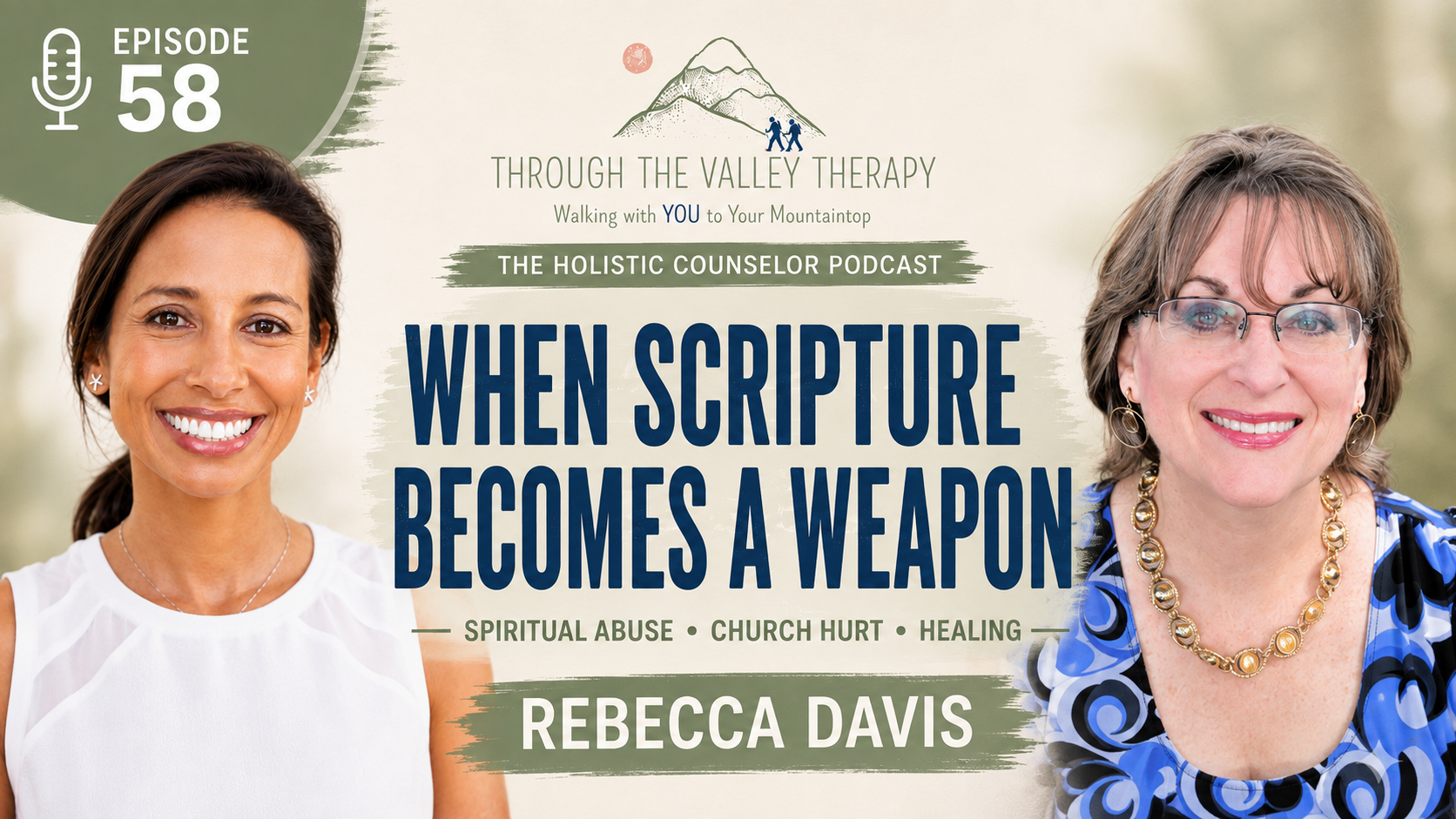
Episode 58
Untwisting Spiritual Abuse: How Scripture Gets Weaponized—and How to Heal
with Rebecca Davis, Author & Trauma-Informed Christian Book Coach
Hosted by Diana S. Rice, LMHC, CIMHP, QS
In this powerful episode of The Holistic Counselor Podcast, Diana sits down with Rebecca Davis, author of the Untwisting Scriptures series and a trauma-informed Christian book coach. Together, they tackle the painful but necessary topic of spiritual abuse, how…
Listen to the Episode
Press play when you’re ready.
Educational content only; this podcast is not therapy, diagnosis, or medical care.
About This Conversation
Show notes
Jump to a section
In this powerful episode of The Holistic Counselor Podcast, Diana sits down with Rebecca Davis, author of the Untwisting Scriptures series and a trauma-informed Christian book coach. Together, they tackle the painful but necessary topic of spiritual abuse, how Scripture has been twisted to control and silence victims, and what it really means to experience biblical healing.
Rebecca shares her own journey into this work, her years of Scripture study, and why she believes that God's heart is always on the side of the oppressed. Listeners will learn about common misused Bible verses, the dangers of church-based mind control, how religious trauma impacts mental health, and how to rebuild faith after church hurt.
This episode is especially for those wrestling with church trauma, faith deconstruction, or a distorted view of God—and for the Christian counselors and helpers trying to support them.
What You'll Learn
- The origin story behind the Untwisting Scriptures series
- Commonly abused Scriptures used to control, silence, or shame victims
- Why understanding dissociation is crucial for trauma-informed care
- How religious teachings can reinforce abusive power dynamics
- The difference between dying to self vs. biblical self-denial
- The truth about spiritual bypassing, emotional suppression, and sin-leveling
- How survivors can reclaim their faith without guilt or fear
- The role of faith in healing from SRA, trafficking, and DID
Powerful Quotes
"Spiritual abuse often begins with three core lies: 'I'm your authority, you have the sin problem, and you need to be quiet.'"
"Dying to self is not in the Bible. Denying yourself is—but they are not the same."
"God is not the breaker—He is the healer. Evil breaks. God restores."
"You don't have to shrink to glorify God. You can live joyfully and fully in Him."
"The Scriptures have been used like weapons—but when rightly understood, they're actually cords of love."
"Trauma recovery and biblical truth are not at odds—they're powerful allies."
Resources & Links
- Visit Rebecca Davis's website: https://heresthejoy.com
- Explore the Untwisting Scriptures series: https://untwistingscriptures.com
- Learn about her book coaching: https://rebeccadavisinfo.com
- Free Download: How to Enjoy the Bible Again After Spiritual Abuse – available at untwistingscriptures.com
- Called to Peace Ministries Retreat (Annual in May): https://www.calledtopeace.org
Related Episodes
Connect with Diana:
Instagram: @throughthevalleytherapy
Website: https://www.throughthevalleytherapy.com
Podcast: The Holistic Counselor Podcast
If this episode blessed you, please consider:
- Subscribing and leaving an honest review on Apple Podcasts or Spotify
- Sharing this episode with a friend or client who may need it
- Joining us weekly for more faith-based conversations on mental wellness, resilience, and spiritual healing
Episode transcript
Read the full transcript Close transcript
Automatically generated from YouTube captions. Names and wording may contain errors; listen to the episode for the original conversation.
Hello there, fearfully and wonderfully made human. It's me, Diana from Through the Valley Therapy and Transform Mind Consulting and Coaching. And of course, you're listening to the Holistic Counselor Podcast, a space where faith meets mental wellness and healing gets real. If you're a person who's ever wrestled with church hurt or religious trauma, especially where domestic violence and spiritual abuse overlap, I want to gently invite you to go back and listen to episode 10 where I began exploring this intersection with a Christian counselor named Dr.
Kate Johnson. That episode planted a seed for deeper conversations and one of the paths it led me down was to the work of today's guest. I came across her blog and books while doing my own research and I found myself saying, "Yes, this is the conversation we need."
So today, I'm honored to welcome Rebecca Davis, a woman whose wisdom and grace have helped many untangle the lies that kept them bound and rediscover the true heart of God. Rebecca is the author of the powerful Untwisting Scriptures series written for those who have experienced spiritual abuse and are looking to reconnect with the real true Lord Jesus, not the distorted version that they've been handed.
With over 40 years of scripture study, Rebecca writes to help Christians deepen their understanding of God's love, find hope in Jesus Christ, and offer meaningful support to those who have been hurt or oppressed. She also serves as a compassionate witness and prayerful presence for survivors of deep trauma, including those impacted by domestic violence, ritual abuse, and mind control.
Before her adult focused books, she authored award-winning Christian biographies and missionary stories praised by sunlight curriculum as glorious, challenging, and beautiful. Rebecca is also a traumainformed Christian book coach, a mother of four, a grandmother of four, and a lover of group games and imaginative play.
Married to Tim for nearly 40 years, she spends her days discipling others, praying with survivors, and helping people write their own redemptive stories rooted in truth and soaked in the love of Christ. So take a deep healing breath in and let the stress out and join us as we explore what it really means to untwist scripture and walk toward healing.
Rebecca, thank you for being here. Thank you so much, Diana. I'm so glad to be here. And I'll add, I am no longer a grandmother of four. Now I'm a grandmother of five because a new one just came along the other day. So congratulations.
I'm a grandma of five, too. So it's fun. Yeah. Yeah. I I love it. I absolutely love it. I wish I could do that as a full-time job. Except when they're being a little, you know, then I'm like, "Okay, go back to your parents."
But that's the thing about being grandparents. Right. Right. The beauty of that. Um, so let's just start with the a little bit about who you are and um, you know, your untwisting scripture books, what I read about and I was looking into it and I'm I'm I have one on my shelf because I have so many books to read, but I want to understand more like you've helped so many people heal from spiritual abuse.
So, what inspired you to start that series and how has your own faith journey shaped your writing? Thank you. That's a great question and I love telling this story. So, when I I grew up in a non-abusive home, I married a non-abusive man.
I had no context for abuse. Everything I knew about abuse was a stereotype, but I didn't know that. I thought abuse only happened among poor people. Abuse only happened when there was alcohol or drug addiction. Uh, I had no context for abuse in the church of Jesus Christ.
Zero. And when I first found out about domestic abuse in the church through a woman who came to me, well, a mutual friend connected us. And I started listening to her story, I was just stunned. I was absolutely stunned. Her husband who had deeply abused the family in horrific ways was an elder in the church.
I had zero context for that. That was in 2006. But I thought at that time that it was an isolated case. Social med I wasn't there was no social media then. I mean it was very new and I wasn't on it. So I didn't have context.
I thought this was an isolated case. So then 6 years later in 2012, a survivor of sexual abuse in the church came to me and was talking to me and asked me to start reading the blogs and Facebook pages. Well, it was six years later.
We had social media. I dove in deep and I felt the Twilight Zone music playing like you are entering another dimension because I had no idea about the sexual abuse in the church. the trafficking that happened in the churches, it was it was so horrific to me.
It really laid me flat. And now I can use terms like secondary trauma to describe what I experienced. But in those days, I had I didn't have vocabulary for what I was experiencing, what I was hearing, and what what was actually going on inside of me at the time.
But one thing I was writing about it on my Facebook page just a couple of days ago. So my Facebook page is Rebecca Davis untwisting scriptures and I was writing there's a photo of little shoes where I wrote this. I said when I first found out about this I was angry because I said I've been in church all my life.
Why hasn't anyone ever talked about this? And I could think back on situations that I knew like as a teenager or as a young person and I thought, I wonder if that was a an abusive situation. It never crossed my mind like, oh, maybe that Yeah, that maybe that was an abusive husband or something like that.
Although I couldn't know for sure because nobody ever talked about it back then and I was just trying to figure things out. But one of the things I was hearing in all of this, trying to get educated, I was hearing the scriptures being twisted.
And one of the biggest ones at that time, well, two the two biggest ones that I was hearing, especially from this one friend, one of them was they tell us we're just bitter. And if we weren't so bitter, we wouldn't be talking about it.
We wouldn't be posting about it on social media. And since we're so bitter, we're going to defile many because that's Hebrews 12:15. And I thought, "No, no, that's not the heart of God. That's not who God is. That's not what that's about. I'm not sure what it is about because I haven't studied bitterness yet, but I'm sure it's not that because I know God and I know that's not his heart."
So, the other one was they tell us we're supposed to give up our rights. We're just supposed to give up our rights. And that's what Jesus did. And I was thinking, that's wrong. That's wrong. And so I did a deep dive and I'd been doing Bible study as you mentioned when you introduced me.
I'd been doing Bible study for 40 years. And I'd been done big word studies and subject studies and and deep long book studies. And this was all just for my own benefit so I could know the Lord. And so to me, I thought, okay, I'm going to do the deep dive and study I'm going to study rights all through the Bible. and I'm going to study bitterness all through the Bible.
That was the kind of thing I did all the time anyway. And I started doing that and came up with what I now understand as the biblical concept of bitterness, the biblical concept of rights. And I started blogging about those things. I made a separate blog for these things because I thought my own blog is a devotional blog and I don't want to mix them up, right?
But that didn't last very long. I ended up putting everything on my own blog and and then after a while when I was getting a good bit of of uh people expressing appreciation for what I was writing and helping them see then uh people started asking me will you put this into book form and I initially said no I can't write a book on this because I don't have any credentials.
I mean I have like zero credentials. Look at Diana Rice. She has all these letters after her name, but I have zero letters after my name. My master's degree is in math education. So, I can't and I can't do math very well. So, I I'm not the one.
Somebody else needs to do this. I saw I saw the need and I saw that nobody else was addressing these things really. And so eventually I did compile the things I'd been writing about, put them into a book. That was my first Unwisting Scriptures book.
And for the video viewers, here it is. Okay. And it shows the full title is Untwisting Scriptures that were used to tie you up, gag you, and tangle your mind. Wow. And it shows a woman loosely bound in a chair with her Bible in her lap.
And I wanted I wanted it to be a series because I thought I really have in the back of my head I have a lot of other things I want to write about in this same vein. It took a while for the series to really get going because of other things that were going on in my life.
But now there are six of them in the series. Wow.
And so are these stories of like people that kind of stories like you know that are you know non-fiction or the you know I don't want to because we have to keep people's um privacy but how did you come up with all these you know now you said there six books what they aren't they aren't people's stories they are the untwistings of the scriptures and I'll insert people's stories if I find something pertinent online or I'm
sorry, not online but published somewhere or if people write to me privately and they have given me permission, okay, to tell their stories or or to quote them.
I love quoting the survivors themselves talking about how this scripture or that scripture was twisted in their lives and the effect it had on them because that brings it to life.
I've heard from quite a few licensed counselors who say your books have been so helpful to me to understand what's going on in the lives of my my counsel and they're also helpful for my counsel who can say yes this is exactly what I experienced and you why it was detrimental in my life so the stories are minimal there stories are interspersed mainly as test testim ies from people like this scripture was twisted this way and this is how it turned out.
I I do a lot of quoting of preachers, especially bigname preachers who at least bign names in my world. My world is the conservative evangelical fundamentalist world, especially in that world who use these twisted teachings. And sometimes we would call them twisted scriptures, but sometimes they're just twisted teachings because they're not even in the scripture.
They have no scriptural basis at all. One of those would be Bill Gothard who is well known among some circles. He was a very popular teacher for a while from the 70s through the 2000s and he taught something called the umbrella. And the umbrella is a kind of covering of authority.
And many many people were were abused under this teaching of the umbrella of authority. They felt like they were not allowed to do anything other than what their umbrella person, which would have been their father or their husband or their pastor, told them they could do.
They had no ability to be their own person. So, and I've heard Yeah. Listen, the umbrella teaching isn't in the Bible anywhere. So, I can't say I can't say that's a twisted scripture. It's just a twisted teaching that people pretend is in scripture and that people grow up in.
And okay, so I'm just going to Have you heard of TL Levings uh and her book uh a well-trained wife? Yes, I have. I read that. I did read that book that book in a weekend and my husband said, "Please put it down.
You're being really mean to me because I got so angry from the book." You know, but that's what you're She's coming out of patriarchy. So book number two, which is this one, specifically addresses the patriarchy movement and the twisted teachings that took place in the patriarchy move movement.
Some of the twisted teachings that were used to keep people in the umbrella so-called like rebellion is as a sin of witchcraft. That one gets a whole chapter and that one is an actual scripture.
But I say let's look at that scripture. let's actually look at it instead of just ripping it out of context and saying this applies to you that you if you don't obey your pastor or your husband or your father usually that's what it is then you are you might as well go be a witch oh no people listen I didn't become a Christian till I was 29 and so I but I married a Southern Baptist preachers kid and and from the south I'm from Northeast.
I mean, I live in Florida now, but but I Rebecca, like I remember when I became, you know, I got married and I became a Christian, the older women were telling me like, "You need to submit and all this stuff." And my personality was like, "Wait, what?
What do you mean? What do what do you mean by that?" And then and then one time a man came to my husband at the church and said, "You need to teach your wife how to submit to and and then he goes to men.
No, like that's not first of all, that's my wife." like you don't tell me what to do with my wife like and so him you know like and and then I did see domestic vi and this is before I became a therapist Rebecca I s now that I look back I didn't know you're right you don't know until you realize and you learn you're like wait and I remember this woman suffering and her husband was a
deacon and I and that was the same man that asked told my husband that I need to he needs to teach me how to be submissive and I'm my husband's second wife anyway can we talk about a little bit more about what scriptures you're talking about like like how you know that are twisted to control or silence victims and I know one of them it's like be submissive to your husband in Ephesians that's the one that
they kept Bible darting me with constantly yes and I actually don't address that one in my books because there are other people addressing the husband wife men scriptures very effectively and I'm trying to fill the gaps with the other things that aren't being addressed so when people come to me that question, I'll refer them to Bruce Fleming of Truth 316 or Marge Mosco.
I I don't know how to pronounce her last name. Sorry. Or a few others that are that are just very capably. And for me, I'm my first book addressed bitterness, giving up your rights, and taking up offenses. like not allowed to take up offenses for others because then you're going to be the most bitter person in the world and you're going to defile so many.
Anyway, it's all mind control and manipulation. And so I I lay all that out very systematically and logically. In fact, one of the reasons I got started doing this was when I was first putting my toes in the water with it, a friend said to me, "Rebecca, you're really good at analysis."
And I don't know if it's that mathy brain or what, but I love it. Yes. But I thought, "All right, that's great to know that I'm good at something." And so I I continued on with an analyzing the scripture and analyzing the teachings that are that claim to be based on the scripture but are not.
And so the first one is those three. The second one I address patriarchy that very specifically the biblical pat what they call the biblical patriarchy movement very specifically addressing some of their teachings and why they're wrong. And then the second half is about church authority and very specific addressing of verses and teachings that church leaders use to say you have to obey me.
One of those would be Hebrews 13:17 I think it is. Obey those that have the rule over you and submit yourselves for they watch for your souls. And I take that one and take it apart bit by bit to say what does this really mean?
And it means something very different from how it is presented. Just like I'm the boss and you're under me and you o you have to do everything I say. You have to obey. So then the third book is in two parts. The first part is your words.
The second part is your emotions. So, the first part with your words, I'm trying to address everything I'd ever heard that was used to shut people up. So, the cover photo on this one is a woman with duct tape over her mouth. Every single ex churchy expression used to shut people up.
Every Bible verse that I was aware of used to shut people up. And to Can you give a couple examples? Yes, absolutely. Chapter one is the gossip chapter. So I talk about because people will say if you're naming an abuser, if you're asking for help for an from an abuser, if you're warning people about abuse in the church, you're gossiping.
And so I take the scriptures that talk about gossip and the definition of gossip to say, what is gossip really? And I think I have five things that I come up with from the scriptures about what gossip really is. It's an idle person going around from here to there wanting to either spread news or get news and they don't care if it's going to hurt someone else.
They don't care about the fallout. They just want to give or get like salacious news and maybe a few other points that aren't coming to me at the moment. But I said this is very different from and then I look at the other situations.
We've got people trying to get help in abusive situations. people trying to warn others. There is I am observing behavior that looks like pedophile behavior. For example, let's be on the lookout about this. Uh this pastor is exerting spiritual abuse over his people.
This is cult-like teaching. These different things, they're called gossip. They're not gossip. They are warning. They're trying to get help. And I also talk about the need to process trauma. When people need to have someone to talk to about trauma they experienced at the hands of someone else, they're called gossips.
They're told not to gossip. But the need to process trauma is a very real need. And people need safe people to do that with. And that isn't anything like what the Bible calls gossip. Uh also I I address the slander is is very similar.
The accusation of slander. um the accusation that you shouldn't destroy a person's reputation. Uh all of these are very similar and very related because they're all ways to shut people down from talking about abuse. And there are several others. And then in the second half, I talk about emotions.
And I especially address the six big negative emotions. sadness, anger, disgust, shame, anxiety, and despair. And and in that I I think I have two or three chapters on fear because fear is such a big deal. And people feel so shamed for having a having fear issues because they say, "Oh, the Bible talks all the time how you're not supposed to be afraid, so I'm sinning when I'm afraid."
Spiritual bypassing.
I talk about that a lot on my podcast, spiritual bypass. and and and so I go to well what does the Bible say about being afraid when the Bible says don't be afraid what is it talking about and I I address all of that so anyway that's the second half of book three and then book four addresses righteousness and wickedness uh subtitle of book four is wolves sinleveling uh hypocrisy and righteousness so sinleveling is that concept of of treating treating all sins like they're the same.
That's what I grew up with. All sins are the same before God. And so we should treat all that sins the same. And your sin of not forgiving the man who raped you is just as bad as what he the the assault. That's the kind of teaching we would hear in church.
So I spend a good bit of time addressing that, addressing the teaching that we are all hypocrites. So if you expose hypocrisy in a great Christian leader who was who had a few women on the side or something, well you you're a hypocrite, too.
So how dare you call that out? So I addressed Yes, you're projecting. I addressed that and things like we shouldn't throw stones. I addressed that. What is that story? What was Jesus saying? What was the actual context? So that's book four. Yeah. In book five, the subtitle is brokenness and suffering.
So the common teaching is that we are all broken or we all should be broken and God needs to break us because we need to be broken. And I look all through the scriptures about what God says about breaking and what God says about healing.
And I show that God isn't the breaker. He's the healer. He doesn't do the breaking. Evil people do the breaking. The one time the scriptures talks about God breaking people. Is when he talks about breaking the arms of the wicked or break he I I especially remember breaking the arms of the wicked.
He might have talked about breaking something else but especially the arms. And I thought, well, that is so cool. If we separate out who are the wicked and who are the righteous, which I did in book four. And so I reference I reference my other books when I write a new book.
Then we can see God isn't out to break us as his people as his his beloved children. He wants to break the arms of the wicked who are harming his children. And then suffering, the concept of suffering that we're all suffering is going to make us more holy and things like that.
I have several chapters on that. Mhm. Book six is about striving and dying to self and life. I make the case in book six that dying to self is taught nowhere in the scriptures. But then I go through and address every single scripture that's used to teach dying to self to talk about what it really means.
So and and there's more. There's lots more. But that's a that's just an overview of all six books of the untwisting scripture series. Mhm. I love that. Can you Okay, because I do hear that a lot like you got to deny yourself. You got, you know, and I Well, denying yourself is in the scripture.
Dying to self is not. Ah. All right. So, can we talk a little maybe? I mean, is Sure. What What can we Because this podcast is about teaching, right? Teaching others, opening up their minds, their spirit to understanding the one true God. But because he's a a to me he's a god of grace and love and I know I was raised Catholic.
Okay. And with with um another religion at home, Santaoria and and so it was and because I'm Hispanic, you half Puerto Rican and my grandma, my Puerto Rican grandma was involved in that stuff and anyway, but I know when I came to start reading the Bible for myself, you're not really encouraged to do that in the Catholic church, right?
Oh, right. Yeah. Yeah. So, I started reading and I'm like and I'm asking questions to men at the church that I'm at and they were like, "What are you trying to be a preacher?" And they get all mad and some of them got defense.
Some were really great, some were very defensive. Um, and I realized it was a Southern Baptist church. Yes. And and you I know I noticed or I I observed I know I knew this about the Catholic Church. You're not encouraged to read the Bible. you're just going to let the the priest or whoever explain um the truth to you.
And it turned out that in the evangelical church, it's similar in that people are not encouraged to read the Bible on their own. They are encouraged to just listen to the preacher or the teacher, whoever it may be. I never I never ever bought that.
I was 18 when I started really studying the Bible on my own because I thought I'm responsible. People tell me if this is a message from God to me. If it's a message from God to me, I had better know what it says and I can't be depending on somebody else to tell me what it is.
Now initially I did depend a lot on commentaries and things and there came a time over the course of years when I thought I think you know I can understand the Bible too. I don't know the original languages but I have lexicons and I have friends who know the original languages.
Yes. Exactly. So I can ask them questions and and I started going to commentaries less and less and seeing them not as authoritative but as peers. You know they had ideas about what the word of God said and I had ideas about the what the word of God said and I wanted to respectfully listen to what they said and then draw my own conclusions.
And eventually coming from the independent Baptist world, I didn't know much about the Holy Spirit. But eventually I got to know the Holy Spirit and I realized I need to be asking the Lord every single time I read the Bible to show me to help open it up for me.
And I have stories about that that would be too long to tell here, but I'll tell them someday. And to just to see I'm responsible. The Lord can show it to me directly. I can listen to the wise voices of others, but ultimately I'm responsible for for my understanding between me and God.
And for you, you had the same experience that a lot of people have. I didn't so much because I didn't really go to people other people for help. Uh but you had that experience of why are you trying to study the Bible? Who do you think you are?
Yeah, questioning. I'm a I'm I'm always questioning. That's why I'm a good CBT therapist, Rebecca, because I know how to sit in a safe environment with another human being and say, "Where did you get that story from?" Ah, yes.
And I and you know, and especially when I have the Christian female that comes in in pain and depression and anxiety with so much guilt and shame because they're told, "Well, you're not praying enough or your faith is weak or you need to be mentally tough or or maybe it's your sin because I was starting I did not I did not know about Jay Adams and Nutheetic Counseling until someone asked me to come be part of their their team because they knew I was a Christian therapist.
And I started questioning. I'm like, "Well, what this is about?" And so I researched, went to the rabbit hole. I'm like, "What?" I go, "No, I have clients that come with that with that. They went to counseling and they hate counseling because of that situation."
Absolutely. And Jay Adams and counseling is probably the topic I've written on more than any other topic on my website. And my website is here's thejoy.com for anyone who's interested. You can also just go to untwistingscriptures.com and that will take you to my website.
That's a little easier to type in. But exactly what you just said, in fact, over the course of my studies, when you combine scripture study with abuse study is very interesting and finding the spiritual abuse, I just I found these patterns repeated over and over so that you get down to about three or four basic teachings that are always there when it comes to spiritual abuse.
One of them is, "I am your authority and you should not question me." And it could be plural. Could be, you know, more than just one person, usually a man or perhaps a group of men. Number two, uh whatever the problem is, it's yours.
You're the one with the problem. It's a sin problem. It's a lack of belief. It's lack of forgiveness. uh the person who comes for counseling is the person with the sin problem. That's what Jay Adams teaches. That's what the majority of people in this world in this in this world in which I'm ministering believe the the people who are doing the counseling.
That's at least from what I've seen. I hope that's changing. But I'm trying that's why listen that's one part that's why you're here because I'm trying to get people to understand a lot of people are and I'm very thankful for that. So I do believe that's changing but that has been a huge belief.
The problem is yours. You need to repent. You have the sin problem. You need to forgive. You need to stop being bitter. You need to stop talking so nasty, you know, when they're trying to get help from abuse. And um the the third one is related.
You just need to be quiet and kind of a sit down and shut up sort of attitude. Just be quiet. Sit there in the pew or in the chair and learn from your pastor. Obey your husband or if it's a man, obey your pastor and everything will be okay.
So, I've just seen that over and over in the teachings and almost everything I talk about comes back to that. My goodness. So, when say somebody's listening now and they're just like, "Wait, am I like some of those things I'm hearing like, oh, I've been told this or I'm feeling a certain way and you know, it's it's disentangling because to me that's what I say. you were disentangling your faith and and maybe reconstructing cuz there's such a big expangelical.
I mean, you look at that hashtag expangelical or uh deconstruction, but so many are leaving completely or going into other or becoming atheists and they have that pain, that pain and that hurt and that anger. What do you say to someone like that?
Oh, it breaks my heart. It just absolutely breaks my heart. I received an email from someone who said, "I am no longer a Christian, but I'm glad to see a Christian addressing these issues." And I just wanted to weep. If I remember correctly, that was very specifically about my empathy article uh because there's this teaching out there now that empathy is a sin.
And so in several years ago when that when the first of the empathy articles were coming out so maybe six years ago I wrote an article refuting it and I believe that was in response to that. Um, deconstructing is a wonderful thing as long as you don't stop with the deconstructing.
And it's in sorry I have a guest article on my website from my husband. It's called our Christian deconstruction journey. And when I think about it, I think deconstructing is taking the house apart brick by brick. But some people just take it apart and then they just walk away.
But what I would love to see, and I understand why people don't do it because it seems it they have so much trauma and it seems too hard and they don't know who to trust. They don't know where to go for help. So I understand why people walk away.
But they're walking away to something that is not going to help them. And they need the true Lord Jesus Christ. the one who he's he's in there somewhere in the rubble. And so the construction then needs to take place brick by brick back to reconstruct what is truth.
And that's what I want to help with with my books. I never just say this is wrong, this is wrong, this is wrong, this is wrong. Although I do a lot of that, but it's always coming back to so what is right, what is true, what is good, what is beautiful.
And I'm always coming back in every book to the true Lord Jesus Christ. Yes, he's the cornerstone. Here is who he really is. Here is why the true Christianity, the real Christian faith is beautiful and wonderful and you can trust him. He has been misrepresented by those who sometimes people are well-meaning.
Sometimes they don't even realize they're misrepresenting him. But he has been misrepresented. And here is who he really is. And I will tell you Diana, one of the biggest reasons, maybe the biggest reason I got started in this work was because I was angry about how God was being misrepresented.
I I hated that. And I wanted people like this friend who first introduced me to the issue. I wanted her to see who God really is. And other people like her. And I have received through the years I I often receive emails from people thanking me for helping them see who God really is.
So that is a very very important work. Yeah, it is to to help people understand who God is, who they are, and how to perceive the world. It's all every all of it's been twisted and all of it needs to be untwisted and undone.
My desire, my hope, my dream is to write a devotional book for abuse survivors, an untwisting scriptures devotional book. And I want to call it chords of love because I want to untwist those twisted scriptures and to see that they are the the scriptures are really chords of love for you, for the survivor of abuse who who has been so twisted up.
Yeah. In these in these uh wrong teachings. Oh, no. That's that's beautiful. So, how do we do that? How what are some key steps for reclaiming faith after that kind of spiritual trauma? That's a wonderful question. The first thing I would recommend is go to my website and download the free guide.
And you can go to untwistingscriptures.com to get there. The free guide is called How to Enjoy the Bible Again after spiritual abuse. Let's see. how to enjoy the Bible again when you're ready after spiritual abuse without feeling guilty or getting triggered out of your mind.
Wow. So, that's the first thing I would recommend. And then when you're ready to read or listen to, all of my books are on audio. Read or listen to my audio books. I read all of them and get some help that way. There are group studies out there that people can join and trust God that he actually is good after all and you really can know him.
You can cut through the fog and know him. getting help from traumatraed people like Diana to work on your trauma and then getting to know what the the scriptures really say. It's this powerhouse combination. I do have some guidelines on my website. I think it's on the about page uh on I think it's my page of beliefs or something somewhere.
I don't remember where it is that are some guidelines for how to read the scriptures accurately. They've been twisted and I have certain certain tools of hermeneutics. Hermeneutics just means how you interpret the scriptures. Tool tools of hermeneutics to use to read the scriptures accurately to see who they're written for and who they're what they're about, what they're saying.
One chapter in my most recent untwisting scriptures book was called, "He must increase but I must decrease." M and we are taught that in order to make Christ big, we have to become very small. And if we were invisible, it would be even better.
The better we can shrink, the more honoring to him it will be. Well, I I take that and blast it to smithetherreens because I look at who said that, who was it about, what was going on, and why is it that this scripture I can say with 100% certainty that this scripture does not apply to us.
We don't have to figure out how it applies to us. We can actually say, "Oh, this doesn't apply to us at all." We could just let that one go. We don't have to try to figure out how to become smaller and smaller by decreasing.
We can just live our lives joyously in the Lord to his glory just like John the Baptist did who is the person who originally said that and and not worry about decreasing. So that's just one little example. Can I ask your opinion on Proverbs 31 woman?
Um, she seemed like a a woman with a lot of energy. What are Well, the What are you thinking? Because because Rebecca, listen, it's I remember when I first, you know, heard that cuz remember I I come from I was into new age.
I was in and then I went into a church and they're like, "You need to become this Proverbs 31 woman." And every time I read it, I'm like, my goodness, she's perfect. She is doing everything. And then it was just like a I hate to say a brainwashing, but you you do you understand where I'm getting at?
So I hear that I heard it. Not anymore. I don't that doesn't I don't see it that way anymore. I think it's a beautiful thing.
But there's women that come and they're like, "Well, I need to be cooking and cleaning and doing this." the superwoman complex that a lot of these women come to me that they are working outside of the home or they're a stay-at-home mom and they're they're not doing outside of it just becomes such a tanglement and so yes I understand that I came from the homeschooling movement I homeschooled my children for 24 years and in the homeschooling
movement women I guess it might have been a bit of a competition Uh, nobody would have ever said it was a competition, but women trying to be the best Proverbs 31 woman they could be making their own bread, maybe even growing their own wheat and doing all the things.
And over the course of time, many of these women really, really burned out. And I think that we can take the Proverbs 31 woman as as a beautiful example. We can be inspired by her, but we don't need to get depressed about it or or feel like we have to measure up to her.
We can just thank the Lord for her beautiful, inspiring example. Yeah. Yeah. That seems good enough. Yeah.
Because that to me I just like I think it's because of what I do and who comes to me and you know the guilt that they have that they are not waking up in the morning you know to do whatever it is that I forget what she does you know and it's like we're supposed to be like that that's something that I've heard about she wakes up early and she stays up late and she works very hard and I think working hard is a good thing.
I think that's everybody should be working hard but I don't think anybody should be burning out. Exactly. Exactly. Oh man. Okay. So, for Christian therapists like me and and and counselors, um what are the biggest mistakes to avoid when working with clients who have experienced religious trauma?
That's a really good question and I hesitate to give advice to licensed counselors. No, Rebecca, listen. I I let me before you go, I want you to understand like just because we have this thing on our wall and I'm looking at my my thing, my degree.
Um, and I truly believe that you are the expert because you have done the research. And that's why I am the like that's why I bring people from all walks of life on here, authors and and just because I I'm looking to help the human out and you've done the work.
Like you just said, you've done the work. You have studied. This is what God is. I know I know my niche. Yes. Yes. Right. And God has given you this and I respect that. So just because there's those letters and it doesn't to me like no I'm not as a Christian woman.
I'm here to try to bring the kingdom forward to people for people to understand that that Jesus loves them and there's healing and hope. Yes. And whoever I could get on the show to to encourage that movement to make people understand like let's disentangle, let's reconstruct, let's understand that anxiety and depression are symptoms, not just diagnosises or sins.
You know, they're symptoms, not sins. Yeah. their sin because that's how they were very often addressed in the churches of my past that as sins like you're not trusting the Lord and you're not having joy in the Lord and so get with the program.
But one of the things that immediately came to mind when you asked the question was a little bit off track from what we've been talking about and that's another reason I hesitated and that's that I've been surprised at the lack of understanding of dissociation among licensed therapists and I know this because of the people who come and talk to me who many many many of whom have dissociation issues and learning about dissociation And the spectrum of
dissociation was one of the things that the Lord thrust me into back in 2013 and put me uh on the track to help people with dissociative issues.
I'm not licensed and they understand that before they come to me, but I offer a certain kind of help that they want to explore as a possibility. And I wish more licensed therapists understood the spectrum of dissociation, understood did, understood the evils of the the the tremendous the great evils that are going on in our world that harm people to the extent that they develop.
Yeah. disorders like dissociative identity disorder and more and more people are becoming aware of the sex trafficking problem but that's been around a long time. It's just been in recent years that people have been talking about it more and then other abuses even worse than that that are going on in our world and in this country.
But for me, so so my more public work is the spiritual abuse and the untwisting scriptures. My more private work is work with these abuse survivors. But I see the overlap because these mostly women occasionally men but the Lord at some point they come into the church and the teachings in the church are often kind of reinforcing some of the things that they were taught in the abuse world.
The abuse world in the church and the abuse world outside of the church can often overlap. So I see them as very integrated works and I wish more licensed therapists understood that. Yeah. I mean I there's a I' I've had to deal with uh you know did borderline I mean I to me it's all all under the umbrella of complex PTSD.
Yes. CPTTSD. And even though I don't work with those clients anymore, um I do, this is another reason why I started the podcast cuz to me I'm able to because vicarious trauma is real for therapists, you know, unless you're really really trained, but there's people that are specifically trained for did and there's a lot of resources out there as well.
So to me that if you're working as a coach I would say and you understand did that's so beautiful because we need more of that training. You're right for for therapists and to understand because they you know what it is it is when someone has that coming in it is very overwhelming at times too especially if they um switch like and and so you know how does faith play a role in healing from that?
Oh it is so beautiful. Um, so the very first woman who came to me for her for help, she was desperate for help and didn't know what was wrong with her. Yeah. She's given me permission to tell her story. The Lord had been training me for four years in this, telling me this is coming.
Get ready. So that's another story all its own. But in 2017, this woman came to me for help, not knowing what was wrong. In the middle of the night, a little girl from her account was writing messages saying, "Mommy, mommy, please help me.
Daddy is hurting me." And uh also I was getting messages like, "She is ours. We will kill her. You do not have any right over her. Uh we will destroy her." And I thought, hm, I think I know what's going on here. And I didn't know that I was looking at a case of satanic ritual abuse at the time.
But I did believe that I was looking at dissociation and a demonic issue, which was correct. And uh she's been in my life now seven and a half years, and the Lord has given her great healing. I love that. I spoke with the little ones, as we call them, the the little insiders.
Yeah. to help them know who Jesus really is rather than how he had been presented to them and to help them come to the Lord Jesus. And then eventually the woman who was an atheist and the only reason she was willing to come to me for help was because she was extremely desperate.
She came to the Lord too and got to know him and now talks about how wonderful she wonderful he is and how she wishes the people of her um the people she interacts with could could know who he really is. So I get to see the Lord doing these beautiful things in a in a quiet and um private type of way, not in a big flashy way, but The the intersection of faith and healing from the from these traumas at least in my work is integral.
Absolutely integral. The Lord brings the healing. The Lord brings the little ones to the safe place and gets helps them get the help they need and the healing they need. And then the woman herself is able to grow in the Lord and understand who he is.
Oh my goodness. Anyway, that's a big thing that I could go into for a long time. No, but listen, can can people work with you for that? Like, honestly, do do can can they I mean, how can you because we we need more of you.
Let me tell you how my life is split. I guess it's split into three parts. There's the untwisting scriptures part, which is why you had me on the show, right? And then there's the private ministry part. And then there's the book coaching part.
And the book coaching part is how I earn my living and that is traumainformed Christian non-fiction book coaching and the place to go to find out more about that is rebeccadavisinfo.com. It actually that's that's the page where I just put everything together because I'm doing all these different things.
I put it all together on this one page. rebeccadavisinfo.com and that's what I charge for the ministry. I don't I don't charge for. Okay, that's good to know. And that's I love that because this year like uh in December when I was writing my faith and prayer board, I write one every year.
Not a vision board, but a faith and prayer because this is how I pray. And yes, it's like write my book and I'm like, I'm not even a writer, but I know ChhatBT is there, but I do have my story and I I think I might be get I think you would have an amazing book, Santrea. in itself would be that's huge.
I've wor I've worked with people who have been in Santia. Yeah. I mean I was I was a a witness to it and it wasn't as extreme as like the movie The Believers or whatever back in the 80s that you know it wasn't that extreme.
It was you know it was just part of my my my heritage and it's that's another thing.
It's like I love being a Latina you know I love that and I want to hold on to that the ancestral wisdom that was given to me. uh you know cuz that my mom's from Colombia you know from the farmlands of Colombia my grandma was an herbalist I mean like the Lord made a the whole world is just disentangling one more time untwisting things to yes to realize that the Lord Jesus Christ though is the center
of my life and that absolutely and my protector and my guide absolutely that is so beautiful so listen I know that the call to peace ministries retreat is coming up Right.
Can you just share a little bit about that? Oh, yes. Thank you for asking about that. On May 1st, we'll be gathering at Lake Junalco, which is in the Asheville, North Carolina area. I believe last I heard there were going to be about 400 women coming together.
We'll have Leslie Vernick as the I believe she's the primary speaker. Also, the wonderful Nagme Panahi, who is a high-profile domestic abuse survivor. Wow. and many other speakers. I'm speaking in the organized abuse track along with another wonderful woman, Lisa Meister. So that would be for anyone who's experienced any sort of organized abuse or anyone who wants to understand organized abuse better.
So I am very much looking forward to that. Yes, every year. Every year, usually in May and usually at this same conference center like Junalca in the Asheville, North Carolina area. beautiful area. I have a I have a little tiny cabin up an hour north of there.
So that that that's I understand why it's called God's country. I do. Yeah. So this will be coming out after May first. So um that's why I asked does this happen every year. So I will put I I take it that there is a website for Call to Peace Ministries.
Called to peace.org. Yes. All right. All right. I will put every May it comes out and I've been speaking at it every year for a few years now. So, wow. I hope if I don't see your listeners in 2025 that maybe I'll see them in 2026.
I Yes. Or, you know, we can we do your books like a Bible study or I was, you know, while you were talking about the the every uh book I'm like maybe I should start a book club with Dr. Kate Johnson about your book and we can do it as a therapeutic thing.
You know what I mean? There are several people doing book studies with my books and they'll occasionally ask me to come in and you know just like come in for a one slot and take questions or something and I think that's great. I think that's a wonderful thing to do.
Yes. Oh my goodness, Rebecca. Well, it has been an honor. Is there anything you would like to say to the listeners before we say goodbye? God is good and there is hope. Amen. Amen on that. All right. So listener, thank you for being here and listening to the whole thing.
I hope you got something out of it. And understand, please keep trusting in the Lord, guard your heart, and renew your mind. Bye. And now for the disclaimer to make sure you understand that you are responsible for you. The content provided on the holistic counselor podcast is for entertainment,formational purposes only and is not intended as a substitute for professional medical advice, diagnosis, or treatment.
Always seek the advice of your physician or other qualified mental health provider with any questions you may have regarding a medical or mental condition. Never disregard professional medical advice or delay seeking it because of something you have heard on this podcast. The views expressed on this podcast are my personal opinions and do not represent the views of any professional organizations with which I am affiliated.
Call your doctor, 911, or 988 immediately if you have a medical emergency. The Holistic Counselor podcast does not recommend or endorse any specific tests, physicians products, procedures, opinions, or other information that may be mentioned on the podcast. Reliance on any information provided by the holistic counselor podcast, guests appearing on the podcast at the invitation of the holistic counselor podcast or other listeners to the podcast is solely at your own risk.
Confidentiality notice. If you engage with the holistic counselor podcast by commenting or posting and are a client, please be aware that you may be revealing information that could compromise your confidentiality. Please remember that disclosing your identity or personal details can be linked to your clinical material.
As a therapist, I am bound by confidentiality and will not respond to any disclosures of this type on this podcast. I am committed to upholding the ethics and confidentiality of the therapeutic relationship which extends to all forms of communication in accordance with the laws and professional guidelines that govern mental health professionals.
I want you to know that your privacy is of utmost importance and you are responsible for protecting it when interacting on this platform or any other public forum. Thank you.