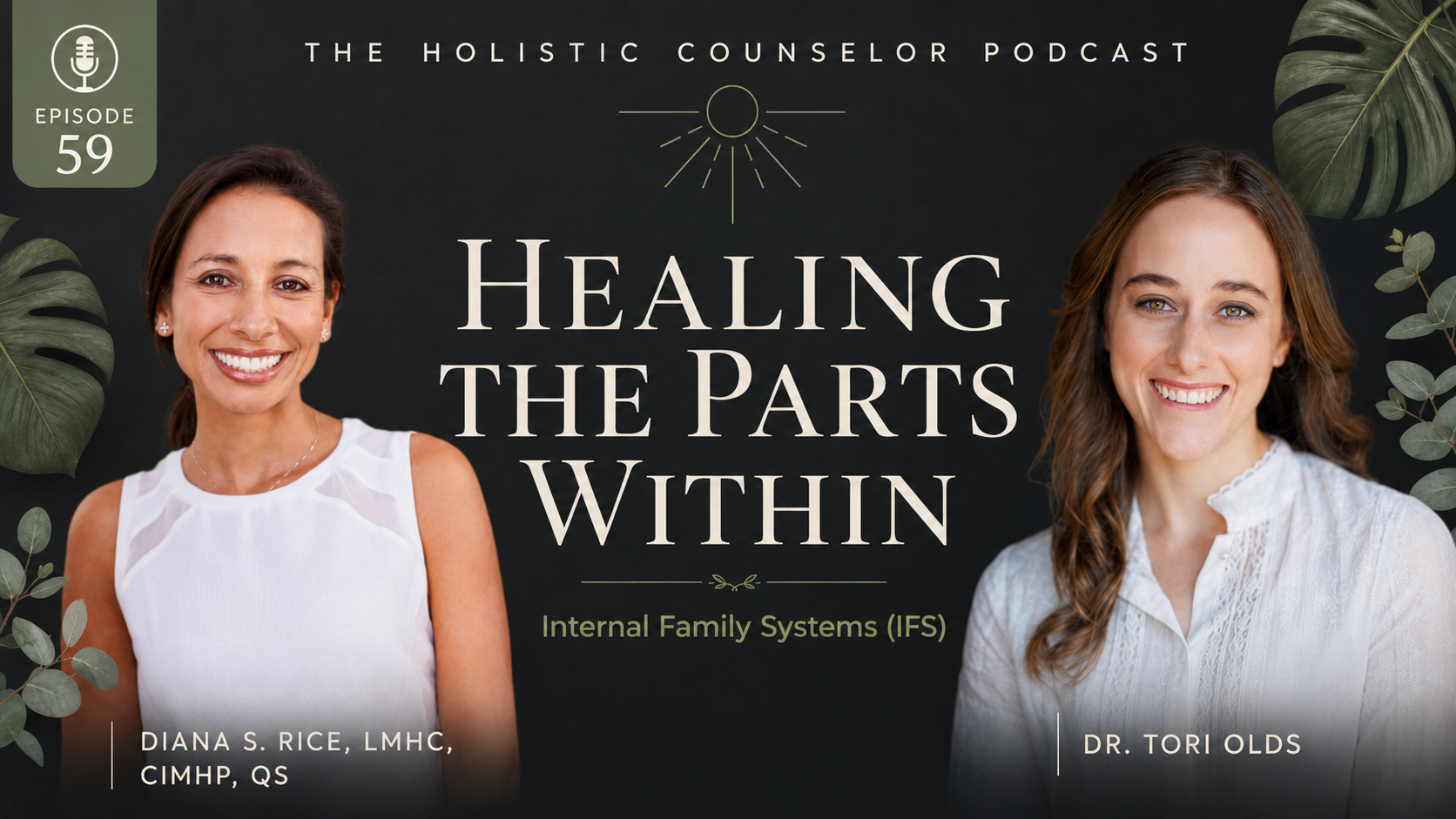
Episode 59
Unlocking Self-Healing with Internal Family Systems (IFS) Therapy: A Deep Dive
with Dr. Tori Olds
Hosted by Diana S. Rice, LMHC, CIMHP, QS
In this heartfelt and informative episode of The Holistic Counselor Podcast, your host Diana S. Rice, LMHC, dives into Internal Family Systems (IFS) with the brilliant Dr. Tori Olds—psychologist, educator, singer-songwriter, and co-founder of Deep Eddy…
Listen to the Episode
Press play when you’re ready.
Educational content only; this podcast is not therapy, diagnosis, or medical care.
About This Conversation
Show notes
Jump to a section
In this heartfelt and informative episode of The Holistic Counselor Podcast, your host Diana S. Rice, LMHC, dives into Internal Family Systems (IFS) with the brilliant Dr. Tori Olds—psychologist, educator, singer-songwriter, and co-founder of Deep Eddy Psychotherapy.
Diana shares how a single YouTube video titled What is IFS? changed the game for her personal healing and client work. That video? Created by today's guest, Dr. Tori Olds.
Together, they explore the neuroscience behind IFS, how to work with wounded parts (exiles), and why self-compassion—not shame—is the key to healing.
Whether you're a therapist, a faith-based practitioner, or someone simply curious about why you procrastinate, rage, people-please, or spiral into perfectionism, this episode is for you.
In This Episode, We Explore
- What Internal Family Systems therapy actually is (Hint: It's not "multiple personalities")
- The difference between protectors (like managers and firefighters) and exiles
- What the "Self" is in IFS—and how to connect to it
- The science of memory reconsolidation and how real change is possible
- How IFS complements faith-based healing (even for those deconstructing rigid religious upbringings)
- Why your coping behaviors aren't bad—they're just trying to help you survive
- A healing path that integrates body, mind, and soul—without shame
Powerful Quotes
"It's not about fixing yourself—it's about getting to know yourself with compassion." — Dr. Tori Olds "The more you ignore a part, the more it screams at you. It's not trying to sabotage you—it's trying to get your attention." — Diana S. Rice "Firefighters are there to save your life... but sometimes they break a few windows in the process." — Dr. Tori Olds "Even with trauma, your true Self is never broken—it's just buried under protective parts." — Dr. Tori Olds "Change comes through acceptance, not punishment." — Dr. Tori Olds
Resources Mentioned
Dr. Tori Olds' YouTube Channel (watch What Is IFS? and other playlists): https://www.youtube.com/@toriolds/videos
Playlist: Internal Family Systems (IFS) Go to Tori's channel > Click "Playlists" > Look for the IFS series
Self-Therapy by Jay Earley (IFS-based workbook for individuals) https://amzn.to/3qW5hdb
IFS Institute (Find a certified therapist or trainings) https://ifs-institute.com
IFS Workbook by Dr. Richard Schwartz https://amzn.to/3r0r7Al
IFS & Neuroscience: Watch Dr. Schwartz on the Huberman Lab Podcast https://www.youtube.com/watch?v=lyFffF1z1pE
Bible Verses Referenced
- Psalm 46:10 – "Be still and know that I am God."
- Galatians 5:22-23 – "But the fruit of the Spirit is love, joy, peace, patience, kindness, goodness, faithfulness, gentleness, self-control..."
Connect with Our Guest
Dr. Tori Olds
Website: https://www.toriolds.com
YouTube: @DrToriOlds Trainings: https://www.mindingtheheart.com
Connect with Diana S. Rice
Website: https://www.throughthevalleytherapy.com
Podcast: The Holistic Counselor Podcast
Instagram: @throughthevalleytherapy
Enjoyed this episode?
Share it with a fellow human who's trying to reconnect with their true Self. Don't forget to subscribe, rate, and leave an honest review to help more listeners discover healing through holistic mental health.
Episode transcript
Read the full transcript Close transcript
Automatically generated from YouTube captions. Names and wording may contain errors; listen to the episode for the original conversation.
Hello there fearfully and wonderfully made human. It's me Diana from Through the Valley Therapy and Transformed Mind Consulting and Coaching. And today on the Holistic Counselor podcast, I became interested in internal family systems, I started watching Dr. Richard Schwarz's videos, trying to understand how I could use IFS as a healing tool, not just for my clients, but also in my own personal work.
In the middle of all that research, I came across a YouTube video called What is IFS? And wow, it broke everything down so clearly and so gently that I immediately started sharing it with the my clients. I asked them to journal their reflections after watching it.
And suddenly we had this beautiful bridge to deeper work in session. So naturally I thought let me be brave and reach out to the person behind the video and asked if she'd like to come on and talk all about IFS. And guess what people, she said?
Yes. So, let me introduce you to Dr. Tori Olds. Tori is a psychologist, a mom, a singer, songwriter, a teacher, and someone whose life truly weaves together the creative, the contemplative, and the clinical. She helped start Deep Eddie Psychotherapy alongside her sister, husband, and both of her parents.
Yes, her whole family is in this field, which is probably why she says she's wanted to be a psychologist for as long as she can remember. Tori now leads a six-month intensive training called Minding the Heart, helping therapists go deep into experiential methods because she believes, and I agree, that real transformation happens when we touch the deepest part of ourselves, the parts that can't be reached through words alone, but through sensation, imagery, and presence.
Her heart for this work is undeniable. Whether she's guiding therapists, writing songs about healing, or simply tending to the land. Well, I don't know. Do you still live in Vermont? Oh, I'm in Austin. Ah, okay. Well, she brings a sense of reverence to the inner world and invites us to do the same.
So, today we're diving into experential therapy and how we can meet the many parts of ourselves with compassion, patience, and curiosity. Dr. BS, thank you for being here. Oh, thank you for that very sweet introduction. I was really touched. You know, it it makes me very happy to know that you when you watched the video on IFS that it made it more clear because it was really beautiful modality and that then could be an opening for your clients.
That's just what I would dream. So, thank you.
Yeah, the way I mean everything is very well made too like because I was in the um South Florida film industry so I learned a lot about creativity and how things are put together and so your videos they're not only like hey this is ABC because sometimes those learning videos are like that especially if you don't but you have the creativity in it too so I'm not sure like you know your production value is very beautiful
too it's beautiful to watch all right so let's just get into the AFS journey because people are like what internal family systems what's that mean sometimes people are like wait is this for uh those with multiple personalities wait are you saying that I have multiple personal like it gets very confusing until I try to explain and and the way you know no bad parts by Dr.
Richard Schwarz and me trying to really learn it without spending so much money in another certification that um I thought this would be beautiful for you to explain it. So, what drew you to internal family systems? Yeah, you know, um I've always, as you said, I've always been interested in psychology.
My parents were passionate about what they did and they had like all of these really wonderful minds that would come to train people in Austin. So, I got to meet a lot of people who had invented forms of therapy growing up and pick their brain and and it was fascinating to me.
It was hopeful and fascinating to me that that it was possible to talk in a coherent way about the mind like that that was open for exploration and discussion. I think a lot of families culture, you know, just kind of leave it in the background.
They don't really bring the inner world forward. Yeah. And I noticed the fact that my family did that more was a huge advantage for me. It's like, wow, it was made life more rich. It meant if I had an issue, I could reflect on it and put it to words and get help.
And um so I started training all my friends and anything I could it wasn't IFS back then but it was like how to be in with our feelings and in our body and was doing sessions out of my dorm room and you know just really getting training like it's like going to try I went to my first intensive experiential training 25 years ago 26.
Wow. You know when I was very young. So um so I I love just going deep. Um, the second thing I really love though is um I really believe in the beauty of the human heart, mind, spirit, just us who we are. I think and I've always held it um as a sort of I don't know if it's a value or just like it just it seemed obvious to me that we're doing our best.
Yeah. Like when people a respect It's a respect. It's a respect for a human. Exactly. It's not easy. Yeah. It's not right. you had trauma and oppression and all but it's like and then we just have brains and bodies trying to survive and so I think I had a really empathic view of the human condition and really believes people were doing what they could we can't judge each other or ourselves so that I have had my whole life actually.
So, when I learned about IFS and the concept of no bad parts, which we can talk about if you want, but and just what Dick realized in talking to parts about the intentions they have underneath and how they're very different than what we think they're going to be.
They're much more positive. It was like, yeah, that makes sense to me. It just makes perfect sense. And I I like kind of some brain science. I'm not an expert on the brain, but I like understanding the basics of how the brain works.
And it fits scientifically. IFS is very IFS, from my understanding of the brain, IFS fits the best of any almost any model. There's some other models I love too, but like it really perfectly every part of it seems like a fit with science.
So, I just want to say that because some people think it seems kind of woowoo on the surface. Yeah. No, and and it's true. It's like, wait, what what new age stuff are you, you know, and I'm like, well, no, why don't you why don't what part is that of you?
Is that the manager? Like, you know, and they're like, what are you talking about, Diana? But it's it's when you really go into it and and because I am a faith-based therapist, like I'm like, listen, even in the beginning, think about it. Father, son, holy spirit, what in your beliefs, he's all one together.
That's a good point. It's one and not one at the same time. Yes. So it was just so then they were a little more open because you know people being in this field somebody that has come with so much pain or narratives have been taught to them this is you know so cognitive dis you know when it it becomes uncom they're already coming to us in crisis and being uncomfortable so I don't want to put more on top of that.
So, like let's go back to the parts because they're like, "Wait, manager. What are you talking about? Who's who's dick? You named you named Dick. Dr. Schwarz is she's who she's talking about." Um, you know, like, so in a in a nutshell, like how would you explain it like if IFS for someone that's unfamiliar, like how would you describe it that would resonate especially with someone that's a holistic practitioner or faith-based?
Okay. Yeah. Let's see where how's the what's the right length for that? Okay. Um All right. So maybe giving a little of the story of how it came how he discovered this method might actually context. Okay.
So Dick Schwarz um uh he first worked with families actually not individual work but with with families and there's a model in psychology called family systems and family systems kind of showed that like okay like whatever is happening with one individual member of the family probably relates to like the role they took on in the family like the family needed them they already had a kid that was acting out now they need the other kid to
be like the golden perfect child you know and and the system's kind of trying to create balance I won't go to describing that more but that's where his mind was was like okay most things are like systems we're not just like understood as as individual parts okay so then he started talk looking at the inner world and saying okay well if this is true for for a group that we have these different roles we take on
in the group we have almost like different sides of our personality that take on different roles to balance things out and he did not come up with the idea of parts that's been in psychology most many many forms of therapy at least lightly touch on the kind of concept of parts or there are other you know forms of therapy that work with parts.
So it was kind of a known thing already. Um but he began touching into saying okay well let's say let's find that let's say someone has a drinking or he worked with like a lot of anorexia or cutting behaviors or like problematic behavioral patterns and he would say okay let's see if we can be curious just like we would in any kind of form of therapy.
We're going to put this little part as as the as the member of the family we're talking to. We're going to we're going to talk to it.
Um but the first thing he realized was okay so he so he was able to say okay wow we do we are like an inner f we have an inner family of sides of us basically and and there they they kind of balance each other out like if we're really hardworking maybe we have another side that comes out and like manages that through like oh my god I just want to go crazy and go drink or
something you know we have these different needs that get met in different ways and so the first thing he's like okay wow so we can actually learn to hear from the part the side of us that is the one that learned to be the child or whatever to be in this role.
And and the first thing he tried to do, I think it was with a woman who was cutting. Okay. He like heard from the part that's doing the cutting and he was like, "Okay, we're Oh, great. We're in conversation with this kind of this aspect of the person, right?
This that wants to cut and they and the only thing you'd think to do is like try to convince the part not to cut." And so he just said like, "You're hurting Sally or whatever." Like don't do that. This is not good. Okay.
Then they left and the next week he opened the door and they had a huge gash on their face and he let sat down on the couch and was just like I've given up fighting you like I don't know how to fight. And the kind of part said I don't want you to fight me.
I just need to be understood. Wow. So then he shifted into okay well let me learn from these parts why they like now it seems but like let's learn from the parts why they're doing what they're doing. If we have a part that's cutting us, why?
Why? And so then he began to see, and this is what he found. every single part and everyone else who's practiced this has found this a million times over that even if you take a behavior that seems toxic, self-defeating, you know, from procrastination to bulimia to raging at other people or addiction or just self-attack, self-critic, all of those things that we could think of like not healthy or even bad or even, you know, problem, you know, immoral or all of that.
If if we get in touch with that, really claim it as a part. And we can talk about why it's important to see as a part versus just us. But um if we can talk to it, it actually has a story to tell.
It can say, you know what, I had to take on this role to protect me or someone in my family or someone I care about from something actually fairly serious. Yeah. Now, I took on that defense, you could say, when I was sick, so it may not be the most enlightened one, but it was in an effort to just protect somebody.
And so that was a big shift. That's why we have say no bad parts like any behavior um or or emotional state, depression and anxiety, you know, all these things. If we kind of really get curious and track underneath that part is willing to really share with like there's a learning here.
I learn to do this in order to stay safe or to keep safe. And we could get into some science about how that gets imprinted subcortically because there's like a parallel. I would love that. Yes. But like that is how the brain learns.
We have when we're born there's some things we kind of already have at the ready you know startle response and right eating and digesting food and you know but a lot of the humans like came into existence a lot of different parts of the world different climates different you know so most of what our brain is trying to do is learn how to be human.
It's learning what's safe and dangerous and if there is a danger problem what do I do to fix it and most of that is not pre-wired. So our brain's looking looking for patterns seeing it and wiring it in subcortically. That means in our not our thinking brain but in our emotional brain you could say.
So if you wanted the science version of what this a role like this rub apart you know it's just a different it's a neural network. It's a firing of you know neural firing pattern that knows I better always be perfect because I'll be judged and and therefore once that it's like preventing pain constantly.
We're always trying to prevent pain pain rejection. It's like how will I be safe? How will I be loved basically? And because we need to be part of a group. I mean that's like a mammal kind of thing like you know because you don't want to be ostracized.
So you you have to learn how to be part of the village that's raising you no matter what village or what part of the world you're in. And no matter what they demand of you they might demand something really horrible. Yeah. And then you you like the the psychological impulse to be like oh I better go with that.
Right. It's racism. You know, I'm thinking, you know, if they're like, "Oh, but that's what my parents say and I need to be accepted by the," you know, it's like it doesn't make sense, but the but the brain will say, "This is to survive."
Like, I will take it in and and imprint that. It'll be conditioned kind of if you know about classical, you know, operate conditioning and all that, but I'll condition that in because it's going to be good for me. Yeah. Or my people. Maybe I'm protecting my mom or my younger brother or whatever.
But anyway, so I guess that I know it kind of went off longer than I probably No, that's okay. I have time. This is this is my show and I don't have any clients after I I have I don't have anyone till 4:00.
So to me I this is why this this podcast exists because I'm trying to teach people because listen, you're one person. You can only see a certain amount of humans during the week, right? And me too. And this is why I think it's important for people to learn other theories that go beyond the pathizing of the human because sometimes they feel stuck.
Like right now, like as you're talking, like if someone's listening, they're like, "Well, yeah, I've been I've been drinking alcohol since I was 13 or watching porn or smoking pot or whatever, and I don't think I could change. This is who I am.
My parents tell me I'm a loser. I'm I'm I was bad." Every time I hear someone like, "I was really really bad as a teenager." And I'm like, "Yeah, you're 30 something years old and you're still saying you're really really bad, but you own a business and you're you see what I'm saying?
So, let's let's can we go into these? If you want to talk science, bring that in because I want people to understand this because they might get curious and then they'll start looking within themselves because they can't change anybody else but themselves." Yeah.
Right. Right. And what's lovely about this new understanding and that it does map with science is it does give us a chance to change. But it's a little bit counterintuitive because it's changed through acceptance. Wow. Or understanding. Let's put it this way. It's not like I have to accept it like I'm not going to try to change it.
But I first understand it and accept accept as in love. You know, like oh I I get why I started watching porn as an addiction at 17 or started smoking potter. Oh, I get why. At least for that age version of me, that was the best I could.
That was the It was better than the alternative of some alternative I picked it. Whether that be rejection, emotional overwhelm. Yeah. I mean, we if we don't have the support, we could literally lose our sanity. Like we had that like turn those feelings down.
Like, okay, go smoke or drink. It's like you either disassociate or become psychotic. Yeah. I mean it's like right where my like or barely want to get out of bed because I'm so terrified. I mean like we had to do something and we were young and no one was helping us and we probably didn't have a therapist talking us through all the coping strategies.
We just figured something and but the problem is once that something gets figured out by the brain. it does get imprinted and it becomes unconscious because it's less we're just wired such that um our brain doesn't want to have to consciously think about everything because our conscious brain is very expensive from a gluc perspective.
So it wants to offload as much of the work to our subcortical brain as possible. So if we learn something worked it just gets imprinted as an impulse and it's not we don't think about it. It doesn't say why it just makes us want to do that thing. doesn't come ac come up as a conscious thought, right?
I better do this or I'll feel this. It's just like I suddenly want to smoke. I don't know or yell or beat myself up. Um so so traditionally up until today, well the last 20 I mean this has been people have been doing this kind of work for a long time but traditionally now it's finally becoming coming into public awareness.
But the main thrust of psychology was okay if you have one of these knowings. We could call it part, we could also call it a schema. It's like an unconscious belief that's pushing like you're bad or you're bad so you have to earn your keep by being perfect or you better give up because you're going to lose anyway.
Like has some kind of like learning about reality that got imprinted that's leading to either problematic behavioral problems or emotional states. Then the traditional thing was just to try to override it. Yeah. Okay.
So think your way of it like say that's irrational so just be rational right just be mentally tough be tough or yeah it's like in psychology with kind of CBT it was like just do the other behavior just you choose you know wasn't really realizing how these early these imprints are very strong in our emotional brain you can override it temporarily and get a new habit but under stress it'll just come right back up because this
this old learning is still there now there luckily is a science that shows we can get in we can actually update those or dissolve dissolve or update those old imprints which they didn't know about till about 20 years ago right they thought once something was like conditioned in in that's it right and now we actually show it can dissolve and two it takes actually two seconds for the dissolving process happen it takes a lot of work
to set that moment up but I I I won't get into that just yet I will just plant the you know note that every process is really welldesigned exactly what the brain needs to update those old knowings so That's that that we could describe for a long time, but it's exciting in that sense.
Yeah. Yeah. So, can we talk now about parts because I know like what I've learned at this far, right? Because I I do I have his book. I have the IFS flip chart that I inhale, you know, at times. And it's still like I know that if I really want to say that I am, I would have to get trained and certified.
And I respect that, you know, and that's important because like right now what you're saying like, oh, there is these ways of going AB, you know, to get to the point and this is how like DBT will do the same thing. Like I could I could give my clients the accept man or whatever it is the other things, but it's not that I'm spending eight weeks in a group.
I'm like, no, you need to go see a DBT specialist that that's what they do or EMDR. So this is the same thing listener that IFS is the same. You would want someone to that knows that's a certified trained and I think there's levels.
Yeah. Right. And so to me like I know what a manager is, a firefighter is. I'm on like you know 101 IFS you know 101 like in the beginning but can you explain to someone that's listening right now what do I mean by those things?
Okay. So there's the first first let's make there's a couple differentiations to make. The most important one is the difference between our self and apart. So basically one and this I find so fascinating that Dick wasn't trying to find this dick shorts um but it just kind of kept coming up.
So as he was working with these clients he would identify a part and then maybe another one would part come in. That's very common. Like let's say we're we're dealing with our inner the fact we binge and we're like trying to get curious about that but then a critical part comes in.
Well that's so stupid I shouldn't do that you know so we can kind of get have more than one part talking it's like little voices almost like talking at the same time but once he would kind of like he learned to kind of help them soften back like okay we heard you now can you soften back to see who else is there.
It's kind of like peeling back the onion a little bit. Eventually, it would get to a a spot where people's parts felt hurt and they could soften back. And then you'd say, "Okay, well, what part's there now?" And people would say, "Well, doesn't feel like a part.
It's just me. It's like myself. I'm I just feel like really myself, like my best self right now. Like all my conditioned ways of being just kind of got deactivated, you know, all my learned responses."
And when when we when we deactivate sort of like or just soften back or help relax these kind of like learn things like I better beat up on myself or just kind of like okay that's feeling heard but it's relaxing a little bit stressing to okay I can step back like we are more than that.
We're not just a collection of learnings. We're actually incredible intelligence that can work fresh in the moment and put new datad together and have new ideas and have compassion and have insight and creativity like our human mind, body, spirit, whatever we got is like really brilliant actually.
So in IFS they call that our self like our like our true self kind of like our adult true core self. Okay. Um and that is always there. Everybody has it. It's never broken by trauma. It's just when we have traumas, these learned patterns come in to protect us and then because they become habit and we're often doing this thing, we just think that's who we are.
We are a rager, a rager or a drinker or a insecure person or something. And then we identify with the part. That's the whole reason they use big reason they use parts language is to say, hey, that's really not who you are. I mean, it's a part of you.
It's not like it's not like we don't look at it. It's like, what are you talking about? I don't drink. Well, you do. you have a drinking part, you know, but but it's not who you are at your core because and and and what I love that's so that speaking of spiritual that feels so spiritual to me, but Dick did not go in looking for it.
Like sometimes people want to find something and then they'll look for it, you know? I'm so surprised. Like he kept helping these parts step back. He's like, "Okay, when when you're sort of what they call unblended from like when you let these activated learned things soften back, he just didn't know what he'd find."
And he what he found is like, "This is my true self." And he started like noticing that this true self, this self that just isn't the learning, has all of these qualities, which he calls the eight C's. Calm, I won't be able to list them all.
Calm, compassionate, clear, competent, creative, connected. Okay. I got through a good number of them.
No. and and you know anything that you mention I will put it in the show I'll find it I'll research because that part of me I'm that wait what is it the manager I I'm always managing a long time all the details yeah yeah so so you know there's nothing sacred about that list it's just kind of lovely that there are eight C's but yeah other ones we add to it or whatever um but it just
showed that like wow those are just natural qualities we have we don't even have to learn like they're there it's we're not if we're not demonstrating those qualities or in touch with them is because some other learning we got trained out of it.
Wow. Other learning came in and said, "No, no, no. Don't be compassionate right now. If you do, you'll be taken advantage of." Right? Something we learned is taking us out of a natural maybe we're very creative, but our parents shamed that. Okay? And so we block we have a block actually that came in.
So we don't know that we're creative. But if that if we can get in touch with that, help talk to it, hear it out, see what it needs, soften back, the creativity is just there. I didn't even have to learn it, right? Um, so that's that's the first really important biggest distinction is just between our parts and us.
Okay. Yeah. And that's helpful, right? Like just because in terms of setting up to begin healing work. Yeah. Well, to me it's like first of all, when a person comes in to a therapist or psychologist or someone that understands trauma work, it is them trying to feel safe, right?
It's like all these parts are probably like, "What's going on? No, you don't need that. No, you need this. Oh, no, you're messed up. look at you, you're crazy, you're going to a therapist. Like, these are the things that I hear a lot of.
And it's just trying to get them to relax and to become a cur curious observer and not to be so judgmental and giving them permission to be because sometimes people come in to in, you know, in this work and they're like that, you know, there's worse things going on out there than what I'm going through.
And I'm like, but you're going through something and it's okay to to be in a place to figure it out. Yeah. Absolutely. Right. It is the comp. It's like people are missing grace, compassion, forgiveness, love, acceptance. You know, we could keep going and going.
So, Dr. Olds or Tori, see, that's the thing. I mean, this is how I kind of explain it, too. Like we all have different roles, don't you? Like you're you said you're a mom, you're an artist, you're a psychologist, you're a daughter. Yes.
Yes. Yes. But you're one human. Yes. Exactly. Exactly. Yeah. So can you explain like because like a manager, a firefighter, an exile, and then the self, you did explain the true self. That's something we're born with. That's when we're relaxed and feeling at peace and we're like, "Oh, I want more of this and I'm not getting a lot of that, especially in this world nowadays."
So, um, so can you explain the other ones? The parts. Okay. So, and then Okay. So, so a part um um there's really so we've made the distinction between self and a part and then there's really two main categories of parts. Um, sometimes people throw in a few.
I'll I'll get to that. But there's really only two that you really have to know as a lay person. There's two c main categories of parts. The one the the the one actually I'll start with protector parts. The one we typically see first in therapy and the one that we're usually most conscious of are parts that came online to protect us.
That's what we kind of already were describing. I felt overwhelmed and so I numbed out or blocked from having my feelings. It's just a learned adaptation and a part of me, a side of me, it's not the whole of me because some other part may be in charge just doing something else, but a side of me came on to make sure I numb out whenever I'm getting too overwhelmed or whatever.
So that is um what we would call a protector part. All right? And that's a that's a kind of a learned response. Now when we get enough safety with our protector parts, uh they learn that we are exist because they don't know that actually um and that we're oh we can understand why you did what you do and we can give compassion to you.
Then they'll often feel enough trust now that they can give access to a deeper kind of part which is you could think of as a wounded part. And the wounded part are less likely less about adaptation and more just the trauma or pain itself. like the part that remembers that, right?
And it still feels maybe a little bit trapped there even, right? Um and so you could think of um uh often when I'm working with my students, I'm like, okay, whenever a client is telling you something deep, they're either telling you about what they suffered or what they learned from that suffering.
Wow. So that's so the exile really remembers and can be the one that most clearly speaks and this is what I suffered.
And sometimes we really have to go back to that for a number of different reasons. either for grief either to let that part that's kind of holding the memory but trying not to remember it that is also a neural network just like all the all these are memory stuff all neural networks but for let that that part that's like oh no I'm still there to feel like no you're safe now you're not a child anymore like
let's bring you into the present like to do some like healing work with the exile um IFS sorry they call the wounded part the exile because we tend to exile them from our system we don't want to pay attention to them so that's one of the jobs of the protector parts like let's not feel that pain that's in there, right?
Um but uh but I find wounded part is an easier word for people or inner child or whatever. Um but uh so those are the only that's really the only distinction you have to learn. Is this is this a protector part or is it a young wounded part?
Usually young um that I need to tend to. Sometimes people for training purposes we do divide protectors into two types managers and firefighters that really you do not need to know the difference. Okay. But if you want to know the difference, it's really very simple.
It's just it's just a division of between two ways of protecting and you'll relate to the manager one. Yeah. So I want to make sure. So protector. So it's it's the wounded wounded and the protector. The wounded, the exiles are under the wounded for verbiage reasons in case the wounded and I just use the word wounded.
They would use the word exile. Okay. So that's that. And then protectors are the managers or firefighters. Then there's two types of protectors, managers or firefighters, which you do not need to learn that if you don't want to. Like if just know that there's the pain we hold and the way we learn to protect oursel from that pain.
Let me say that actually kind of simple. There's the parts of us that remember the pain itself and we usually try not to touch into that. Right. Right. And then there's the ways we learn to protect oursel from that pain ever happening again.
Okay. Yeah. Now that makes a lot more sense. Yeah. That's the whole that's the whole model. Wow. There there happens to be two very different on the surface looking ways of protecting. That's why they give them separate titles because they're so confusing. How can they?
They're so different, right? One is more to prevent the exile from being triggered, you know, like to keep my stuff together, you know, that's the manager. That's a manager, which makes man it manages things.
And that and those types of defenses, we classically call them in psychology defenses would be um the ones that are more socially acceptable. perfectionism, pleasing, controlling things, being organized, being hardworking, but a lot of that to be really nice all the time, you know, a lot of that is to make sure no one hurts us.
Basically, it's it's an adaptation we took on or that we don't feel too chaotic inside by organizing things all the time or, you know, so it's either protect oursel from some feelings inside or from some, you know, treatment of other from others, you know, just to keep things good.
Okay, that's manager. However, we do have another kind. This is a little bit confusing. We have another type of behavior that doesn't look so pretty. Um, that could be cutting, that could be raging, that could be going out and sleeping with 10 people in one night, that could be gambling, addiction, yelling, giving, losing my job and storming, you know, all these kind of things that look more uh destructive actually or diagnosible.
So, like borderline bipolar, let's see. I mean, we could did or but it could even just be like obsessively shopping online, but but the idea is that it's there because I was already feeling overwhelmed, right? My ex was really up. I got very triggered and I was going to do anything I can to get that back in the closet.
The one so managers manage try to manage to keep it in the closet, right? Falling in your face, right? Then then you'll do anything to get it back, right? It takes more energy, right? So yes, that they use the image of the firefighter because like firefighters will um are there to protect you, right?
They're there to save a life, but they will do it at risk of collateral damage. Wow. They're going to break the window to get in and get filed out, right? Yeah. These firefighters like I will break a window. I'm I might even break a relationship that matters to me.
I just have to get myself back under control emotionally back or I there I'm touching into feeling powerless. I cannot I refuse to ever It's like up. I'm really literally reliving the powerless feeling. Okay, I'm gonna rage at someone that'll give me some power back.
Right. And wow. Thinking about is this going to be good for my relationship? Yeah. Right. Call them firefighters. So, they're a little scarier for people often like to to to and they're often more shamey. But it's the same core process. It's the mind trying to figure out how am I going to survive and stay sane and stay not reliving horrible suffering.
Okay. So both of these are have the equally good intentions underneath. Even though it yells at their partner, right underneath if you if you slow down and get curious about it and begin to talk with it, it'll say I have to I'm really afraid that if I don't that I'll just drown in powerlessness.
I'll be a lot you know and um and that's why actually the main question when you're doing IFS work when you get in touch with any kind of part usually starts with protector parts in touch with the protector part. Um, the question you ask is, "What are you afraid would happen if you didn't clean out your desk 10 times a day or if you didn't eat that fifth piece of cake or if you didn't yell?
What are you afraid would happen if you didn't do that?" And that begins to point you to to how it's an adaptation, what it's protecting you from. Um, which is really really useful to know.
Is there do you use because once you get to that point right that the person's now willing to sit with you trust you enough to open up and let these exiles come out because that's what I'm hearing is like these exiles have to come out to heal them so then we can all come together within right all these parts come so then you can now move forward and realize you're not stuck and you heal correct what do you do how how do you do this like cuz some people come with more trauma than others, right?
All different layers of trauma. I mean, it could be the the one huge event. It could be the whole childhood PTSD kind of thing going on or high a score, adverse childhood experiences. Um, and different personalities taking different things. I mean, so it's we're such beautifully complex human beings with different bi and I say this all the time, biology, theology, and psychology.
So, so to me, that's right. Right. Being in this field now for how long I've been, it's like we cannot just it gets me a little bit um frustrated when especially because I am a therapist in the Christian realm and automatically it's like that's you're talking about demons inside a person and I'm sitting there like oh my goodness please.
Okay, who was that?
in you that automatically you think that instead of trying to understand you know so can you talk a little bit about the misunderstandings about that that you encounter and how do you clarify them so yeah I mean there's two approaches to that one is to go super simple and one is to go more technical and complex so the super simple one would be like this is actually not a complex idea we all know we have parts of us It's kind of like um that we we use that word colloquially for a reason.
Like we might say that my my best friend brings out the best part of me. We we know that like we know that different sides we even use the word sides of my personality. So we're not really saying anything different.
It's not pathological. we're just all have different kind of aspects of who we are and that but that are worth slowing down with to be curious about how did that side start showing up in that way like maybe I was born like a hard worker maybe that's just like a natural side of me but how did I learn that I have to be that hard working to kill to like run myself into the ground that's not
I wasn't born with that pattern if we just and I and I think you from a lot of people also is very organizing because it's actually when you begin to see that we have more than one side it can really organize the chaos because other because people are very confused like it's not you know they come in like I think I should leave my husband but no I definitely shouldn't and and then I but I probably
should I mean you know it's like they it's like or or they'll come in with two very different behaviors you know like like the one I was mentioning I had the a client that was like raised to be so perfect and like good and like there's attachment reasons there was cultural reasons and and um but and so she really took that on right that became a manager to man to make sure she was playing by the
rules of her family.
So she got really good at being a perfectionist like okay but then that creates another problem which is I I'm I really may want to just kill myself like I cannot this is not this is draining everything out of me I'm miserable. Yeah.
And I'm so trapped by it. I feel so trapped. So every once in a while, even though she's like a good wife and good, you know, worker and therapist actually, um, she would occasionally like fly to Las Vegas and like I don't know if she like was sleeping with guys, but she was acting in ways that was not like typical to her, right?
Other side of her, think how confusing for her is that like who am I, right? Which and the truth is she's neither of those things. She's just herself. She learned to be driven, you know, this came on this the habit kind of this pathway to protect her.
But then she had to protect herself from that by occasionally doing something that could prove she has some freedom, right? Thumb power away from this. She had to do like ah something, you know, unc she wasn't really sitting down to reflect. So she just reflexively came up with this thing and now wants to do this and so she has another part.
So just be able to organize and say sounds like these are just two sides that came online to protect you from different concerns. Um, and neither are bad. They both have their concerns. This one's concerned that you might die die inside. You always have to be so perfect and wants to prove you can get away with something, you know.
And this one just wanted mom to the family to be okay and to be accepted and feel in control, you know, feel okay. And those are both understandable. But now, if we can pull them out to here, now she gets to be the one that's being curious and helping and working with both parts, right?
and she doesn't feel crazy like it's a battle like she's just in the middle of this battle. She's like, "Okay, look, these are parts of me, but they're not who I am. So, I don't have to like go into a spiral like am I this crazy person or this perfectionist?
These are just sides that came online to solve some problem and I wasn't, you know, okay, so now I can be the one to to say, hey, you don't you don't have to be alone sorting this out. I can kind of probably help you sort this out, but why did you like but I can also understand what you were up to.
So, you feel seen and understood. Okay, great. So now that this part feels seen and understood, it's like it's almost a dawning awareness. Oh, we have an adult in in the house, and it's like, oh, okay, now they're willing to say like, okay, you figure out the solution to this.
And now we can take more what they call self leadership, which is kind of like the key is like instead of letting our parts lead us, okay, know we have a self. We we unlend from them. Oh, there's that part doing it, saying, there's that part doing it saying.
I'm not either of those, but I'm not hating them either because I realize they're trying their best, but they're kind of children basically. if they came along when we were kids, you know, back and we say, "Oh, I have an adult now that I didn't when I was five and trying to figure out how to survive.
So, I can probably come up with a better way to protect against to make my self feel powerful or regulate my feelings or, you know, like, oh, okay." And then that that's a shift into what they call self leadership. Now I with my whole intelligence online, not a learned pattern I'm stuck in my whole system, everything I have inside, can be the one that's like making my choices, okay, and perceiving things and figuring things out.
Does that make sense? Yes, it does. It does make sense.
And I'm trying to because I actually after studying this and creating this and I told you earlier like you know chat is pretty chat GPT AI is pretty smart and I'm trying to because I understand what I'm reading but I do a lot of the reading and so I'm trying to help some of my clients who are Christians to understand it as well where they're not, you know, I think it depends on what denomination they were
raised in or what what was happening because some people come in with like you know carrying wounded parts due to rigid religious upbringings.
Yeah. Oh, sure. Yeah. Yeah. Right.
So, I was wondering like how can IFS help those healing from spiritual abuse or fundamentalist conditioning because they still want to have that relationship with God. and and to to me I think that's important to us because I've done a lot of my own um trauma healing work as well and I had to disentangle a lot of things and then I've have these part and that's where I realized I'm like you know oh wait I did
go to an IFS uh therapist once and so yeah because then I went to EMDR and I think EMDR really helped me as well and then of course sematic experiential like getting it out of your system because honestly ly you have this in your mind, right?
You have things, but stuff gets stored in your body as well. And a lot of people don't understand that. They think it's just I'm going to go in there and just talk therapy. Talk therapy. But sometimes you need more than just talk therapy.
Yeah. And so the same way you need more than talk spirituality. Right. Right. Exactly. Exactly. So to me like that wounded part in a rigid religious upbringing, you know, how can IFS help them to heal that, you know, from that? Absolutely. Absolutely. You know, IFS helps bring awareness um slow things down and really see without judgment, without an effort to immediately control.
It's about building relationship. So we're building a relationship to various facets of oursel and our experience. And what's lovely about that is there can be space for some complexity there. I have a part of me I mean some is just myself like I I long for God.
Okay that's just like maybe that's just me myself. I'm going to call that a part necessarily but maybe then I have a young part that's scared of hurt of God not loving me. And then I have a scared part that's like or or or like slightly older part.
It's like okay because I was so scared I got so scared that God was going to think I'm worthless that I became perfectionistic and like try to do everything right. But then I came like maybe my teenage years come along and I have a slightly older part that's like f that I'm going to like totally rebel and go over here.
That would be me. That was me. And you might still have like somewhere in your system a little teenagery, you know, and so so okay. So that's that's all that's that's organic and understandable, but we don't want we want to bring real awareness and bandwidth and resource to these big issues.
We don't want them just reflexively whatever my 15-year-old decided or whatever my 8-year-old decided or whatever my four-year-old. like those are all at play and our systems our system can kind of be like tripping different knowings, different imprints, right? And so we say, "Oh, okay.
I can sometimes I still feel inside. I can connect with and feel the four-year-old that's really scared. Something will happen. My husband will give me a look or I'll make a mistake and suddenly I notice this anxiety. I've really I've connected and now oh my gosh, there's some learning in there that if I'm not perfect, God's going to let me not going to let me."
My rational brain knows totally better because I'm my neoort. That's my neo cortex. Totally separate part of my brain. But my emotional brain somewhere, not even along the whole, just somewhere in my emotional brain. There's many different learnings. That's why there's many different parts.
But somewhere anxious, it's like anxiety comes up. And when I really track it, I say, "What are you anxious about little racy heart?" I'm like, "God, I made a mistake. God's not going to love me." I'm kind of simplifying, but something, you know, like that.
And then or maybe sometimes I trip into like, okay, to the minute I'm just like noticing being per trying to be perfect. Oh, why why am I like obsessively cleaning this plate? You know, what's up with that? And then I get curious about it.
Instead of judging myself, trying to just change it right away, I say, I'm just get curious about it. I'm not going to judge it or think I'm crazy. Why am I literally rubbing a clean plate? What's going on? Why? That seems a little like what's And then like I can connect.
Oh, yeah. I can feel a part of me. There's an ins. It's like an impulse just clean. It has to be clean. It's like the words has to be perfectly clean. Huh. There's some knowing in my subcortical brain that things have to be perfectly.
And then I just get curious. Well, can well, can you tell me more about that? Why? What are you afraid would happen if it wasn't perfectly clean? You know, and they might say, well, it might trip into this fear I have that, you know, I have to be perfect.
Like, this is a proof moment. I'm trying hard and they saw it and then they go off my back or whatever. And we just learn about it. Or or if we have the the the rebellion part, like that's understandable, too. But then we don't want to be running our life forever either because we want our adult to decide whether we believe in God.
You know what I mean? Like our whole system, not just like a part that's in reaction to another thing. Right. Right. We can listen to it and say, "Oh, that makes so much sense." Because yeah, some of it was BS and you were you I needed you.
And one of my favorite parts is when we really thank our parts and love on them, you know, that's a needed thing. Like that 15-y old whatever age you were 15 and you had that like and maybe you've done this at some point, but like at some point really going back and thanking her like, "Oh, you saved my sanity.
You saved my heart. You protected me."
Like I'm glad I moved beyond you because like I'm always stuck in that pattern for but like thank you. you know those parts sometimes are like they feel so finely understood like yes I was just trying to help you know that can be very healing between you know our relationship to us and parts of oursel you know yeah to me it's like a relationship about actually like when you're being still because that's where parts don't like
is to be still to start thinking right or you know especially the firefighters and the managers it's like no we got work to do or the firefighters going I don't want to feel this I don't want to feel this and I don't want to feel this and to me spiritual speaking it's like being still and know that the connection to God like there's something above all of us no matter what belief system you have you have
a belief system of something like why are we here in this world I mean it could get really really deep and overwhelming for many but understandably like I hope that whoever's listening understands like we're all we are all born and we all will die and we need to figure out why are we here and we all have purpose And so sometimes these parts will distract us and but I I don't think it's a distraction like you
like you know I think what Dr.
Schwarz were talking no bad parts it's not a distraction it's some something inside that needs healing. Yeah. And it's trying to get your attention. Yeah. And the more you ignore it the more it's going to scream at you. Yeah. That's right. That's right.
Right. And the more that it screams at you, the more pain you're either going to cause within yourself or it's out you you will shoot, you know, put it on somebody else. So, how does a person who's listening to this right now and might not be able to afford to go to an IFS specialist, which to me I always say like, you know, you can't afford the help because you're going to end up paying either way.
I mean, you're right. Right. Okay. you're getting. So, to me, it's like you're worth the for you to go get the help you need now so then you don't pay bigger later on. Um, is there anything like any resources that you would recommend for a person or any anything PDFs?
Do you have something on your I mean obviously your YouTube videos are phenomenal and I will put a link in the show notes of everything that you have your website and and everything but is there anything else that and I wanted to mention this.
Did you watch um Dr. Schwarz with Dr. Huberman? Andrew Huberman. I did just watched some of that recently. Yes. Yeah. I'm going to put that in the show notes as well. Uhhuh. Because to me, I thought that was helpful that and that he was that uh vulnerable to do it with him.
And I was just like, "Oh, okay. I'm more I love Dr. Huberman and so I'm more impressed now." And uh is there anything that you recommend or how how would someone start like, you know, cuz this is going to be weird. At first it was weird for me.
So I can and I'm a therapist who like loves to learn stuff. But once you understand the modality and the theory behind it and really do the research, it's it's not woowoo, guys. Yeah. Right. Yes. Okay. Great question. So um yeah, you could certainly watch my series on IFS, which means going to Toriel's YouTube, but then go under playlists because there's different that's a little bit easier than you get them in order kind of.
Mhm. You really want to understand the science, I might go more to my playlist on or also on experiential um experiential therapy movement because that goes over just general science or my um video on memory reconsolidation which is the science of why we can like unlearn things in two seconds.
Takes some work to set it up, but when we have these certain kinds of experiences unlock it's a really profound it's the most profound type of neuroplasticity which just means the brain can change. Um uh so you could like peek into the science if that matters to you.
If not um then you might get uh there's a book self therapy by Jay Early. I think there is actually there Dick just also put out an IFS workbook that I've been looking through. You do the IFS workbook. Um but mainly it's just whatever feels what you know it's really actually not that maybe it's like learning anything at first.
Maybe it's a little awkward but it's really not that complicated. Um, so just sticking there over just getting the idea of like, okay, we have parts um, and pretty much anything that I'm stuck in, whether it's an emotional state or um, uh, a pattern, a behavioral pattern, a interpersonal dynamic, if I have a certain kind of reaction that doesn't seem like a fit, like some things are just sad and we feel sad.
That's not a part. It's just it was sad and I felt sad. But if it doesn't feel like a fit, like if someone's nice to us and we're getting angry like you know or or we're stuck in a thing like or why am I being that hard on myself or why do I have a critical inner voice?
Those things it's a lovely practice. Even if you just practice calling that apart saying oh the critical part of me is talking rather than I am bad. Oh, I just had a critical part say something right or or an insecure part came up.
Huh? And then you just begin if you can just begin it's a mindfulness practice really of just noticing like oh hi who are you? you know, like what's what you know, and just see if you can bring friendliness to it. That's such a huge shift away from I hate my inner critic or I hate the part of me that procrastinates or just like get curious.
See if you can get some curiosity online, you know, that's more self, but like just get if you can even even if you don't have compassion, if you just have curiosity, right? Like can I learn from you why you're procrastinating?
like what do we what are you afraid would happen if we went ahead and did the the thing and just begin learning and and usually that's the deepest way towards self-compassion because once you start hearing what's really underneath it's really hard not to be compassionate like oh I actually get that I get why that's um so it's a really lovely basically self-compassion practice um and uh and there's so many wonderful um resources once you start digging
around I mean yeah think so your see that's it you could create your own algorithm them people like people don't understand the importance the more you research them the better the algorithm will come yeah to help you like honestly like sometimes I wonder in the future I mean I guess people are going to need the the human connection with us like coming into a space with us to to share and journal and go through stuff I
get it I don't think we'll ever be taken over by the robots but but but you could start your own work now and get ahead of the game so you're not in therapy for 10 years straight.
Oh yeah, that's the other thing is if you can supplement it with some therapy like you know people spend the reason therapy gets so expensive is because we do it every week and then often we're not doing much you know we're just chatting or whatever and then we do that and then so because we're not doing much we have to do it for five years that's like so much money.
No, right. But if you did if you were more uh strategic about it you said I'm doing as much as I can on my own. I'm going to about so that when I go in I'm making the most of every session. Yeah, find the best therapist I can hopefully with from a referral, but there also is IFS directory that you can just look around and stuff.
Um, but then then maybe go in once a month for six like maybe you only need six sessions total but if you're using the time in between to do what you can, but then you have these touch touch points of support, right? Right.
Help or maybe more at the beginning, but then it spreads out. Um, there's probably ways to supplement between like self-help and therapy. I agree. I mean, it's about being intentional because it dep, you know, some people come in and it's like I I tell them I'm like, I'm going to give you things to do, deliverables, because some people don't like some parts of some of my clients hate when I say the word homework because that's their teenage part that they had issues back then.
So, I'm just like, okay, they taught me, honestly, their part taught me to not say homework. I'm like, okay, you're right. We'll call it deliverables or action something. Yeah. Action steps. So, and they're like, "Oh, that's much better." I'm like, "Okay." Anyway, um Yeah.
I mean, it is to me like I think everybody needs a good listening to. I go to therapy. Yeah. I do. I Because I have stuff that our job is is a hard thing to sit with people with, you know, a lot of heaviness.
Yeah. You know, but it is a glorious thing when the aha moments come, right, Tori? like and all of a sudden you're seeing them picking it up and then they come in already going, "Oh, the critical or the this part and this part and this is what I did this time.
I journaled it here. You want to read my journal?" And and they're doing it and they're excited and they're getting freed. It's a freedom. It's a freedom. And your audience, I think, and is more spiritual, right? It's spiritual. I really don't know who my audience is.
Somebody tell me. Can someone leave me a good review and let me know? No. But but like then if you if you're bringing that to the table then that's even more um if you're bringing God or you know whatever like then that's even more power you're bringing.
Um and I will say uh in one of the books um Dick talks about um uh he's not Christian, he was raised Jewish and now he's kind of more probably Buddhist because a lot of you know it does match a lot with Buddhist philosophy in many ways.
But um but he was talking about it in the early days some church there's a fairly conservative church I think brought him to train the ministers and the congregation and everybody love that and they said because I love their reasoning which was okay it's not about whether you're Christian or not this system helps us be more Christlike oh say that again that was it say that again be more Christlike or live more you know like Jesus or you know of course a lot of people are more Buddhist about so more enlightened or whatever.
But the things we're going for compassion, self, you know, self temp, you know, temper, you know, not having a like, you know, love, love, yeah, understanding, forgiveness, all of those things like like they're really hard for our parts to do, but they're not so for ourselves to do.
Yeah. Like the main trap is that we're blended with a part. Yeah. And so, so if so then them learn I love the minister saying um how it was so powerful for him to realize that the whole time he was leading the congregation every time he was doing it from a a part.
He was doing it from a part that wanted everyone to like him and be a good boy. Wow. Yeah. And just like be, you know, as a young learning be good, right? Kind of stayed with him. That way of being that stayed with him and he was praying from this learn mode of I've got to be good and impress God or something, you know, be good.
Yeah. And then and then he could soften back from that and find something that's much deeper and more natural and less conditioned and just more full, right? And then lead the congregation from there. Yeah. A huge shift. Yes. Totally. It goes from like searching and running after sin into more of like understanding and running after love and grace and forgiveness and kindness and the fruit of the spirit.
Like I mean that's something in Galatians 5 that we talk about in my faith practice and it's just having that understand. I mean I know there there has to be accountability for poor behavior. I get it. I understand that. But that but that Yes.
But but at the same time also has to be healed. Right. Because the poor behavior is going to keep going over and over and over. Exactly. And and you actually can't heal this. I often talk like my clients come in wanting to manage something like I know you have to manage your life.
Managing energy is not healing energy. Mhm. If the healing energy means witnessing and building too. Yeah. Let for a moment man let the manager step back and see if you can just get in touch with from a heart space with just and say I want I I respect you.
I want to actually hear why tell me about it. Right? And now there's a conversation so that then you can teach back too. A part's not going to open until it feels you understood my concern. They say you understand that concern.
We do need to be safe and here's another way. right now there's a lot more openness for like yes actually make shifts if we realize we're all on the same team actually you know it's like okay and and when you say all on the same team I I truly believe that all of us humans are on should be like on the same team because we're made out of matter now let's go to science and you know
molecules and you know protons neutrons and electrons and to me it's something bigger that made us and we're made to be in community and in love and in and holding each other, you know, in safe places.
And instead, here we are. But it doesn't mean like if you keep chasing back to algorithm, if we're chasing this stuff on social media constantly, guess what's going to keep showing up? Those things. And so, how do we heal? You know, like how do we heal?
Well, we pick up tools little by little. And sometimes it's learning to be comfortable in the uncomfortable because the chaotic is what's been comfortable for so long and that's all we know. And it's, you know, false evidence appearing real. We're fearing something that we don't know.
Why don't we take the chance at times? Cuz I know that I could tell that Dr. Olds is not trying to hurt anybody. Like, you know, you got to hear her music people. Like, you know, just Google her and and just, you know, listen to what it's beautiful.
Very folksy, by the way. Your music's very I love it. And for me, I mean, I know the attention of my heart and to and and not that I'm perfect. No, I'm not. And this is not about becoming perfect either. It's about holding space for yourself to have an understanding and actually becoming responsible for yourself.
It's actually much e it's true responsibility without the fight. Without it being Oh, I love that. True responsibility without the fight. Oh, girl, I could listen, I could talk to you for another hour, but I know you have things to do and I have to get some stuff done, too.
And I just wanted people to understand internal family systems. Is there anything you would like to say to the audience and maybe how they could find you and before we say goodbye? Oh, yeah. Yeah, I mean let's see any I mean I think the the main thing is that that you are worth doing this you know like if it seems daunting if it seems confusing or vulnerable or it's or work or money but like this is your relationship to yourself.
It's just worth it. You're you are worth it. You're worth other people coming in to help you, you know. Um and uh and there's people have been you know worked really hard to develop like like all those people that came before you did all the healing work that they did with themselves before you like they actually got some jewels of wisdom like those are just so precious like we need those otherwise really really really hard.
Um but if you I mean you can feel free to I try to put things on free on YouTube. That's the that's why I did the YouTube stuff for free. If your therapist wants to train with me, you can um go to my website tutorials um.com and just kind of look at my u reach out to me or whatever because I love training therapists, too.
Yeah, that's wonderful. Hopefully, I'll I'll get there for the training sometime soon, maybe this year. Um well, thank you. I'll put everything in the show notes and I really appreciate your time. Thanks. Thank you. All right, listener, remember to trust in the Lord, guard your heart, and renew your mind.
Bye. Huh? Heat. Heat. Heat. Heat. Heat. Heat. Hey.