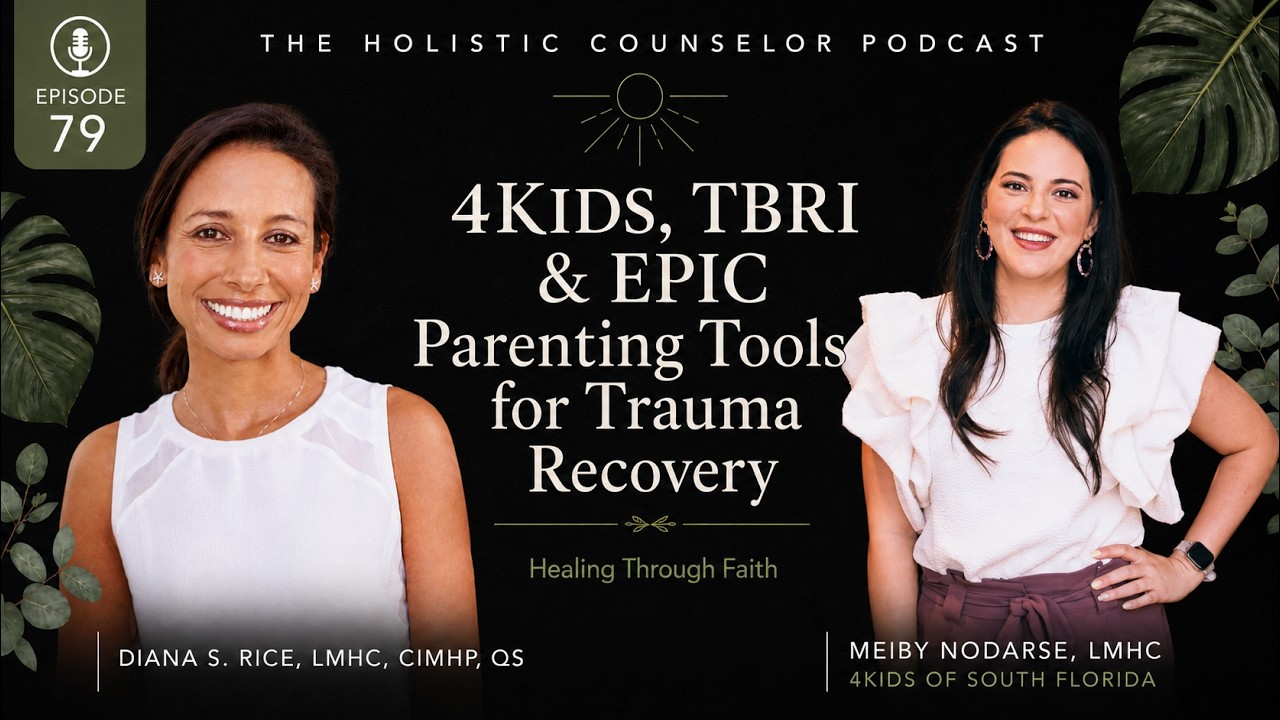
Episode 79
4KIDS, TBRI® & EPIC Parenting Tools for Trauma Recovery | Meiby Nodarse, LMHC on Healing Through Faith
Hosted by Diana S. Rice, LMHC, CIMHP, QS
In this powerful episode of The Holistic Counselor Podcast, host Diana S. Rice sits down with Meiby Nodarse, LMHC—a Licensed Mental Health Counselor and TBRI® Practitioner with 4KIDS of South Florida. Together, they unpack what trauma-informed parenting really…
Listen to the Episode
Press play when you’re ready.
Educational content only; this podcast is not therapy, diagnosis, or medical care.
About This Conversation
Show notes
In this powerful episode of The Holistic Counselor Podcast, host Diana S. Rice sits down with Meiby Nodarse, LMHC—a Licensed Mental Health Counselor and TBRI® Practitioner with 4KIDS of South Florida. Together, they unpack what trauma-informed parenting really looks like and how the Trust-Based Relational Intervention® (TBRI) and EPIC faith-based trainings are transforming foster care families and Christian caregivers across Florida and beyond.
We explore the intersection of faith, attachment science, and parenting—from healing early childhood trauma to supporting teens navigating emotional and behavioral challenges. Whether you're a therapist, foster parent, teacher, or someone healing from religious or relational trauma, this episode offers clinical insight and Christ-centered encouragement.
In This Episode, You'll Learn
- What 4KIDS of South Florida really does (hint: it's more than foster care!)
- The heart behind the TBRI® model and why trauma-informed parenting matters
- The power of EPIC training (Emotional, Physical, Intellectual, Character) for Christian caregivers
- How to shift from "willful disobedience" to "survival behavior" in parenting
- What it means to "take thoughts captive" as a parent and therapist
- Real-world examples of trauma-informed care in foster and adoptive homes
- How spiritual disciplines and neuroscience work together to rewire the brain
- Common myths about trauma-informed parenting (and what the research actually says)
- Ways to support children who self-harm, hoard food, or resist touch due to past trauma
- How churches and ministries can actively help solve the foster care crisis
Resources Mentioned
- 4KIDS of South Florida – Organization supporting foster/adoptive families
- EPIC Parent Training (FREE) – Trauma-informed, faith-based parenting course
- TBRI® Overview – Texas Christian University's attachment-based model
- Trust-Based Relational Intervention® Practitioners List
- Diana's Neuroplasticity Webinar – Christ in Private Practice Summit
- Theraplay® – Upcoming modality Meiby is pursuing for deeper parent-child connection
Support This Work Each episode takes 3–5 hours to prepare, research, record, and produce with care, intentionality, and trauma-informed planning. If this podcast has encouraged you, supported your growth, or offered meaningful insight, one way to help keep it independent and ad-free is by visiting the merch store. Your purchase helps sustain thoughtful, holistic conversations on mental, emotional, relational, and spiritual well-being for listeners around the world.
Explore the collection: https://theholisticcounselorpodcast.printful.me/
If this episode helped you, please take a moment to leave a review or share it with someone who might benefit. Reviews are one of the most impactful ways to help others discover the show.
Episode transcript
Read the full transcript Close transcript
Automatically generated from YouTube captions. Names and wording may contain errors; listen to the episode for the original conversation.
Hello there fearfully and wonderfully made human. It's Diana from Through the Valley Therapy, Transform Mind Consulting and Coaching, and your host of the holistic counselor, where I pray that faith, psychology, and whole person healing intersect on this podcast. Today, I'm joined by a passionate soul who embodies both clinical integrity and gospel- centered compassion.
Maybe Nordst, I hope I said that right. Maybe is a licensed mental health counselor and TBR practitioner with four kids of South Florida, an organization dedicated to restoring hope to children in crisis. She specializes in traumainformed care for foster and adoptive families offering parent training that is both ethical and rooted in the love of Christ.
She holds her MERS in clinical mental health counseling from Palm Beach Atlantic University and her bachelor's in psychology from the University of Florida. Go Gators to my Gator my Gator crowd. If you've ever wondered how trustbased relational intervention, yes, she's hopefully will be explaining what that is, c can be applied in real world family systems or how therapists can integrate faith and science in a way that actually helps people heal.
Well, this episode is for you, maybe. Thank you for being on the show.
Hi, good morning Diana. I'm so excited to be here with you today. So, let's start with um those that are not familiar with four kids. I know what four kids because I'm from South Florida and I worked in the Brower County school system and so I know what it is.
Plus, I'm involved in the women's leadership network that meets at 4Kids and I know people that work there. So, can you tell me a little bit of your journey with this organization and how it began back in grad school? Yeah. So, you know, my original introduction to four kids uh was on way FM, the radio station.
I don't know if you listen to that, but I would just hear like these commercials.
Yeah, I remember.
Yeah. Four kids and
man, how old are you, girl? Because radio like people are listening and they're going listen to the radio. I'm like, yeah,
I still listen to the radio. I still listen to the radio.
Probably driving, right? When you're driving around.
Yeah. Um, so I didn't really know what they did aside from those radio commercials. But fast forward to grad school, um, it's internship time and I always knew that I wanted to focus my clinical work um, with children. Um, you know, I have my history is in children's ministry.
You know, I just have always known that I wanted to work with children. um in Gainesville. Actually, while I was at UF, I uh spent some time volunteering at a child advocacy center, which introduced me to um you know, kind of a little bit into the child welfare system, a little bit into trauma focused therapy with kids, um all these things.
So, when it was time to do my internship, I was very intentional. I only interviewed at two sites, which was either very brave or not very wise of me. But um and I remember I heard back from from the first site. Um and I prayed about it and I just felt like I couldn't accept it.
Like I just didn't have that confirmation from the Lord and I hadn't heard back from four kids yet. And I was like, "Oh my goodness." Um, but
you had to probably pick something right away because if you're in grad school, I know like I had a practicum, a year of practicum. So,
exactly. That's what that was for.
Okay. Yeah.
So, you interview maybe like 6 months prior. This is probably fall of 2019 to start January 2020, which was a whole other thing. Yeah.
Yeah.
So, I hear back from four kids and, you know, the rest is kind of history. So I fell in love with um not only the agency but the work, our families. Um my internship was during the pandemic. So it's probably not what you remember a clinical internship was like or what anybody currently walking through this journey of mental health counseling um will ever experience in terms of internship.
But it was definitely, you know, we had to get creative.
Um we had to get really, you know, innovative with how are you doing, you know, virtual therapy with 5-year-olds, right? And so, but that's we could have a whole other other show on that, but um I just fell in love with the mission of four kids.
I my prayer and why I even chose PBA in the first place was you know mental health is a pretty secular field, right? We have to um you know be ethical, right?
Well, whoever else has gotten their theories out there to be um Yeah.
Yeah. Exactly. But for the most part, right, when we think of therapy, if unless you're specifically a Christian counselor, pastoral counselor, you're not
that's different. Totally different than us.
You're not doing,
you know, we're not doing that. So, I was I was like, Lord, how am I going to integrate my faith and and and and my my calling to into this field. And so, PBA was an answer to prayer. And then four kids um was an answer to to prayer in that regard.
Um, and so I just fell in love with being able to be, you know, authentically Christian and authentically Christian workplace, but then go in and do, you know, quality ethical clinical work um that's, you know, backed by evidence and we're trained in all of the different things and um the support that we receive.
So I I our previous president um will would never let me live this down, but one time in like our staff meeting, I said, you know, I'm never leaving four kids. So he would quote that every time. And he's like, "Remember, you're never late."
A wow. So, so what is your Well, I still want to know a little more about four kids because to me, um, like we're saying four kids, four kids, and you say it's advocacy, but how I know it, it is for f it's like a it's a alternative from the government foster care system that, but is it more than just foster care?
Like, can you explain for kids a little bit more, please? Like you said, the mission. I want to know what the mission is because like I said I've I've heard of it for a long time. I mean when did it start? I I know
1997.
Okay. So since it's starting like I remember listening on way FM and then just being part um I knew someone that I went to high school with that worked for Four Kids. I don't know if he still works for Four Kids or not.
Um Andre McNeel I think it was his name.
Yes. Did you still work for Four Kids?
He's actually o in our um I don't know if you've heard of Care Portal.
No. See, like I
So maybe I I'll give you a little rundown. How about
Yeah. Yeah. Let's just see how how for kids like because somebody that might be listening either goes, "Hey, I'm in a place where a child needs help or I want to volunteer. I want to donate my money to somewhere that's actually making a difference because I know that that's part of like there's a handful of places that I give back to and 4Kids is one of them because of I see the fruits.
It's not this huge organization where there's a board member making millions of dollars.
Sure. Yeah.
And that to me, you know, I don't want to put
Okay. All right. Diana, reel it in.
And actually, Diana, you'll have to forgive me. That's not the Andre I'm thinking about. Our Andre's last name is Harris. So, I did I did get our Andre's confused. So,
all right. So, I don't even know if his last name is McNeel. Maybe it is. No. Is it? I don't know. He went Hey, listen. If there's an Andre that work for four kids, it's you. It's you. Class class of 1989 from Deerville Beach High School.
Anyway, all right. Maybe. Sorry. We're g We're gonna have a great time today.
And I just met my maybe by the way people literally. But I could just feel Yeah.
I just feel her her beautiful soul and and honestly the people that I've met at four kids,
they you guys must vet people very well because Oh, yeah. Everybody that I have met, um, their hearts are just so tender and really really care about the children. Oh, I know someone else that works there. Um, uh, she went to school with my youngest son and she's a twin and her maiden name was Lassen.
Oh god.
Kayla.
Kayla.
Yes, I got that one right.
Yeah. Anyway, sorry. All right. All right. So, back to four kids. Yes. Yes. back to four kids and what it actually stands for in here in South Florida.
Yeah. So, four kids, our mission is to bring hope to kids in crisis. And so, we do that through a variety of programs. Um, and so primarily you you know us because of, you know, foster care. So, when a child gets removed from their home, depending on which agency, so in Palm Beach County or in Broward, it's uh ChildNet. um they'll call the licensing agencies in their community, Four Kids being one of them, and say, "Hey, do you have a home for this child?"
Wow. Okay.
Um which is why, you know, our efforts are, you know, really focused on a lot of the time recruiting foster families from our, you know, network of churches because, um we want to be able to say yes every single time. You know, our email signature is until every child has a home because that's what we're working towards.
We never want to have to say no. Um and so that is you know number one. So then we have our licensed foster homes. We have a team of amazing support workers um that support our foster families not only through the licensing process but then you know with everything that comes after.
Um then we have uh transitional independent living homes for aged out youth um in Broward County. We
till what age? May I ask what?
I I don't know exactly till what age. I know that it's a program, so there are a couple of requirements. Um, our RAS and and the team over there does a really great job in not only, you know, spiritually supporting this these youth, but helping them again gain that independence that they'll need to transition fully into the world, if you will.
Wow. So, if I'm hearing this correctly, if a if a child is placed with a four kids family, they stay there until they age out, is usually 18, what I know about foster care. And then some of them don't have anywhere to go and they become homeless youth.
I'm telling you because I've had to deal with that back when I worked in alternative high schools. But with four kids, what I'm hearing is that once they age out, there's a place for them to go as an independent like an adult, but like a group home
kind of. It's like a like a group home, I guess, traditionally is they're kind of sometimes um I don't not notorious, but it's and and it's not for all of our counties. So, like I mentioned, this particular program is in Broward County.
Um and so it is an option for youth that again age out of care to be able to remain, you know, housed and supported. Um, so for sure and we've had wonderful foster, you know, um, relationships with youth that have turned 18 and have been able to stay in the home or through different programs the community they've helped them transition to other um, independent living housing situations.
But you are correct that you know if
so so can I ask four kids of South Florida is it in every South Florida county like can you explain where four kids um where you can find four kids?
So we are in Miami Dade County Broward County
Palm Beach County.
Okay.
The Treasure Coast which is like Martin St. Lucy all the way up to you know Ver all of this
up here. And then we're in Southwest Florida. So like Lee County area, Fort Meyers area.
Wow. Okay.
So that is our current um those are our current regions that we serve at this point.
The area. Okay. Good to know. All right. All right. So let's talk a little bit about this TBR. All right. I saw that and I'm like, man, another rabbit hole I need to go down into because this is this is if you listen to my podcast, you'll know that every time I'm curious about something, I you know, I go into that hole for a while and then my poor husband is like, "Diane, are you ever going to pay attention to me?"
And I'm like, "Sorry, I'm in this hole." Um, but it's a good thing. But honi rabbit hole because I was waiting for you to
teach me.
Yeah. and the listeners, what is that? Where did it come from? And and how does it work?
Yeah. So, TBRRI, like you mentioned, trustbased relational intervention was developed by um Dr. Karen Pervvis and Dr. Cross out of Texas Christian University.
So, it is a attachmentrich relationship focused evidence-based model for um parents. It's a relational model for parents and caregivers of children from hard places. So, um, as an organization, TBRI is our our language. It's how we do relationships even with adults. Um, but it's also where our faith-based trauma-informed training, epic training was born from.
Uh, and we also teach the TBRRI curriculum to our foster adoptive and and community families. So,
so, so this is something that if you are becoming a foster parent or foster caregiver, right,
and the licensed therapists have to be trained in this too, like everybody has to be trained in this. So,
so our so our leadership um at four kids and a lot of our therapy and foster care team is our TBRI practitioners. I think we're up to maybe around 15. Um, so you have to be a practitioner to train the TBRRI curriculum, but you don't have to be a practitioner to implement TBRRI.
Um, and so all of our therapists use um TBRRI as a foundation for all of the parent education, parent coaching, parent support that we do at 4Kids. Um, and as long as you've gone through the caregiver training, which is um the the practitioner trains, TBRRI caregiver training, you are able to then
kind of go ahead and and use it with your clients, use it with your families. So, it's not a therapeutic modality. Um, but it is the foundation for even like how we build rapport with clients, how we interact with clients, how we interact with families. like it is kind of like the heartbeat of relationships uh you know for kids.
Can you give me an example of how it's utilized? Because to me it's like okay I get it like I am not certified in IFS internal family systems at all but I am I went into I've been in that whole now I go in and out of it for the last uh probably year and a half two years because it's a fascinating modality.
So what I mean like you know TBRI it is made by these two individuals two doctors you say are they psychologist psychiatrist
they are um therapist based on that right now I know Dr. Dr. Cross I I believe is a psychologist and um
Dr. Pervvis it it was like the Dr. Cross was like the she Dr. Pervis who has passed since unfortunately. Um and if you ever go down that rabbit hole and you hear her speak and watch her videos, you'll see why she's, you know, was such an amazing woman.
But um they she kind of designed and she knew kind of like the qualitative part of it, right? Like
yeah, the science like this is the research and all.
Yes. And Dr. Cross is like okay, let's design the experiment. Let's let's let's test this out. let's you know and so it is I mean it's it's uh tried and true if you will um for its impact on bringing children to just you know incredible levels of healing.
So how like can you give me an example like if you're if all of a sudden I'm curious about like or wanting to become I know that there has to be some kind of meeting before you have to vet everybody. I mean, you're working with children.
You better be vetting everybody like more than anybody else gets vetted, I'm thinking.
And uh and then you pass that and you get into this kind of like I'm taking it that you do the training maybe like
Yes. So, our training is actually open to anyone that wants to come because it is it's virtual. Um and so they can be found on our website. So the training aspect we I mean we're currently even have um so many foster families like out of state from Texas there's a foster care agency out of Texas that has been sending their foster parents to our training.
Oh my goodness.
Um so we Yes. So so the training portion is is you know we make it available and accessible to to the community. Um, and so it's about it's it's connection first, right? We I don't know about you, but the kind of parenting that I grew up with, right, wasn't necessarily connection first.
It was more, you know, discipline, correction, punishment focused.
Can I ask if you're from a different culture?
I am. I'm originally Cuban.
Ah, okay. That's all you have to say. That's all my listeners know.
Yes. Exactly.
So, it's like, and I, you know, I love our culture. I'm I'm a Latina. I mean, do you speak Spanish?
Yes. Yes. Yeah.
Really? Okay. That's nice.
We do we do a lot of international trainings and I know we'll get into that as well.
Yes.
With the Latin American community,
but I get it.
Yes. So, so it really is what we know about trauma and how it impacts the brain, right? We know that traditional parenting, traditional approach does not work with our kids, right? The way their brain has been wired, the way their uh nervous system has developed, um it's just not going to work.
So, um, TBRRI basically, you know, the goal is to speak the language of this child to create felt safety to the point where they don't have to be on this fight, flight, or freeze mode. They don't have to be in the survival mode, survival brain.
Um, and they can actually let that guard down, build that connection and that relationship with the adult in their life. And then through that relationship, healing comes. through that relationship, then you can effectively correct and behavior. Because what we want from correction is that it's a learning opportunity for that child to gain the skills to actually make a different choice next time.
We can actually empower that child. We can help them. Now they're no longer in survival mode. So now they can focus on relationships. They can focus on emotional regulation. They can focus on social skills. Um their brain actually now has the capacity to learn and and you know actually engage in school, right?
it's no longer looking for threats. It's actually able to thrive. And so that is what TBR is getting, you know, to the heart of um through through the this parent relational model, if you will,
right? How long does uh like say someone's in this
epic? Well, epic is different than the TBRRI, like how do you Okay,
so so Epic um was born from TBRI in the Bible, if you will. So it is a trauma-informed faith-based intervention that was developed you know through four kids um informed by not just TBRI but other you know evidence-based modalities but it's essentially integrating um faith and and and trauma-informed care.
Um, and so it is uh a 12-hour virtual training that we offer um for parents um typically parents of, you know, faith, right? Christian parents that are doing this hard work and need a lot of encouragement and need a lot of support. And so we have found that once they're able to to see both, right?
see how this comes from the heart of Jesus. How how yes, there's so much science and research and all these things that are is wonderful, but it it was originally already in the Bible. It was it's already how God interacts with us and how how he calls us to interact with others.
Um and so we just bring that together um for parents. So that's our epic training called the epic department.
All right. So the epic training though, anybody can go on and is it a is there a fee for it or it's free or
Epic training is completely free? Yes.
Wow. Okay. And I love that because it is really hard because I work with a lot of people that are coming out of religious trauma.
Yeah. That's so hard.
And so to me, can anybody even if you're not a parent take that?
Yeah, everybody can can take it. We have a whole section where we focus on our own histories.
I love that. Okay, good. That's what I wanted to hear cuz I was about to challenge that cuz I was like,
"Yes, yes, we know." And and you see our stuff.
Yes.
We because that's that's why I stopped working with a lot of family. I don't I used to work with adolescence, but it was like when I had parents, I go, "No, I see that you might need to go have your own therapeutic alliance somewhere."
And they didn't want to. They did not want to face their own inner I hate to say demons or inner pains or or cuts. unresolved areas.
Yes. All over or the parts of you the you know that inner child part that that still needs something especially if you grow up in a place or you know with religion high control religion along with high authoritative parenting.
Yeah.
And then all of a sudden you're to me I don't say you're dis deconstructing you're disentangling faith from trauma.
Yeah. Sure.
Okay.
It's hard right? It's hard to see this loving, compassionate God when you haven't experienced that in in human interaction, right?
Yeah.
Yeah. I love this. Oh my. Okay, guess what? I'm going to be the the next
We can't wait to see you.
The next time I'm going to get on there and get certified 12 hours or I have to commit 12 hours, people. Someone maybe hold me accountable now that I know you're my Christian sister. Okay. Anyway, so back to Okay, so epic training is one thing.
TBRI is the other thing. And how do you, you know, utilize that in in a family in crisis? Like, so because you have to go in into crisis, into a crisis place when you're dealing with the foster kids.
Sure.
And you teach these parents because I've seen parents meaning well, the mean wells, where they're meaning well and they're wanting to do this and then they they don't know how to really deal with what's coming, you know, because my aunt when I was younger was a foster care parent.
So, I got to see firsthand, you know, someone coming in the house, leaving the house, coming in the house for a few months, and the heartbreak of when the kid has to go back to that. Okay, I'm going to stop. Go on.
Yeah. Yeah. And so, you know, I guess it kind of varies. And because we have such a wonderful um fast growing clinical department here at 4Kids, we are I think we hit 30 if not now we're almost at 30 therapists um across all of our regions.
And so every child that gets placed into one of our homes gets a therapy assessment from zero to 18. So they could have just come out of the hospital, right? Because we have myself and a few other therapists have been trained in first play.
Um, so if it was a child that was substance exposed or that had a physical trauma or that had a prolonged NICU stay, we want to be working with that foster parent to just not only monitor developmental milestones, but how do we now reintroduce like safe touch?
How do we introduce that child to like a a positive sensory experience? So that's why sometimes we a family will get a placement, a baby's like, "A baby needs therapy." I was like, "Yeah, a baby needs therapy." But it's not what you will what you traditionally think, right?
that parent child work. Um, so from zero to to and and we have therapists in our even young adult homes. We also serve our foster parents. So I worked with foster parents as a couple and I worked with foster parents as individuals who, like you said, this is hard work.
These kiddos will push buttons and will trigger us. And so we have to
and parents take it personal. I'm telling you, I mean, even parents that don't have their kids in foster care, I see that. I look back and I'm like, "Oh my goodness, you're you're dregulating. your kids disregulating and you're taking their behavior personal. They're eight years old.
Like you're expecting an 8-year-old to have a brain of your adult size. Like,
sure.
You know, because we're not taught these things, maybe.
Oh, of course. And and and we always like our motto in we we take this from Maya Angelo, right? We do the best we can until we know better. And when we know better, we do better. And so that's what we're trying to help parents realize.
It's like we're not, you know, we're not here to to crumble down your world, right? We're not here to even, you know, criticize. We know that you've been doing the best you can with the heart posture of loving these children. And so our goal is just to equip them, to help empower them, to give them tools and practical techniques that um that they can easily apply to, like you said, to actually, you know, feel like, okay, I'm I'm not drowning.
I'm not always overwhelmed. not always becoming disregulated. And so um you know we so again we work with the families, we work with the children and even when the children are the is the client for example, we always always always do parent work.
Um it varies. It looks a little bit different in the teenage years, right? Because we want to make sure that that alliance with the teenager is clear. I know you know what that's like.
Oh yeah.
Um
I'm glad I'm over that whole entire stage. My baby's 26.
Listen, it is Yeah, it is. It's a little different, but um anything before that, we're always doing parent work. And so we're meeting with a parent depending on the need, sometimes weekly. I've had clients where I've met with a parent weekly for two years, you know, um just doing the TBRRI epic coaching.
Um and then I'm meeting with the client individually and then we have family sessions, right? So, it's um so we literally even as the parent has gone through training. Then in these one-on-one sessions, we're breaking down behaviors. We're brainstorming techniques because it's not prescriptive, right?
I can give you a list of interventions, but they're not all going to work.
Human you're dealing with human beings. And I think that's what sometimes we forget in our field is that we're dealing with
a whole being. That's right. you know, and and once again, I'm going to say it, people, it always comes up, the psychology, theology, and biology of the human. And it's like even if they're tiny, even if they're just two weeks old, like, you know, you're right.
I love that you mentioned that because our our verse for epic is Luke 52 and and Jesus grew in wisdom and in uh stature and in favor with God and with man. And so epic stands for emotional, physical, intellectual, and character. And I did not know that.
I love that
seeing the child as this whole being, how God intended them um and how we fit into that puzzle and how our histories impact those interactions. And so that's our goal to grow in all these areas and to help children heal in all these areas so that we can have this holistic approach.
So I love that. Okay. Say say again what what each letter for epic is.
Emotional,
physical, intellectual, and character. Okay. I love that. So that is something that everyone that e works for four kids or works with the children in foster area because you said four kids has uh all different kinds of uh
Yes.
Yes. So Epic is is also I know I mentioned that TBRRI is like the heartbeat of our interactions, but Epic is is our baby for kids if you will. And so anytime that we're, you know, making a joke of like someone was kind or uh intentional, like that was very epic of you, like we're always, you know, referring to it as a verb, right?
Because that's how we, you know, we guide our interactions. Like are we are we, you know, hitting all these areas? Are we growing in all these areas? Are we surrendering these areas to the Lord? You know,
yeah, I love that. The word surrender. I think that's the most important word actually is the surrendering. no matter where you're coming from, who you are, what's going on in your life, what narratives you believe, right? Um, so tell me a little bit more about like the practical tools or I mean, you said the go-to phrase being epic, epic, but that you share with caregivers or parents when they feel overwhelmed or stuck in a child's behavior pattern.
Yeah. So, um, the number one thing that we always encourage parents to think about in those moments is to shift that lens from, you know, willful disobedience to survival behavior. Cuz when we're looking at something through the lens of willful disobedience, we are, like you mentioned, we're taking it personal.
We feel attacked. We are going to get really frustrated and disregulated very quickly.
Um but when we look at it as a survival behavior when we look at it and we say okay this child's brain for whatever reason maybe you know the reason maybe you don't in that moment um is not capable of regulating right now this child's brain has gone into survival mode this child is what we say you know I always use the term like you know Diana's not home like some something else is driving the car
right now um and so when we shift that and we can have compassion understanding in that moment we say okay this is not about me.
This is about the trauma, right? It's not me against my child. It's me and my child against this behavior, but first and foremost, I have to be there for my child, you know, and shifting that, I think, is so powerful. Like you said, it's it's having that knowledge of, you know, it's it's not about you.
There's so much going on. And I know it feels about us sometimes cuz that that child in that moment could be saying things that feel very much about us. They could be, you know, there could be,
yeah, I hate you,
right? I mean, I saw that in this house, the worst mom in the world. And so parents who are sacrificing everything, that feels very personal and rightfully so. And so we really try to encourage parents like
do everything you can in that moment to, you know, take those thoughts captive and and switch that lens of like, okay, survival.
Can you because I know that's a Bible verse you just quote, but because I have a lot of listeners that are not Christian.
Yeah. And so I want to make sure you understand when you said take that thought captive, she actually meant take take that thought captive to Christ. This is the spiritual aspect of the things that can help
because right I mean I'm I'm pretty sure that's the probably part of the training because that's what I love about four kids too. They are the people that work there are disciples of Jesus Christ. I I think no matter what denomination, right? Like you you all understand that it's about loving the Lord and loving others.
Yeah.
And um so yeah, the importance of taking that thought captive, that's something I do in in when I work with the adults because you do you do take things personal. If a if a spouse, a loved one, any relationship, your boss, whoever, especially the child,
you know, it's like, all right, how do we take so how do we take those thoughts captive? Maybe how
well and and that's where a lot of the the the proactive work comes in, right, for the parent. So this is a parent that you know whether it's in training whether it's in their own individual therapy we're talking to them about you know how how are you taking care of yourself what is your personal calm down plan right what is your personal regulation plan
yeah your safety plan
right what is the support that's available to them cuz if in any given moment like okay this situation is really triggering me I'm getting disregulated do they have a spouse do they have a grandparent do they have anybody that can tag them out right?
Um what does their, you know, daily walk with the Lord look like? Are you spending even 5 minutes in prayer in the morning? Cuz sometimes it's, you know, we do fall away from from our spiritual habits, especially
when you have little in the home.
Yeah, I know.
So, how are we Yeah. How are we just in constant communion with the Lord um as a mom now and my baby is only eight months old. Um and so
is that your first?
In my first baby.
Congratulations. Wow. Things are all going to shift now. I'm telling you. they already have. And even like at 8 months old, right, with the long nights and, you know, no communication, right, cuz baby can't tell us exactly what's going on. I'm finding myself like losing patience sometimes and I'm like always in communication with the Lord, like give me strength, give me wisdom, give me cl, you know, all these things.
So, what does their daily walk with the Lord look like? And then, you know, what is um what is any barriers to implementation of TBRI? So, for example, in the connection strategies, we talk a lot uh about um and in epic emotional, we talk about those strategies of like healthy physical touch, eye contact, playfulness, right?
Um things that build connection, things that build safety.
Explain healthy physical touch for someone that's like, wait, what is that? What do you mean? I don't know. Am I being now healthy? You know, am I doing the right thing?
Yeah. And so, you know, physical touch for children who've experienced trauma has not always been a source of like nurture and care, right? Um, and so we want the parents to um make it available, but never force it, right? Always with permission, always offering and letting the child lead when when they're ready.
And so that's what I mean by healthy physical touch. Not like forcing a hug when a child's having a hard time, but just offering, hey, do you want to
give Alita a kiss on the lips? Exactly. We we talk a lot about that in our training, right? Cultural variations of physical touch, right? And educating families because I I you know, we come from that Latin culture of you arrive somewhere and you kiss everybody and you hug everybody.
Ben, who is this? Ben.
Yeah. I'm like somebody's cousin's uncle's friend, right? And so for our kids, like the expectation cannot be like, well, you're being disrespectful if you're not comfortable hugging or kissing a stranger. come from abuse.
Exactly. So, how do we how do we introduce healthy physical touch? How do we make it available? Because it, you know, touch is super powerful. It balances brain chemistry. It helps build deep connection, but we want to do it when the child is ready.
And so, are there any barriers? You know, we've had parents that because a child has been aggressive in the past, now they have that anxiety and that barrier. Well, I'm afraid to get close, right? So, working through that or, you know, tone of voice.
Hey, do you always go to a 10? Um, or are you, you know, one of my fellow Cubans that it's like one tone for everything. So, this child's brain is registering that tone as a threat,
right? So, we talk through those things and that's why the parent support as a part of our therapeutic um you know plan and treatment plan is so important because yes, you come to a training, you spend 12 hours or 16 hours or 24 hours in a training and you're on information overload and it's all wonderful information, but after what happens when my kids, you know, throwing themselves on the floor screaming and crying and I haven't had my coffee yet, right?
like um and so we need to we we you know really value being able to offer that ongoing support for our parents.
So so say that you have now a young you know middle schooler or teenager and because I'm just bringing up things that I saw. Okay. Not not with four kids but in foster care.
Sure.
And um you know and that I worked with the student for these situations like they self harm and the do you train the parents as well with situations like that?
like all of a sudden there's a whole bunch of melted Snicker bars in between their beds and and you didn't know that was happening and they were hiding food or the things that I know that um some not all and I don't want to scare anyone away either because that's the thing you have to understand we're dealing with human beings that are coming out of a traumatic experience.
So they're hypervigilant. And so this these are Christian words we're using, but hypervigilant basically means your brain's on fire and it's in safety mode trying to be safe either with flight, fight, flight, fight, freeze, or fawn. And you're trying to um get regulated.
And so co-regulating would be that healthy touch. But do you do training for parents with like situations, hard situations that can happen when you adopt a foster kid?
Yeah. And so, um, we do have, uh, a a separate training that's not internal. It's like the government training, if you will. Um, and I don't know if it varies by by region, but in our county, so in like Palm Beach, um, Treasure Coast, and I believe Broward, it's called care training.
So, that's kind of all of the like, hey, this is everything you need to know about foster care in general. That comes
everything's up front.
That comes from the state, right? um when it comes to um like food insecurity behaviors, self harm behaviors and um so like I mentioned all of our families get access to therapy. So, a lot of those things will come up within the therapeutic process and so that therapist will be supporting the family through that on a one-on-one.
But we saw such a need, just a general need that we are um in the development of uh um and it's almost ready. We're so excited about it. um a training for parents or foster parents, caregivers of adolescents who have experienced trauma.
And we break down, you know, some of these major like mental health challenges, what to look for in the teenager, what the parent needs to be checking in themselves, and then what are some practical interventions, you know, we bring in some DBT skills, we bring in some different things like that.
So, so DBT for anyone that's listening that does not know what that is, it's dialectical behavioral therapists. And I did interview a very big DBT um therapists here in in the local area if you want to go back to that.
Say go listen to that podcast.
Yeah. No, no, go listen to that episode because I do that's why I try to bring people from all that's why when I saw that TBRI, I'm like, okay, you're coming on because this is amazing. Like for for anyone that's listening like you can they give you a training for free.
Why not just do it just to do it to have that to if you're a teacher I would think you would want to know how to do this.
We go to schools. We're going to to a school next week. We have a 4-hour trauma-informed care in schools training that we offer for free to the community. So far we've only been able to go into Christian schools cuz there's a lot of red tape in the public school system.
Um but yes, we would gladly um go, you know, go to the
charter schools might take you. Alternative charter schools will take you, I would think.
So, we're we're we're working um we've had like I've done inschool services for a couple clients. So, we always offer, right? Hey, just so that we can support your teachers. It's another tool. Yeah.
What about churches like youth groups?
We do that. We've uh do family ministry uh family ministry training as well. We just did want to um Oh my gosh. First, oh my god, something Broward Church of Christ. I'm so sorry. I forgot.
Oh, it's okay. My personal church uh my home church, Christ Fellowship, we did it a couple years ago to um for the man family ministry staff and volunteers. So, we are trying to get this information out there. We are not gatekeeping anything.
Good for you, baby. I love that. I love that. So, um, there's so much information out there for trauma-informed care. What's one myth you'd love to bust wide open for our listeners today? Yeah, I love that question. So, um, there, you know, when I was, uh, when I think about this, two, two things come up.
And the first is that, um, to be able to do trauma-informed care, you have to be perfect. And I think when we go through our training, we talk about all these things that like you should be doing and all these things. And so, um, I think a lot of our parents at first before we clarify this, like, how in the world am I going to be able to do this all the time?
And so, we, you know, to be trauma informed does not mean to be perfect by any means. Um, in fact, quite the opposite. We want to model to our kids what it looks like to make a mistake, to be flawed, and to then be able to, you know, come back and seek redemption, seek repair, um, be humble, you know, extend forgiveness.
So, we want our children to see those interactions. Um, and what we know from research, uh, you know, the TBRRI institute always, you know, highlights this. If we are doing trauma-informed care um parenting 30% of the time, just 30% of the time, then we are um helping, you know, the brains and bodies and biology and all of this heal in our children.
And the other 70% of the time we're going to repair cuz we're going to make mistakes and that's okay. Um and you know, I think the important takeaway is they're all learning opportunities. how can I grow from this so that next time I don't make the same mistake.
I might make another one. I probably will.
Um because it's, you know, the same thing with God, right? He finds us where we're at, but he doesn't leave us there, right? He exposes these areas and helps us grow, and we're going to keep sinning and falling, but um you know, we're growing along the way.
So, that's the first myth, if you will.
And the second is um that being trauma informed means being permissive. Oh, you just let the kids do anything they want.
No discipline.
Yes. There's no discipline. You don't
gentle parenting. It's gentle parenting.
Exactly. And that is not at all. In fact, we help parents introduce more structure into their lives because our children need structure. They need predictability.
They need boundaries. All humans need boundaries. Hello.
Exactly. It's it's just how we do it, right? and making sure that we have equal nurture. So, we're going to be high structure, but we're also going to be high nurture. And they're not mutually exclusive. We're not going to be structure when we discipline and then nurture when things are good.
It's like, no, how can I still be kind and compassionate and loving to you in your ugliest moments when I am having to hold hard boundaries? Right.
Well, isn't that what Jesus says in the word? It's easy to love the lovable.
Yeah. Exactly. But but to me, I want to see you love the unlovable. Not saying that kids are not lovable, you know what I mean?
But it's those moments that there it's hard to love. I mean, I'm sure in all of our lives, we've had relationships where even family members have been hard to love, right? Our spouse might be hard to love or, you know, and so in those moments, how do we still show the compassion and the love of Christ when things are hard?
So, it's not permissive. It's it's basically learning h what to what to prioritize. And so in those moments, you know, when my child is completely disregulated, no, I'm not going to give a consequence cuz guess what their brain is going to do? Just continue to escalate until things get really unsafe.
I'm going to recognize that in this moment, this child needs, you already mentioned, co-regulation from me. They can't do it on their own. I need to bring them back down to their real self, to that real child. And then we're going to talk about what are those natural consequences from their actions.
We're going to talk about okay what how can we practice um what to do next time. How can we you know even you know introduce a game or an activity with teenagers? How do we verbally process a redo? How can this have gone differently?
What can I do different? What can you do different? Right? And so when that child is regulated, when their brain is back online like we call it, um then we're gonna, you know, use our discipline strategies. So it's not about permissiveness, it's just intentionality because
yeah,
yeah, I can I can, you know, be have that structure, that discipline when my child is completely disregulated, but it's not going to be effective. No, you're just causing honestly I'm just going to keep escalating. My child is escalating.
Yes. And it becomes this uh power struggle between a child and an adult. But then honestly, when I see that, I look at two children like one adult, you know, a child in an adult body that's unhealed because or or they're psycho psych psychologically immature,
right? So it's like trying to to take that step back and this is why I like IFS honestly because when you start looking and becoming aware because that's what happens when you when you get disregulated and your brain goes offline it to me it's going in the subconscious of of like safety safety or whatever or
that's survival survival
that or your or you you you shrink down and you just uh people please people people please people please or you you know you you start
all those behaviors serve a purpose right even if that purpose We say that all the time to our foster parents. We know that your home is safe, that you are loving, that that child is safe, but their brain doesn't know it yet. They haven't internalized that yet.
So, even though that behavior is no longer helpful,
it's still what their brain learned that they need to survive. So, it's going to take time
to rewire the brain because I do a lot of neuroplasticity work and I I do training on neuroplasticity and and just understanding the rewiring of the brain. I'm actually doing a training in September for Christ in private practice.
There's a webinar for any therapist or anybody honestly and uh in in September, but this is not going to come out until after.
I mean out at the end of October this podcast, but it's just understanding how the brain rewires and that's maybe that's what I'm hearing is like the TBRI and Epic and understanding the whole approach of a human of little humans, big humans, all age humans, all color humans that they have this beautiful brain that God has given us and this beautiful soul and this beautiful body
and how do we, you know, understand that no matter where a human comes from, there's a way to always get better.
Yes. And that is our hope, Diana. That is exactly what we highlight in um in our work with parents is that there's always hope because of God's design. God designed our brain to be plastic. I know that sounds a little bit silly to people who are not, you know, um, used to neuroscience language, but just like you said, we're able to form new connections to heal these areas of our brain from from birth to to death, right, across the lifespan.
And that was God's design because he knew that we would be in a fallen world where we would endure really hard things. And so, um, but the beautiful things is that he also didn't design it to happen on its own. Um, this has to come from, you know, the healing power of relationships, this, the restorative power of Christ.
And so, um, he was very intentional with that.
I love it. I love it. Oh my goodness. I could sit here and talk to you for another hour, but I know we both have to go because I know your supervisor is going to wait for you at 11:00.
Plus, I have clients, so I need to to get going. But looking ahead, what's your prayer or vision for the future both for yourself as a clinician and for what 4Kids is building in the world?
Yeah. Um, that's, you know, such a a heavy question, right? Because all of us who work at 4Kids have such a heart for, you know, children in in crisis. And so we what we believe and our our prayer and our vision if you will for for the future is that you know the church is the answer to the orphan crisis, right?
And so this is a calling to you know you know the the church really to to really um examine and see you know is this an area where the Lord is is calling you to. We know um in in James, God says that, you know, pure and un uh defiled uh religion, right, is caring for the orphan and the widow, right?
We know that this is a cause that's near and dear to to God's heart. And so, we believe, again, I'll repeat that the church is the answer to to the orphan crisis.
And I think he and God's cleaning house right now.
Yeah.
That's what I see because
he's I mean, he's he's doing his thing. in every denomination.
Yeah. And and when you look at the statistics, you know, across the US and even just in Florida, if you're in Florida, um you know, the foster care statistics are very daunting. Yeah.
Um and so I I think sometimes we have that like um and I I'll I forget the the psychological term, right? But like somebody else will do it, right?
Um kind of mentality like yeah, there are other really awesome Christians out there who they'll do it like, you know, it doesn't have to be me. So, I guess my challenge to our listeners is, you know, could it be you? Why not you?
Right? Um, put that in prayer. And then as a clinician, um, I really hope to continue to grow in in my skills and in my knowledge to be able to support our families. Um, next, my next rabbit hole, if you will, um, is therapy.
I don't know if you've heard of therapy.
Okay. Once you're done, we're going to bring you back.
Okay.
I have no idea. And so I'm hoping to to get trained in that and and certified in that because it is um a really uh um good um oh my gosh I can't think
modality.
It's a wonderful modality but it's a very companion of TBRI.
Oh
so um in fact some of the TBRRI skills or tools that we use have come from therapy. And so, um, to be able to integrate those two, those two modalities, those two areas of passion and, um, implement those with our families. Um, I know, uh, in our clinical department, we, you know, we want to do like therapeutic camps for our families in the future.
We want to be able to do inhome intensives. So, we have a lot of dreams that we are lifting, uh, up to the Lord. Yeah. It's up to him, you know.
I mean, we're vessels. We are vessels. And so
if this is what you want, then you know, continue to guide us this way and open the doors so that
and protect and protect because I mean we see how the world's going and and and things with children and stuff like and if I start talking about I'm going to start crying and I don't want to. So um where can someone find you?
And you don't do therapy outside of four kids, right? You only work for four kids. You don't have your own private thing going on. Okay. So
four kids and by the time this comes out, this will be live. So um we are launching a sort of like a um
a a a separate sector of clinical services. So our priority is foster and adopted families always but we are um having kind of like a sister program if you will called uh epic healing and it is to provide therapy services to the community.
So, uh, Christian families, um, from the community, um, based in Florida cuz our our therapists are licensed in Florida. Um, but, you know, we wanted to without sacrificing our availability to serve all of our foster and adoptive families um, meet this need that we see in our churches and in our community.
And so, um, through our website forkids us, okay, you can access all of that information. Um we also have you know Instagram forkids us and our epic department has their own Instagram that we've just started um our you know our social media life so you can find us at 4Kids_epic um okay
and follow us there and um obviously we would love to see any of the listeners and you Diana um our trainings we have uh about three different training options every month. Um, you know, we have TBRI, Epic, and then we have the 4hour intro,
and it's all online.
Yes. So, trauma informed care online. You can register through our website and and all
and donate online because I'm thinking that's how how does a therapist like a clinician get paid? Like, honestly, I mean, because sometimes that that's a whole another hour of us clinicians of of Christian clinicians because we kind of feel guilty like we should be doing this for free, but honestly, you see that light in the air conditioning, I got to pay for that.
So, like how do you
It must be from donations or grants and stuff like that.
There's there's a lot of different ways that that funding comes, but if someone feels called to give to four kids, they can also do it through our website. They can read more about our vision and our mission and the work that we're doing um and the different programs that we have in a lot more detail than we have.
I love the yearly tea party. I go I because I love tea parties. Oh, Gallentis. I I've done Palm Beach and Broward. Amazing.
And so, yeah. All right. So, I thank you so much maybe for come for hopping on and and getting to know you and what TBRI is. I will put everything in the show notes. And before we end, is there anything else you would like to say to the listener before we say goodbye?
Well, I just, you know, thank you for having me here today and this opportunity to speak about um, you know, a cause that is so near and dear to my heart. And, um, to the listeners, I will ask for prayer. you know, if you can't give and you can't foster and you know, um you can always pray.
Um pray for the children that are in the system waiting homes. Uh pray for the children that are in our homes and of course pray for the caregivers who are doing this incredibly difficult um work that you know is incredibly fulfilling and wonderful, but it is you know very um it's a big sacrifice and investment as well on their end.
So pray for their strength and and endurance um in this calling. So
and patience.
And patience. Yeah. You know what they say when you pray for patience.
Oh yeah. Oh yeah. For sure. For sure. Well, thank you so much. And listener, please do not forget to trust in the Lord, guard your heart, and renew your mind. Bye. And now for the disclaimer to make sure you understand that you are responsible for you.
The content provided on the Holistic Counselor podcast is for entertainment,formational purposes only and is not intended as a substitute for professional medical advice, diagnosis, or treatment. Always seek the advice of your physician or other qualified mental health provider with any questions you may have regarding a medical or mental condition.
Never disregard professional medical advice or delay seeking it because of something you have heard on this podcast. The views expressed on this podcast are my personal opinions and do not represent the views of any professional organizations with which I am affiliated. Call your doctor, 911, or 988 immediately if you have a medical emergency.
The holistic counselor podcast does not recommend or endorse any specific tests, physicians, products, procedures, opinions, or other information that may be mentioned on the podcast. Reliance on any information provided by the holistic counselor podcast, guests appearing on the podcast at the invitation of the holistic counselor podcast or other listeners to the podcast is solely at your own risk.
Confidentiality notice. If you engage with the holistic counselor podcast by commenting or posting and are a client, please be aware that you may be revealing information that could compromise your confidentiality. Please remember that disclosing your identity or personal details can be linked to your clinical material.
As a therapist, I am bound by confidentiality and will not respond to any disclosures of this type on this podcast. I am committed to upholding the ethics and confidentiality of the therapeutic relationship which extends to all forms of communication in accordance with the laws and professional guidelines that govern mental health professionals.
I want you to know that your privacy is of utmost importance and you are responsible for protecting it when interacting on this platform or any other public forum. Thank you.