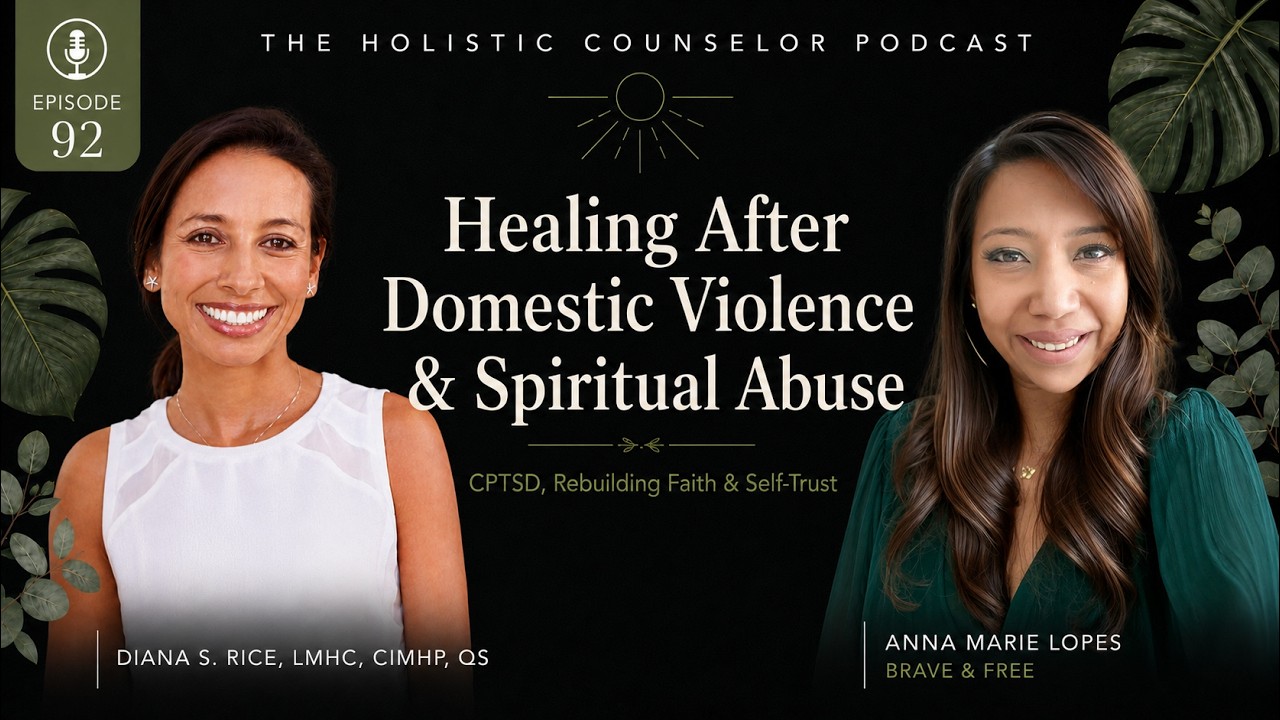
Episode 92
Healing After Domestic Violence & Spiritual Abuse
with Anna Marie Lopes, Abuse-Recovery & Post-Traumatic Growth Coach
Hosted by Diana S. Rice, LMHC, CIMHP, QS
In this conversation, Anna Marie Lopes—abuse-recovery & post-traumatic growth coach, founder of Brave & Free, and Engagement Director at the Healing & CPTSD Community Hub—shares her journey from witnessing domestic violence and surviving an abusive marriage to…
Listen to the Episode
Press play when you’re ready.
Educational content only; this podcast is not therapy, diagnosis, or medical care.
About This Conversation
Show notes
Jump to a section
In this conversation, Anna Marie Lopes—abuse-recovery & post-traumatic growth coach, founder of Brave & Free, and Engagement Director at the Healing & CPTSD Community Hub—shares her journey from witnessing domestic violence and surviving an abusive marriage to building a global community that helps survivors reclaim voice, identity, and freedom. We talk CPTSD vs. PTSD, spiritual abuse, self-advocacy in healthcare, and practical nervous-system regulation tools that supported her healing, all through a faith-informed lens.
Mission fit: The Holistic Counselor Podcast exists to break stigma in churches and BIPOC communities by bridging faith, science, and holistic wellness—and Anna's story models that integration in real life.
What you'll learn
- What CPTSD can look/feel like day-to-day—and why many survivors only get "anxiety/depression" labels
- How spiritual abuse hides in plain sight, and how to disentangle faith from manipulation
- Practical tools Anna used to move through flashbacks, hypervigilance, and body memories
- How community care (support circles, survivor-led spaces) accelerates healing
- When coaching helps, when licensed therapy is essential, and how they work together
- A faith-anchored reframe: separating God's character from people who misuse scripture
Notable quotes (Anna)
- "Be your own brave. The next courageous step is yours—and it may look different than anyone else's."
- "For me, the first thing was to differentiate God from men… just because someone uses the Bible doesn't mean God is a reflection of that person."
- "It was as if I was in a constant state of danger—hypervigilant… then the flashbacks and nightmares started."
- "I've been in therapy and on medication for over 10 years—healing is a long journey."
- "Self-advocacy matters. Trust your gut. If a diagnosis doesn't fit, keep asking questions."
Notable quotes (Diana)
- "Hey there, fearfully and wonderfully made humans."
- "We're never going to receive 100% healing on this side of Earth… If we did, I would not need Jesus Christ as my Savior."
- "Sometimes we chase the healing… and that becomes an idol."
- "Every human is raised by a village—and if the village has unhealthy dynamics, it's going to affect you."
- "You gotta get into the Word. Yourself. Not just what someone else says."
- "I have a hundred tools. I don't know which will work for you—I'm here as a guide."
- "Turn off that rectangle that's wrecking people. Be still and know… journal what comes up."
- "Be a curious observer of yourself—without shame."
- "Please trust in the Lord, guard your heart, and renew your mind."
Links & resources mentioned
Connect with Anna
- Instagram — @iambraveandfree: https://www.instagram.com/iambraveandfree
- Coaching w/ Anna (abuse-recovery & post-traumatic growth): https://braveandfree.co/trauma-coaching
- Rediscovering Yourself After Abuse (e-workbook): https://braveandfree.co/rediscoveringyourself
CPTSD education & community
- Healing & CPTSD Community Hub: https://www.healingandcptsd.com/
- Free CPTSD Awareness Kit (The Healing & CPTSD Foundation): https://www.healingandcptsd.com/free-guides
DV identification & safety
- Power & Control Wheel (Duluth Model): https://www.theduluthmodel.org/wheels/understanding-power-control-wheel/ PDF: https://www.theduluthmodel.org/wp-content/uploads/2017/03/PowerandControl.pdf
- The Hotline (U.S., 24/7): https://www.thehotline.org/ | Call 1-800-799-SAFE (7233) | Text START to 88788
- UAE help & reporting (includes helplines like DFWAC 800-111): https://gulfnews.com/living-in-uae/safety-security/how-to-report-domestic-violence-in-the-uae-and-get-help-1.500207174 Official UAE emergency guidance: https://u.ae/en/information-and-services/justice-safety-and-the-law/handling-emergencies (original link no longer available)
- Dubai Foundation for Women & Children (DFWAC): https://findahelpline.com/countries/ae/du/topics/abuse-domestic-violence
- Maitri (culturally-specific support for South Asian survivors, U.S.): https://maitri.org/
Books we referenced
- The Body Keeps the Score — Bessel van der Kolk, M.D.: https://www.penguinrandomhouse.com/books/313183/the-body-keeps-the-score-by-bessel-van-der-kolk-md/
- Complex PTSD: From Surviving to Thriving — Pete Walker (incl. 13 Steps for Managing Flashbacks): https://pete-walker.com/complex_ptsd_book.html | https://www.pete-walker.com/13StepsManageFlashbacks.htm
- Twisted Scriptures: Breaking Free from Churches That Abuse — Mary Alice Chrnalogar: https://www.amazon.com/Twisted-Scriptures-Mary-Alice-Chrnalogar/dp/0310234085
Related episodes on this theme
- Ep 10 — Overcoming Domestic Violence: Biblical, Christian & Secular Counseling (Dr. Johnson)
- Ep 58 — Exposing Abuse in the Church (Rebecca Davis)
- Ep 66 — Escaping Spiritual Abuse & Church Trauma (Sowania Germain)
- Ep 90 — Christian Spiritual Abuse & Recovery (Naghmeh Abedini Panahi)
Safety note
If you're in immediate danger, call local emergency services. In the U.S., contact The Hotline 24/7: 1-800-799-SAFE (7233) | thehotline.org | text START to 88788. In the UAE, DFWAC 800-111 and the official channels above can help. You are not alone.
Episode transcript
Read the full transcript Close transcript
Automatically generated from YouTube captions. Names and wording may contain errors; listen to the episode for the original conversation.
Hey there fearfully and wonderfully made humans. Welcome back to the Holistic Counselor podcast where faith, science, and holistic healing intersect. I'm your host Diana S. Rice, licensed therapist and integrative mental health professional. If you've been following this podcast for a while, you know one of the recurring themes we explore here is what happens when faith and trauma get tangled and how we begin to heal, reclaim our identity, and rediscover God's heart for us after that kind of pain.
We've talked about this in episode 10 with Dr. Johnson on overcoming domestic violence through biblical Christian and secular counseling. In episode 58 with Rebecca Davis on exposing abuse in the church in episode 66 with Sana Germaine on escaping spiritual abuse and church trauma.
And in episode 90 with Nagme Panahi Abedini on Christian spiritual abuse and recovery. Each of those episodes brought a different lens, biblical, therapeutic, theological. But today's story reminds us what it looks like when someone takes that pain and turns it into purpose. My guest, Anna Marie Lopez, is an abuse recovery and post-traumatic growth coach, the founder of Brave and Free, and the engagement director for the healing and CPTTSD community hub.
She's also a certified professional coach and mental health first aer using her lived experience as a survivor of domestic violence, narcissistic abuse, and spiritual trauma to help others reclaim their voice, identity, and freedom. Anna's story has been featured on BBC, Golf News, Feminina Magazine, and Kh Times, and she was honored as a mental health hero at the 2024 Mental Awards.
But today, you're going to hear her story in a way that connects deeply to the heart of this show. how trauma, faith, and healing can coexist and how God can meet us even in the spaces that once felt unsafe. This episode matters because stories like Anna's break stigma.
Not just in therapy rooms, but in our churches, families, and communities of color. Where silence has too often replace support. When survivors speak, they give language to those who are still finding theirs. So, wherever you are today, maybe driving, walking, or simply needing to feel seen, thank you for joining us for this sacred conversation.
Anna, welcome to the Holistic Counselor Podcast. Excuse me. [clears throat]
Well, thank you so much for having me, Diana. I am so so so honored to be here today.
Yeah. So, um, first of all, I [clears throat] want to I was before we pressed record, we realize like we are I don't do math well, but it's evening where you are and it's morning where I'm at. So, that's so cool. I I I really This is why I love podcasting, especially like this because I mean, I've interviewed people in Australia and now you I don't know if you want to say where you're at because of privacy.
I have no idea. But I just love the fact that I'm able to connect with people from all over the world to share their stories on this platform. And so can you just tell me a little bit about you? Like you know you were born and raised in the United Arab Emir I don't even know how to say that how do you say emir sorry
it's ai United Arab Emirates. So usually they call it UAE and most people know Dubai as one of the most popular cities that's in the UAE. So yes.
Okay. Oh, I'm so sorry. I know. I'm so I'm so sorry for being so ethnosentric.
That's that's okay. Well, here we are. We're we're you know getting to know people from across the world and um that's what's happening today. So that's totally fine.
A All right. So tell me a little bit about like uh where you grew up, how you grew up. I mean, I'm I'm intrigued by that because, you know, I was born here in America and I have my lens.
And that's why to me it's super important to understand that that there's an entire world out there and even though we have different backgrounds, religions, races, whatever, like you know what I mean? that we have to understand that we have a human connection and sometimes we have human tragedies together as well.
Right.
So can you just tell me because this is what really intrigued me because when you were talking about like on your Instagram which is very popular especially your break I mean I don't know if you realize how it how it affects humans but it affected me that I'm like oh maybe if I reach out she'll say yeah I'll come on and you did because some I reach out to a lot of people that I get curious about and uh you said yes and I was so excited about it but I also understand um your story.
It is one of the most I I listen to you on other podcasts too and um
can you just tell me a little bit about you and yeah like your childhood and stuff? Yeah. So, I was born and brought up in the UAE and um you know, my my mom and dad originally from India, but they moved to the UAE in like the late 1970s and then I was born in the late8s.
And I am an only child. So basically, you know, the little girl who was on her own and um I grew up with an alcoholic dad. So my dad was dealing with his own trauma and his coping mechanism was was alcohol and it reached the point where when he was under the influence, he would get really violent towards my mom.
So for most of my childhood or rather all of my childhood in fact I was witnessing domestic violence at home and um being the only child there was really no outlet or no one to share that pain with and my mom was more surviving that marriage.
She was trying to she worked a job as well. So she did a 9 to-5. My dad did a 9 to5. So everyone was doing their own thing. Everyone seemed to be surviving and living their roles under that one roof. And I was there in the midst of that.
And so I went to school and I'd come back and I would just have this routine where I would, you know, I came home, I knew I had to get my homework done before a specific time. I knew that my dad came home at a specific time.
Then I knew at around 9:00 p.m. That's when things started to go downhill because he was drinking every day. And then once he reached that point where he was intoxicated, then it started to get loud and violent at home. So I really had that routine and life was pretty much that way every day of my life.
And um because of that routine, I ended up being a very closed child um very quiet by nature. And a lot of people, including my parents, would praise that quality. You know, it's like, you know, she's such a quiet child. She's such a sweet girl.
But in hindsight, when I look back, I'm like, well, that was a lot of fear there. that was um that became my first language I would say. I was just scared of everything. So quite the introvert, very quiet, very closed. Even when I'd go to school, and I share this a lot on other podcasts, there is the specific statement that a classmate of mine would say, and she called me, she said once, "Anna, you you're like a wall."
And what she meant by that was that I was so expressionless that I did not respond or react to anything. I just looked I just had that one blank look um throughout. And um yeah, it was it was a lonely period being an expat, you know, growing up in another country.
We had lots of different nationalities but at the same time because everything was so different in terms of like there were different cultures, different people, there wasn't really this grounding element where it felt like oh this is what it's like or this is what I can do or this is who I can talk to and they'll understand because everyone was coming with their own perspectives and their own upbringing that it became became quite lonely to or
even it it took a lot of courage to want to think oh can I talk to this person about what's going on and will they understand it so really lonely really feeling depressed I was very anxious since a young age and mental health issues run in my family from my dad's side as well so lots of trauma and mental health challenges like all put together.
Mhm. [clears throat]
And um really that was what childhood was like, surviving um the day-to-day battle of living with a dad who was um struggling with addiction and a mom who was not really present. Not both of them weren't able to be present because you know dad was struggling with his own trauma and mom was surviving and then catering to him.
Yeah. So really, I was there in the background uh trying to make it on my own. Yeah.
And just listening to your story, I can tell you've done the work. You know why? because you're able to speak about the situation without cuz as a therapist, you know, and and I just pick up I hate to say energy, but but but the way the verbiage you use and it sounds like you have done the the hard work that many people don't want to do because it's very very painful to go through it.
Okay. And and I get it cuz I have my own CPTTSD story. And by the way, I was raised as an only child. I mean, I have a half sister, but that was on my dad. So, I get that that loneliness. I mean, I'm in New York City, so where I grew up, my mom's an immigrant from a different country, and in where I grew up, it was kind of the same.
It was
where it was different cultures. Like, everyone in their homes are speaking different languages. You smell all the different foods in the building.
Yeah. Right. And and I'm sitting there like, "What's that stinky smell?" And then it's like, "Oh, it's so and so from this country and that's how they cook and stuff." And but my mom worked her tail off.
And so and my dad was a gambler, so his addiction was different
than your, you know, but I I get I get it. I get that whole like, "Oh yeah, when you were talking about that loneliness, I get it." Like,
yeah,
it it was I know my imagination was very vivid. Yes. Right. I relate to that.
Yes. And uh I mean there were times when I would I know it sounds weird. I would put on a record like back then it was little orphan Annie and I got you know I got the record and I would sing it on the fire escape to I'm very outgoing so as you could see and I would sing um the sun will come out tomorrow to all the people in the parking lot at the caravan diner in Queens.
Oh my goodness.
But but Anna I can't sing. I was high. I mean,
anyway,
I think that makes it all the more fun, doesn't it? Oh, yeah. But listen, that story like I have quite a few clients that um have that same like when you're talking about the parental units and how that is and and that's what I'm helping them.
I I pray that they listen to this podcast because what you said, I know they would be like, "Oh my goodness, Anna gets it.
Anna gets it." because this I've heard not the same exact story because yours is unique,
but you know what I mean by that. There's so many humans out there
that have grown up, but so many get stuck.
They get stuck. They don't do the work. And and so I want to talk about that a little bit. But first of all, I want to understand what does complex PTSD look and feel like in your daily life? How did that come about?
How did you learn about that verbiage? first because many people don't understand that complex PTSD. What's that? What's CPTTSD? Or there's many that will take it and be like, "Oh, everybody has it."
Yeah. Yeah. Yep. Yep. Well, you know, for me, I never got formally diagnosed with CPTTSD. Um, for one, because it's usually called PTSD or it's usually recognized as PTSD even though it's not PTSD. It's more than PTSD. It's more complex. And the name itself tells you that that, you know, it's complex.
And for me, I um you know, growing up, I went through all of those um abusive relationships as in escape mechanism from what I was going through with my parents. And you know, I ended up being in an abusive marriage and being a domestic violence survivor myself.
And so once I got out of that situation, I knew I needed help. I wanted help because I think for me what I wanted was to be heard and I wanted to to tell my story and to talk about my experiences in a way that I would be seen and believed.
And I felt that therapy was the only way to achieve that. And so it started off with nightmares and flashbacks for me. So once I got out of the abusive marriage and you know finally all of that um you know all of the abuse and the traumatic events had finally settled down from whether it was growing up with my dad being you know an alcoholic and then in my own abusive relationships that I was in.
Finally, there was this time where it was like, okay, system now has time to process what's going on, to even acknowledge what's happened. And now that I was a bit out of the survival mode, the body started coming back to, you know, it's like telling me, okay, well, this is how we've been impacted.
This is what's going wrong. And so, I started having flashbacks. I started having nightmares. There were days where I would go into the office and I would feel like everybody was plotting against me.
Um, you know, so I was starting to notice these very distinct behaviors and feelings that I was having that almost felt as if like I was in always a constant state of danger,
you know?
Yep. Always. I was always hypervigilant. I couldn't just let anything go, you know, was always on the lookout. And um besides that, the depression was more persistent now. So it was constantly it was either I'm feeling too anxious or I'm feeling really depressed.
And then one day I remember um this was a significant point where I was dressing up to go to the mall on a Sunday and I dressed up and all of a sudden I just didn't want to go anymore. And just like that in whatever I was wearing dressed up to go out I just went back to bed and I just lay down and I just stayed that way for the rest of the day.
And then I started to have crying spells and all of this started to just you know happen one by one. It was almost like a domino effect.
Yes.
And that's how I realized that you know something is not okay. And of course the people around you would kind of be [clears throat] like something's wrong with you or why you like this
not realizing that it's not that something's wrong with me. It's what was what happened to me that what is what was wrong you know
your body your body was reacting to
exactly
to a system.
Yeah. Like how I say it's um
every human is raised by a village.
Mhm.
No matter where you are in this world.
Yeah.
And if the village has very unhealthy dynamics, it's going to affect you.
Absolutely. I mean, I'm sure you know Dr. Bessel Vanderok's work, The Body Keeps Score, right? That's like our number one CPTTSD book, right? Yes.
And so to me, that's it. Your body was keeping the score. But when you're in it, right, when you don't understand it and then everybody wants to throw labels because you already said depression, anxiety, these are symptoms. These are symptoms. Your body was now spurting out symptoms.
Yep. Exactly.
Exactly. And it's it's funny you say that you know symptoms the depression anxiety because for the longest time even till date I look at I you know look at sometimes my um like my prescription and when you look at the diagnosis it'll say major depressive disorder generalized anxiety disorder and I'm like where is
it's supposed to be CPTTSD until date there were only two doctors who ever took that diagnosis seriously and that the First one was actually I think a general practitioner
who I didn't expect to recognize CPTTSD, but I went to him and I'm saying I'm having nightmares and I'm waking up and then I'm having muscle spasms in my chest because I'm always in an anxious state in my sleep. And so he just put scribbles PTSD on the paper, circles it and gives it to me.
Doesn't educate me about it, but I look at it and I'm like, what is PTSD? This was sometime back in 2013 or something.
Okay.
And and so ever since it's it's about living with those symptoms, you know, I went to therapy. I've been in therapy for over 10 years. I've been on medication for over 10 years because
these symptoms sometimes can get so overwhelming because there's the impact of the traumatic events which is complex trauma and then if our bodies don't get the chance as you so well know doesn't get the chance to recover and we don't have that support it ends up you know we we end up having it be stuck in our bodies in our systems and as As a result, we are we've got that CPTTSD.
And so that's what happened. It it just accumulated and I was just living with CPTTSD, not knowing about it
until, you know, I've started researching myself and educating myself and um getting connected with people in the CPTTSD community. And finally now when I go to the doctors I name it myself and I'm like I have CPTTSD. I you know stop telling me that I have depression and anxiety because that is a symptom.
Those are the symptoms. That's not what I have. And even till today 10 years into I mean it's been not just 10 years it's almost 13 years into the healing journey. I have to say that it's been a journey. And a lot of people think that, oh, once you have CPTTSD, then you're going to have all these symptoms and then you're going to do the healing work and then you're going to be healed,
you know? And I'm like, at least for me, it's like I have accepted and I acknowledge that in my life and in my story that this healing journey is going to be a long one. It's gonna be honestly Anna uh in in my opinion, my personal opinion.
Yes.
And and my spiritual opinion.
Yes.
We're never going to receive 100% healing on this side of earth.
Yes.
Ever. And and I and because I am a woman of faith because if we did,
I would I would not need Jesus Christ as my savior.
Yeah.
That's my belief. And and and because of that, that's what keeps me focused because sometimes what happens with CPTTSD and I see it, we chase the healing.
We chase the healing, the healing, the healing. And that's what And that becomes an idol.
Absolutely.
Yes.
And when that becomes an idol, then we forget like wait, we're more than these circumstances. We're more than these symptoms. We are more than the labels that are given to us,
right? Like I think the ICD there's an ICD code now for but because I'm in America we'd go by the DSM my
my you know um my career
and um and I think because if CPTTSD was in the DSM
that that fat book would end up being this tiny little pamphlet.
Yes.
And you can't make money off of that.
Yeah.
Correct. And and and I don't want to, you know, make people feel bad or anything like that because you have to, but I want you to understand that you like you advocated for yourself, Anna. You advocated for yourself. Many people don't know how to do that.
Yeah. Yeah.
Can you tell me how you did it for you? Cuz I know how I did it for me.
And it is education. It is learning. It is community. It is asking questions. It is if that therapist, psychiatrist, medical professional is like still I hate to say gaslighting you or you're you're it deep down in your instinct, right? Because God gives us all intuition.
Yes.
You go to the next one, the next medical professional or somebody that understands. That's why I'm a holistic therapist.
I love that
because Anna, I had to understand, wait a minute, why are we separating the mind, the body, and spirit? And they were all against each other at one point in my life back in the day. You know what I mean by that?
Yeah.
The psychiatrist or the psychologist is saying, "No, it's this thing and here's the science,
right?
The body, the medical doctors like, oh no, you have whatever autoimmune and it's that thing."
And then for let's not talk about some of the the the
theology out there. It's just just, you know, it's like, you know, Jesus I I I love Jesus Christ, but he God made this whole entire world
Yeah.
to come together in order for all living things
to be respectful
Yeah.
of each other. And and to me the theology part was like, wait a minute, why do I have to go through man
if if the word says and Jesus came and flipped tables and was like, "Wait a minute." That's when I realized I'm like, "Wait, he's the one who brought women forward. What's going on here?"
[gasps]
So anyway, for you though, like what would you say to someone who right now is listening to your story just a little bit that you've already given and it's like, "Oh, no. I I I get it. This is how I'm feeling. I've been in and out of the the, you know, doctor's offices and and I've been told this and I've been told that."
H what would be the first thing you would say to a a human being that is like what do I do now? I feel like I want to
there's no hope.
How do you give them hope?
So I know it's a painful journey and I know it's unfair like I need to say that first that it's unfair to every victim and survivor out there. Um, and I just say victim not to like label somebody but just to differentiate like before and after leaving an abusive relationship.
Yeah. that it is so unfair that we on top of having to suffer and endure the abuse, whatever form of abuse, that now we have to go and search for the help that we need and then advocate for ourselves when it should be there available to us to help us and support our healing, right?
Cuz these days you've got a lot of people saying, you know, healing is your responsibility. And I have a lot to say about that, but um I'm just like, okay, if you want to put that responsibility or you want to say that healing is there and we need to go and do the work, it's like what are the resources that are available to us, right?
And so to anyone who is in that place where they feel confused, where they feel like they are not getting the right diagnosis or something's off or they feel that there's more to it, you know, like for example, for me, for a long time, people were saying anxiety and depression despite knowing that um I had a history of domestic violence, you know, enduring that, living with so much of trauma, I I think one thing that is
so helpful is to do your own research, you know, is to educate yourself, is to be curious about what's going on, what doesn't sit right for you.
It is to trust your gut. And you know so often for us as survivors we do not trust our intuition, our gut or
because you were taught that especially if you come from domestic abuse or uh spiritual church abuse, high controlling religion or anything like narcissistic parenting or whatever like you are trained right away not to trust your intuition or your gut instinct at all.
Yeah. Yeah. Absolutely. And so I would say that that that intuition or even if somebody out there is listening and is a person of faith and you feel like there's a voice inside of you that's telling you there's more to it, listen to that voice.
More often than not, that voice has very valuable information and is actually pointing to something that is monumental. And that's what I did. I went out and I did my research and what I saw the difference when I started, you know, reading up about um complex trauma and CPTTSD was that when I was going to the doctors, there was always this feeling and this notion that something is wrong with me.
I never got the feeling that I was never it was never spoken in a way that you know what happened to you was not okay and because this happened this is the impact that it is had on you and as a result this is what's going on and this is 1 2 3 whatever it was always about you need to change your mindset or you need to do it was like there was a lot of and nothing against things like CBT, but sometimes a a trauma survivor is got a completely rewired system
and we're not the same. We don't have the same system as somebody who hasn't experienced trauma. And so the way we even look at ourselves in the world is completely different and therefore I really truly believe that we need a very different approach.
I agree, Anna.
Yeah.
Let me let me tell you like you're you're spot on. Even even though listen, that's that's the thing. We are such unique individuals that you know I I'm a CBT provider. All right. But I do understand like
what I tell my clients is like you're with yourself 24 hours a day, seven days a week. Who knows you the best? You.
Yeah.
I'm just here as a guide. I have a hundred tools. I don't know if it's going to work for you or not.
Yeah.
Okay. And you're you're right on. I know there's something called trauma CB like TCBT like uh that's that's been utilized for situations like yours. I also know there's EMDR, but I also heard horror stories with EMDR. So, it's like these modalities are not the
end all of everything. It right. It's not like you're going to go to therapy and and your first therapist might not understand be culturally competent,
might not be trauma informed in this in in this. Like that's why there are specialists out there. And when you're talking about advocacy and listening to your gut,
honestly, like you said,
many survivors don't know how to do that. And we have people on the other end that have degrees on the wall that expect a person to think like them already.
Yeah. And not everybody, but you have to like really So tell me, I want to know what were you reading because this is a dangerous thing with with those that are coming of age with the Jenzers and I would say some of the zelennials is that they have Tik Tok and they have these fast quick YouTube and algorithms, Anna.
Yeah.
And so for me to say go research, I'm I'm a little more like
with my Gen X skeptical,
you know what I mean, right? Like a little bit more like uh critical thinking. Let's figure this out without going into rabbit holes. Because what I see too nowadays with working with younger,
I have people coming in with psychosis because of spending too much time,
you know, scrolling and and then trying to believe and then now they have so much information. So Anna, what helped you? Because to me, a good book like the body keeps the score. Woo, that's a good one. Was there anything else that you found so we can guide our listener if they're looking for help so they don't go into rabbit holes and end up worse than better?
Right. Yeah. Yeah. Yeah. No, that's a good point and I'm glad that you brought it up because as I was saying that I'm like, "Oh my gosh, there's there's so much now that you can information that you can be exposed to and that's not accurate information and not healthy and you know all of that."
And I think to make it really simple even sometimes people who are not very okay with going to a book like for me I went specifically to I didn't know what I was looking for honestly like I was just
you know going on Google and typing like keywords like domestic abuse or abuse or
just I can't even remember because I wasn't I didn't have the vocabulary at that time because I didn't know. So I was just posting random things that I was experiencing and then I was coming across things like these blogs and that was giving me this that was opening my eyes to what I didn't know at all.
But I don't want that like now I have this information I can pass it on. There are communities out there. There are resources out there that exist with accuracy. For example, um you know, I work with the healing and CPTTSD community and [clears throat] they do some remarkable advocacy and that includes like we have an entire CPTTSD awareness kit.
So, and it's for free. It is absolutely for free and I can I can share the link with you for your audience. Yes,
but you know it's it's stuff like this that it's about going in first taking a look at okay who is this person that's giving this information what is the work that they do um you know and and then getting that information from that kind of a trusted source that is working around CPTTSD.
And so one is like I said being connected with such communities having access to these little resources that don't feel so overwhelming.
Um I've also enjoyed a lot of um the books by Gabber Mate Pete Walker.
Uh you know
let's name the book Pete Walker. That's the one um from surviving to thriving.
Yes.
That's the one you're talking about. Yes. That one. I'm going to put everything that we're talking about in the show notes. So there'll be links for anyone that's listening so they can go. That's a good beginning for people.
So So I I also want to know because part of your story involves spiritual abuse.
Can you help me understand that?
Absolutely. So, um I when I was 18, I met somebody through a friend who went to Bible school and was, you know, apparently came back from Bible school, had had done some kind of a certification, was a youth pastor. And because of how broken I was, you know, coming from that my broken home, my friend said, "Well, why don't you speak to him?
he might be able to counsel you and help you and all of that. And I was like,
okay. And it was new for me because I grew up in a Roman Catholic
home. So my my parents were Catholic and so I didn't know anything outside of that.
Um
and so someone telling me, you know, they went to Bible school and all of that and they're a pastor. I'm like, "Oh, what's that? Tell me more." So it was a bit intriguing. And um so he was somebody who was very charismatic. we met, he started to counsel me and um he [snorts] started to introduce me to his faith and he came from a Pentecostal background.
Um but at the same time, he went to a Bible school that was non-denominational. Um and so a little bit more more open.
Okay. um I guess some some would call it like a born-again church
uh a believer's church. So he had that background of the Pentecostal and then he was also a little bit more non-denominational. And so he started to introduce me um to a very different kind of like having a personal relationship with God versus what I grew up with um with a lot of theology and like you don't question you just go to church because you have to and then you say these prayers and then you do this this this this you know
so very very
I do know I I was raised Catholic
okay Roman Catholic so I understand Catholic and and I had um Sanoria too background So,
okay. Okay.
I didn't practice anoria. It's just I had that in my family me my grandma. So, I get it. I get it. Yeah. So, so when you say Pentecost, and that's this is the thing that as as a Christian therapist, what I've had the understanding in the last five years is that I have studied so many different denominations.
And the more I study denominations, the more I'm understanding like, wow,
right? Like, wait a minute, where's the truth?
Right. Yes.
And and that that right there to me, this is why I when people come to me and they're disentangling their
their abuse or their trauma from from Christ. I don't know how else to explain it. This is where I'm like, you got to get into the word yourself. Not because what happens is you have people with maybe the knowledge like you're talking about.
You can stud you could be a theo theologian all you want. All you want.
I agree. Yeah.
But to me what Christ says, you will know them by their love.
Yes.
And their fruit. And their fruit.
And if those things don't align.
Yeah.
Right. Anna, it is that's when you start questioning. And you have every right to question it
just like you're have every right to question science.
Yes,
you do.
Yeah.
Because that's what science is.
Mhm.
Because that's how we evolve.
Well, anyway.
Absolutely.
But that's also my opinion, too. But
I mean, I think having that freedom to question
Yes. It's freedom, you know, and freedom is something we all deserve
and we've all been freely given that freedom. So,
yes, free. Yes. Free will.
And what do you what are we going to do with it?
Yes.
Are we going to cause harm?
Yeah.
Or are we going to bring unity?
Mhm.
Okay. Within ourselves, within our family, with others,
it's choices. We all have the choices. So, back to
you're 18 years. Sorry. See, I told you I go into these whole rabbit hole.
That's okay.
Um, so you are this youth pastor, Pentecostal, and I don't want to put Pentecostals down. I know some really wonderful, amazing Pentecostals, just like I know wonderful Roman Catholics, but I also know horrible ones too on each all those denominations because, you know, it all depends on the on the heart like what you're utilizing the word of God for.
I mean, we can look at history and we could see what's happening right now in this well, in the US and stuff like that, but anyway,
um,
this this guy, this youth pastor, you did you end up marrying him?
I did.
Oh, girl. Okay. I don't know this story. I I know I I heard your one of the podcasts and I knew you were married and Okay, keep. It's Anna. All right. I know this is gonna sound so weird, but I just interviewed Nagme Panahi.
Do you know who that is?
I don't actually.
No. Okay. Her story. It's weird. I'm like, "All right, Lord, what are you doing here with this podcast?" Because I I don't specifically say, "Okay, this this moment, this moment, this." I just interview and whatever pops up pops up and whatever I put in, I put in and that's it.
I don't plan it all out. her story kind of aligns like yours. Like she in I think it's going to be the episode right before this one drops. Anyway, yeah, she married a pastor, too.
Wow.
And he abused the crap out of her.
Mhm.
And I I was See, so go ahead. Tell me the story because if I might get angry, let me go grab my tissues because I know I was crying and she's sitting there like, "Oh, girl, stop it." Like, you're you're the host. Calm yourself down.
I can't help it because I get such an anger. I get such an anger because to me I'm like let any any man do that. Like I I don't know. I will I will it just drives me
like how do you claim the name of Jesus Christ in one time and then
hurt
any human? Absolutely. That's that's the the qu the bottom line or the the main question to be asked.
All right. So, sorry. I just I get get so annoyed easily. Okay. So, this this you were young, 18. When did you get married?
A 19.
Okay.
Yeah. So, 18. Met him. He was counseling me. A week into, you know, him getting to know me, he started to express feelings. And for the first time, perhaps because he was the good guy, um he, you know, somehow I was not attracted to that.
I was more familiar to the the uncertainties and the highs and lows. Um those kind of relationships. and I didn't really want to get into a relationship with him, but he was very persistent. He was very manipulative.
And I can say that now and I didn't know that then where he was saying things like you know what I've invested so much time and I've been we've been spending so much time together and it almost made me feel as if I led him on and that was completely on this guilt trip that eventually after I said no he was completely down.
He was very upset and it made me think, oh, I should probably give this person a chance. And I said to myself, well, okay, well, I can get into a relationship with him and then if it doesn't work out, I can, you know, just tell him it's not working out.
Well, at least I gave it a chance. But as soon as we, you know, started dating, he started in what we call lovebombing me. So, you know, taking me out to dinners, buying me gifts, um cooking for me, picking me up from wherever I went, um pretty much spending all day with me and very discreetly coming into my life and telling me, you know what, I don't think the friends that you have are a good influence on you.
I don't think you spending time with your family is a good idea because your dad's an alcoholic. Um,
isolating you.
Yes, exactly. Isolating me to the point where he started to um, you know, he changed my SIM card. So, he brought me a new SIM card and he said, "Here's a new SIM card I got you."
And you know, because he was simultaneously talking to me about the word of God and becoming a new creation, he was also saying, well, one of the steps that you can take to being this new creation is by leaving the old things behind, including your friends who are not a good influence on you.
Um, and then talking about how I need to dress differently and how I didn't I shouldn't be wearing jewelry and makeup. And this was all coming because of that Pentecostal cultural aspect, right?
But all of this was being I mean it was being spoken to me in a way as if either it was because it was through the word of God and of course he was spinning the scriptures or it was because he wanted to manipulate me into and control me into being this person he wanted me to be. but by telling me that oh you know you look beautiful um without the makeup or you know using those
kind of lines so that I wouldn't see it as a flag or I wouldn't be you know my eyes wouldn't like I wouldn't be like oh what's going on here or suspect something off about it and so this was like how it was gradually going on like very gradual but it was going in that direction where when I would start to stand up for myself, it would always end up in me being in tears because he
always had to have the last word.
He always started to get loud. And so there were lots of funny things happening. All of a sudden, I was starting to get weird emails from unknown people.
And at the end of the day, it was him who was sending those emails because he was trying to tell me that, you know, you are, and this is where the narcissistic abuse piece comes in, that, you know, you are dating a person who is really looked upon um by so many for the work that he does and you are so lucky to be be with him. you this very sinful person who's been in multiple relationships and who's has an alcoholic father and blah blah
and then he comes you know sweeping in I need to understand this right now
yeah you're he would send an email in and the email address was probably some madeup whatever that he created you had no idea at that time
exactly
and psychologically
starts having this information come into your brain to doub make you doubt because you're young. Listen, your brain's not fully developed yet.
Correct.
Right. And you also come from a traumatic background, which this is something I have seen time and time again
because if you you think about it, I want you to to tell the audience because I know you get it at that young age. And I know in my own personal experience as well, we're we're us young women, girls
that have had daddy issues because I'm sure you heard that, right? You have daddies.
Yeah, I did too. I did, too.
I still do.
I mean, I'm I'm Remember, healing is still it's it's sanification. It's like going to continue on until another thing gets revealed and then you take care of that situation and then you move and you go to the next level, right? It's like a continual work.
It's never perfection. Never.
Yeah.
It's learning how to forgive
Mhm.
yourself and others.
Yes.
Right. Yes.
To love yourself and others even though
they might not be lovable.
Yeah.
So for you, he sends you these emails. How old? Can I ask how old he was? He was probably around I was 18 at the time. So he was probably around 24.
Okay. All right. Yeah. All right. So a little bit older.
Yep.
And he's trying to get power because that's what that is, you know, and
and then he comes back to be your s. So he g he gives you this image of him and and makes you and then totally downgrades you by saying these things to bring your past constantly to you because those are red flags. I I want to talk about those red flags because that's important for people to understand red flags
and and what's sometimes what happens there's a yellow flag because sometimes we we're hanging out and that yellow flag's waving.
Yep. Yep. And and it and because we want to be loved and accepted and and we live in a culture as women, right, to it is such a a thing where it's like, oh, we are secondhand or if we're watching commercials like, oh, it it is about our beauty or it's so it's so many layers.
Yes.
So many layers, Anna.
Yes.
So, it's like we cannot pinpoint just one thing. Yes.
Well, and and that's what we need for people to understand as two humans that are now at a place
not a complete 100% healed because I'm sure things still come up for you and then you but you have the tool set now where you know like when I get this regulated it's not going to take me 3 days to get regulated again.
Yeah. Yeah. Yeah. It's now like my husband's like, "Uh, yeah, go outside and do some stretching and breathing and go hug a tree like get off the caffeine because it's holistic."
Yeah.
Okay.
Yep.
So, he starts using the word of God, the Bible.
Yes.
Sacred text against you.
Yeah. [snorts] So, with that being said, what would you say to someone that's hearing that and they they're like, "Oh, yeah. Well, people say that to me all the time in my church or my husband tells me that constantly." And I'm going to put in the Duth model wheel that I utilize
in in the show notes, but it it is like how do you still have a faith in sacred text after being hurt by it? For me, I one the first thing that was so important for me is to differentiate God from man.
And knowing that just because this man is using the Bible or is using the name of God, that doesn't mean that he that doesn't mean God is a reflection of this person or what this person says. So I had to differentiate those two pieces.
For me it was very important. And I think a lot of us when we go to church or whatever faith we come from, there is a tendency that we even put that man of God on a pedestal and we almost forget that there is a God and we start believing this person more than you know the scriptures or the sacred text and we need to come back down and be like okay well this person is here as a shepherd to guide us.
But he is not God. He is a human being. He makes mistakes.
You know, he is not perfect. Because a lot of people are like, well, this person can never fall. This person can never do anything wrong. And that is a total delusion. Um, unfortunately I have to say that but that is not true because as long as we are human, we are imperfect
and we need and that goes for just about anybody whether they are a survivor or they are a person who is a figure of authority they're a pastor a priest whatever they may be and for me that was how I was able to keep my faith by that differentiation and also by seeing how, you know, God because I'm a person of faith, how God came through for me, but the people within the church, the men or
the men and the women there were not able to be there for me in a way that God was there for me.
And that kind of set the stage for me in a way that was like, you know what, now my faith is unshakable.
Amen. I've seen I've seen like my whole story of even coming out of that marriage is a miracle in itself. And I'm like, all of these people were praying for me and were like totally ne neglecting or, you know, kind of showing a blind eye to what was going on.
Or they wanted to impose their beliefs onto me, you know, and throw scripture at me and say, you know what, what what God has put together, let no man separate and stuff like that or divorce is a sin. And I'm like, let's bring out the scripture that talks about how God is, you know, goes and saves the oppressed.
You know, there are things that there are other things that God hates perhaps even more than divorce, but why aren't you talking about that? And you know, so it's like one again, it's about having your own personal relationship with God. And as you begin to have that, you kind of tend to see, okay, is this person walking the talk, is it reflecting what the word of God says or is it not?
And I know that's hard for survivors and you know, or if you're you're still in that situation to believe yourself and your voice because the voice of the abuser is so loud
that you're like, you know what, I don't know. I cannot trust myself. Am I even um is what I'm thinking even right? That person's probably right.
But more often than not, your inner voice is so powerful and there is truth to it.
You have to be still. And many many people that come from hard, really, really hard places,
it's very uncomfortable to be still. Yeah.
Because when you're still, that's when stuff starts boiling over.
Mhm.
And but I know in in the words that I read in the in the Bible, it be still and know that I am God, not me. But that's the that's the verse
and I will put the verse. But that's the thing because that's when you start realizing and you look around in nature and you know turn off the computer, the the the TV, the radio, and especially that rectangle that's wrecking people,
the phone. Okay.
Yeah.
Turn it off and be still.
Yeah.
Take a journal and whatever comes up.
Yeah. And if a lot starts flowing over, it's okay. You're not alone. Because this is why you have wounded healers. And at that, not that I'm a healer. I'm not because I can't claim that. I'm just a human being that has tools due to my past that I've gathered and that's my purpose in this world.
Mhm. Mhm.
But everyone has a purpose.
Absolutely.
Every human being.
Yeah.
And it's just being still because sometimes, guess what? We get addicted
to the noise. We get addicted to the ignoring
or the or the negativity of it or and we get so stuck in a cycle because we are still getting attention sometimes.
Yes.
Okay. Okay. And I'm not trying to I'm not victim blaming no flipping way. I just want to get the person to understand though they have power.
Mhm.
And they have power to change.
Yes.
So I want to know about brave and free
like that that to me that community. I'm like looking at it and this is what got me into that rabbit hole for a while and then finally I snapped out of it. I'm like oh man two hours of this and I'm like what's going on?
See, I have to I have to talk to myself too, people. Like that's why I you hear you hear me with conviction with that rectangle and I'm sitting there with the rectangle like having this this uh like let me put it away. So tell me though about Brave and Free.
The brave and free is um an Instagram page that I created at sometime during COVID and um you know when I was in the abusive marriage one thing that I used to do was journal. I used to actually journal in my well I used to have notebooks but I would also journal in my Bible.
So that was the only way that I could sort of um it was like sort of a tool to regulate myself and also a tool to feel like to kind of release in ways that felt a little bit safe because at that point being isolated and it being risky to talk to people around me for fear of it, you know, coming back to my abuser and then I would be abused doublefold. old, I would start to,
you know, write down like when I was angry, when I was sad, whatever those feelings came up, I would write.
And so I had a lot of like written content. And of course, after coming out of that abusive um marriage and getting awareness on what domestic violence entailed or what spiritual abuse entailed. And by the way, I'd like to throw in this book that the audience may love, which is called Twisted Scriptures.
And it's a great book about spiritual abuse. If anybody is struggling with that, I highly recommend.
Do you know who wrote it?
Um, I'm not so
sure. Did you say untwisting scripture?
No. Twisted
scriptures.
Scriptures.
Okay. I'll find it. I'll find it. Or if not, when you find it, send me the link.
Yes,
I will.
And and so, you know, after like having all of that awareness and the passion and just feeling this sense of like injustice of what was done and what other people are going through who are enduring this abuse, I just wanted to create awareness, you know, I was like sharing my story a little bit and that was I was empowered by the nonprofit that had helped me, but I was also So, I also had this fire inside
of me where I'm like, I want to educate people, including churches, about what domestic violence is and how they need to deal with it differently than a normal marital issue
and I want to talk about the impact of it on our mental health and like so I had all of these things that I wanted to, you know, talk about and share and I was just doing it as a form of just like a form of like um you know of of release but also as something that I enjoyed doing and thinking I could make an impact as well at the same time.
But I never took it too seriously. But I just kept consistently doing it because I enjoyed it. But come 2023, you know, at that point was specifically 10 years into my healing journey
where I hit rock bottom. And by that I mean what I mean to say by that is I was on my healing journey but I hadn't reached that point where I was truly doing the work of all of those deeprooted trauma that was still there like I was hitting still I was still hitting the surface because I was you know going and seeing therapists who were also talking about anxiety and depression but not talking about the we weren't we weren't dealing with the trauma.
Okay.
You know, I hadn't gotten to EMDR yet and all of those. Um,
so you've done EMDR?
I have. I have. Yes.
Okay. Did that help?
It helped me.
Okay. Good. I did it, too. So, it did help me. It did help me. It helped me a lot actually. Like, I was like, whoa. But I was ready for it. And that's the thing like you got to, you know, it is a process.
Yes, it absolutely is.
Right. You just said 10 years. Can I ask how long you were married for? Six years.
Okay. So, for six years you Oh my goodness. Wow. Yes.
I mean, and then I'm sure that it just progressed. And I don't want the gory details. That's not what kind of podcast this is. But I I can imagine you got into it because the little bit you shared in the beginning with the love bombing and the degrading and the psych psych psychology like I mean I've heard some some stuff in as a therapist so I could I can only imagine.
And then it must have progressed and progressed. And I'm I'm wondering, did it progress into anger?
Yeah.
Physical. It was physical.
It was everything. Everything.
Was it financial too?
Yes. Okay. And so this is why I'm going to put the duth model in this episode like I've done in the past just so people understand like what a healthy relationship should be like and what an unhealthy relationship is. Because sometimes when you grow up in toxic environments, that's all we get used to that.
And then that's what we like. It's the weirdest thing cuz you you kind of said like, "I didn't like the nice guy." Well, that I get it. I remember like dating before my husband and it it was just like
they were boring.
Yes.
And I hate to say that and and I feel bad because I have guys as uh clients as well and they're like, "Well, the nice guys always finish last." I go, "No, that's not true." And then we go through that because
now you realize like why and and it's important for people to understand why they make the choices that they do without the shame, the guilt, or the blame.
Yeah.
It's being that curious observer of yourself.
Yes.
Because that's how you get to what you're getting through without being stuck.
Absolutely. So Ravenfree is a community and now you are a coach,
a professional coach. Do you work with people all over the world?
I do. Yes.
Cool. How can how can um someone Well, first of all, Brave and Free, it's it's the Instagram handle is Brave and Free.
It's I Yeah, it's I am Brave and Free.
Okay. So I am Brave and Free. Okay. So I'm I'll make sure that's in the show notes. But if somebody wants to work with you, how can they re how can they reach you? How can they work with you?
Well, I mean, I just like to leave the Instagram handle. So once they get there um in my link in bio, I have all the other links there. And I am personally I work with um those who are survivors of abuse. So, we'll work around abuse recovery and something called post-traumatic growth.
And the reason I do that is because I know that, you know, recovering from abuse and processing trauma takes a lot of deep work. That a survivor deserves to be working with a specialized therapist.
Yes. Um,
and then there comes a point where they have all these tools
and they're like, I need this practical help to just move forward with these tools. And then there are some people who want to like me or like you turn their pain into purpose and that's where I come in and I just help them.
It's sort of like walking beside them and saying, "Okay, let's walk together and let's move forward with what you've learned so far." and what you've processed so far and let's now take you to the next step. You know, let's rise together.
Right. So, you don't deal Well, good to know because that's the difference between coaching and and a and a licensed therapist. And I'm glad that we we make that crystal crystal clear.
Absolutely.
It's very important
and that's why we work together. People need to understand I have a team like and when I say I have a team to help take care of all of this so I don't lose my mind. I you know I have my integrative doctor.
I have my acupuncturist. I have my chiropractor. I have my nutritionist. I have you know my masseuse. And I know it's like oh you must have a lot of money. Uh well you're gonna pay either way.
You're gonna And so to me I save my pennies to be able to. And I don't do it all at one time. It's I I am at a place now where is as needed which could be once every few months. Just like as a therapist I have clients that have been coming to me for 5 years but we meet quarterly now because they're doing very well.
Yes.
And they just need a tuneup
or something or or it's life. Anna, life is not all about always being so happy because right
no matter where you come from, no matter how much trauma or abuse or I mean I I've had uh prisoners of uh not prisoners of war but those that have been in a different country and has seen war. I mean I can't imagine like being raised in that.
So like trauma comes in all shapes and sizes,
all sorts of different ways. So it's not comparing it,
right? It is not comparing it. It is about it's happening or it's happened. I mean, we've had the collective trauma of
COVID
because I know I that that did a number on me.
Yep.
Right. And I'm a I'm a therapist with a lot of flipping tools. Mhm.
Okay. But how do we now I love the post-traumatic growth because I know what that means. That's positive psychology. That is seeing how far you've come because
it is how you whatever you focus on.
That's how that's neuroplasticity.
Yes.
Okay. So, I love that you work with people all around the world. I'm going to leave your information in the show notes. Is there anything you want to say to the audience before we say goodbye?
I think I want to say and this is something that is actually a slogan for brave and free and it is to be your own brave.
And what I mean by that is that you know a lot of people may tell you what to do or not to do. There's a lot of noise out there. And at the end of the day, we need to look inside ourselves and look at what is it that we need to do for ourselves,
you know, and that can be something very different for different people. For somebody, it may be leaving that abusive marriage or leaving that abusive situation. For somebody else, it may be waiting a little bit until the time is right for them to be safe enough to get out of it, you know, while somebody else out there is like, "Leave, leave, leave."
And you're just like,
"No, it's not the right time. It's dangerous."
And sometimes it's, you know, getting the support that you need, the help that you need, even if people are looking down on you or are labeling you.
And so it's just about you know going your own path understanding what is it what is this courageous step that I need to take for myself and it may not align with what society believes or what they say or what they've what we've been conditioned to do but it is your story it's about you being the author of your story.
So,
if I want to say anything to someone listening today, it is go be your own brave.
Yeah, love that, Anna. That's a good place to to end this episode. Thank you so much again for coming on.
Thank you for having me. I really enjoyed our conversation.
Yeah. All right. And listener, please do not forget to trust in the Lord, guard your heart, and renew your mind. Bye. And now for the disclaimer to make sure you understand that you are responsible for you. The content provided on the holistic counselor podcast is for entertainment,formational purposes only and is not intended as a substitute for professional medical advice, diagnosis, or treatment.
Always seek the advice of your physician or other qualified mental health provider with any questions you may have regarding a medical or mental condition. Never disregard professional medical advice or delay seeking it because of something you have heard on this podcast. The views expressed on this podcast are my personal opinions and do not represent the views of any professional organizations with which I am affiliated.
Call your doctor, 911, or 988 immediately if you have a medical emergency. The Holistic Counselor podcast does not recommend or endorse any specific tests, physicians, products, procedures, opinions, or other information that may be mentioned on the podcast. Reliance on any information provided by the holistic counselor podcast, guests appearing on the podcast at the invitation of the holistic counselor podcast or other listeners to the podcast is solely at your own risk.
Confidentiality notice. If you engage with the holistic counselor podcast by commenting or posting and are a client, please be aware that you may be revealing information that could compromise your confidentiality. Please remember that disclosing your identity or personal details can be linked to your clinical material.
As a therapist, I am bound by confidentiality and will not respond to any disclosures of this type on this podcast. I am committed to upholding the ethics and confidentiality of the therapeutic relationship which extends to all forms of communication in accordance with the laws and professional guidelines that govern mental health professionals.
I want you to know that your privacy is of utmost importance and you are responsible for protecting it when interacting on this platform or any other public forum. Thank you.