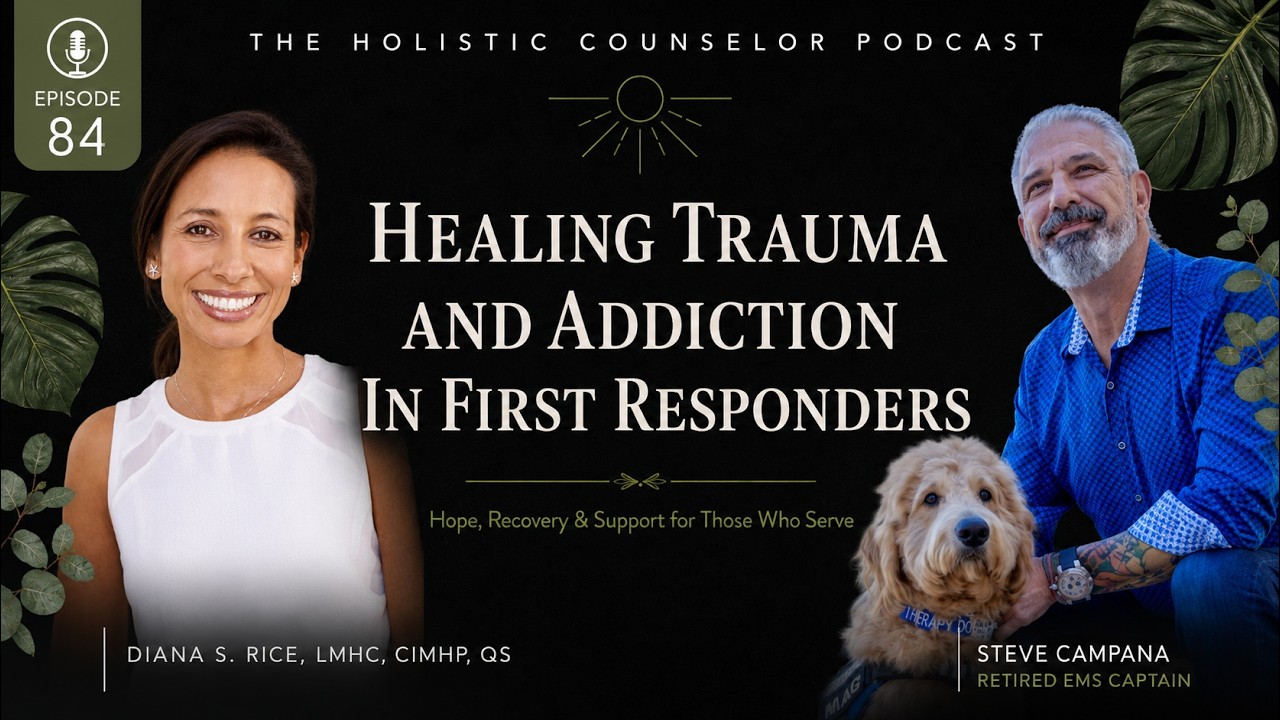
Episode 84
Healing Trauma and Addiction in First Responders
with Steve Campana, Hanley Foundation First Responder Liaison & Retired EMS Captain
Hosted by Diana S. Rice, LMHC, CIMHP, QS
Hello there, fearfully and wonderfully made human. I'm Diana S. Rice, LMHC, CIMHP, CTP, QS, and the host of The Holistic Counselor Podcast—where faith, science, and holistic healing intersect. Today's episode is especially for first responders—and the loved…
Listen to the Episode
Press play when you’re ready.
Educational content only; this podcast is not therapy, diagnosis, or medical care.
About This Conversation
Show notes
Jump to a section
Hello there, fearfully and wonderfully made human. I'm Diana S. Rice, LMHC, CIMHP, CTP, QS, and the host of The Holistic Counselor Podcast—where faith, science, and holistic healing intersect.
Today's episode is especially for first responders—and the loved ones who support them. Whether you serve as police, firefighter, EMS, paramedic, military, nurse, therapist, or teacher—you know the toll trauma takes. Even those of us who aren't running into burning buildings feel the weight of vicarious trauma in our daily callings to serve.
That's why I'm honored to welcome Steve Campana, Hanley Foundation's First Responder Liaison and retired EMS Captain from Palm Beach County Fire Rescue. Alongside his therapy dog, Mac, Steve now helps first responders and veterans struggling with addiction, PTSD, and substance use disorders find healing and hope.
What You'll Learn in This Episode
- Steve's journey: From a 12-year-old police cadet to serving 30+ years in Palm Beach County Fire Rescue.
- The hidden toll of trauma: Pediatric codes, car wrecks, shootings, and vicarious trauma that first responders carry.
- Addiction in the firehouse culture: Why "suck it up, buttercup" led to self-medicating and how recovery changed Steve's life.
- The Big Book of AA: Why recovery is a spiritual program rooted in humility, not just abstinence.
- Hanley Center's approach: Trauma-informed, 12-step immersive care that includes CBT, DBT, EMDR, and somatic therapy.
- The Patriots Initiative: Specialized peer groups for first responders, veterans, and ER professionals.
- Therapy dogs in recovery: How Mac the therapy dog provides comfort, connection, and hope on campus and in children's hospitals.
- Tools for leaders: How firehouses, EMS teams, and police departments can create cultures where "I'm not okay" is safe to say.
Resources & Links Mentioned
- Hanley Foundation & Hanley Center
-
Website: Hanley Foundation
- Programs: Hanley Center Treatment Services
- Alumni Services & Patriots Initiative information available through Hanley
-
- Recovery & Trauma Resources
-
Alcoholics Anonymous Big Book: Read Online
- EMDR Therapy: EMDR International Association
- DBT (Dialectical Behavior Therapy): Learn More Here
- CBT (Cognitive Behavioral Therapy): Patient Pamphlets
-
- Therapy Dogs & Certification
- Emergency Support & Peer Groups
-
Alcoholics Anonymous – Find a Meeting
- Al-Anon Family Groups
- National Alliance on Mental Illness (NAMI)
-
- Contact Steve Campana (Hanley Center First Responder Liaison)
-
Phone: 561-841-1171
-
About Today's Guest: Steve Campana
Steve is a retired EMS Captain with Palm Beach County Fire Rescue and now serves as the First Responder Liaison at Hanley Foundation. With over 30 years of frontline experience, he understands the culture, struggles, and resilience of first responders. Having overcome his own battles with addiction, Steve now walks alongside first responders and veterans in recovery—offering practical resources, peer support, and hope. Together with his therapy dog, Mac, he brings comfort to those carrying invisible wounds.
About Your Host: Diana S. Rice
I'm a Licensed Mental Health Counselor (LMHC), Certified Integrative Mental Health Professional (CIMHP), and Qualified Supervisor (QS). Through The Holistic Counselor Podcast, I explore the intersection of faith, science, and holistic healing. My mission is to break the stigma around mental health—especially in faith communities and BIPOC cultures—and empower people to heal with evidence-based tools and Christ-centered hope.
- Website: Through the Valley Therapy
- YouTube: The Holistic Counselor Podcast Playlist
- Email: diana@throughthevalleytherapy.com
Support This Work Each episode takes 3–5 hours to prepare, research, record, and produce with care, intentionality, and trauma-informed planning. If this podcast has encouraged you, supported your growth, or offered meaningful insight, one way to help keep it independent and ad-free is by visiting the merch store. Your purchase helps sustain thoughtful, holistic conversations on mental, emotional, relational, and spiritual well-being for listeners around the world.
Explore the collection: https://theholisticcounselorpodcast.printful.me/
If this episode helped you, please take a moment to leave a review or share it with someone who might benefit. Reviews are one of the most impactful ways to help others discover the show.
Episode transcript
Read the full transcript Close transcript
Automatically generated from YouTube captions. Names and wording may contain errors; listen to the episode for the original conversation.
Hello there, fearfully and wonderfully made human. I'm Diana S. Rice, licensed mental health counselor and the host of the Holistic Counselor Podcast, where I hope faith, science, and holistic healing intersect. If you are a first responder or you love one, this episode is for you.
Whether you serve as police, firefighter, EMS, paramedic, military, a nurse, a therapist, teacher, you know the toll that trauma can take. Even when we're not the ones running into burning buildings or emergency scenes, many of us feel the weight of vicarious trauma just from showing up day after day in our callings to serve.
That's why I'm honored to welcome today's guest, Steve Campana, Hanley Foundation's first responder liaison and retired EM captain from Palm Beach County. I first met Steve this past May at the 10th annual South Florida Behavioral Health Conference alongside his wife Annette and their amazing therapy dog Mac, who by the way, I completely stole my heart.
After decades of being called to scenes of calamity, destruction, and chaos, Steve has seen firsthand the impact of trauma on first responders and their families. Today, through his work at the Hanley Center, he focuses on supporting first responders struggling with addiction and substance use disorders, bringing both professional expertise and lived experience to the work.
And with his certified therapy dog, Mac, by his side, he offers a unique kind of comfort and connection that only a four-legged partner can bring. So whether you're a first responder, a loved one, or someone in a helping profession who knows the weight of secondary trauma, I encourage you to lean into this conversation.
You'll walk away reminded that healing is possible, you're not alone, and hope is real. Steve, thank you for being on the show.
Oh, thank you very much for having us. All right. So, for the listeners who may not know you yet, can you share your journey from firefighter and paramedic to becoming Hanley Cent's first responder liaison?
Okay. Uh I hope you have a minute here. Um so I was blessed uh to know my calling as a young man. Um when my family moved to Florida in 1980, I was 12 years old. Um, and my parents were looking for something to get me involved with to keep me engaged and keep me out of trouble.
And they got me involved with a police cadet program um, in the village of North Palm Beach, which is where I grew up. And, um, I was exposed to police, fire, and EMS all there cuz they're a public safety department. So, um, I had a great mentor by the name of Jack Wattress, um, who kind of took me by the hand and showed me all three facets of public safety.
And I truly did fall in love with the MS. Uh, I did enjoy firefighting. I did enjoy some aspects of law enforcement. Um, so right after high school, um, I went to a college preparatory school in West Palm Beach and, uh, I chose to go straight to vocational school.
Um, and right out of high school where a lot of my, uh, schoolmates were getting accepted to IV league schools, I jumped right into um, EMT school. Uh from there I jumped right into paramedic school and um I was uh then hired by Palm Beach County Fire Rescue and started this amazing journey in the fire service.
Uh I went to fire school um and had the opportunity to serve in some of the lower socioeconomical areas of Palm Beach County. Uh because that's where the actions at, right? That's where every that's where everybody wants to be when they're, you know, when they're young and in the service.
They want to cut their teeth in these really exciting places. And um I uh I thoroughly enjoyed it. Um I got on the SWAT team at a young age and uh was put through police academy as well as um onto the helicopter. So within 5 years of being on the job, I was a SWAT medic with the department.
I had a competition team that I was competing in advanced life support uh competitions around the country. Um I was on the helicopter on Traumahawk. I was really enjoying my youth in the career. Um, and it was taking its toll and you know I remember calls that were taking a toll on my mind, body and soul from a very young age.
Um,
can I ask can I ask you about that?
Yeah. Mhm. Um, I think that the the one that set the impression the most on me was um my first because I mentioned first of three double pediatric cardiac arrest calls.
Oh my. um where you know a brother and sister were in cardiac arrest. Um you know those calls aren't easy. They're just not easy.
Um and I've had three of those throughout my career. So um I've always been a blackcloud. I've always had those types of calls follow me. You know, I've been on triple shootings where I was the only the only paramedic. I've had, you know, uh a call that always will sit in a a certain place in my heart and in my mind was um an 80-year-old couple that were in a car crash together.
And I the last thing that their last act of love was holding hands in the trauma room before they both expired after we got them to the hospital. Um but at least I gave them that opportunity to hold hands in the trauma room before they passed, you know.
So you look at it, you know, things like that. Um, so yeah, so I had a really illustrious career and I b I battled drugs and alcohol my entire career. Um, c
can I ask you about the because drug and alcohol use, right? People like some people that don't have that situation kind of I hate to say demonize it, but I understand why people do it. I would I'm just going to be honest with you back in the day it's like you medicate, right?
you turn to it because of everything you we're holding space for things that most humans should not have to hold. But this is life. This is reality. So, and there's a lot of functioning um addiction in the in these services. I'm telling you, even teachers, like I I I'm a therapist, so I have to work through that with some people.
So, tell me like when you're now that you're looking back, because that's what I'm hearing, right? you're looking back and you you you remember these these times or uh certain um places you had to go to as this first responder. What is it that you think that you might have needed at that time after it happened to maybe help you through it better?
Because I think that's what I hear that's missing. When I used to work in an alternative high school, some of the police officers um would come into my office to discuss one of the students, but honestly, they were there decompressing because of stuff that's happened.
And I say, "Why don't you get mental help?" And over and over, I would hear the different police officers saying, "I don't want to be in death duty. I don't want to be I I don't want to be seen as crazy." you know, and honestly hearing that over and over, I'm like, "Oh my goodness, how so what do you think is needed?"
So, law enforcement's a completely different animal from uh fire and EMS. So, for me, growing up in the 1990s in the service,
there wasn't a lot of talk about mental health and there wasn't a lot of talk about
um decompressing after a call. You know, you ran a really bad call. It was suck it up, buttercup. you got another dozen to run before your shift is over. So, just stuff it deep, stuff it hard, and you'll get through it. And that's really the mentality that I had um at the time of where I was.
Um now, I will say that it's gotten so much better in 2025. I still think we're only touching the tip of the iceberg with it,
but at least there the needle is moving in that direction. that at least they're recognizing that hey um sleep issues that's a big thing right now with the fire service. Uh reducing the work week. Um because you know most fire departments would work a 2448 schedule. 24 on 48 off. 2472s are now the trend because it enhances and it definitely gives you a better sleep cycle.
Um but also just talking about calls. you know, if I were to sit at a a a table in a firehouse um 35 years ago and say, "Hey, I really had a problem with that call we just ran," you know, people would look at me and they're now going to wonder, "Hey, man, is this guy going to be 110% on the next call?"
Or, you know, if if I we're in a situation where this guy's got got to have my back, is he going to have my back?
Wow.
So, you just really just didn't talk much about it. You didn't. Right.
Um so you know drinking was part of the culture but also um I drank to excess from the beginning. Um it it wasn't like um I I I've been drinking to excess from long before I got into the fire service.
I just didn't have a label for it. And I was able to put it down and walk away for a period of time until I couldn't until I started to to rely on it. And when it didn't work, I reached out to other substances and they all worked until they didn't,
right?
Um, and then there's the
and then there's the physical addiction. You know, once once you cross that threshold, once you pass that line, as it says in in in the book, um, once you cross that line, there is no going back. Um,
can I ask you what what book you're talking about when you said
the big book? The big book.
It's a big blue book that we use in recovery.
Okay. Will you explain that to me? I'm not in the recovery as a therap. I mean, you know what I mean? I'm not a therapist. I don't even know how to explain it. Like, I'm not in that world, you know, at all. I I'm not I was always alternative high schools at adolescence and now I'm private practice with many young women and men that come to me and faith-based.
Okay. So, like that's why I love to learn and I want to know the big book of recovery. I'm like, what are you talking about? So, please
Well, it's technically called the big book of Alcoholics Anonymous. Okay.
Uh, second most printed book in the world. Um, most people know what the first most printed book is,
the Bible, right?
Very much so. Uh,
okay. So, to make sure
Yeah. And then, you know, before they actually had a big book of Alcoholics Anonymous, they used a lot of religious books.
Okay.
Um, but that's a whole another topic to go down a whole another rabbit hole.
But with that said, um,
yeah,
you know, on and off, I battled I battled with drugs and alcohol. I've worked a program of recovery. I had 10 years of sobriety and then I didn't.
Um and I just last week celebrated 8 years of sobriety.
Congratulations. I know that's a big deal. Every every day that you can go without it is a big deal. I know that from from you know those that are in aa
Yeah. work you know this morning's the best lesson in my life. You know I woke up this morning sober and that's really all I have I have today. You know, I woke up this morning and I know if I do the same things today that I did yesterday, I got a pretty good chance.
Also happens to be my wife's birthday today. Um, so, you know, and we got married, we got married on my sobriety date.
So, my wife and I have been married for four years.
Um, and we got married on my sobriety date, uh, which was, uh, last week.
Uh, so, you know, I call these things the blessings and the, uh, the spoils of sobriety. So there's a line, you know, there's a point in the big book that tells us that once we cross that line and we become alcoholic, there is no going back.
And to quote um an amazing person in the program, um Miss Joan, you know, once a cucumber becomes a pickle, it can never be a cucumber again.
So as much as we think in our minds that it's going to be different this time, it never is. In fact, it just gets worse. And I had mentioned a moment ago, uh, when I was in my 30s, I got sober the first time
and had 10 years of sobriety, but I worked a very arrogant program of recovery.
Um, so
what do you mean by that?
Um, I wasn't humbled. Um, you know, the pro a program of recovery is a is really a spiritual program and a lot of people don't understand that. Um, in fact, the the book doesn't really even talk about not drinking much. He talks about total abstinence is the only solution to our problem.
But also um is a solution to the problem. But what we truly need in order to stay sober is a spiritual experience. We have these little spiritual awakenings along along the line. Um the program of recovery is about a relationship between you and your higher power.
And that's whatever you choose to call your higher power,
right?
Um it's a it's truly a spiritual program. I wasn't working much spirituality in my first round of sobriety. I was working arrogance. Um, you know, hey, how many how many sponses do you have? Oh, you got five. I'm carrying 10 right now. You're going to drink.
How did you do the steps? Oh, if you didn't do them this way, yeah, you're going to drink.
That was my program.
Um, and then, you know, God served me that that piece of humble pie that I needed. Um, and I ended up on the the doorsteps of Hanley in uh 2017. Um, you know, I had a great career in the in at Palm Beach County Fire Rescue.
Um, I was tolerated. My arrogance was tolerated because I think my skill level was high. Um, I was always bettering myself um to bring information back to the department, but not so much to like be like, "Hey, look, this is the stuff we can do."
It was more like look at what I've learned and let me teach you kind of attitude,
right?
Um and I uh I was served that slice of humble pie and it's really what I had needed. Um and I ended up on the doorstep of Hanley on um August August 14th of 2017.
Wow.
And I never left. I really never left. Um I
So it was different then like because to me like you you know I I've I've heard of this before with with some people that will go and they're sober. I I want to help uh the audience if they're going through this or even if they love someone that's going through this or even those that don't understand it completely.
There must have now looking back there must have be like red flags that that now like you're you see what happened before it you got there. Do you know what I mean? Can can you explain maybe a few of those things that you notice now?
So then we can maybe help someone that's listening that's like, "Hey, if you're doing A, B, and C or whatever, I don't even know what's going to come up, you know, after asking that question." But I would love to know because that's how we help each other is to to right to recognize these things and say, "Oh, I I heard I heard this or this is what I'm going through, but I got this."
Because that's what I'm hearing. We choose either to live in pride, right? Ego or humility or spirit. Those are the two choices every day you wake up to do.
And so what I heard is the first 10 years it was
pride, you know, pride disguises service.
Very much so. Very much so.
And now it's different. So yeah, tell me some of the red flags that you might have like now recognized so we can help some people listening. So, first and foremost, I suffer from a disease that's centered in my mind. And um if my mind is broken, which I truly believe it was, I can't solve my own problems with my own mind that's broken.
So, I have to reach out to a power greater than myself
to relieve me of this mental obsession from alcohol. No one person can call I believe that no one person can call another person an alcoholic. that person has to come to that realization themselves.
Wow.
But what I can tell you is um if you are suffering from a physical addiction to a substance to where you're getting the shakes if you don't drink um if all you're thinking about is how you can get away from this family event, birthday party, XYZ, whatever it is, just so that you can go spend time alone to drink or use drugs.
Oh, there's probably a really good chance that that you have an issue with alcoholism or addiction. Um, but no one person can call themselves that. Um, I'm sorry. No one person can call somebody else that. That person has to come to that to that conclusion, to that realization.
Um, they have to concede to their innermost self that they are alcoholic or an addict. Um, conversely, having some information in the program and being sober for 10 years when I was back in into the throws of addiction, which by the way, um, for those of us that have stopped, um, and are thinking about going out and testing the waters again, um, there's three words that get you every time.
I got this, right? Because it's going to be different this time. It's definitely going to be different this time. I'm just going to have two beers and it's going to be okay. And for me, the natural progression is two beers, two shots, and an eightball of Coke and I'm off to the races.
Um, and I'll I remember shortly after doing drugs again after being sober for 10 years, there was a short short period of just drinking. And when I got back into drugs, I remember um waking up in the morning and conceding to my innermost self that I was just going to die an addict.
Um, I was I had about uh I had four years to retirement, excuse me. And if I made it to retirement, I was just going to be dead shortly after. So, I just made sure all my affairs were in order.
Um that, you know, my kids were my benefactors on on all of my accounts and um and it was just going to be this way. This is the way it was going to be. But I'm so thankful that God had a completely different plan for me, you know.
Yeah.
Um, and he let me walk through that for a reason, you know. And I firmly believe that that reason is to just be able to relate to another sick and suffering alcoholic. Maybe that has sobriety and went back out for a little while.
Um, just to be able to relate to that person. you know, I um our my spirituality, I think, has has increased 10,000 times in this round of sobriety. Uh cuz I truly feel like I've walked through the gates of hell. I mean, I know what that that life is like.
Um I know what it's like not being able to look at yourself in the mirror. Uh just, you know, eye to eye. not like the physical body of what you look like after a night of drinking and partying, but just not even be able to make eye contact with yourself in the mirror because you feel like the shell of a person that you really are.
What I'm hearing is it's and what I've also seen and others um is it's shame and guilt. You get a lot of shame and guilt and you don't know what to do with it and you don't want to hurt the human that you love, right?
Because this is what I I work with people that like like the spouse per se or back in the day with the with the children, you know, Alanon and like the children that go to that, you know, Steve, like I think if we I want to understand your experience when you first finally went to Hanley because I did read a couple of the articles that's in the newspaper to get some more information about you and how to, you know,
and um that that story like I think needs needs to be told because that is what I've seen I in um many men because we are we live in a society that manhood or the way a first responder should be or it's like you know suck it up buttercup like you just said and we're trying not to be you know uh wusses like
like I get it
I have I have a husband I have two sons I get it I I understand I'm around men and I have men as clients and that's what I hear as well is like how do we balance this without going to a place where you're seen as like some wimp
right?
Yeah. So the one thing I can say about the Hanley Foundation and the Hanley Center is u Mrs. Hanley opened that place um 40 years ago um so that people could have a place to heal with dignity and love and those pillars still and respect and those pillars still stand about Hanley today.
Okay. So, what happened with me when I got there? First of all, I was tricked into going um I was told. So, at the at the end point of my drinking and drug use, um the last place that I thought I was safe was the firehouse.
I wasn't safe anymore. Nobody knew what to do with me.
Um so, finally, you know, my chiefs came to me one morning and they were like, "Hey, man. We really think you're using drugs and alcohol. Um we want to we want to piss test you." And um sure enough, I I fessed up. It was like a weight came off my shoulders.
It was like, "Yep, I'm going to test positive." Um I didn't use this morning or today, but I I was using some drugs yesterday and I'm going to test positive. And um there was a gentleman that worked for the union that helped people in addiction services, and he got me placed to Hanley, and he told me, "Oh, you're just going to go there for intensive outpatient couple days a week.
Everything's going to be okay." And um you know, I did what every good alcoholic and addict did. I left work um because I was off the truck at that point. I left work. I went and got a bottle. I went and got some drugs.
And I did my pre-admission assessment um high.
And when I got there for what I thought was intensive outpatient, they were like, "No, you need to come in for 28 days. You need inpatient treatment." Um, yeah, there was a lot of resistance. There was a lot of cursing. Um, which made for great amends, by the way.
Um, and uh, I was sitting there in an office realizing I really didn't have much of a choice because the guy that got me there told me, "Hey man, if that's what they're telling you, then if you want a job, excuse me, then that's what I recommend you do."
So coming close to retirement and knowing that, you know, I have kids and people to support, I really I just stayed. Um, and 24 hours into that stay in detox, I had a PTSD flashback that lasted a few hours.
Wow.
Um, I was rolling around in bed screaming, apparently. Um, that was the first time I ever experienced sleep paralysis where I was in a dream and I couldn't wake up.
Yeah. And um the way I describe it is it was like a Quinton Tarantino black and white movie with splashes of blood and like going back to the 1980s and 70s when you were in school and the real is breaking and it was it was just crazy.
And the detox counselor heard me screaming and got me into the um the uh psychiatrist's office and um he started asking me questions. Excuse me. He started asking me some questions and I guess in the um clinician world you have this like two column quick diagnosis for PTSD and um he's like Steve has anybody ever told you you know you suffer from PTSD.
And I'm like no man I know I'm an alcoholic. I know what I got to do to get back back on back into the program. He's like yeah yeah. He goes and I believe that. I believe that you know what you need to do.
Um because the Hanley Center is a 12step immersive program. He's like, I know I know you know what you need to do there. He goes, but has anybody ever diagnosed you with PTSD? Because I could have stopped asking you questions halfway down that first column.
Wow.
And I'm like, no. And he's like, well, he goes, Steve, we're going to do some more testing, but you've got PTSD. So now I'm sitting in a chair. I'm still like sweating. My clothes are wet. Um, you know, I I'd come off a bender to come into treatment.
It's not even 48 hours later. I don't even know if I had showered in that time. And here I am sitting in this guy's office in a chair. And I know I'm an alcoholic in an addict. I know how to fix that. But now he's telling me I'm broke.
Like my brain is broken.
Like I don't know how to fix that. And at that time, PTSD, you know, that was a touchy subject at the fire department. You know, people didn't want to work with somebody who's got shell shock, you know, or they just I don't think they had the faith in people, you know, that were were diagnosed with that.
But, um, it was a blessing to be diagnosed with it. Um, because as a result of that, at the time, the Hanley Center didn't do trauma therapy in 30 days. They start trauma therapy immediately at the Hanley Center. Now,
um,
and can I ask you, Steve, about trauma therapy at the Hanley Center? What do you mean by that? Who's doing the therapy? Are these like licensed professionals? Are these psychiatrists, psychologists? Do you know the modalities? I want to know more about like what do you mean?
Because that is such a broad spectrum, right? So, tell me about it.
I'm going to start speaking some of your language and you can explain what it is.
I'll try. I'll try.
So now uh at Hanley, yes, we do have licens licensed clinicians. We have LCSSWS and LMHC's that are seeing patients. We also have interns that are all seeing patients um that are all, you know, going towards their lensure. We do have a medical doctor.
We do contract with a psychiatrist. We have a psychologist. We have um a full medical staff. So to explain a little bit about Hanley, Hanley treats the alcoholic and the addict from the beginning to the end. And what that means is we have our own admission staff.
Those are the people that are talking to the patients. They're not some third-party company out in Colorado taking your phone call. They're on Hanley property and they only work for Hanley.
Our detox center is ours. 14 beds, five nurses by day, three nurses at night, around the clock care. Uh we have um our providers that are anywhere from um ANRPs, nurse practitioners to uh PAS as well as our chief uh chief medical officer Dr.
Angelo Sha who is a medical doctor. So we have the full array of treatment up to detox. Then we have residential treatment which is in-house treatment.
Okay.
Um and that'll last from 45 days till whenever. Uh we've had patients stay with us for extended periods of time in residential. We also have partial hospitalization. Um we have two houses offsite. Um people will stay there from 30 to 90 days. Um and then they'll step down to IOP5 intensive outpatient 5 intensive outpatient 3 and outpatient services.
So we service the the sick individual from beginning till end in treatment and then our alumni services kicks in for a year. And that sets us apart from any other treatment center is that not only are we 12step immersive,
but our alumni services will follow you for 12 months,
calling you at benchmarks, making sure you're okay. our continuing care coordinators will reach out to you making sure you're following through with your continuing care treatment plan. Um, we have a very extensive treatment plan for our patients at Hanley and it's all compromised.
I'm sorry. It's all put together for the individual patient. It's not like, okay, Steve the firefighter comes in, he gets firefighter plan A.
There is no such thing. Um, but when somebody comes in that's suffering from trauma, whether it's PTSD as a result of like an occupational stress injury, which I like that new term that they're starting to use, um, from like the fire service or a veteran or a police officer, they're going to do CBT, they're going to do DBT, EMDR, um, you know, they're going to they're going to utilize all the latest and greatest forms of treatment for these patients to help them recover.
Um, I got to tell you, one of the one of the best uh therapy sessions I ever did was um Oh, you'll tell me what the name of it is, but um we were sitting in a group setting and they brought out some scarfves, different color scarfves.
Okay.
And we were going to associate scarfs with a feeling and a mood. Um,
so it's sematic therapy
maybe. I guess. Were you moving around? Were you moving around? Oh, yeah.
We were. So, there were five guys in this group session and the the therapist happened to be gay and he was telling us about this therapy and we were all looking at each other going, you know, I love the guy. He's a great guy and he's a great therapist, but there is no way that I am going to be doing this.
And by the end of that therapy session, it was like, dude, did you see how you rocked that green? Oh my god. You know, so there has to be a certain amount of open-mindedness going into this as well for the individual.
Well, Steve, like what you just explained is an understanding of how your brain is wired, right? Because right from the beginning, you were trained at a young age by a village. All of us, me too, we're all have a village that raised us, no matter where it is from.
And so we get whatever fires together, wires together.
So this guy, this is what I'm hearing is this guy comes in with this new thing that you you men were was it all men have never exper but you're right you decided to rewire your brain at that part and surrender because that's the key that's the spirit is surrendering to your higher power or to whatever and saying okay why because that's it you have to question like why do I believe the way I believe why am I stuck thinking this way why am I Like, I love that.
I want to know who that is. I want to bring whoever that was on my show to talk about the scarves and stuff like that.
I'll be happy to introduce you to Carlos one day.
All right, but anyway, back to I love to hear that that that you were that comfortable within your own skin because usually what happens with addiction, the person doesn't feel comfortable who with who they are or they have so much subconscious pain. I just learned this word emotional concussions by Dr.
Don Wood instead of saying trauma, right? It's like emotional concussions at that time of your life and now it's there in the subconscious. And guess what? You had to keep working. You had to keep husbanding and fathering and doing things in society that was expected of you.
This is what you signed up for at a young age, right? And then all of a sudden it you probably felt like you had this secret life and you're like uh Dr. Jackekal and Mr. Hyde.
Oh yeah. Absolutely. Absolutely. And now it's all out in the open and
Oh yeah.
And there's a level of expectation that you feel that you you know you should have as a public servant and then as a battalion officer in the fire department and guys are guys and girls are looking up to you. Um you know there's there's a lot of that guilt.
There's a lot of that shame. Um there's a lot But you know, you mentioned a couple things about surrendering. Absolutely. That you know, we have to surrender. Um everybody hits a bottom at a different a different level, right?
Um I'm I consider myself a yet in the program that I have no legal ramifications yet. I I I did lose a marriage and and I lost the faith in my kids for a long time. Uh but as far as like these huge ramifications, you hear people, you know, you know, they've been in jail, they've been incarcerated, uh they may have committed a crime that was, you know, heinous as a result of their drinking and alcohol uh usage.
I I never had that.
So for me, it was a lot of just guilt and shame that I carried for living this double life. um you know living a life of being this you know public servant and citizen in the community but at the end of the night here I am in the closet um you know with my plate of cocaine and my bottle of my bottle of alcohol and I'm all by myself you know um so in going to Hanley Hanley just gave me that place um to learn who my authentic self was.
Wow.
Um they really allowed me to not only get back into a pro a 12step program of recovery very quickly. Um like not too soon after that meeting with you know the doc I was back into a program or recovery. Um it also let me learn about myself and who I am and through the trauma therapy that I got once I once I left there.
I connected with a trauma therapist who um you know started on EMDR with me. Um I learned about those things in my past that you know here I am going to a trauma therapist thinking that I'm going to be dealing with hair, teeth, and eyeballs in the street and dead babies.
And I'm talking about when I crapped my pants at home plate when I was 8 years old wearing white baseball pants.
Yeah.
Right. Yeah, you know, I know.
And it's like, you got to be kidding me.
Um, so I I firmly believe that the the few months of EMDR that I did consistently every week
really had a profound um positive experience and helping my brain rewire.
Yeah, I agree, Steve. I I had to do EMDR, too, because I I'm not a first responder, but I had um complex PTSD. It's called
childhood trauma.
And so we carry these things, right? All of us. We all have something. And it's not about comparing who had it worse or who had it better or because I have to deal with that too as a therapist when I have someone come in, they're like, well, I don't want to complain about like my life is really good compared.
And at that time, I'm like, no, this is your time. So it sounds like you had a safe space to actually be you without having you to compare or protect everybody else because those in service in service you know um first responders or like I mentioned earlier like nurses teacher especially teachers now because it feels like teachers now have a lot of trauma as well because of what's happening in our system and therapists
you know we we hear this vicarious we pick it up we pick it up and then we carry And we don't realize because we have to keep going.
So I I want to know too now like
you EMDR the scarves the scarf guy.
Yeah.
All right. What else helped you to understand your authentic self? Because to me when you're so busy trying to do things on the outside, you don't get to to sit still and be with your authentic self a lot.
Yes.
And then when the authentic self might come in, all these assumptions come in. And that's where I think the guilt and the shame and then when you're like, I don't want to feel this stuff. It's better to to, you know, snort a line of coke or drink that alcohol because guess what?
That stuff is fun. I'm not going to lie. I get it. I used to do all that stuff, too, Steve.
I was a big pthead. Well, I'll just tell you that marijuana was my thing because I was highly anxious
and so that calmed me down. But I realized like you're right, it's the surrendering and understanding. So, what else has helped you? And what have you been doing now? Because now that you're on the other side, you're a liaison. I need I need my audience to understand what that means.
How did you go from
to picking up these tools that that helped you heal now? you're kind of like going, "Hey guys, it's okay to do these things or feel these feels with with these
responders who,
you know, they they're like, "Oh, come on, Dave. Stop being a wuss."
Yeah. So, I think um you know, one of the um the beautiful things about the program of recovery is um doing an inventory of your life,
right? And it's in the fourth step. And within that fourth step, you you and your sponsor get to identify when you're reading your fifth step, you get to identify your character defects. Um, and it's those flaws in our makeup that once they come to the surface and they've been brought out, um, you know, how to work with them.
So, I write a forep. I read it to my sponsor in the fifth. He helps me identify character defects. Um, I list them. I I say a prayer to God in step seven to take them. That doesn't mean that they're gone.
No,
it just means that I'm aware of them now because I am human,
right? And I know when I exercise my character defects, boy, do I I think all of us kind of like to exercise them every now and again, but it doesn't feel good after a while. It really doesn't um because I've identified them now.
So, I have these tools. And the point I'm getting at is going to Hanley and getting back into the 12 steps of Alcoholics Anonymous allowed me to identify the things that weren't making me happy in life. And it also helped me identify the person that I truly am.
And I'm I found out that I'm actually a pretty good person. I'm kind, loving, caring. Um I struggle with ego and humility and I know that and I work on that every day of my life. if I pray for it. Um, and then getting out of Hanley and joining a PTSD group really helped me tremendously.
And I didn't join, I was kind of told to go um by the leader of the group. Um, and that really being amongst our own that really helps dramatically. So when I was a patient at Hanley in a regular group setting, I had trouble.
I didn't want to share a lot about what the things at work that were bothering me because they don't get it and they shouldn't have to number one and they shouldn't have to take that bite of the apple, right? I chose that profession.
I signed up for it. They haven't. So why should I talk about those grotesque things in front of people when it may start it may affect them because they're in their early journey with their recovery.
Yeah. So with the Patriots initiative and when we have a group of first responders and veterans, we can put them in the group setting together and now it's like everything's off the table. Whatever you guys want to talk about, you talk about because I know what you're going through, brother.
And I know that if I'm sharing on something, he knows what I'm going through. Um, even though veterans and first responders, it's a completely different level of service, there's still that same parallel understanding about the service and about the things that we've done and we have to do.
Yeah. I want to ask questions about the Patriots initiative. That's what you call. Okay. Because I want to make sure I understand. So the Patriots initiative is for first all first responders or do they now sub subgroup him like all police officers here, all firefighters here, all you know what I mean?
And is it male and female too? Like how do you work this patriots initiative?
So on on Hanley's campus, we we're like a little um college campus. Um and I I'm going to extend an invitation to you to come tour anytime you like. Okay?
But we have different units, right? We have a men's unit, a women's unit, an older adults unit. Um, and those units can house up to 20 patients in each unit. if we have a first responder or a veteran and at times we've grouped uh we've put um ER nurses in there um ER physicians um we will pull them for their own group and it is a co-ed group and it goes across all different levels all the different programs within Hanley
um I think Hanley has seven programs we do um center for men's recovery women's recovery older adults we We have the headquarters program, we have a mental health program, we have Kasa Flores, which is a perinatal unit, and I'm sure I'm missing something in there.
Um, but anyone in any of those programs will come to a group session for the Patriots. Also, we're going to be making sure that we identify that those people um see me on a regular basis. Like, I get notified that they're coming in.
I make a point of of making sure that I connect with those people. um along with Mac, right? But Mac connects with everybody on campus because he's just he is the big man on campus. Um he's Hanley's favorite employee. Um and he doesn't discriminate whether you're a first responder or not.
He leaves
Is Mac is Mac there.
Oh, absolutely.
Can is there any way you could So for those that are listening, um Oh, no. It's blurry. He's blurry. Oh, there he goes. Hi, Mac. Oh, hi Mac. For those that are listening, you could see this on YouTube if you want to see the video of Mac for a second.
Okay. All right. I know. Here I go. See, this is why I had to have questions because if I don't have questions, Steve, my brain will go here and there.
I want to know about more about the Patriots initiative, but I also want to understand Mack and your role in Hanley because wasn't this a role that I mean like I I asked before like you went from being someone that was helped by Hanley and I think what you're doing is still helping you because honestly you're you're you're realizing that
this is the the beauty from the ashes. this is this is the
the calling that was set on your life and you've surrendered to it instead of fighting it. Right? Because this is what happens a lot with addiction. I I believe is that
you know it's it's such a hard place. It's such a hard place because people have so many different viewpoints on addiction from all walks of life. And so for you though, what I've seen and when I met Annette and Mac and you at this, you know, and I and I felt the energy of the three of you together,
it was a beautiful thing.
It was a beautiful day. And then Mac, I'm telling you, I I sat down and I pet Mac and I'm just like, it made me want to cry because I felt him just being this kind, sweet dog. How did you
Is he So he's a Tell me about Mac. just tell me about what he what he does and who what you guys do together.
I'm gonna give you the story from the time I left Hanley till till now and I'll try to make it quick. So, um after I left Hanley after a brief stay and being in their outpatient program, I was very active alumni.
Um, I was on campus two to three days a week working with the guys, just volunteering, just sitting on the patio of the men's unit, working their workbooks with them, hanging out, listening to them, as well as anytime a first responder was there, somebody kind of put it a little, you know, bug in my ear that there might be somebody you want to stop by and see.
So, I was always on campus. COVID hit, that kind of took a little step backwards when COVID hit. Um, and then a year before I retired, um, I met this amazing woman. Um, I had made a deal with God that my life was content.
I didn't need anything. I was going to work on myself for 14 months. I was sober for about a year and a half, two years. Um, and then, you know, man plans and God chuckles and, uh, he put a net into my life.
Um, Annette and I were together for about a year. We married um just after I retired from the fire department. Um I got to complete my 30 years 32 years of service with Palm Beach County Fire Rescue. I retired out. Annette retired with me.
We traveled and she agreed to travel with me as long as that when we were done traveling after about 18 months, she can go to nursing school. So at age 53, Annette went into nursing school. And she graduated this year and passed her ANCLEX in February of this year.
So she is an RN but in that time she was in school I kind of felt a little bored. So um I uh I went to Hanley and I started working there actually. Um I started working on the very unit that I stayed on uh working with the guys and helping them along their journey of recovery.
The Hanley Foundation reacquired the Hanley Center. That's a whole another story.
Okay. Um, and when the foundation came in, they asked me to be their first responder leaison. They really couldn't tell me what the job entailed. Uh, but they knew that they wanted me to help get first responders and veterans to treatment. So, it's been this great journey for the last year and a half
of working with first responder and veteran agencies and letting them all know about the Hanley Center and what we have to offer. because for 40 years we've been treating veterans and first responders.
Wow.
And they've had success.
Yes.
Um so I still do suffer from PTSD. Um one of the the one of the ways that dragon rears its ugly head is through sleep um and insomnia with me. Um so one night it was like 3:00 in the morning and I'm on um I'm on I think my computer or my phone.
I'm going down a rabbit hole about, you know, holistic ways to try to help with insomnia and therapy dogs came up and I went down that rabbit hole for a while and I just sent a oneline email to the CEO early early in the morning um 3:00 or 4 in the morning.
I just sent a email to her saying, "Hey, have you ever thought of a therapy animal like a dog for Hanley or me?" And in her fashion, uh Dr. Rachel Dosicle sent back a three-word answer. I love that. So, I reached out to a good friend of mine uh from Orange County Fire Rescue that works with um Charles Schultz's company, K9 Companions.
Okay.
Um he's got a a not for-profit in Orlando where they they do service dogs. And she was like, "Steve, I can get you on a wash out list, but it could take 6 months to a year to get a dog." But she found an organization called Paws and Stripes.
Um Paws and Stripes pairs um therapy dogs with first responders generally for um the fire department, police stations, active duty, but because Hanley has first responders there, they agreed to partner with me.
Wow.
And um there happens to be a South College, which is right in Palm Beach County. The original one is out of Bvard County Sheriff's Office.
Okay.
Uh South College is out of Palm Beach County Sheriff's Office. Uh the guys there um were made aware that, you know, I had been accepted to the program and that I passed all, you know, the the background stuff that they had needed and it's like a four-page application.
And um they're like, "We don't have any dogs right now, but when we get a dog and we're going to have a class, we'll let you know." And um I got to tell you, every day for two months, my co-workers were asking me when we were getting a dog.
Oh.
And then I got a phone call and they said, "Hey, we think we got a dog for you." And two weeks later, they said, "Why don't you come meet him?" So, um I walk into the training room. They're training with Mac at the time I showed up.
I walk into the training room. I sit on the back wall. He's facing the other direction. They take him off the leash. He turns around, does a 180, and jumps into my lap. There's 10 other people in the room. jumped right into my lap and they were all like, "Dude, that's your dog."
He chose you. He chose you.
Sorry, I'm I'm emotional.
Yeah. Yeah. Well, it was an emotional moment for me. Um, Mac chose me.
They invited me to come train before the class started and I did. And, uh, the weekend before the class started, they asked me if I wanted to take home Mac early.
And when I showed up for class that Monday morning, they were like, "Dude, this is your dog. this is your dog. And it's just been that relationship ever since. Annette says to this day, she's like, "That dog thinks that you carried him in your belly for 9 months
and that you birthed him." Um,
yeah, he's uh
Well, I saw it. I saw it in person when you guys were together and you were sitting there on that chair and your dog, you know, and Mac was there and I looked at him looking at you and I'm like, my goodness, there's there's this love like
I've had dogs all my life. I've never lo loved a dog like this.
And Mac, you know, Mac's a therapy dog. He's he's well trained. He's not like a Belgian Malwa that's like, you know,
perfect in every single way with training,
right? But he does exactly what I need to do him to do when I need him to do it.
And he's got this uncanny way of just making people feel good.
Yeah.
And that's really what a therapy dog is.
Well, that's what I want to just to clarify because there's so many people out there like, you know, here uh they call me up and I don't do the letters, but you know what I mean. Here, write me a letter from my therapy dog.
And I need to get people to understand Mac is an actual uh dog that's been certified. correct certified. So if there is an is it just for
Hanley or are you able to say if there's another something horrible happens like a hurricane, natural disaster or school shooting or something like that, are you able to bring Mac with you to do therapy? You know what I mean?
Yeah. So there's um there's different governing bodies and certification bodies within the therapy dog world. All right. Um I would say that um a pretty a standard across the the country
is AKC, the American Kennel Society, right? They have um they have a therapy dog certification. Once your dog gets the K9 good citizen certification, which is that means that your dog has taken a you and your dog together have taken a 40-hour class,
okay,
at one of their approved 40hour class sites, which they're all over the country.
Um, and once you've passed that class, as well as pass the K9 good citizens test, what is that? a short written test along with um a uh a practical test that's done by outside evaluators. So let's say I'm going through it at Paws and Stripes South College, they can't do my evaluation.
They bring in people from another place to do the evaluation. Once you've passed that and you've made x amount of visits, you can apply for the therapy dog certification.
Um, within the AKC,
okay,
there is the Alliance of Therapy Dogs. Um, there are many different uh certifying bodies. So, we're with the AKC. Um, Matt is AKC advanced therapy dog. That means he's made 100 visits. He's on his way to therapy dog excellent, which is 200 visits. 600 visits is like the top dog in the program.
That'll be a couple of years. But yes, Mac is um Mac can go to different disasters. Uh we're not with the disaster team. I had thought about getting involved with that very early on, but you know what? I'm I'm not interested in doing that.
Mac is on staff at our local children's hospital. So, we do go to our local children's hospital a couple times a month and we make visits
and I got to tell you that brings it's it's
a joy and it's also a tearjerker um to to go to the hospital and but to see the joy that he brings um into these kids and staff, the nurses and doctor's lives
um really just he's a special dog. He really is.
He's just he's just this really cool cat. Nothing really phases him. Um, he know he doesn't have these facial expressions that you see some dogs may have.
Yeah.
But he I don't know. Him and I just communicate. I know exactly what he's thinking when he's thinking it.
I love it. That's the answer. That's to me like it's he's a he's a living like I think if we all were to become in tune, right? Because now you you know your authentic self, Steve. That's the thing. You've gone through, it's hard to say, the fire, right?
And now you come out gold.
Yeah.
Gold. And and it's like you've been purified in a way to a place
to a place where you have this understanding
um that you respect living things more than ever.
And so that energy you have between you and Mac that I saw and I realized and and that's it. Like you kind of know. I knew when I talked to Annette and you and I'm just like, "Would you be on my show?" You know, like
I can tell you I got to I got to talk about my wife, right? Cuz today is her birthday.
Happy birthday.
I will tell her you said you said so. Um
yeah,
I could never have the relationship that I have with Annette today unless I had been through this process. Um, so Annette, not that she doesn't understand addiction or alcoholism, she would never be involved with somebody who was addicted or um has that or had the traits of my old personality.
Yeah. um I don't think she would ever be involved with. Um and because I've gone through this process and because I've evolved and come to be the person that I truly am today, I get to have what I call the spoils of recovery.
And that's the relationship not only with my higher power, because anything I put before that, I'm just going to lose.
That's right.
Um I get to have a relationship with my wife. I get to have this amazing relationship with my dog. Um, I get to go to work and have an amazing relationship with my co-workers as well as uh the patients, which is where I truly enjoy being.
Um, you know, the fire department was my tribe for a long time. They truly were.
Yeah.
Um, but all along, um, alcoholics and addicts, they're my tribe. They're my people. And I I feel no I feel there's nowhere I feel more comfortable than walking into a um a room full of them.
Yeah.
Because I although I haven't walked exactly in their steps, I know what they're going through and I know what they're feeling.
Right. It's it's how I I say it to some of my clients or people that I know is we're on the same road but different scenery.
We're journeying together, right? with different different scenery and
and you have your tribe. It is it's about community and connection. So, I know I could talk to you probably for another hour, Steve, but I really want to leave the audience, especially if it's somebody that might be in leadership or in firehouses or EMS teams, right?
How can they foster a culture of support that pre that prevents prevents these crisises before they happen?
So, that's a really great question. um as far as prevention um outlets on how to handle stress. So I was never taught how to deal with stress. I was never taught how to deal with these adverse things that I had been exposed to in my life.
So give your people the tools that they need um to be able to process. um team building skills. Um things that you do outside of the workplace I think are huge um in bringing people together to have a level of comfortability to be able to say, "Hey, I don't feel good about this that we're doing or I don't feel good about this that happened."
Um, when you have people that are just there just getting a paycheck and trying to trying to go day by day, you're not fostering a family and a relationship. Um, and putting emphasis on their well-being and their mental health.
Um, I definitely think now for me, it's normalizing the conversation within the first responder community. is being able to sit at that firehouse table where by the way all the problems of the world are solved and being able to say I'm not okay and having that culture that it's okay to do that.
It's okay to say I'm not okay because in the past when you say that you get sideeyed. Now I believe the needle is turning to where hey let's go talk. Let me see if I can help and if I can't help maybe I can point you in the right direction as someone that can get you help.
Yeah.
Without being judgmental, without being without saying, uh, I want to get this guy some help and I don't know if he should run the next call. You know what I mean?
Yeah. Yeah. that that should be like what I'm hearing though that should be something before they even graduate.
You see what I'm getting? That should be something like be put in place with like social emotional learning number one or how I do like when I had to deal with and I still have men come to me even though I don't but I have train I've trained and what's worked with my my men I never say therapy.
I'm like, "No, this is psychoeducational training.
This is psychoeducational coaching. Do you want
I tell you, when it comes to firemen and paramedics, we're not the touchest, feelest people in the world when it when it comes to emotions,
right?
Because it's like job go."
Yeah.
Fire do.
And we need you guys like this. We need that kind of personality. I'm I'm not married to a first responder, but my husband has that personality. And I had to come to understand and respect those parts of him because that's what keeps it stable enough where if there is the grid goes down or something like that.
He's the first one who knows how to triage
a situation without
the the emotion and but we also need people with the emotion because we balance each other out. It's learning to respect it to love it and to understand that we all have a place in this world. We all every human being has a place.
Sometimes though they feel like they've been misplaced and and not understood. So Steve, like this is this is wonderful. Like I I am I'm going to come and visit. I promise after we hang up, we're going to make a time for me to come and check out the Hanley Center.
Is there anything else you would like to leave the audience with before we say goodbye?
Wow. Thank you. Um yes. Um, if you're out there and you're listening or you have a loved one that's that's listening, just know that there's hope. There is hope. Um, there is healing. Um, you can be whole again. And if you're broken due to PTSD or to addiction or alcoholism, there's help out there.
There's people that know exactly what you're going through. don't hesitate to reach out to myself, the Hanley Center, or just your local AA clubhouse. Um, you know, it's there's help out there.
Yes,
there's help.
Yeah, Steve, thank you so much. And listen, I will put everything we talked about, if there's a a website or something, into the show notes so you could click on it. And remember to please trust in the Lord, guard your heart, and renew your mind.
Bye. And now for the disclaimer to make sure you understand that you are responsible for you. The content provided on the Holistic Counselor podcast is for entertainmentformational purposes only and is not intended as a substitute for professional medical advice. diagnosis or treatment. Always seek the advice of your physician or other qualified mental health provider with any questions you may have regarding a medical or mental condition.
Never disregard professional medical advice or delay seeking it because of something you have heard on this podcast. The views expressed on this podcast are my personal opinions and do not represent the views of any professional organizations with which I am affiliated. Call your doctor, 911, or 988 immediately if you have a medical emergency.
The Holistic Counselor podcast does not recommend or endorse any specific tests, physicians, products, procedures, opinions, or other information that may be mentioned on the podcast. Reliance on any information provided by the holistic counselor podcast, guests appearing on the podcast at the invitation of the holistic counselor podcast or other listeners to the podcast is solely at your own risk.
Confidentiality notice. If you engage with the holistic counselor podcast by commenting or posting and are a client, please be aware that you may be revealing information that could compromise your confidentiality. Please remember that disclosing your identity or personal details can be linked to your clinical material.
As a therapist, I am bound by confidentiality and will not respond to any disclosures of this type on this podcast. I am committed to upholding the ethics and confidentiality of the therapeutic relationship which extends to all forms of communication in accordance with the laws and professional guidelines that govern mental health professionals.
I want you to know that your privacy is of utmost importance and you are responsible for protecting it when interacting on this platform or any other public forum. Thank you.