
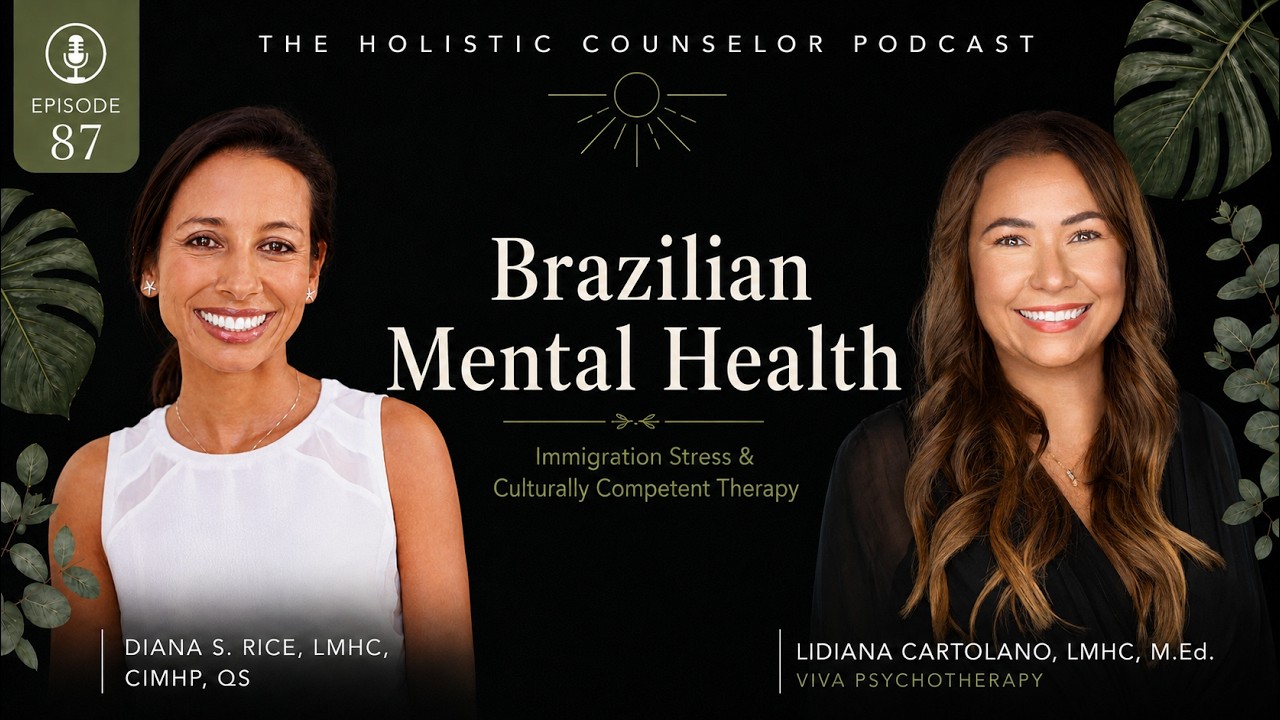
Episode 87
Brazilian Mental Health, Immigration Stress & Culturally Competent Therapy
with Lidiana Cartolano, LMHC (Bilingual Portuguese Therapist in Florida)
Hosted by Diana S. Rice, LMHC, CIMHP, QS
In this episode of The Holistic Counselor Podcast, host Diana S. Rice, LMHC, CIMHP, CTP, QS sits down with Lidiana Cartolano, LMHC, M.Ed.—a bilingual Portuguese/English therapist and founder of VIVA Psychotherapy in Boca Raton, Florida. Together, they discuss…
Listen to the Episode
Press play when you’re ready.
Educational content only; this podcast is not therapy, diagnosis, or medical care.
About This Conversation
Show notes
Jump to a section
In this episode of The Holistic Counselor Podcast, host Diana S. Rice, LMHC, CIMHP, CTP, QS sits down with Lidiana Cartolano, LMHC, M.Ed.—a bilingual Portuguese/English therapist and founder of VIVA Psychotherapy in Boca Raton, Florida.
Together, they discuss the unique mental health challenges faced by Brazilians and Portuguese-speaking immigrants, including immigration stress, family role pressures, cultural stigma, OCD, and faith-based misunderstandings. Lidiana also shares practical tools such as TF-CBT, play therapy, sandtray, and mindfulness-based stress reduction (MBSR).
This conversation also highlights the Brazilian Mental Health Professionals Collective (BMHP)—the first organized network of its kind in the U.S., designed to increase access to culturally sensitive mental health providers who serve the Brazilian community.
As the year comes to a close, this episode invites you to reflect on the importance of community, culture, and connection in your own mental health journey.
Featured Quotes
"If God gives us doctors to heal our bodies, He also gives us therapists to heal our minds." — Lidiana Cartolano, LMHC
"A regulated parent can help regulate a child—but when the parent is dysregulated, that's often an unhealed part of themselves showing up." — Diana S. Rice, LMHC
Resources & Links Mentioned
- Brazilian Mental Health Professionals Collective (BMHP): www.bmhp.org
- VIVA Psychotherapy (Lidiana's practice): www.vivapsychotherapy.com
- Conexão Presente (Portuguese MBSR / Mindfulness playlist): YouTube Playlist
- The Holistic Counselor Podcast (Diana's podcast website): www.throughthevalleytherapy.com
- Book Mentioned: When Narcissism Comes to Church by Chuck DeGroat
Episode Chapters
- 0:00 — Intro, year-end reflection, review/share CTA
- 2:30 — Lidiana's journey: Psychologist in Brazil → LMHC in the U.S.
- 10:00 — Immigration stress: breadwinner pressure, family role shifts, burnout
- 13:30 — Second-generation struggles: bullying, perfectionism, OCD
- 21:30 — Family systems in therapy: play therapy & sandtray
- 31:00 — Cultural fit: language, spirituality, warmth in the therapy room
- 36:00 — Tools & modalities: TF-CBT, MBSR, play therapy, sandtray
- 54:00 — Brazilian Mental Health Professionals Collective (BMHP)
- 1:05:00 — Portuguese closing message & resources
- 1:07:00 — Outro
Call to Action
If this episode encouraged you, please take a moment to rate & review the show and share it with a friend. Your support helps others—especially in Brazilian and Portuguese-speaking communities—find culturally aligned care and resources.
Diana S. Rice, LMHC, CIMHP, QS Licensed Mental Health Counselor (FL #MH18034) Certified Integrative Mental Health Professional Qualified Supervisor for Registered Interns
Therapy
Website: www.throughthevalleytherapy.com Consulting & Coaching: www.transformedmindcc.com
Podcast: The Holistic Counselor Podcast Blog: Liberation Lunes
Instagram: @throughthevalleytherapy @theholisticcounselorpodcast
Episode transcript
Read the full transcript Close transcript
Automatically generated from YouTube captions. Names and wording may contain errors; listen to the episode for the original conversation.
Hello there, fearfully and wonderfully made human. Welcome back to the Holistic Counselor Podcast, where I hope faith, science, and holistic healing meet. And I'm your host, Diana S. Rice. Before we jump in, I want to ask a quick favor. If you've been enjoying these conversations, please take a minute to rate and review the show and share it with a friend.
That simple act really helps more people find these episodes. And as we close out the year, it's one of the best gifts you can give to support this work. And don't forget to check out past episodes, too, because there's so much wisdom waiting there for you.
Now, I'm especially excited about today's conversation. I first met Lydiana Cartellano through the Mental Health Counselors Association of Palm Beach events. They always put great events. So, if you're a registered mental health counselor, intern, a social worker, anyone under the Florida board, I s and you're in Palm Beach, I suggest to to um check out the mental health counselors association in Palm Beach and in Broward or the whole thing in Florida.
Anyway, she immediately stood out as someone passionate about creating spaces for therapists and communities that are often overlooked. Here in Deerfield Beach, where I'm from, we have a large Brazilian population. So much so that people sometimes assume I'm Brazilian myself. I always have to laugh and say, "Nope, I don't follow Portuguese."
But I've never had anyone come on this podcast to talk specifically about Brazilian mental health until today. Virana is a proud founder of Viva Psychotherapy in Boca Raton. offering bilingual therapy in English and Portuguese. With over 23 years of experience, her work spans trauma, addiction, and the unique challenges faced by immigrant families.
She's also the visionary behind the Brazilian Mental Health Professionals Collective, the first formal network of its kind here in the US. And as we head into the holiday season and the end of 2025, I hope this episode inspires you to reflect on the importance of community, culture, and connection in your own mental health journey.
So, as we begin, let's thank Lydiana. Thank you, Ludiana, for being here.
Thank you so much, Diana, for having me here. It's it's an honor. It's an honor to talk about Brazilian community mental health. It's an honor to talk about the Brazilian collective, mental health professional collectives and and and introduce, you know, my my work in the community and and I think it's important to spread the word.
And since I started my work here in Florida, it it's been just three years actually.
Oh, wow. Oh, I I I lived in Massachusetts for a decade and when I come here and when I came here I actually start like working more closely with the Brazilian community. So, so that's when uh I started noticing the need for more cultural sensitive uh approach to my community.
So,
yeah. Yeah. So let's start there because now that you just shared a little bit. You came you were a psychologist in Brazil.
Yes. So let's me talk about a little bit about my my my background. Um so I'm a psychologist in Brazil.
I I'm a mom. I'm a married I'm married. I have a daughter. And uh so I've been living here United States for almost 13 years. So when I came here it was because of my husband's work. So uh so I have to quit my career in my country and it start all over here.
So kind of like when I see my clients I totally can relate to them you know especially in the immigrant uh the immigration process. I've been there
I know they are paying I know their struggles to adjust and uh so I in Brazil I had my office but I also worked I started my work like 20 something years ago. uh in police stations and shelters with victims of uh domestic violence and and then I also worked develop like different social projects with adolesence in slum areas in Rio de Janeiro.
I also worked uh did clinical work in Brazil but also I worked also industrial sector field uh with change management. So when I got here, I start I I couldn't like I I was a psychologist in Brazil, but here I couldn't practice as a psychologist.
That that happens. Listen, that happens with a lot of fields. Like I've had doc, you know, doctors that come in and they can't practice. Now they're custodians.
Yeah.
So let's talk about that a little more.
I had my masters in Brazil. I was like I I'm a I'm a mental I'm a public health specialist there. So I had my masters in public health and I was starting my my doctor program and when I got here I was told that I have to start over again and if I want to pursue and continue that career mental health.
So big shock for me. It took me you know it takes like five years to to go over the the entire path of lenture becoming fully licensed. So,
you know, I have just to swallow my pride and go back to college.
Well, that's hard for for many immigrants to do on I'm okay. So, I'm a daughter of an immigrant. So, it's very different. So, so my mom came from Colombia
and to New York City and and she didn't have a career like she came at a very like 18 years old, 19 years old and then got pregnant with me at a young age. But anyway, and I'm I'm you know, I was the spoiled American in my family.
Okay. Gotcha. It's a different thing. But I know being raised by I she taught me a lot like I I really respect the immigrant journey because you come here for that American dream and then I also know working in alternative high schools in Broward.
A lot of the parent that's how I know these stories and stuff because I dealt with the kids but or the kids that come at 14 or 13 and they get thrown into a Broward County school with no English.
Yeah.
Right. And so for you, did you come knowing a little bit of English or you just
Yeah, I studied English in Brazil when I was a kid. Okay. And this is a normal thing in Brazil like that like the English classes, after school classes. And when I was at college, my last year of college, I got a scholarship in Columbia University to work in a lab there because at that time I was working as a research assistance in the lab in my college working with autism and applied behavior analysis ABA.
This was like 20 years 20 something years ago 2002. So I went to New York. I stayed there for three semesters like almost two years working in this lab like doing research and presenting international conferences and then I came back and I I got my I graduated I got my certificate and I started like working as a psychologist.
So yeah at that time when I moved here 13 years ago I knew a little bit in my my other works as well like I had to speak in English. So, but it was not that like fine language and fully confident speaking English.
And I remember and when I got here, I had I was recently a mom. My my my daughter, she was only 3 months old. So, I for 6 months I was stuck in apartment with a newborn with a baby. And I remember like waiting for my husband to come back from work and handing them the baby and just going to the p like the not Publix but like a market basket in in the supermarket and just talking with the cashiers.
I was so happy to you know like interact and
yeah and start like practicing my English again. So it was like it's
oh my gosh your your life just turned from upside down. It's it's
Yeah. incredible because we are so resilient,
you know, and
well, you have a choice. You either
right that's the thing is that I see in in a lot of immigrants.
I just literally had a meeting with someone and she came at 14 from Haiti not knowing the language and to a Brower County and you know we talked about the culture shock and stuff and I'm just like yeah I mean this is something I've heard for a long time and and this is why I I I created this podcast Lana like to break the stigma in the bipac the black indigenous people of color community and just
because I use that term does not mean I'm a left liberal okay this is not politics so if you're listening because some people love It's just a very easy term that I grabbed and said, "Okay, that makes sense."
And a lot of people understand it. But that to break the stigma there and then the churches because we have people suffering in so many different cultural places, right? And this is why I I wanted you on just to speak about the Brazilian mental health situation because even though you have the immigrant thing like other cultures that come here, it's still different.
It's a still different culture. And so, you know, what are the most common mental health challenges you see in Brazilian and Portuguese-speaking clients living here in the US and how are these shaped by cultural and immigrant experiences?
One thing I can say, this is a very good question and one thing I can say, I think all the most of my clients, their mental health issues are deeply tied with the immigration process, you know, in a way that for example, I'm going to I'm going to think about men when I see an adult man here in my office.
Mhm.
So, Latino cultures like your like you're saying your family, we have this machismo mindset very strong that places a man as the the uh the main bread winner, the the sole provider for the family, right? And for the family well-being. So I see a lot of like families where the family came because of the man he decided to immigrate due to work or better opportunities or you know I want to provide something bad better for my family
no matter reason. So and they feel this pressure like I need to take care of my family. I bring my I brought my family to this country. Now I have to and and and and the forces is like that like pull him every day.
It's I went I need to succeed. I need to get better you know I need to provide something
better for my family. So what happened is they start working like long hours seven days a week. they they spend more most of more time outside home than with the family. So they start feeling burnout, depressed or anxious because all the pressure building up on them.
It's it's I I hear this all the time. I feel like there's this amount of pressure in my shoulders right now.
Yeah. I feel like I cannot fail. And come on, we are humans, right? We we fail sometimes. We don't succeed all the time. So, so and I see for men a lot of like burnout, anxiety, depression or even like they feel and they feel depressed because they start like disconnecting with the family because they spend so many hours uh uh traveling or working or trying to worrying about I need to make the ends meet.
Yeah. you know so there's this huge amount of worrying that causes some anxious symptoms when we when I see women it's a little it's almost like the same but there's like a difference because especially if they are mother the first instinct is I need to help my family to adjust you know I need to help my kids I need to help my husband I need to be this this like they need they they are counting on
me so but also like me and like the others we had like our network support and and we had our friends, we had our family, we had our own careers and when we come here everything changes.
Yeah.
So there's there's all we are talking about adjustment disorders you know we're talking about also
uh relationship issues because now they are not spending much time with their husbands. Now they don't have
they don't have a family support. They don't have an a safety network with them.
It's all about work. That's what I hear about a lot of the immigrants, right? They come in, it's like you guys work too much. And I'm like, yeah. Well,
and eventually they are going to start like are working long hours like they are husbands or like they are partners.
Yeah.
Know and again there's like this family disrupture and and and and emotional distancing. And for the children, they have they also have their own struggles.
Oh yeah. That's what I deal with or used to is that is the second generation that come.
Yeah. And the second generation comes like like you said, you had like a client that she came here 14 years old, didn't speak a word in English. The same thing. Imagine this kid coming here. They have to leave all their family and friends and house and pets and and school where they used to ace all the grades and and here because of the language barrier they can barely have a say like get a C or a D.
So they start failing academically they start fail like uh impacting their relationships at school. uh and because of the it's not uncommon to see they suffering bullying and bullying takes into like the trauma realm and then in takes into substance use defy the positional behavior you know parents are not around all the time so they feel also and and seeing the kids is struggling also adds another layer of guilty into parents
yeah and then that's where I know when I used to I don't work with teens anymore but they came to me because I had that I've done this that's most of my career was working with alternative in alternative high schools or with teenagers in a nonprofit but and being who I am the second you know I saw firsthand experience of of that to me I also heard this kids that come here with that pressure like you said or they're born here Okay.
So, say they're born here or came at 2 months, 3 months, but they grew up in the American system of how things are here. And the the guilt that they have is I don't ever want to tell my mom or dad they sacrificed everything for me.
I don't ever want to put that on them. I love them. And so, they suck it up and they're like have their own inter trauma. And then they're anxious and depressed. And now now they're coming to me at 27 28 years old, second immigrant, you know, women and men and going, I grew up.
And so I give them a space for them to be able to work that through without the thing. They come feeling real guilty. I'm like, you're allowed to be upset that you didn't get what you needed from the parents that sacrificed for you.
You're allowed to have hold both, you know, and right Lana?
Like that's a hard place because you know I get that situation because I was in it just like you get the situation of like the fear of I mean especially now I can imagine my mom was in the 70s we had a she had a little more freedom with immigration and stuff now with social media and everything like you know I don't know what the fear is because I was born here but I could imagine the parents were going oh my gosh my stuff is in in the court system.
I'm trying to do the right thing, but is ICE going to come get me?
Yeah.
So,
and and I see this in my my office here like people calling me uh like I'm looking for I'm seeking therapy because my daughter start like having uh separation anxiety. She she's fearing going to school and something happened with us and when she comes back home she's not going to see us.
This is really sad. This is really like and and we are talking about a five years old daughter like a like a like a very young kid
fearing for their family you know fearing to talk with strangers on the street because if they realize that they are immigrant you know the other the other day in session someone like a kid told me you know I I hate that they call us alien and I was trying to explain to them like what alien resident means you know because they kind of like because their parents keep like the TV on watching the news worry about
and they kind of like hear and there listen here and there what they are talking about behind doors and they start like making their own formulations about safety about being vulnerable or not trust the trust information you know like building trust with people.
So it's and and in some cases also the kids are invol ended up like get involved because they are the main main translators for their parents.
That's it.
They got like lawyers conversation, doctor conversation.
Yeah. We're forced to grow up. That's why when people are like, "Wait, you were 23 when you got married and with a man with three kids?" I'm like by 23 I've experienced so much because of that. I had to grow up. I had to read the lease and I had to do everything for my mom because she couldn't speak the language and that and you know do I I know I went to a lot of therapy.
I had to work through that. You know what I mean? I forgive that part and I still love her. You know there's just so much
I know
right
and one of the things that I see in kids also uh cases of OCD because of the perfectionism you know all the pressure it's and I haven't seen cases like this in in Brazil.
I haven't seen cases like this even in Massachusetts because in Massachusetts although I was working with immigrant kids in elementary school and even trauma survival my main comm my main clients my main community were not was not Brazilian community you know and when I got here I started seeing like very like um I I I started seeing this pattern in cases for example second generation kids suffering from OCD and they were like that's this the that's
this uh I I had my my my my parents they want me to follow this prestigious careers because I need to honor they never had that so they give up to provide me that so I I I feel this responsibility I need to take this role but at the same time I don't want to be a doctor I don't want to be a lawyer
but my whole family back in my countries are expecting me to graduate and be the first doctor in the family.
That's it. I was the first.
Yeah.
I think I was might have been the first uh high school in in my mom's side. I don't want to say on my dad's side, my mom's side. And so Yeah. And then she sacrificed Lana. Many of these immigrants come to work their tail off to send the money back to their people, to their family.
That's what I had to work through that too. that that resentment I want to say of like we were poor we I was hungry at times but guess what that money that check went through Western Union all the time to pay for that and I I didn't understand as a kid I did not I understand it now as a grown 50some year old woman who's raised four kids but
you see this is what you know what I'm seeing is like it is the immigrant story of first generation the guilt and the shame and then the second generation what we See, how do we fix it? Lana, now that we're both therapists and we've done the work, right, and we've seen things, what do you what how do you deal with, you know, like what do you do when someone comes into the office?
Let's say the first generation that comes in and you know, you you talked about the machismo with the men and then the woman having that responsibility, but So, so I take it you do family therapy. I won't touch family therapy anymore. I can't I'm I'm
I mean primarily I don't advertise myself as a family me
but what I usually do is I tell the parents I don't don't come here saying to fix the kid
you know that's not the kid's problem I think the kid is just like uh expressing or behaving accordingly what it I'm a behaviorist person so I truly believe environment you know can play a huge influence in your the your your your feeling. Although a behavior is pure behaviors, they don't they don't talk about feelings and emotion, but I that's why I'm a cognitive behavior therapist, but it's like we have to check what's going on in the environment with the family system.
When someone in the family is not okay, it's because the system is not okay. It's unbalanced. So we have for for me in to restore the balance in the family system we have to work with everybody.
So what I do is I see the kid but I also see the parents in separate sessions and when I feel I need to put everybody together in the same room I will do that and because I usually incorporate uh play therapy in my uh in my work I invite them to a play therapy session.
When you say them, like the whole family
sometime. Yeah. As parents and and sometimes siblings and the kids
play. Okay. Tell me about that a little more because I
I I facilitate communication. For example, I facilitate I uh for examp the the family and I start giving them the providing them direction on what to do. I kind of like observe their communication style.
I kind of observe who uh kind of like shy away and who is the bossy person who uh and how like visually you see everything the whole dynamic in a simple like play playful activity and after that I kind of like after the play we kind of like talk about our experiencing our experience playing during the play and I kind of like offer some feedback and insights from what I have seen. me and and also I I role play during the play.
I wrote, for example, if I want to teach a parent how to communicate with a a client, a a kid that is, you know, throwing a tantrum, I will role play. I will like intervene and ask the parent to watch me and and and then at the end of the session, I will ask them, do you think you can do that?
or next time your kid behave this way, do you think you can instead of raise your voice because um a disregulated parent cannot disregulate a disregulated kid.
Exactly.
You like promote this emotional atonement, look in the eye, you know, lower your tone of voice, offer, be curious of what's going on with your kid. So, so I think during the sessions, this family sessions, they are they are amazing because they provide like so intense like awareness to the parents about their kids and also their kids about their parents for the kids their parents
you know and I have kids that they ask me when we are going to have another session with mommy.
Oh wow. So, so is that what you see more of is the like individual like the kid first or so you do all people like family?
My my youngest my youngest is five and my oldest is 64 right now. So what I do is when I see adults I see them individually like morning time and after like afternoon it's all the kids
and uh some sessions separate sessions with parents in the mornings and and sometimes I'm I will invite the parents oh just be ready next week we are going to do a family session we are going to I'm going to put like the two of you together in the session.
So, how do you calm the the anxiety or the dep or like you know help them with the depression and because I know in my community right um they don't trust the system at all. They and especially like in the churches they're like wait you need to pray you have to have more faith or whatever but also they don't trust like they come because many of our people come with understanding of different like herbs and men you know other things besides the conventional
American insurance model of things. So that was something was hard when I'm working with colleagues that are not culturally competent and they making assumptions right away of certain diagnosis and I'm like wait no like part of that culture they have that religion and that's how they see things.
So like how do you how do you educate those that don't have the cultural competency because the school system here I mean I didn't learn it. The only reason I'm culturally competent is because I come from a different culture and I challenged that DSM constantly when I was in school.
My professors thought I would they're like, "Why are you in this field?" Like, because I was always I would always ask questions like, "Wait, why, you know, who wrote this? And and why is this the belief system?" Like, "Wait, where did this guy come from?"
Oh, Germany. Well, well, how does he know about what's going on in South America or Caribbean? Like, I always ask that. Plus being in South Florida in Broward County, Palm Beach County, we have a a taste of of a different than many people across the country.
So I want to understand what do you do differently or not differently but like comp culturally competent or what do you want to say to pe to people in our field or industry that you probably have seen things that have frustrated you?
Yeah, of course. And I and and sometimes uh I I get calls from colleagues that they say, "I have this case and it's a Brazilian family. I've been working with them for x amount of time and I feel like I'm totally lost and uh I I I'm honest to say that I I have not been successful in this case and refer to me."
And then like after months I get back to the colleague and I say they're doing fine. You know
what's going on? And I said it's it it is about I I think like knowing the culture, knowing the background like uh as many Latino cultures, we are very spiritual. We are very religious
you know and uh and I think one of the things that fail and when you don't know it's when you when you deny that spirituality and therapy,
you know, because they feel confronted about giving up about that. It's really important for them. I think the other thing is Brazilian they love they love the con emotional connection and relation. They come to me and say I started with this for example American therapist and she was so cold.
Yes. Yes. I get I'm like the fourth or fifth therapist a person has and then they come and they're like wow like you you understand. I'm like you're right. it. And okay, I do not want us to sound like we're racist or
No, not at all. But you know, I'm gonna give you an example. They come here,
they don't want to shake hands. They want they want to hug you.
Yes.
You know, and they give you a hug and they too and and grab your hands and like they want to treat you like as a family and
and we have to be as like
don't touch me. Yeah. At the same time like yeah there's this mindset like we need to like to follow the code of ethics but at the same time I need to be very responsive emotionally responsive to this client you know and I understand that it's important for them to be seen to be to be like welcome with in a warm and comfort and cozy environment.
Yeah. And what I do in my and I I ask I usually say to my colleagues like translate if you're seeing this population get everything translated you know into their native language.
I love that. Yeah.
You know I all my materials even like all the consent forms I have everything translated to Portuguese.
Good. you know, everything from the flyers in my waiting room to all the consent forms, all the tests and assessments. I look all the assessments out there, they already translated in Portuguese. So, I bring it to my, you know, and I explain everything.
So, the other thing I these are like little things, you know, like uh we are very uh because we value connection. We value connection through music. We value connection through food. So in my waiting area, you're going to see like Bosan Nova playing.
You're gonna you're gonna listen to
Oh, Bosanova. That's the music. Yeah. Yeah.
You're going to you're going to see some Brazilian treats in the
Oh my god. The the cheesy thing. What's the cheesy thing that I love so much?
Oh my. When I got introduced to that, I'm like, I want to be Brazilian
because they because I know that sets the tone for them to come and
respect. Yeah. Yeah.
And feel home.
I love that.
They don't like to go into a place that feels like a doctor's office, a medical doctor's office.
Exactly. Look at our offices. If you're not listening, I mean, if you're listening to this, go on YouTube and you're going to be able to see the video and you'll understand why our offices are the way they are.
Yes. It's like the they are living room.
Yeah.
You know, it's like
welcome in. Yes.
Yeah. They your living room. So I usually say hire people if you if you if you want to work with Brazilian population. Why hire people that speak their language, you know, that can welcome them the front office like the front desk to the wait in the therapy room like they they know what's going on.
They they understand like
translate materials like get to know the their the importance of the spirituality for them, you know. So let's let's talk about that
actually incorporate that into the therapy
you know and uh so we are very spirituals like I said
spirituality can work can play a dual role it can be like a a strength like a source of support
but also can be something that means that you're that you are it's a lack of faith.
Yeah. So what you're talking about
mental health.
Yeah. Yeah.
So what we do is I get some clients here that they say, you know, it took me a while to to come and and and and start therapy because in my mind or in my community, I I was raised saying that if you get depressed, it because you're not praying enough.
You're not you don't have enough faith. It's kind of like a a spiritual weakness.
Well, that what we call because I've I've interviewed quite a few people and that's that's what the religious trauma is. That is the the spiritual bypassing. And if you're listening to this, I have quite a few episodes with different professionals that we talk about all that because you're right, it is a source of community and beauty and and and to feel at home.
But it all depends on how healthy the church is because the some churches are not healthy. They are a narcissistic system system and everybody there has been part of that narcissist. And there's a book that I just finished reading called um when the when a narcissist comes to church by Dr.
Degro. I don't know if it they have it in Portuguese or not, but I'm sure if you look up the book on Amazon it'll say. But I say that because what you are talking about Lydian I don't want to put the church down because spirituality is very very important from Catholicism.
I mean don't doesn't Brazil have the big Jesus?
Yes we are I mean I think if you think about like in a census we are we have a huge evangelical community. We have a huge Catholic community. So the other thing that comes into when I that shows spirituality as some sort of like a barrier it's when they think that there's some sort of like because I'm I'm I'm suffering from depression.
I I'm probably like suffering some negative influence from like a evil possession or a negative spiritual influence. So in this case I don't need therapy. I need to like a spiritual cleansing or I just need to pray more
right
and that's the other thing what I do is I don't confront them you know I don't confront what I say it's I meet where they are
and I try to say that therapy it's it's not a comp it's not a competition they don't need to choose between their their spiritual belief versus therapy it's a complimentary it's a complimentary tool you Well, the same way that and I and I usually kind of like I I I I I tend to uh normalize the experience in a way that people with very deep faith they also come they also suffer from you know mental illness.
So I think it helps them break the shame and isolation but also I say to them uh if God g I usually frame this if God gives us doctors to heal our bodies.
Mhm.
God also gives us therapists to heal our minds
al so we can so we can be healed in our body mind and a spiritual
Yeah. and a spirit.
Exactly.
You know, there's no competition. It's complimentation. It's complimentary.
Yeah. It's integration. It's integrating these things that are to me when your body is acting or trying to tell you something, right? Let's just take anxiety for example because I had anxiet I still wrestle with it. But I've come to understand that the anxiety, what what part is it?
Is it the mind? Is it the spiritual? Or is it is it my body? Because maybe my estrogen levels are low and I haven't gotten blood work lately and I'm realizing you see where I'm getting or maybe I had four cups of coffee this morning.
I don't drink coffee but you know what I'm getting. So it's like having that understanding to take that step back and not put it on one thing. Understanding that we are created like in this mind body spirit connection and our body is trying to tell us something. depression the same way because is it a chemical imbalance?
It could be. Is it that we have carried for so long and we didn't we haven't filled our cup because we're taking care of children too much or or the husband like you were talking about in the beginning, right? With that pressure pressure.
Well, guess what? He's not sleeping. And if you're not sleeping well, your body's going to react. And then you're not eating well because guess what? You're working. And so, let me hurry up and get the Burger King real quick. or I don't know what what what do Brazilians love to eat?
Fast food. I don't know.
Ah,
I'm talking about Americans.
Yeah. Yeah. The same.
But you see what I mean? Like
it is is taking the step back and challenge and this is what I love that you're a cognitive behavioral because it's a challenging the thought like okay here's So let's go there. What what tools do you utilize like you said play therapy um you you human centered you know Carl Rogers I'm sure like right
to respect the you know unconditional positive regard but what else do you do you utilize any kind of like hey I don't know like the the triangle for CBT or
all the time all the time I do because I work with trauma I do TF CBT I do the CB CBT.
So let's explain that a little to the audience.
Trauma, it's uh the uh the trauma focused CBT, cognitive therapy.
So I I usually say like I blend different approaches according to my clients needs you know uh I do a little bit of play therapy sentry and art therapy with adults and kids and adolesccents. No matter the people think like play therapy is for more kids but now I do play therapy with adults and they love it.
Centray as well.
Okay. Explain centra because honestly I have
you use like a like centree uh use like a centray with miniatures.
Okay.
And I well my other my century room is over there but I would love to show you one day. And uh so what we do is like this miniatures kind of like mimics the it kind of gets the whole elements you have in the real world.
Okay.
Like you have like mini people, mini uh animals, mini food and you have like mini like uh cars and objects and and places like churches, school and this. So what we do is we work with uh it it it's based on the symbolism you know centra came from like the yung approach you know from psychalysis like you're going to work with with the symbolic
okay
I will ask my client how you feeling today use this objects to express that and then you're going to grab and and grab whatever your hand feels to grab don't overink too And then they have to place on the sentry and they kind of like there's no right and wrong.
I cannot say anything to them how they need to play or place the objects in the century. And after they done they are done placing the objects we are going to talk about it what they did.
Wow. Then
comes all the insights.
Yeah. Oh, I realize I put I place myself at here on the corner and all my families are there and then there's this fire and then there's this the school and this person like this character looking very angry towards me or at me or and that's when they start like kind of like um talk.
It's a I think that it's it's a very there's many different ways we can express our emotions.
Yes. You know we can express through arts through games through talk
dance through dance through music but also like creating something. I think
the whole century process is very creative. It's like you bring what it's unconscious to the consciousness when you look what you have done in the tray and you kind of like start talking about it.
That's so cool. So you would have to see someone in person to do san tray therapy unless you Right.
They they do have like now some tools that you can do centray virtually.
Never done that.
Okay.
I like when when the client it's in person and and we do
Yeah.
a playroom that there's like a century station there. There's like some there's puppet uh puppets and like all the pretend play all the games all the the uh the playhouse and everything. So the games and yes
I love that. I'm I
I incorporate that. The other thing is I I during pandemic I got a certification in MBSR which is mindfulness based stress reduction. Uh at that time I live I was living in Massachusetts and where the MBSR was created was the UMass the University of Massachusetts the hospital.
So they started uh applying mindfulness with chronic patients or like chronic pain patients or chronic illness patients. So to and and kind of like experimental and and and and group control like kind of like understanding if mindfulness would play some sort of like stress reduction into the body
and mind and they they they actually they they discovered that there's a huge like benefit when you play when you practice mindfulness and how actually helps reduce anxiety, pain, you know suffering brain or even like um you will start responding to situations versus reacting to situations.
There's um there's an increase in healthy coping skills, decrease and unhealthy coping skills. So I kind of like at that time I was working in a trauma survivors program and I was like oh that would help my trauma clients you know.
Yeah. So I I so I love MBSR and I I I work with my clients during sessions. We do different like we do body scans, we do chair, a yoga chair, we do like uh gratitude mind uh meditations and there's different sort of like meditations we like even like eating mindfulness, walking mindfulness we practice here in my uh and I teach them and then they have to practice at home and I also I also translate most of the meditations that I've learned here in United States.
I translated in in Portuguese and I have a YouTube channel with all that playlist
really
as we call which means like present connection.
Will you send me the link so I could put it in the show notes?
Yeah, sure. Yeah.
No, seriously. Like I that's what this is where I was going to ask you is what other tools set that you have come across or created for your clients that speak Portuguese or because this is another thing I realize even though I I try to do therapy in Spanish.
And that's the thing. It's not fair that I realize all my Brazilian friends and neighbors they understand my Spanish.
Yes. But when they speak Portuguese, I'm like, "No, I have no I mean, I could pick up one word and I think it depends on what part of Brazil they're from."
Yeah.
Right. They're sp like they're Portuguese. I could understand
differences in accent.
Yes. Or like in the words that they use kind of like with us in um
Yeah. So sometimes I'm like, "Wait, I understand you." And then other times I'm like, "I have no clue what you're saying." So what what resources do you recommend or is there any book in Portuguese that for mental health or what what what do you have like now I know the the YouTube channel is there anything else?
Yeah, I do the YouTube channel because all the time I was like searching on YouTube like the same like translations for the activity we were doing here and I couldn't find like good ones and I decided you know what I'm going to face my remember that I told you I'm very shy I don't like much like the the video and camera stuff but I said you know what I have
and here she is
and here I am. So, I was like, I need to face my my my fear of this and and start like getting more confident producing like content for my clients.
So, I I do that. So, now like uh every week I I I I
I record a new episode and and I put there. The other thing is I go to Brazil every year, sometimes twice a year. Every time I go, I'll bring with me tons of books and toys
and adult books for adults, for the parents, especially for the psycho education piece.
Yes.
Of like the parenting consultation, you know, like um and also for the kids. I bring a lot of books for the kids and a lot of toys. So, you're going to laugh at me if you see me coming back in the airport coming back from Brazil because I'm always bringing like a lot of stuff uh from there.
Uh so I use so uh basically what I do is I I keep myself tuned. I I still have like a I still have like lots of many friends that they are psychologists in Brazil. We we talk daily through WhatsApp and I I I'm also a member of the Brazilian psychology society in Brazil.
So I'm always up to date kind of like following you know the tendencies in Brazil because even it's different how we practice therapy there and how we practice therapy here.
What do you mean? uh even like uh we have like I'm not saying that our code of ethics are different but there's slightly slight slightly differences and also how we how we we practice like it's how how can I say this I think the approach is different even the forms the consent forms even the how we handle the the red tape part of our our work, but also how we handle the sessions, how we for example I it's hard to explain, but it's like
Yeah. And you don't need to because we don't need to get ourselves in any kind of
No, there you go into for example, you can offer like packages of therapy sessions.
Oh, like coaching,
but it's different. We have coaching there, too. But and there this like when you a coach you cannot advertise yourself as a therapist or a psychologist.
So you don't Oh yeah. So less red tape. I understand what you mean now.
Yes. It's different. But but you it's different in a in a sense like when they come here they say oh my gosh therapy here is so different from Brazil. And I say yes. So what I have to do what I do is I keep myself updated with all the or for example in Brazil they're going to shift all the discussion or the the concern the parental concerns for one thing because we have problems like adolescent issues problems there that they don't happen here.
Yeah.
Vice versa.
Really?
Yes. So it's because it's tied with the way we raise our kids
you know.
That's true. Wow. Wow. So I mean but they still have
so what I have to do even the when we think about um food uh when we think about like u you know when you have like a sensitive kid with food issues
eating disorders it's different because the way we approach nutrition is different the way we approach nutrition here.
Yeah. way like the you know the way you raise your kid when your baby there is different when you raise your baby here.
I can imagine like I know like for for me I was like there was no crib in my house.
Yeah. the same thing, you know, like
but then the pediatrician was freaking out. But that's because I took information from outside of America to learn how to because I I
like breastfeeding,
you know,
right?
The breastfeeding talk and uh even like how can we parent our kids physical punishment versus positive talk.
Yeah. Right. Right. Well, I think there's a change in that. I don't know. I I saw some There's a change here now. Shift because people are realizing and and I'm I'm not talking about corporal punishment because to me there is a way to communicate with with all ages with that because you're what you said earlier
a regulated parent can help regulate a child. But what happens is when a parent's disregulated
Yeah. they pop off, get angry or they to me when a parent gets disregulated because I I uh I'm in the internal family system like learning a lot. That's a part of them that was not healed and or you did not learn healthy coping skills, right?
And that's the job that we do. It's not like there's so many
like when we talk about the community
like we are very collective collectivist society versus individualistic society that's a huge
a kind of like shock of realities
because I come from a a a community that says it takes a village to raise a child and it's different especially especially when here and when you're an immigrant and you don't have your safety network,
right?
So, what I try to do is I keep myself updated what's going on in Brazil.
Mh.
Even like if there's like um if there's like a an author that it's placing something new in the market and I buy the books and I start watching the videos and following and and reading more because the parents they will come and they will say, "Oh, do you know this exo and so person that now it's talking about this in Brazil?"
And you have kind of like you have to know, you know, what they
Exactly. No, you have to stay connected to your people somehow some way. Even though we're here to, you know, I know that they love to say melting pot, but I to me I I'll never forget when I was in college, someone said, "No, we're a fruit salad,
not a melting pot." I know that we have the we are Americans like here in this country because it's true. If I went to Brazil, I want to learn how to be Brazilian, respect the culture. So here though it's a a fruit salad because some of us are sour grapes and other ones are sweet cherries but we still come together to make something beautiful.
Yeah.
Right. But we still have our cultures and to respect one another and to be kind to one another and to understand one another instead of having this fear of like or the othering. You know what I mean by that? Cuz that's the bullying you're probably talking about in high school or schools is that you're this, you're that.
I remember I remember being called I was called so many names from a different culture I wasn't even part of just because of the way I looked.
Most people think I'm from the Middle East from India. So it was just like I'm like okay if you're going to make fun of me at least make fun of me because I'm Latina, not because or whatever. So I had to learn how to deal with that.
And that's what you know that's the thing we are now at a place where we're seeing how do we help the next generation? How do we So let's talk about a little bit before we go because I mean it's been an hour already.
I'm like I know right. Um
I feel like there's so much to say yet.
Yeah, for real. So I just want to know a little bit about your collective because this is so important. Um because there aren't we live in South Florida where there's a big Brazilian population. I am telling you just go to Deerfield Beach north of the pier and everybody's playing volleyball with their butts.
I don't even know what that is but they're all Brazilian guys and girls and I'm like what is this?
Beach volley.
What is it called?
Beach volley.
Yeah, beach volley. But they're not playing with their hands like volleyball. It's the with their feet.
Yes.
And I'm going this is flipping cool. I grew I grew up on that beach, you know, and that's, you know, it's changed a lot. Well, anyway, beach volley. All right, cool. See, I'm learning something new. I want to know about the collective because that's what I'm saying.
Like, I know of schools, private schools around the corner that have a big population of of of Brazilians and churches and stuff. And they asked me, "Where do I know?" And when I met you, that's why I'm like, "Lanna, you got to come on.
I know you and and Dr. Teis are the only two therapists that speak Portuguese fluently where I can be like here parents you talk to them
and the kids get to you know because they speak English but yeah tell me about this collective
so it was like very natural I I hadn't planned anything about the collective it was like when I moved here so that's when I got to so when I moved here to Florida just to be more close to my my my culture so I could raised my daughter close to their uh her roots.
Right. So, and I know Florida, Florida, New Jersey, Massachusetts, they are the three largest states, United States with the the largest community, a Brazilian community. And then
Wow, I didn't know that.
Yes. So, uh and especially South Florida and Orlando area, right?
So uh so when I got here I I start getting uh so visiting talking to people visiting you know clinical work can be very isolating so my first thing is I need to connect start connecting with people so I start attending the associations workshops and trainings I start meeting people and I start like uh visiting Brazilian's doctor's office you know just to get to know people and I understood that my realization was like there's just a few professionals in right in the field this huge need for culturally sensitive therapy for my community
and even these few professionals they are not connected I mean there was like a handfuls groups that they would speak or they would say oh I've heard about this this person but I've never met with her or with them so what I start to do is as soon as I open my practice uh here in Bokeh.
I start inviting this uh professionals to come like once a month on a Friday afternoon and as you imagine they will bring like pong ku cafe coffee and like we'll become like a small party but it's it was like a networking event.
I love it.
And then every month you're gonna I would I I saw new faces coming and then they will bring more people and then they start bringing more people. So it was like the the creating the collective was just the next step. It was in inevitable inev inevitable because
they were there and they were thirsty for connection and they were amazed by finding like fellows like them you know like I can't believe you you you are in Weston. I can believe you are in Ventura. I can believe you are in Palm Beach Gardens.
I can believe like and we start connecting and and we are talking about psychiatrists. We are talking about nurse uh psychiatrists. We are talking about therapists, we are talking about uh master's uh students, registering interns, occupational therapists, speech therapists, neurologists.
Wow.
It's a mental health professionals collective. It's not only therapists.
I love that. ABA uh professionals, therapists because it's everyone that it's in some form like related to the like providing services in the mental health field. Case managers, we have case managers. So today we are about 50 members. Yeah.
Is there a list? Because listen, this is something that we me like someone that gets called because they're, you know, they're like, "Oh, can you" and I'm like, "No, I don't speak Portuguese. I hardly try I try to speak Spanish really well, but that I'm not going to do, you know, I just know my boundaries, right?"
But this is something that I think we all need in the field, like, you know, making the list and handing it over to the president of the Mental Health Counselor Association of Palm Beach and Broward. I'm because I do events and I think about I like to moderate.
I'm thinking already like, "Oh my goodness, here in Deerfield Beach, we can create an event with you and Dr. Teas and one other person and even though I don't speak Portuguese, I bet you anything we do a Brazilian mental health something, people will come because they're hungry."
Yes, that that would be
We're needing that. You're right. We need to break stigma in all cultures. We need to teach others in our field how to be culturally competent.
There's got to be, you know, well, after we're done here, we'll we'll uh connect and I'm sure I'll see you again and we'll have conversations and everything. But I'm excited for what you have going on. And if you want to adopt a Latina that speaks Spanglish to your group, I'm more than welcome to come and try to learn for you.
You're welcome to come because it's it it is amazing because what we do is we have network we have networking like social events
but also we have training events meetings uh we have um we have a list of providers now we we have a s website now and this website we have a list of providers there
so I could put that website in the show notes and somebody can anyone that's now listening to this and they're wanting Portuguese speaking
understanding of the culture. Oh my goodness, that is wonderful.
It's amazing because the website is for both like if you want to become a member into the collective or if you're just like someone that is seeking for a Brazilian provider. Yes, you can go there because that's one of the perks of becoming a member.
You have your own information. You have your information on the website like a list of providers.
Okay. So and since we started it was amazing. For example, I have like cases of registered interns. They said, "Oh my gosh, I filled up my all my case load now since I start attending these meetings and became part of the collective because we are doing this referral uh all the time."
And that was me as a public health specialist.
We need to increase the access.
Yes.
To the population.
I agree 100%.
Open up doors. I've heard since I got here, I've heard like horrible cases about people feeling misunderstood, belittled, misdiagnosed or not like uh seeking for therapy due to language barrier, you know, like or oh the the only therapist I knew, she was private, she she was she couldn't accept uh health insurance.
Yes, we do have therapists that accept health insurance. We do have a therapist that accept Medicare, you know, like uh that works with all sorts of health insurance and so we have like school psychologists that does uh assessments.
We have all sorts of type uh of professionals that right now takes pride and one of the thing is we have we we are we also serve as a some provide guidance to the uh professionals like me when I came to Brazil I didn't know what to do where to go to get my license took me like probably six months to understand all the path so we welcome those clients as well those uh those members as
well come and join us even if you're not fully licensed or even start your license process, but at least you're going to get trained here.
You get orientation guidance. You're going to know what to do. You know, we have like interns seeking for internship and we have qualified supervisors in our group. So, it's been amazing. It was
I think it was meant to be.
Of course, Liviana, this is amazing. This is I am so glad that I kept on you because I think it was two times that I came up to you, right? It was one time I'm like, I need you on my show. And you're just like, I don't talk.
And I'm like, and then the second time I saw you, I go, this is a sign. You go, please come. I'm in Deerfield. I know. I need I need you to, you know. So, listen. I This is great. I am I am so excited for for this because that's the whole point of this show is to try to get resources as much as I can to the people that I want to serve, but I can't.
I'm I know my I I have just a you know my bandwidth but I also understand that I'm you know God gave me the ability to network and to bring things together on for a reason and that's it. We're we're here to take care of it.
We're here to build a village.
Yes.
Right. We're here to and and to help those that are suffering and and make them understand they're not alone because Yeah. Everything you talked about, I've seen it through either personally or the lens of others. And I'm only one per, you're only one person, but if we build the village and we build the resources and the person listening is like, "Oh, wait, there's this link."
I mean, I could imagine right now that I hope that someone's listening looking for Brazilian mental health either goes to understand it more or they go get the help they need without shame or guilt.
Yeah. what we are doing right now, we are attending like Brazilian fairs, we are attending like Brazilian events and and and we we set up a table of uh the collective table and we invite all the members, they go there, they like they give like give out their flyers and and talk about their work.
Like in uh we had an event in September that the council was there talking about the collective Brazilian council.
I love it. This is great, Lydiana.
It's amazing. It is amazing, you know, uh how things are growing and like you, I felt the same way. I'm alone. I'm just one person.
How can I help these people out there? I cannot see all of them in my office, but I can think about solution that the help they need will be just an arms length.
Yeah.
You know, yes.
From them. So, so the idea of the collective is this, you know, it's just like enhance access, increase access.
Yes.
Give everybody the opportunity to have a decent service, a culturally sensitive service so they can speak their language. And we know that trauma work and and and a therapeutic work needs to
it's tied with our native language, you know, to process it in a deep way. Yes, I agree. Yeah, because there are there is a lot of misunderstanding in words and I could I mean we could sit here like another hour talking about that too.
So
is can is there anything you would like to say in your native language right now to anybody that speaks Portuguese or that are Brazilian. I might not understand it and that's okay because it's a beautiful language that you would like to say to someone listening.
Okay, here we go. Second generation. Wow. Okay. So, I understood a little bit about the collective mental health second generation. I picked I picked up a few here and there, but that was great. And I just hope whoever is listening that you understand there is help out there and please seek it.
Do you service the whole state of Florida, Lydiana? Are you hybrid?
Yes. No, I I Yes, I do online and virtual and in person. Yes, I I have clients that I've never seen in person. So, I both virtual
for the whole state of Florida.
The whole Yes.
Okay. Wonderful. And is this collective just for Florida? Are you trying to bridge it?
When we started, we thought about something like South Florida. In our later discussions, people like the members are saying, "No, we have to do this like nationally."
Yeah. So little by little, it's it's a grassroot movement. That's what we call it, a grassroot movement.
So that's our vision. Maybe like we were just like creating mission and vision statements. And what is becoming this like this leader association like
national association?
Yeah little by little by little.
That's wonderful Lydiana. Okay. Anyway, thank you so much for coming on and sharing your heart and sharing for the the beautiful Brazilian population because I do I love I love them so much. I I'm thinking of all the people that and and the families that I did serve back in the day when I was um with the teenagers and their parents.
They'd come in and you know they come with all the food and and that was a thing. I'm like I don't know. I'm not allowed to have gifts. But then I understood I'm like no that's part of the gift and it was tasty.
So I'm like yeah let's do it. Anyway, Lydia, thank you so much. And listener please do not forget to trust in the Lord. Guard your heart and renew your mind. Bye
bye. And now for the disclaimer to make sure you understand that you are responsible for you. The content provided on the holistic counselor podcast is for entertainment,formational purposes only and is not intended as a substitute for professional medical advice, diagnosis, or treatment. Always seek the advice of your physician or other qualified mental health provider with any questions you may have regarding a medical or mental condition.
Never disregard professional medical advice or delay seeking it because of something you have heard on this podcast. The views expressed on this podcast are my personal opinions and do not represent the views of any professional organizations with which I am affiliated. Call your doctor, 911, or 988 immediately if you have a medical emergency.
The Holistic Counselor podcast does not recommend or endorse any specific tests, physicians, products, procedures, opinions, or other information that may be mentioned on the podcast. Reliance on any information provided by the holistic counselor podcast, guests appearing on the podcast at the invitation of the holistic counselor podcast or other listeners to the podcast is solely at your own risk.
Confidentiality notice. If you engage with the holistic counselor podcast by commenting or posting and are a client, please be aware that you may be revealing information that could compromise your confidentiality. Please remember that disclosing your identity or personal details can be linked to your clinical material.
As a therapist, I am bound by confidentiality and will not respond to any disclosures of this type on this podcast. I am committed to upholding the ethics and confidentiality of the therapeutic relationship which extends to all forms of communication in accordance with the laws and professional guidelines that govern mental health professionals.
I want you to know that your privacy is of utmost importance and you are responsible for protecting it when interacting on this platform or any other public forum. Thank you.

