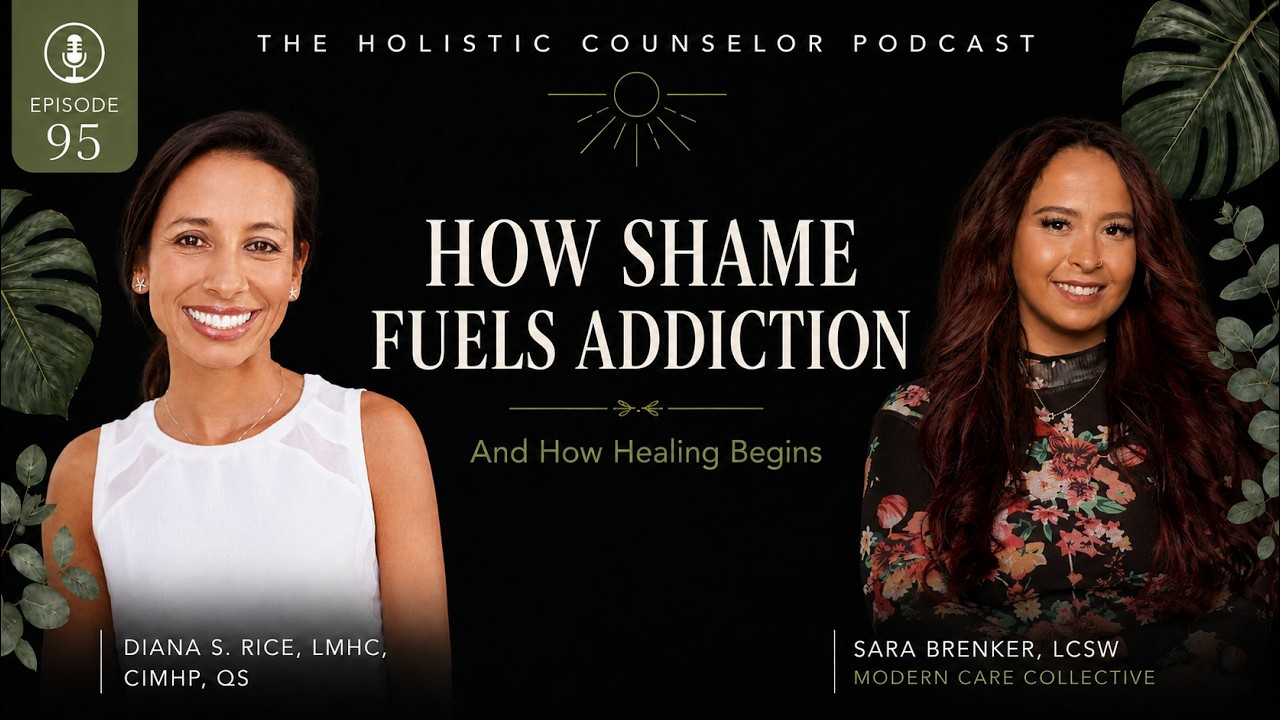
Episode 95
When Shame Meets Healing: Addiction, Faith, & Identity
with Therapist Sara Brenker, LCSW
Hosted by Diana S. Rice, LMHC, CIMHP, QS
Episode Summary Hello there, fearfully and wonderfully made human. I'm your host, Diana S. Rice, licensed mental health counselor and founder of Through the Valley Therapy and Transformed Mind Consulting & Coaching. Welcome back to The Holistic Counselor…
Listen to the Episode
Press play when you’re ready.
Educational content only; this podcast is not therapy, diagnosis, or medical care.
About This Conversation
Show notes
Jump to a section
Episode Summary
Hello there, fearfully and wonderfully made human. I'm your host, Diana S. Rice, licensed mental health counselor and founder of Through the Valley Therapy and Transformed Mind Consulting & Coaching. Welcome back to The Holistic Counselor Podcast—the space where faith, science, and holistic healing come together for grounded, real conversations about mental health, purpose, and personal growth.
As we enter this Valentine's season, remember: love isn't only something we give—it's something we intentionally cultivate within. The way we nurture our minds, bodies, and spirits shapes how we show up for others—and how we heal.
In today's episode, I sit down with Sara Brenker, LCSW, a South Florida-based therapist and co-founder of Modern Care Collective, a practice known for its warm, direct, and collaborative approach to healing. Sara has spent years working as an individual therapist, clinical director, and crisis-stabilization specialist. She integrates CBT (Cognitive Behavioral Therapy), DBT (Dialectical Behavior Therapy), strengths-based approaches, and motivational interviewing to help clients rebuild self-worth, address shame, and navigate recovery from addiction and identity loss.
This conversation moves through the grey space between faith, trauma, and transformation—and asks us to re-imagine healing as both clinical and spiritual.
Key Themes
- The connection between addiction, shame, and identity loss
- How addiction can show up as behavior, people-pleasing, or performance—not just substances
- Living in the "grey zone" instead of the extremes of shame or denial
- How faith communities can hold love and disappointment at the same time
- Why outpatient harm-reduction models save lives
- How authenticity and selective self-disclosure build trust in therapy
- Learning to sit still with discomfort and letting healing unfold
Resources Mentioned
- Modern Care Collective – therapist-run practice based in East Boca Raton, offering outpatient and telehealth care for clients in Florida https://www.moderncarecollective.com/
- CBT & DBT explained:
- The Trevor Project – 24/7 support for LGBTQIA+ youth → thetrevorproject.org
- SunServe Wilton Manors – South Florida resource for LGBTQ+ affirming mental-health support → sunserve.org
- Faith-Integrated Therapy – find trauma-informed, holistic Christian-based therapists via openpathcollective.org or psychologytoday.com filters
Takeaways
- Healing begins with safety. When stories are met with compassion, shame loses power.
- Faith and therapy coexist. Grace and groundedness are both essential.
- Addiction hides behind perfection. Even "high-functioning" lives can mask deep pain.
- Therapist fit matters. Don't give up on therapy—try a different provider or approach.
- Love is cultivation. The inner work you do becomes the love you offer outwardly.
Connect & Share
Follow and tag on socials: #throughthevalleytherapy #theholisticcounselorpodcast #transformedmindcc #holistictherapy #faithbasedcounseling #mentalhealthpodcast #addictionrecovery #shamefree #therapyworks #dbt #cbt #selfhealing #faithandscience
Final Word
"To every listener: you're not alone. You're loved. Trust in the Lord, guard your heart, and renew your mind." — Diana S. Rice
Listen now on Apple Podcasts | Spotify | YouTube Playlist → The Holistic Counselor Podcast
Episode transcript
Read the full transcript Close transcript
Automatically generated from YouTube captions. Names and wording may contain errors; listen to the episode for the original conversation.
Hello there, fearfully and wonderfully made human. I'm your host, Diana S. Rice, licensed mental health counselor and founder of Through the Valley Therapy and Transformed Mind Consulting and Coaching. Welcome back to the Holistic Counselor Podcast. The space where I pray faith, science, and holistic healing come together for real grounded conversations about mental health, purpose, and personal growth.
As we step into this Valentine's season, I just want to gently remind you that love isn't only something we give. It's something we intentionally cultivate within. The way we nurture our minds, bodies, and spirits directly shapes how we show up for others and ultimately how we heal.
Before we dive in, I'd love to ask a small favor. Please share this episode with someone who might need a reminder of their worth. And if it resonates with you, take a moment to leave a quick review on your favorite platform. Those reviews aren't just digital stars.
They help more people find this podcast. people who are searching for hope, clarity, and evidencebased strategies for whole person healing. Today, I'm joined by Sarah Brinker, LCSSW, a South Florida based therapist whose warm, collaborative, and direct approach encourages trust, transparency, and meaningful dialogue.
With years of experience as an individual therapist, clinical director, and crisis stabilization specialist, Sarah brings a grounded and practical perspective to healing. She draws from a range of evidence-based methods, including CBT, DBT, strength-based therapy, and motivational interviewing to help clients navigate their anxiety, depression, low self-esteem, codependency, substance use, and major life transitions.
What I love about conversations like this one that we're about to have, it's real, human, and full of insight. Whether you're a clinician, a caregiver, or simply someone exploring your own healing journey, my hope is that something here sparks reflection, compassion, and maybe a fresh way of seeing yourself or others.
Sarah, thanks for joining me.
I'm so happy to be here finally.
I know, right? Yeah. Sometimes it happens like especially with what we do, right? It's like we realize things happen and we're human too, us therapists. Huh?
We are human. That is true.
All right. So, let's just start with your story. You know, what first drew you to the field of therapy and why addiction, shame, and identity loss resonate so much with you?
So, it's actually really funny. Um, I when I was like very little, like 10 years old, I used to watch Intervention and I didn't quite understand like what it was, but I just loved it. probably shouldn't have been watching it at 10 years old, but um I loved it and I always said like growing up like, "Oh, I'm gonna be an interventionist."
That was like the word.
Hard word to say, but I would say it. Um and then I got older. Um and that's exactly kind of what I did.
You know, I dabbled around, but it was always like a full circle moment. Um you know, I did beauty school for a little bit. Um then I did nursing school and then I jumped back to therapy. And it's funny cuz I laugh cuz like that 10-year-old version of Sarah, now here I am um doing it.
So, um I definitely for some reason I was always driven by um addiction. I always thought it was so um powerful and to see the change that people had from navigating, you know, trauma to leading into addiction to the transformation after that. It was such a beautiful metamorphosis that I just like loved to watch.
Yeah. Um, so I um
here I am.
Yeah. Well, okay. For those honestly, I have never s seen that show. I don't even know what you're talking about. I'm Am I a terrible therapist? Am I fired? Am I fired? Honestly, I So, can you tell me a little bit about that show?
Because I mean, I think we're I don't even I'm not going to even ask your age, but I have a feeling it's because When did the show come out? First of all, then I could I could
It's been around for a while. It's been on A&E. Um, it's definitely been I want to say for at least 15 years.
Okay. I'm trying to do math now. 15. Oh, so it started in the 2000s.
Yeah. That's why I don't know it because I was too busy with four children and and Okay. and never watching television because probably like a lot of moms who are moms now probably just
put their kids to bed as early as possible just pass out, you know. So, okay. So, if that happened in the 2000 Yeah. Yeah, that makes sense. Okay. So, can you tell me a little bit about the show and and inter Okay. Is this the one with Dr. um
He has glasses. What's his name?
Dr. Drew.
Dr. Drew. Yeah, he's famous, too. Oh, I am fired. I'm a fired therapist. I can tell. um he's not on it, but it's basically um some well-rounded um people that are interventionists um that go on and they kind of help families connect them to resources and get their loved one to kind of like buy into treatment.
Um
it obviously shows all different stages of addiction, but um you know, it's it's not a light um airy show. I mean, it definitely
Okay. Of course. But yeah, Sarah, I mean, think about Okay, so tell me like intervention are are you an interventionist now or do people like the way I see that because I'm not in substance treatment at all? Okay, that was never my I was always a adolescent teenagers, alternative high schools, inner city.
So it's like working in with that. That was mostly my career. So, and I know addiction overlaps with that population because that's usually where they're they start addiction, you know, but um I would always hand that off to whatever happened in the school systems and stuff like that.
So, can you tell me a little bit about that so I can understand in case somebody also is listening that doesn't understand what that is?
Sure. So, I typically see clients when they're in the height of crisis. So, being that I worked in um crisis stabilization and high acuity um treatment centers, you know, I always saw clients that were, you know, at their worst. Um there wasn't a lot of um I have to do this and this and this and then this so this thing doesn't happen.
It was like the thing already happened. Okay.
Um and we're already like in a really heightened state. So, um typically at the outpatient level, those are the clients I see too. Um, and I and I love those clients um because I feel like a lot of times they slip through the cracks um at the outpatient level because there's not a lot of providers that can offer that support and you know it's scary at the outpatient level.
Um so I really like to be accessible for clients that are you know like I'm not quite ready to go to treatment but I want to do everything I can at the outpatient level. And that might mean like you know what we started offering at our practice is individual therapy and group therapy along with sober coaching and oh wow
a lot of ancillary things um to stop them from going to those higher levels.
Yeah. So, I'm thinking just I've worked with clients where I would have to find a woman who probably now that I know this is exactly what you do. Now, you're on you just been bumped up on my list because there's been times where I'm like, okay, you know, they're not ready to go to a full substance use treatment center, you know, like leave their job and go there for 28 days or a week or whatever.
Do you do that in between stage? Do you know what I mean? like I okay
I'm a big proponent on that because in theory sure it sounds great to go to treatment and kind of take a step back but not everyone can do that and I think it's really shameinducing to assume that that people like if they care about their kids or their families and stuff but it's like
they also have to like pay bills and they have other things that are
children and and a spouse or whatever animals or plants I mean like any living thing underneath it. I mean, so Oh my goodness, this is good to know, Sarah.
You know, because to me, like sometimes, you know, I have clients that come to me because I'm private practice and then I realize after first, you know, because a lot of people with the shame because this is what we're going to go to now, the shame and addiction. they come to me and they're not thinking they have an addiction until we get into the nitty-gritty and you know it's session two session three and then I'm like oh no you we got to have to do something.
So for for those like me, okay, what would be the best thing practices to to do? Like do I do I call you? Who do I call? Because sometimes, you're right, they don't want to go to these big centers or they can't, especially those that don't have the resources.
Sure. Yeah. No, exactly. And you know, that's what uh me and Ashley, the co-founder of Modern Care, were thinking too. Like a lot of the groups we needed to offer for substance use disorder and very niche groups were only offered at the higher levels of care.
There wasn't um a group for first responders that were struggling with addiction. You could find that uh you would just have to go inpatient um and eventually move to an IOP program. So that's why we created this because we realized there was such a need and as clinicians in the field we would try to refer people and be like there is no such thing unless they go to treatment.
Um and the thing is is there's something to be said about that because in treatment it does work. Having those groups is very effective um the 12step meetings and to not have that at the outpatient level is like a huge deficit
right
for that community. So that's why we created it. So, we like we like those clients. We like those hard cases that are kind of like in the gray area. Like, they probably should go somewhere, but they're not quite ready.
Um because that's it's a harm reduction model to be honest. Um I rather get them to buy in
in the way that they can versus nothing at all. So, so let's talk a little about shame and addiction because like I said, I I've had quite a few clients that have come to me. They're wanting a faith component.
They want um you know we've connected because you know that's the thing with with having a client is that you have to have that uh cohesion that buyin the therapeutic alliance the the safety the trust and everything and I want to know though and and I see like when I worked with men and you said first responders so when I worked with first responding men or even doctors, lawyers, teachers, I mean everybody this is the thing
about addiction that people sometimes our TV makes it look like it's only a certain kind of people or certain like one drug is for one kind of people or whatever and I have to get people right Sarah I want to know more about like you know that that intersection can you share a defining moment in your work that reveals how deeply those two are connected
well I think I always say like addiction doesn't discriminate you know it it we kind of hide behind that because I think It self-regulates our own stuff a little bit better. Um, but you know, I've seen it in people that have picture perfect lives that you would think could have everything that they've ever could have dreamed of.
The beautiful house, the cars, the families, the jobs. Um, and I've seen that, you know, the the substances is it's just a symptom of whatever that problem is. Um, so like the shame in that and admitting that you have a problem, but also existing in a world where everything looks so perfect.
I think people get very black and white and they're like, "How can these things both coexist? It's it's not possible when in reality that is life."
Yes.
And they do.
Yeah, they sure do. And and so when someone feels like they've lost themselves, right, their sense of self, because we also have to have the listener understand that addiction, people think it's a substance. Sometimes addiction can be what you're viewing,
right? Sometimes an addiction could be with another human being,
to me. In my practice, when we talk about addiction, it's like anything you idolize.
Sure.
Right. because it could be shopping, it could be, you know, porn, it could be uh just like the other human where it gets so toxic with a toxic other person like it's trauma bonding, right? And so what's the first step you guide them through to begin reclaiming who they are when you first start working with somebody with maybe that that shame and addiction?
Well, I I really am a strong proponent in shame dying in places that stories are told safely.
Um, so I think like fellowshipping and finding someone that could be like, I felt the same way. Like that's so important because you really sit with it by yourself and it becomes like very like no one has ever felt this way. And for someone to sit there and be like, I know exactly what you're experiencing.
I mean, that's the most healing thing in itself. Um
so that's why I think with the 12step world um to have that fellowship is so important and that's why there should be more support in other areas. um you know along with addiction and and all that um we created very um kink friendly groups poly um poly relationships we have all that stuff going on to kind of help with the community because there's a lot of shame in that too be you know marked as an addiction or addictive personality but you know it's
it's not a bad thing if it's handled in a way that's appropriate. So, um, you know, it shows up for everyone differently. Sometimes it's not just the alcohol. Sometimes it's
completely the opposite of that. Um, and there's no substance, but it's the behavior. So, it really depends.
Can you explain that a little bit more? Because I know we're living in a culture and society because some people are going to be like, "Oh goodness, this is a Christian woman talking about polyamorous and kink and all that." And I want to be raw and real because listen, we are working with younger people that are are are doing these things.
Are they I have no idea honestly because you're about to teach me. All right, Sarah. you're about to I do know a little bit because I do have say like a parent that comes to me as as one-on-one and this is what their children are doing or they're in something and and they're trying to figure we're all trying to navigate this life as best we can with the resources we have.
And it's not about shaming. I'm not trying to shame. I want to understand because some people, you're right.
I know that when I did work in alternative high schools, these young teenagers were coming out of the hospitals because they try to kill themselves because of the shame of either being homosexual or bisexual or pansexual or as I had to learn so many of these terminologies and they would still come to me even though they knew because I'm like, "No, I I am a disciple of Jesus and that's what makes me love you and because of my love, I want to give you a safe to figure yourself out because I don't know.
I'm not your God and I'm not God. So, I don't I want to make sure you're healthy, you're strong, you have tools, and that you go on into your life to come become who you need to be. So, because we're all in community together and if everyone is in a healthy space, then we all could be in a healthy space together because we're all interconnected.
That's how I see life.
Sure. Yeah. No, that's beautiful. And I think I think the thing that makes it really tricky is it looks different for everyone. And I think that's what we have a really hard time with as humans. Like it's someone else's reality doesn't match our reality.
So it's really hard to sit with. Um because of our own belief systems or moral compass or whatever you want to call it. Um, so I definitely think that's what makes it so hard for people because it's such it's there's so many elements to it.
Um, and it everyone lives their lives differently through it.
So I think um, that's the first step is sometimes like asking the questions and really seeing like how that shows up for that person. What does it mean to be Pauly or whatever whatever they kind of identify with? and um seeing how that fits in their life because usually there's there's always a root to it, you know.
Um and some it's a maladaptive behavior. Sometimes it's not appropriate for them because it's causing more, you know, chaos, I guess you could say, in their life. Um and some people it's the it's the most corrective experience ever. So, it just kind of depends.
And sometimes having someone to that's, you know, aware of it and can kind of embrace it, it can kind of navigate through the complex part of it and being like, "Oh, this is like uncomfortable." Once you get through all of that, you'll see like, "Oh, there's a complete reason why this person is engaging in these behaviors."
Right. Right. Wow. So, is this is this something you're Well, let's talk about your company and what it specializes in and and stuff because I mean, we go to the same groups and everything and and I I we've had conversations but not this deeply, which I'm so grateful for at this as this moment.
Um, so what's the name of your company?
So, we created Modern Care Collective.
Okay.
So, we're who's we? me and my um colleague Ashley Luca Revski. She's also a therapist, so we're therapist run.
Um and we kind of wanted to create something. We're located in East Boka. We take insurance.
Um we wanted to create something that we felt was kind of like taboo. like we wanted to be the person that you call when you're struggling with um out of control sexual behavior is what people call it or an addiction um and you're living in East Bokeh or you're living in an area where you can't necessarily find your community. um we wanted to kind of inject ourselves in like the prime part of Bokeh and just be like, "Yeah, we're here and we're not like afraid to talk about it."
Yeah.
So, with that, we created
therapists that kind of work with us that have the same type of
feel. We're very humanistic, non-pathizing. You know, we try to keep it real, um, solution focused, and along with that, we offer services that are not always rendered at the outpatient level. So, we'll really help the client if they might need two therapy sessions a week, then we'll do that two to three.
If they need that in a group and a peer support specialist, you know, we offer that and we really try to combine the person with the perfect fit. So, for example, um like I have a mom who is from East Bokeh that struggles with substance use disorder and it's really hard for her to connect with other moms that struggle cuz there's a lot of shame surrounding that.
So, we connected mom to someone that's been sober for over 5 years, has their own kids, lives in Bokeh, has the whole
good beautiful on paper, um but that struggles. So, that is like the most healing thing for that client. So we wanted to offer those services too.
Do you do you serve the whole state of Florida? Do you do teleaalth?
Yes, we do.
Okay, good.
So what would you say because like I'm just thinking of a few um caregivers that have that are really into their churches, their their their religion, all right, no matter what religion. and they have young people in their lives and they've cut off their kids because of the choices they realize that their kid get and I see that a lot in my community especially you know in the Caribbean community and stuff like that and I know
that it's been heartbreaking because I when I did work with teenagers so I had a few really hard cases with conversion therapy and just you know it's such a hard place because of a a woman of me as a woman of faith people assume that I believe the same way they do in that manner and people forget there's like 40,000 denominations of Christianity and and everything and everyone wants to be right and so to me I'm
just like okay because I remember the suffering my empathy is so high Sarah like now I'm about to cry because thinking about some of these clients what would you want to say to people in the faith community right now that would cause more help than harm
I mean I would say a lot lot of times with faith it could be very black and white and I think we live in a gray world. Um I think there are so many things in life that are sometimes black and white but when it comes to things that are complex that include other human beings and their feelings and their traumas and all these things that are kind of warped into one.
It's really important to live in the gray area of things. Like we could love someone and we can also be really disappointed.
You know, those things can coexist because I think we get so caught up in the black and white and that is what induces so much shame and guilt
um really with with the per the person involved and the person that's using like back and forth.
Yeah. Yeah. I mean it is it's learning how to communicate understanding who you are right you and why you believe because to me addiction anything addiction religion anything that is causing uncomfort there's a root cause to it
right and it's being still and and I I think this is why Sarah like someone would sit still with you in a safe place they'd sit still with me in a safe place without judgment and give them a safe place to work it out because sometimes it works out in the way that the family comes together.
Sometimes it works out where that person will never talk to their family again,
right? And so to me, I want I want you to explain the modalities you use because people need to understand if they can't afford therapy at this moment or if they can't if they're not in Florida and they can't hire us, right? You specialize in CBT, DBT, right?
Um, strength-based therapy, motivational interviewing. How do you utilize those? Can you explain what each one of those are and then tell me what you do with them?
So, the good thing about like CBT is pretty much behavioral, right? So, like we have a feeling, we don't want to feel that way, so then we do a behavior that makes us feel differently. And the good thing when I morph it into DBT, it's the premise of feeling both things at once.
So like
I could feel really sad and then I could allow myself to feel that way and not jump to fix it and then move into something really positive. So letting various emotions coexist. Um I fall more into the DBT because I don't want people to spend their lives running.
Okay. Explain DBT like what the initials are because remember we're we have listeners that probably never heard about DBT because this is a worldwide podcast and so you know what I mean. I want them to really understand because then they can look it up and maybe create, you know, like if they can't work with us, they could find someone if they like that modality.
So I know CBT is cognitive behavioral therapy and DBT, let's explain that a little more, please.
So dialectical behavioral therapy. So a dialectic is basically two opposing things existing at the same time.
So it's that black and white, holding that black and white together and going, "Oh, look at the gray."
Yeah. like I love my kid but my kid is like I'm very disappointed in what they're doing.
Um those things can happen. I could love you and I can also set boundaries with you.
Um so that does that is very implemented in my work that I do with people struggling with addiction. And within DBT there's four components. There's distrust tolerance, interpersonal effectiveness, mindfulness, and um I just lost the last one.
That's okay. Um,
we'll put it in the show notes.
Yeah. And I think, um, that's really important because it gives us tools within those moments to utilize. So, like if I'm having a really hard time, I can use the tip scale, which is a scale that I can help to regulate my emotions when I'm feeling really escalated.
Um, and it's a step-by-step evidence-based practice that you can utilize and you'll feel better when you do it.
Can you tell me a tip skill? I know. I've I've heard it and I utilize, you know, cuz to me I was always really honestly psychoeducational working with other teenagers because sometimes it's like, all right, you're here with with me 50 minutes, but you know, do you want to do something on your own so you can learn and and everything.
So, um, tip scale. I remember that. I accept ACC pts, too, because these are all like initials of things to actually do to make you remember. Right.
Right. And it kind of brings you back to the present moment and you're able to navigate heavy emotions and also not have life interfering things happen like you know negative um communication styles and um relationships being able to communicate what you need appropriately.
Um, so being able to have that, especially with someone that's struggling with addiction and not being able to regulate their emotions or really share what's going on internally and how their needs can be met, um, to have those skills, it's highly beneficial for clients because it's like a step-by-step process that'll you will feel better after you do it.
Yeah.
Do you have any um resources or books or or something like say someone's listening right now and they are struggling or they they they feel alone because they you know they're getting in they know they have an addiction they just don't know where to turn or they might be in polyamorous you know I have no honestly I know the Trevor Project is something that I would like um tell adolescents to go get help or or the
local place in um Wilton manners and now it's uh I forget the name because I haven't worked with teenagers but there's not sunshine
sunshine
sunserve yes right right
because those are the only places I knew where to you know and and there's so many people that want to like you said have both where they want to you know they say that I am a disciple of Jesus Christ I love the Lord or Muhammad or whatever religion and they are now still wanting to have this lifestyle as well.
And to me, it's not for me to to judge them and say, "No, it's it's for me to say, is this helping you or hurting you? How are you using your five senses?" This is because I was basically middle school, high school kids.
It's just like,
yeah,
are you using your five senses to hurt you or heal you? Those are the choices we have every day,
right? So, is there any the thing that's coming up that you're thinking about like when I'm asking that question? I mean, I think too, like when when I think about that, like a lot of people aren't mindfully present. They're not in the moment.
They're thinking about what happened years ago or in the future. Um, and I think we forget how like we go through life and we look back and we're we have moments in time where we're like, "Wow, I really wish I could have sat with that version of me a little bit longer, even though it was so hard." um you know that that's a version of you that you might not be able to get back.
So I think being able to kind of help people say like I might not be happy in this season of my life but this is also teaching me something so I'm going to lean into the discomfort a little bit um I think is really healthy with that
we spend our lives running. That's really what it is.
Right. And this is how I I would tell the people that are like wait what? And I'm like, "No." Well, first of all, I know in the word it says that we we Jesus states that we have problems this day. Why are you worrying about tomorrow?
It has problems of its own. I have just butchered the Bible, but I will find the verse and put it in the show notes.
But I'm just it's just the um anxiety is us so worried about future stuff and depression is us ruminating of the past mistakes,
right? Right? Because people, you know, people want to they in our field, a lot of people are pathological because it's a conventional insurance model and we have to diagnose and that's how we're trained. But when you really sit back right in the gray, I love that.
I like it like, you know, in the purples and pinks and, you know, the rainbow colors. But but when you're sitting there being mindful of you in the present moment, right? being still and understanding your why and then choosing, right? You choose. You get a choice.
No matter how bad things have gotten, we get to choose and to understand you're not alone. That's that's what I'm hearing, Sarah, that you and Ashley, right?
Okay. So, the next time we were in person, introduce me to her, please, so I can hug her if she hugs. But but um that that space and that place that you you know that you offer, how do you you know how do you stay hopeful when a client is in their deepest pain?
I stay hopeful. I mean I I would say you know nothing really is forever. Even though in the moment we feel like if we're feeling the like it's the worst day, then it's going to feel like this forever. And it it knowing that everything really is temporary, even negative things.
Um, you know, I show clients like I am very raw when I'm doing my own therapeutic work with someone, you know, I'll say like I'm sitting with you and I'm having a really hard time holding this. Like how does this feel for you?
I can't imagine. Um so sharing my own experience and like being authentic in that regard is validating in itself and it also lends them my nervous system to regulate to help them you know.
Yeah. You're co-regulation.
Yeah.
Yeah. But that could be d I know like when you're sitting with another human being because we are an energetic beings and that's scientifically proven. So, I don't want it to sound woo woo, but you know, it's like it's true,
right? You have group think where a whole group of people all of a sudden behave kind of the same way and you're like, "Wait, what just happened here?" And so, we we have that those mirror um neurons in our brain that we mirror certain behaviors and stuff.
And so this is why it's so important to be still and be mindful of ourselves and and take ownership because there's a difference like in the healing process Sarah when you are dealing with a human being that comes to you in crisis,
right? And you work with them and work with them and you see the the evolving, right? They're transforming into something, you know, and they're doing the work
and stuff.
How do you um like what else do you do for them or what else do you offer or how does that is that how's that make you feel because this this job is hard Sarah we got to let people know like it's not an easy especially when you're doing root cause work and not just the conventional case managing of just okay here's this diagnosis here you know and stuff like that which you know we know we
need all those things but to get to the root cause because like say a borderline personality disorder, a bipolar, um you know ADHD, I mean we have these diagnosises.
How do you like work with that? Well, I sometimes like when it comes to the diagnosis, that's only for like dictation of treatment, but I again I really try not to pathize because when I'm seeing people at their highest form of crisis in their life, like they're going to look a little bipolar.
They're going to look a little borderline. Um, so I always like to fix the symptoms around it before I like even with before I tell them like this is your diagnosis because like especially with addiction, you really want to wait until you diagnose someone because there's so many elements in the picture, right?
So a lot of it is like normalization like I don't know how you don't feel this way.
Like I'd be worried if you didn't feel this way. Um, so a lot of it is like validation in that regard that helps people feel like a lot more regulated
because I mean if they're struggling with addiction, the last thing they need is like a path like someone pathizing their behaviors in front of them,
right? Yeah. And I and that's the that's what I learned working with adoles I loved working with teenagers. They are the honestly they taught me how to be a better human and therapist. So what what I know now is what I was taught not by books, not by the halls of the universities, not you know it was being in the trenches with these human beings and they were the ones that really Do you work with teenagers by the way?
I do. Yeah.
Okay. Tell me about the ages you work with. What's the youngest?
Youngest I mean I'll go 10 and up. 10 year olds actually 16y old.
Yeah. Well, nowadays, you're right.
Yeah. So, I'll see 10 and up. Um, I I love like clients that you have to help them buy in to therapy. Like, there's like a bit of ambivalence. Those are my favorite.
Oh. Oh my goodness. I love knowing this, Sarah, because guess what? Guess what's coming to you? Probably a list of human. They're gonna like because Yeah,
those are I guess I like a challenge, but it's like once they buy in and there's rapport built, it's like you can't put a price on it. It's the best feeling.
I love it. That's wonderful. So, is there any like books or resources that you love that really like helped you become a better therapist or human?
So, I um I mean through supervision like I I had a really good supervisor. Um his name was Dr. David Wolsifer. Um and he was very real. Um he shared all the areas that he made mistakes in. He didn't only real.
So I I utilized him in a great way. But I also really only surround myself with colleagues that are likeminded in that way too.
Um I want to hear how you completely messed up and how you got you got through it. I don't want to hear all like the beautiful stories and the transformations. Um so I really try to surround myself with people that show up that way too authentically. uh and maybe not always have the answers and not know what to do.
So, I I definitely um sit with I roll with those people and um oh my god, I just forgot his name. the author. Um it's going to come back to me, but um it's he talks about basically having like being real therapeutically um and building a therapeutic alliance and utilizing self-disclosure to build rapport.
Um
yeah, but that how do you have boundaries with that? Because to me, like I just listen, I'm creating a a course right now, which hopefully by the time this episode comes out, it will be done. But it is like I realized there was a situation in Texas, Sarah, where the client figured out that the p therapist went on a therapy show.
Okay, two therapists have a podcast like what we're doing now. the the third therapist came on to talk about her course that she created due to being stalked, okay, by a client, but the client figured out it was her. And so the client's room, I know it sounds crazy, the client's roommate decided to create a YouTube video going, we know this is about my roommate.
And it was like it when you hear I heard both sides and that at that moment there was something in me and this was in a different state and I was just like so disappointed in our colleagues because these were colleagues of ours and it was just like you know they were talking of because the the the the client was talking about how in therapy for 18 months doing EMDR and wanting to have uh you know she would show pictures of her children.
And so this is the therapist because remember in the beginning I know back in the early, you know, in the early 2000s they're taught like the whole you're a mirror. Yes, you're a mirror. You're not supposed to share anything at all. So how do you differentiate or what what boundaries you because I understand I I you feel it out like it's a gift Sarah, right?
Like when you're with a human being, you know what to share and what not to share, what when to pull back and stuff like that. But sometimes it can when you're dealing with a stranger, you never know. So what how do you know like what when to stop and stay in our profession ethical and stuff like that?
Well, I always think like there's a way that you can always test the waters with something like light, right, and kind of see what the client does with it. Um, and I but I do think like self-disclosure has helped with some of my toughest cases.
Um,
I really try to think like if I if the roles were reversed and I was on the other side, right? What would I want? And I wouldn't I would want someone to be authentic and big on the human connection. Yeah, there are certain things that like we don't need to share, but I think there are things that make us human and they're important.
Um, a lot of times like with clients, I'll try to explain a theory and I just know it's not landing. Like I just know. They're like, "What are you talking about?" Like, so I'll be like, "Okay, I'm going to tell you something that happened to me and like, let's see what you pick up on it and I'll share a story and they'll be like, I totally know what you're talking about now."
That fits. So, like, yeah, I'll throw myself out there to like get you what you need.
Oh, I love that.
And like, what what would I say that? Like, would I be okay with this person repeating what I'm saying? Yeah.
Right.
So, like go ahead, you know? Um, so I really try to um be authentic in that way. And I'll ask like, "How do you feel about that?" And a lot of clients are like, "No, I want to know like I'm here for a reason.
I'm not here to not get answers. Like I want to know if it showed up for you. How did you navigate it? And what did that feel like?" Because that's healing in itself.
Yes. We learn from each other,
right? And honestly, like if that approach isn't for you, like if you don't want a provider that isn't a blank slate or that keeps it real and is very solution focused, like I might not be the provider for you. And that's okay.
That's right. That's right, Sarah. That's what I say, too. This is why when I do a 15-minute consultation, I actually have a questionnaire. I I go through the rigomearo because I don't want to waste your time or your money.
Sure.
Right. Because there are thousands and thousands and thousands of therapists out there. You just have to find the right fit for you.
Yeah.
You know, right. And and for those listen, because this is something that happens too, Sarah, and I'm sure you probably get quite a few too that have gone through therapy that have been in the system for a long time and they don't trust it at all.
And they finally come in front of you. I could tell, sir. I could tell like they'll come in front of you and you're finally they're like they don't know what to do with it. You know, it's a little cognitive dissonance because they were so used to being either labeled and disabled or or just like never being heard, you know, and then you finally give them that safe space to be raw and real and authentic where they can actually work stuff out and they're just like, whoa.
Okay. And so, like, I love that. I I that's why you're on my show right now because I could tell like after the few times that we met, I'm like, "All right, we got to get make this work." Um well, I could probably talk to you for another, you know, hour, but I know that we both have um clients to go see.
And so, if somebody wants to work with you, how can they find you?
So, they could look up Modern Care Collective, it better come up because I've only been I've been posting it on social media like all the time, so I hope it comes up. Um, but also they could look me up uh Sarah Brank or LCSW and they'll find me.
Um, and even if I'm not a good uh fit for you, I always love to provide resources and help. So, utilize me in any way. Um,
love that.
Always always available in that regard.
Wonderful. Sarah, is there anything you would like to encourage the listener with? Um, a resource or words or anything before we say goodbye that are struggling right now? I would say if you're on the fence with therapy, um I would really try to find a provider that is different from what you've tried in the past before you completely take it off the table because you might not even realize like what you're taking away from yourself and the growth that can experience,
right? Because us therapists is not just, you know, I know the the stig this is why this podcast was created because I'm trying to break stigma in faith-based communities and in the BIPO community, right? And to have them understand like just because you you know need all of us need I go to therapy.
Okay. And we all need some kind and if it's not therapy, you're not in a crisis. You still can utilize a therapist for psychoeducational training.
Yeah.
Right. Or for accountability.
Mhm. right? Or just to learn something. I have clients that meet with me once a month. They hired me to meet with them once a month to go over certain things that happened that month. And and then I teach them communication skills. I teach them how to, you know, cognitive distortions.
Uh just certain thing had a challenge and a place where they could just, you know, work it through. And things come up. We all have something coming up. We all have that inner child healing that we need and and just things that come up in our subconscious.
Listen, if there is a because this is what I want to give a human example, Sarah, you're you're just driving and the next thing you know you hear a song and a song that was in the 1900s. All right. And all of a sudden you're remember everything that happened.
That goes to show how your subconscious stores things and sometimes it's affecting you and you don't even know.
Yeah. Oh yeah. Me with every Mariah Carey song.
Me. That is me. To me, it's all freestyle. I don't know. I don't even know if people know what freestyle music is, but that's like my favorite music from the 1900s. Oh my gosh, I can't believe I'm sitting there saying, and this is going to be like uh aired in 2026.
Oh, I'm old. But whatever. Age is nothing but a number, right, people?
It isn't.
All right, Sarah, thank you so much for being here. And anyone listening, please know you're not alone. You're loved. And to trust in the Lord, guard your heart and renew your mind. Bye bye. And now for the disclaimer to make sure you understand that you are responsible for you.
The content provided on the holistic counselor podcast is for entertainment,formational purposes only and is not intended as a substitute for professional medical advice, diagnosis or treatment. Always seek the advice of your physician or other qualified mental health provider with any questions you may have regarding a medical or mental condition.
Never disregard professional medical advice or delay seeking it because of something you have heard on this podcast. The views expressed on this podcast are my personal opinions and do not represent the views of any professional organizations with which I am affiliated. Call your doctor, 911, or 988 immediately if you have a medical emergency.
The Holistic Counselor podcast does not recommend or endorse any specific tests, physicians, products, procedures, opinions, or other information that may be mentioned on the podcast. Reliance on any information provided by the holistic counselor podcast, guests appearing on the podcast at the invitation of the holistic counselor podcast or other listeners to the podcast is solely at your own risk.
Confidentiality notice. If you engage with the holistic counselor podcast by commenting or posting and are a client, please be aware that you may be revealing information that could compromise your confidentiality. Please remember that disclosing your identity or personal details can be linked to your clinical material.
As a therapist, I am bound by confidentiality and will not respond to any disclosures of this type on this podcast. I am committed to upholding the ethics and confidentiality of the therapeutic relationship which extends to all forms of communication in accordance with the laws and professional guidelines that govern mental health professionals.
I want you to know that your privacy is of utmost importance and you are responsible for protecting it when interacting on this platform or any other public forum. Thank you.