The Holistic Counselor Podcast
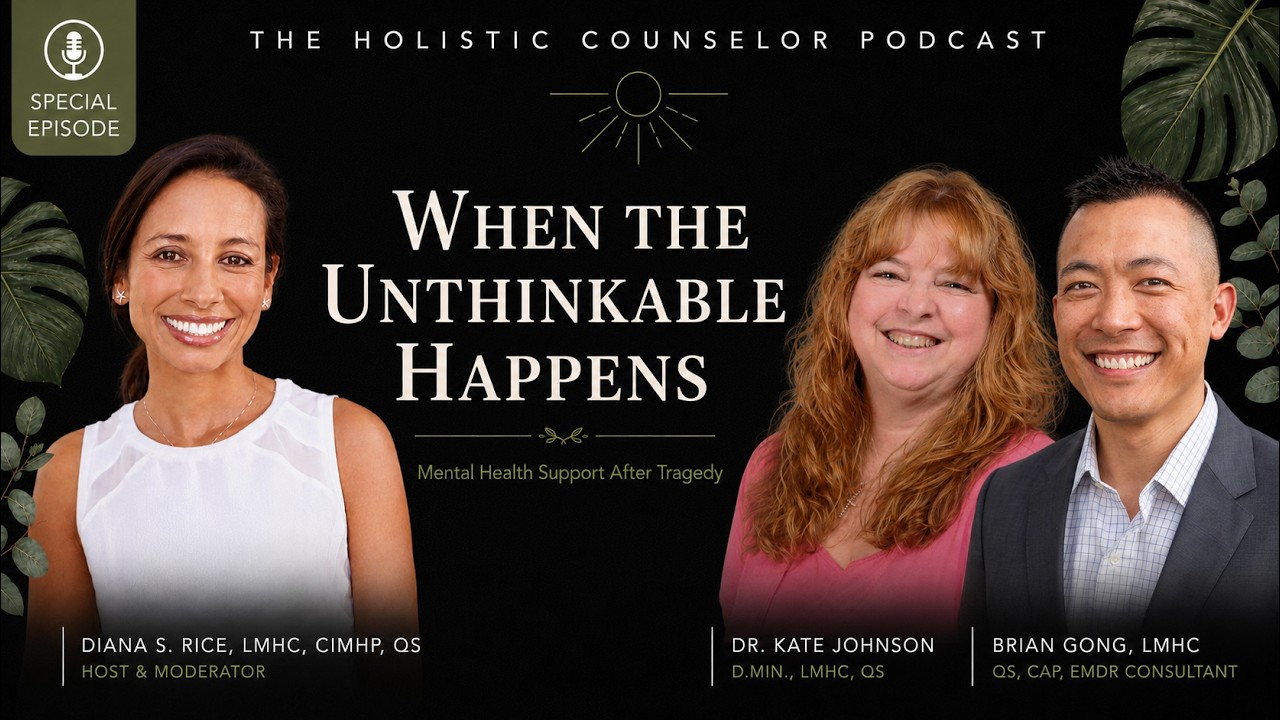
Special Episode: When the Unthinkable Happens — Mental Health Support After Tragedy
Hosted by Diana S. Rice, LMHC, CIMHP, QS
Host: Diana S. Rice, LMHC, CIMHP, Qualified Supervisor Moderator & Founder: Through the Valley Therapy & Transformed Mind Consulting and Coaching Release Date: July 21, 2025 Event: A live webinar hosted by The Agency Austin, created in response to the…
Listen to the Episode
Press play when you’re ready.
Educational content only; this podcast is not therapy, diagnosis, or medical care.
About This Conversation
Show notes
Jump to a section
Host: Diana S. Rice, LMHC, CIMHP, Qualified Supervisor Moderator & Founder: Through the Valley Therapy & Transformed Mind Consulting and Coaching
Release Date: July 21, 2025 Event: A live webinar hosted by The Agency Austin, created in response to the devastating Central Texas flood and sudden loss of a beloved colleague in a hit-and-run.
Episode Experts
- Dr. Kate Johnson (D.Min., LMHC, QS) — Featured in Episode 10: "Untangling the Threads: Insights on Biblical and Clinical Healing"
- Brian Gong (LMHC, QS; Certified Addiction Professional; EMDR Consultant) — Featured in Episode 60: "Healing Trauma at the Root: EMDR, Addiction, and Accountability"
What We Talk About
1. Why this panel matters In light of the Central Texas flood's massive loss of life and the hit-and-run tragedy, we gathered in community to bring real-time mental health support. This episode isn't clinical theory—it's grounded, compassionate care for real people in real time.
2. Live webinar replay Hear the moderated conversation in full, with trauma-informed tools for healing, grounded in both professional experience and real-life crisis response.
3. Trusted expertise on trauma Each of us—Kate, Brian, and myself—has walked alongside people affected by natural disasters, mass shootings, and community-wide grief. What we offer here is rooted in lived and professional wisdom.
4. Credential clarity Note: I was misintroduced at the start as a registered play therapist—that's incorrect. I am a licensed mental health counselor and integrative mental health provider, not a play therapist.
5. Core message: Hope over credentials Our combined goal: meet you where you are, equip you with hope-filled tools, and remind you how to show up when everything feels broken.
Resources Mentioned (All Hyperlinked)
Grounding & Calming Tools
- 5‑4‑3‑2‑1 Grounding Technique: A sensory method for present‑moment awareness Scribd+7Mental Health Center Kids+7Healthline+7
- Grounding Technique Handout (PDF) – 5‑4‑3‑2‑1 printable sheet
Apps & Tools
- Calm (meditation & breathwork app) — mentioned as a go-to for early regulation
- Apps like Breathly and PAUSE were also referenced as free tools to assist self-care
Books & Bibliotherapy
- Anxiety & Phobia Workbook — recommended for structured coping exercises
- Brave Bart and A Terrible Thing Happened — children's book supporting grief conversations
Professional Therapy
- EMDR therapy — highly effective for treating trauma symptoms in youth and adults
- Children's Bereavement Center — national resource for grief support in children
- Psychology Today therapist search — for vetted local providers via insurance, sliding scales
Community Support Models
- Recommendation to connect with local schools, hospitals, or mental health agencies for support groups
Quick Links
- Dr. Kate Johnson – Episode 10 – Untangling the Threads
- Brian Gong – Episode 60 – Healing Trauma at the Root
- The Agency Austin – [Real Estate & Community Hub]https://theagencyatx.com/
How to Use This Episode
- Listen now wherever you get your podcast
- Share with individuals, support networks, schools, or nonprofit teams
- Check links above for tools you can implement today
- Keep the conversation going—check back in with those hurting tomorrow, next month, next year
- Subscribe for more trauma-informed care, biblical insight, and mental health restoration
Episode transcript
Read the full transcript Close transcript
Automatically generated from YouTube captions. Names and wording may contain errors; listen to the episode for the original conversation.
Hello there, fearfully and wonderfully made human. It's me, Diana from Through the Valley Therapy and Transform Mind Consulting and Coaching. What you're about to listen to is a special webinar I had the honor of moderating on Monday, July 14th, 2025 titled When the Unthinkable Happens: Mental Health Support After Tragedy.
This event was hosted by the Agency Austin in Texas in response to two heartbreaking events. the devastating flood that struck Central Texas and the tragic loss of a beloved colleague in a hit-and-run accident. When I was invited to help bring this panel together, I knew it needed to be both practical and tender.
And I'm deeply grateful to the two trusted trauma specialists who said yes to showing up on short notice. Dr. Kate Johnson, who's featured on episode 10, and Brian Gong, who's featured on episode 60 of this podcast. Together, we faced a variety of crisis from natural disasters to mass shootings, and we've walked with individuals, families, and teams through the rawness of collective grief.
This conversation comes from that place. deep experience, deep faith, and deep care. A quick note before we begin. I was introduced at the top of the event as a registered play therapists, which I am not. My credentials are in clinical mental health counseling, integrative health, and teleaalth supervision.
That said, this conversation isn't about credentials. It's about hope, healing, and how we show up when the world turns upside down. May it serve you and your community well. Thank you for listening.
Good morning, everybody. Thank you all for being here. The agency Austin is honored to present When the Unthinkable Happens, mental health support after tragedy webinar. In the wake of recent events, we knew we needed to do more than just express sorrow. we needed to act.
That's why we partnered with local organizations to raise funds for grief and trauma counseling and we've brought together experts who can help guide our community towards healing. Leading today's panel is Diana S. Rice, LMHC, CIM, HP, and QS as a licensed professional counselor and registered play therapist supervisor with decades of experience supporting children, families, and communities through trauma and loss.
The Agency Austin is a boutique luxury real estate brokerage serving central Texas. While real estate is our business, community is our heart. And today we're here to support the people who call this region home. And as part of the agency ongoing efforts, the agency also launched a campaign with give back homes where 100% of all donations made through August 1st will directly support relief efforts in Texas.
To donate and learn more, go to the agencygs.com. Now I'm going to hand it over to Diana S. Rice, our moderator for the day. Hi, and thank you for that introduction. Um, and thank you for everyone that is joining us today. Especially those of you in Texas and neighboring New Mexico, we know your communities have been hit hard recently with devastating floods and heartbreaking losses.
Our hearts are with you. Whether you're tuning in from central Texas, New Mexico, or even further out, maybe you've been impacted by natural disasters, sudden loss, or you just feel the weight of everything happening in the world right now. This space is for you.
Today's panel, when the unthinkable happens, was created to offer real support. Not just theory or platitudes, but tools, truth, and encouragement from people who've been there. We're not here to fix everything, but to sit with you in it, share what's helped in our own healing, and offer some hope for the road ahead.
Here with me today are two trusted colleagues who, like myself, live and work in South Florida, an area that's no stranger to natural disasters, mass tragedy, and deep grief. We've walked through hurricanes, school shootings, and communitywide trauma. So, we understand not only the clinical side of recovery, but the emotional and spiritual weight these experiences carry.
It's an honor to introduce Brian Gong. Brian is a licensed mental health counselor, a certified addiction professional, and an EMDR consultant. He's a co-owner of Mangrove Therapy Group here in Delray Beach. Brian played a key role in community healing after the Parkland school shooting, co-founding the Southeast Florida Trauma Recovery Network to support those directly impacted.
This trauma work is grounded, compassionate, and deeply informed by both clinical skills and lived experience. Dr. Kate Johnson. Dr. Kate is a licensed mental health counselor, author, professor, and founder of the Living in Freedom and Empowerment Life Ministry. With over 24 years in the field, she specializes in traumainformed therapy that integrates faith, psychology, and spiritual resilience.
Her work has helped countless individuals, especially survivors of abuse and crisis, find healing through cognitive, behavioral spiritual therapy. She's a steady, gracefilled voice for those walking through the hardest seasons of life. So, thank you guys, my friends and colleagues, for being here to help out um those that are in Texas or whoever's listening.
So, let's start with each one of you. Can you just right now just let me know your experience that helps you connect with what people in Texas or beyond are going through right now? Brian, can you start?
Sure. Uh, thank you for having me here, too. Um, I I think the the answer to your question is that because uh I'm human, I was sitting, you know, at home watching the tragedies unfold and just thinking, what can I do to help?
It's a pretty helpless feeling to see people suffer and um and then you emailed me and uh it it it just would seemed like a great opportunity to take uh the experience that I had professionally and be able to hopefully help out whoever is listening with some um support and guidance.
Thank you. How about you, Kate? Yeah. So, um I it's interesting when I was thinking about how as you were talking and I'm like how what do I say? Um my son when he was in his 20s, we had been through Hurricane Andrew.
We lost everything in Hurricane Andrew and um we were devastated. I had three sons at the I still have three sons, but my three young sons at the time um and I ended up having no place to live. And so we moved six times in one year just trying to find a stable home because if you know anything about natural disasters like this, when they rip through, there's nowhere to live.
There's nowhere to stay that's local. That's in your place of being. And that experience plus then my son was in New York at 9/11 and went through that tragedy and me as a parent saying, "Oh my god, is my son okay? Where is he?"
And not being able to get a hold of him for 4 days because all of the lines were down and just having that angst of never being able to find him. And then he moved to central Florida and all the tornadoes came through and right next to his house, thank God his house wasn't damaged.
But I talked to him afterwards and he said, "Mom, we're disaster magnets." And I thought, "Oo, unfortunately that's true." Because we also our lived experience includes 25 years of abuse in marriage. And so trauma has been my lived experience and my professional experience.
Wow. Thanks for being vulnerable, Kate. So the next question I want to ask both of you, let's start with Kate this time. What are some of the first emotions or responses people go through after a tragedy like this? Yeah, I think that's so important that we we often say, "Am I the only one?
Am does anybody else feel this way?" Yet, we know that shock and disbelief are usually the first emotions. Like, did this really happen? I It can't possibly. And yet, it did. And from there, sadness, grief over what was lost, what had happened, the dreams for the future are often shuffled, and we don't know if we're ever going to get them back at that time.
Couple that with fear and anxiety and I know the people out in the flood zones and then a week later you get an announcement that there's going to be more flooding and more rain and the fear that that instills in people and the level of anxiety thinking, okay, at least it's over, but it's not over.
And then we come to anger, right? We're angry about what happened. We're irritable. People talk to us and we're not our calm selves. We snap at them and then after we do it, we think, "Why did I do that?" But it's all part of the emotional reactions, I think, to traumatic experiences, especially like this.
Yeah. Okay. Brian, I know um because this is how I met you. We were at a Parkland shooting um two years after just going through things and I know you were talking about EMDR and stuff and I know that you had to work with a lot and I know a school shooting is different but kind of what happens to the body and the reaction.
Tell me what you saw when you were helping.
Yeah, I like how Dr. Kate um talked about normalizing these reactions because it is a lonely experience. Uh and people often wonder, you know, am I going crazy? Is there something wrong with me? And um you know, traumatic stress symptoms are a natural way the body responds to overwhelming situations.
And uh we used to think that trauma was psychological, but we realize now that it's very neurobiological. It's there's a lot of stuff happening in the brain and the body. And so um it can feel very physiological. Um uh you know hyper arousal symptoms, feeling keed up, startle response, um difficulty sleeping, difficulty concentrating, uh intrusions, person might have some nightmares, um thinking about it out of the blue, um easily triggered, uh you know, strong emotional experience.
These are really common and and and so it is important to normalize it. And and the good news is that these are also very treatable um you know with with effective therapy.
Oh yeah.
Okay.
And I think one last thing is
you know we have the saying a normal reaction to an abnormal event.
Yeah. Right. We
what people feel not everyone reacts the same
but everyone has something. Yeah. So let's move to the like because I know with experiences of different humans with different situations, right? Um some feel like they have to stay strong for everyone else. I know I grew up with, you know, single immigrant mom.
It's like you got to be strong. You got to be strong. You got to be strong for everyone else. But like what would you say to someone that feels like they have to or the first responders because that is their job. Like honestly, what Brian, let's start with you.
What would you say to someone who feels like they have to stay strong for everybody else?
I mean, it's understandable to have that mentality. Uh, you know, to project a sense of sturdiness to those who are feeling uh powerless. It it it it is uh comforting to see people who seem impervious. And I guess I what I would say is that um we actually get strength from seeking help and support and and to be the strong person that's often necessary to carry this recovery through and it's it's going to it's going to be a longterm process unfortunately.
It's going to be many years. Um it's really important to get help for yourself um so that you can actually be that um sense of strength. Um and and I would say that it's good modeling it to show someone that it's okay to ask for help by asking for help myself.
I think gives permission for people to go seek support themselves. So it could be a very powerful process. But I I understand that mentality.
Yeah.
Oh yeah. How about you Kate? like what would what in your personal experience too like through this situation and I'm sure you being the mom of sing you're a single mom of three kids that ended up having to deal with hurricane Andrew and I remember Andrew that was devastating.
Um like how did you deal with it? A couple things I think about is one, as um Brian said, self-care is so important. You know, we use the analogy in the um airline industry that they tell you if the masks come down, put it on yourself first so you can put it on someone else.
Cuz if I can't breathe, I have nothing to give. I can't help the other person. So self-care is so important. But the the other thing is and and I I don't like when people say, "Well, be strong for your kids or be strong because in all honesty, you are already incredibly strong because you've lived through it
and you're still going forward." So I think it's also reframing that mindset that I am strong. What do I need to use my strength for now?
Where how do I move forward now using the strength I have? And I think that that is a very empowering way to look at it like yes you are strong. What do you do with that strength? Where do you go from here? Wow.
I love that. Wow. Yeah. So, there's people probably listening that are really affected that we're in it around it. I mean, listen, with the the way the global news of 24/7 on us, right? All of us. And then,
you know what? What what what are a few things people can do today, Brian, right now to be calming their body or mind when they feel so overwhelmed,
right? Yeah. Well, I mean, you you mentioned 24/7 news, and I think um having some media boundaries and limiting exposure to this. What it's hard sometimes to find the balance of being informed um while also managing our threshold for and uh and it's important though to take that into consideration.
And so, you know, living limiting our exposure to stressful situations. Um grounding skills I think are really helpful when we're uh bodies are um extremely agitated by you know this physiological arousal that we talked about. You know taking some deep breaths and practicing some calming uh methods uh can be super helpful.
Getting support um this thing called the social engagement system. It's amazing how much more comforted we feel knowing there's someone next to us um than than if we're going through the same thing ourselves. And um and you know if appropriate I think that you know medication is an option for a lot of people that can help you know um address some pretty acute mental health symptoms.
Yeah. Yeah. How about you Kate? What do you think?
Yeah. I think um I'm big into deep breathing
and I think that in those moments that you are just feeling overwhelmed besides the um grounding techniques um which I'll talk about in a second. It's just learning how to stop and take a few deep breaths and do one of the easiest things to remember is box breathing where you breathe in to the count of four, you hold for the count of four, you breathe out to the count of four, you hold for the count of four.
It's just a easy way to think about it
um because it helps to slow down your metabolism and slow down the anxiety in your body and mindfulness, being aware of your surroundings. And then as Brian talked about, grounding techniques, two that I really like are the 54 321. When you're in those moments of anxiety, you look for five things you can see, four things you can touch, three things you can hear, two things you can smell, one thing you can taste.
And what that does is it refocuses your energy on your surroundings. like I'm here in this moment, not thinking 10 steps ahead about what's going to happen. And the other technique I really like is taking off your shoes and standing on the floor or standing in the grass or standing on the road and just feeling connected to something other than yourself.
If there's people around, that's great. But if not, you we can round ourselves as well. I think that that's important. And the last thing I would say is journaling. I think journaling your your thoughts, what you're going through, it does not need to make sense to anyone, but it gets your feelings out.
It gets your emotions out. It gets your thoughts out. And the interesting thing is when we put it on a piece of paper, an 8 and a half by 11 piece of paper, it's more manageable.
It stays in our head, it gets bigger.
Yes. When we put it on paper, we can look at it and go, "Okay, got it."
Yeah.
Is there anything that you use with your clients like a app or any other resource that I mean I know with my clients I use the pause app and there's other apps for breath work uh breathly that's a free app cuz I'm always working in um alternative schools back in the day you know I had to find free things because not everybody could afford therapy and and especially if listen if if they're in a place where they're everything's gone like you know but they do still have their cell phone.
I you're right on Brian. I mean the 24/7 it's like curating. You have to curate your feed because if not it's you already have anxiety. You already have a big sadness depression which is normal you guys. Like if you are in the midst of this and you're feeling these things it's normal.
There's nothing broken about you. It's not that you're going to get stuck in that cuz that's one thing we had to work with. I'm sure you did too with after the Parkland shooting. It's because you become hypervigilant. You have PTSD. You have all these things.
And then all of a sudden you just feel like, "Oh my gosh, this is it. It's this is how I'm going to be." Because that's what your system is telling you. But it's not true, you guys. Like there is hope. It takes time to heal.
It takes work, you know, a little bit every day. So is there anything like now that I'm asking you this question off the cuff, um, anything that comes to your mind?
Um, talking about like apps like technology
apps a book I don't know something or what you do like EMDR like how's that work?
Yeah. So I I will say that um uh these techniques are really important especially in the beginning when we're trying to manage you know we have this threshold for emotions and when something overwhelming happens we're kicked up to the very high edge and sometimes above it and helping even just doing some of these simple tools to turn the volume down a little bit on that can help us feel more in control of what we're experiencing.
At the same time, if there are some significant traumatization uh and impact that happened to people, then then it's really important to get professional help. And there's therapies that can be really fast and really effective at resolving uh the impact of those experiences.
And as far as apps, um I use a comat myself, but unfortunately a lot of those meditation apps do cost uh money. I think you can get like free trial with some but
the the internet yes while while it has a lot of stuff that we have to be careful of uh there there's a ton of resources there if you just Google um grounding exercises or um
mindfulness exercises or how can I calm my body down there's a million people posting a million different ideas and and and the thing is things work differently for different people and so you you go and you say oh that looks weird. Let me try it.
And I feel a little better. Great. You just added one tool to your toolbox. And if it doesn't help, no big deal. Just move on to the next one. There's just a lot of resources out there.
Yeah. How about you, Kay? What do you think? What would what was beneficial for your community?
Yeah. I I'm a little older, so apps and podcasts are your thing much more than mine. So, it's a little hard for me to say, "Okay, try this app or whatever." However, um the anxiety and phobia workout book is one that I often recommend to clients because it teaches the breath work, the mindfulness, the a ton of techniques on how to calm yourself from anxiety.
Um, and so I I I like that book, but as Brian said, Google and then try it and if it doesn't work for you, move on to the next. Because some things work for some people. I have clients who do the breath work and they're like, "This this works great for me."
And I have other ones who say, "It makes me more anxious." And so people have to realize people have to realize people I hate that terminology and I use it right. You don't have to do anything. You don't have to realize anything. But it would be good to realize that people respond to different things.
Our bodies and our minds, our thoughts, our spirituality all respond differently. And so we find what works for us. Um, self-care is huge, right? In those moments of what do I do?
Um, take a bath, take a cold shower, you know, something, go for a walk. Um, and I agree with with both of you on reducing media consumption. I remember after Andrew, see I don't call it Hurricane Andrew more anymore. It's a guy Andrew.
After Andrew, um I couldn't watch the news for at least three years.
Wow.
And every time somebody would say, "Oh, did you hear a hurricane is coming?" I'm like, "Nope. Don't want to know. Don't want to hear it." I was in total denial because I could not emotionally handle thinking another hurricane is coming.
Yeah.
And so I think you you have to turn on the news to hear what's going on. And once you hear what's going on, turn it off.
And maybe do that once a day.
Yeah.
Or once in the morning and once at night so you feel connected. But don't turn on these news channels that you listen to 24/7.
Oh, no. But that's the hard part, too, because we want we're I I think it's because our brain wants to protect us, right? That's the job of our system, our central nervous system and the brain wants to protect us. So, automatically, we need to be protected and we're the one, you know, and so what you're talking about is trying to regulate a disregulated system.
And that takes time and work and understanding because many of us humans don't understand that. I mean we do because that is our training. But someone that just is like all of a sudden like feeling these feels and these emotions and you know this is grief and trauma mixed into I mean it's just and like you said earlier both of you it's like everybody responds differently.
So do children and so do teenagers. So, is there anything that you would recommend maybe a caregiver that has teens or um children in their midst, especially if they're in the middle of this situation? What would you say to them or any kind of advice?
I I we're not supposed to be giving advice, but you know what I mean.
Um yeah,
Kate, start with you and then we'll go to Brian. I worked for over 20 years with children um who experienced trauma and most of the trauma was abuse, neglect, domestic violence. And so children have different ways of expressing themselves than adults do. And often trauma in a child has no words because they're not sophisticated enough to put words to it yet.
So the way we talk to children, especially in a gentle, calm manner, we're honest with them. We answer their questions as best as we can. We acknowledge and validate their feelings. It's I I I see that you're angry. Can you tell me why you're angry?
And and with very young kids, they don't know anger. They just know, I feel this way. And so sometimes what we do is as adults and parents is we label the feeling for them and say, "Are you feeling angry or are you feeling mad or are you feeling sad?"
And then that helps them to talk about it, I think, in a a way that they can verbalize their best. Um, I also think art therapy with children, you don't have to be an art therapist. Just let them draw a picture and tell you what the picture is about. and that's their way of expressing their emotions and their feelings and what's going on in their head that we don't necessarily see.
We also want to reassure them. You're safe now. We can't make promises, right? So, we want to be careful to say, you're safe now. I'm here with you now. And keep it in the the present. um give them a sense of control. I think this is so important and it's so overlooked.
The reason that children the reason adults the reason that children respond so to trauma, especially natural disasters, is there's no sense of control. We all need control, right? And anybody says, "I don't need control." They're lying. They need control because we all do.
That's human nature.
But with children, what are some ways that they can regain a sense of control? Maybe it's choosing what to have for dinner.
Maybe it's choosing what clothes to wear. Maybe maybe it's choosing what book to read. All those things seem simple, but they're all ways to help a child feel I've got a little bit of control in my life.
Yeah, that's wonderful. And Brian, I know you worked with teenagers um and and you know, families. What What would you say like how can how can we make this a little bit better for the children and teens?
Yeah. Well, I I like everything that Dr. Kate had talked about, especially that idea of feeling a sense of control. um you know the general tried and trueue methods of using age appropriate language, creating a safe space. I mean they they know that something's happening.
There's no denying it. And so um I think so you're going to have to have that conversation and um but creating a safe space to be able to talk about things um and to ask questions is is super important. And um and kids and teens actually respond very well to EMDR therapy which um which is an evidence-based therapy uh based on the idea that um traumatic stress um is due to unresolved traumatic memories.
And so with EMDR go in and process through these memories and then you know the symptoms reduce and kids and teens move through these traumatic experiences very fast. And so while I do agree uh kids need a sense of control, um it is the responsibility of us parents to get our kids professional help when we're starting to notice symptoms or maladaptive behaviors um sprouting up.
Um and uh you know, do you want to go to therapy? Um you know, you're probably going to hear the word no. Um, but therapy can be a really effective way at resolving the experience in a in a fast way. And I'm a big proponent of
um, you know, teaching kids skills, but also addressing the trauma that they've been through.
Yeah, I know with uh, what I utilized was um, a worksheet called the anger iceberg. That helped so much uh because you have all those emotions and the emotion wheel. So these things that I'm me me um mentioning I will send over to the agency all the things that we're talking about.
So for anyone that's listening right now because I know questions are popping up and I don't want you to feel ignored at all but I just want to make sure you understand I am reading the questions and those answers will be um given to the agency at the end of this segment.
Okay. So I so what I'm talking about right now um the anger the emotional wheel these are beautiful things when someone dies this book by um Andrea Dorne she did a magnificent mindfulness job for children so like I am going to create something for everyone to read and like I said Anna and I are working together on this so thank you Brian and thank you Kate for answering that question I mean because we could go on and on with children and teens.
Go ahead.
Can I answer say one more thing?
Yeah,
of course.
Um, I would say don't wait for a child to show symptoms before getting them somebody to talk to. I know when I used to work for the Department of Children and Families with abused and neglected children and they would be put in a foster home or they'd be put in with relatives and they'd say, "Oh, they're acting fine.
They don't need therapy." And then six months later, they're acting out. They're wetting the bed. They're doing all of these things. So, my recommendation is always don't wait for the symptoms. Give them somebody to talk to now.
And that way they can move forward and maybe not develop the symptoms.
Yeah, that's true. And and and the hard thing is though, I think is there are resources out there. We're talking about it, right? It's just so many people, especially if they're in shock. Say the parental caregiver unit is in shock right now as well as the children.
It's it's, you know, it's hard because you get into that brain fog and you're trying to process and live and see, okay, where's my next meal coming from? Am I going to have a roof? I'm I'm crying and feeling these feels like, you know, where can someone find, you know, these resources?
I know like Brian if you want to share a little about how this happened here and maybe Texas will have that as well or New Mexico or wherever in your community where would be like the first places to look for for help?
M you know uh I I do feel good about the fact that lately um therapy uh has become so much more accessible especially with teleaalth and um uh many people taking insuranceances and uh to be able to now obviously with a major natural disaster there are issues with you know even finding a private area to do a therapy session but um but but there is help there available And you know, as long as a person's licensed
in the state of Texas to practice therapy, they they they they can they can be with you, they can see you.
And so, um uh so so it may be a little challenging finding someone, but um I I have faith that now uh more than any time, uh therapy is accessible if if you want it.
Yeah. How about UK? Any thoughts? Well, uh, there's a national organ organization called the Children's Bereavement Center. You can find them online and they have some great resources there. Um, I'm also a proponent of bibliootherapy, right, where books can help with the healing process.
And there's two books for children that I think are really good. One is called Brave Bart
and it's about a cat who is afraid and he's helped to learn to go talk to somebody about everything he's experienced. So, it's a way to let children know that talking about it is safe. And the other book is called A Terrible Thing Happened.
It's a story for children who've witnessed violence or trauma.
And again, it's about somebody who has experienced something, a trauma. It's a little I think he's a raccoon. Um kind of this nebulous character. But the the other thing about that book is at the end of the book there are there are 15 things for helpers, parents to say and do with their children.
And then there are pages of resources at the end of that as well. So it's a great book. It's a great resource for helping.
Yeah.
And I'm and I guess ask after asking that question I'm answering it into my own brain is that um going on psychology today in your area and it actually makes it crystal clear where you can click on your insurance you can click on EMDR or whatever it is grief support and it will bring everyone that's in your area that's able to and I would vet them though there is you have to vet them because honestly even though our field we have a in therapy and we're, you know, breaking stigma.
There are people in our field too that might not know what they're doing that could. So, you have to vet them very well. Okay. But that psychology today tool does help vet things like to a tea in and sliding scale um what in how much they cost all those things.
Okay. So, let's go on to what to say and what not to say because this is something is the hardest thing I think for people that are trying to be helpful or they're fixers, automatic fixers or they just don't know what to do or what to say or they have their own belief system of how things should be and so they just do them the way they do.
And so what are some helpful things people say to someone who's grieving and then we'll go into what are things that might be better left unsaid. I would start with Brian. Brian, would you like to answer first, please?
Sure. Sure. Yeah. I mean, um, I've had so many sessions with people after hearing things from people that were unhelpful and, um, it it leaves a it leaves a very negative experience. And so I think generally and it's very hard right cuz people are very well-intentioned that you like like you mentioned um generally our job is just to be there for people just to be there and support them.
Um validate it's tempting to want to offer uh advice. Um it's tempting to want to offer platitudes or comforting words and sometimes it can uh backfire. So, you know, just just being there and just seeing someone in their pain and just being there with them is really um is just really what what it's all about.
It's it's hard too, right? Because you see this person in pain and you can't take it away. Um and the thing is it's just not our job. Like we're not we're we're not necessarily supposed to take it away. We can't even if it was our job. we it's a process that a person's going through and being there with them in that together is helping.
Um and if I were to say what not to say, um they're in a better place. Uh it must have been their time. They lived a great life. You'll get past this soon.
I know exactly how you feel. No one knows exactly how anyone else feels. that can feel um challenging. Even if you had a very similar experience, people experience things differently. Um don't cry. All time heals all wounds. Uh yeah. And so, uh it's hard, but our job is just to be there with people when they're
Yeah.
And painful.
Yeah. And and Kate, what do you think? because I know you understand too um in the Christian realm because there's something called spiritual bypassing. I don't know if you want to touch base on that a little but go you know please answer the question.
Yeah, I like what Brian said about just being there for them. I mean, often we don't need many more words than I'm sorry or I can't imagine how you feel, which is better than saying I understand what you're going through, right? I can't imagine because I went through Hurricane Andrew.
I don't know how somebody else experienced it. I also don't know how somebody else experienced a different disaster. And so to assume because in my head when somebody says to me, I know what you're going through. In my head I'm going, no you don't.
Because we just don't. And then I think um what you were talking about spiritual bypassing right where our or actually twisting um scriptures to make it fit the circumstance, right? Um, I know after Andrew and I would because we were moving so much and I would be going to different churches, how many people came up to me and said, "Well, Romans 8:28, God works all things together for good, so don't worry.
All it's all good." And I'd be like, "No, it's not good." And scripture says, "Woe to you that call evil good." Right? No, it's not good. However, what that scripture really means is God will redeem the broken pieces.
That's what it means. And yet, again, as Brian said, with all good intention, we want to give simple answers.
Yeah.
Tragedy, there are no simple answers. It it cannot be fixed with a platitude or a scripture or denying my reality or denying my anger at God. I can be angry at God for what happened. Right? It's okay. It doesn't make me less of a Christian or it doesn't make me less of a Muslim or a Jew to say I'm angry at that being who is supposed to be there making my life okay.
Wow. Right.
Because there are no easy answers for that. Yeah.
So I mean to me what I'm hearing is that validating the other human's experiencing experience of what happened which means really understanding what active listening is listening to understand instead of listening to respond because I know that's something I mean we had to be trained to listen to understand it is something you have to work on because many people have conversations and they just want to you know and it also depends on the the posture of the heart, you know, and I know that many people want to help.
They want to help. So, what what would you suggest? How can someone help? I know you you guys said a couple of things, but is there anything else that comes to mind as we're speaking right now on encouraging people what to say instead?
Like, I'm sorry. Anything else that you can think of? Brian, I think I think part of Okay, sorry.
I think part of it too is knowing that practical help is help. So, can I bring you dinner tonight? What do you need to make it through? Do you need some blankets? Do you need um dry socks?
What do your children need? Did they lose all their toys? Can I buy them a new toy? I mean, those are tangible, practical ways to off also offer assistance.
Yeah, how about you, Brian? What do you think?
Yeah, I agree with that. Um uh even just checking in with someone uh to again, you know, Dr. Kay had mentioned that it's a very lonely experience to go through trauma and um uh being thought of and checked in on even if you know, no actual practical help.
I mean that is actually you know practical uh because it provides a sense of support and care and I and I would say on that um again this is going to be a long-term recovery process and there is um research on what happens after a tragedy and the community comes together and uh there's this honeymoon period where a ton of people show support and but that dies down that dies down a few months later u we saw it here in um the Parkland area uh and people started feeling forgotten about.
It was a very publicized event. And so um uh it it was less forgotten about, but people, you know, people are I think people just kind of move on when you're not in it. And uh but the people who are in it are in it uh for a long time.
And so remembering to maybe pace yourself or just anticipate checking in on loved ones for a long period of time. Um and pets matter, too. the pets man as a as a pet dog lover. Um, if there's pet loss due to this tragedy, I mean, honestly, some some people many people experience more heartache from a pet loss than than a human being.
And so, that just needs to be validated. Yeah.
Yeah. Yeah. Listen, I forgot about that. I'm so sorry. And I'm a I'm a pet lover as well. Like, yeah, that's true. I would set an alarm. I know when my um a friend of mine lost her husband and in the beginning support was there.
You know how it goes. Three months, four months. I would say about after like the fifth month, I put an alarm in my calendar. Check on so and so. Check on so and so because then because we do we get busy. It's not we're not trying to make you feel guilt or shame or anything like that.
We want to just give you as many tools as we can to provide because if you're here listening right now, it's because you care. You literally care. And and if if it's not that, it's because you're hurting. So, we care. So, we're trying to just navigate these systems and the situations in the in the best possible way.
So, you know, as we start, I mean, is there anything else you would like to say as we just start um winding this down? because I I think we talked about resources, books, podcasts, therapies, EMDR, uh uh cognitive, behavioral, spiritual therapy. I am uh I'm really diving deep into internal family systems to understand the parts of the person.
Um you know, because these different things come up. I mean, we're human beings. Is there anything else with in the resources area that you would like to share before we start winding down? I think one of the things that tremendously helped and I am and I'm hopeful that Texas will do this as well, but Dade County instituted support groups in all of their schools.
Wow. So no matter where my children were at the moment because they moved schools, they were able to connect into a support group in that school and talk about their experiences.
And I wish they had had that for me, right? They didn't.
But I think we've learned a lot since then
about how how connecting to a support group. So call the local hospital or the local mental health office or agency and say, "Hey, are you going to be running support groups for this?" Because often there's either free or a nominal charge for those kind of things.
And I think that they are an incredible resource that what Brian talked about that connection with community.
Yeah. How about you, Brian? Any thoughts about that? Uh I guess um yeah I I would encourage everyone to prepare for the long haul uh recovery. Um it's going to be a difficult uh road filled with challenges but also um uh examples of resilience and strength.
Um but it will be a long road. Um and that's I just I guess I just want to normalize that everyone's path is different. um and being a community disaster, it makes it difficult because there are going to be some policies put in place that don't please everyone.
Um there's going to be some um lack of transparency from government officials. There's going to be news reports coming out and it's going to retraumatize some people and it is what it is, right? I mean, it it it there's nothing you can do to prevent these things from happening.
But, you know, it's important to be prepared um to address any stressors that come about and um and that some people are going to respond to some things differently. There were people in in the in the in the Stone Stoman Douglas High School where weekly they would um do announcements honoring the people that were lost and people felt really good about that.
But some people just wanted to get back to normal.
Yeah.
And so the school chose to do that. Um and not everyone's going to like it and that's okay. I think it's working with with the uh treatment professionals or your family to figure out how to cope with whatever comes uh comes forward.
Yeah. And so as we start um winding this down, is there any final I don't know words of encouragement that you would want to say, Brian, to the listener right now? any anything you would like to help them, encourage them, love on them, care for them, any therapeutic, anything?
Just uh just like uh I I see you, you know, it's just it's it's like
Dr. Kate said, we we can't imagine what it's like. Uh every tragedy is different and um I can only imagine what it would be like to go through. It's heartbreaking over here in the state of Florida watching from afar. I can't even imagine what it would be like being close to the area.
And so, um, uh, I do know that there are a lot of, um, experienced and skilled people there, uh, waiting to help, uh, for whenever you're ready. Um, I encourage you to do that soon. Um, but yeah, we we we see you.
Yeah. How about you, Kate? Well, something I just thought about with the agency is I mean, you're in real estate. My husband's a realtor, so I know he has certain clients that he's stayed with connected with over the years. So, I might encourage you to reach out to those clients and just check and see how they're doing,
right? um because maybe you weren't personally affected, but maybe a client was or just that checking in on them as Brian talked about and as you talked about Diana might be like a lifeline to somebody.
Yeah.
But um the statement time heals all wounds, right? We know that that's not true,
right?
However, time can help us move forward. Yeah,
we don't move on. The the connotation of moving on is like we've gotten over it.
And some traumas you just don't get over, but you can move forward from. And I think that that's an important thing. It does take time. We know that the grieving process takes at least two years to go through. We want to hurry people through it, but it's not if the grief continues, but the memories can help us move on.
Um, we were at dinner with my, it was my husband's birthday, um, Thursday and he turned 90. And we're at dinner last night with my son and daughter-in-law and two grandkids. And my 8-year-old grandson looks at my husband. He says, "How have you lived for so long?"
Which, when you think about it, that's a profound question. Like, how do any of us make it to where we're at, but we're still here? Yeah.
And so because we're still here, we can move forward knowing that there is always hope. There is always light. There is always uh one thing I love about um during difficult times, I always go back to the Psalms
and I read the Psalms. And when you read the Psalms, David in most of them, he's yelling at God. He's crying out. And then the end of the psalm, he says, "Ah, yet I will remember you. I remember that you're there for me."
And many theologians believe that when he wrote those psalms, it wasn't he wrote the psalm and then, "Oh, yeah." No, he wrote the first part of the psalm and then time passed and then whatever happened in his life happened and he went back and he finished the psalm and said, "I remember you."
And so I think that to me that brings me a lot of comfort to say eventually I'll move forward. Yeah. Eventually. Eventually. Oh, thank you Brian and Kate for everything you shared today. And to all of you listening, whether lit live or on replay, you're not expected to have it all together.
You don't need to rush your healing. And you are not alone. We hope today's conversation helped you feel seen, supported, and reminded that even in chaos, healing is still possible. Take gentle care of yourselves. And thank you again for being here and for having us.
And now for the disclaimer to make sure you understand that you are responsible for you. The content provided on the holistic counselor podcast is for entertainmentformational purposes only and is not intended as a substitute for professional medical advice, diagnosis or treatment. Always seek the advice of your physician or other qualified mental health provider with any questions you may have regarding a medical or mental condition.
Never disregard professional medical advice or delay seeking it because of something you have heard on this podcast. The views expressed on this podcast are my personal opinions and do not represent the views of any professional organizations with which I am affiliated. Call your doctor, 911, or 988 immediately if you have a medical emergency.
The Holistic Counselor podcast does not recommend or endorse any specific tests, physicians, products, procedures, opinions, or other information that may be mentioned on the podcast. Reliance on any information provided by the holistic counselor podcast, guests appearing on the podcast at the invitation of the holistic counselor podcast or other listeners to the podcast is solely at your own risk.
Confidentiality notice. If you engage with the holistic counselor podcast by commenting or posting and are a client, please be aware that you may be revealing information that could compromise your confidentiality. Please remember that disclosing your identity or personal details can be linked to your clinical material.
As a therapist, I am bound by confidentiality and will not respond to any disclosures of this type on this podcast. I am committed to upholding the ethics and confidentiality of the therapeutic relationship which extends to all forms of communication in accordance with the laws and professional guidelines that govern mental health professionals.
I want you to know that your privacy is of utmost importance and you are responsible for protecting it when interacting on this platform or any other public forum. Thank you.