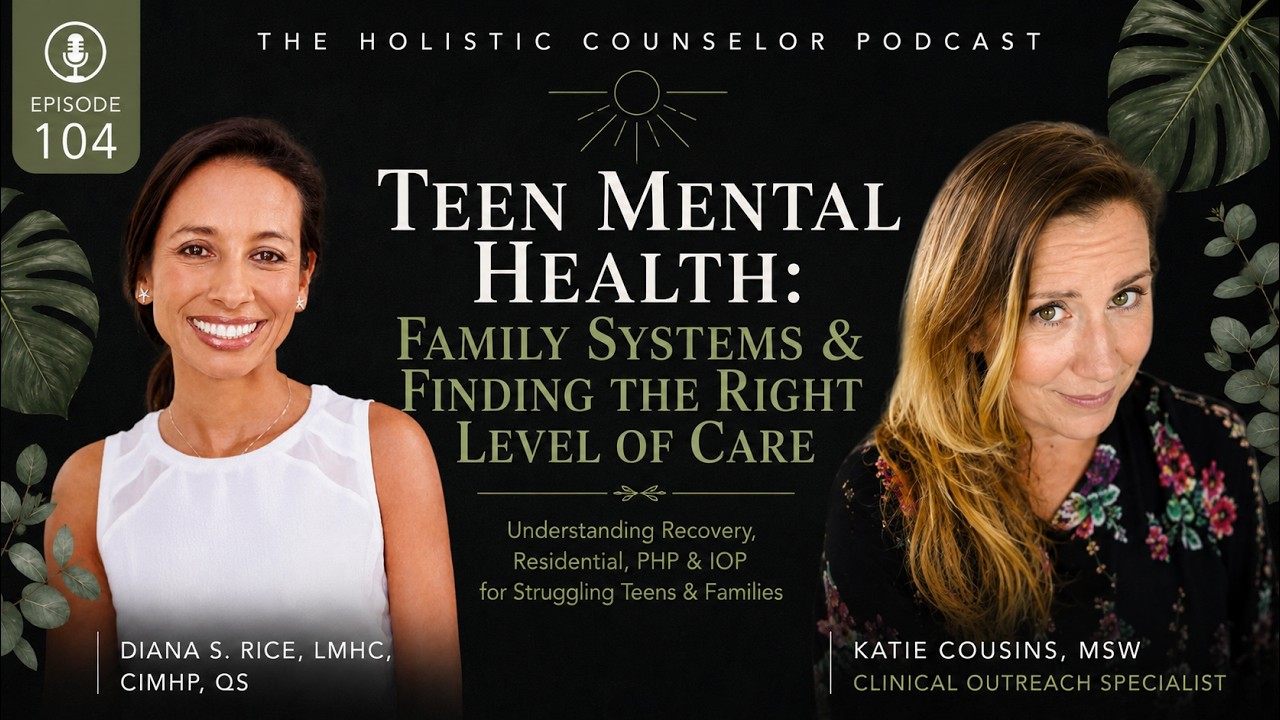
Episode 104
The Truth About Teen Recovery: Family Systems, Stigma, and Getting the Right Level of Care
with Katie Cousins, MSW
Hosted by Diana S. Rice, LMHC, CIMHP, QS
Hello there, fearfully and wonderfully made human. In this episode of The Holistic Counselor Podcast, host Diana S. Rice, LMHC, CIMHP sits down with Masters-level Social Worker and Certified Life Coach, Katie Cousins, to explore how family systems, recovery,…
Listen to the Episode
Press play when you’re ready.
Educational content only; this podcast is not therapy, diagnosis, or medical care.
About This Conversation
Show notes
Jump to a section
Hello there, fearfully and wonderfully made human.
In this episode of The Holistic Counselor Podcast, host Diana S. Rice, LMHC, CIMHP sits down with Masters-level Social Worker and Certified Life Coach, Katie Cousins, to explore how family systems, recovery, and access to care shape the outcomes of adolescents, young adults, and their families—especially in moments of crisis.
Katie brings over a decade of experience in clinical residential treatment, program development, and community collaboration. Now serving as a Clinical Outreach Specialist for Newport Healthcare, she helps families navigate levels of care, understand systems theory, and access ethical, evidence-based treatment across South Florida.
This episode is for listeners searching for support in: family systems, residential treatment for teens, PHP vs. IOP, understanding trauma, South Florida mental-health resources, breaking stigma in recovery, and how to find the right level of care for a struggling loved one.
What We Discuss in This Episode
- What family systems theory is—and why it's not about blaming parents
- How systems influence behaviors like depression, anxiety, addiction, self-harm, and eating disorders
- Big T trauma vs. little t trauma
- Why South Florida has such a robust mental-health and recovery ecosystem
- What a Clinical Outreach Specialist actually does
- How to know when a child or adult may need a higher level of care
- Clear explanation of Residential, PHP (Partial Hospitalization Program), and IOP (Intensive Outpatient Program)
- The difference between the visible stigma (opiates) and the silent stigma (alcoholic moms)
- What "recovery" really means—and why it's more than addiction
- How accurate fact-finding reduces fear, stigma, and shame for families
- The role of community, collaboration, and asking better questions
Two Powerful Quotes from This Episode
From Katie:
"Recovery means, I don't want to feel this way anymore, and I'm doing something about it."
From Diana:
"We go from false evidence appearing real to facing everything and rising."
Resources Mentioned & Helpful Links
Newport Healthcare (Adolescent & Young Adult Mental Health Treatment) Learn more about programs, levels of care, and family support: https://www.newporthealthcare.com/
Through the Valley Therapy (Diana's private-pay online practice for adults in Florida) https://www.throughthevalleytherapy.com/
The Holistic Counselor Podcast Homepage & Episode Library https://www.throughthevalleytherapy.com/podcast
988 Suicide & Crisis Lifeline (U.S.) Call or text 988 for immediate support if you or someone you love is in crisis.
Support This Work
Each episode of The Holistic Counselor Podcast takes hours of research, recording, and trauma-informed production to bring you thoughtful, faith-integrated conversations.
If this episode encouraged you or helped expand your understanding of systems, recovery, or family dynamics, one way to support the show is through the merch store:
Explore the collection: https://theholisticcounselorpodcast.printful.me/
If this conversation resonated, please consider leaving a review or sharing the episode with someone who may benefit. Your support helps more listeners discover these healing conversations.
Episode transcript
Read the full transcript Close transcript
Automatically generated from YouTube captions. Names and wording may contain errors; listen to the episode for the original conversation.
Hello there, fearfully and wonderfully made human. Welcome back to the Holistic Counselor Podcast, where I hope faith, science, and whole person healing come together. I'm your host, Diana S. Rice, licensed mental health counselor and certified integrative mental health professional. Today's guest is someone who embodies heart-c centered leadership, ethical practice, and innovative thinking in the mental health field.
Katie Cousins is a master's level social worker and certified life coach with over 10 years of experience across health care systems. At her core, she's a collaborator, someone who brings passion, integrity, and creativity into every space she enters. She thrives in communities that elevate purpose-driven professionals and believes in leading from the heart to move individuals, programs, and organizations toward meaningful growth.
Her niche is recovery. recovery from trauma, addiction, eating disorders, and complex mental health challenges. She brings deep systemic experience in health care management, program development, clinical outreach, marketing of health care services, and interprofessional collaboration across multidisciplinary teams. Katie currently serves as a clinical outreach specialist for Newport Healthcare, supporting adolescents ages 7 to 18 and young adults ages 18 to 35 across the South Florida region.
In this role, she collaborates with behavioral health providers, educators, and medical professionals to expand access to innovative, ethical, and sustainable mental health treatment. I first met Katie at a South Florida networking event and later we sat down for a morning meeting where she casually mentioned systems theory.
I remember thinking, h tell me more. That moment sparked such a thoughtful, rich conversation that I knew I had to bring her onto the podcast. So today she's here to share her expertise, her heart for recovery, and her perspective on what truly moves people and systems towards healing.
Katie, thank you so much for being here.
Hi. I really appreciate it. I'm very excited.
Yeah, I know. Like, it's great. All right. So, before we even dive into clinical stuff, like can you just share your story and what led you to specialize in family systems and recovery work?
Sure. Sure. It's how how long do we have? Right. Um, let me try to condense them for you. Uh so I come from a I'm an only child um to fantastic parents that I'm very close with. Um growing up uh both sides of my family have struggled um outwardly openly with uh both mental health and addiction.
Um and I'm actually really grateful and I've said this to a lot of my clients in the past. My parents have always been very open and honest with me age appropriately.
Yes.
About the struggles of my family and honestly I sometimes feel like it probably saved my life because I have a lot of some of the traits um maybe that I have seen in my clients over the years. Um and so having that information about my genetics was very beneficial.
Um so growing up as an only child but um because of some of the dynamics in my family um also was raised very closely with my cousins and um with that kind of learning about the intricacies of mental health and addiction in my family.
Uh I was a undergrad major of elementary education and child psychology. So I was a teacher for about six years. And when I was teaching in public schools in Massachusetts, um I noticed some similarities of what I saw in my d my family dichotomy at home uh growing up with some of my students.
And as a teacher,
you know, you have a duty to take care of these kids, but you're also limited, right?
Yes, you are. Yes.
Um and that really I had a really hard time with that. I struggled with that. So, I went back to I went to grad school for a clinical masters in social work um a social justice based program up in Massachusetts and my focus of study was um the cycle of trauma in the foster care system specific.
Oh, wow. That's
And so I worked Yeah, I worked in
What grade did you What grade did you teach back then?
Uh so when I taught in public schools, I taught um second grade and fifth grade.
Oh, and that's so different, right? people like that aren't teachers don't understand like okay elementary school but man a fifth grader especially nowadays fifth graders are like
eighth graders
and now that I have my own children like they're five and seven and even that is different let alone second grade and fifth grade um and so I taught second grade and fifth grade in the in public school setting and then I actually went to the opposite end of the spectrum and I taught at a collaborative preschool um kind of right in Cambridge Massachusetts near Harvard and It was this beautiful warm amazing like vibrant community of parents that were extremely extremely involved.
Yeah. What's what's what do you mean by collaborative preschool? I worked in preschools too. So be you know when in my when I was going to ma working on my masters I was a preschool teacher the whole time. That's what I did during the day while I worked on my masters at night.
So essentially it's a 501c3 right? So the family is the basically the school operating almost depends upon the family the families of the kiddos in the school in certain aspects right so obviously there's education professionals there's a director of the school um but
uh I gosh I don't even know like it's almost like they were our worker bees right like the school would not have really been what it was for the age bracket that we were serving without the parents direct involvement every single day.
So, kind of like sort of homeschool or they they were not allowed in unless they had a certain amount of hours volunteered in the school.
Yeah, you could put it that way. Um, they weren't they weren't designated a specific number of hours they chose.
Oh, wow. Okay. Okay. I see.
And we're talking Harvard professors, we're talking MIT robotic scientists, like
Wow. Okay.
Really just brilliant people.
Yes. um which also served the curriculum, right? So, as teachers, I taught what they consider that they called it the oldest group, the the OG, they called them the OGs, which was I thought very adorable. Um but these are kids that
were very advanced for their age. Um
yeah, that makes sense though if their parents have that kind of brain. That's where we're talking about genetics, right? Genetics.
Genetics. But there's nurture and nature because honestly there's people that are really brilliant in in inner city urban you know where they don't have the resources. This is a group of humans that had resources.
Yes. That is a very good way to to distinguish the difference. Yes. And the thing that was also amazing was
um I had so much freedom especially coming from the public schools at the time um I got to develop my own curriculum. Right. So, and and I and I did so with the specific children that I had in my class at the time.
Wow.
Right. And so then that meant that I could also utilize the parents as resources, right? So like
as an example, and I will never forget this little boy and he now just graduated from MIT um which is so cool. But uh you know a podcast so now his parents can watch it, right? But um I had this little boy, his name was Aiden and I his name is Aiden.
He was like one of my favorite. And um one of my favorite things to do was like get all the recycling goods and just throw them in the middle of the classroom and then just put duct tape everywhere and they could create whatever they wanted to create and then I had this like quote unquote luxury of like a parent that understood robotics like actual mechanical engineering come into the classroom and then demonstrated in a real way.
Right? So now Aiden is
graduated from MIT or is in the middle of junior year or something like that of MIT, right? So it's just really it was just this amazing space that was literally the polar opposite. Part of the reason I went back to grad school because I was teaching at this school for three years after my public school uh kind of stint, if you will.
So I went from
kiddos that I knew were sleeping on the floor, not eating, not having meals. Yes.
To these families. And in my brain, because of the way my brain just works, like,
wow, this is too big of a gap.
Yes.
There's too big of a gap here.
Especially in this country.
Especially in this country. And keeping in mind, we're in like at the time I was in Massachusetts,
right? like Massachusetts that often times is like kind of almost viewed as like a pinnacle
of yes diversity but then also equality in certain aspects. Um
and that was not always my experience in Massachusetts.
Um and so that I actually had a student intern that was in my classroom at that collaborative school that was from the school that I went to grad school and she was the one that gave me information. I had her as an intern and I learned about the graduate program.
There was only 80 people in the program in the graduate program. So it was very small, very specialized. It had a spirituality component. It was a very social justice-based program. And I ended up going there and getting my masters from there because I was like, I'm not okay with this gap.
Right.
This gap is unacceptable for children and their families.
Right.
Right. because their families also don't know what they don't know.
Exactly. Listen, Katie, you're you know, you're hitting a point that is so important for our listeners to understand no matter where they are right now in life because, you know, some people think that they're stuck in that system. Okay?
And I know that listen for you know for me it was I I subbed between being a a you know I was a preschool teacher then I was a therapist and then stuff happened and then I ended up in the film industry but in the film industry I never I the days I didn't have gigs I was substitute teaching.
Yeah.
And so I'm as a therapist I was in an alternative high school. So alternative high school you know what that means. Yes.
And then when I started subbing, I subbed in a public school, private school, and then a super what you're kind of talking about where it's a lot of res. I used to call it the cruise ship school. I'm like, I'm going to the cruise ship today
in a lot of ways.
And that's not to minimize the fact that that that demographic also has there's a lot happening, right?
Um there's a lot going on, right?
Yeah. And that's the thing is
everybody's got problems.
Yes. We're human beings. Yeah, that's right. We're all struggling
in one way or another. And here's the thing is that's okay, right? Because I can also say with certainty because when I was in graduate school, I actually I had a full I was in school full-time, full-time internship and I nannied my old students um almost practically full-time as well.
And I can also say that like as I'm learning while I'm in graduate school, I also know that the demographic in that like cruise ship school also didn't know that there were resources. and also didn't know that like some of the things that they were experiencing
were I don't want to I hate the word normal but not necessarily typical
and it was and their children also might potentially need a little bit of extra support and education around what they were experiencing. So on both sides it
it well listen I what I saw was like you know like anger just let's let's say anger right anger in one in in a group of of people was different because it was very out anger in another group it was so in and hidden
in yeah it was a little
so it's not trying to say one one situation is better than the other it's trying to understand the system your own family system or your own system so let's talk about systems Because to me that systems theory, you know, I know systems, I mean, I'm I'm licensed mental health counselor, LMHC.
So, as as people start understanding and listening and and because people sometimes think it's all the same, Dr. Rice, I'm like, I'm not a doctor. Aren't you a psychiatrist? No, I'm not a psychiatrist. Oh, you're a psychologist. No, I'm not a psychologist.
You see what I'm saying? A social
not the same. I do. I know exactly what you're saying. And it's funny because people like us, we are hyper aware of the differences. And again, people don't know what they don't know. Like if you don't have any reason to know the difference, then that's okay,
right?
Don't know the difference, that's fine. But
but when somebody can maybe potentially explain the difference to you, it's a good like teachable moment. Right.
Exactly. And so systems theories like you you started talking like, "Hey, what? Huh? Are you talking about this?" And you're like, "No, no, this this is what I've taught. This is what I know. this is what I you know and I'm like oh please explain.
So
can you you know explain to the audience what you know how does understanding family systems change the outcome of treatment in in residential settings or even in in their own families
even in their own family. Yeah. And the thing is is like it's got this cute little title of systems theory, right? But at the end of the day, I'm going to let you all in on a secret is that it's nothing that's super complex.
It's this simple notion that literally everything that a human being uh everything that we encounter, everything that we kind of exist through on the dayto-day is interconnected in one way or another, right? And all of those things over time especially will create a person's perspective on the world, right?
And so that perspective is typically what will then trickle down and also kind of create a person's value systems, a person's behaviors, a person's responses to like external stimuli. um the way a person engages in other with other humans on the daytoday, the way that a person shows up to work or shows up to school or drives a car, you know.
And it's funny before we hopped on this, I was like, I need to make sure that I'm not saying that that this is a Freudian thought process where everything's the parents fault, right? That's
Oh my god, I just had that. Listen, I just interviewed a a a therapist, the one before you, the episode. We we had that conversation, too. It's not
psychoanalytical. We're faulting mommy. Mommy's fault. It's always mommy's fault.
No, it's it's it's and I say this to parents every single day in my day-to-day work. And and I can't tell you and I'm almost um I have to remind myself that I'm not talking to the same exact parents every day because I say it so often that I'm like, Katie, you need to stop saying this.
But it's but it's absolutely true. It's one of those scenarios where
I just lost my I just lost my train of thought. It's it's a scenario where
Oh my gosh, Diana, remind me of what we were just
Yeah, the family the Well, see, she's got the mommy brain because she's got little
I do have the mommy brain. And it's okay. It's with the family with systems theory and the family system and understanding like the thing that you keep saying to new parents and you have to remind yourself not to you know that there each person is different.
So but even even then it's okay. It's okay. Listen I love this Katie because to me this goes to show
we're showing off authentically here. Well, we're humans and we're mothers and that Well, I think the point was that we're not blaming when we're talking about family systems and you were talking about the village because this is how I see it. It's the village that raises you.
I was raised by a village. You were raised by a village. We pick up how it is to be a male or a female, how to how what religion, what this is, what is that, what's important. And
the thing is, a lot of people do blame, but it's not about the blame.
It's not about the blame. It's about having That's what it is. Thank you. You You got me there. It's a factf finding mission.
That's what I say to parents, right? We're not talking about We're not talking about blaming. We're not talking about um identifying perpetrators. We're not talking about where the specific moment that everything shifted. We're not talking about a catastrophic event necessarily. when I am speaking with parents that are really like in the middle of crisis truly like in the middle of crisis and they're scared and sometimes they're really angry.
Um it just depends on the scenario and I and I try really hard when I'm gathering like systemsoriented information because that's all it is is information. I try to just kind of take a step back, try to help them and encourage them to take a step back and like listen right now we are in it.
We are in the thick of it. So for this moment while we're on the phone, let's do everything we can to have it just be a factf finding mission.
Not all the emotion attached to it.
Yeah.
Just the facts. Right. So my goal in saying that and I say it to I've say it in this job. I've said it in every job that I've had really clinically for the probably the past 11 years of like and I say it even in my own family sometimes which is important because again as we've already shared they've got a lot we have a lot going on in our family systems.
Um, we need to understand what a human being has experienced in their daytoday because what it's going to help is give us information on how their perspective has gotten to a point of addiction, suicidality, eating disorders, um, addiction to social media, addiction to pornography, um, self harm, um, lying, manipulating, deceit.
These are things that when we can have a better global perspective on okay, tell me about who who's living in the home, who lived in the home, do you have animals? Do they go to a typical school or are they homeschooled? Um, are they missing school because there's so much going on?
What are they like when they're at home? How does the teacher report they are at school? Um, I will ask parents and I because I genuinely believe it's extremely important that parents feel heard and validated that their experiences are scary and anxietyprovoking and sometimes more often than not very traumatic.
I will ask them for like
if I were in your home
when this occurred, what would I see?
Right? Because having an understanding of the PE something that facts of who's in the home, facts of what behaviors occurred because of an event, um having an understanding of children maybe were a pregnancy was difficult. Um were they in the NICU for a certain period of time?
Um did they were they bullied? Uh did they have a tremendous amount of loss in their lives? Maybe grief. um maybe there was trauma and there was um and I kind of delineate it as trauma with a capital T or trauma with a lowercase T, right?
And I learned that from a f fantastic clinician that we have in the field here down in South Florida. I went to one of his talks and he's a a phenomenal EMDR therapist and I actually learned that um from him and and it works really well with parents because
more often than not when people hear trauma they think
right the two major is war and rape
right or or
or the school shooting or
school shootings or sometimes in South Florida we have such a you know a dynamic cultural population down here sometimes it's tsunamis or hurricanes or um and Those are big tragic moments in life.
Displacement.
So this is why um it sounds like you you do a very thorough biocschyosocial bringing in all the information
to find out how to help.
That's really that's why the more facts that I have,
right? And and there's always, you know, kind of why I'm very grateful that I'm no longer on like clinical like a clinical team for an organization or at like a a treatment facility or whatever it might be. I'm very grateful that I'm no longer on like a clinical team anywhere because now I get to have
the biocsychosocial conversation, but I get to do it in in a way where I have time.
Oh wow. Yeah.
Right. Like think about it like you have you every therapist that's listening to this knows exactly what I mean because usually it's like okay you got 90 minutes you got one hour and a biocschosocial is really long it's very thorough
and you have to like do I hate to say short well not me like if you're in in the insurance model if you're in the insurance model that's how you have to do it you have minutes your company right and you have to get it done to get information
diagnostics and things like that
yes and that's important that's important It's extremely that yeah, absolutely. It's very important especially because financial stressors are not again talking about systems. We don't want families to incur a financial stressor. So you being able therapists that are watching this being able to do a full bio psychosocial get a true diagnostic so that they're reimbursed by an insurance company so families don't incur the cost is extremely important.
I have the luxury,
right?
I see it as a luxury of being able to not put a time stamp on it,
right?
So, if I can do a full bio, but then also mom gets a little bit I had a father the other day um that was just so desperate
to help and was so in it that he he got sidetracked. And you know what? That's okay
cuz that makes that's human. That makes all the sense in the world. That was his moment. He needed it. and and and he was receptive to me being like, I'm really glad you shared that with me. I just need to really quick jump back to this because the more facts I have, the more I know
what to do,
what to do or what to suggest or is it, you know, in my current role, is a residential level of care necessary
because parents don't necessarily know.
Yeah. So, explain to me though the clinical outreach specialists because I know quite a few of you and I love all of you. I love all of you because the way you collaborate and I have to tell you Katie, there's a few therapists that have moved here to become therapists, right?
And got licensed and and now they're therapists here. They said in their states, they don't have what we have down here.
Oh, they don't at all. Absolutely don't.
I don't know any different because I went from alternative high school to private practice. I never took insurance. I I I mean in the beginning of my I had to chase insurance down when I was working for a nonprofit as a 1099 but um then I went into the school.
Okay. So I hear this from my colleagues.
It's not normal.
Then and then when they're like Diana like at these networking events they're like yeah we don't have that in California or we don't have that in Chicago or they don't have and I'm like have what? I don't understand it but you you guys do.
So maybe you can explain it a little bit about what I
definitely understand it. Yeah. Um so I'll tell you kind of like a very brief bullet point snippet of what a so a clinical outreach specialist which is my role. Um my job is kind of it's multiaceted. Um my job is to do two things at one time and to do to do them as well as humanly possible. on one side, my job is to go out.
My my territory is specifically South Florida. Um, so I'm I don't know. I guess it doesn't necessarily matter what that literally means, but for those of you that are not in Florida, it is kind of like north of West Palm Beach all the way down to the Florida Keys and then over to Naples, right?
That's that's South Florida. My job is to, as we like to call them, be a road warrior and drive anywhere I need to in my to territory to find professionals that align with our values, right? to find professionals that are perhaps um therapists, psychiatrists, nutritionists, dieticians, teachers, school professionals, guidance counselors, hospitals, nurse practitioners, um other treatment providers, uh like residential treatment providers, um really anyone that might in some way, shape, or form be working with individuals that might need help in mental or behavioral space.
Mhm.
All right. So, there's that part, right? And there are a lot of all of you beautiful people in South Florida, a lot of you. So, I'm very busy, which I love. I love um and so that's one role. And then parallel to that, if any of these beautiful people over here that I'm meeting happen to have a family, whether it's a young adult, so Newport serves up to the age of 35 and then as young as you mentioned, as young as seven.
So, if any of you beautiful people have someone that maybe is in need of I like to say support, not even necessarily services, but really support, right? Um, and you feel like you trust me and my expertise enough to connect us. My role is also to do everything I can to help my clients and their families.
Okay?
Right. So my days are very I don't want to say chaotic because I feel like coming from clinical care it's a chaos that I really I really thrive in and enjoy and sort of can can manage. Um but it's a lot of movement.
So, I'm in my car meeting beautiful people at an event or at a one-on-one meeting like we had while simultaneously
calling and having detailed conversations with parents or young adults and having a deep getting a having a factf finding mission. Right.
Yeah.
And then with those facts, I am supporting them in options for whatever level of care they need, whether that's residential or an outpatient therapist. It just depends on what the facts are telling me.
So, it sounds like you're a bridge.
So, we're on this journey. A human being is on a journey. And sometimes what happens because I I you know, this this podcast is for breaking stigma,
right? In faith-based communities and in in the BIPO community, in all communities, because still to this day, after all this information is out there, people still have this stigma of like, I don't need a therapist. I'm not crazy. Mhm.
Uh I don't have a problem. You know, denial the first one, you know, once you realize, okay, fine. So, to me is we're all on a journey at different levels, situations, and sometimes we get to a like, I hate to say it, like a dead end, and we're sitting there knocking our heads against the wall, hoping that things will change.
To me, it's like you're a bridge to go find whatever help you need.
Yeah, that's a really good way to say it. And and I think that a part of that that that's really important, at least important for me, I think this is probably a Katie thing, like a personal thing, is I'm a bridge that's done the work,
right? I I didn't Google it.
I didn't call an insurance company and ask for like a list of in network providers. Like I am physically driving to individuals and and sharing space with them.
Right.
Right.
I mean, that's what you did with me.
Yeah, I know. cuz you have great energy.
And so and we and I remember that when we were sitting there and and I was like oh my gosh we both like I think we were there for almost three hours and I'm like
oh yeah and I'm like I have to go.
I know. And then I was like I
I have to too. Yeah.
We both were working. I loved it. It was like collaborative working. I was working on my own stuff on my laptop. You were working but we also
like every five minutes we would breathe and talk and then go back to work. So anyway, the
something that that you just said that I think is kind of like for me at least
because I come right so bringing it back in our systems theory oriented perspective here bringing it back to the beginning of like quote unquote my story. Mhm.
I come from a family, my parents are in their 70s, right? I come from a family of really, really good people, but also my parents were sort of the only ones that we talk like my parents talk to me. They always have, right?
And very age appropriately. But that's not
norm. That's not the norm at all.
That's not where they come from. That's not what I even see now, right? There's not a lot. I have I will say though I have this one I have one auntie my auntie Jet and I hope she watches this because I love her so much.
She is 92.
Oh wow.
100% Italian, right? Her first generation born in America. And my auntie Jet breaks all the stigmas of that though for that like hardcore Italian Catholic family. So big shout out to my aunt Debt for trying to change generational cycles, right? But they don't come from like a space where that was normal in the family. like it was kind of like a sh kind of vibe.
And so for people that are listening,
um
it's for me,
the way that I sort of have broken through even with my dad a little bit. Sorry, daddy, for calling you out, but it's not about a problem. It's do you I don't want to feel this way anymore.
Right.
Right. It's like
whatever the problem is, quote unquote, who knows? Who knows what the problem is?
Yeah. It's not always something in the in psychological. Sometimes it could be something hormonal.
There's just like and you're eating. I mean, so many things.
It's starting with the simple fact that you don't want to wake up feeling in your gut and in your heart the way that you are,
it's literally that simple,
right? And so when you when when people are connected to the right resource. So like after if I'm a bridge and I've done that work like I'm getting a factf finding mission with the clients and what they need and then I'm like okay going through my rolodex of like okay who's the right practitioner.
Exactly.
And it's like creating a it's all about creating a space where a person feels safe enough to just not want to feel that way anymore.
Right.
You know what I mean?
Right. and pick up tools like you you find the tools for the human because we're so uniquely made,
right? And so I what I'm hearing is that okay, you're a bridge that has done the the actual work of going out there collaborating, meeting, understanding this person's good for that one, this is good for this, this is good for that, here's what you need.
Oh, you have a seven-year-old. The seven-year-old goes with that or you know, it's just like
Yeah.
building the bridge and putting it all together like the puzzle pieces together for the human.
Yeah.
So, so tell me more about Newport then because like I'm I'm still continuing learning between you and Venina and
Yeah.
and and the group that group I mean I'm in a lot of different collective and networking groups
just
that's good. a lot of different perspectives on things, right?
Yes. And the and so in the and and in the recovery space, I really never was in the recovery space. I am learning from scr's degree, but if you're not in the trenches,
I don't have and I and I admit it. I don't have and that's why I'll be like sometimes you'll see my emails like this is happening. Uh I need somebody.
Yeah.
I think that's what you're building as well for us.
So important. Yeah. And because here's the thing, and this is true as as human beings, it's okay to not know the answer.
That's right.
You don't have to know the answer. That's okay. But who do you know that does know the answer or who do you know? Sometimes it's five degrees of separation. Sometimes it's who do you know that knows someone that maybe works somewhere that might have the answer.
Right.
And so I think a part a part of all of this that we're trying to do and I can speak to South Florida specifically is like we're trying Venina Amanda they're all great examples of like we're trying to create a space where like if I don't know the answer you can call somebody else or if you don't know the answer and you know that I spent 10 years on clinical teams in adult co-occurring residential treatment in
South Florida like you could call me and you can ask me questions and I will give you my experiences, but if if my experience is I'm hearing your facts about your person and I'm like, "Ooh, I know somebody who's even better,
right?" And then I'm connecting you with them. That's really what it's about. That's what the social work, right? That's the social work component. And it actually, this also speaks to why South Florida has so much more than the rest of the country, right?
So, kind of circling back to your initial Yes. You're meeting practitioners that are coming from Chicago or New York or wherever.
Yeah.
And now they're here in South Florida and they're like, "Holy shamolley, this is a lot of a lot of stuff."
Every week there's something to do and go meet every if you really wanted to. And I said this to my boss the other day because he lives in Texas, but he's a he's familiar with South Florida and he was like, "I need to make sure that you're not just going to networking events."
I'm like, "Don't worry, that's not I'm more of a one-on-one person. Everybody that knows me knows that." Um, I get a little uncomfortable in like the 70 plus people networking events because I really like the authentic connection and it's hard for me to do that in that in those.
But a lot of the reason um that there are s there is such a robust networking scenario in South Florida is really because of all of the residential treatment for adults specifically uh really co-occurring substance use primary uh mental health uh programs that are down here in South Florida.
So between those programs of like a residential detox residential level of care for adults, partial hospitalization for adults, um a lot of times practitioners like yourself, outpatient therapists, they're also creating their private practices in this space where those individuals that maybe are discharging from that level of care um have a safe place to go when they leave or some of them were similar to me that they were on clinical teams in these programs and then decided after a period of time I want to go into private practice and so that's what they did
right
and so you have a highly concentrated space in South Florida and a lot of that and you know maybe people that have been
um down here longer than me and there's some great ones uh there's some fantastic uh women and men that are a little older than me and so have been in the field down here longer they might be able to share even more about why that is.
But in my experience, um, in the past like 12 years of being here, that's really what that's about.
Okay, that makes sense. A lot of sense because even even I think before I even became a therapist or graduated, I mean, I know there our our state was known for being the pill mills
and the opiate crisis and all that stuff. We went from, you know, the problem coming and then now we're trying to
and then the solution
the solution solution. Yeah.
And and now and and the thing is like we live in a culture and society I don't care if it's Florida or in the middle of the mountains or wherever we have people that um need help.
Yes. in recovery and there's such a stigma with recovery because even me I am still learning because since it's not that's the thing us therapists don't know everything and we have our niches I have my niche you know my niche right I'm very clear about it because it's important so I first do no harm
yeah absolutely
okay and so so to me
understanding recovery and the stigma and um
I just want to understand like
there's there's some myths out there and you know Yeah. And so and I know you're passionate about psycho education.
Yeah, I am.
To me that's important.
It is. You know I can only share like my so my experience is sort of twofold, right? Um I obviously have a lot of addiction in my family. Um, I've lost my par, my parents especially, like we've lost several family members to um to active addiction and also suicidality.
Um, so I've kind of been, this sounds a little bit morbid, but it I don't necessarily mean it from a morbid place, but I've been going to funerals my whole life.
Yeah, I hear you.
Right. Um, and so I have that genetic component, right, where there's a lot of loss, but in the same time, and if my cousins listen to this, I will be very grateful because I don't want to get emotional, but I don't tell them enough like
my um I lost two aunts, one on each side. Uh, one to active, very active addiction and one kind of at the end of her addiction. So, a little bit more complicated than that. But my cousins that I was raised with, right, there there were three of them now.
Unfortunately, there's only two. We lost one to suicide. Um, but my two cousins that are still with us. Um, have recovered on a lot of different levels, right? And and I remember I remember like vividly,
right?
Like how bad that was for them.
Yeah. And so I've seen it in my family, right? Um, one both recovering so beautifully and are phenomenal mothers. Um, especially from addiction and also like mental health, right? Like
so not recovery doesn't always mean addiction, you know what I mean? Recovery means I don't want to feel this way anymore and I'm doing something about it.
I love that.
I love that, Katie. I love that this is what people need to hear because
it's not about,
you know, out there.
It's not about and and and sometimes it is about like an individual. This is going to sound a little bit crazy. Actually, it's not. I don't think it sounds crazy at all. It's actually one of my favorite things sort of to say because it's true.
Um, when I was on clinical teams down here, I did work in adult co-occurring treatment, really primary substance use. And my favorite clients, my favorite clients were the, and those of you that are listening to this and either work with people in recovery or in recovery, you'll know exactly what I mean when I say this, are the 20s something yearear-old male heroin addicts from New Jersey.
They're my favorite.
They're sassy. They're ready to They are like They're coming at you. They're coming at you full force with exactly what they've got going on. They are my fa they were my favorite clients. Anybody that's listening to this that are my alumni from my programs that I've worked with will would completely agree with you or agree with me.
They're my favorite.
They are the ones that the stigma is about the work the the most stigma right is really if I'm in my experience especially professionally the stigma is around opiates more often than not. The in-your-face stigma is opiates. The silent stigma
is alcoholic moms.
Wow.
That's the silent stigma. The in-your-face stigma is opiates, right? Opiate addicts. Whether that's pills, whether that's heroin, whatever, fentanyl, whatever it looks like.
And I love both of these populations. These two populations are my favorite for two very different reasons. One, I love it when those hard those men I in my experience, it was primarily men. um those younger male because I liked that population and most people didn't.
Okay.
They would give me all of them.
Right. Right.
Wow.
Because I'm I'm very blunt.
Yeah.
Right. And so when you I'm going to show up for the specific individual that's sitting in front of me. So when I would have the uh individuals with that demographic show up, it was usually hard and loud and big,
right?
And so it allowed me sort of to be myself,
right? I'm sort of those things, too.
Yeah.
I'm loud. I'm Italian. Most
I'm big, you know. I'm I'm boisterous. You've met you've you know me. Um and so I find a little bit of peace in their chaos.
Wow.
Right. because I can show up exactly who I am, too. And we got a lot of work done, me and in that population. But the moms and I and I actually was on clinical teams treating um more of some of these more silent stigmas um before I was a mom.
All right. Wow. That to me right now, I've never even heard that. You know what I mean?
I'm in my 50s girl and I've been doing this quite a while, but the silent stigma.
Oh yeah. moms, women are less likely statistically, and I don't want to give you a stat because I couldn't tell you like a true one of 2024 or 2025. But I do know for certain that there is a lot of data surrounding the fact that women are always statistically less likely to get help for two reasons.
One, because of the guilt and shame of the fact that they have families, right?
Yeah.
So, there's that. or depending on their drug of choice. Um not it's typically not alcohol that this is the the case but usually they are in a abusive type of dynamic where the person of authority or power
um keeps them sick usually with drugs usually with elicit drugs. And so that's usually those are the two biggest reasons that women typically don't get help. In my experience, it was more the first, right? When they have children, who was going to watch the kids, how what happens if somebody finds out that they're in treatment when they have kids,
right?
And that and that type of dynamic. Um especially, I mean, just think about any work you've done with women that are experiencing postpartum OCD, postpartum anxiety. Usually, you know, sometimes the drink will calm those things and then that escalates over time and then COVID hits and
Yeah. Oh, no. That That's a whole another episode.
That's a whole other episode.
A whole entire other episode cuz
But yeah, but wow. Silent stigma. I'm I'm wondering I guess I'll do some research and see if there's something to put in there. So,
you know, I if somebody wants Tell me a little a little bit before we wrap this up about Newport healthcare. Like who who can go there? Like what you guys take insurance? Is this country uh like intern not international like
I know national.
Thank you.
Yeah.
Yeah. Yes. So Newport, you know, I never thought I never thought I would honestly I never thought I would be doing a clinical outreach role. I sort of didn't necessarily peg it in my future. Um but for me it's all about authenticity,
right? And Newport is an organization and we actually I actually just said this as a comment on our national all call yesterday. It's an organization that I'm extremely grateful for because from the top down truly and I'm obviously I people could say I was biased because I work here but I choose to work here,
right? I choose to work at Newport really for two reasons. The values that I have experienced with Newport and all of the all of the professionals that I have met and worked with that work at Newport align with my values. Wow.
Right. Connection, authenticity, person centered. Like we're really about the families, right?
Um whether it's families of adult ch uh adults or young the kiddos that we see. But also it's like a trickle down effect, right? Like Newport is authentic from the top down.
I love that. Right. And that I've only ever really experienced it one other time in my professional life and and so it's a great it's a great space. Um Newport operates really all levels of care. So residential level of care, PHP level of care, and IOP level of care.
Can you can you explain what those PHP and IOP
I would love to and I'll I'll do it briefly. So residential is 247, right? Clients are living with us at one of our sites, right? 247 monitoring, full clinical care, psychiatric care, um medical, all of the things that a person that is in a little bit more of a crisis, um struggling to figure out what would help them not feel that way anymore,
right? And I'm not even I'm not always talking about medication in that aspect. I'm talking about an individual that is for kiddos, it's usually their parents waking up and being like,
"We can't do this anymore." Because of what the way that their child is responding to an environment. Um, and so maybe they need more clinical support in addition to potentially medication, but not always. Mhm.
Um for adults it's I don't want to feel this any way anymore and I have no idea where to begin
or what I have been doing is not enough.
Okay.
Right. So they need to be removed from their environment by choice voluntarily. Right. Um voluntarily removed from their um their environment to maybe some people might even consider it a fresh start, right? Pick peel back the layers of the onions and see what's going on.
So that's our highest level of care. um PHP, partial hospitalization program.
Um that is a step down, a lesser level of care. Clients are not living with us at that level of care. So it's considered an outpatient level of care. We only have that in certain states, right? Um
and essentially it's it's what you would consider day treatment, right? You're there five hours a day, Monday through Friday,
right? And it doesn't have to be all recovery, right? Say someone's got depression and they absolutely try to take their life and they get out of the hospital and they need to Okay. So, it's
a little bit more of a we're more of a mental health primary
and then any type of addiction is secondary.
Okay.
Right. So, we're getting a lot we do treat kind of like a co-occurring where they maybe are both mental health and substance at the same time. Um but not all of our sites are like that. Um, I really feel like we we are similar to you.
We do what we do really really well, but we also stay in our lane.
Oh, I love that.
Right. Like we know that we truly want to help people and if we're not the right fit, that's totally okay.
Right.
We're not competition. If you're
We're not a competition. We're a collaborative effort.
Thank you. Yes.
That's right. So, it's like there are people that do my job.
Yeah.
AC for Newport across the country. Okay.
Right. So, it's if we are not the right fit,
it's all of my co-workers jobs in different states to be a road warrior
and meet all of the the amazing programs and professionals could that could potentially help those families, right? So, that PHP is technically an outpatient level of care. We only have it in certain states and it's basically day treatment Monday to Friday, five hours a day.
Right? And then after PHP, the step down from that is IOP, intensive outpatient programming, and that's nine hours a day. Also living at home, sober living depending. And it's usually three days a week, three hours a day.
Okay.
Or night, depending on where.
Okay. All right. So, and then after that, that's when you do you have somebody?
Yeah. So, but do you have somebody do you have a a actual place where people could come and and do individual therapy if they wanted to too? Like, you know what I mean? Like they might not be in recovery. Like say I have a client who's a teenager and I'm looking can I send them to you to find a therapist for for them that don't have any kind of crisis?
100%. Absolutely. I'm glad I'm actually really glad you asked that question because and any one of my bosses, my boss, my boss's boss, my boss's boss's boss would agree that really like I want to be a resource.
Okay.
I have therapists in down here in South Florida and you're welcome to do this too, that they have a kiddo or a young adult, they're they've learned that maybe they have a little bit more OCD traits and that therapist no longer feels that they're the right fit.
Katie, do you happen to know? Absolutely. Okay.
And then even if like you know that they take a certain insurance and they're insurance bound, that's all information that I also have for the different beautiful people that I'm a gold warrior to and I have like a basically a whole system.
Okay.
That I can go through and be like this is a great fit.
Okay, good to know because that to me like I sometime I don't work with adolescence anymore. I used that was my niche and now I'm just over uh I try to take them over 18 or 21. But but that's the thing. I'm still known because I you know they remember, teachers remember, schools remember and just like hey do you know someone and and that's when I'm always trying okay do you take Oscar?
Do you do this? Do you do that? You know um
that's that's what 90% of my job. Well maybe not 90%. That's like 75% of my job.
Okay. All right. All right. So listen Katie, this was so lovely. Is there anything you would like to you know tell the audience before we say goodbye? GH that's tough.
Ask questions
if you don't understand something.
I think that's a good and I feel like that's true on all accounts whether it's in your home with your spouse or your children or you don't know what you don't know and you need information maybe don't web MD it but ask a real person.
Yeah. You know, because I also think that that helps break stigmas. It helps it helps curtail fear
and anxiety. So, ask questions.
Mhm. Right.
Don't be scared to ask questions. Like I ask question Listen, I I've been
I've been doing this a long time. Yes. It's about finding the information in order to grow. It's finding the information in order to evolve and not be stuck because people go to therapy. It's not just in crisis. They do go in crisis. Thank goodness we have this.
But at the same time, it's it's understanding that there are better ways.
Yeah. And you don't have to feel this way anymore.
Exactly.
Right. You don't have whether you personally as like an adult or adolescent, if you're waking up every day and like you just feel uncomfortable in your skin,
right?
Or in your head or in your heart, you don't have to feel that way.
Right.
Right. And if you're you're waking up and you're a parent and you're walking on eggshells in your home
because of something that your child or your children are experiencing, you also don't have to feel that way. It's just about finding out facts, factf finding mission because then when you have facts, we're kind of killing some fears,
right? And that's the idea because fear is toxic and it grows roots.
Yes. False evidence appearing real. False evidence appearing real. Right. And this is what I tell my clients. It's like we go from false evidence appearing real to facing everything and rising.
Yes. See, I love that.
And that you have the ability because sometimes what happens, you just get stuck. And it's okay. It's a strength to ask for help. We're meant to be in community.
Yes. And that's the that's the stigma I'm really trying to break in a lot of different communities because they're like well I should have enough faith or I'm not or or if if it's not that they're like oh no that's a weakness that I need help
and I'm just like okay you can think that but is that a
fact serving you right
that's really that's really what so if like if I was back in my office and I had my my good old 20some yearear-old heroin addicts in front of me I'd be like how's that working for you,
right? Yeah. Exactly. Exactly. See, it's like working with the alternative teenage guy from like the inner city. Like I would tell them that I'm like, I know that you have to be this strong guy, but at the same time, like do you want to end up in prison for the rest of your life?
Like
I mean that's the fact,
right?
Right. That's the fact like statistically shown, right? Like there's
it's like get the facts and and then you have choices,
right? which means you get your autonomy back
and people and that's you people usually like feel like they don't have choices and I'm like I think you're you're not asking enough questions because you
everybody has choices but some but it's definitely true that sometimes it takes a village to map them out. That's true.
That's true. Like sometimes it's okay that you can't you can't find the facts by yourself,
right?
That's all right.
Yeah. No, it's okay to to not be okay. Yeah.
Yeah. Here we are.
All right.
The best we can. One hour at a time.
Yeah. One hour at a time. Actually, one second at a time because tomorrow's never promised.
I know. It's so true.
Don't Don't let me get started on the Bible.
All right, Katie, I appreciate your time. Thank you for coming on the show. And um Hey, listener, please do not forget to trust in the Lord. Guard your heart and re renew your mind. Y
I appreciate you all.
And now for the disclaimer to make sure you understand that you are responsible for you. The content provided on the Holistic Counselor podcast is for entertainment,formational purposes only and is not intended as a substitute for professional medical advice, diagnosis, or treatment. Always seek the advice of your physician or other qualified mental health provider with any questions you may have regarding a medical or mental condition.
Never disregard professional medical advice or delay seeking it because of something you have heard on this podcast. The views expressed on this podcast are my personal opinions and do not represent the views of any professional organizations with which I am affiliated. Call your doctor, 911, or 988 immediately if you have a medical emergency.
The Holistic Counselor podcast does not recommend or endorse any specific tests, physicians, products, procedures, opinions, or other information that may be mentioned on the podcast. Reliance on any information provided by the holistic counselor podcast, guests appearing on the podcast at the invitation of the holistic counselor podcast or other listeners to the podcast is solely at your own risk.
Confidentiality notice. If you engage with the holistic counselor podcast by commenting or posting and are a client, please be aware that you may be revealing information that could compromise your confidentiality. Please remember that disclosing your identity or personal details can be linked to your clinical material.
As a therapist, I am bound by confidentiality and will not respond to any disclosures of this type on this podcast. I am committed to upholding the ethics and confidentiality of the therapeutic relationship which extends to all forms of communication in accordance with the laws and professional guidelines that govern mental health professionals.
I want you to know that your privacy is of utmost importance and you are responsible for protecting it when interacting on this platform or any other public forum. Thank you.