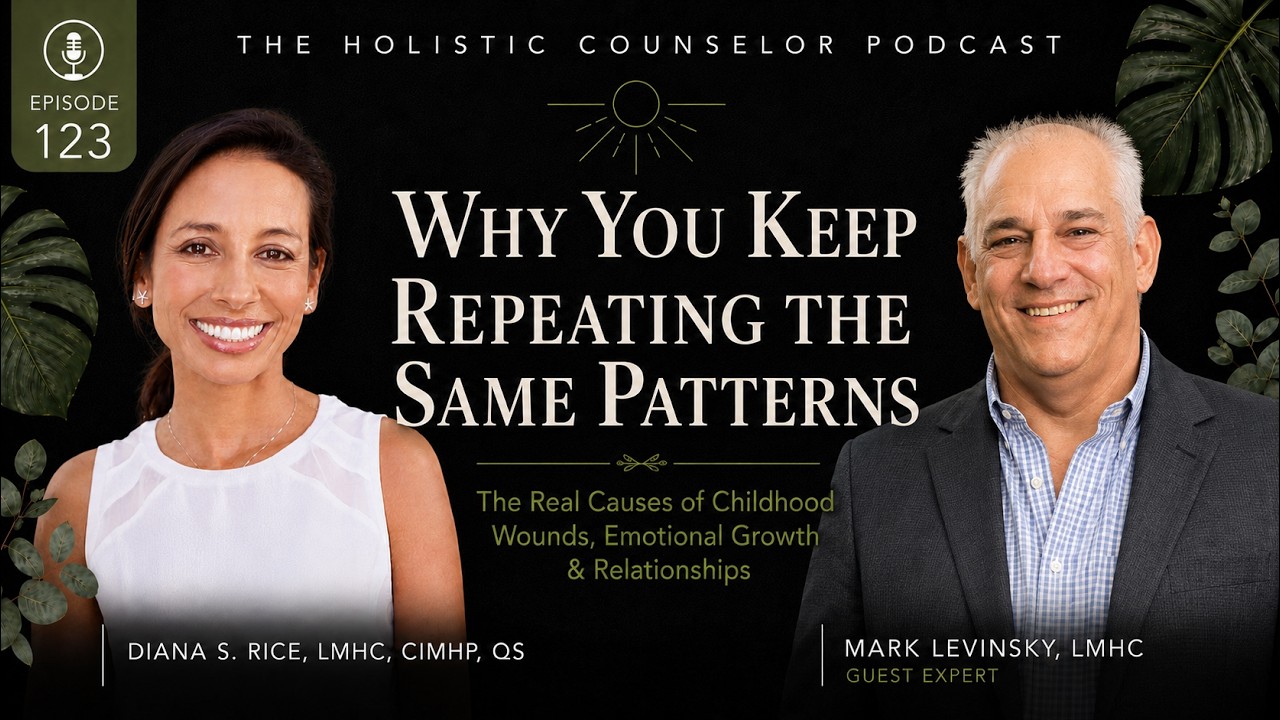
Episode 123
Why Do I Keep Repeating the Same Patterns? Childhood Trauma, Emotional Growth & Authentic Relationships
with Mark Levinsky, LMHC
Hosted by Diana S. Rice, LMHC, CIMHP, QS
Why do we keep repeating the same relationship patterns, emotional reactions, and self-sabotaging behaviors—even when we understand where they come from? In this episode of The Holistic Counselor Podcast, Diana S. Rice, LMHC, CIMHP welcomes Mark Levinsky, MS,…
Listen to the Episode
Press play when you’re ready.
Educational content only; this podcast is not therapy, diagnosis, or medical care.
About This Conversation
Show notes
Jump to a section
Why do we keep repeating the same relationship patterns, emotional reactions, and self-sabotaging behaviors—even when we understand where they come from?
In this episode of The Holistic Counselor Podcast, Diana S. Rice, LMHC, CIMHP welcomes Mark Levinsky, MS, LMHC, licensed psychotherapist, life coach, Certified Instructor with The REAL Courses, and founder of Intentional Living Coaching & Counseling Services.
Together they explore childhood trauma, family-of-origin influences, emotional maturity, vulnerability, shame, men's mental health, addiction recovery, inner child work, experiential learning, and the connection between faith, psychology, and personal transformation.
If you've ever wondered:
- Why do I keep repeating the same relationship patterns?
- Why do I feel emotionally stuck?
- How does childhood trauma affect adulthood?
- How can I stop reacting and start responding?
- Why is vulnerability so difficult?
- What is experiential therapy or experiential learning?
- How can faith and psychology work together?
This conversation offers practical insights and hope.
Mark shares how experiential growth work transformed his own life after years of traditional therapy and discusses why understanding our story is important—but often not enough to create lasting change.
Listeners will gain a deeper understanding of emotional growth, self-awareness, relationship patterns, trauma recovery, community, belonging, forgiveness, and the lifelong process of becoming more fully who God created us to be.
WHAT YOU'LL LEARN
Childhood Trauma & Family Systems
- How childhood experiences shape adult relationships
- Family-of-origin patterns
- Attachment wounds
- Core beliefs and self-worth
- Understanding emotional triggers
Emotional Growth & Mental Health
- Emotional maturity
- Vulnerability and shame
- Self-awareness
- Emotional intelligence
- Emotional sobriety
Faith, Psychology & Transformation
- Personal responsibility
- Community and belonging
- Forgiveness
- Spiritual growth
- Why perfect love casts out fear (1 John 4:18)
Experiential Growth
- What experiential learning is
- How action creates transformation
- Why insight alone isn't enough
- Building courage and resilience
POWERFUL QUOTES
Mark Levinsky, LMHC
"To love and be loved. They're starving to be loved, and they want to love."
"Understanding is the booby prize."
"With action, I believe deeper growth occurs."
"The main thing is not to isolate."
"Vulnerability is strength."
Diana S. Rice, LMHC
"Perfect love casts out fear." (1 John 4:18)
"We're trying to understand. It's not blaming."
"Learning how to become the parent you needed."
"The lessons become blessings. The wounds become wisdom."
RESOURCES
Mark Levinsky, LMHC
Website: https://marklevinsky.com
The REAL Courses
Official Website: https://therealcourses.com
Instructor Directory: https://therealcourses.com/instructors
Adlerian Psychology
North American Society of Adlerian Psychology: https://www.alfredadler.org
Through the Valley Therapy
https://www.throughthevalleytherapy.com
Transformed Mind Consulting & Coaching
https://www.transformedmindcc.com
Related Episode
Episode 103: Why Men Struggle With Emotions with Jon Waller, LMHC
YouTube: https://youtu.be/NR_bKRvPc3w?si=4cVJ2y44HkD889LN
ABOUT THE HOLISTIC COUNSELOR PODCAST
The Holistic Counselor Podcast is where faith, science, and holistic healing intersect.
Hosted by Diana S. Rice, LMHC, CIMHP, the podcast features therapists, physicians, attorneys, pastors, authors, educators, wellness professionals, and advocates exploring mental health, trauma recovery, neuroplasticity, relationships, emotional wellness, faith, personal growth, and whole-person healing.
The mission is to challenge stigma, foster meaningful conversations, and provide practical tools that help people grow emotionally, mentally, physically, relationally, and spiritually.
SUPPORT THE SHOW
If this episode encouraged you:
Leave a review
Share the episode with a friend
Subscribe on your favorite podcast platform
Visit our merch store: https://theholisticcounselorpodcast.printful.me/
Episode transcript
Read the full transcript Close transcript
Automatically generated from YouTube captions. Names and wording may contain errors; listen to the episode for the original conversation.
Hello there fearfully and wonderfully made human and welcome to the holistic counselor podcast where I hope faith science and transformation inter intersect in a holistic way. I'm your host Diana S. Rice, licensed mental health counselor and founder of Through the Valley Therapy and Transform Mind Consulting and Coaching.
If you've been listening for a while, you may remember episode 103 with John Waller where we explored men's mental health, emotional vulnerability, relationships, and personal growth. During that conversation, John briefly mentioned the real courses, which sparked my curiosity about experential growth work and how it helps people move beyond awareness and into meaningful change.
Today, I'm honored to welcome Mark Leavinsky, licensed psychotherapist, life coach, certified instructor with The Real Courses, and founder of Intentional Living Coaching and Counseling Services. Mark has spent decades helping people better understand themselves, their relationships, and the patterns that often keep them stuck.
His own journey through experential growth work in 2011 became a pivotal turning point that shaped both his personal and professional life. Many people today are asking, why do I keep repeating the same patterns? Why do I understand my struggles but still feel stuck?
Why is vulnerability so difficult? How do faith, community, and personal growth work together? These are questions that touch all of us regardless of our background, profession, or beliefs. I'm looking forward to exploring these ideas with someone who has experienced this work firsthand and spent years helping others do the same.
Mark, welcome to the show.
You know, such a beautiful introduction. Thank you for having me.
Yes. Yes. So, I'm excited here as you could tell because like first of all, real courses and now we get to do a deep dive and second of all, um Mark, this is this is your first podcast episode and I'm always honored when someone takes the chance with me to do this.
Yes. you know because they're getting out of their comfort zone and that's what we teach in therapy as therapists right so even before becoming a therapist emd EMDR practitioner an instructor with the real courses you were someone searching for healing yourself you shared that taking the course in 2011 became a turning point in your life what was happening internally during that season and what made you finally decide to step into something so outside probably not just your comfort zone but everybody's comfort zone honestly.
Exactly. Great question. Um actually I I heard of the course a year before I actually signed up for it and um at the time the person I heard it heard it from it. It wasn't resonating with me at the time um I was probably um not open to it and um dismissed it pretty quickly.
And then uh right before I signed up for the course, I actually met a colleague at a networking event who brought it up again. And so I'm one like when the universe gives it once, you know, you can't refuse it twice.
Exactly.
So that that was one thing that really got me intrigued about it. Um I was also in a different place in my life career-wise. I was uh very aware I was stuck and um and stuck in my career. Um I wasn't moving, my clients weren't moving.
I was in adult therapy, you know, I was in therapy most of my adult life and so I was just ready for something different. And so I signed up and
um just it was amazing. It was amazing experience. So, can I ask you said you were in adult therapy? You were you a therapist in a in therapy or or do you mean that you were a human being that was going to a therapist?
Please explain that a little better.
Yes, of course. A human being going to a therapist. I've been in therapy most of my adult life for different reasons
and um the course and the experiential work uh from the course uh really opened up a part of me that just traditional therapy didn't.
All right, let's just go do a deep dive like
you know like you mentioned that although you had previous experiences in psychotherapy, experiential work opened an entirely different door for you. So I want them to understand though their struggles intellectually but still feel emotionally stuck. Why do you think insight alone is sometimes not enough to create real transformation?
Uh there is a big slogan in a personal development world. They say understanding is the booby prize. I don't know if you've ever heard that yourself before.
Oh no no no. Let's do it. Let's do it because you're teaching me. This is what I love about podcasting because my guests usually teach me. What do you mean by that?
Yeah. So, understanding is just a a very small portion of it. Um, with with action, I I believe deeper growth occurs um in in um acting and doing things outside of our comfort zone.
Uh stepping into new experiences. there is just a sematic awareness that come comes from that an experiential awareness that just goes deeper than insight and um and so that was a big part of my experience you know I couldn't make up what was happening I was I was in what was happening and in that I I watched my mind fight it and I noticed protections and resistances and you know things that I would not of of received just in talk therapy.
Yeah. So what do you mean by experential work then? Because I I want the audience to understand because we hear these terms, right? It's just I want to in layman's term like you're talking to an eighth grader.
What what is that? Like you know what actually happens? Because sometimes it could be scary especially like I have a lot of people from the Christian background that anything psychology is evil or or it's from the devil or it's new age or you you better be careful.
But I'm trying to break that stigma to to make people understand that we're whole beings,
experiential like sematic healing. Like this is what I'm trying to understand, right? And I know I've done my own work and and gone to therapy as an adult and and had to deal with a lot of
uh inner child healing and shadow work and money and mommy and daddy issues and just it's a lot of things to to really like you said you have insight and you start understanding but you have to continue like
tell me what the experiential work is. Well, our our course itself is is based on a poem that each line represents a different activity. It's it's not necessarily a poem that rhymes, but it is each line represents a a very specific activity that we um walk our students through.
Um we we let them know why we do it. We just don't have them do it. So, there is a a specific intention and a purpose to it. And um again it's just not talking through things. It's actually walking through the exercises and activities that um from that there's a deeper learning a a a a deeper experience.
Can can you give me an example then? because because I don't know like first of all I don't know how much you're allowed to let us know like about the poem or maybe a personal experience that you had with the situation that that could make us realize what the work is
for me one of the most powerful exercises was where we um got to declare something that we're done with. Um so um and for me uh we cannot ever be done with an emotion. It's what we do with the emotion that we could be done with.
So um for me it was uh not good enough um that I was you know carrying and felt weighted down by it. And so that is something I was throwing away. And then and uh at the same time I'm also picking up um something that I want as I throw it away.
So I chose to pick up confidence. So I'm doing this I get to pick a mom or dad. A lot of what we do over the weekend is inner childbased. It's we it's a lot of inner child healing and repair. So most of it is either with mom or dad.
So I I chose mom and in that there's a declaration and steps to take to throw it away and I was getting stuck on that particular exercise. And in that in that stuckness I I learned a lot. I I realized how my um basically my learning disability from a child was showing up in that exercise.
Wow.
Yeah. And and
so you're doing this one-on-one with a person or are you doing this with a group or tell me how this works?
It's with a group and um and I know that's threatening for a lot of people. It there's so much love and acceptance in the room and we've all taken the course at one point. So we make it clear that they're not alone. So it is group based and yeah so part of it is doing it in front of a room and it's interesting that I'm choosing to throw away not good enough and told it's not good enough in front of people.
So it was really it's uh it was just a whole in doing it there's a whole learning experience as a result of that.
Yeah. I think there's something about when you have witnesses and then you have it makes sense like it it makes sense especially when um I I kind of study al um Adler Adler yeah principles and stuff can you just you know that's rooted in the real course is rooted in that right
yeah yeah
can you can you explain like what that means like family dynamics and maybe just his
theory Sure. Yeah. So, so Alfred Adler actually broke off from Freud early on and he was
Did I say that out loud?
It's okay. A number of people broke off from him, but uh and he specifically focused on, you know, family constellation, family dynamics. He did a lot of around birth order, early childhood recollections and and just saw how from a very young age from events we develop beliefs about ourselves and about others and how we recreate those over and over again in our life.
So it's it's a it's offshoot of his work. He actually um trained somebody by the name of Rudolph Drikers who took a lot of his work and and made it into uh groupbased uh exercises and activities. So this is just an offshoot of of that work.
Okay. And and see this is the thing because I'm trying to remember when I was in school because we know that therapists when they're in school they they learn different theories, right? CBT, DBT, all the all the all the things. And then you get parts and then whoever you are as a therapist, you'll you'll cling on to something you're loving
because usually in in my experience and when I've talked to colleagues, it's usually because we're working through some stuff as well. Like this is right. So I'm still wanting to know like how did those early experience experiences quietly impact adult relationships, emotional triggers, self-worth, leadership, vulnerability, and even the way we experience faith and community.
Yeah. So those early childhood experiences I I touched upon belief systems, how we create beliefs and from you know events from a very young age. There's a thing we we talk about it's called the circle of belief. So Friday night we start off with a little bit of education even though most of you know the weekend is group based and experiential.
So the circle of belief you know starts off with an event from very young and and from there we have feelings and it's usually anger, sadness, fear or shame and from a very young age we make a decision. We make a decision about that event and we develop a belief system around around the event and then we recreate it over and over again.
And so those early childhood experiences and the beliefs it it frames you know how we see ourselves, how we see others, you know [clears throat] how we do relationships, you know how we do life. And it's usually we learn to from there we we those events we're we're reacting to life.
We're we're getting triggered by childhood events and reacting. And a big part of the work is to understand, you know, that what's still alive from our past and working through it so we can respond to life rather than react to life.
Go ahead.
No. So it affects it affects faith. It affects all aspects.
Yeah.
Oh no, it does.
Adult life.
No. And when I do work, like I do a little bit of IFS. I I I eclectic like a lot of us are. And what I'm hearing is like you give them a it seems like it's very um like an intensive which is great because some people once a week, right?
One hour a week they go to therapy. Not saying that talk therapy is not good at all because I am a talk therapist, right? Because I'm not EMDR. Do you use your EMDR in there too or No?
No. No, we don't in there.
Okay. So, that's just for your clients that you see weekly then.
Yeah. And in all honesty, I I'm I'm trained to do AMDR. I don't use it a lot. I'm not certified. So, Oh, yeah.
You know, um Right.
Yeah.
But, um it it is a good good tool to have if people are not moving through talk therapy.
Right.
Yeah. But we we don't practice that in the course.
Okay. So, you said course, right? Because like automatically I'm thinking a course. Oh, is this an 8week course? We meet once a week for an hour.
How explain the whole course like how because I want to just you know like in case someone's there fearful like I want to do it but I can't because I don't know like how do we explain to the listener what it entails so they will either check it out or calm their their fears because that's it vulnerability is something that many people are not comfortable with being vulnerable especially men
you know I I know women too you know I'm not going be that person. I know. And and people, let's just say humans, there's humans there on a spectrum that vulnerability is was taught. They were shamed about it. They were hit about it.
They were I mean,
I I'm surprised I'm very very vulnerable because um
because I did my work. But but I was I was raised in a culture that shamed it. vulnerability, being emotional, like this world is going to eat you alive if you don't toughen up. Tough. I mean, I don't know how many times in Spanish did I hear toughen up
and and if you know me personally, and Mark, you probably sense my personality. I'm a person that's just very open and I cry and I learned that I I had to do the work to accept that the vulnerability is who I am and it was nothing to be ashamed about.
All right, so back to the real courses. You said Friday night. What do you mean?
Well, so if I could share like I have a very I have shame about being, you know, as a as a man of of, you know, expressing vulnerability, emotions. Uh, also part of it was, you know, my training as a therapist, you know, don't show, you know, and I've learned to be very
Thank you, Freud.
Yeah. I'm sorry. That's why I said, thank goodness we all spun out of that because
Exactly. Yes. I've learned to be vulnerable. Uh, and where that came from for me was more my mother and her inability to handle certain emotions. And when I was emotional, she got triggered. And so, she subtly found or not so subtly found ways to shut my emotions down.
And so, that was a big area of of, you know, that I had to work through. I got to work through to be more uh open and vulnerable.
Yeah. So, um it's it's a 25 hour plus course. Um and it starts uh it's Friday evening, uh 6:30 to 11 at nights. Um we we start off the the students meet upstairs and there's some introductory exercises and then we have them come into the room.
Starts off with some lecture. We go over some concepts of u the weekend. We talk about the circle of belief. We talk about um what's called the victim triangle which is how we do drama and in life and and um and uh we talk about we recognize that everyone there is in some form of protection.
So we work on you know calming their protections and uh bringing them into a place of learning and then we get to meet all the students and then there's a wonderful closing activity we do uh Friday night
and then Saturday is a long day. It's 8:30 in the morning to 8 at night.
Wow.
And um you know we you know get we start off with some meditation and then we map out their work for the weekend. Um and then we start getting into our uh [clears throat] exercises and activities and um a part of our course is when a student takes it they get to come back for free to assist and it's like a life lifetime membership.
What?
Yeah. and and and everyone gets to come back and you know reexperience it and learn and uh
and help and help be supportive so that the students have some assistance assigned to them over the weekend
so they have like a support team
right like a sponsor I want to say I'm I'm trying to I've been to some stuff like that for marriage where it was like United marriage encounter where you go for the whole intense weekend with your significant other and then the couples that have prayed for you and and and go in there with you.
They've done it, too. They had to do it to be able to. But that's the building of the community like AA or Oh, man. That's smart. Okay. Who invented this again? Who Who created this?
Who created this?
Yeah.
Uh it's an offshoot. We I mean our um course came off from a a course in the 80s
that so it's been going around since 1900 1980s
not the 1880s 1980s
and um and then we've just uh after the pandemic we we shifted into uh the real courses and um
we've made it more of a traumainformed um um uh course. Okay.
So we we you know we recogn rec recognize the traumas. We do a lot of work in terms of you know debriefing after the exercises to help them calm their nervous system and help them co coales learning and um so you know so Saturday is a bunch of exercises. is we end Saturday night with some really just very uh soft loving exercises and then Sunday is also 8:30 in the morning and graduation ends 8 at night.
So yeah.
Okay. So I have to ask for for because this is what I would ask anyway would be um how do they eat?
Do they eat? Do people eat or fasting?
They go out to they go out to lunch with their assistants. So those that are assign assigned to them, they have a lunch break. That's where they really get to bond and connect and
and we um
we assign the assistants based on what we know of the students. We do an intake before a student takes the course. Okay.
So we do a there's a a good matchup process that we're making sure that the students well cared for. We usually have a like a a more senior assistant along with uh some other assistants.
And is this this is an individual course though because now that I'm thinking I'm like do couples come together or can family members come together or you think that's not a good idea. How does that work?
Well, it depends on the relationship. I love when couples do it together as long as
they don't so they're both there doing their individual work but like witnessing each other's work.
Oh my god.
And as long as they're not weaponizing the the information against each other that that's that's really important. You know that they're not weaponizing it. Um that they're in witnessing each other's work. They have a deeper understanding of each other's childhood.
Wow.
And understanding like, oh, that's what that's about.
Because, you know, when two adults are fighting, it's really two kids fighting.
And I love that. I just heard that theory. I don't know if you've heard this theory yet, but there's a theory out there that I It's probably Tik Tok. And I work with such young people at times that they teach me so much.
I'm not on TikTok. And uh it it was like everyone's 12 years old. Have you heard of that? Everybody's 12 years old. I I mean I've I've heard like even sometimes before 12, but yeah, probably everyone goes like my my thing is 10,
you know.
Oh no.
For some reason age 10 just brings up a lot for me.
Wow.
And and that's what I ask, you know, when somebody's reactive. It's like, how old are you right now?
Wow.
And then it brings them to the moment from their past at their end. And a lot of, you know, what we do over the weekend is reparing. So, it's learning to take care of our younger selves and uh and it's a big part of the healing.
And so, with the couples is if they're healthy and they're look having more uh creating more empathy about each other's past, it really helps the relationship. So, I love when they take it together. There's some exercises that I usually love having couples in the same pod together for that reason to get a deeper understanding of of each other's childhoods.
Oh man, that's so great because you know there's there's quite a few people that I know when [sighs] you especially men that I talk to that that they're just like why do you go to the history? The past is the past, you know, why would that?
And I'm like, and I tell them what I think, right? Is like it's important to understand history. It's not to blame because there's a lot of guilt in some of our cultures out there that, you know, we're blaming mommy and daddy or especially mommy.
Like that that's why Freud always got on my nerves because I'm like, you're always blaming the flipping mother. Where's the father here? You know,
exactly.
But it's like I want people to understand the importance and this is how I express in when people work with me. It's like I know you're going to feel like you're going against your family or the collective family unit. It's it's we're trying to understand.
It's not blaming. You might have to be with me and blame a tiny bit to be a victim for a minute, but you're not going to get that's the fear. they're stuck that they're going to have the victim mentality or they never were given the permission
to explore and so they're living on this edge and they're wondering why they have anxiety and depression.
So what you what do you say about what I'm what I just blurted out?
Well, no, I I get it. It's a it's a big it's a big uh obstacle over the weekend when they see it as we're just blaming our parents and and what we do is we really uh stress that it's not about blame, it's about honoring your truth, honoring your experience and um we do work on forgiveness over the weekend.
So it's not holding on to blame. There is a part where we do forgive and and realizing that the blame is really harming us. It's not, you know, only getting in the way of the relationship with our family, but it's also harming us.
So, it's a big part. We don't keep people
in victim. We we we point out victim when when it happens, but in in, you know, in a way that they can hear it
and and see it because they don't always see it. and and we just work work through it in terms of uh you know our processing.
Yeah. So the intake I think would be super important because you must do a really thorough biocycle social because you have to make sure like that people that need a higher level of care do not infiltrate something like this that ends up like you know if there's like an emergency because I know in our like we like Mark understands what I'm talking about because we're therapists and we probably have seen some stuff And so how how is that intake?
Like how do you protect the space?
Well, so there's an initial call and part of that is like a mini kind of intake. And so this course isn't uh recommended for somebody who is just out of detox. Let's just say, you know, somebody who's um alcoholic or an addict. We want them to have a foundation of sobriety under their belt because we don't want to trigger a relapse,
right?
And and we we call our work emotional sobriety, which is a big term in in in the recovery space.
So that, you know, that's where they get excited once they have that foundation to, you know, take our course because it's the emotional sobriety piece that they're working on. Um, anyone who has like a a psychotic uh process going on like a a fragile ego u is not recommended.
Um, we are open to talking to therapists um that they're working with not only before or after if the client wants us to. And uh so there is that screening process and then once they sign up there's a more lengthy intake to get more
the history and setting their goals and intentions for the weekend.
Okay. It's not like you're just taking in people and then have a bunch of strangers there and then you're like
hoping for the best.
No. No.
Good. Good. I'm glad to hear it cuz there's, you know, there are people out there that create things and then,
you know, sometimes they can do more harm than good. I just want to understand a little more of the the meditation because I know my Christian listeners are some of them, not all because remember all religions are on a spectrum how I see it.
Some are very fundamentalist conservative and others are like more in the gray area of understanding like okay, God is much bigger and a mystery that we can't put him in a box.
Mhm. with [clears throat] the meditation is it like you know do you take people from all walks of life of faith?
Yeah. Yeah, we do.
Oh, cool.
Um the meditation it's being that a lot of what we do is inner childbased. It's a guided meditation to go back to the time in childhood where there's, you know, a lot of emotions and just uh separating the emotions and attaching them to the event
and just getting in touch with what their little child needed in that moment.
So, it's just really to guide them into a space where they can map out how they're going to do the uh emotional work over the weekend.
Okay. Um we we we make it clear that we're not an um discern exercises where somebody um there might go against their values, their faith, faith, their morals
and we're we're sensitive to that. We of course don't force them to do it
our way, but we also explain the purpose of the exercise and we help them find a way that is true for them to do that exercise.
Okay. Good.
Not to force it, but a way that feels in integrity for them.
Okay. Wonderful. Good. Good. Because I I I'm going to tell you the story. I I went to a my boss at the time asked me to go to this training and I'm like, "Oh, yeah, great." And the first um hour of the training was very science-based, neuroplasticity, my mind.
And then at the very end, they're like, "Okay, if you want to come back next week, you need to bring flowers and fruit." And then brought out a picture of a guy in a whole white robe. And at that moment, I'm like, "I'm out."
And then I went back to my boss going, "Are you flipping kidding me?" Like, you really
Wow. So none of that.
Did he give you some extra vacation time at least after that?
No, but these are lessons like you know when I look back at life, right? These are like lessons and bless and what I love and what I just heard. Well, first of all, please make that crystal clear. That's not what you do.
That's not what we do.
Okay, good. So it's not at the very end like on Sunday evening after everyone graduates. You're not going to come and say now you join the cult.
No. Okay, good.
I mean, some people refer as a cult, but it's like a cult of love.
It it's we
I think it's community. I hear I hear it's a community and not not cultish where you're there's not one leader and every and and he's right or she's right and then everybody else is wrong. I'm hearing that
you are creating a safe space for people to come together
to in order to to really move that like you said because sometimes in our field we are just managing symptoms.
We're just managing the anxiety and managing the depression and then you're there for decades managing and what I'm hearing is like you guys do a deep dive when the person's ready because not everybody's ready for something like this.
Yeah. And that takes, you know, brave, like bravery, like, did I say that word right? Bravery. Yeah. You know,
it does. It's definitely stepping outside of the comfort zone.
And and with anxiety, um,
which uh, you know, we we see over the weekend, we we a big part of anxiety, I'm sure you know of this, it's it's really emotions having a fight against each other. So it's a it's a tugof war between, you know, wanting to be angry and being afraid, let's just say.
And so a big part of the weekend is like separating each emotion. We work on anger, sadness, fear, and shame. And we we intentionally separate each emotion so they can tap into it without getting into other emotions and just working through it.
I love that.
Helps people calm down. Yeah.
Wow, Mark. I love that because like I'm just thinking of some of my clients where you know it takes months because they have to get to that place to really touch that right and they're in and so here it's like they get to go in it if they're willing though that's the thing cuz that protector part will come in and
boom like keep shutting it down and I'm the one who will be like stop it like we got to let that that part of you come up but there it sounds like you have such so are all the instructors licensed therapist.
Yes, we have uh one as a coach but um well uh uh the rest of the instructors are licensed therapists and um you know even though we um consider Ursa's personal development, not therapy, we do have uh you know obviously we're trauma informed and and so we are able to handle anything that does come up over the weekend.
I love that. and um and so um yeah, so it's and we've all taken the course so we've all been there, done that and um it's benefited all of our lives and just we it's my passion and I know it's the other instructor's passions too.
Yeah. So um when you're so the weekend happens, Sunday happens. What if somebody like Sunday evening is like you know I think I want to do more work and and how do you do that? Do you recommend therapy too to like do do the courses and and go see a therapist once a week or or twice a you know a month or once a month too?
Like how how's that work?
Yeah. If if they're not in therapy, we do recommend therapy.
Okay, good.
We're very mindful if somebody is already in therapy.
That's where we're uh the student is open to it and a therapist is open to it, we we're happy to talk about what we do and and what showed up for the student so they can incorporate that that into the therapy. Um mo most of them just naturally go back to their therapy and talk about their weekend and what came up for that.
Um and uh um we do have a 4-week followup with via WhatsApp in terms of the student group.
Uh so and it's overseen by some people in our community. I'm one of those who are on the WhatsApp just to stay connected to the student, answer any questions that they're having,
right?
Um, you know, it's a way they they can stay, you know, connected and supported and accountable to um their commitments because they do make some commitments like forgiveness on what they're going to do to continue
living a life of forgiveness, for example.
Wow. I I really love that because forgiveness is so important. I know if I wasn't able to forgive, I would I would still be stuck or doing drugs because I was I started drugs at 12 years old.
So, you know that that's how Yeah. Like and so I mean there's a theory there too where they say wherever you start smoking marijuana that's where your brain gets stuck at.
Exactly. Exactly. Yeah.
And I'm like, "Oh, okay. Maybe I'm still 12." But I don't feel like I'm stuck.
Mhm. Yeah. And that's why that emotional sobriety piece is so important. Like for somebody who's giving up their drug, it doesn't mean that they're going to automatically catch up. It's that Yeah.
Gosh, I wonder if I'll ever catch up. Anyway, so I I want to
I want to know what you think about like, you know, from your experience leading these groups and experiential work, what do you think people are truly starving for right now when it comes to healing, belonging, and authentic connection.
Yeah. To love and be loved. They're starving for they want to be loved and they want to love and and so um to be seen to be understood in that space you know the student connects more deep with themselves and as a result of that they connect to other people more deeply
you know there is a exercise uh what I see in you that I see in me it's um it's it's about really sharing you know, from looking within and really getting understanding where we're at that we can understand and and connect with others.
I love that. It's so important. And you know what just came up to me while you were saying that and I'm going to say it because I'm a woman of um that that's a disciple of Jesus Christ and many Christians are listening to.
It's perfect love casts out fear.
That verse just came to me, right? Perfect love cast out fear because we live in such an age at this moment where we are not meant to be holding the whole world's issues in the palm of our hand.
Yes.
Right. Yes. Yes.
And and fear is how we're controlled.
And what I love is that you have a safe space. Okay. So tell me how if anyone wants to do this, how did they start? Where did they go? When is it happening? Well, let's just say like I don't want to give exact dates because this episode I'm recording right now will come out in a few months.
So, so let's talk like
how do they find out all about this and also I want to know about you personally like tell me about the real courses but if somebody wants to work with you maybe there's a young person or any person that are you still seeing clients?
Yes.
Okay. Okay. So tell me all about it.
Okay. Uh so for the course you know uh we have a website the real courses with ans.com and um there they can um learn a little bit more about what we do. Uh you know get to meet our instructors and our our backgrounds.
And then there's the dates on the website for our weekend intensives.
Wonderful. Um, for me, I'm in Boca Raton. I'm a licensed mental health counselor. Um, my website is M. Leavinski, LMHC at markleinsky.com. And, uh, there they can kind of read up more about my background and and get to know me. And, um, they can call me um on my cell, it's a business cell, 954-5478416.
Okay. So either way whe whether it's working with me personally or for the for the courses that's a number they can call and I'd be happy to talk to them.
Do you meet in person? Do you have an office that people could come to in person? Now my question is can people from all because people listen from all over the world?
Can anyone take this course and can anyone work with you? Like how's that work? Well, not. So, for the real courses, yes, anyone could take it from from AC across the world. Cool.
And um and
uh with me, you know, I'm only licensed in the state of Florida to do therapy. So, that's where it becomes
Okay.
Yeah. Yeah. A little bit more challenging. Yeah.
Do you do online therapy, too?
I do online.
So, you're h you're hybrid.
I'm hybrid. Yes. Yeah. My my office is in Boca Raton.
Yeah.
And uh you know I prefer in person if people want to do in person but virtual is great too.
Okay.
Also run a men's group uh
um you know virtually which works out really well.
Oh no. Now you got to tell me about this men's group because listen there's I'm always looking for resources for men.
Um, just because you know like I work with a few and I they call me their psychoeducational trainer because I'm trying to break the stigma of therapy because a lot of them their culture has told them that therapy is stupid therapy makes you a a wussy therapy you know all the things that some cultures will really really make or you know you're not man you're not a man and I'm like sitting there I'm like no to
me you're are more of a man when you can actually be holistic and touch these parts of yourself, take responsibility and learn and grow and evolve.
Yes. Yes. Let me not
No, no, no. I I I hear you totally on board with all of that. Yeah. We we have a you know, vulnerability is strength. I don't know if you've heard that phrase.
I love that.
Yeah. And um so with actually during the weekend when we do have men that open up and get vulnerable, it's it's just beautiful first of all to see them, you know, and that safety for them to do that. But uh and and every once in a while because men often look down in shame.
I noticed that doesn't doesn't mean women don't also but it's often the men looking down in shame and then we we point that out you know um you know just look around the room and I ask you like what are you seeing right now and they say people they're seeing people that care
you know people that are safe you know they they start identifying what they're seeing which helps with the shame and Um, I've learned for me to, um, I have my people I can go to when I'm experiencing shame and um, and usually the response is, "Yeah, yeah, me too."
Which, you know, I'm not alone. So, for a lot of men, it's that normalization. I'm not alone. Um, there's a a deeper intimacy. Um, so yeah.
So with the men's group, is it is there a name for it or does it start like here's week one and it's and you have like a curriculum that you've created to work through things or is it just an open air online men's group?
How's tell me a little more.
It's an open men's group but it is specific to the course. I should have shared that. So like men who have taken the course that want to continue doing their work,
you know, and and because they have the same language.
Yeah, that's working on the inner child. It's it's it's for them. But I I know of some male therapists that have open men's group that's not attached to having taken the course.
Okay. No, that's I just wanted to clarify that in case because people are searching. They are they're searching for comm healthy communities. They're searching to learn what's going on inside. I see it in this younger generation more than ever ever wanting that truth
and and trying to like stop the intergenerational trauma. And you you said something important the vocabulary. So to me like something just happened in in my realm in my personal life and I had what helped me the most is the education and learning the language of what was happening and that helped so much.
So I guess on the real courses everything will be in the show notes and on the real courses website it does is there a glossery or vocabulary or you know like say that someone's listening right now who feels emotionally numb, disconnected, guarded, ashamed or afraid to ask for help.
What would be the practical first steps would you encourage them to take toward healing connection and becoming their authentic self?
Well, first of all, I would I would encourage them not to isolate. That's the first thing somebody wants to do in that state is they want to isolate and and and do their best not to. I would encourage them to um look at some people that they could trust, you know, one or two people that they could trust and start opening up to.
Yeah. Um definitely community finding a group of you know like-minded individuals that you know are working working and moving towards where they want to go and um main thing is not to let their mind trick them into um I I know for me I I've learned to witness my mind in action and so you know I just shared like uh how I'm becoming more comfortable sharing shame, but there are some times afterwards where like why did you just say that?
You know, so it's my mind wanting to undo some really good things and and I would encourage somebody to be aware of when their mind is trying to rob them
and not let that happen.
Right. to to me in my in my faith tradition, it's like, you know, there's evil that wants to steal, kill, and destroy you. And and they don't only want to steal and destroy you, they want to steal and kill and destroy your entire all your relationships.
And so, I like how you said that. Yeah. You you start witnessing yourself like you you teach your brain a new way of stopping and
you know wondering without shame or guilt, right?
Yeah. And and then I love I love that. Yeah. So I I see that with the theories and the modalities that you have come up with not only in your personal um therapeutic alliances with others but also with the real courses that's so important and that's what I want the listener to understand like that you have the right to stop and and be with whatever comes up.
It's what you do with it, right? It's because I mean I get angry but I'm not going around punching people in the throat anymore.
Oh good.
That's a good thing,
you know, and you can learn this at a very young age. Oh. Um, can I ask you what's the age? Can because that I think that's important because I have listed teenagers and stuff like that. Like what for the real courses, how old do you have to be?
Well, we have a minimum of 13, but a parent has had to take the course. So, we we don't, you know, the parent needs obviously know what they're getting their their child into. And um
and so, and that's just amazing the dynamics that happen with younger people mixed in with the uh you know, uh adults. Some of the dynamics. Um there was one one student that I remember she was actually a teacher an older woman who was really having a strong reaction with somebody who was so young and by the end of the weekend she learned so much.
It was just such a shift like you know her her judgment of it
when she was able to kind of get through that and just so many lessons for her in that. So
it is
so we we average you know it's it's we're probably middle mid um what would the average age be? I would say like uh upper 40s is the average age. That's when everything kind of slows down and you start your kids are grown and you're realizing what just happened in this culture
because we can't speak about other cultures. We could speak about our American culture because it's a fast-paced don't feel individualized. I love I love my country. I love USA.
At the same time, I have come to see the destruction it has done to our humanity.
Yeah.
Right. And so it's like learning how to re re redo things and become the human or the parent you needed. That's what I had to do. I had to become the mom
and without blaming her or putting her down. Like I realized she had her stuff that she didn't deal with.
Or even the village that raised me, they we were all unhealed humans under one roof in survival mode.
Yeah. Yep.
Right. And so it's like Oh man, I could keep talking you on and on. Is there any Oh, anything you want to say before we say goodbye?
Oh, just in line with that, I and I I know politically we're in like and and this we're in trying times. Mhm.
Um but I do see you know as we learn to connect and become the parent that we didn't have and and take care of yourselves that becomes le less we can live through that more with more ease.
Yes. live through politics, religion, all the things, all the isms that keep us separated, alone and isolated, thinking like this or othering. I mean, dude, I guess we could sit here and talk for another hour
because it it is Mark. It's like understanding that and then we become we get it's like a power that you end up having that you never really had but without without like cruelty. M
without like that anger and hatred and because that's fear to me that's the fear and that's why I kept saying you know per perfect love casts out fear and understanding what perfect love is and it's not us being perfect ever
ever.
Yeah.
Right.
Yeah.
So is there anything you want to say before we say goodbye?
I I think this is in alignment with what you were just sharing. I just want to share like uh after I took the course
um I went to I was at dinner with my mother and um my mother and I had a pretty contentious relationship.
I feel you.
And um because of the you know the shifts and and um you know being more connected to myself and comfortable in my own skin after the weekend. You know, my mother noticed at dinner that my hands were open. They weren't baldled up in a fist.
And I just remember when, you know, just the openness that I had and and how things that used to kind of, you know, get me and attached to me were were not there because nothing in that moment could have kind of taken that away.
So, it's just uh yeah, it's a beautiful experience.
It's a surrendering. you surrendered it
to
I want to say a higher power. I don't know what you believe in,
but to me it's a continually surrendering and because sometimes what happens we hold on really really tight and we want change and this is when we become with the black or white thinking or all or nothing or the othering like I was saying and
man just what a beautiful I mean like I know people are going to be like well how much is it I don't know if you want to say how much it is or you know it's really important for people to understand that you're going to pay either way.
You're either going to pay for prevention or you're going to pay for like the the outcome of not helping yourself, right? Because either way you're paying. You're either paying for your illness or you're going to pay for your wellness.
Exactly. Exactly. Um
does it say on the website how much it is?
We're we're going to add that into the facts and questions. So, it is uh $1,125 for the weekend.
Okay.
Um we do have payment plans. I don't want finances to be the reason why somebody can't take it if they're ready to take it,
right?
And I I have some students on long-term payment plans and that's fine. So, I I work with them
um if needed. there's a bit of uh some scholarship money that could be taken off uh of their price, but you know, just if anybody out there is listening and and just cringe with that price, still give me a call. So,
yeah. And also, you got to think about it. If it's how many hours? 25 hours time 100 if you're going to therapy.
Uhhuh. Yeah.
You know, so it's actually half price.
Yeah. Exactly. So you get it.
It's very reasonably priced and again people get to come back to assist for free.
Ah yeah that's right.
We do a lot of community events so it's uh
Oh wow. All right.
It's well worth I've had people say we should charge more. So
Right. Right. No, I think it's because you're realizing like, well, we have to pay to put keep the we're in South Florida, the air conditioning on and, you know, bills that we all have to pay. And then you also want to be affordable.
Um, and and and to encourage the the healing that so many people need,
so many, you know, and have that understanding.
Man, Mark, this is great. Thank you so much for coming on.
Thank you for having me.
And, uh, yeah. So, do you want to say anything else before I uh hang up
again? Thank you. I just like uh experiential work. This was a new experience for me. So, thank you for helping me stretch and
yeah,
I'm I'm [clears throat] glad I'm glad I was on. Thank you.
Yeah, you did a great job, man. I loved it. All right. And listener, if you made it this far with us, thank you. Thank you for listening. And if you have a chance to, please rate and review. It helps others find these conversations that are really important.
And do not forget to trust in the Lord, guard your heart, and renew your mind. Bye.
Bye. Thank you.
And now for the disclaimer to make sure you understand that you are responsible for you. The content provided on the Holistic Counselor Podcast is for entertainment, informational purposes only, and is not intended as a substitute for professional medical advice, diagnosis, or treatment. Always seek the advice of your physician or other qualified mental health provider with any questions you may have regarding a medical or mental condition.
Never disregard professional medical advice or delay seeking it because of something you have heard on this podcast. The views expressed on this podcast are my personal opinions and do not represent the views of any professional organizations with which I am affiliated. Call your doctor, 911, or 988 immediately if you have a medical emergency.
The Holistic Counselor podcast does not recommend or endorse any specific tests, physicians, products, procedures, opinions, or other information that may be mentioned on the podcast. Reliance on any information provided by the holistic counselor podcast, guests appearing on the podcast at the invitation of the holistic counselor podcast or other listeners to the podcast is solely at your own risk.
Confidentiality notice. If you engage with the holistic counselor podcast by commenting or posting and are a client, please be aware that you may be revealing information that could compromise your confidentiality. Please remember that disclosing your identity or personal details can be linked to your clinical material.
As a therapist, I am bound by confidentiality and will not respond to any disclosures of this type on this podcast. I am committed to upholding the ethics and confidentiality of the therapeutic relationship which extends to all forms of communication in accordance with the laws and professional guidelines that govern mental health professionals.
I want you to know that your privacy is of utmost importance and you are responsible for protecting it when interacting on this platform or any other public forum. Thank you.