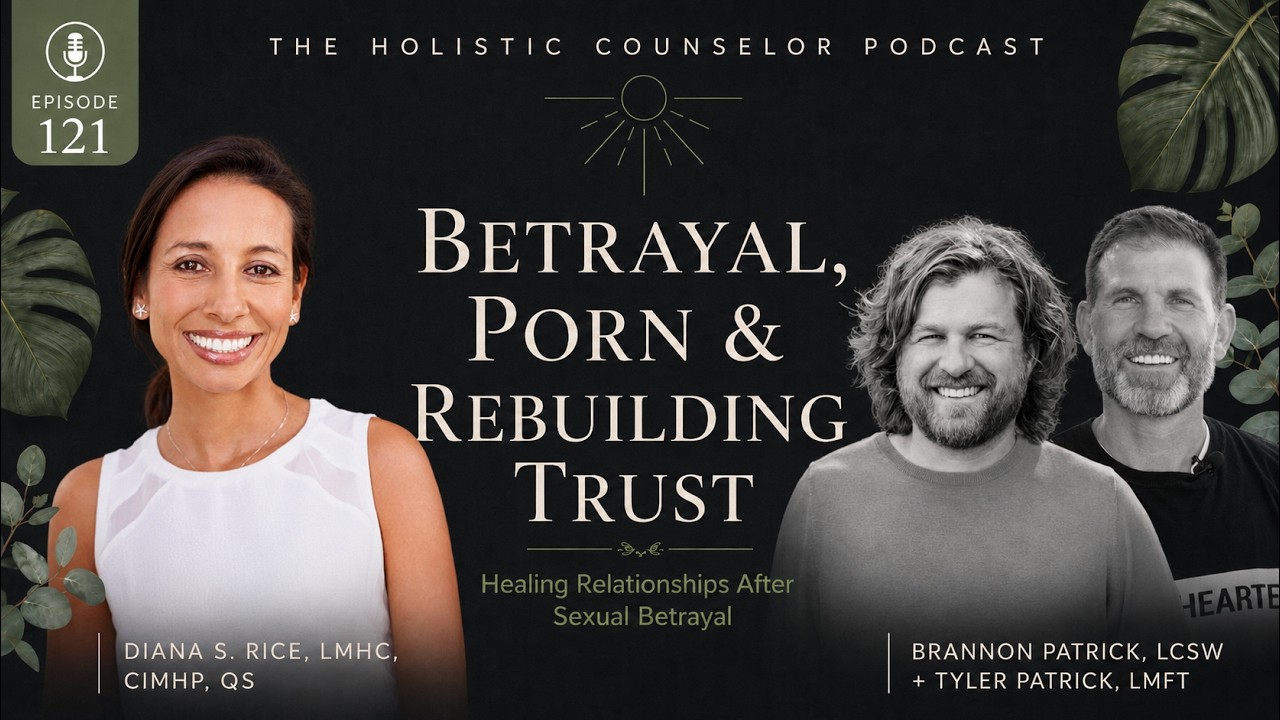
Episode 121
How to Heal Betrayal Trauma, Porn Addiction, and Rebuild Trust in Relationships
with Brannon Patrick, LCSW & Tyler Patrick, LMFT
Hosted by Diana S. Rice, LMHC, CIMHP, QS
What happens when two brothers both become therapists—and dedicate their lives to helping people heal from betrayal trauma, pornography addiction, shame, secrecy, broken trust, and relationship pain? In this deeply honest and powerful episode of The Holistic…
Listen to the Episode
Press play when you’re ready.
Educational content only; this podcast is not therapy, diagnosis, or medical care.
About This Conversation
Show notes
Jump to a section
What happens when two brothers both become therapists—and dedicate their lives to helping people heal from betrayal trauma, pornography addiction, shame, secrecy, broken trust, and relationship pain?
In this deeply honest and powerful episode of The Holistic Counselor Podcast, Diana sits down with Brannon Patrick, LCSW and Tyler Patrick, LMFT of Therapy Brothers for a raw, compassionate conversation about addiction recovery, betrayal trauma, faith, emotional healing, and what it actually takes to rebuild trust after secrecy and infidelity.
Together, they explore why betrayal trauma can feel like PTSD, how shame and secrecy fuel addiction cycles, and why many people struggling with pornography addiction are not "bad people" but hurting humans carrying unresolved pain, loneliness, and disconnection. The conversation also dives into purity culture, high-control religion, emotional safety, grief, attachment wounds, and the healing process for both individuals and couples.
Diana, Brannon, and Tyler also discuss Internal Family Systems (IFS), EMDR, DBT, EFT, accountability, self-acceptance, faith deconstruction, and the importance of moving beyond symptom management into true root-cause healing.
This episode is filled with practical insight, psychoeducation, hope, humor, honesty, and real conversations many people are secretly searching for but are often too afraid to ask out loud.
In This Episode We Discuss
- Betrayal trauma and why it can feel like PTSD
- Porn addiction in both men and women
- Rebuilding trust after infidelity and secrecy
- Shame, guilt, and emotional coping
- Purity culture and high-control religion
- Healthy sexuality and sexual self-acceptance
- Faith deconstruction, reconstruction, and spiritual grief
- Emotional safety and attachment wounds
- Why accountability matters in recovery
- The role of grief in relationship healing
- Root-cause healing vs symptom management
- Internal Family Systems (IFS)
- EMDR trauma therapy
- DBT and emotional regulation
- EFT and attachment-based couples work
- Healing through honesty, humility, and connection
Memorable Quotes
"Protection without the education causes a problem." — Tyler Patrick, LMFT
"We don't have sexual self-acceptance, we don't have adequate sex education, but what we do have is the box that you're supposed to fit it in." — Brannon Patrick, LCSW
"My sacred text, the Bible, is a mirror—not a weapon." — Diana S. Rice, LMHC, CIMHP
Resources & Links Mentioned
Therapy Brothers
Official Website https://therapybrothers.org/
Therapy Brothers Special Listener Page https://therapybrothers.org/the-holistic-counselor (original link no longer available)
Reclaim Your Heart Healing Journey https://reclaimyourheart.org/
Therapy Modalities Discussed
Internal Family Systems (IFS)
Official IFS Institute https://ifs-institute.com/
Dr. Tori Olds – IFS Explained https://youtu.be/tNA5qTTxFFA?si=CCCbRhwKGjn1hH2H
EMDR (Eye Movement Desensitization and Reprocessing)
EMDR International Association https://www.emdria.org/
DBT (Dialectical Behavior Therapy)
Behavioral Tech – DBT Information https://behavioraltech.org/resources/faqs/dialectical-behavior-therapy-dbt/
EFT (Emotionally Focused Therapy)
International Centre for Excellence in Emotionally Focused Therapy https://iceeft.com/
Faith Development Resource Mentioned Fowler's Stages of Faith Development
PDF Overview https://www.leaderresources.org/assets/images/Youth/Fowler_FaithDev_chart.pdf
Additional Topics Mentioned
- Betrayal Trauma Recovery
- Addiction Recovery
- Faith Deconstruction & Reconstruction
- Shame Resilience
- Attachment Theory
- Emotional Regulation
- Trauma Healing
- Healthy Masculinity
- Relationship Repair
- Accountability and Authenticity
About the Guests
Brannon Patrick, LCSW and Tyler Patrick, LMFT are licensed therapists, brothers, educators, and founders of Therapy Brothers. With over 20 years of experience each in betrayal trauma recovery, sexual addiction treatment, and relationship healing, they help individuals and couples move from shame, secrecy, addiction, and disconnection into honesty, accountability, emotional safety, and authentic connection.
Their work focuses on helping people heal the deeper root causes beneath addiction and betrayal—not just manage symptoms.
If this episode encouraged you, challenged you, or helped you feel less alone, please take a moment to rate, review, and share The Holistic Counselor Podcast. Your support helps more people find these conversations around faith, trauma, mental health, relationships, and holistic healing.
And don't forget to check out the merch store: https://theholisticcounselorpodcast.printful.me/
Episode transcript
Read the full transcript Close transcript
Automatically generated from YouTube captions. Names and wording may contain errors; listen to the episode for the original conversation.
Hello there fearfully and wonderfully made human and welcome back to another episode of the holistic counselor podcast. It's me, Diana Rice from Through the Valley Therapy and Transformed Mind Consulting and Coaching, where I hope faith, science, and holistic healing intersect. And today's episode is going to be a really interesting one because I have not one therapist joining me today, but two.
And not only are they both therapists, they're brothers, which honestly, I don't think I've ever come across before in this field. and I immediately thought, hm, this could either get really deep, really funny, but I hope both. I spent some time checking out their podcast and listening to their conversations.
And what stood out to me right away was how real they are. No polished perfection, no clinical robot talk, just honest conversations about relationships, addiction, betrayal, healing, shame, trust, masculinity, recovery, faith, and what it actually looks like to do the hard work of becoming emotionally healthy human beings.
So today joining me are Brandon Patrick LCSW and Tyler Patrick LMFT, founders of Therapy Brothers. After more than 20 years each working as therapists specializing in betrayal trauma, sexual addiction recovery, trust restoration, and relationship healing. They created a platform and program designed to help men, women, and couples navigate some of the most painful and uncomfortable parts of being human.
They also host a weekly call-in show where people openly share their struggles and ask the kinds of questions most people are afraid to talk about out loud, which honestly is pretty brave. And I think what intrigued me the most is that these are conversations so many people are secretly searching for right now.
How do you rebuild trust after betrayal? Why does addiction keep happening even when someone wants to stop? Can relationships actually heal after infidelity? What does accountability really look like? And how do shame, trauma, faith, and emotional safety all intersect? And maybe most importantly, how do we become more honest with ourselves and the people we love?
So, wherever this conversation goes today, I think it's going to be real, human, thoughtprovoking, and hopefully leaving us walking away with a little more insight and compassion and maybe even hope. Yo, bros, thanks for being on here.
It's good to be here, Diana.
That's quite the intro, Diana. Thank you.
Yeah. Okay. So, you know, I'm going to have to ask this question like two brothers becoming therapists. What was happening in your home that you both became therapists?
It was a pretty interesting upbringing. You know, I think I think part of it was um we we lived in kind of like a middle class home in Salt Lake City, Utah growing up, but my parents had both kind of the hearts of helpers.
My mom is a is a counselor herself, but my parents always had people coming in and out of our home, whether it was foster kids or somebody we we one time had a kid from Brazil show up and stay with us for like 3 months.
And you know, they just they were always ready to help and ready to support people. And I think that kind of rubbed off on us.
And then Brandon and I actually had two different paths into becoming therapists where mine was more of like a instant life calling kind of a thing and Brandon was looking at it more from a wow there's a need in the world and I and this could be a business opportunity and I'm pretty good at this and both of those things I'm the heartless one that's a roundabout way he's trying to say wait who's older which one is like which and and where do you have more siblings is there a pecking order
there there is a pecking order I'm I'm the oldest I'm Tyler and Brandon's with us today. And then we have three other siblings that are that are also there, but none of them are are therapists, so it all kind of rubbed off after the first two.
I'm I'm a year younger than Tyler, so we're pretty close in age.
The Kane and Abel situation. No, I'm just kidding.
Exactly. Exactly.
That's it.
No, seriously. All right. Well, that's interesting. And then your mom was a counselor. So, wait, how many siblings are all together?
There's five of us.
Five? Wow. Yeah. Every time I hear that, I'm just like, "Okay, mom,
counselor." Oh, all right. So, before all the credentials and the podcast, you know, you you said your um bio was like, "Okay, you both were pulled into betrayal, addiction, and relationships. Was this personal, professional, or both?"
Go ahead, Tyler. It Yeah, on my side of things, it was definitely personal and professional. So early on when I was deciding what to do for a living, I kind of had some what I felt like were some spiritual prompting to go a certain direction and I was prompted to work with family specifically.
And uh so I started to become a marriage and family therapist. All the while I had my own problems with a secret addiction to pornography that all kind of blew up about seven years into my marriage where I'd been keeping secrets and hiding things and struggling with my own issues.
And at about the same time, Brandon was working in the field. He just barely graduated from school and he called me up one day and he didn't know what I was struggling with personally, but he said, "Hey, there's a niche that we need to fill and we need to work on people who are experiencing betrayal, trauma, and sexual addiction."
And that was like music to my ears because it was such a personal thing that I was already starting to climb out of and work my own recovery on. Mhm.
And um and so when he called and said, "We need to start a practice together because there's a huge need here in our community, but nobody's touching it right now." And this was a long time ago. And I said, "Well, let's do it because I number one, I need all the help I can get.
Number two, we're going to learn because I'm doing this and we're going to be able to help people."
Yeah. How about you, Brandon?
Mine Mine was both personal and professional. I the you have to understand the dynamics a little bit of that time when I was trying to figure out my career. I really did want to I I got a job that I hated and didn't feel any purpose in.
And at the time the internet had been out for less than 10 years and uh just porn on the internet was everywhere and the our the religion around here is pretty pretty high demand. Um, the messaging was, "Don't do it. It's bad. It's bad.
It's bad." Um, all of my friends were getting involved with porn. They were feeling horrible about themselves. The shame was just increasing. Um, [snorts] and I could see this the storm. I could see the mix of the high demand religion along with the just how how accessible whatever is online.
And um I I realized there was an issue there and I wanted to help. And um as I started helping, I think I actually I actually did some harm honestly the way I approached it at first cuz I didn't know better. [snorts] Um but then I think I figured some things out along the way.
And um now uh I Tyler and I have really gotten to I think the root cause of things more so and in helping individuals and couples actually heal. So it's been a journey. Um it's been it's definitely a personal thing. Um my job is yeah we talk about money and business and all that stuff but it really is I feel called to this.
I I wanted to get out of it Diana. I was my you ask my wife like I've had every business idea and I was going to do this and that and I was so like oh my gosh I don't know if I can do this and God was just like nope you're here nope you're here and so
here I am
I feel you exactly you know and and I want people that are listening to understand that porn addiction is not just for men
I work with women I was I'm you know I'm honest too like I was addicted to a lot of different things porn was one of them
and and I And this is why I was like wanting to have this conversation with you because in high control religions no matter what it is they there it's the there's so much like the do not do like don't don't do this don't do that or you're going to go to hell like everybody ends up in hell right and so the guilt and the shame as a teenager as an adolescence right we teach them like you
know purity culture stay modest do this but then there's no accountability or we don't know how to teach like why the why like you don't want to go into this situation and also honestly I think what happens is that many people that are leaders are the ones that are causing some harm too with this kind of addiction as well.
So what do you think about what I just said?
I just I just think you nailed it. What what I've seen is there's there's two things missing. one, there's a lack of any teaching around um sexual self-acceptance and that that sexuality actually comes from God. Um that like that that I'm looking for the lightning right now cuz I said that out loud.
It's like you know sex and God and you know we [snorts] don't teach that. We don't teach that sex is part of being a human and sexuality is part of being a human. And along with that, we we we also just don't teach that.
There's a lack of education about what normal sexual development is and healthy sexuality. And so, and then alls we have is the don'ts. We So, we don't have sexual self-acceptance. We don't have adequate sex education, but what we do have is the box that you're supposed to fit it in.
Um, and that is a recipe for secrecy and self-rejection, shame, and actually the very thing that you you're trying to fight against. It's a recipe for acting out sexually in ways that are harmful and um and and really not not healthy. Um,
so I agree totally. actually the perfect storm because when you see that box that we all kind of find ourselves conforming to and here's a short story with that. But I remember going to a church meeting with it was a for it was a men's church meeting and it was my dad, me and it's like the like the three bears, you know, me, Brandon, my other brother all in line and they got up and started talking about pornography.
But they did it in the way that you were describing, which was this is bad, this is bad, this is bad. And the more it was talked about, I started to slink down in my chair. And then I see Brandon slinking in his chair and I see my little brother slink in his chair.
And by the end of the meeting, all of us are almost like laying on our chairs like, "Oh no, oh no, oh no." And I don't think the intention was for us to feel bad about ourselves. I think the intention was protection.
But protection without the education
causes a problem because then when you're in that box, the other side of the equation is that there's an industry out there that capitalizes on that and says, you know what, we'll we'll give it to you in secret. We'll give it to you quietly.
We'll give it to you for free. We'll be your education. And then your education will become your entertainment. Then your entertainment will become your emotional coping. and your emotional coping will become your addiction, but we'll just give it to you over several years and you won't pay for it until you're about 34.
But because no one will talk to you about it, we're here and we'll do the teaching for you.
And that combination of those two things is is the perfect recipe for a lot of people to start to find themselves in addicted places.
Yeah. No, that this epidemic is is so harmful. Like I was telling Brandon before um you came on, you know, I I well I live in Broward County, Florida and I worked in alternative high schools and many of these young men and and girls, but the men what I was seeing like 19-year-olds with erectile dysfunction because they started porn addiction at 12.
Okay. or you or a many of these young people don't have healed home life, right? Mom and dad at home and so everyone's in survival mode and they don't know, you know, and we don't talk about the biology like the science part of the body like you're going to get these feelings.
You're going to get horny like, you know, how else do you talk about them, right? And what do you do with that? because there's spaces that are, you know, a lot of parents that I worked with, they're like, "Well, if I talk about birth control, if I talk about this thing, I'm giving them permission."
And I'm like, "No, the only permission you're giving them is to have convers healthy conversations with you because if they don't learn it from you, they're going to learn it from the streets. That's how I learn, from the streets."
I don't know where we got this belief of like if I don't talk about it, then it's not going to come come out. You know, it's like, well, if I just kind of avoid it with my kids, then, you know, they're not going to act out se in their sexuality.
Like, no, it's in them. It's part of who they are. I can't just not talk about it. And then it's like in this bo safe box. In fact, I need to go talk about it so that we can educate, so that we can equip them with the knowledge they need in order to harness it because that's what's healthy is you take it, you harness it.
And that requires some openness and some communication, some education.
Yeah. No, for real. So tell me like you work with clients of all ages. Like tell me a little bit about who you guys work with.
The typical client that would come in to see us. This is usually how it works is it's a couple probably most often in their mid30s to late 40s. and there's been secrets in the relationship for several years and it's finally just broken loose and now they're in here in our office going, "We just had a big huge massive betrayal.
There's been an affair or there's a secret addiction or there's something else going on where it's really shattered trust and we want to try to figure out if it's right to stay or not. And if we do decide to stay, how do we fix it?"
Because it just feels so devastating. And so that's they come in and that's probably the spot they're at right when they start with us most of the time.
Yeah. So, how how do you deal with the grief? Because like, you know, we're all trained differently like uh wait, one of you is a social worker, one of you is marriage family therapist, and I'm a mental health counselor or I don't know what they call us in in Utah,
CHC. Oh,
okay. But you see what I mean? Like, we're all have different trainings, but we're kind of seeing the same patterns because to me, it's patterns, right?
It's like that's why when people come in with with such heaviness like I work with a lot of young women with porn addictions like they're 23 24 they're virgins they have that purity culture mindset you know and the guilt and the shame of like you know and I can't stop I can't stop like how do you deal with well this is two different things because you were talking about couples coming in and your clients that usually come in but I want to know how do you deal with the grief with with them?
Like what are what are what are your modalities? Like how do you actually first of all if you want to talk about how you guys healed yourself? Because to me I like hearing that that you guys went through it and now now you've gone through this situation didn't go over around or you know or ignored it.
You actually did your own work. I did too. And now that's where we're now looking and going, "Okay, this is how we help." Right? Because it's a hard place. It's a hard place when you're dealing with someone that comes in and so much guilt and shame from all the narratives that they've been told from either their religion or their family life or the lack of understanding or the streets.
Where do you start? Like how do you work this through? I I love you just said some words that most of our clients don't associate for the first appointment when they come in. And the first word that you used was grief. And actually using the lens of grief is really powerful for couples because they don't think of it as grieving.
But what they're doing is they're actually going through a grieving process where they're going to experience all of those different stages of grief. There's going to be bargaining and anger and depression and denial and and all of those things. and they think they're crazy when they're going through it when in reality they can't avoid having to pass through these different elements of grief over and over again as part of the healing process.
And so we actually try to help couples frame some of their healing partially in terms of a grieving process. And then the other words that you used were shame and guilt. And when a couple comes in, they're like, "We just had this breach of trust.
Teach us some communication skills and we'll heal and we'll get better and we'll rebuild trust." And our job is to actually slow them down and go, we're not going to rebuild trust until we address the other word you used was shame. And the shame that's wrapped up inside of what this thing is that led to all of the secrecy, all of the hiding, all of the disappearing, all of the manipulation.
If that shame doesn't get addressed, if it doesn't come into the light, if the person doesn't start to learn that there's life on the other side of their secrets, uh then they can never start the process of restoring trust. So those two frameworks actually become really important in the healing process.
Yeah. What say you, Brandon?
Um I'm just thinking to to answer that question is tough because it's such a process. It's it's one step at a time. Um, and and it's different for the the recovering addict, it's different for the recovering partner, and it's different for the relationship.
So, there's actually three different things going on at the same time. So, [snorts] when a when when a couple comes in in crisis, there's a lot going on. And the first thing we need to do, you think with any grief or or any pain that someone's in before we dive into like let's fix it, let's go, let's like everything's, we just got to hold some pain.
We just got to validate hold that pain. Um sit in it, be in it,
validate validate some more. But but then there there comes a point and especially for the betrayed partner and this is a really like inflection point. It's difficult where they come and they actually have to step into doing their own work. And so as we validate their pain from being betrayed because they've been betrayed and it's not cool,
the the hard reality sometimes is and it's time to start to process and move through this grief and to actually do that work. And their partner can't do that for them.
Yeah. Um, and so we very delicately walk them through the process to start doing their their work as the betrayed partner. Um, in the meantime, we're working with the person struggling with addiction on all kinds of stuff through that process. And then as they they individually do that work, they both become the type of humans that go from being unhealthily attached to capable of healthy attachment. and
and it's awesome to watch a couple start to change everything about their relationship because they've worked so so much on themselves and they've walked through that grief individually. Um, so that's a huge question. Um, there's little pieces Tyler and I we use DBT, we use EFT, we use all the T's like,
"Oh, slow down. Slow down because we're going to explain to the audience because you never know. It could be their first time listening to a a mental health podcast. So, we're we're we're speaking therapies right now and I know what you mean, but like Well, there's one that you just said that I'm like, wait, I don't think I've ever heard it.
I know what DBT is. Would you explain that? And then you said another one. Did you say ZBT?
No, I said EFT.
Oh, yeah.
Um,
okay. So, let's explain to the And there actually two kinds of EFT because I just had two different people with both EFTs talk about their EFTs. But anyway, go ahead. Explain the modalities that you do use and what it's about.
Well, it's kind of an eclectic uh approach because we take the best parts of each and then we we really like kind of have some of them just under underneath everything that we do. So, like for example, DBT um was created to treat borderline personality disorder.
Um Tyler's the DBT guru. He loves it. He talks about it all the time. Um but it's so applicable to to the process of healing. We learning things like mindfulness, emotion regulation, distress tolerance, um all of those things coming together. There's it's skill-based.
And so to learn how to do those things is really helpful, really powerful.
Um Tyler, do you want to talk about another one we use or
Sure. So yeah, so DBT I would say is we use it a lot for the skills training to help people actually have tangible things to practice with managing their emotions, climbing out of crisis, all of that. And then EFT, we do a lot of that on the personal level with just kind of learning to become emotionally intelligent, but also as couples start to heal, we start moving them into some emotion focused therapy.
Emotion focused couples therapy is a lot of what we use. And that's a way of helping couples start to see their patterns with each other and learn to break the unhealthy patterns and then lean into healthy attachment with each other. So it's based heavily in attachment theory which is could be a whole other episode itself.
Um so we use those that mode Elliot and the other two therapies that we probably use the most inside of our programming is um IFS internal family systems.
I love IFS.
Oh, we love it.
Sad. Okay. Sorry. Because to me, IFS has transformed my whole practice even though I'm not certified. I didn't do all the things.
It's not easy to get certified,
right? And I but I know enough about it and I've interviewed some people that are just they're, you know, level two IFS practitioners and it's just a beautiful modality between and what you're talking about like being eclectic.
I love that because we forget I think sometimes in training in the halls of university like you get this one modality and this is it but we're forgetting that we're dealing with human beings with different backgrounds different everything unique narratives that have been told them since they were you know in the womb
and understanding how to pick up those tools for us to be able to hand them over and say okay now you practice in a safe space with these
it's it's beautiful I Love it. So IFS is internal family systems. Keep going.
Yeah. Yeah. We love it. And we love that. And I think the reason why we love that is because our one of the bigger principles behind our whole programming is the continual process of radical self-acceptance. And IFS does a great job of bringing people into self-acceptance with compassion and curiosity with themselves.
And then we use things like for trauma we use EMDR and ART which EMDR is the eye movement desensitization reprocessing. It's the one with the eye movement.
Yes.
Everyone thinks is weird, but it's it's actually really powerful for reprocessing trauma. And it really really helps our clients a lot. And so we kind of mix those things together and we've made our own sort of process and program that we call the healing journey that kind of
pulls what we think are the best parts, you know, and I know all the purists of all those different therapies like, "Oh, you can't do that." Like,
no. Oh, no. No. They'll have your head for that. Well, maybe not. They're therapists. Hopefully, they wouldn't have a head.
But, but that's what we use. Those are those are kind of where we're most that's where we're most informed from. And I would say the biggest portion is right back down to that place of shame. The people that are willing to do the work to become resilient to their shame are the ones that thrive the most and they're the ones who also give themselves the best chance to save their relationships if they're supposed to be saved,
right? Because that's the thing like I know in a many high control religion like that that's
I've seen a lot of domestic violence um out of churches and just things and and when I say domestic violence it's not just getting a beatdown. Okay. I saw financial abuse. I've saw emotional abuse, spiritual abuse. And you know when you're raised in that kind of um I'm a Christian.
All right. I I love the Lord Jesus Christ. And we we also have like 40,000 different denominations, you know, Mormon including, you know what I mean? So, and and so you have
different and each denomination has its I don't even know spectrum. I don't know how to explain it, but I think it's always trying to figure out the leaders h if they're if it's a healthy green flag church, it's healthy leadership because you're allowed to question things and it's about safety.
I would think what I read in in my sacred text, it's, you know, about love and safety, loving God, loving others. It's pretty simple,
right? And so to me, like what would you want to say to those coming out of, you know, I have a lot of people disentangling. I hate to say deconstructing. I mean they are deconstructing and then reconstructing or letting go fully and like there so much pain and anger and hatred and they have every right to all those emotions.
But what would you like to say to some some of those people because if you guys grew up in Utah then Mormon you have this the same thing I'm talking about in Christian Protestant movement or Catholicism or any religion. What would you like to say to those humans coming out with so much pain where some doctrine might have been used to abuse?
Um I I uh like to I like to call it expansion. Um you can call it detangling or deconstructing. Um but it's you're expanding, right? And and even parts of expansion are at times look angry and um frustrated and confused and that that that can be a phase of expansion.
Um, but what I would say is that uh it's a process. Again, I keep coming back to this. It's you're actually in a grieving process again. Um, and you'll go through different phases of it. At times you'll feel so lost and confused. At times you'll feel angry.
At times you'll feel enlightened and a ton of peace about that. And as you sit in that space and you allow that grief to to to move, um eventually you start feeling more and more peace, more and more acceptance. Um you start to learn to navigate life, um [snorts] with with relationships and family and things like that so much better.
Um rather than just lashing out or shutting down. And so I would say be patient with yourself. Um, Fowler's stages of faith really helped me like understanding what those are.
Oh, wait, wait, wait. You got to stop. I had to write this down because guess what? I have not heard that before.
Ballers stages is fo w.
Yeah, he was a professor, a religious professor and
I think a sociologist too if I remember right.
Okay.
Um, but it's like understanding what those are is and I could go through them really quickly. um if it's helpful. Um
there's there's five stages of faith that he talks about.
Uh the first is when and you got to think about it in terms of development um at like human development. So the first stage is when you're a little kid and you're just kind of running wild and doing your thing. Um the second stage is when you start to believe things.
So your parents are saying, "Hey, the Easter Bunny is, you know, real and Santa Claus and
it's called mythical or literal faith."
Yeah. You just you just kind of accept like, "Oh, cool. I love Santa Claus and Jesus and the Easter Bunny." Um, the third stage is more uh uh solidifying your belief system. So it's it's usually starts happening in in adolescence and especially in late adolescence.
You start to just get very clear on this is what I believe. Um I don't deviate from that. I stick to it. I'm faithful by staying in. Um what is that called Tyler?
They call that they call that synthetic or conventional faith.
Conventional faith. And so a lot of people will spend their life in a stage three development of faith. They'll you can think about like older people who are just very and it's not a problem. I'm not I'm not trying to say this is a problem in any way but they'll they'll spend their life there.
I'm I just this is what we do. We stay strong to this,
right?
Um in fact generations of people will will stay in that stage three and they'll pass that down to the next generation. Stay in that stage three. Um, and so a stage four is is what you're talking about, Diana, when somebody starts to we'll say deviate or question or step outside and they they they hit a grief process of like, whoa.
When I look and I look closely, I'm kind of angry a little bit about I feel like I was duped. And um I I if I go to church, like everything they say just bothers me or I don't go to church anymore and I just talk about how much I hate it to everybody.
And the this again, this is not bad, but staying stuck here could be. Um you're in that deconstruction phase and you're challenging and questioning and lashing back at um the beliefs that were just handed to you. Um, that's stage four. And you
they call that individual reflective faith. Reflective faith. So you can imagine a stage three and a stage four having a conversation, right? A stage
a stage three is like, "What are you doing? Don't sin. Stay in." Like this is what we do. And the stage four is like, "I hate this and I'm going to get you out and I'm going to tell you everything bad about this thing and I I want to prove to you that I'm not wrong for leaving."
So the and the more they try to convince each other one way or the other, the more the other one digs their heels in,
right?
Um and that's where a lot of the friction will happen um in family systems and things like that. Um and then a stage five is where everybody claims to be but not everybody's there. And that's more of a
they call that they call stage five conjunctive faith.
Yeah. You're you're really nuanced. You're open. You you you're you're you have individuation. So So you're able to say, "Hey, Tyler, you get to be you. Brandon, I get to meet be me. Diana, your faith is yours. Your relationship with God is between you and God.
And I I love you where you're at, and I accept you. And um I can not take personal your faith and um still allow space for that." And so it's a really healthy stage to to to get to. And yeah,
some people can be still practicing a religion and be in a stage five.
Um, but they are somewhat nuanced. They're not they're not stuck in the rigidity of it anymore.
Well, the black and white thinking. Let's go to CBT now. No, I'm just kidding.
Yeah.
Um, so and then there's actually a last one that's that's like enlightenment. It's like Jesus and Gandhi and it's where Tyler usually lives like
you know. Um, yeah, not many people stay there long, but some people get there. And
yeah,
so anyways, I probably went on too long, but that's
No, Brandon, I love this. And this is what I'm talking about. You guys like listen when I listen to your podcast, like you're real, like authentic. We're we're actually having a conversation that people are curious about and want to know because like I have a lot of questions when you were talking about like, you know, Fowler's stage of where where have I been?
How do I not know this? I'm a Christian therapist or I'm a and that's another thing like in my in my circles or my field like no it's biblical counselor only you should be the noetic kind and you're not what you're practicing is not right and you know you have so many opinions and how I see it is my sacred text the Bible
is a mirror
not a weapon it's a mirror for me it's a mirror of how I should behave how you know how I should treat other human beings Because, you know, if we keep looking outwards, outwards, outwards, we we give our our souls and our power to the the village out there that's raised us, you know, and so so back to your program because I'm curious about that.
Tell me how someone can, you know, like do you work with people from all over the country, the world? like tell me about this program and what you guys do and how and all all the all the you know all the things.
Yeah, we um we we it actually includes some of this spiritual wrestle because just to just to answer your question before and then I'll I'll explain the program a little bit more because it fits into it. But um doing this work I we it was kind of an unexpected and unintended thing that happened. doing this work personally and also with all of our clients, it's amazing how parallel it runs to have a wrestle with spiritual things and faith while also growing into recovery.
And so, a huge portion for most of our clients is a parallel journey of this spiritual process that we're in. And so, we we call it the wrestle with God.
And we believe that the wrestle is a good thing just to be in the wrestle. um you don't have to have all the answers and just to be on the journey and on the path is still a worthy cause because there's going to be growth, there's going to be learning, there's going to be development and so we don't want people to need to have all the answers as much as it's important just to be in the wrestle.
Um and so so in included in that we created something that we call the healing journey and it's it's a it's an online program that we do. It's through a a platform that we host called Reclaim Your Heart. And people join groups and they work usually with a group or they could do it with their own therapist or whatever.
Um, and they they go through a series of um assignments and challenges. We believe that change happens best when people have what we call an emotionally or spiritually corrective experience. And so there's a lesson, there's a homework assignment, and there's a challenge. And the challenge is meant to be done and then shared with people on your team.
And so hopefully we're getting the heart at work as much as the head inside of those challenges. And we walk people through uh becoming conscious of the outcomes in their lives, becoming conscious of their core beliefs and how those beliefs affect their choices and their outcomes. and then all the way down into the places where there's police reform form, their shame, their trauma.
And then that's kind of the going down the hero's journey. And then the climb up is building the life that you were designed for that God intended you to live. And we help them start stepping into stepping through fear and into courage. Um taking risks, healthy living, building right relationships, that kind of a thing.
And it takes people Brandon, how long does it take them? about usually a year to 18 months. Yeah.
Oh wow.
Yeah. So
So you do it online
or in person?
It's all online. Um the content, the groups, the so people from all over the country can join.
Okay.
Um and yeah, we Tyler and I have done this a long time and we understand betrayal and sex addiction really well. And what we've seen over the years, we like people get stuck focusing on the the surface level stuff and then actually don't get better.
And so that the journey that we take them on, it does heal sex addiction and it does heal uh the wounds of betrayal. And and so as they go on that journey, they go through a process of of deep spiritual and trauma healing.
And
and as that happens, then the things like acting out sexually or um staying stuck in anxiety and fear, they start to go away and um people actually heal. So our our our journey is actually the root work. It's the right way to do recovery.
Um but it's challenging. It's we're not like Yeah.
There's some of the things we ask people to do is it's really tough, but it's it works. So,
so it sounds like you're not managing symptoms because this is what happens in our field a lot. Like we're trained to manage symptoms. You know, we have the DSM, we have the labeling, here's your meds, whatever it is. And I'm not putting that down.
It sounds like you get to root causes, which takes time because if you got to that place, it took time to get that place. You're not working with three-year-olds that have been, you know what I mean? you're dealing with adult humans that have gotten so much
parts in them and and you you probably explore. So I hear also that you have accountability because that's what's missing because to me evil wants to keep you alone and by yourself in the lies and and that's it. I mean to me how I believe the the evil one wants to steal, kill and destroy.
That's the main purpose is to steal, kill, and destroy every relationship, especially the one the relationship with yourself. And so I hear accountability. I hear root cause work. I hear you being honest saying this is going to take time. There's no magic bullet.
There's no like easy peasy lemon squeezy. Like here you are. And you're not promising any of that either.
Yep.
Wonderful. So, how do we work with you? Where do we find you? Well, I mean, if you wanted to, you could go to reclaimyouheart.org and look at that. There's a free community there. We also just for this episode created a specific kind of web page um that you that your listeners can also just go to if they'd like to.
And um I can just give you that really quickly. It's therapy.org/theholistic counselor. And when they go there, they'll see a picture of you that's like as seen on your show.
Oh, wow. And then we've kind of found a couple of our own episodes that we think will fit well with your community and your your target audience.
Wonderful.
Um, so that's probably the best way.
Wonderful, Tyler. I love that. I guess I I I hurried through and didn't even see that. Well, thank you.
No, we we'll get you we'll get you the link and you can throw it in the show notes and it'll be easy that way. But you said something that I think is really important there. Um, that idea of connection. You know, we that idea of like sin, you know, if you look at different roots of the word sin, one of the different roots of the word sin is disconnection.
And so that idea of disconnection from God, others, and self, like shame's best friend is secrecy.
And so shame wants to drive us into that hole where we're completely, utterly alone. And to me, that's a different definition of maybe what hell might be like. So it's not that you're going to hell, fire and brimstone, God's disappointing you. It's more of like the more I pull away because of my shame, the more isolated alone I am.
And that's where that destruction happens, the evil one, whatever. And so recovery process is actually about re-establishing connection three ways. God or higher power, others authentically, and then self, heart, and mind.
And that accountability piece you were talking about is really important. Most people think of accountability as I need to hold you accountable. When in reality, a broken heart and a contrite spirit seeks accountability. It says, "I need to find people who will hold me accountable.
I need to hold myself accountable
to the things I'm changing, to the places I want to be going, to the people that I love." And so, learning to come out of secrecy and out of hiding, it's so important and it's so scary and hard, but that's as a way of living that fosters the right kinds of connections in in those arenas of God, self, and others.
I love that, guys. All right, so listen, the hour is almost up and I know we all have work to do and I just want to know as we wrap up and anyone that's listening right now that may be in betrayal, addiction or a relationship that doesn't feel safe, what would you want to leave them with?
And is there any practical steps or encouragement or resources that you want to leave them with? I would just say if you don't feel safe, then that is step number one is if if you're in a in a relationship where you're getting gaslit, manipulated, abused, um then go get some support so you can create a safety plan and start there because you're not going to do any healing until you get there.
So, um a good therapist will help you create that safety plan, will help you uh build resources around you. um so that you can connect to others, you can bounce things off of others. Don't stay isolated in your unsafety.
Um go get those resources. And uh the second thing I would say is once you get safe, there is a process and and a way to heal. And so have hope. Believe that you can and just start one day at a time. And if you do that, I promise you that you'll feel more peace in your life because you were willing to go do that.
So those two things, you go create safety and then find and and understand the process to healing. [clears throat]
And I would just add to that that if you're listening to this and you find yourself in the spot of having just discovered a secret or you're experiencing some betrayal or you find yourself in the throws of addiction, it can be a pretty dark and helpless place.
And having been in those places before myself, um, I just want to say to you that there's a path out of this. There is there is hope. If you find yourself there, there is actual hope. It will come with all of your blood, sweat, and tears.
But there's a beautiful life on the other side with the right set of principles. And those principles are things like openness, transparency, humility, accountability. And when you start to live that way, connected to Godself and others, there is a vibrant, beautiful life ahead of you, even though it's not devoid of challenges.
Um, I'm I'm a father of four daughters and I
I feel like one of my life callings is to try to help create the kind of men that my daughters are going to marry.
And um,
wow.
And I welcome every one of my daughters to marry a man who's in recovery because a person who's in recovery is willing to confront their demons. They're willing to take accountability. They're willing to be humble. They're willing to grow. They're willing to be honest.
They learn empathy. They learn presence. They learn mindfulness. Who doesn't want to be married to that person?
Wow.
And so the process you're in right now is a transformational process where you will like what you see in the mirror if you continue to work it. And um so there's hope here.
Yeah. Oh my goodness. This was wonderful. Yo, bros, I I this was amazing. I'm so glad I said yes to have you on here this we are too. Oh wow. Anyway, listeners,
please do not forget what these men have said and just this conversation and if you reach this point, do not forget to trust in the Lord. Guard your heart and renew your mind. Bye. And now for the disclaimer to make sure you understand that you are responsible for you.
The content provided on the holistic counselor podcast is for entertainment,formational purposes only and is not intended as a substitute for professional medical advice, diagnosis, or treatment. Always seek the advice of your physician or other qualified mental health provider with any questions you may have regarding a medical or mental condition.
Never disregard professional medical advice or delay seeking it because of something you have heard on this podcast. The views expressed on this podcast are my personal opinions and do not represent the views of any professional organizations with which I am affiliated. Call your doctor, 911, or 988 immediately if you have a medical emergency.
The holistic counselor podcast does not recommend or endorse any specific tests, physicians, products, procedures, opinions, or other information that may be mentioned on the podcast. Reliance on any information provided by the holistic counselor podcast, guests appearing on the podcast at the invitation of the holistic counselor podcast or other listeners to the podcast is solely at your own risk.
Confidentiality notice. If you engage with the holistic counselor podcast by commenting or posting and are a client, please be aware that you may be revealing information that could compromise your confidentiality. Please remember that disclosing your identity or personal details can be linked to your clinical material.
As a therapist, I am bound by confidentiality and will not respond to any disclosures of this type on this podcast. I am committed to upholding the ethics and confidentiality of the therapeutic relationship which extends to all forms of communication in accordance with the laws and professional guidelines that govern mental health professionals.
I want you to know that your privacy is of utmost importance and you are responsible for protecting it when interacting on this platform or any other public forum. Thank you.