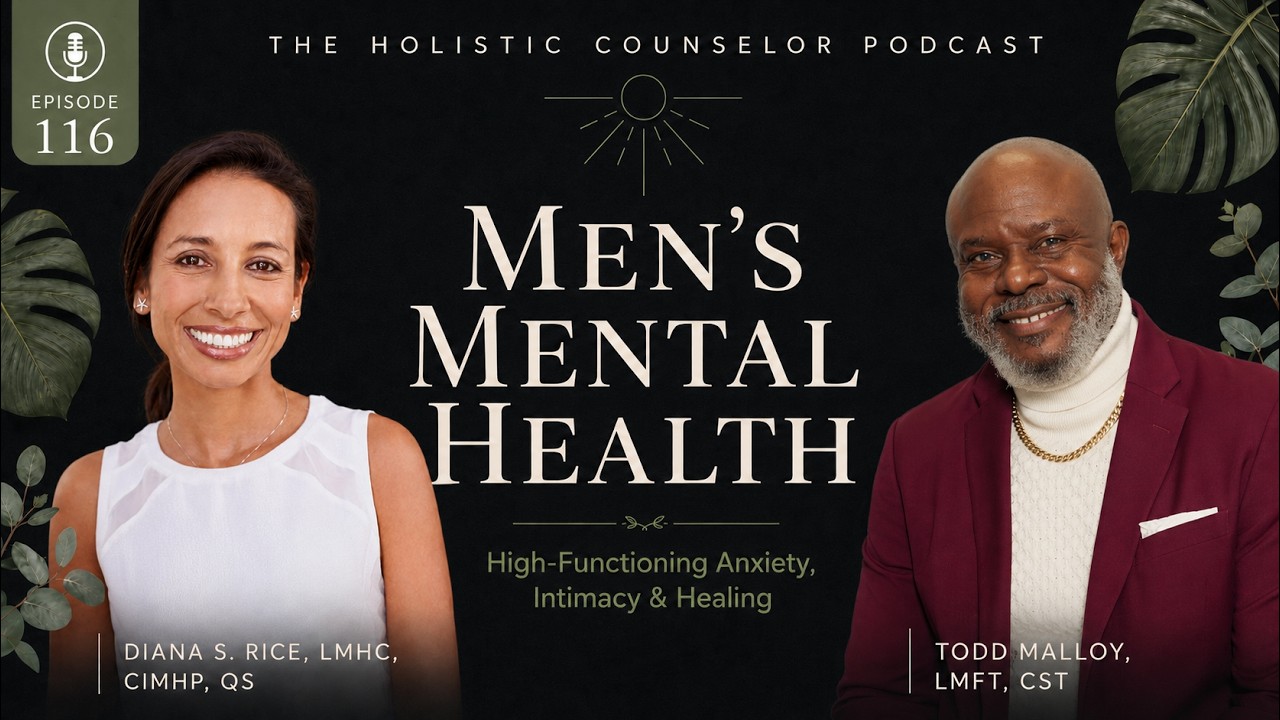
Episode 116
Why "Strong" People Struggle in Silence: Men's Mental Health, High-Functioning Anxiety, Intimacy & Healing
with Todd Malloy, LMFT, CST
Hosted by Diana S. Rice, LMHC, CIMHP, QS
Why do so many high-functioning people look successful on the outside while silently struggling on the inside? In this powerful episode of The Holistic Counselor Podcast, Diana S. Rice sits down with psychotherapist, Licensed Marriage and Family Therapist,…
Listen to the Episode
Press play when you’re ready.
Educational content only; this podcast is not therapy, diagnosis, or medical care.
About This Conversation
Show notes
Why do so many high-functioning people look successful on the outside while silently struggling on the inside?
In this powerful episode of The Holistic Counselor Podcast, Diana S. Rice sits down with psychotherapist, Licensed Marriage and Family Therapist, Certified Sex Therapist, former engineer, and former pastor Todd Malloy for a deeply honest conversation about men's mental health, emotional neglect, survival mode, intimacy, trauma responses, burnout, faith, relationships, and what it actually means to heal.
Todd shares his own story of growing up in poverty, helping support his family as a teenager, suppressing parts of himself to survive, and eventually realizing that achievement and productivity were not the same thing as emotional health.
Together, Diana and Todd unpack:
- High-functioning anxiety and emotional exhaustion
- Why many "strong" people suffer in silence
- Childhood emotional neglect and survival programming
- Men's mental health and emotional suppression
- Faith, healing, and emotional honesty
- Relationship struggles, intimacy, and communication
- Why social media is increasing anxiety and disconnection
- Emotional fitness and nervous system awareness
- The pressure many men feel to provide while neglecting themselves
- Trauma responses disguised as resilience
- Purity culture, shame, and emotional disconnect
- How to stop living from other people's expectations
- What true healing and self-reclamation actually look like
One of the most impactful themes in this episode is Todd's insight that many adults are not truly living their own lives — they are living out emotional scripts handed to them through family systems, culture, religion, fear, survival, and unresolved pain.
Todd also explains:
- Why emotional suppression often turns into anger, anxiety, or depression
- How survival mode impacts relationships and intimacy
- Why many men were taught to "suffer in silence"
- How rigidity in faith or identity can block healing
- Why emotional safety matters in both therapy and relationships
- The importance of learning to identify and communicate emotions honestly
This episode also dives into:
- Attachment theory
- Emotional fitness
- Bowen Family Systems concepts
- Emotionally Focused Therapy (EFT)
- Communication patterns in relationships
- Trauma-informed healing
- Self-awareness and nervous system regulation
Todd shares practical tools listeners can begin using immediately, including:
- The "Five Whys" exercise for uncovering root beliefs
- Writing your life story from a third-person perspective
- Becoming aware of emotional triggers and body sensations
- Learning to pause before reacting emotionally
- Asking better internal questions
- Building intentional emotional connection in relationships
- Reframing success based on authenticity instead of performance
If you've ever felt:
- emotionally exhausted but still functioning
- disconnected from yourself
- pressured to always be strong
- misunderstood in relationships
- spiritually confused
- burned out from constantly surviving
- afraid to slow down
- lonely despite being surrounded by people
…this conversation is for you.
About Todd Malloy:
Todd Malloy is a psychotherapist, Licensed Marriage and Family Therapist (LMFT), Certified Sex Therapist (CST), Certified Sexuality Educator, former engineer, and former pastor who helps people move from survival mode into "a life worth celebrating." His work focuses on emotional fitness, intimacy, communication, identity, relationships, and helping people reconnect with themselves in authentic and meaningful ways.
Connect with Todd Malloy:
Website: ToddMalloy.com Counseling Practice: Inner Peace Counseling Center Podcast Listener Resource Page: Todd Malloy Podcast Resources
LinkedIn: Todd Malloy on LinkedIn
YouTube: Todd Malloy YouTube Channel
Resources Mentioned
Attachment Theory Overview: Attachment Theory Explained Bowen Family Systems Theory: Bowen Center for the Study of the Family Emotionally Focused Therapy (EFT): What Is Emotionally Focused Therapy? Asbury Theological Seminary: Asbury Theological Seminary
Connect with Diana S. Rice: Through the Valley Therapy
Transformed Mind Consulting & Coaching
The Holistic Counselor Podcast
Support the Podcast + Merch Store: The Holistic Counselor Podcast Merch Store
If this episode encouraged you, challenged your thinking, or helped you feel less alone, please leave a review on Apple Podcasts or Spotify. Reviews help more people discover these conversations around mental health, trauma healing, faith, relationships, emotional wellness, and holistic healing.
And if you'd like to support this independent podcast and its mission to break stigma in churches and diverse communities, check out the merch store above. Every share, review, download, and purchase helps continue these important conversations and keeps the podcast growing organically.
Episode transcript
Read the full transcript Close transcript
Automatically generated from YouTube captions. Names and wording may contain errors; listen to the episode for the original conversation.
Hello there, fearfully and wonderfully made human, and welcome back to the Holistic Counselor Podcast, where faith, science, culture, relationships, and holistic mental health come together for real, raw, and meaningful conversations. S I'm your host Diana S. Rice, licensed mental health counselor, certified integrative mental health professional, founder of Through the Valley Therapy, and Transform Mind Consulting and Coaching.
Today's guest is Todd Mallaloy, psychotherapist, licensed marriage and family therapist, certified sex therapist, certified sexuality educator, former engineer, and former minister who now helps high functioning adults move from survival mode into what he calls a life worth celebrating.
Amen. Raised by a single mother in a lowincome New England housing project, Todd learned early what it meant to carry responsibility, push through pain, and survive. But after building success in engineering and corporate project management, he realized that looking successful and actually feeling aligned are not always the same thing.
Today, Todd blends lived experience, clinical insight, faith informed perspective, and straightforward truth to help people build emotional strength, deepen intimacy, and stop outsourcing their lives to expectations they never chose. In a world where so many people are silently carrying stress, pressure, loneliness, burnout, shame, grief, relationship struggles, and emotional exhaustion while still appearing fine on the outside.
Conversations like this matter. They matter in our homes. They matter in our communities. They matter in our churches. They matter for men. They matter for women. They matter for the people who were taught to survive but never taught how to slow down long enough to ask themselves if they are truly okay.
And they especially matter in communities where mental health has historically been stigmatized, misunderstood, minimized, or simply never talked about openly at all. So, wherever this episode finds you today, whether you're driving, working, resting, cooking, walking the dog, at the gym, on your lunch break, or simply trying to make it through another day, I hope this conversation reminds you that your story, your mental health, your relationships, and your healing matter, too.
Todd, welcome.
Welcome. I I feel welcome. Extremely welcome. Thank you. How are you? Oh, I love that. Okay, so let's start with you. Like that's just to me, you went from engineering. Engineers that I know I have some in my family. They're pretty logical, right?
So it's like logic engineering to ministry. I want to know a little bit about when when it says ministry. Were you a pastor?
Yes. I actually went to seminary school Theological Seminary in Wilmore, Kentucky, and served as senior pastor for seven years. But I've probably done everything there there is to do in church. Uh Ben's chorus, our sir, you know, you name it, I've done it.
Okay. Wow. Okay. And now you went from that to all these other licensed marriage uh family therapists and certified sexuality. And that's the thing like for me to think about a minister who's certified in sexuality because sometimes we don't talk about that stuff in the church
at all. Definitely. Correct. And I don't care what color you are.
Very true. Very true. It It's a taboo subject. Everybody wants to do it, but we can't talk about it.
Oh, yeah. Exactly, man. Exactly. So, tell me what happened in your journey that made you realize something deeper needs to change here. I at the I guess right now the best way to say it is that I betrayed myself when I was younger and I came to understand that when I was a kid coming up in a marginalized environment very lower socioeconomic situation basically my mother started started us off on welfare
my mother had a ninth grade education and we had to figure it out. folks survival was the mindset and the biggest what was she taught was one of the best keys in life or one of the valuable nuggets in life is learning to adapt and adjust to what's going on.
Yeah.
So in the midst of that I saw a lot of tragedy. I saw people being hurt, disappointed, um a lot of things. And when I looked at life, I recognized I wanted to be a part of a solution, not to be a part of the problem.
And it at a very young age I wanted to be a therapist. However, but when I was a senior in high school and I had to and I went to a private Catholic high school. I started off in a public high school.
However, I went to my mother at the end of my first year and I was in Higher Horizon. I I'm I'm the quintessential nerd basically. I guess you probably figured that out by now. So I at the end of the year I told my mother that I'm going to be consumed by the environment in which I was living working and living in.
So in the midst of that I said I want to go to a private school and she said well hey if you go to work if you can work then we can figure it out.
Wow.
So that's what I did. I figured out I got a job and I contributed to my high school education. So now senior year they're saying hey what do you want to do career day? So I I want to be a therapist. So they sent me to University of Connecticut Medical School.
There was a guy in a white coat with u with a white coat on with the glasses hair comb like kid, you know, just just looking apart. So and I'm the in the front of the line in the front of the line up front and actually the only African-American of any gender there.
And I'm in front of the line and he says he turns around and says, "Hey, what is it that you want to do?" I said, "I want to be a psychiatrist." And he said, "You got 12 more years of school."
Yeah.
And I said, "Wait a minute. I barely afforded to pay myself through high school." Had a 17-year-old kid not having having a mother with a nth grade education, not really understanding money, financial aid, and all of those things. I my head dropped
and I said, "Well, I can't do 12, so then I'll do four." because I was my I had an uncle that was in um a draft for an engineering company said, "Todd, you're good at math and science. Why don't you become an engineer?"
I said, "Okay, I'll just take my uncle's advice." And that's when I betrayed myself because what I did is I settled based on my lack of knowledge and understanding.
But then the the joke was on me because then it took me 10 years to get a four-year degree. So by the time I graduated, I actually cried at my graduation because I came successful at what I didn't want to do.
Now, however, but now I've invested all of this time, effort, and energy in it. So now here it is. I felt kind of stuck at the time,
right?
So that's how I betrayed myself. But as a course of life, there came a point where and and totally be honest with you, after being married, having a family, I was raising my kids, you know, teenagers had talked back. Oh yeah,
I know. I've had four of them.
Yeah, exactly. I have four as well and they all talk back. So, however, when they started talking back, I noticed I was, you know, you want to choke them sometime, but when I was noticing, I said, Todd, you're upset because you're raising them not to be you.
I was let raising them to use their voice, to use autonomy. Even as kids when we went to parent teacher conferences meetings I always brought my children because they had to advocate for themselves from from kindergarten all the way through.
So but what it wasn't now that they're asserting themselves using their autonomy saying what they want to be who they want to be in life. I'm sitting there feeling like a hypocrite because I raised them not to be me.
And in that moment I gave myself permission. I was 42 years old
and I gave myself permission to be who I wanted to be on the inside. That didn't manifest openly outward.
Okay.
And started instead of telling myself no, what I can't do or what I can't have or I have to be everybody's savior based on how I was raised. Being the oldest child giving giving the speech, you're the man of the house, your younger brother who's two years younger than you calling you dad.
Wow.
All you know how to do is, you know, provide and protect,
right? And it's not in at any cost because you don't know how to survive and save yourself because you look outwardly
and which is typical and as you're aware of people that suffer the trauma of emotional neglect. Not that your parents didn't love you, didn't care for you, they could not meet your
emotional needs. So therefore in turn you become you have the potential becoming people pleasers and all these other things that then as an adult we have to work through all the pre-programming that came before we were fully aware of what we were doing. and the choices we wanted to make.
But most people don't recognize that we might not be living our own life.
We may be living a pre-programmed experience that was told and directed to us by the people before us. And we're just playing that game out as opposed to being relevant to the situation we're in and the time that we're in.
Yeah. Well, Todd, listen, that that resonates so much with me because childhood emotional neglect I've talked about in many episodes. And that is the thing like you you have to move through those spaces of of healing, right? Because you could stay as a victim.
Correct.
You could stay for a victim. And I get it. I'm a I'm an immigrant's daughter. So my mom came from a different country. She had the uh
education of a second grader because they took her off to work on a farm. You see where I'm getting at? And then single mom in New York City in the 70s. And it's just I feel you, man. And and and to me though, what you're stating it's like yeah, like these are the stories that were told and everybody was in survival mode and you can hold space for both feelings of like,
oh my gosh, this sucks. I hate my mom and I love her.
You know what I mean?
Correct. Two things could be right at the same time. The older you get, you recognize the the tale of two cities. It was the best of times and worst of times.
And and when you hear it as a kid, it's just a statement. But if you live long enough.
Yeah. Yeah.
No, no, you do. And and this is it. Like now you we have it's a you and me right now. We just met
and we're experiencing um how we got through it because this is why this podcast exists. I'm trying to break the stigma in churches and in the black and brown communities and whoever wants to listen. I don't I really don't care about your color.
I love you no matter what because it's to me as a as a woman of faith, I'm trying to to help your soul because that's what's going to last after the meat suit is gone.
And to your point, we're all a piece to each other's puzzle.
Yes, Todd. Yes. Preach it. Okay. Is this for preacher coming out?
Don't start. Don't start.
I don't care. Let's do it, man. This is what this is about. the the freedom of having genuine raw conversations because people are searching for truth. Let's get to the to the very
is I work with more women of of what you're saying. They're high functioning. They've come from a place where they were told how to be and now they're in their 30s or 40s or even 50s or 60s. Honestly, like my clients go and they're just you could they feel the
the the the rub or the the loneliness. That's the thing. They feel like they're misaligned or and stuff. And
it's not it's trying to get them to understand like no matter what, there's a purpose for all of it. and very much so. I worked with a handful of men and I've had some um professionals come to talk about men's mental health. But man, what I'm seeing nowadays between male and female, especially on social media and all this information coming on and the manosphere all the way to the, you know, women don't need men anymore and that's why the divorce rate is so high.
And what do you say about this, Todd? Oh, it it first of all it it's amazing how many people like right out of work and and part of the coping strategies or techniques is stay off social media. I'm talking about architects, doctors, and everybody.
They're everybody's figuring, oh, my life doesn't look like them. And I have to say, you know, they're lying correctly. They're only telling you what they want you to know, and nobody's validating anybody.
Yeah. What it is is that we're so we're so focused on looking outwardly, we're not really intentional about living inwardly. It it for men or women both what what I always share with people is that we're a traumatized society. My perspective.
Yes.
And and we're traumatized not because of heinous things. It goes far deeper than that. What it is is that the trauma starts with when we're a kid. We're supposed to be seen and not heard. M
when you get a little older, if you can't say anything nice, don't say anything at all. When you get a little older, you got to be politically correct or your socioeconomic situation is challenged. When does anybody say connect to your own experience? Value it enough to share it with someone else that they love you enough to adjust that you have internal peace. [snorts] They don't, whether consciously or subconsciously, we're taught we have to go along to get along.
We try that for as long as we can. Then we find ourselves having to be in relationship. Now, what that's called attachment theory, right? And attachment theory, 70 years of research, but basically says we all want to know that we're wanted. We know that we're wanted, desired, fit, belong, loved, and all that other good stuff.
The best way I know how to explain is when a baby's born, somebody makes the baby cry, they give the baby mama, baby stops crying, baby hasn't been around long enough to be trained. M
it's wired in our DNA that we want to be relational
but the way we're reared we suffer in silence because when you're taught when you're taught to suffer basically to suffer in silence therefore how do you ever really begin to verbalize emotional conversation because you're not putting words to it and therefore you're not utilizing the muscles to articulate it.
So now we come having to be in relationship. Now I got a one person speaking Chinese and another person speaking Spanish. Why? Not because they they're from a different culture or different the mere fact they come from different houses. The tone of voice at one house doesn't have the same meaning of the tone of voice at another house.
A facial expression at one house would have the same meaning the facial expression another house. A joke somebody laughs at at this house they won't laugh at at the other house. So now so now what we do is battling banjo. while regressing whose house was better and so forth.
But neither house was better because nobody neither one of you in your houses had any power to determine the structure, the content, you paid no bills, so forth. And everybody that you're talking about lived back there. Well, excuse me. Everybody that you live back live behind you, and you're going to live in front of them.
So, they can only be a benchmark. They can't be the standard
because there are variables that they'll never count as a factor.
Only you can. Yeah,
because we've been pre-programmed up. Remember, we know this. Our prefrontal cortex isn't fully developed. This is where all the executive fun.
So, the younger we are, we're getting fed information that we don't know is true for us. So, unless we do our own internal work, we'll be a hamster on a hamster wheel and we're wondering why we feel void because we're not dealing with ourselves.
Because we're not taught, remember, nobody teaches us how to live. We're taught to be students, professionals, law enforcement, military personnel. The rest of it is you got parts, I got parts, they're stolen together, hope for the best.
That's an accident waiting to happen.
Yeah.
What if we were just as intentional in our personal intimate life as we are in our professional life?
Think about this. Business is strictly business. It's a monolithic system. We go to college. We study industry journals. We get certifications. We do all of these things. Now, the complex system is the the rest the family system because it is a business. So they got that business life.
But then you got got feelings, emotions, and all that other good stuff. That's the more complex system. So if we're intentional here and can have success, why are we winging it here?
Why not we become just as intentional about who we are, where we're going, and do my actions and behaviors support the truth that I'm saying? Because if not, I need to change what my truth is.
Yeah. But I mean understanding that right logically
it it it makes sense but many I know many of my clients and what I had to work through personally is understanding in my body
right like getting and working that through. So how do you how do you do therapy in that manner to help people because
it's like survival mode you know in survival mode you you are disregulated your whole system is disregulated and especially I know in the black and brown because I worked in alternative high schools and I come from that community
and it's just understanding like oh my everybody's yelling everybody's screaming everybody's hurting that's how I see it
correct
right so what what what are your go-tos? What are your modalities? How do you help that human being that's coming in going, "Man, I want that, Todd. I I I want what you're talking about. I want to wow." Yeah, that makes sense. Like, yeah, like all these stories in there and they come in with that because it is you have to work through all these emotions of grief,
right? Like, you got to be angry that it was not fair and then you're forced into a resilience because some, you know, like, well, you know, this is life. you you don't ignore that part of you because this is how it is and you're never going to be successful because that's the word that I have to work through a lot of the high functioning people I work with is success like
success is like kind of brainwashed into us in our beautiful culture of America I love America
yeah go ahead
yeah but what what I always share with but success you have to define your own success
success is not something for example even when I talk about you when we started we were talking about man. But even when I talk to men, I always ask you where did you get your definition of manhood? And then I asked them really how relevant is it to you?
How really relevant is to you and where you live and how you live now? And why are you living to someone's script that doesn't have your experience?
Yeah.
So what it is is for me to stimulate a challenge of thought. So from a modality perspective, I'm a very Bowenian EFT CBD kind of guy. However, it's it's more so part of part of what I was taught in graduate school is to bring the authentic self, bring me into the office.
So I kind of really like to connect with the client and because in in the programs that I've been in, multitude of programs I've been in, we were taught multiple modalities. Mhm.
So actually I really just connect to the client and then my responsibility is to meet the client where they are and pull out the tools that they need in according to where they need to be. So initially what I share with my clients is first learning and what I how I've coated being present honest sincere in every moment.
What it is a lot of us are trying not I have to give people permission to be human. We're too often times trying to be better than human. But I have to remind everyone that we are human and that we are all perfectly flawed.
In order for any we we we like real diamonds. We like real leather. But anything that's natural has flaws in it. That's how you tell it. The difference between synthetic
and and and natural is because natural always has a flaw. What makes the the diamond so brilliant is how it's perfectly flawed.
Wow. I love that, man. You're you're making me emotional,
right? So now, but as a result of that, as a result of life, we cut off our emotions in order to survive. The body is a living organism, and we begin to cut ourselves off building these walls up. So number one of my biggest things is first getting people to connect to their feelings and emotion
by and and truthfully just by walking through life observing experiences and being intentional about how they feel.
And first of all just to be open in awareness that they can feel.
And then what I teach also is that now emotions well let I say it this way analytics is not a new thing. I recognize everything now is a math equation, but it's always been a math because you've always been able to explain things by a math equation.
However, but analytics is basically what I share with people the modern day of a a modern day version of the nervous system. Our emotions when you put a hand to a stove when you're a kid and it's on and your back, that's to teach you that not to do that again going forward.
Your emotions are pull marks. They're guidepost that shouldn't cause you to be stuck,
but you learn through them to achieve destiny, purpose, and passion. When you're when you're fearful, that means slow down. You're in a new terrain. There may be landmines. Be strategic in your movement. When you're anxious, slow down. Slow down. You may trip over your own feet.
When you're feeling lower than you want to, you're internalized. Basically, when sadness, depression, is basically internalized anger. Basically, I'm disappointed in what's happening out here, but I don't for whatever reasons, I won't let myself say it. So, I hold it I hold it in and and abuse myself instead.
So, what we do is now what I really have clients do is really begin to connect to yourself and now help them figure out what their emotions are teaching them and guiding them through life and now giving helping them give themselves a voice to articulate their own truth.
Now, first of all, acknowledging it with for themselves, but then they're and then their environment because I share that the precursors to to freedom are being honest with yourself and honest with your environment.
But if you if you stall there, you Houston, we have a problem.
Seriously. Yeah. I mean, wow. You're right. And it's the stalling that people and I think that's what's happening now more than ever. what are you seeing in your practice more like or um like because everybody's like I'm anxious I'm depressed and I have to remind them I'm like those are symptoms I know that there are gener you know people love to diagnose everything right and especially with the Tik Tok generation and and and you know them
like the therapist like the quick Instagram therapy that people are gathering and they're like I have this I have that what are you seeing and I know you work with men. I want to talk about the in in the men's
sphere of like things because
I I hate to say it, Todd, I'm seeing more and more and I don't know if it's the algorithm because I try not to go on social media, but I'm seeing more men, I don't know, like angrier or
No, very much so.
Yeah, very much so. Very much so. and acting out of character, all of these different things because those are repressed emotions.
I I work a lot I work with Ben on a lot of varying things. For example, I had a gentleman that always comes to mind. He was 42 years old. His wife sent him to me because she felt he was insecure. And when talking to him, he'd been a man that had been providing for his family and been the primary bread winner.
I was not he's not the primary bread winner. he makes less money than his wife. He he a number of things. So on the maybe first day I met him, I said, "How do I know that you're 100% man?" And he gave me a nice little speech.
I said, "Oh, that's so nice. You're so educated." I said, I said, "However," I said, "Um, let let's do let me ask you a question." I said, um, when you come home from work, do you greet your family, give love, help the kids with homework and all those other things?
Do you bring your spoils from work for home for everybody to share? I said, do you take your wife on a date? Do you share your expressions, your feelings on? He said, "Yes." I said, "I know. I know. I figured it out. I know exactly why you're 100% man."
He said, "How?" I said, "You do it every day. You are meeting the expectations that are relevant to your situation
and that's how you red you have to define your manhood based on the reality of your life and what's realistic to your situation as opposed to an antiquated standard that never took into account the changes of society or the nuances we have in us as individual people.
So as opposed to having a traditional mindset, why don't we have a more customized mindset that's relevant to my specific situation?
Yeah. Yeah. And that's that goes into that black and white thinking and that and cognitive distortions and everything like that. And I try to get people to be like, okay,
we have to learn to live in the gray.
Correct.
Because okay,
but we but we do we we we actually do live in the gray. What it is is that I would I I have I created a discussion card. It's called tism cards.
Oh, tell me about that.
Okay. Well, Toddism cards is to help people find their why. Basically, get to the to the root truth
and then and then walk in the knowing of their now truth. Basically, it helps you rewire. So, for example, you it'll be a statement like why fear the unknown when the unknown is common?
Okay. Why fear the un? Wait, wait, wait. Why fear the unknown when the unknown is common?
Correct. For example, when you did you when you went to sleep last night, did you know you were going to wake up this morning?
I had no clue. I was hoping.
Exa. Exactly. We don't know that. Exactly. But did were you afraid to go to sleep?
No.
That's my point. We live We live on the other side of risk all day, every day. When you get in the car, you don't know that you're going to drive. For example, this actually happened. client was late that normally shows up on time.
She shows up, she comes to work, she and I said, "You were late?" And she said, "Yeah." She said, "I had a very tragic, traumatic experience." She was driving from work. Someone committed suicide on that day on a high-rise building and person landed in front of her car.
Oh my goodness.
Nobody was expecting it. No,
it did have an impact on her, but it did not destroy her. When we get out of the shower, we don't know that we're not going to bump our head and fall.
So, we're never worried about it. It's only when we're thinking about the future, the unknown, do we worry about it.
But how rational is to worry about something that you read every day.
What I find and what I share with people a lot is that we are not quite rational in our thinking.
And it's time for us to be intentional and begin to like in corporate America there's a there's six sigma there's continuous improvement the lean initiative and that really boils down to a lot of it about root cause analysis is asking the five wise why do I believe what I something's happening why and you ask yourself why five times that helps you get to the root cause so the tism cards are are prompt for discussion that begin to ask the question the five wise so you can get to your root truth.
Yeah.
And then in turn now that I'm then I can live my life and achieve a life worth celebrating as opposed to replicating somebody's experience that's not fully relevant to me.
I want to know more about the Toddism cards now. Are they are they used with couples groups um with I mean how how are they and can you give me another example of one?
Okay. Well, um, it says the one who controls your emotions controls you. If you do not control your emotions, it's not have nothing to do with anyone else. It's about you.
No, for example, and and I don't mean to be graphic, but you said raw. No outside force should determine our internal experience.
For example, everybody owns their own orgasm. Just because you're penetrated doesn't mean you're going to orgasm. You determine that by you being comfortable, emotionally safe, and secure and all those other things.
Yeah. Yeah.
So therefore So therefore, no, we determine how we're impacted. We determine. No one else does that for us,
right? But that's where Okay. So you're you're going you're going there, so I'm going to go there.
Yeah, I did. I did. I did. Well, and that's important for us to talk about because I see a movement right now and I think I've had quite a few clients in the last couple of years that have come through um like sexual abuse in their marriage and people telling them you can't be abused in your marriage sexually if you're uh married, you know what I mean?
And and so
okay, that's that's peculiar, but okay. But that's confusing for a lot of because a lot of denominations the way they utilize the word of God and being submissive and all the things.
And so then they're so scared and men, you know, I think it's the purity culture that a lot have been raised in where men are saying if I stay a virgin and I stay this way and I find a female that's, you know, and we're both virgins, but I'm told that once I'm married, she's mine.
You see what I mean? as a
like a like a like a possession. Yes. However, but then but but that's what people have limited understanding of word because uh because yeah we talk about the fraud not one from another and all of these things but basically also she owns his body he owns her body.
Mhm.
Hey, and and I my my wife, my my first wife and I played a game when we were when we were newly married, we were based thinking each other were manipulative.
So we said, "What we're going to do is use whatever the Bible says. That's what we're going to do. That'll be our standard. It won't be he said, you said. Whenever we have an argument, we'll go to the Bible." So I was one of those guys like, "You can't defraud me.
I won't say anything. You can't tell me no."
Right?
Okay. So, and and I'm using Bible scripture and so forth. And then she did her own Bible research and she said she said, "Um, your body belongs to me and and my body belongs to you and you have a headache."
Yeah. Yeah.
Yeah. No, I I it hasn't taken away my autonomy from my body. And what I what I try to share in my office how I address those things is I have couples couples don't talk about the thing we never define intimacy
for example everybody uses the word but have we ever explained what it means to us
the word intimacy
right because what it is is that what it is is let's talk about intimacy intimacy is emotional connection
and I look at sex as a form of emotional connection because it is intimacy and emotional connection. So hey, any any moment that someone happens to be amorous, desiring, however, what it is is a negotiation because hey, I and I use this always as an example.
When a woman goes to a gynecologist and she's in the stups, that's the day the guys the hornies
and then she he she comes home, he whether he knows she's at the doctor or not, then he's going to be horny. He asked a question, she says no. He feels rejected.
Right?
But what what I have my clients do is create an intimacy and everything that creates emotional connection and that fondness that you're looking for that you can experience during sex but in other opportunities. A long walk, holding hands, watching a movie together,
just sitting, spooning, cuddling, but full body massages, all of these different things. So when one is desiring the other, now there's no no room for a no. What it is is, hey, I went to the gynecologist and that and the rods have been places and you can't compete with the rod.
So I need we need to work on some other things and now that because we've built our relationship and we have a wide variety, a big window of how we can emotionally connect, right?
Vaginal penetration may not be the thing for me, but I'm open for other things.
Right. Right. Well, yeah. It sounds like it's so important for the respect and communication within the couples.
And I guess I guess my because I'm an in I don't do couples therapy. I do individual. It's just and I work with women and like the I want to because I know what many women are like really struggling with behind closed doors and they're trying to be these good Christian women.
I want to understand
the men's perspective of things because I'm not a man. I work with a handful but it's just you know like I don't know I I know like many of them are sad. I have never seen so much depression in men and you said anger and I can understand that.
I also think it's remember holistically it's not just the anger it's like what the food, what the job is, are they inside? You know, there's such there's so many layers that we can't just pinpoint,
right? But what it the layers, one of the roots of it is that men want to feel respected when they're contributing and they're investing in a relationship and they feel they're doing the best they can to to provide care for love. That's where's my reciprocity?
And there and a lot of times men feel defraed when it comes to reciprocity. And I'm always saying it's a woman's fault. Men don't always express their needs, their wants, and their desires because we've been taught to suffer in silence.
I went I went to I went to a conference
um in January, earlier January this year, and I met five guys organically that were over 550. We all sitting at the same table. And they said, "Hey, we came here to figure out to live to learn figure out how to live because all I know how to do is survive."
These are all accomplished men, college educated, business owners, varying things, but accomplished in their own right. But they've recognized, they brought into the quintessential package, a man is a provider. So that's what I have to do. I have to work hard. I have to work.
The guy told me, I've been working two jobs my entire marriage and so forth. And that my job is to provide. I said, "But what about emotionally, physically, spiritually, emotionally? What about those things?" And he said, "That's not what was taught to me.
I just did what my father did. No, it's true.
Yeah. We're not again, we're not having those conversations. And part of the discussion card with the TISM cards is to to people to plow to begin to have real conversations and to be able to learn about themselves so they can reveal it to each other.
And now we can begin to have an intentional mindset about how we want to live and and and where we live and the quality of all of those experience.
Yeah. But the communication has to happen when when we get together. Do we really talk about what we want our marriage to look like? The shared experiences,
you know. Um I had a new couple coming together and I'm having them have real conversations about what their sexual wants, desires are needed. Um and talking about a full gamut, no no holes barred conversation.
Why? Because hard conversations are meant for adults. Children are don't have a frame of reference to be able to have a heart conversation.
Right. And many are emotionally stunted.
Right. Exactly. But what it is is we're going to have to normalize and and make regular hard conversations. It's a part of life. Iron sharpens iron. When we're at the workplace, we know those heated discussions at work bear good fruit. Just because we're arguing doesn't mean it's a deal breaker,
right? Yeah. Well, that's the thing I think that's missing nowadays with many is they don't know how to, you know, every everybody's taking everything so personal and everybody wants to be right.
Correct. But now what I and with that I always share other person your perception is not the other person's truth.
For example, in truth and and I'm going to be very direct with you. I don't really think we should and I'm going to caveat this. I really don't think we should take other people's feelings into account when we're communicating.
You're you're a Gen Xer, aren't you?
Sorry. Go on.
So, I I really don't because this is why is because the basic neurological science teaches us that feelings deceive us,
right? Because if I were to say, "Hey, it's snowing outside." People go, "It's snowing." Where do you get a chill from in a warm room? It's a false feeling. It's a it's a false father.
So therefore, when I have no malice to offend you, why do I count it as a factor?
So therefore, I'm going to have a conversation with you. Now, if you take offense to that, all I do is say, I apologize for whatever part I played in that, but help me understand where I threw you off.
I love that.
Then then I'll say, well, I apologize for that. Hold on. Let me go back and restate it differently. Mhm.
And then there therefore but then after if they don't want to receive your retort
Yeah.
forgive me for but you're talking to a fool.
So therefore if you keep talking to that person you're actually the fool.
Because if you're not willing to hear my truth because I initiated the conversation. I know what my motive and intent is when I communicated. I communicated just the words that came out of my mouth. I didn't give you the underpinning or the motive and intent.
But now that I've given you the motive and intent of the conversation and you're still refusing to accept it, I'm at the end of my conversation because this is a no- win situation here, [clears throat]
right?
So why continue it? What why don't we just to the Bible the six condemnations, the seventh is an abomination just brought about brethren.
That means we must learn to agree to disagree.
Yes.
Yeah. But like I understand that and there you know but you have many people that social emotional learning has never been taught to them and and like you know you talk about emotional fitness.
I want to understand that more in your perspective because I know what social emotional learning is and emotional fitness
and it's just that's where I think a lot of people aren't they're trying to learn it but it's just it's like everybody's on edge. you you were right in the beginning when you said like we we're we're in a global traumatic experience right now.
So emotional fitness, you know, I've been surviving and not living. And that's where a lot of people, even therapists that I work with have that same mentality like
you know, how do you help that? Like what do you
But that but that's what we're talking about. That's why we have the podcast you have now. That's why we're having the conversation we're having.
Yeah. is to to have the listeners learn and be challenged to stimulate avenues of thought. This is this is our role. Our job is to challenge people to stimulate avenues of thought and to teach it and to make the sounds as loud as possible because we're part of the solution to the ills of society.
And it's not it goes back to being present, honest, sincere in every moment. It's about can first first thing is that in any communication in any experience I should start with myself. It is not selfish to be connected to yourself and use you as a priority.
You should be a priority in your own life.
So what it is I want to connect first to how I'm feeling,
right?
Hey, when someone communicates to me, I shouldn't commu I shouldn't just automatically respond. When someone's communicating with me, I should actually take it in. How does it resonate with me? And then start and then if I feel any if I feel comfortable, fine. then we're just talking.
If I feel any adverse experience, I have to say, "Hey, hold on for a moment. I'm not really sure what's going on, but I'm not sure if you're talking to me or at. I'm confused." So, before I pick an emotion, I'm going to take make an inquiry.
And the inquiry based on whatever bubble guts or discomfort I have physically
and then I'm going to say, "Hey, help help me understand what your motive and intent here is before I pick an emotion." Then when they tell me what their motive is intended, I abort whatever I'm thinking and I have to expect their truth.
Wow.
So first is to start with myself and and the truth because a lot of things start with yourself. When even I wrote an article on my website about how to be the best lover
and it's not about finding you know Don Juan Julio. It's about understanding your own body. Mhm.
Your success starts with you and being honest with yourself and your truth and then that be from there you begin to communicate that to your environment because if your environment doesn't want your truth, how might that be a data point to say that that you're in the wrong environment,
right?
So to make this simple, I think we should all be like lights. You know, light requires positive and negative current.
Now it take that means that it's accepting 100% of the data that's coming to it. It doesn't judge it. It doesn't say good or bad because according to Hamlet, there is no such thing as good or bad. Good or bad constructs of the mind.
It only is what it is.
So now in life as a but what we do is we get a 100% of data. Some I like, some I don't like. And the ones I don't like I ignore. The ones I like are the ones I focus on.
But then I'm getting a 100% of data. I'm throwing away 50% of it. yet I expect to be 100% accurate. Why not instead of looking at things as good or bad, why don't I just look at everything as information
that and when I get that data, how does it resonate with me? Let me slow myself down and understand what it means to me, then I articulate that to my environment for the regulatory system to decide if I'm on point or not. And then once I get clarity, I can I have the opportunity to make the next best move.
That goes back to starting with my when I shared earlier my clients first observing life and the impact that life is having on you on a day-to-day basis. Whether you communicate with people or not doesn't matter.
First you become aware just become your own body aware become aware of your emotions and your experience. And then once you have a better understanding about that then I then you begin to use your voice and test the people around you. But in doing so, one of the things is as you're transforming and changing and part of the emotional distress happens is that relationships around you change.
Those are the people that want that like the old you that wasn't working for you, but was benefiting them and they don't want to change. So, they're trying to make you stay where you used to be, but you can't be. So, you have to be willing to be willing to let those people go.
For example, the way I explain it, when a rocket ship is going to the moon, it begins to drop pieces and parts so it can reach altitude.
We don't believe in Santa Claus or the stork or the Easter Bunny. So why are we holding on to the rest of
Wait, Easter Bunny is not real? No, I'm just kidding.
I'm just kidding. I'm just kidding. Wow. So I I want to know, you've worked in both faith spaces and clinical spaces. Where have you seen faith genuinely support healing? And where have you seen it unintentionally keep people stuck in survival mode?
Well, well, I can share with you on a day-to-day basis. I work with people of multiple phase.
Okay?
And and I work with and I'm a strength based basically a strength-based person. When people have a belief system,
that's what you build that and you identify how it's their strength and utilize show them historically how it's been benefiting their lives,
then it it works beautifully. Just it's simple.
Um where it can be challenging is when you have a dogmatic mindset,
right? A high controlling,
right?
Right. Because for example, I can't and I'll be honest, I was a very dogmatic pastor initially.
The letter it was a fire. I grew up in fire and brimstone church, everybody going to hell.
Oh yeah. I was I was Yeah.
Right. However, but then as God matured in me and I recognized not the letter of the law but the spirit of the law. Love me and keep my commandments. Don't keep my commandments to show me that you love me. I want you to love me enough so you don't disappoint me.
And it's just the love you have that you don't want to disappoint me will keep you in order. M
so it's about it was about a relationship
right
between a father and a son that saved the world.
So now it's about it's more about relationship and right and wrong he's a punitive higher being that's just looking to punish you.
And then when you're that rigid instruction so for example when I have rigid clients like that I ask them to stand up and I recognize I'm not supposed to touch people but I always have permission. I say I want you to stand very I want you to put your arm out straight ahead.
I want you to hold your body real rigid. And I just take two little fingers and I put it at their wrist and I just pull it by one or two pounds of pressure and they fall over. And I said, "That's you being rigid and not wanting to change.
You see how easy it is for you to be destroyed."
And then I say, "Relax your body. Do the same thing." And then when I pull it, they don't move. I said, "The buildings that fall during earthquakes and so forth are the rigid building. The building that have flux stand. So do you want to stand or do you want to fall?
Which one?
Make a choice. Choose either day. Life, death, pleasure, or curse. Which one you want?
Yeah, that's good. That's good stuff, man. So, if someone's listening right now and thinking, I look like I have it together, but I don't feel like myself. What is the first honest step they can take toward reclaiming their life? is embracing that thought and then taking the inquiry and going to explore.
Okay.
Yeah.
Being first step was yourself. But then I would ask for go them to go for professional help.
Yeah.
The people around you have been around you your entire life and you're still where you are.
So I would re go to an unbiased a biased source. An unbiased source,
right? that someone that doesn't know me that can be open and and and not judgmental and seek that counsel, but also, you know, there's nothing wrong with self-help books and things of that nature,
but but again, those are generic if you want something specific. Now, if I were just in talking and someone wanted to start, what I'd do is I'd say, "Hey, I want you to write your life story." M
and what it is is that I want you to pretend that you're at a movie theater and you're watching a movie that looks exactly like your life growing up between birth and 18. And what I want you to do is focus on the main character.
It's going to be your character will be the main character. And what I want you to do as the adult you are, I want you to watch this movie and write that person's story. Not from a nine-year-old or child perspective. You're with an outside person, third person watching it and just writing.
I want you to watch facial expressions, tone of voice. I want to talk about the environment. Then when they write this story, when they write it, what and I have them come back and then we read through it. But then when we're reading through it, we dissect it.
I love that.
At that point, then they begin to recognize, hey, that child was innocent in that situation. It was the environment that was trying to dump their yuck on the child. Now, now therefore, but now that now you being the adult can minister to that part of the womb and say, "Hey, I'm a bigger version of you and now I can protect you now because I have autonomy.
I know how to use my voice. I'm established and we don't have to depend on anybody for our survival. We can do it ourselves." So now instead of the child shaking and the child shaking and shaking the adult, when the child shakes, the adult says, "I got this.
We have a testimony we've built over the years
that tells us we're saved.
And and I was showing just being transparent. One of the things I learned in my own personal therapy back in 2011
and and I shared with you I'm a martial artist, a very formidable martial artist.
I've gone to seminary school. I'm an engineer. You name it. It's all of these things. I I bench pressed over 400 pounds and all of these other things. But then when she shared with me, I recognized that I built myself even academically being an engineer therapist yada yada yada as I built myself for warfare.
My fear of being not being prepared, my fear of disappointing people [clears throat] from fostered me trying to build myself to be impenet.
So my nerdish tendency came from with birth through fear.
Wow. And but once I began to understand that then I cannot then I understand emotional safety and security is what I want. Therefore now I look at what's how can I build that for myself but then now I can teach the people around me relationally how to support me in my journey.
Now if they don't want to support me then obviously you're somebody to be pruned.
But if they really care about you they'll they'll they'll shift and adjust with you.
Right.
Did that make sense?
Yeah. I mean it's just you know understanding what a healthy relationship is when you know it's a give and take and under you know both people know how to communicate love each other communicate even when things it's not perfection cuz I'm going to be like mad at my husband and sad
but but but the perfect that that healthy relationship is when two people sit together not looking to replicate a traditional model
that come to you and say here's my heck yeses and here's my heck knows right this is what
what these are the factors that create an environment for me where I can thrive tell me the factors where you can thrive and let's put that together therefore we're creating a customized situation where we can both win
yes
it's about being intentional about building together and having the hard conversation hey how often do you want to have sex that how important is sex to you
right
hey hey um hey I can be real I'm grumpy in the morning so in the morning. You may not get a good morning, hello, a hug, and a kiss, right?
But then we have to talk about, well, that's kind of rude. Well, then we'll negotiate what that looks like, but in respect of the person,
right,
demeanor, but also recognizing the care of others. There's a tism that says to love someone means to
to love someone means to protect them from you and themselves.
Wow.
You love them enough to know your hiccup. So you re you control your hiccup not to adversely impact them but you know them well enough know when they self-sabotage you can protect them from themselves.
Yeah. And [clears throat] that and to learn each other's nuances and just
correct but that takes communication. That takes intentionality and moving away from fear about oh I don't want to seem squeamish. I don't want to feel like I'm stupid. I'm not a meal fight or whatever the case may be. One of the most beautiful things I experienced with a couple I was working with is that have they were married 25 years and they were came to me to say we're not sure where we're going to go.
We're at a crossroad.
Kids are empty nesters. That type.
However, they began to have real conversations and they happen to both happen to be um survivors of emotional neglect, maybe sexual abuse, all kinds of things.
Wow. now and they haven't really talked about they don't haven't talked about sex even being married that long and having children
after being in therapy the husband they were having they went fishing of all places and they were sitting down talking and the husband said you know what I've always felt uncomfortable sexing
but I really don't know what I'm doing and then the wife said I am too I didn't know but they were both afraid and uncom this moving pieces in parts.
Yes.
But then by by them being willing to be vulnerable and transparent, they they rededicated their lives and got married and remarried
to do it to start it all over again.
Wow. Okay. No, thanks for ending the freaking episode, Todd, with me in tears. That's beautiful. And this is what people need to hear that there's hope. There's there's people that are out there like you, like me, like trying to, you know, we worked through our stuff.
Not that it's perfect because you know stuff still comes up. I'm I mean Oh yeah. I'm 54 and you know like there's stuff this is just life. This is where we need to because what we're changing all the time.
Yes. Evolving. It's an evolution. People hate that word.
So if we're not having if we're not having allow Jay-Z moments allow me to reintroduce myself. We got problem.
We should be always re reintroducing ourselves. According to science, every seven years
we have a different DNA because of cutting our hair, washing our face, we shed like snakes. But after every seven years, we got all different shells and everything.
So if we're consistently changing, why are we canonizing people when we meet them and forcing them to stay in that box?
Exactly. No, for real. It's like that's it. You know what it is? It's power and control. And we won't even go in there because that's a whole other hour of human beings want and you know whatever in corporate America in the government in churches whatever it's like taking taking something beautiful to to just be selfish and greedy and in the ego but that is you know that's like that's like I said we could probably sit here and talk for hours.
So if somebody wants to work with you
um where can they find you? Well, you can you can go to toddlloy.com
and that or you can go to innerp peacecounscenter.com okay
and I'll give you all my social medias the Facebook LinkedIn all of those things how to contact me directly
and build from there.
Yeah, I'll put it all in the show notes. And do you are you do you do therapy um outside of North Carolina or you licensed in any other states?
Actually actually have clients all over the country.
Okay. Now, now that insurance companies allow you to use virtual, you know, I have a HIPPA approved virtual system and so forth.
Okay.
So, you know, so therefore, you know, I'm licensed in a number of places and
Okay.
And if you if you want the help and and and for those people that live in the area, I would say come to my office.
But if you're you know, if you're out of town and you're comfortable with the virtual session,
I'd be more than willing to work with you. Are you um tell them where your office is.
I am located at 13420 Reese Boulevard West in Hunterville, North Carolina 28078.
Oh my gosh, you just gave you just doxed yourself. I'm like, wait a minute. Because this this podcast goes all over the world, like you know. So anyway, but that's a thing too, like the the beauty of being virtual. So before uh we say goodbye, Todd, is there anything you would like to tell our audience?
Well, I I really want to share with you that the best thing you can do for yourself is allow yourself to be one person.
Okay.
Forget roles and titles. Bring them all together and just be true to the true nature of the organic in you. Give yourself permission to be who you are on the inside. that doesn't always manifest openly. You deserve a life worth celebrating. Don't have to live in mediocrity.
That's a choice, not a requirement.
Okay. All right, Todd, thank you so much for those wise words
and it was really nice meeting you and
pleasure. Definitely
listener, please do not forget to trust in the Lord, guard your heart, and renew your mind.
Amen.
Bye. And now for the disclaimer to make sure you understand that you are responsible for you. The content provided on the holistic counselor podcast is for entertainment,formational purposes only and is not intended as a substitute for professional medical advice, diagnosis, or treatment. Always seek the advice of your physician or other qualified mental health provider with any questions you may have regarding a medical or mental condition.
Never disregard professional medical advice or delay seeking it because of something you have heard on this podcast. The views expressed on this podcast are my personal opinions and do not represent the views of any professional organizations with which I am affiliated. Call your doctor, 911, or 988 immediately if you have a medical emergency.
The Holistic Counselor podcast does not recommend or endorse any specific tests, physicians, products, procedures, opinions, or other information that may be mentioned on the podcast. Reliance on any information provided by the holistic counselor podcast, guests appearing on the podcast at the invitation of the holistic counselor podcast or other listeners to the podcast is solely at your own risk.
Confidentiality notice. If you engage with the holistic counselor podcast by commenting or posting and are a client, please be aware that you may be revealing information that could compromise your confidentiality. Please remember that disclosing your identity or personal details can be linked to your clinical material.
As a therapist, I am bound by confidentiality and will not respond to any disclosures of this type on this podcast. I am committed to upholding the ethics and confidentiality of the therapeutic relationship, which extends to all forms of communication in accordance with the laws and professional guidelines that govern mental health professionals.
I want you to know that your privacy is of utmost importance and you are responsible for protecting it when interacting on this platform or any other public forum. Thank you.