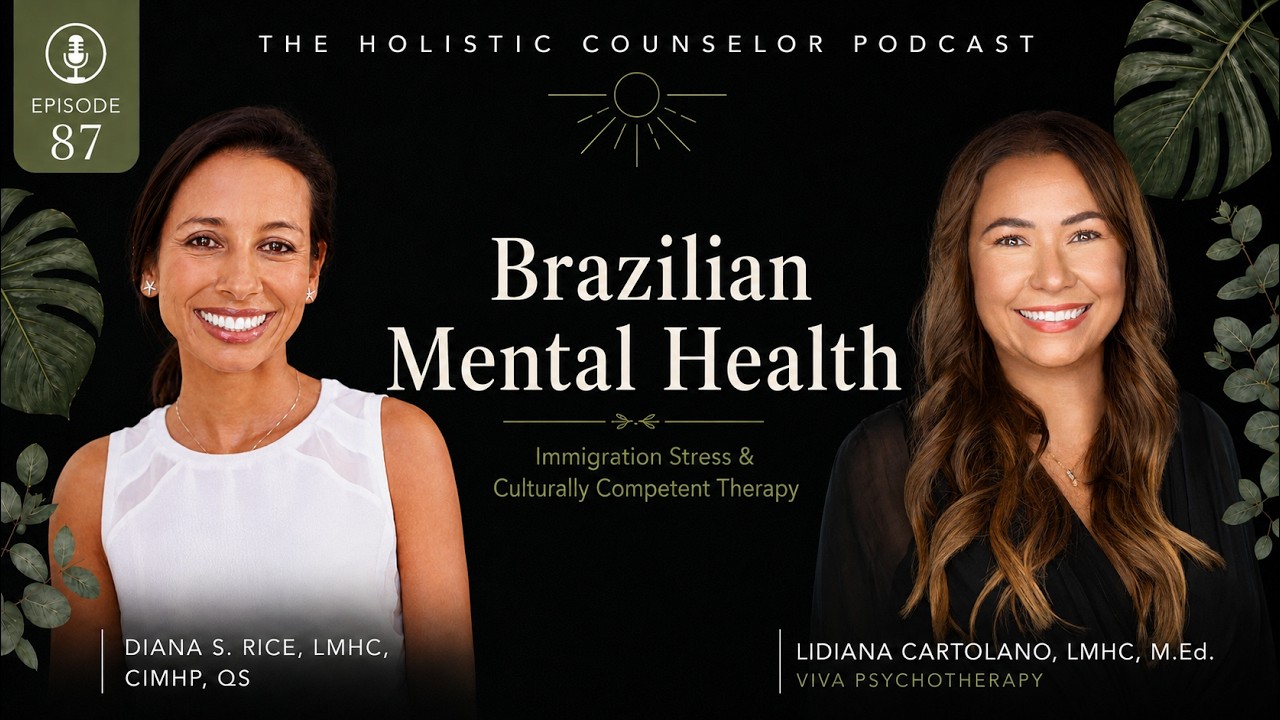
Episode 24
Breaking the Stigma: Mental Health and Vulnerability for Hispanic Men
with Leonardo Aguilar, LMHC
Hosted by Diana S. Rice, LMHC, CIMHP, QS
Welcome Fearfully and Wonderfully Made Humans! In today's episode, Diana dives deep into a conversation with Leonardo Aguilar, LMHC, a bilingual therapist who has over 10 years of experience working with children, adolescents, families, and men. The discussion…
Listen to the Episode
Press play when you’re ready.
Educational content only; this podcast is not therapy, diagnosis, or medical care.
About This Conversation
Show notes
Jump to a section
Welcome Fearfully and Wonderfully Made Humans!
In today's episode, Diana dives deep into a conversation with Leonardo Aguilar, LMHC, a bilingual therapist who has over 10 years of experience working with children, adolescents, families, and men. The discussion focuses on the unique mental health challenges Hispanic men face, the influence of cultural expectations, and the role of faith in healing.
Key Topics Covered
- Cultural Expectations & Machismo: Leonardo discusses how cultural expectations and stereotypes affect Hispanic men, particularly regarding vulnerability, mental health, and seeking therapy.
- The Role of Faith: Leonardo emphasizes the integration of faith in the therapeutic process and how churches can support men in addressing mental health issues.
- Machismo vs. Vulnerability: A powerful exploration of how machismo can prevent men from seeking help and how embracing vulnerability can strengthen their relationships and mental health.
- Navigating the Church and Mental Health: Diana and Leonardo touch on how mental health is discussed in Hispanic churches and the stigma often associated with it.
- Immigrant Experience: Leonardo shares his personal journey as an immigrant from Uruguay and the challenges he faced growing up in a different culture while attending public schools in Miami.
- Practical Advice for Men Seeking Therapy: Tips on finding culturally competent, affordable mental health care and how to take the first step toward getting help.
Resources Mentioned
1.A Mindful Process Therapy (Leonardo Aguilar's Practice)
Website: https://www.amindfulprocesstherapy.com/
Contact: (305) 224-6434
Email: Leonardo@amindfulprocesstherapy.com
2. Open Path Collective:
A directory for affordable therapy services.
Website: openpathcollective.org
3.Psychology Today Directory:
Find licensed therapists that match your specific needs (e.g., Christian, Hispanic, male, etc.). Website: psychologytoday.com
4.Books Mentioned:
No Bad Parts by Richard Schwartz (recommended by Diana in her practice)
Final Thoughts
Leonardo encourages listeners to remember that seeking therapy is a sign of strength, not weakness, and emphasizes the importance of finding the right support, whether through faith-based therapy or culturally aligned services.
Connect with Leonardo Aguilar
Website: amindfulprocesstherapy.com
Phone: (305) 224-6434
Email: Leonardo@amindfulprocess.com
Stay Connected with Diana
Website: throughthevalleytherapy.com
Instagram: @throughthevalleytherapy
Closing
"Trust in the Lord, guard your heart, and renew your mind." — Diana S. Rice
Remember to subscribe, rate, and leave a review to help more people discover The Holistic Counselor Podcast!
Episode transcript
Read the full transcript Close transcript
Automatically generated from YouTube captions. Names and wording may contain errors; listen to the episode for the original conversation.
welcome fearfully and wonderfully made humans it's me Diana from through the valley therapy I'm excited for today's episode as we dive into an insightful conversation with Leonardo agar did I say that right agar no ag ag okay I had I had the pleasure of connecting with him through the Christian mental health professional group that were both part of and we've shared some really thought-provoking conversations Leonardo is a bilingual licensed clinical social worker practicing in both English
and Spanish with over 10 years of experience working with children adolescence and families in a variety of settings including outpatient schools and Community Mental Health he holds a passion for helping people of Faith navigate the complexities of their mental health integrating their spiritual beliefs into the healing process as the founder of a mindful process therapy Leonardo emphasizes mindfulness-based interventions to help his clients manage anxiety depression and Trauma today we'll be discussing the mental health challenges men
face particularly Hispanic men though Leonardo's insights apply to all all men we'll explore how cultural expectations family Dynamics and Faith play significant roles in shaping their experiences Leonardo's expertise in helping men break free from stereotypes and embrace vulnerability while strengthening their faith is sure to provide valuable takeaways for all listeners well Leonardo welcome to the show thank you for having me that was that was a nice intro like can I C can I get a copy
of that yeah it'll be in the transcripts LCSW lmhc so licensed mental health counsel so good oh okay I'm sorry yeah well well let's let's talk of that for a second you know let's talk about that the differences because you're right like people ask that question all the time especially in in our population like you know what's the difference guess that well I can't even say it in Spanish what's the difference like people will come up
to me and ask that like oh you're all the same some people were like are you a shrink and I'm like no like so go ahead explain what the differences it's a Sho shrinking have you I think it's uh it's on Apple yeah have you seen it no it's pretty good it's with this dude I forgot his name um tall guy he did uh forgetting s Marshall forgot his name right now he's on everybody um what
is it uh How I Met Your Mother yeah that guy so oh okay uh what's his name what's his name I know who you're talking about he was uh dogie Hower right the one that played Doogie Hower toer T guy oh I don't remember I never watched how me okay so anyway let's let's explain the difference between LCSW lmhc lmft AB BCD e FG no I'm just kidding yeah so and the shrink right when shrink gets
the the SIDS and PhD so so yeah we have so many different um I love it because we have so many different backgrounds so let's start I guess with the one that we cuz you're let me see to right yeah yes Health Counselors we just have a uh Masters on psychology right so I think mine uh was in counseling psychology I know people have a masters in Clinical Psychology so there's different psychology routes so even in
our uh that's what I what I've seen so even to El see you can have different kind of degrees LCSW and I say that because I've had the experience lcsws which stands for list licens iCal social workers right right they do adhere to like social workers have a protected title to themselves I think and I like that because they're very proud of what they do right so I think I say like I'm not a social worker
by education but by trade in a way because I've worked in the Ryan White program for so long helping people in the medical case management uh helping people with HIV and AIDS uh any before that doing different kinds of uh advocacy work and legal and so so that goes a lot of my background and what I still put into my practice right so I like they they are very social work driven so that's another uh different
kind of uh methodologies is the way that they do therapy right so they see the world in a different way perhaps the person that uh went to psychology and then you have the lmfts licensed marriage and family therapist so they have another kind of um understanding of family Dynamics and they have more expertise in that the genogram right yes have you got a genogram done yes I did because I had to take that that class marriage
and family therapy to graduate so definitely they the professor made us do the Gen and I was like whoa yeah I did that too yeah and so they have different Specialties right so like the fact that we all have different um ways to look at a problem right so if you go to one therapist they might you know see okay you know we're going to tackle it this way we're going to focus on more on the
family Dynamics and how that affects but also Focus another one may have no let's do more of the individualistic because you have this is your um specific culture so there's so many different ways to look at a problem and I think having different therapists do different things differently is good and we all you know I we we still kind of like look at things from one view of like if you have like if we get a
little more specific like CBT right cognitive hero therapy you look at it from a cognitive hero therapy standpoint right you can have the three therapists do the same kind of therapy the LM L MHC and LCSW but they have their own flavor to it right so yeah exactly we're not a one-sized fit all no no and so what made you focus on immigrant and Hispanic men's mental health oh yeah so I'm an immigrant myself so I
came here when I was 13 um from Ur okay for those that uay for us Americans I mean I'm a Latina but you know I was born here so yeah Uruguay Uruguay okay okay and I said your name right right Leonardo Leonardo yeah I love it Leon he he rolled his arms I love it I did yeah uh sometimes I do have to say Leonardo so I'm it's already bias on like it's already strench but I
I do like to say my own name in my yes Leonardo so it's I love it and it sounds much more prettier than I said it that's for sure I love well it's the same with my name honestly I have a lot of people call me Diane I'm like no it's Diana with an a you know what just call me DI because that's my name di di there you go you know so but most people call
me Diane yeah Diane okay so back to the Immigrant and because you're an immigrant and then and that's and and I'm a male too so I think right now like as you said I serve women and men but I think God uh has also put a in my heart to serve men because men do and we tal I know we talked today more about that what that means for a man to actually see couns and what
I've heard from man is like oh you know I chose you because you know it's it's funny like even if it's you know different um culture right doesn't have to be Hispanic but the fact that you have that you are Hispanic because our culture are similar right so and you know so when we talk about culture the collectivistic culture versus the individualistic right so if we get into that different set of things how Hispanics we have
this familiaris right very oriented right so I love you know being able to communicate with uh the people that I you know that are part of me and so I I like to have that as a resource you know that I you know and when one one says oh I get you we never get that person specifically but there are different things that we can understand because different similarities that we live and I think people do
value that um yes more and more now especially now that we're going into churches and the black and brown communities and really getting them to understand that we it's you know you don't have to hold on to all that uh activation in the brain and body right the trauma right anymore and there's better ways of communicating and still being Collective because I don't know if you felt this you're not a growing up did you come to
Miami when I went yeah I went to Miami directly from Uruguay yeah wow okay so that's a whole listen that's a whole different culture in itself Miami no d County brow County and PM Beach County comparatively to the rest of Florida oh yeah right right and so it's also understanding like even in this country the USA we have different cultures in in in America and different Latin cultures and stuff but for you when you came to
Miami wow at 13 and I know I have had to work with a lot of adolescents who are first immigration here at as a teenager being thrown into one of these Public Schools yeah tell me can do you mind talking about your experience a little for sure yeah I love I love doing that um okay so tell me like what was it going on in your brain at that time or the on your mind because I
know with my personal experience even though I'm born here I still know at home it was one culture in the public schools it was a whole different culture and I did not I've always felt weird because I did not feel like I belong to either one yeah so I had a I think I had a good experience and I say why I I was fortunate to be uh put into a school so it was it's close
to my house and and it was it's no longer I think it's it was called aspa so Aspire but aspa aspa scho in mi and it was uh very Hispanic friendly right our the director was Puerto Rican woo I'm sorry I'm half and it was really nice and I even remember there was this Prof I never forget there was this professor for it was a math professor he was from one of the GU guanas right the
close to the Venezuela and spoke Spanish like he would like it was so cool because he would speak Spanish to me in the middle of the class and that was like when I was like wow this dude is really wants to make sure that I got it and yeah and actually math was fun because I kind of like so I came when I was in seventh so I finished you know duai is different so we have
we don't have like you know elementary middle and Senior by high school we have basically Elementary and then High School basically okay so I have finished first year of high school basically Lis in uai and so I basically came and then but had to do half of seventh grade uh because of when I came I came like in December I came in I came in December 24th 2001 I remember that so so I was half year
uh so I was like you know I went in there and I kind of knew a lot so and I remember that year I was doing good in in math my teacher uh my teacher like is like oh he knows he knows his stuff so so I think it was for me was a good experience I know that's not uh for everybody I also like the fact that I was in ESO I don't know if you
know about what esil is well explain it to the I do know what it is because I I worked in the Brower County School System so and so explain to The Listener who might be somewhere else that you know in the middle of nowhere that doesn't even know what that means esol is I don't know if it's like a program but I think it's just something that you um if you come specifically from another country um
you are put into a a specific um set of there's different advantages that you have right so you can you know take a little longer for test and you're put in a cohort of you know for example was in a cohort of you know students were Hispanics also so and we so there was a Community Based part and so I think it goes well with you know you know our you know commun his because we get
put into this community we're this esil and we actually get to speak Spanish with ourselves so that was helpful right because yeah coming to another country being you know um and I had my sisters from U so I left them you know we left my sisters you older sisters so yeah you have guilt for that because I I do know when I work with immigrants they have guilt some of the parents or you know because they
come here for a better life right and then you leave Family behind I know with my own experience my mom's from Colombia and I know that she had she came and worked because she made it here and so she had to work her butt off to send money back because she comes from a very poor place and I didn't understand that being an American because I'm American right and so this is the thing it's like the
trauma comparison like you do not know you're an American but she was kind of not validating my own experience of being this American in a school system and having teenage problems and I had no one to talk to at home because you see what I'm getting at yeah that's something I see in a lot of immigrants and I'm sure you do too so can we touch on that a little bit of course yeah the guil I
think that's universally I think it's it's not even two three part tier like you know tier right so for me specifically maybe the guil came in me when I was older when I was just came in it was just trying to maneuver everything that was going on yeah I think there's there's the guilt and the hope that man I wish my sisters you know would have been here that you know have the same chances that I
got to become a citizen like I have dual citizenship that's something I can say that I have than God um you know so different things I think if you want to maybe the guil perhaps I think the father and the mother hope more the guilt maybe not so much the brother I think the brother also can my case it wasn't so much that experience it was that desire of man I wish they you know first of
all I wish they were together again and you know when especially when you go back like if you get the chance I know some people don't have the chance to go back which I'm privileged to be able to have gone back and visit because able to obtain you know residency you know through my Father which was a citizenship became a citizen so that I was able to get citizenship you know so then you go back back
and then there is that separation again so every time we get together there's also the grieving that kind of gets put and that's a we are feeling like we talk about it with my sister in Uruguay a lot you know so if she I think she she does you know that that touches her a lot um yeah it's a sitation all over like and is a protective Factor because then I think then you don't want to
get too attach again because then you again anymore right so there's that inner fight like inner strugle like got so there's so many components to being an immigrant that you know unless you live it or work with people that right are and you and you learn to have compassion for it right because that's our job like we you know I I know unconditional positive regard I talk about that all the time with Carl Rogers and just
having that understanding that's why a lot of black indigenous people of col color B poac and latinx I know I use those terms because I worked with young young people teenagers all the time and so back in the day now I only see adults but it is and these are conversations I have with people because I see all walks of life personally as well and some you know have strong political mindsets and everything and that's fine
but they get triggered or activated by a word like immigrant immigration right and then right away it's just like okay are you listening to try to understand or you just listening out of fear and you're just trying to respond right so what do you see as the most difficult challenge right now for mental health especially for Hispanic men I think a combination of you know I would say anxiety uh and so we get and it's funny
because for for Hispanics we have different ways of kind of like talking about mental health and so we we say you know oh I have a a a nerve attack or like or like and it's also when you look at it like even looking at it from the Academia standpoint susto even feels like a out of Soulful experience so we're Hispanics are very spiritual you know like in in in the way that we so being able
to reconcile all that and and as so Hispanic men Hispanics I think it's a lot of the I'm not crazy right so if you talk mental health I've gotten it from people it's like well I don't need a therapist because you to local I'm not crazy so what has been basically filtered in the Hispanic Community is that if you not only I think that's a more Universal but I think it's very prone to Hispanics where it's
like yeah we have I think it's one of the strong suits for Hispanics which we are so familiar but because we're so familiar then it's like what shouldn't need it because I got my family wow so my family should be the one that talks to me or I shouldn't need to go see a shrink I'm not crazy right I talk to but and that leaves this you sometimes our experiences being invalidated because we're not able to
say well you know what but I'm GNA talk to my mom but whatever the issue is with my mom because I can't you know I you know I can't mom doesn't stand my wife or my girlfriend and or you know or and I just need to talk to somebody about it but I should be able to figure it out on myself right that I don't need a therapist because I'm not you know I don't what do
you what do you think is the the wall that they're hitting or the understanding of what therapy is because I I know I have my opinion and what I've heard in the past from the families that I served back in the day you know because I know it's like I did not trust the system right or where raised right we're like uhuh you know and then you you go and you figure like okay this doesn't feel
right you know and then you have emotionally immature parents because of their traumatic situation for you know and they think that's normal and then you know how do you how how do you do therapy with a family say you have a man coming in finally right yeah I need help right yeah let me tell you something if I got the do to Kong that's already like I'm just celebrating so that that actually doesn't happen often so
what you just described it's will be the goal of the therapeutic to actually get the guy to come because the fact because why because there's so much expectations for men when we talk about man right so what your question was so layer right so we got the fear of um first of just man I don't want to go see anybody because then if I say something that I shouldn't say then they might call a cup something
or wowow so you know I don't especially last year when the the rule the the law that came in uh there was a law that you couldn't transport people and and that was a lot of things were going on you know like or you couldn't go to the doctor there was a lot of fear it was a law that was in um and and Tena there was a lot of myths so debunked and I was I
was um fortunate enough to actually be part of the you know some groups that were actually given information now this you can still you know go to the doctor they're not going to reny you coverage right and you don't have to say you don't have to like you know they don't have to know like they're not the cops they're you don't have to tell them that you don't have papers so I think from a structural so
there's so many ways to look at things stral right uh being able to actually get people you know say well I do need help but then can I do it can I go and I know you know if I go how do I go like do I can I afford it or is there something that I can do so I think just getting to see that's already even that's that's a whole bottle and we can talk
so many the various you know different so many things go go into that if you the guy came in I was just actually honor the fact they can so actually use that so when we talk about machismo right so let's put that the so I love talking about machismo because I there's so many layers to machismo right people forget about talking about the kayis right kayis which is like the being you know sort of the very
very you know proper and like very a gentleman a gentle that's how I see it like gabo and gentlemen and then machismo is that that hi testosterone I'm it I'm the man you're you know you're a peon you're the female kind of thing so let's let's go in there for a little bit for both yeah yeah sure so I like to actually differentiate that because we look at the if we look at it and I like
to look at things sometimes academically because it kind of like says there's re research has been done here so cismo is part of Maes so if if the men is coming so I have either I can hold space for that man to actually be able to say hey actually congratulate you know really be from a place of you're here so you know actually have you know the the positive side of what means to be a man
for the Hispanic Community which is so many different things uh name a few because like remember that my listener hopefully will be Hispanic men some of them and also women and also I teach cultural competency to people that don't understand different cultures so I want them to understand these things because some people listen and they get you know triggered all you know these immigrants and stuff and I'm just like no can you please just try to
understand the situation before you give me a whole bunch of opinions yeah so Hispanic men right yes so when we think about machismo right the the this the whole talk is that you know men don't let women you know or don't let women do you know things so then that's why women sometimes don't go to the doctor because men don't want hurt them to go or the daughter there's this protective side so I look at look
I like to look at things from a value standpoint right a practice acceptance and commitment therapy which that gives me it it goes and when I say value it's not I value family it's more about qualities of behavior so we think about to act in ways that are protecting so in which way so like we look at men that when a protect right so and this this is part of him and also I'm not saying that
there's not a way that you do it that can be I'm putting quotations for those can hear me toxic right because that the toxic masculinity which has been you know a lot talked a lot what I'm saying is that there's a part of that person that men that there is a value H in there which is guiding their behavior is to protect the people that they care about any ways it's they have being taught how to
do that properly or in ways that are inviting and and that are compassionate and there are you know caring to their whole family that can be you know in many ways even like um that they feel that you know what my wife feels that I'm actually not trying to Manda right to like actually take over her life right so I I so when I said so when a person comes in there is a level of you
know what the machis has you know has that right why do men many times if you think of the wise right why do men feel that you know that they have to have this Persona of you know you know I have to be you know so strong and I have to be right you know this the costone thing alpha male kind of thing because you know if you want to look at it from many different facets
spiritually like there is a different responsibility for the man right that have if you look at it from from a Biblical standpoint that responsibility men is they have a hard time to to cope with that uh I struggle with that as a man myself as a you know father and so that is like okay well you know what I can't be weak and what does weakness mean vulnerability I can't tell my wife that I feel scared
I can't my wife that I feel uh anxious because would show I am weak so and that's but are you but are you weak if you show that I don't I don't believe so I believe exactly showing vulnerability you know actually expressing that I at times don't know how to do things correctly and I it it's and I don't know where I'm going but I and I feel anxious about that I seek help and I and
actually it's a sign of strength it's a sign of actually wisdom because I'm able to utilize my resources effectively wait and and so what I'm hearing is that you're and I see this too remember because I am female married to a male and and so what I see in is just that they want the protection remember like you were talking they want to protect the family or protect who they are and biblically speaking though we are
meant to be in community not to be a man on our own island or a human on our own Island and so a lot of it's learned behavior as well learn behavior of like oh my papy I saw that call me papa you know and all this and this is how they treated and sometimes that's what we do like We're Young we're little we that's what we think because we're not bored knowing how to be in
relationships we're taught by the village that raises us and then we but then we sometimes excuse it well you so Latina that's why I yell there you go and and if you don't like it then you know go marry a non Latino yeah but in a way because and that and I say that for the man right well J see you know I don't and if you don't like it then go marry a guy that you
know is weaker you know that doesn't show and that leaves so you know it it just man if we can yes that's how I currently am because of this and this and I struggle with that and I'm sorry I I I behave that way because I know that affects you I'm going to try to be more mindful about that and help me and I need your help when I do please let me know when that behavior
comes up when I because I want to be make sure that you don't feel that I'm you know walking over you or I'm trying to tell you what to do right it sounds like maturity and learning communication skills right it's like learning how to speak and and evolve because that a lot of us are emotionally stunted or communic you know communication and then it's the pride that gets because you either live in Pride and ego or
you live in humility and spirit and I think for men and I and I say this and I even hear it in podcast and things like that I think and I've heard it from clients it it's I would say it's not a catch 22 but it can be it's not over the time but unfortunately men have experienced you know what why bother because when I try to be vulnerable it's look and I've heard it from men
that have done it and they're Partners have looked at it their family like because it's so bizarre that when when the male does it and not saying this all the time so it's not a generalization but it is happening so there the other side of the coin where men have learned believe me I tried but when I done it it's not received the way that I intended it and I go back to just trying to suppress
it and deal it on my own that side of the experience that I don't think it's sted a lot I mean um which is like man it's not like all the time there is that level of because like I said it comes from somewhere and I think some where it comes from is that that man has tried to be vulnerable to their own to whatever they meant they thought that meant and at times that has been
received in a way that hasn't been validated wow that's the key word validation yeah right I also seen that so that's how work in itself because you know there I I never you know and you mention um something unconditional positive regard whatever the person comes in right I take it right yeah they're telling me that I'm not here to say well no are you sure about that are you sure you heard it right cuz I'm sure
if you told your wife that you're sad she would have say oh don't be sad or at least Cog you oh my gosh that's gaslighting and that's what that's that like you know I don't think so man come on just s dude yeah but that's the difference between going to a professional who's trained because like the reason we know what we know Leonardo right it were you born knowing this stuff no no it was a training
I still go into training I still like you're teaching me right now more and more I go into my cus or and above I listen to things because I want to be the best professional person for my clients because this is a calling on our lives Leonardo on your life too because what you're talking about you're breaking stigma in a population that is suffering too like we're a lot of us are suffering I mean anxiety and
depression are through the roof in all cultures in the church outside the church I don't care what color you are what beautiful caramel vanilla whatever it is that you are right inside our souls let's talk about that a little because now there's a to between the secular environment that we both worked at right and having to be clinical in science and everything and now we are both Christians so we see what goes on in spiritually and
in the church yeah right and I know we have different denominations in the church too right so not only different Hispanic heritage but because we all take pride because I know being half Puerto Rican half Colombian it was just like well in so don't pick up that and I'm just sitting there like I'm already trying to just be in America being an American girl like you know I'm trying to figure out who I am at home
and everywhere so let's talk about the church a little okay and what you see do you go to a Spanish church I do yeah okay all right so and I know at the church I attend even though I attend the English service um they have a Hispanic church too a Spanish they call us yeah and so it's all in Spanish and I think I'm going to start making my husband go because he doesn't speak Spanish and
just for him to feel a different kind of culture just to and me too because I want to I I want to connect with my people yeah so I so much to say about that and so you're saying in the Hispanic church or the church itself because that's a different thing in itself well wherever the Lord leads you to talk about because remember like right now whoever is listening and hopefully will be some men and people
that are in the church um recognize what you see there when it comes to men so my observation it's I would say in the Christian English church mental health is spoken more than the Hispanic chur I would say that 100% yeah now it wasn't 10 years ago 20 years ago at all now they're finally realizing that wait you can have a therapist and Jesus that you just don't pray everything away because honestly you know any any
little thing that happened it was like oh that's a demon oh you're not praying enough oh and that's spiritual bypassing right so but now ter again spiritual bypassing yeah spiritual bypassing I'm trying to find someone to speak on it with me and I'm I'm working on that because I'm not going to do a solo episode on it because i' rather have the conversation but that's what happens in a lot of churches and yeah I find with
my clients a lot of the women coming um you know were raised in the Purity culture and they're deconstructing and I'm like please understand it's a crisis of Faith but Jesus still wants to have a relationship with you because they grew up in this you know so yeah and thank you yeah so what the Yeah so many things you said something I was like it was triggering me to talk about something else but I'm going to
stick to what you said uh so mental health in the Hispanic and you know English church that is Christian it's not talked about enough it's being more talked about in the English church like I said because I've seen the difference I've done like we had an event for men um and it was actually we did it bilingual so it was nice but it was a lot of it was done in English because a lot of people
more english- based so we actually got to talk you know about mental health pornography addiction we got to talk about anxiety fear it was amazing uh and and I love to do I like to do like things where the men can feel like this kind of questions like has any what has been the greatest fear what has been one of the reasons you haven't shared it was so unanimous saying like because when I shared like kind
of like the thing that I talked about like it hasn't been invalidated or the fear of fear of rejection wow fear of rejection that man had that I think it happens um when we talk about like being able to talk about mental health and I think that happens so much in the Christian because in the Christian realm and I talk more about this on the pornography right so they're going to bring pornography about it because the
people that get most attacked when I say attacked because there is also a spiritual component I would say for to with pornography and and the struggle are men who are in the worship Ministries and are pastors yeah what that means if I struggle with pornography and I'm a pastor or a worship leader or I I'm not gonna talk about because first you know I haven't gotten the okay first you know I'm and it gets tricky right
because maybe you may be staff and you don't want to boost your employment there's also that piece of it right but there's that piece of has my cultural love me to share something I'm struggling with in a way that doesn't seem that I'm going to be looked down as sinful and just judged and just you know say I'm going to hell or you know I think like I said Has Changed is changing more but historically I
think it's been that way like the you know really the look down of you know this a sinful behavior and and even when you talk about faith right the lack of faith right meaning if you are on the G in when you talked about the um you know spiritual bypassing is if you well you're just not praying enough or you're trting the Lord enough or you are not enough enough enough meaning like so that imagine how
that exat anxiety where it's like I'm already feeling anxiety and now I have because I'm not trusting God enough so and I think what the church can do better is not to look at a at a you know issue like anxiety and simplify and into a simple Bible verse or something that you know and then just to repeat like it isn't as easy and just trust the Lord it's not that easy it would it wouldn't be
happening in the in the skill that it is right I mean it's a training I'm thinking for people in the church to understand science of the body of addiction of why it's happening because there's not only people like you know suffering I mean I actually have women that come to me that are Christian women who you know have been keeping their virginity and they're in their mid 20s and they have come with so much anxiety and
then when they finally tell me what actually is happening it's pornography and when they're finally have someone of Faith going okay like let's talk about the science and what's doing to your brain why do you feel you need to do this how are we going to come up with the tools right and they're like you're not going to tell me that I'm going to hell I'm like that's not my job I'm a therapist like that you
know you could go talk to but it's making people understand their B the way we're made and what's happening what is it doing for you yeah right what people do the you know or engaging the things they engage when there's a there's a Solace there's a Solace that they're obtaining there's a you know there is when we talk about pornography and I talk about this there's also a connection it's easier to connect with the person on
the screen than it is with my wife o it's easier to yeah that's deep right there but that's his right you just gave me goosebumps on that one you're so right on you're lonely you're feeling a certain way I mean pornography I know there's visual people I'm I don't know the science behind men being more visual V visual than women but you guys are you're visual creatures like I know that's why us girls get doled up
and everything tips when you don't say the science you say anecdotal because thank you yes but but it's just trying to have the understanding of why you're doing what you're doing and what is it doing for you and how do you want to change think about Jesus when you know uh the woman that was caught in you know John 8 he just said he didn't condemn her he you know he he didn't he just said now
just try not to do it anymore but there's tools like we're hired because we have been gifted tools and a service just like a medical doctor you don't go around when someone has a belly ache and say well you're not praying enough yeah well yeah yeah you're not eating you're eating on on on on the Sabbath and that's why right we yeah in the church we need to stop being so legalistic on things take the word
of God as a to it is a tool I mean it's the main tool he is the wonderful counselor but you have to have the understanding that we have to understand us holistically yeah and I love when you said you know yeah Jesus is the the best counselor there is and I and I love to ask this question I Al ask it in you know my intake sessions right the first session we meet how much of
your spirituality do you want to be involved in our session I love that yes it's not up to me to decide how much like are we praying and you know I've gotten people they weren't but then it's like oh can can we pray like and I love when they when when that happens it's like oh okay they feel and actually it speaks to the therapeutic relationship because if you have a person that you can pray with
says something about what's going on and about relationship you know if you when it comes to like therapy I think relationship is the one of the most significant factors of change the therapeutic relationship than any other kind of technique even when I because I train providers also like I do trainings and stuff and when I train it's like the biggest skill is yourself and if if you're Christian I would say in the holy spirit amen it's
just you in the room and another person that it's and you're you're on you have the honor to hear their story that you know when we hear stories like you know the Hispanic Community the immigration that's the traumatic experience that they go to everything that we hear that's an H honor for you know yeah so what what actionable step can church leaders take to Foster an environment that's um where mental health is openly discussed and men
feel supported in seeking help I think especially leaders I think normalize it the normalization of Mental Health Access and you know to say you know it's you know that continue that message first of all that it's okay that if you go and and knowing that hey I'm going to go talk to my pastor you know I'm going to talk you know the pastor can do counsel not saying pastors don't are not counselors they're you know from
a layment standpoint and even professionally but say you know what we met a few times I think it would be great if you spoke to a counselor about this I'm not saying that cannot be of support for you but I think if you spoke to the therapist what you're going through right now you know that would be amazing so to normalize it and to advocate for it to advocate for mental health so to actually invite to
actually invite speakers like you know Dianna rice Leonardo Leonardo a who did I say that right yeah you got it you got to about in in different you know to speak on even a Sunday I will because you know what I say this there's so many events but bring us on a Sunday when worship and just you know like I know sometimes you know that's a little you know I'm not going to talk but too much
but like just normalize it to the point where it's like it's part of Sunday it's part of you know the Sunday you know church too like it's not only a special event it is amazing this have special events for mental health yes that's that's a amazing step also like this this find be creative in how many ways can we normalize you know mental health and if as a leader I am actually struggling be open first of
all seek out support right you know you know be brave and and if you're undergoing something like actually imagine what how powerful it is to hear from a pastor you know what congregation you know I'm I'm undergoing some stuff right now and I'm seeing a therapist um yeah imagine how powerful and this is what I've learned about my therapeutic experience wow that's vulnerability right there I'm telling you right now for that to happen in churches listen
I I create like I I didn't create it the Lord used me after a year of me saying no I don't want to do this those mental Wellness Ministry um panels on purpose yes Saturday this past Saturday was the third one that I've moderated so I moderate I find the and now you just gave me an idea and I'm GNA talk to my pastors because if you're listening to this I'm coming at you um that I
love this like I I create the posters and I love creating events because that's something I did back in the day before I was a therapist but professionals Christian professionals talking about a subject like parenting but this time maybe men's mental health I think I'm gonna ask my pastor maybe our next event because we do it two times a year to do that and I want you as my one of my speakers you do it of
course yeah but people come to me after that are not part of the church because people from all over the community come to these events and they're like oh my goodness you need to do this you need to have it like as a traveling show and I'm going well the thing is I have reached out to the pastors and when they're not ready what do you do you can't you could give them the some of them
honestly some pastors think that they are the therapist yeah and that's dangerous in my book at times and like we said we some pastors you know I have I know a pastor Pastor juang GAO and I say his name out loud uh he's part of our group and he's a great pastor P he's done pastoral work and he is a licensed mental health counselor but even then well I think he's a register but even then I'm
gonna pastor and I'm gonna counsel there's also distinction of that so I'm not pastors cannot be great counselors but know limitations and limitations in a good way because I wna like you know I want to be your pastor and I want to know what like if I can't it it if I don't if it's if you have a better fit Seena concert it doesn't speak you know bad about me as a pastor it says actually you
know what I'm utilizing my wisdom and knowing that I recognize my limitation as a pastor counselor as a counselor Pastor that this has become more of a than a spiritual issue and a mental health issue that needs a it needs even like a diagnosis and you need a professional guidance right and not saying that the pastor say the pastor can become happy can become such an assd even un like Hispanic community because we we really look
up to our pastor so what I'm saying when the pastor is able to advocate for mental health that's a win win win win you know like yes for real they can't carry the burden all on their own we're all meant to be in community we all have our gifts and talents I just wrote that on my blog about uh mental health and church like you know what's your spiritual gift and how are you going to utilize
it so before we wrap everything up I would like for just like practical tips on like what would be be the first step a man just heard this and said oh man okay this is a sign I need to go get help what would be your first step to do like where where would they find a good quality Christian therapist or if they're not Christian like somewhere they could find like a therapist that his latinx Hispanic
whatever it is like what your needs are and and if they can't afford therapy you know because that's another thing in our community we're not as rich as other right some of us where can they go to find quality therapy because I know working in Community Mental Health sometimes I felt like I was red taped and it was just about chasing that Medicare or whatever Medicaid and insur and and you're then then you're captured in diagnosing
and and medicating and all that what would you recommend yeah so if you have so this two things right if you have insurance and you need to use your Insurance look out you know for the provider P right but if if you're a part of a church right and you want to seek out um a counselor like I know we have the group created just for Christian therapist we have therapists that have take insurance that are
self-pay we have so much access and and therapists do have you know you know obviously depends on therapist sliding skill so like you know and they can look at a case say you know what is a sliding skill scale mean like they look at a case you know your fee may be whatever you know 120 let's say but you have a slot and you you're able to accommodate another client that you know let's say they can
only pay 70 so you if you're able to accommodate them then that's also avability so what I'm saying don't be afraid to reach out to your resources so if you know okay I have a therapist in my church maybe they don't want to see me because they they know me but they might know of a therapist that is Christian that takes my insurance so that's I think just use that resource there's directories everywhere and I obvious
see we can't get into like okay well I can say Psychology today is one yes I cannot vouch for every therapist and exactly that's what I say do your own research you know and I like I said ask for consultation have a consultation so you know if free consultations talk to them before committing to a you know appointment say if they have a free consultation hey talk to them if use the filterings sorry go ahead yeah
no no that's what I about to say use the filterings because they have where you could click Christian you could click your insurance you could click uh whatever issue you're feeling anxiety sadness anger whatever it is or in mail you can mail online in person I mean they psychology T does a very beautiful job the other one that I like is uh open path Collective I was going to say open path Collective yep when it comes
to that was maybe I was going to say so thank you for saying it but I thought about it because they offer that's specifically for um if you're a therapist and you go into that provider Network there's a cap on how much you can charge your client you're AIT to if no more than $70 okay that's what it was I didn't know 40 to it's $40 to $70 for a licensed therapist and then for a registered
intern I think it's $35 that you have you're only allowed to charge but there is a fee that the person has I'm part of well but I only take a certain amount because if not then I can't you know you see these lights in the airs on right now I have to pay my bills but you know but that's my contribution now that I'm in private practice is like I take one or two pro bono cases
I take one or to three open path Collective and the rest is um full payment but I I put a lot of work in as a therapist you know like we do we we've done a lot of work for our clients and it's not only the 50 minutes that we're with them it is right I think that's the understand oh you get paid this much money hundred and something dollars an hour I'm like yeah but according
to how much work I put in it might not be that much because I'm still thinking about you I'm still wanting to serve you well I I'm praying for you I'm finding resources for you I want you not to be with me for the rest of your life because then I'm not a good therapist I want you to be healthy and strong and go out there into the world and and use your gifts to to you
know and then after you're he healed and those places you'll be like oh I have a great therapist and the word of mouth yeah there you go the great yeah the the best marketing tool right help path yeah all those different directories and just be able to like I said utilize your resources and and I say even before that just know that you're worth it you're worth seeking com amen you're worth it and that should power
you know hopefully that you know invites you to say you know what I'm worth looking for help because I'm worth being you know well what's the alternative because this is something I say a lot too you're either going to pay for prevention or you're going to pay for intervention right either way you're going to pay you're gonna pay because if that anxiety or um yes and and that but guess what if it's up to there already
and you don't take care of it it's your body keeping the score telling you to do something do one thing so I know I could talk to you forever about this I might have to have you back on or we're going to set up something where we're gonna go on tour together with with the I'm gon I'm already thinking of all the panel the mail panels that can come and and we can talk about different cultures
and different things for men's mental health you know especially in the church um any final words before and and tell the audience how to find you of course thank you uh just thank you for having me I think mental health is something that as you said we can continue to talk and talk and I'll just read itate what I said you're worth it if you're listening and you are under you know and if you're listening to
the Jana and you know you're in good hands because it's amazing what she does thank you and just know that you're worth it you're you know seeking Counseling doesn't mean you're anything l than what you think you know the church if you're a Christian doesn't mean you're less Christian or or have less faith in what you uh think you should have it means you're human yes and if you are working on your mental health buos to
you continue to do so and whoever you have as your therapist it's know that you are important to their life and that they they do honor being in that space for you well if they're a good therapist people in our field and that's in every field they it's like what are you doing but yeah hopefully right that's a hope um but you know and if you want to find me you can do so at a mindful
process therapy.com uh you can reach me at uh by phone number 305 224 6434 or email Leonardo or Leonardo at a mindful process therapy.com wonderful well once again I thank you so much for taking your your time and um remember listener to trust in the Lord guard your heart and renew your mind bye and now for the disclaimer to make sure you understand that you are responsible for you the content provided on the holistic counselor podcast
is for entertainment and informational purposes only and is not intended as a substitute for professional medical advice diag nois or treatment always seek the advice of your physician or other qualified mental health provider with any questions you may have regarding a medical or mental condition never disregard professional medical advice or delay seeking it because of something you have heard on this podcast the views expressed on this podcast are my personal opinions and do not represent the
views of any professional organizations with which I am Affiliated call your doctor 911 or 988 immediately if you have a medical emergency the holistic counselor podcast does not recommend or endorse any specific tests Physicians products procedures opinions or other information that may be mentioned on the podcast Reliance on any information provided by the holistic counselor podcast guests appearing on the podcast at the invitation of the holistic counselor podcast or other listeners to the podcast is solely
at your own risk confidentiality notice if you engage with the holistic counselor podcast by commenting or posting and are a client Please be aware that you may be revealing information that could compromise your confidentiality please remember that disclosing your identity or personal details can be linked to your clinical material as a therapist I am Bound by confidentiality and will not respond to any disclosures of this type on this podcast I am committed to upholding the ethics
and confidentiality of the therapeutic relationship which extends to all forms of communication in accordance with the laws and professional guidelines that govern mental health professionals I want you to know that your privacy is of the utmost importance and you are responsible for protecting it when interacting on this platform or any other public forum thank you