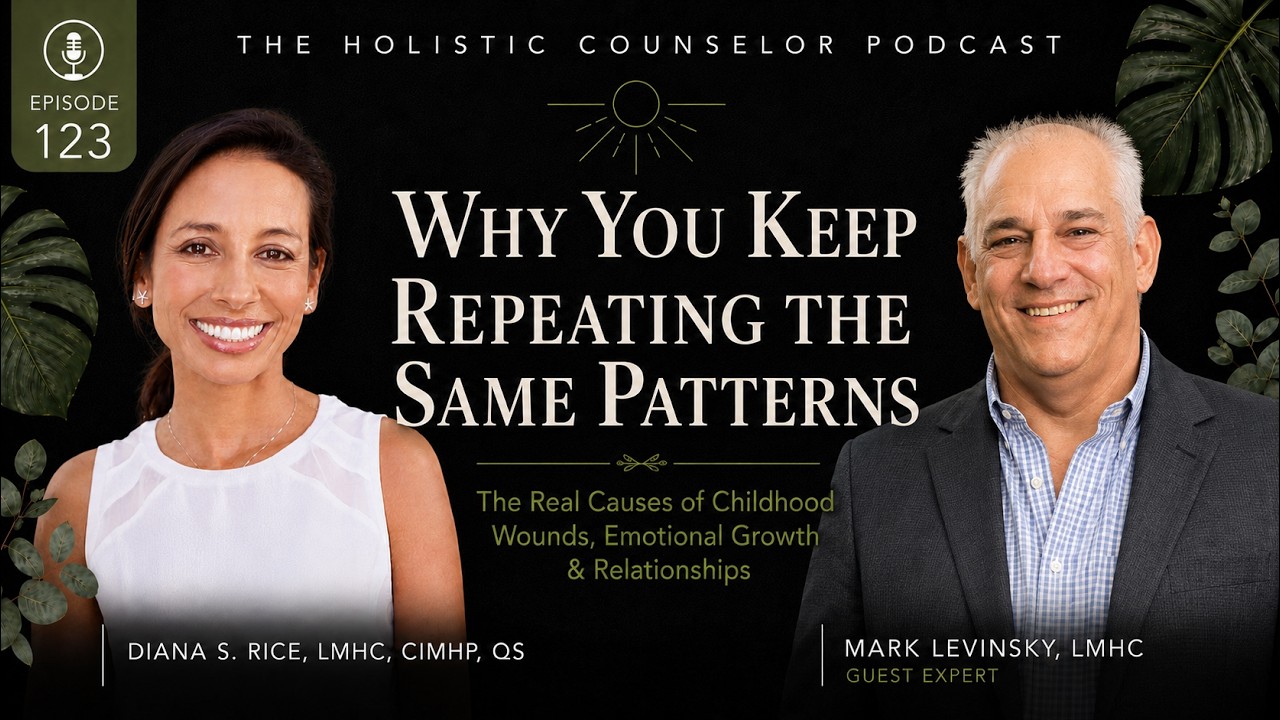
Episode 31
Teen Mental Health: Navigating Trauma, Social Media, and Family Dynamics
with Mike Giresi, CAC, CTP, ICADC, NMP
Hosted by Diana S. Rice, LMHC, CIMHP, QS
In this insightful episode of The Holistic Counselor Podcast, host Diana S. Rice, LMHC, CIMHP, sits down with Mike Giresi, Chief Clinical Officer at Family First Adolescent Services. Together, they explore a range of topics focused on the complexities of teen…
Listen to the Episode
Press play when you’re ready.
Educational content only; this podcast is not therapy, diagnosis, or medical care.
About This Conversation
Show notes
Jump to a section
In this insightful episode of The Holistic Counselor Podcast, host Diana S. Rice, LMHC, CIMHP, sits down with Mike Giresi, Chief Clinical Officer at Family First Adolescent Services. Together, they explore a range of topics focused on the complexities of teen mental health, offering guidance for both teens and those who are raising them.
Having worked with teens for decades, Diana reflects on her experiences as a parent of four while bringing in Mike's expertise to highlight the current trends, challenges, and solutions in adolescent therapy. From self-harm to dissociation, marijuana-induced psychosis to social media's impact on self-image, they unpack the issues affecting teens today.
Key Topics
- Understanding the NeuroAffective Relational Model (NARM®) and its role in treating complex trauma.
- The rise of self-harm, dissociation, and autism diagnoses in teens.
- The impact of social media on teen mental health and body image.
- The increasing prevalence of marijuana-induced psychosis in adolescents.
- Practical steps for families to support teens, including creating individualized parent treatment plans.
Notable Quotes
- "Narcissism is the investment of our life energy in maintaining our self-image." — Mike Giresi
- "Children are hardwired to internalize the failures of their environment. If their survival depends on their environment, they will see themselves as bad rather than believe their environment has failed them." — Mike Giresi
- "The greatest gift we could ever give to our children is our own happiness. They'll take responsibility for it." — Mike Giresi
- "Becoming self-aware isn't just for therapists—it's for everyone. Knowing why you believe what you believe is crucial to real, lasting growth." — Diana S. Rice
Connect with Mike Giresi
Mike is the Chief Clinical Officer at Family First Adolescent Services, a premier residential treatment center in Palm Beach Gardens, Florida. He has extensive experience in trauma and addiction therapy, specializing in working with adolescents and families.
Resources
- Visit Family First Adolescent Services for more information on teen treatment programs.
- Book recommendation: Healing Developmental Trauma: How Early Trauma Affects Self-Regulation, Self-Image, and the Capacity for Relationships by Dr. Laurence Heller.
Final Thoughts
Mike shares invaluable insights for parents, caregivers, and teens alike, emphasizing the importance of self-awareness and addressing trauma for healthier relationships and family dynamics. Diana closes the episode with encouragement to listeners: "Trust in the Lord, guard your heart, and renew your mind."
Call to Action
For more practical tips and psychoeducational insights, subscribe to The Holistic Counselor Podcast and check out the latest blog posts on Liberation Lunes.
Episode transcript
Read the full transcript Close transcript
Automatically generated from YouTube captions. Names and wording may contain errors; listen to the episode for the original conversation.
welcome to another episode of the holistic counselor podcast I'm your host Diana and today we're diving into all things teens I'm really excited about this conversation because although I no longer work with teenagers after Decades of doing so I still get calls from people seeking guidance on how to help teens or navigate the challenges of raising them I did raise four so I thought it would be helpful to bring on someone with Incredible expertise in this
area to share insights with us joining me is Mike Jessi yeah okay the she Chief clinical officer of family first adolescent Services a premier Residential Treatment Center in South Florida Mike's passion for helping others see stems from his own healing journey and his impressive credentials include being a Florida certified addiction counselor internationally certified alcohol and drug counselor and a nationally certified trauma professional he's also a narm master practitioner where he teaches professionals around the world how
to work with complex trauma in adolescence Mike I'm thrilled to have you here today welcome to the show thank you so much it's a pleasure being here wonderful okay before we even get started what is narm uh narm is um model that was uh originally created by one of my mentors and teachers Dr Lawrence heler uh it's a model the the acronym narm stands for the neuroaffective relational model it's a m wow model that was specifically
designed for treating uh attachment relational and developmental trauma or what's kind of being coined in our field as complex trauma right cptsd okay so I have been practicing you know complex PTSD and everything in the inner city and stuff because of my background and narm has never even came on my radar so now I'm really curious about that because now I'll probably Rabbit Hole it and try to listen to every YouTube and podcast about it so
this is wonderful and I'm I'm sure you're going to go into it a little more yeah sure yeah it's it's definitely an approach that informs a lot of how I relate to you know some of the core difficulties that people have and working with the kids and oh all right is there a book about it at all or something yeah it's funny it's one of those books that a lot of people have on their bookshelf like
in their therapist office kind of a thing okay and they didn't necessarily know it was the narm book uh the it's called healing developmental trauma okay how early trauma affects self-regulation self-image and the capacity for relationships okay it's a green book the uh it's funny the so in just a couple years ago the World Health Organization announced the formal recognition of cptsd as a formal diagnosis it's not in the DSM yet it hasn't made its way
to the United States in the DS M but it is now in the icd1 oh cool and the uh the three additional symptom categories so the the the book that Larry wrote Dr heler wrote and published and released in in 2012 the that subtitle how early trauma effect affects self-regulation self-image and the capacity for relationship three new symptom categories for CP PTS according to the icd1 are self-regulation self-image and the capacity relationship wow it just spoke
to the Brilliance of how he really um designed this model specifically to address those kinds of underlying patterns of both nervous system disregulation and identity distortions of how how harshly people uh relate to themselves as they carry those patterns forward from their ear early life adversity yeah wow okay so if cptsd does get into the DSM in America I'm telling you that DSM is going to turn into a pamphlet instead of the big fat book I
think that that's right well anyway all right so I think we're on the same page when it comes with adolescence and labeling them but we're not even going to go in there we're going to start with how did you end up being here in mental health right because I know there's a little bit about your own Journey will you share that with us sure yeah I mean the I think the cliff notes version is uh I
got in I in my late teens early 20s uh really struggled in a bunch of different ways ended up going to Residential Treatment multiple times and uh getting into recovery um from alcoholism and drug abuse and the I was so broke and hopeless and uh the I I felt so unlovable and and I was surrounded by these people that I went to treatment with that uh were spending time with me and they were uh you know
uh giving of themselves in ways that I just didn't feel like I could I deserved even at that time and they you know there's this saying in 12-step recovery that we're going to love you until you love yourself wow that was really my experience was that people were there for me that when I didn't think that I deserved it and um the through that process really I I I experienced a a transformation of how I related
to myself and the world and spirituality and everything in between and uh fell in love with helping others in the ways that I was help and then you know as that just kind of progressed I uh my focus really turned towards teens and working with kids in a way that you know I could be for them in a certain kind of way uh that I didn't have and always needed right and uh it's it's been really
special yeah I bet I mean how long have you been working for family first uh going on 10 years oh wow okay all right so that's yeah you're getting more so what trends are you seeing because if you've been doing this now I know like I took a little breather like I was a therapist in nonprofit Community Mental Health then as the audience knows if they've been listening that you know my youngest son had a traumatic
brain injury so I quit tried to help with him in his situation he was about 12 years old when this happened and then he got better and then I did not want to go back to being a therapist purp so I ended up in the film industry so I took a break a little break and then but I always kept my uh certifications up just just in case and then after the Parkland shooting is when I
went back to being a therapist with teens at an alternative high school so I when I got back I already saw a whole bunch of Trends happening and I was like blown away but now that I'm not um because you know as therapists we have to have continued education not just for the license but if you're a great therapist you want to continually educate yourself right and and so what trends are you seeing with with adolesence
more than anything right now sure um I first off I completely agree with you so much of effective therapy with I think comes from this kind of spirit of humility which is all learning because it's all about not knowing and the recognition that you don't know so the I we're we're definitely on the same page there with continued education and so and that's both education externally and internally right that's right the knowing ourselves more and more
deeply uh is really the the greatest thing that we could do for our clients because you can't really help somebody navigate territory that you haven't navigated inside of yourself o love that mik yeah preach it all right sorry that's wonderful okay so like you're right it's it's becoming self-aware within ourselves right therapist or not therapist listener right is just becoming awake to who you are and why you believe what you believe yeah right in terms of
Trends I mean there there's a couple of different routes we could go I think in terms of Trends with the kids with the teens yeah teens only yeah the with the with the teens I think that uh there's a a far greater um what we've seen come into our our facility and into our program is a lot more self harm uh a uh way more dissociated dissociative um processes and Related Disorders um a uh slew of
more uh teens coming in with either undiagnosed or uh already coming in with a diagnosis of autism yeah the uh the you know there's this like classic kind of um thing in our field where we they we used to talk about um how treatment with girls was often times like this very they would act in on themselves more than they would act out towards others whereas boys would oftentimes more act out more than act in right
and that distinction does not exist anymore why do why do you think that is I'm I'm really not quite sure I'm sure I'm sure it's very complex having to do with culture and community and social media and all kinds of other Dynamics in the home and the pandemic and all the trickle down effects of these systemic failures that the that the kids really end up being the receptacles of yes right we we like to blame the
Next Generation and that's the thing it's like understanding that we're the ones raising them yeah you know the the the way that I I I've learned to put it this actually came directly from Larry who I was mentioning earlier he when he first said it it just hit me like a ton of bricks he said uh a young child can't understand that they can be a good child in a bad situation o wow that's neat children
are hardwired to internalize the failures of their environment because to experience your environment the only thing that's in charge of your survival as failing you is too threatening so in order to preserve the idea that my environment that's in charge of my survival is good I make myself bad oh my goodness wow that's good stuff Mike like yeah people need to hear this and if it's a teenager listening understand that you're not alone like there are
people special special people like Mike and the others because I know Amanda and and your your tribe that that's been created at Family First like I've gotten to know him this is why I'm like all right give me Mike please go get him let him come on my show um because we need more people to have that understanding so like the trends that I saw before I stopped taking adolescence is you know you're right the self
harming but what I saw a lot of was young young men young boys right and I've never seen anything like this marijuana psychosis in the way I've seen now and you know because I'm like and then and it is it is a trickle down it is an environmental situation because back in the day listen I grew up in the 80s early 80s and when I was smoking pot it was 4% not 90% right like this medical
stuff that they're getting their hands on mixed with other things I wasn't staying up all night I was sometimes but not playing video games I wasn't indoors most of the time I'm outside playing in the woods or doing things or going in the streets you know and so I see this Perfect Storm where the cyber bullying the social media the video games and they're not having enough time out in nature you know in creation and uh
it's like you know because honestly they're like no Miss that's all I smoked was marijuana and I and I believe them why would they lie to me most of them are really honest that's what I love about teens they are so brutally honest that there's no lying when once they develop the rapport with the therapist because sometimes therapy has hurt them more than help them so what else are you seeing um I mean everything that you
just said I felt like I was trying to watch my head not nodding too the um the the marijuana induc psychosis is is a massive massive issue that needs to be more and more educated on the social media dynamics of you know I'm a little mixed on the social media dynamic because the I think it's so related to some of these things that we were talking about a moment ago around these early attachment experiences that you
know and an there was this guy so I'm a huge nerd I don't know if you know this about me but so like when everybody's listening to like rock M like 80s hairband music in the gym like that I'm listening to like the psychoanalytic theory ofine personality disorder by you you know Otto kernberg that's me too yeah so the there was this guy uh his name was his name was balant and uh he was an old
psychoanalyst he was a he was an understudy of Freud and he talked about the what Freud called uh primary narcissism stage of development that really kind of ticked balent off and he didn't because he didn't see narcissism as a as a stage of development uh but rather as a product of development gone arai and the so kind of backtracking a little bit to define narcissism in the way that I I I like to Define it the
you know it's it's become this social media term that you know it's a little yes and misunderstood the the it comes right from the Greek Mythos of Narcissus narcissus caught his reflection in the water and fell in love and a lot of people misunderstand that story to mean that he fell in love with himself and that that's what narcissism is is this over indulgence in ourselves and all of that kind of stuff and that's actually not
what happened he fall in love with himself he fell in love with the image of himself in the water the and what happened across the entire story was that he M he would move and the image would change right and so and he would freak out because he fell in love with that image so he made he kept himself incredibly still and just looking at this image of himself at the cost of he stopped eating he
stopped taking care of himself and ultimately actually died wow and the idea is that so from this story what is narcissism then narcissism is the investment of our life energy in maintaining our self-image wow and that can be on a very subtle level and it can be on a very extreme level where you see people who are willing to die to protect how it is that they relate to themselves this image that they've created for themselves
the so why that relates to this whole so social media thing right is the the oftentimes from a psychological perspective these this image of ourselves that we're so identified with and holding strong to typically the degree at which we are invested in maintaining that image is the degree that that image protects us from this early wounding and the sh that comes with it wow so when you see these kids who are on social media who are
painting this picture of themselves to the world trying to portray this image of themselves that's perfect and infallible you see them you know the the body dysmorphia that's happening with editing pictures and filters you start to see how they're negatively comparing themselves to others constantly yeah see all it's a recipe to really kind of reinforce all of these dynamics that are keeping them so stuck in many aspects of their lives because they're this image that they're
so invested in is just getting fed over and over and over again and then when it's not getting fed all of their wounding and shame starts to come to the surface and then they end up acting out or acting in on themselves to try and get back to the image wow wow I have never heard that before and I'm telling you I've been working with adolescence for a long long time so what do we do about
this situation then like how does your program or you um as a therapist or other therapists that you work with in this narm or at your adolescent services like what do you do like you have a teenager or a parent that comes in like what's the first steps in into getting to that healing State oh man um I think first off is you know assessing at any any level of care right it's assessing whether this is
the most appropriate level of care for this person and that oftentimes has to do with just in how much risk or danger are they in without a certain level of external containment and support each level of care is essentially increasing the level of external containment and support all the way up to the most restrictive right which is a psychiatric stabilization right where you know your your so at risk to yourself that can't be trusted to your
own devices in any way shape and form basically uh all the way to a much more mild form which is you are having some difficulties in your relationships you're having some difficulties with anxiety and depression and so you go and you seek some support from somebody individually and otherwise and then there's everything in between the I think it's helpful from my perspective to think about it in the way of like okay why is it that these
people have sought treatment why is what is it that they're looking for we need to start there what is it that they're wanting to address what is it that they're wanting to get out of this because the I'll say this right the two most common symptoms that anyone goes to any form of treatment for adult child or adolescent um is anxiety and depression right symptoms those are about as nondescript as a fever right a fever could
be driven from any of a billion different places same with anxiety and depression and so the treatment approach has to start with again from my point of view and how we do it here is relating to those symptoms that people are coming in often times very painful symptoms yeah the as forms of communication both to themselves and the environment about underlying attachment relational and developmental trauma how they had to shut down and disconnect from parts of
themselves and adapt to what was available to them in their environment rather than what it was that they actually needed and those adap Ive patterns have been carried forward and are now causing all of these different symptoms in their lives the so assessing appropriateness of the level of care relating to the complexity of these symptoms and difficulties that a family and a teenager are bringing in way of not wanting to so quickly eradicate those symptoms and
behaviors but really listen to and understand them honor the fact that they've served a function yeah uh and that uh there's there's wisdom in every symptom kind of a thing the uh you know my one of my favorite ways of describing this with particularly with depression that depression often times is described right as like a symptom or a uh or a disorder or some kind of illness or I've even heard people describe it as a brain
disease yeah and all these different kinds of things well let's not say that it's not those things but put those things on the shelf for a moment and consider the possibility that depression isn't so much a a a a symptom or or a disorder as much as when I have a need or an emotion that doesn't feel safe or deserving of connecting with and expressing what do I need to do to that need or emotion I
have press it right well the or what you do to a a a pedal on the when you want to stop driving your car right you depress the brake right the so you stop it if I want to stop feeling stop needing the idea is that the chronic suppression of our needs and emotions is what oftentimes is the manifestation of this what we call depression this uh lethargy and lack of motivation and loss of Hope L
of Hope Loss of purpose loss of purpose negative self-concept and automatic negative thoughts that have been you know you've been believing since childhood because yeah in the function of those negative thoughts towards the self are to shut down and disconnect from my own wants and desires and impulses and feelings that feel too threatening right and so in that way depression isn't so much again a symptom or a disorder but it's actually a survival mechanism and if
we can again understand how to listen for those kinds of things it it sets the treatment trajectory in a completely different way than if we were just trying to make someone feel better often times uh therapy therapy doesn't yeah that personal experience right it's like therapy doesn't oftentimes make me feel better right the heroin used to make me feel better but I I don't recommend it no no no you're I'm listen I used to do drugs
and drink alcohol and I was big partyer back in the day and stuff like that because I know now because I've done like you're talking to another wounded healer that's right okay and so like from our history from my own history and background yeah I look back but I've done the work I realized that that depression I I think I was more anxious than anything I was a high an anxiety kind of girl and marijuana man
that was my go-to at starting in middle school yeah right and I tried to function all through High School and I'm not suggesting that people that are if you're listening and you're anxious please do not go straight to the marijuana why don't to figure this stuff out now at a young age because guess what there's still consequences for the things that I did in as a teenager even though I'm better now I just still have to
live with certain consequences right and this is part of growing up and and and part of my purpose and so like like Mike I know you see a lot like that could you know I know I was seeing a lot too too and I think that's why I had to take a break from adolescence and plus honestly it was trying to deal with parents this is the next question for you because you work with the family
okay very intensely yeah yes and so when you say very intensely what do you mean because to me I remember you know some parents are like just fix my kid but they never wanted to do their own work or they didn't want to see it like their responsibility in the situation and that's when the kids were start escalating more and more and they're like see they they don't e want to know and and they would just
pop off and so I would have to continue the escalate and it was like going around in a circle I mean some parents did do the work and get it but like what do you do with that and and what would you tell a teenager listening to right now going okay you're at this place you're feeling anxious and depressed like what should they do right now like what is it that you recommend or I know it's
hard for PR therapists to advise anything on a on a platform like this because if they do do something and you know I don't want you know but there's got to be something to give them to give them hope I think one of the processes that we employ here that I decided a long time ago was that uh when the family comes and brings their son into treatment the first week that we're talking with his caregivers
his family they are creating their own individualized parent treatment plans really first family therapy session is so well before I get to that the as you could probably imagine with your experience the first draft of that parent treatment plan is often times Well I want Johnny to start doing this and I want Johnny to start doing that and then I want Johnny to feel better and all of that kind it's all about Johnny yes so from
the front door we're able to start intervening about okay and if Johnny were to do this differently what are you hoping that would change for you if Johnny were to listen more or feel better how what would be on the other side of that for you how would your life feel different and we start to orient them back to themselves around their own what it is that they are most wanting for themselves out of this whole
process okay as we start to reorient them you know sometimes more gently sometimes more directly depending on what's needed yeah the uh they make these consensual agreements to that they've identified these different difficulties that they're personally having and then some goals that they have to address those things okay in the first family therapy session where we bring everybody together the their son is more often than not rot with anxiety yeah and ready for a battle ready
to just get eviscerated and told that he's the whole problem and everything that's going on is all his fault and all that stuff and the first thing that we have them do is have the parents read their individual parent treatment plans to their son wow about the agreements that they've made to address their part of this family system Dynamic okay and we start to what we it's pretty magical honestly that what we start to see is
this identified patient Dynamic where the sun is this receptacle of all the bad in the family we start to see it wash away start to see as that the parents start to take more ownership for their own lives and their own symptoms and their own behaviors and their own difficulties that it opens up more space in the relational Dynamic and the therapeutic Dynamic for this their son to be doing the same thing he reads his individual
treatment plan and then from there where everyone's clear about what everyone's consensually agreeing to work on individually now we can make agreements as a family on what it is that we're most wanting for ourselves and then engage in process of exploring what obstacles internally are in the way or have been in the way of us moving in that direction to begin with Okay so let's explain to The Listener a a little bit about why you keep
saying son because if there's daughters out there they're like what about us what about us girls um just explain a little bit about family first where you're at because I know you opened up a% a girl place a female place right in a water or something we're going to get there but let's talk about familys yeah I'm so used to say Sons for for years been yeah for years we've only uh treated adolescent males then only
in recent times have we partnered with a we actually partnered with a a program really amazing program out in Dallas Texas called Roots renewal Ranch okay and they treat uh adolescent girls uh in the same kind of uh Residential Treatment setting and then we just uh launched a PHP Day program uh for kids of all genders and this is a good reminder I gotta start saying boys and girls and kids well it depends on what you're
talking about so let's go into Family First a little bit um because that that adolescent well it's a treatment center where where is it located it's in Palm Beach Gardens Florida uh so about you know hour and 45 minutes north of Miami on the East Coast uh the uh it's a residential treatment program for kids 13 to 18 uh 18 if they're still in high school kind of hanging around high school kids and don't have a
better beard than me kind of a thing but now there some of them let me tell you I seen it like in ninth grade and I'm like I was about to say it's not that have a better beard than me but still the if they're hanging around like college kids and all that that's probably not our guy okay the uh the way that we're designed is that we have uh multiple different locations spread around Palm Beach
Gardens okay and each of those locations operates as its own mini autonomous program so there's about 10 kids in each of those physical locations and then for each of those 10 kids they get a minimum of four clinicians a case manager an academic coordinator a staff nurse a psychiatric nurse and a host of support staff that we call counselor assistants and program coordinators the uh so they are just surrounded yeah and as you know coming from
this world you know as a result with that much Staffing case loads are really low there's unbelievable amount of individualized attention we don't kind of philosophically we're not what's traditionally referred to as a behavior modification program we're we're not concerned with controlling behaviors okay the uh we don't employ any kind of system of Rewards or Consequences okay the uh the containment behaviorally is uh done through relationship done through respect and compassion and uh a a certain
way of of treating them with dignity uh which we think is is pretty radically different than a lot of what I mean there's all there's a bunch there's several Netflix vid uh documentaries out right now that are showing what has been the prevailing approach to treating teens in our country oh yeah 30 plus years yeah I mean Paris Hilton had one didn't she and that one was I had no idea about her story and and then
when I watched that I was like oh it gets me angry because I know I'm I'm I'm kind of like on the same page as you it's about respect like when I had these you know Department of Juvenile Justice kids coming into my office or just those that have been in the system for so long and never was heard and all I did was hear them and respect them and you know that unconditional positive regard call
call Rogers talks about and just going why you know why what's going on and and listen and you know but they they were so activated right I mean because I've had a lot of the kids they weren't in inwards they were angry and they're outwards punching teachers and you know and ruining my office and and stuff like that and none of them you know ever try to hurt me though which because I think they knew deep
down inside that I was there to help so I have a feeling that's kind of the same Vibe over where you're at is like they feel the energy of the people around them and they're and you're not trying to be over them and like I'm the professional with the degree and you little you know it's more of the okay why here's a safe space for you to really work it out yeah and we're doing things you
know it doesn't feel like a hospital here or something I love that the these homes are in residential neighborhoods the the uh gorgeous you know One Acre Properties we've got a house on the on the inter Coastal wow uh uh they go we take them to the beach multiple times a week for outings we're going deep sea fishing and wakeboarding and kaying and paddle boarding and really utilizing the environment around here to the best of our
ability they're doing things like surf therapy I love it it's incredibly experiential um and and as well as we're just trying to support them in having a certain kind of fun fun mhm that you know really engages a part of their brain and their nervous system to start rewiring itself towards you know connection and health and aliveness that doesn't require some of these artificial means of of getting those things yeah yeah the fake dopamine hits every
five seconds you know and and if you're a young person listen adults are going through this stuff too it's just like we're I think the the reason that I adored working with adolescent because at that age their brains weren't fully developed yet and so like oh if they could get it at that point in their life like they're ahead of a lot of us right because some of us like you know we go through life battling
and battling not knowing until we know if we ever get to know and understand um so tell me a little bit more about the outpatient Pro because that's the the the facilities of like the re rehab right the rehab residential program okay the PHP program which is like a a day program uh that runs about eight hours a day from morning into the early afternoon um that uh it's really kind of amazing I really love what
we've created the and it's really in this infancy phase of of uh you know kind of learning from and with the client about what it is that they want this kind of a pro out of this kind of a program and all of that stuff but some of the tenants of it are one that we're able to uh support them in remaining in school so we're doing actually two and a half hours a day of programming
specifically geared toward supporting their mental health and accomplishing some of those uh more executive functioning kinds of tasks organiz ation time management to execute on things like Florida Virtual School assignments and studying and test taking and ACT prep and those kinds of things and then they're transitioning into things like breath work and yoga and self-regulation skills and process groups around what's going on at home with their parents and their friends and their relationships that they just
broke up with yeah that means something like that's one thing I remember having young young people coming in and it's like they're brokenhearted and you know the adults around them Wen taking ah you'll get over it or H you know it's like it's like I know that parents are I remember I raised four right my baby's 26 so it's like I get it and I'm not perfect mind you even though I'm a therapist I was still
a parent and I had my own issues having to work through and stuff like that I hope I do better with my grandkids but you know with the tools that that's what I'm saying it's you are always learning new skills so with this program that you just mentioned now is this coed go ahead okay and this is in Palm Beach only or where how do people find out about it the location of that program actually is
in Fort Lauderdale okay and the uh you can go directly to our website there's a page uh associated with it uh you can call our main line the website is familyfirst as.com um and you can speak directly to our program director and our Clinic our therapist and uh it's pretty open source at the moment um and so it's it's you can talk to me about it the the it's a lot of fun getting it off the
ground we we only started it a few months ago and we're already looking at a waiting list I believe it needed it's it's a really nice the way I relate to it it's it's a really nice alternative somebody can utilize their insurance to that it is not a a heavy out-of-pocket kind of cost for treatment they can utilize their insurance the uh to access anywhere from six to eight weeks of a full day of mental health
treatment wow and that doesn't require them to be pulled from and fall back behind in school they don't need to go to a residential program like we have in Palm Beach Gardens maybe they just need a break from what it is that's going on at their home school continue to receive uh services to address maybe the fact that they're feeling too anxious to get out of bed in the morning and go to SCH they're too they
they're they've been experiencing bullying at school and they don't know what else to do the and then we're able to not only address these things clinically but we're able to come up with a plan with them and their family on maybe they return to that school maybe they don't maybe they go to another school maybe they just needed a short break and reset and go back in those are some of the the ways that I think
it's really going to be a benefit to the people in the community down in Fort Lauderdale I love that so because we're talking to people outside of our counties Broward and Fort Lauderdale I do want to just maybe figure out a way to give them resour do you know of any resources like online or something like that or maybe you have it on your website or books or podcasts or whatever it is because I don't want
to let the listener leave without practical tools and tips in case they are teenagers or they have teenagers in home like what would you say to them or give them um well I'd say that the one one of the commitments that we made as a as a company when we first started this you know our co-founder our founder James and co-founder Ben were clinicians for a long time at a local treatment center and the uh they
weren't like business guys that got into this the the knew what they were doing you know they just wanted to do the right thing and do something cool with kids yeah do something different and uh one of the commitments that they made was if they receive a call from anyone anywhere whether that was uh somebody who was eligible for our program or not eligible for our program whether that was a financial barrier or a location barrier
or a gender barrier or whatever it was since we were only treating boys at the time the was they were going to follow that person all the way through to get them where they needed to go every single time and that commitment has remained the same all years later when someone calls us and needs help or guidance we hand we do a direct handoff to the most appropriate provider resource level of care so on and so
forth so one of the things that I would say is please call us if you need anything just let us know and we will point you in the right direction because textual what people are so uniquely having difficulties with we a bunch of people that are incredibly sweet and caring and non-judgmental and trained to really listen to the heart of what's going on with you and uh aside from that I I think that uh I mean
this is my a little bit of my bias but the I think it might be a little bit of yours from what you were sharing with me too is the I think that uh too much of what has been called therapy uh these days is uh not therapy at all the um my suggestion to anybody who's looking for help in the way that I've been describing and in the ways that we've been kind of relating to
these difficulties is look for somebody that's has extensive training in trauma specifically early developmental trauma the asked questions about what their training is and all and their background and all of that kind of stuff um and if uh it doesn't feel like there's a good fit for you then you know call us and we'll set you up again you know like sometimes we just have to keep at it yeah it's true it is it's like we
all have our own um biology right makeup we all have our own um psychology right you know whatever tribe raised you whatever Village has raised you we all have different experiences and then we all have our own theology right like how we approach a higher power or how we see that and then to me that's why you know it's the holistic counselor podcast like to have that understanding that you are a mind a body and spirit
and you have a purpose so understand that and it's about finding that purpose are you looking out like you said earlier like you know the social media and just trying to find who you are like that Nars listen man I never heard that story that way with narcissists uh like in the Greek mythology right it's like whoa you just blew my mind with that Mike it was wonderful and so you know as we we wrap this
up Mike what would you say to teenage your teenage self right now what would I say to my teenage self right now yeah uh depends on what year that's funny um I think uh I think what I'd probably my my teenage self might think I'm a dork now first off but the I think that that would be okay the um I don't know if I'd say a whole lot honestly I think I'd I'd uh I think
what something that my teenage self really needed was just really needed somebody that didn't have an agenda for me that didn't try to be right about me and tell me what I should do think feel and all of that kind of stuff and somebody that could just really be with me and curious about me and help me to think about and reflect on what was going on in my own inner world yeah um so uh yeah
I think I think that's probably if I had the opportunity I think I'd like to just spend some time with them without any kind of agenda and see see where that goes yeah right and I think with me I would want to tell teenage Diana that it's okay you're going to be okay you know wow all right so this was great Mike I know I could keep talking with you and everything but I also know my
listeners probably have a short attention span and and I know we both are very busy people so um I would love to have you on maybe in the future when you know who knows we could talk about so many other things um any final words of encouragement to The Listener not to the inner team maybe to the to the listener that I I like ending with this one if it's okay it's a it's a tiny little
uh piece that I I I heard um one of my favorite quotes for by a guy who was a a famous uh mindfulness teacher his name was uh he passed away a few years ago his name was tick Han and tick Han I was listening to him speak one time and he said this it just always stuck with me uh I have a little add-on of my own to the end of it but we'll stick we'll
start with his which he said uh the greatest gift we could ever give to our children is our own happiness and he said because they'll take responsibility for it wow yeah my little addon is that the equal and opposite is also true they'll take responsibility for our anxiety our depression our workaholism our alcoholism our marital difficulties they'll take responsibility for all of it and so really from my perspective the greatest thing we could ever do for
our kids is to address the obstacles in the way of us moving towards greater degrees of connection health aliveness happiness fulfillment in ourselves so that we can be there for them to navigate that same kind of territory yeah wow perfect way to end it man wow all right so as we wrap up I want to remind you listener to trust in the Lord guard your heart and renew your mind bye and now for the disclaimer to
make sure you understand that you are responsible for you the content provided on the holistic counselor podcast is for entertainment and informational purposes only and is not intended as a substitute for professional medical advice diagnosis or treatment always seek the advice of your physician or other qualified mental health provider with any questions you may have regarding a medical or mental condition never disregard professional medical advice or delay seeking it because of something you have heard on
this podcast the views expressed on this podcast are my personal opinions and do not represent the views of any professional organizations with which I am Affiliated call your doctor 911 or 988 immediately if you have a medical emergency the holistic counselor podcast does not recommend or endorse any specific tests Physicians products procedures opinions or other information that may be mentioned on the podcast Reliance on any information provided by the holistic counselor podcast guests appearing on the
podcast at the invitation of the holistic counselor podcast or other listeners to the podcast is solely at your own risk confidentiality notice if you engage with the holistic counselor podcast by commenting or posting and are a client Please be aware that you may be revealing information that could compromise your confidentiality please remember that disclosing your identity or personal details can be linked to your clinical material as a therapist I am Bound by confidentiality and will not
respond to any disclosures of this type on this podcast I am committed to upholding the ethics and confidentiality of the therapeutic relationship which extends to all forms of communication in accordance with the laws and professional guidelines that govern mental health professionals I want you to know that your privacy is of utmost importance and you are responsible for protecting it when interacting on this platform or any other public forum thank you