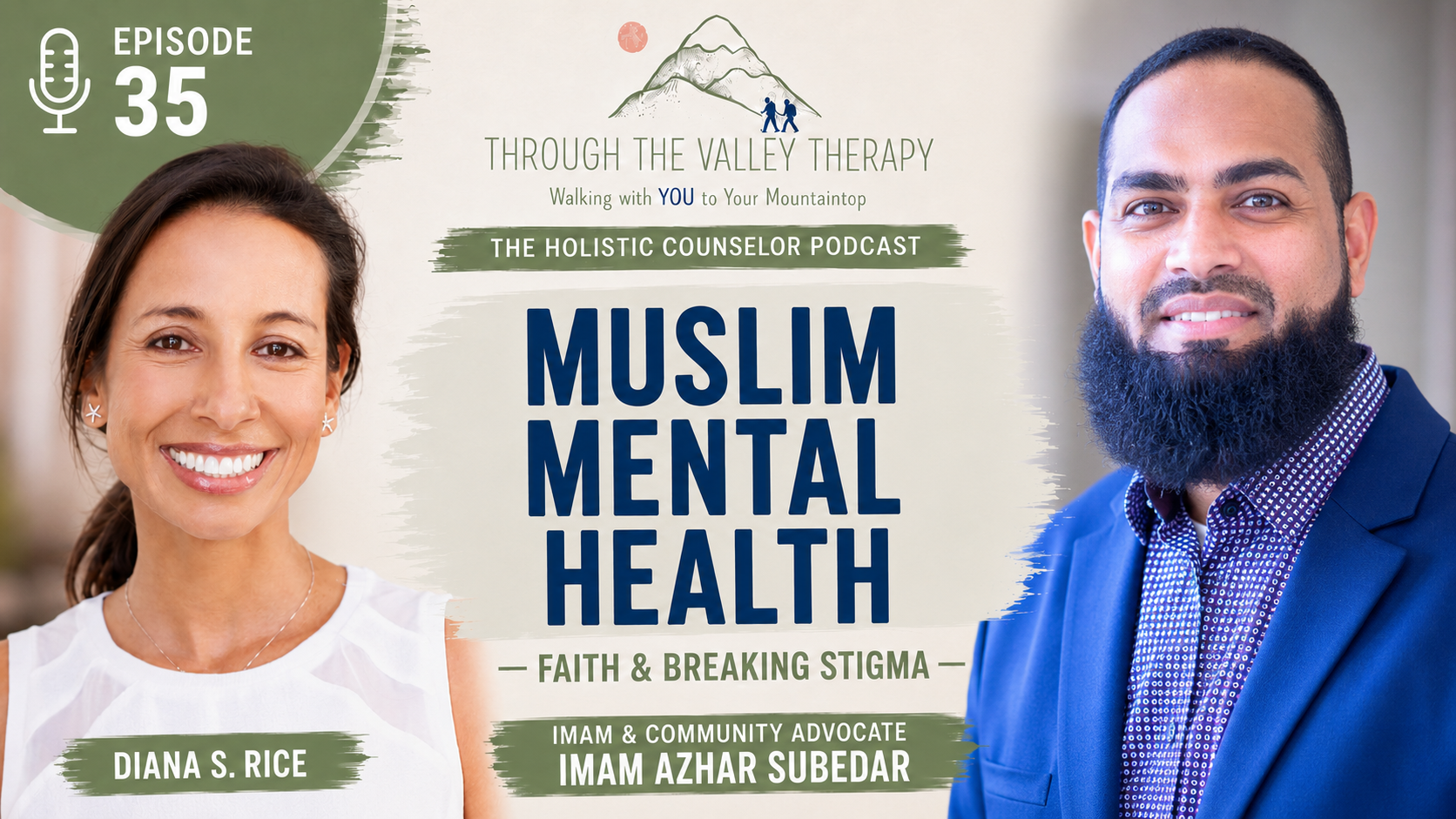
Episode 35
Muslim Mental Health and Faith: Breaking Stigmas
with Imam Azhar Subedar
Hosted by Diana S. Rice, LMHC, CIMHP, QS
In this heartfelt episode, Diana S. Rice, LMHC, CIMHP, CTP, QS, sits down with Imam Azhar Subedar to explore the intersection of faith and mental health within the Muslim community. Imam Azhar shares his personal journey and dedication to making mental health…
Listen to the Episode
Press play when you’re ready.
Educational content only; this podcast is not therapy, diagnosis, or medical care.
About This Conversation
Show notes
Jump to a section
In this heartfelt episode, Diana S. Rice, LMHC, CIMHP, CTP, QS, sits down with Imam Azhar Subedar to explore the intersection of faith and mental health within the Muslim community. Imam Azhar shares his personal journey and dedication to making mental health accessible and destigmatized in diverse faith settings. He and Diana discuss how faith leaders across religions can promote unity, healing, and empathy in times of division.
This episode was inspired by a recent community event hosted by the United Way of Broward County Faith-Based Council, where local faith leaders, including Imam Azhar and Diana, gathered to discuss health and wellness needs in their communities. Through honest dialogue, they aim to encourage listeners to embrace understanding and bridge-building across different beliefs.
Topics Covered
- How faith and mental health intersect in the Muslim community
- Breaking down cultural stigmas around mental health in faith-based contexts
- Imam Azhar's work with SoFlo Muslims and the South Florida Muslim Federation
- Key values in Islam and the universal messages of compassion, unity, and peace
- The importance of interfaith understanding and open communication
- Diana's reflections on faith-based mental health and the call to love one's neighbor
- Honoring the values of freedom and the sacrifice of veterans
Links and Resources Mentioned
Diana's Resources
- Through the Valley Therapy - Diana's holistic therapy practice
- Liberation Lunes Blog - Read Diana's faith-inspired mental health articles
Imam Azhar's Resources
- Imam Azhar Subedar Website - Learn more about Imam Azhar's work, access his writings, and find ways to connect
- Florida Muslim Mental Health Network - Access Muslim mental health resources and professionals in Florida
- South Florida Muslim Federation - Learn about the federation uniting and empowering the Muslim community in South Florida
Relevant Social Media Profiles
Key Quotes
- "As followers of faith, we're called to live out love, unity, and peace, setting an example of compassion that transcends our differences." - Diana S. Rice
- "In Islam, we are taught to be representatives of goodness, aiming for spiritual and mental well-being that allows us to uplift others." - Imam Azhar Subedar
Call to Action
If this conversation inspired you, consider visiting Diana's Through the Valley Therapy website for holistic mental health support, or connect with Imam Azhar on azharsubedar.com to learn more about his advocacy and community work.
For more episodes like this, subscribe to The Holistic Counselor Podcast, and let's continue growing together on this journey of faith, compassion, and whole-person wellness.
Episode transcript
Read the full transcript Close transcript
Automatically generated from YouTube captions. Names and wording may contain errors; listen to the episode for the original conversation.
Welcome back to the Holistic Counselor podcast. It's me, Diana from Through the Valley Therapy and blogger behind Liberation Lunas. I'm so glad you're here today because we're about to explore a powerful conversation that's been weighing on my heart. On October 17th, I had the privilege of attending a gathering hosted by the United Way of Barrow County Faith-Based Council.
This event brought together faith leaders to discuss health and wellness for our communities. I owe a special thanks to my friend Melissa Davis, the Community Impact Coordinator at FHE Health, who encouraged me to attend. With her nudge, I prayed, cleared my schedule, and showed up with an open heart ready to listen, learn, and contribute.
In times when division can seem louder than unity, events like this remind us of our shared mission as faith leaders. As a follower of Jesus, the Prince of Peace, I feel called to promote love, unity, and forgiveness, especially in a season that often highlights our differences.
The gathering began with an invitation to reflect on what we see as the mental health needs in our faith communities. I shared my experiences, and soon after, Nuha from the South Florida Muslim Federation spoke, expressing similar concerns. This unexpected alignment opened the door to today's episode.
Through Nuha, I was introduced to today's guest, Imam Azhar Subedar, a deeply respected leader and advocate for unity and wellness within the Muslim community and beyond. Imam Azhar serves as a development and outreach director for SoFlo Muslims, where he brings compassion, strategic vision, and a wealth of knowledge to his work.
Born and raised in Canada, Imam Azhar's path led him to the United Kingdom, where he dedicated over a decade to Islamic studies, earning a master's degree in Islamic sciences and Arab- Arabic literature. You'll you'll let me know how to say that right in a little bit.
This strong foundation has allowed him to become a powerful voice for spiritual growth, community support, and bridging divides. Since 2002, Imam Azhar served Muslim communities across the United States, advocating for a moral approach to today's social issues. His mission goes beyond merely teaching religious texts.
He's committed to making faith relevant to the challenges we face today. Whether addressing mental health, social justice, or interfaith understanding, he offers a perspective that is not only grounded in the teachings of Islam, but also deeply compassionate and practical. Imam Azhar's work reminds us that faith is not limited to personal belief.
It is a tool for transformation, both individually and within our communities. He provides spiritual guidance, supports Islamic organizations as a strategist, and actively a strategist, and actively works to find solutions that address the mental, emotional, and spiritual needs of those he serves. In a world that often focuses on our differences, Imam Azhar is a bridge builder, striving to foster understanding and peace among diverse groups.
Today, we're here as faith leaders, reminding ourselves that unity, love, and peace are not just ideals, but active commitments. These values form the core of our shared humanity, transcending religious, political, and cultural lines. And as Americans, we're called to live out the pursuit of life, liberty, and happiness.
Rights that have been preserved by our freedoms of speech and religion. We just celebrated Veterans Day this past Monday, honoring those who have fought to protect these freedoms, who also come from all walks of life. So, to any veterans listening, thank you for your service and your sacrifice.
So, with hearts open to learning, understanding, and growing together, let's welcome Imam Azhar to the podcast. Thank you so much for being here and sharing your wisdom. for having me. Good morning. Thank you so much to you and Dena and to all your listeners for allowing us to share their time as we discuss the topic of the hour.
Yes. Yes, wonderful. So, let's just start by sharing your story with us. Like, what led you to advocate for mental health within the Muslim community? Well, I think it's fair to say that almost every person that's listening and almost everyone on the face of this earth, we have had our fair share of challenges.
They can be physical, spiritual, or mental. And mental issues are mental illnesses are on a rise. Actually, when I was giving a sermon back in Texas in 2020, it was January of 2020 when I learned that the World Health Organization had stated that the number one problem facing our world is loneliness.
And I felt that was a topic that needed to be discussed because if a person is lonely, uh that would lead a person down a rabbit hole of darkness where they would question themselves and question their surroundings and question the people who are truly loyal to them and those who are not and they become susceptible and vulnerable to making the wrong decisions and being with the wrong people.
So, to my congregation, I I preached the importance of our unity in Islam. Fast forward 2 months in March, COVID began. And so, that doubled down on what the world was already facing. And so, even before that and post-COVID, my participation in spiritual counseling and helping people through their individual struggles and their marital struggles and their family struggles only allowed me to realize that this is something that requires more attention and it's more of a priority now than ever before.
Yeah, for sure. I mean, and see this for the listener, this goes into every community. Honestly, I don't care what religion you are or male or female, whatever. It's just this is just something that's been on the rise and I've seen it in the Christian community as well.
Um so, how do you see mental health being understood and addressed in the Muslim community? Cuz are there any specific mental health challenges you feel are often overlooked, especially from a faith-based perspective? Well, I think mental health in general, you have to understand the dynamics that the Muslim community isn't a specific race or culture, right?
It's global. It's a globally diverse religion with people from Fiji to Mauritania, China to Australia. Muslims come from all backgrounds and all cultures. And so, you have to understand there's a religious component and then there's a component of ignorance towards one's religion and what the religion talks and then of course the cultural components that kind of double down on the rhetoric that they want to follow.
For example, in many cultures you don't talk about mental health. You don't You don't even talk about the subject suicide, depression, anxiety. These are things that are written off and no medical expert is consulted in regards to these issues because they're either solely a spiritual issue or the lack thereof or you just need to go and you know, suck it up, be a man and just live.
So, what we've been doing for over a year here at in South Florida with our our South Florida Muslim Federation is an umbrella organization just to kind of give context under which 34 of the Muslim organizations here in the tri-county area are under this umbrella.
And one of the services we're providing to our member organizations and in addition to their congregations and their constituents basically their followers is mental health services. So, we created a Muslim mental health platform known as floridamuslimmentalhealth.com but it's abbreviation flmmh.com where we compiled all the mental health experts in this area to serve our community.
But we had to go into a year and a half of training the minds of the community to realize that mental health is an issue. It's something we can talk about and there are people could help us solve issues so we could feel better.
And so that awareness campaign that we set out to do has gone on for quite a long time from Palm Beach all the way to downtown Miami just again to bring light to the issue. So yes, in our cultures there's a huge barrier Uh um lack of uh interest when it comes to talking about the issue.
So, we're not talking about it from a negative perspective, we're talking about it from a positive perspective. Like, this is what a healthy home looks like. This is what a healthy marriage looks like. This is what a healthy family looks like. So, the person listening can put two and two together, well, that's not me, that means I need to work on this, and I'll need help.
Can you guys help me? So, it's as tough I think in the Muslim community as it is maybe in the Christian community and other communities. Mhm. No, it is. It is. It's something that um I know when I started out trying to like I I created at my church a mental wellness ministry, and having to explain to you know, previous generations because it's not talked about, right?
It's not And and to you know, because some people say all you need is the Bible, or all you need it you know, it to me that's called spiritual bypassing. I think I brought that up in our meeting that I met you um at, and it's just understanding.
Yeah, it was yeah, the United Way meeting when I first spoke, and then New Hope was like, well, I we're seeing the same thing, and it's two different religions, and we're like, okay, so this means that we are having to talk about mental health, mental wellness, um but understanding that mental illness, the stigma, because that's the that's what you're trying to break is the stigma, just like I am trying to get people to understand that when
you're feeling super super depressed, and you know, and then other people are trying to help, you know, I get it.
I get it. It's like, oh, you know, you just don't have enough faith, or you need to pray more, or maybe you know, it's a test, or this is something that you know, trials and and I get it. We we this is how resilience is is grown within us, right?
But what happens too is we are ignored and that's probably where the loneliness comes in when someone's feeling ignored by I'm feeling this way. I'm hurting. I'm sad, but your expectations of me religiously is perfection. And then you can't talk about the imperfections.
So, tell me how how do you how did you start really getting others to listen without either ignoring it or sweeping it under the carpet or sharp, you know, like just Mhm. just how did you start opening up conversations to people that might have a very narrow-minded point of view of this is the only way to do things?
Well, thing is that one thing our scriptures, the holy scriptures, bring to light is it breaks us out of a narrow-minded mold. Many of us hold on to uh to to certain beliefs and practices. Mhm. Which again, it's fine, but with a narrow mind, that's not fine.
Like you cannot maintain a narrow mind of how things can be when the Lord in the scripture, like in the Quran, introduces the universe to us, the oceans to us. He introduces the heavens and the stars and like how can you remain narrow-minded on any subject?
And so as a as a scholar of the faith and as a servant of the faith, as an Imam for over 22 years, I learned that our scriptures teach us uh the pinnacle of perfection of well-being. Meaning, it teaches us when you're on your mental, spiritual, and physical completeness, like you're you're on those 100 percentile, you'll be able to experience, live, and accomplish in life more than anyone else.
Uh and it aspires us to get there, but it doesn't say you have to be there in order to be accepted by God. And so it gives us the end picture, and it also gives us the steps to get to the end picture.
That narrow-mindedness is when people of faith and scripture focus that no, this is what the faith, the Bible, the Quran has said, and guess what? If you're not there, sorry, tough luck, you're not accepted by God. When in actuality, any person can enter from wherever they are in their life and climb the ladder necessary to get to the 100 percentile.
And that's something that many in religious leadership fail to acknowledge that narrow-mindedness. So you have to broaden the space and and allow people to understand that our spirit centers, our spiritual texts, our spiritual leaders are tools and aid to help a person from where they are to where they need to get to.
That's how I understood the religion because I too have had my fair share of mental health struggles and everything else. I mean, we all have health issues, mental health issues, up days, down days, but what gives me solace and what grants me that stability and strength is knowing that there is a ladder to climb, there's a goal to reach, and my Lord wants me to know that where you are, it's fine, but make your way to where you will actually feel fine.
And and I'll end with this point. I was just talking about this yesterday to another mental health expert here in South Florida, that when we watch commercials on medications, psoriasis, plaque psoriasis, or whatever else, they don't show you people who are actually suffering in bed and and and and vomiting, or their skin colors are distorted.
They'll show you a very faint image, but they'll show the person in a happy, joyful, proactive mood. They're out on the beach playing frisbee or volleyball, having a picnic with the family, or completing a piece of art. Why? Because they're showing you the end product and telling you, "Hey, if you like this scene, you just need to take this medication according to the doctor's prescription to reach there."
Well, that's exactly what the Bible, the Quran, and other scriptures are doing. There is a scene you can reach without any negative implications or reactions or, you know, just just go up this ladder. So, we as faith leaders in community, we have to support each other up the ladder and not push them down from where we perceive is the top of the ladder.
Mhm. Wow, I've never even seen it like that. Thank you so much for that. See, listen, people, like I'm continually learning. I'm always And this is why I started this podcast cuz I want my listener to understand there are other ways, right? So, to me, when I hear the whole commercial with the medication, yeah, but at the same time, it's like they're they're trying to we have to show that, hey, people are suffering and this is part of life, right?
As well. And these are things and tools like you have some tools that you use with your community just like me, right? Because when we talk about perfection, like I've seen that a lot. I think that's what I was saying at the meeting was um how we have the narrow-mindedness, we have, you know, like leaders in the community that are utilizing the scriptures, right?
Probably in yours, too, to control and manipulate and line their pockets, you know, or whatever, or using script holy scriptures for their own ego. You know, and that's been hurting a lot of communities, too. So, and I'm not saying that's what's going on in yours cuz I'm not in yours, so I don't know.
I can only speak about what I see in mine. But, this is why I try to get my clients to focus on who Jesus is because to me, as the prince of peace and his guidance, this is where I've with my own mental walk, you know, my mental illness to my mental health, I realized that he's given me freedom not to be perfect.
And that's why I need him. That's why I need to come out of myself to focus on something so I can love you, Imam Azhar, right? Or I can be open-minded. So, um let's go into what you feel are Well, first of all, can you explain to my audience the core values of being a Muslim?
Because some people really don't know. They go by the stereotype. They go by fear. Right? Because this is what happens. This is where division comes in is fear. Right? The false evidence appearing real where all of a sudden they're hearing the propaganda, which that's when when I see um commercials like you were talking about, I'm like, "Oh."
You know, because it's they're trying to sell something. Right? We live where commercials are but um you know, we see these things and then people live in fear, and then they're living in fear, so when they see somebody that they don't know or they're not that's outside of their own little community, they assume the other people, right?
It's us versus them, and this is something that I have been trying to break people's mindset of going, "Stop doing that." Because what you're doing is hurting each other. So, can you just share with me about your your faith? So, um look, we live in a in a society and in a world today where uh money talks.
Uh it's all about it's all about bolstering those funds and making things right. And perception supersedes reality. And the perception of fear is such a dominant force that it has led to a multi-million dollar industry of security and the night the whole nine yards.
We have never entered the airport the same way we used to prior to 9/11 and it's never going to happen again. But from personnel to security machines, the more sophisticated security machines, those x-ray machines instead of just a regular scanner that you walk through.
It's all based on fear. Imagine if the world was truly peaceful. Imagine the world was a world that you can leave your gold business without a roof and without a door. And you can walk away to Bahamas for 2 weeks and come back and no one has walked in not even a squirrel.
Imagine that you can live a life where a curtain sufficed as a front door and not a ring camera and security cameras and and what you call it a sign saying that this house is protected by XYZ company. It would be a different world.
But you see there's an economic driving force behind money is made and jobs are produced but at the same time at the same token it comes at the cost of a person's mental stability and sanity. And people are always anxious. And so if you understand that little random mind you understand where Islam comes into the equation.
See Islam means submission, right? Submitting to the will of God. And submitting to the will of God is basically submitting to how God wants you to live life and see life with your choice. You have full choice. You have freedom of choice. But you submit, not surrender, rather than following your own impulses because chances are those impulses are based on emotions, which will take you down a different path.
So, religion gives you the choice, the option through the scripture. And Islam is about submitting to the will of God by following a lifestyle, a doctrine where there are five pillars, which some of your listeners may have heard. One is testimony of faith, the shahada, where you believe that there's no god but God but Allah and that Muhammad, peace be upon him, is the final and last of all messengers.
We believe in all messengers and him. We believe in all the previous holy scriptures revealed by God and the Quran being the final revelation. We believe in the angels, the books, the messengers. We believe that there's a final day, the day of judgment.
We believe that whatever good and bad happens happens from God and we believe we'll be resurrected and returned to him. So, that's our faith component. The second is prayer. We pray five times a day facing Mecca, and we pray to God from the moment we wake up in the morning till before we sleep at night.
The third one is is is fasting, where every year for 1 month we fast from uh break of dawn to sunset. We abstain from food, water, and sexual pleasures and desires for 30 days to break down our carnal desires and uplift our spiritual tenacity and strength.
The fourth is charity, where we give 2 and 1/2% of the wealth left over in charity to help build our society and to help build our community. And the last is pilgrimage to Mecca, which is once in a lifetime you go to Saudi Arabia and perform the pilgrimage reenacting the practices of our father Abraham, peace be upon him, all the way down to the prophet Muhammad, peace be upon him.
So, these are like the five pillars of Islam. Now, what this entails in general, like what's all these commands in the Quran and what it is that what's that outcome sought? The outcome sought Islam and submitting to God is to live a life full of character, morals, and a perfect demeanor, where you are exemplifying goodness through with your personal life, public life, family life, in your community, outside your community, in the light of day, the dark.
Was sent for the perfection of moral conduct. So, is about being a good human being, adopting a certain regimen from spiritual aspect, but also from a physical aspect, what we're allowed to eat, what we're prohibited from eating, for example, we will be able to reach the 100 mark of our spiritual, mental, and physical well-being, that we'll be able to not only be good for ourselves, but then be a source of goodness for others.
Oh, wow. Okay. I mean, that sounds very peaceful. So, we're going to go into the stereotypes now, because to me, these are the things that a lot of people do not understand, especially after 9/11. Honestly, I think I shared with you and it brought me to tears when we had our talk before we came on uh to record.
Um but, you know, like after 9/11, I I was I had to go to a conference with a one of my friends, and um I will never forget how I was treated, cuz I had to get two airplanes to get to the other side of the country, cuz it was the cheapest airplanes, but it just happened and I get I kept getting pulled out.
And my girlfriend, blonde hair, blue eyes, was like, "Oh, she you're being racially profiled." And I'm like, "I am, aren't I?" And they're like, "They must think that you're Muslim." Or they Or they think, you know, and I'm sitting there like, "Oh my goodness."
And I it it made me so angry, and I was so upset, and I'm going, "Wow." And to me, like I I get that it what was happening at the time, but I could just imagine ever since then how it is for your community.
So, can you share with me the stereotypes and and what you have encountered and the misunderstandings that affect mental health in that? Well, of course, that has only doubled down on the Muslim community when it comes to their mental health and well-being. From our children who were born after 9/11, had no idea of what happened, and they're constantly being harassed because of it.
Every anniversary, we're reminded of something that our kids were never alive to see or witness. And ourselves, yes, the world changed. World changed for me immediately when I was overseas and had to travel back. And how many times I've been pulled aside and and humiliated in that sense, it's part of being a Muslim.
And in the current climate of mental health crisis is this was another layer added to the Muslim community. Question the logic thereof is that you know terrorism is not Islam. When they equate terrorism and Islam together, that's where everything starts going wrong. Islam is a religion of 2 billion people around the world, and it's the fastest-growing religion in the world.
So, 2 billion people, if they were commanded by God to inflict harm and kill someone who is not a Muslim, then this world would not be where it is today. Like, all non-Muslims would be dead because all a Muslim has to do, like if we're thinking logically, is kill four people and he's done.
But Islam isn't a religion of bloodshed. Islam came to stop bloodshed. Islam came to stop tribal feuds. Islam gave the guidance to create the first interfaith community on the planet, which was Medina, where the Jews and the pagans and the Muslims came together and actually created a charter of how to live together and prioritize society over ethnicity and tribalism and of course different religions.
And so the history of Islam clearly articulates that it is a religion of peace. And Islam, as I said, means submission. It comes from the And so when a handful of these or a dozen and a half of terrorists went ahead and did what they did, any statistic and study from government or otherwise will show you that over 90% of the victims of terrorism have been and still are Muslims.
Muslims have been impacted by the terror caused by ISIS and Al-Qaeda and the lot. And the last and thing I'll say is that he People like Osama bin Laden, Abu Bakr al-Baghdadi, who were like the their message to the whole world for free, right?
Cuz if you want to go on CNN right now and advertise this podcast, a 15-second slot, I'm sure you know how much that would cost, right? And that is something you have to pay for, which is actually a productive program, a proactive program, something that will help humanity, you have to pay an arm and a leg to get one 15-second slot, okay?
He didn't need to pay for anything. He would be in a mountain somewhere sitting down a VHS on a donkey which would be played for the world to see. And so they are not religious leaders. They are not scholars of the faith. They do not follow the doctrine and the teachings of Islam, but we all two billion of us are smeared to be just like them or followers of them and believers in them.
Truth be told, we believe in Allah, the one and only God that we believe has created everything and everyone. And that isn't his name. That means the God. Allah means the God. And Muhammad, peace be upon him, we follow his teachings of goodness, of morality, of civility, of good moral conduct, of smiling being a charity, of making sure that your neighbor is not hungry while your stomach is full before you go to sleep at night.
These are the teachings of our faith that we've always followed and Muslims in America and in the West and around the world continue to follow till this day. Wow. Wow. Yeah, I mean, unfortunately, the what happened in 9/11 has done a number and and I'm sorry for that.
And I'm also sorry that if any Christians have ever caused you guys harm because I I've seen that happen too because that would be kind of like the radicals in ours in our faith, right? We have the radicals that are constantly fire and brimstone and people and and going after people instead of actually practicing what Jesus Christ is about.
It sounds as the same as as like, you know, it's about peace and love and unity and he's come to to show us the way. And and he called out religious leaders. I mean, that's the what I've learned in the in the word is it that that Jesus Christ called out the the the Pharisees and the Sadducees and said, "Hey, y'all you government people, you religious people are not understanding what's happening here."
So, 100% right? And so, tell me a little bit about the Florida Muslim Mental Health Association. Well, uh before I just do that, I just want to say one more point on this is um speaking the truth and calling things out and trying to re-stabilize the narrative is what all faith denominations leaders and followers should do.
Look, there are criminals out right? There are criminals who take take the name of Islam. Let's call them for what they are, they're criminals. Christian nationalists and supremacists and there are things in every religion. In every religion, you'll find people who use their faith as they backdrop to do the wrong they do.
But, we know from the Torah and the Psalms and the Bible and the Quran, these are not divine teachings and instructions. These are the twisted uh perversions of of the word, taking it out of context and using it to fulfill an agenda. And I pray that there are more people like Jesus, peace be upon him, and Muhammad, peace be upon him, who could stand up and say, "Hey guys, guess what?
That's hoax. That's wrong. That ain't right. That ain't kosher. That ain't halal. Okay? We are not going to do that. We're going to do something different." And that's what we need, people like you who bring an energy of positivity towards something productive, not reactive, not getting indulged in that perception, but seeking reality and and trying to make a difference.
So, with the South Florida Muslim Federation, as I gave a a little summary of what this organization is that was founded in 2017, our goal is literally moving towards something. You know, Muslims have come into this country long before, uh along with the the people who were enslaved and brought into this country.
Muslims were amongst them. The Muslim graves are here from the late 1800s, early 1900s from Sacramento and beyond. So, um Muslims were here.
Uh they have played a huge role when it comes to the economy of America, from 5G technology, from the Sears Tower, uh or what was known as the Sears Tower, I know the name keeps on changing now, uh to even uh the Ford industry, uh where uh in in Michigan, uh Muslims were brought in uh by ships uh from Yemen and other countries to work in building cars because Muslims in the cold winter nights would not
drink and uh have a hangover and come late to work, but they would go to sleep early, wake up early, pray, and get to work, and work hard.
So, Muslims have been a part of the American fabric and society. We've built mosques and institutions. We have members who are in gov- ernment from local to federal and and whatever else. However, lack thereof in South Florida was we lacked everything full. Okay, created a platform.
Uh our motto is unite, empower, and serve. Imam Azhar, our communities, empower our beings to be to do what, right? Yeah? Yeah. Uh you're breaking up a lot. Yeah, I can hear you now, but you keep freezing and then uh I I can't hear what you just said.
Yeah. So, I'm sorry. So, uh our our motto at the South Florida Muslim Federation is to unite, empower, and serve. We've united as many organizations as we can from Palm Beach to Miami-Dade and Broward. Now, we're empowering them with the tools that they need to help themselves and help others so we can go and serve humanity at large.
And mental health is one of the components that we are working on. So, Florida Muslim mental health is bringing together all the resources, spiritual and mental, to help people be better in their mental state. And so we have a website flmmh.com that will allow you access to over 40 Muslim mental health professionals.
Now you may say, "Why Muslim?" Well, because there's a lot of stigma in our community as we talked about, but then there's also the layers of people not understanding my culture and my faith. So by having people who do that reduces one's resistance and allows one to say, "You know what?
I'll go and seek help." So we're getting the professionals to help the community. Our job as a federation is connecting dots. We're not reinventing anything. We're just connecting the dots, making people see the resources and the opportunities before them. We're working right now through this initiative with the Haitian community and other minority communities because we're not supposed to be Floridians and Americans who are Muslim, but we're Floridians and Americans as one community.
Let's all bring something good to the table. Let's make something good together, and let's all nourish our bodies and our minds and souls as we take on the problems of today towards a prosperous future, God willing. Yes, I agree completely. This is why you're you're here talking to me, right?
Like we have to have this understanding that you you are my neighbor. And I need to love my neighbor. Right? And and that's that and how and what are the needs. And I'm glad that that you have that because it is important. This is why I started the initiative that I'm trying to where I bring in four Christian professionals from different walks of life, which I mean different cultures.
And then we talk about one subject, and I So people in the audience are like, "Oh my goodness, this person speaks Creole. Oh my goodness, this person speaks Portuguese." Oh, you know, and that they could find and have an understanding that oh, someone will understand and be culturally competent.
Cuz that's that's important. I mean, we're we're we're one in America, but we all have different needs, different walks of life, and mental health is for everybody, not just for one certain people people or for one certain socioeconomic uh background, either, right? So Right.
Yeah. I want to ask you because, like I said, many that listen are Christian. What is one thing you would like Christians to know that might foster greater under understanding and empathy? Well, to my Christian brothers and sisters, on behalf of Muslim brothers and sisters, we're living in a very peculiar times.
We know that there's a lot of instability, a lot of ins- purity and certainty of our future. The The only thing I would suggest is get to know people for who they are and not what you think they are. We are living in South Florida, one of the most richest and diverse, you know, parts of the state.
You have people from all walks of life, from all socioeconomic backgrounds, people of all faiths or no faith at all. Just say hi. And and just get to know each other. Each other your name and tell them something about yourself. We're living in bubbles and greeting because they fear that they're intruding on someone's personal space.
The result of that is a person ends up not feeling comfortable in their own space. If I create a tight bubble, I'm not going to feel comfortable. I'm going to feel claustrophobic. And so we need to get out of this claustrophobic state, break out of our bubbles and silos, and just get to know each other.
There are mosques in in Florida that have open house day. If not, come and attend and just say hi and get to know the neighbors that live around you, that shop in the same stores as you do. Their kids go to the same school as your children do.
They may be playing on the same team and watching the same sports. Let's get to know each other because when we do that, we not only break down the fear that we harbored within ourselves, but we break away on the rhetoric of fear that's so prevalent in our world that keeps us divided, that keeps us separated, and that keeps us in our corners.
Let's break out of those corners. Oh, yes. That's I I totally agree because united we stand, divided we fall. It's just like that, you know? It's so true. 100%. So, I hear you're an author, and you have a book coming out. Is that true?
Yeah. Yes, I have. So Yeah. Tell me about Tell me Tell me about the I think there's a book that you wrote called I Am the Other. Yeah. So, uh yeah, thank you so much. Uh so part of my spiritual journey uh has always been uh from the day I came to America in 2002, a year after 9/11.
I became the first Imam on the West Coast of Florida between Miami and Tampa. And uh I served not only Fort Myers and Punta Gorda, but I've also been able to help the community all the way to Sarasota, Bradenton, and Brandon, and all the way down to Naples, Bonita, Estero, and the whole nine yards.
And what I've understood is that there's one thing in my life and the mission is to restore the narrative of what Islam is and not what people have made it to be. So, I've engaged in interfaith work and civic engagement work from the Bush administration to the Biden administration and everything in between.
Um I've been working diligently to be the voice accessible for anyone who wants to understand the religion and not live in fear. And so, in 2015, I was doing a program in Longboat Key, Florida, by Sarasota, and I was approached by a Jewish fellow and this was at an Episcopal Church.
I was doing this presentation at Episcopal Church and a Jewish fellow from next door, who was from the temple next door, asked a very derogatory question of me, which led to us having a very open-hearted, honest, and earnest conversation. It led to a partnership where I taught classes at his class.
We did debates on the Quran, not debates, but discussions on the Quran Sarasota with over 700 people in attendance and over 700 people outside waiting to come in. And um long story short, he was worried about Islam since 1995 and extremely more after 9/11.
He traveled the world to understand what this religion is and he believed that the Quran taught us to hate people like him. And so, in response, our engagement with one another enriched both of us that we felt that there was a need to write a book called I Am the Other.
As we other one another and we otherize each other, we wanted to write a book of how to see the other as yourself. And we take on a topic, it's a grand experiment, and we take on the topic of Sharia law. A word that people dread as if it's a law coming to take over America.
We discuss it and it's a beautiful book. I'm I'm proud of I thank God and I alhamdulillah and we say mashallah. I'm grateful to God for this and I'm happy that we've worked 5 and 1/2 years on this book and we're on the end portion of getting it published now and um we believe it's going to be a game-changer God willing in a time that's much needed.
So I Jewish a former attorney who's not a faith leader but he's a reformist Jew and then a Muslim who's born in Canada and who's preached Islam for 22 years. This is not an interfaith book. This is two people coming together trying to understand each other and understand the art and perfect the art of listening and agreeing to disagree but not dehumanizing the other in the process.
Oh my gosh, that that just moved me. I can't wait. I'm like are we going to see a movie? After this book or something? I mean I could see this as a as a show not a show but a talk that travels to colleges and to other churches and just we need more of this.
We do. We need more unity because Yes we do. this the divisions have happened and I mean as a therapist could you could imagine what I'm seeing. You could imagine because I serve a lot of 25 to 35 year olds and they a lot of them just give them a hope.
They've given up hope. And so to me it's like how Listen, I mean I could talk to you on and on and on honestly and maybe I'll have you back on the show when the book comes out with you and the other author or something.
I don't know. Bob Garon What's his name? Bob Garon Okay and so just because to me I would love to just have conversations like this. Um how would you like to end this episode? How can we bring interfaith together?
What can we do for those that are listening that feel like I just mentioned, like there's no hope, that this world stinks, that I'm over it, it's just all division, but I I got to under- you know, make people understand that wherever your brain goes, your energy flows, right?
And so if we choose, because free will, you talked about free will as as well. If we choose to go into those paths of of darkness or of negativity, then that is where we're going to end up going. And so we have the choice to pick up the religious text and and really learn.
And to me uh me being a Christian is not about me changing your mentality. Me being a Christian is because this is what centers me and grounds me, so I can be a productive citizen of this country. Yeah. So what would you like to say in our our last words together?
first of all, thank you so much for doing what you do, because you're actively opening doors, breaking down barriers, building bridges, bringing people together. We should never underestimate the work we're doing. It may not be rewarding right now, but there's a legacy we leave behind that when we're in our graves and uh we moved on from this world, change will continue to happen because of people like yourself and all of us.
So thank you so much for that. You know, when when I when I used to feel down, there's two TV uh channels I love, HGTV and the Food Network. Because they the two of them, in addition to Legos, which my kids love, um it teaches us that perfection doesn't come with a ribbon on it.
Perfection is something you seek through imperfection and through uh you know, ingredients. There's just ingredients on the table. You could say, "Oh my god, what is this? How am I going to eat food?" But a person who loves chef and who is a chef or loves culinary arts is like, "This is an opportunity for me to make a grand dish."
For For those two Musa brothers who walk in and see a house that's, you know, it's it's it's disgusting. It's it's broken up. They don't see and say, "Oh my god, who's going to buy this house?" They start dreaming, "How are we going to change this house to make it the most perfect house to sell it highest margin.
And you see like old bathrooms and kitchens converted into like the state of the art kitchen. And now you don't remember that broken, nasty, ugly house. You see a house, you're like, "I wish I could buy that house." And same thing goes with Legos.
It doesn't come in a box ready-made. It's broken up and they give you a manual and a picture. Hey, you see that image? You can make it that. Our scriptures give us images of perfection and goodness that we should aspire towards, but God didn't give it to us ready-built.
In Islam, we're taught that God told the angels when he created Adam that before he created Adam that I'm going to make on this earth my representative. Meaning people who will come on this earth and actually take care of this earth. But unfortunately, we could see that's not happening.
Our environment is in danger. Global warming. Our waters are poisoned. Our air is poisoned. Um like uh there's chemicals and toxins in our food and beyond. We're in a bad place. But truth be told, this is the best time to live ever because you have that broken-up nasty house.
You have 110 ingredients before you and you have 500 pieces of Lego before you, don't look at it as a failed project, as a lost opportunity. You have the opportunity to use your hands, your mind, your body, your energy, your Holy Scripture, the people you know, and the people you don't know, to construct and build a better world, and that's what we're here for.
To For me to go back to God and say, "I got the world not in a good position, but I worked hard to move the needle a millimeter or two towards better ness, and that's all God God wants to see from us is us trying."
So, let's make the effort. Yes, it's not a good place, but if it was a good place, would we truly appreciate it? Would we truly value it? I don't think so. So, let's make it what we want it to be, not with the excuse that it's for the kids.
We need it for ourselves. We need it now, and we're going to hand the baton to the kids, and who will do much better than we did, and so will the subsequent generations. So, I pray that we see the positivity and the opportunity that lies before us, and not get drowned out in the darkness of what is before us, but actually focus on the light at the end of this tunnel of what potentially lies before us.
Yes, and it starts with us. It does. It starts within ourselves. For So, for the listener, it starts with you. You know, just just do one thing. Like, learn one thing. Just go ahead and and understand and try to learn active listening, right?
Which is to listen to understand instead of listening to respond. And and get back to creation, to nature, the way God created it. Because to me, with social media, with the computer, I mean, Facebook, Twitter, X, whatever they're called. I mean, you have a hundred, and more will be coming.
It's your choice to whether you're going to learn to master those things, or you're going to let them master you. And to me, I want Christ to be my master. And that's what That's what keeps me sane. That's what keeps me off drugs.
That's what keeps me loving and and and every day waking up so I can do one positive thing. Because without my faith, honestly, I don't I think I would be in a really, really dark place. So, right? And so, how can people find you?
Um thank you so much. Uh people could find me on social media. Uh the name is Azhar Subedar, and uh also azharsubedar.com. That's a z h a r s u b e d a r.com. Uh over there you'll find uh the timeline of uh my work from 2000 and beyond.
And uh uh you'll find what I'm passionate about. There's ways to get in contact with me on the website, and you can also find me on Facebook, Instagram, X, and LinkedIn, and whatever else is out there for social But, yeah. All right. Thank you so much.
Thank you for coming. And listeners, remember trust in the Lord, guard your heart, and renew your mind. Bye. Bye-bye. And now for the disclaimer to make sure you understand that you are responsible for you. The content provided on the Holistic Counselor podcast is for entertainment and informational purposes only and is not intended as a substitute for professional medical advice, diagnosis, or treatment.
Always seek the advice of your physician or other qualified mental health provider with any questions you may have regarding a a or mental condition. Never disregard professional medical advice or delay seeking it because of something you have heard on this podcast. The views expressed on this podcast are my personal opinions and do not represent the views of any professional organizations with which I am affiliated.
Call your doctor, 911, or 988 immediately if you have a medical emergency. The Holistic Counselor podcast does not recommend or endorse any specific tests, physicians, products, procedures, opinions, or other information that may be mentioned on the podcast. Reliance on any information provided by the Holistic Counselor podcast, guests appearing on the podcast at the invitation of the Holistic Counselor podcast, or other listeners to the podcast is solely at your own risk.
Confidentiality notice. If you engage with the Holistic Counselor podcast by commenting or posting and are a client, please be aware that you may be revealing information that could compromise your confidentiality. Please remember that disclosing your identity or personal details can be linked to your clinical material.
As a therapist, I am bound by confidentiality and will not respond to any disclosures of this type on this podcast. I am committed to upholding the ethics and confidentiality of the therapeutic relationship, which extends to all forms of communication in accordance with the laws and professional guidelines that govern mental health professionals.
I want you to know that your privacy is of utmost importance and you are responsible for protecting it when interacting on this platform or any other public forum. Thank you.