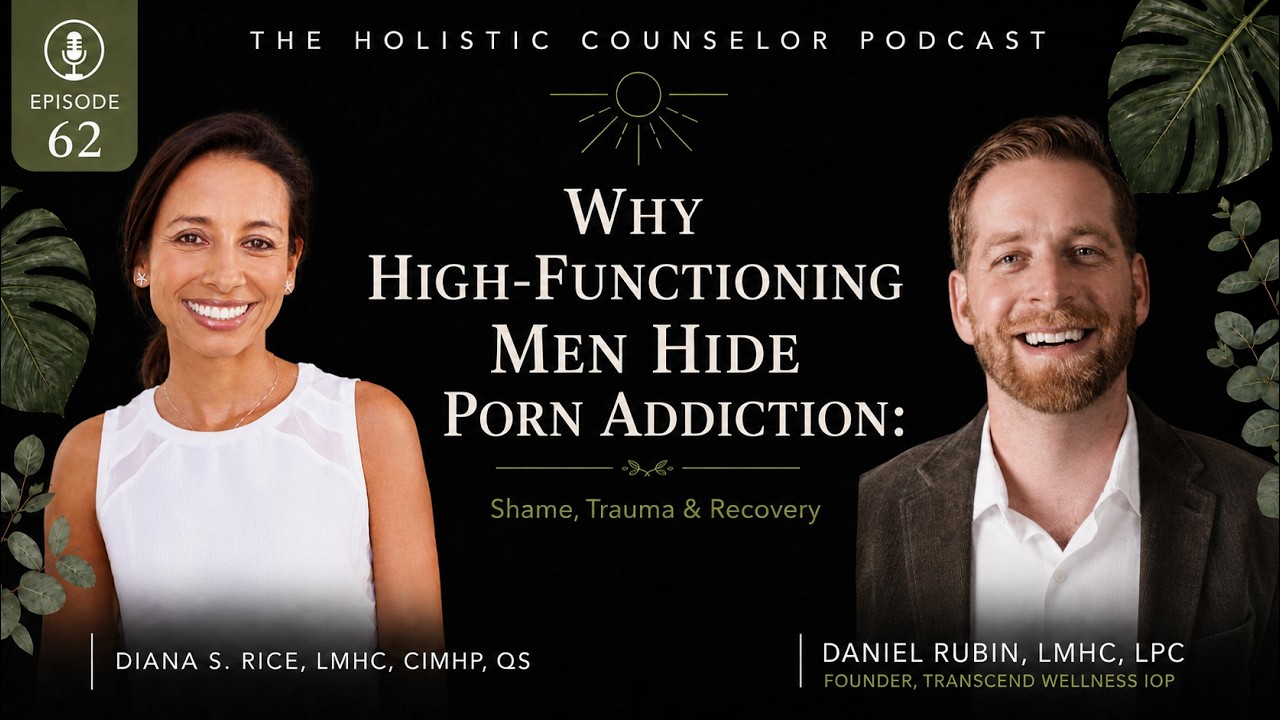
Episode 62
Breaking the Silence: Healing Porn Addiction, Shame, and Identity Loss in High-Functioning Men
with Daniel Rubin, LMHC
Hosted by Diana S. Rice, LMHC, CIMHP, QS
In this powerful episode of The Holistic Counselor Podcast, host Diana S. Rice, LMHC, CIMHP, sits down with Daniel Rubin, LMHC, LPC, founder of Transcend Wellness IOP, for an unfiltered and deeply healing conversation about men's mental health, emotional…
Listen to the Episode
Press play when you’re ready.
Educational content only; this podcast is not therapy, diagnosis, or medical care.
About This Conversation
Show notes
Jump to a section
In this powerful episode of The Holistic Counselor Podcast, host Diana S. Rice, LMHC, CIMHP, sits down with Daniel Rubin, LMHC, LPC, founder of Transcend Wellness IOP, for an unfiltered and deeply healing conversation about men's mental health, emotional isolation, porn addiction recovery, and the impact of unresolved trauma.
We explore the hidden struggles of high-performing men who silently carry shame, spiritual confusion, and emotional neglect. This episode is a call to wholeness, vulnerability, and kingdom-centered healing.
Key Topics We Cover
- The neuroscience of porn addiction and shame
- How early trauma and emotional neglect affect men's identity
- Why high-functioning men silently suffer—and how to reach them
- The truth about incel culture, influencers like Andrew Tate, and spiritual confusion
- How group therapy and IOPs help men break isolation
- Faith, father wounds, and modeling emotional safety for boys
- Masculinity without emotional suppression
- Accountability, compassion, and discipleship in men's healing
- The unique power of male-only spaces for recovery
- How retirement and identity loss lead to midlife crisis
- The spiritual root of addiction and how Jesus redefines masculinity
Powerful Quotes from This Episode
"We have to stop trying to protect our kids from pain and start teaching them what to do with it." – Daniel Rubin
"You don't have to lose your masculinity to be emotionally mature." – Daniel Rubin
"If you wouldn't give it to your inner child, why are you still feeding it to yourself?" – Daniel Rubin
"There's a silent epidemic of men pretending they're okay while dying on the inside. Healing requires truth, tribe, and Jesus." – Diana S. Rice
"Accountability isn't condemnation—it's invitation to freedom." – Diana S. Rice
"Men are longing to be seen, but they've been taught not to feel. That disconnect is killing them." – Daniel Rubin
Resources Mentioned: Education + Support
- Your Brain On Porn – Research on the neuroscience of porn addiction
- NoFap Reddit Community – Peer accountability & support
- Sex Addicts Anonymous (SAA)
- Sex and Love Addicts Anonymous (SLAA)
- XXXChurch – Christian-based porn addiction support for men
- LightPhone – A minimalist phone to reduce screen & dopamine addiction
- Transcend Wellness IOP – Daniel's IOP program for high-functioning men
Connect with Daniel Rubin
- Website: https://southfloridamentalhealth.com/
- Instagram: @transcend_wellness_iop
Connect with Diana S. Rice
- Therapy: www.throughthevalleytherapy.com
- Coaching: www.transformedmindcc.com
- Podcast IG: @theholisticcounselorpodcast
- YouTube: Watch the show on YouTube
Episode transcript
Read the full transcript Close transcript
Automatically generated from YouTube captions. Names and wording may contain errors; listen to the episode for the original conversation.
Hey friends, Diana here. Before we dive into today's episode, I want to offer a quick content advisory. This conversation is powerful, honest, and necessary, but it's also raw. We'll be discussing topics like pornography, erectile dysfunction, sexual addiction, and the mental health struggles that many men face, some of which may be difficult or triggering for certain listeners.
While everything is shared through a compassionate, clinical, and faithinformed lens, this episode is not rated G. If you're listening with little ones around, you may want to press pause and come back to it later. As always, this conversation is not a substitute for therapy, and the views expressed reflect the lived experiences and insights of our guest.
All right, let's get into it. Welcome to the Holistic Counselor Podcast, where we hold space for honest conversations that bridge faith, neuroscience, and the deep work of healing. I'm your host Diana S. Rice, licensed mental health counselor, certified integrative mental health professional, and founder of Through the Valley Therapy and Transform Mind Consulting and Coaching.
This show was created for those of us doing the work. The therapists, the seekers, the survivors, anyone who knows that true transformation doesn't come from surface level solutions, but from integrating mind, body, and spirit in a way that honors both science and soul.
Here we don't just talk about diagnosises. We talk about root causes, spiritual wounds, nervous system repair, and how to reclaim your story with compassion. Today's guest, Daniel Rubin, is a licensed professional counselor and licensed mental health counselor with over 16 years of experience across some of the toughest clinical environments, psychiatric hospitals, prisons, addiction treatment centers, and now his own men's only intensive outpatient program, Transcend Wellness.
Yes. When when Daniel reached out to share his story with me, I felt an immediate connection to the mission behind his work. And after meeting him at Amanda and Venina's clinical collective event a couple of weeks ago, I knew this conversation would be different.
So, if you've ever loved a man who silently struggled, if you are that man, or if you're a clinician trying to support this population with more integrity and depth, this episode is for you. Wow. Let's talk about the truth behind men's mental health, the power of vulnerability, and what it means to rebuild from the inside out.
Daniel, thank you so much for coming on. Thank you so much for having me. I have to admit I'm a little nervous, so bear with me if I stutter or like need a breath, but I have anxiety like most people, right? And that's the thing that one word anxiety like, and it's it could be part of our personality.
It could actually be the true diagnosis in the DSM of anxiety. It could be so many things. And sometimes I think it's because we don't have a lot of words for it. You know what I mean? like we're not taught these things. I mean, I think they just started u in I know in the Brower County school system with social emotional learning.
Can you imagine? But let's not go there yet. But like these are the things that have been needed. I would think fitness, finances, and um social emotional learning and our society would be in a such a different headsp space. But then again, here we are, right?
So, let's talk about your story. It's super powerful, Daniel. Like when you shared what you shared with me, I was like, "Oh my gosh, I cannot wait to have this conversation with you." From addiction to transformation. Can you share the moment you realize success on the outside meant nothing without healing on the inside?
So when this was uh presented, it brought up a lot of stuff for me, especially like when was that specific moment and I had to like start by going back into the journey. Um and I remember like the very beginning of the journey was the idea of success was like the big first thing that I learned as a child and that was the idea of like being better than my dad.
Um so my dad was a PhD therapist. We lived a very nice life. Um Wow. But you know it wasn't really taught in my household about like fulfillment or internal success. It was really the external things that we saw. So from an early age um the first driving things the first like desires were based on the achievement of material stuff, right?
And then as I grew up and got into middle school and high school, there was the social acceptance. That was my next version of success. Like I need to be accepted by my peers. I need to be accepted by the people around me.
And I strove for that. Um and that introduced the world of substances to me. I am somebody that has the anxiety. I have depression. I have some ADHD. I might be on the spectrum. like it was not an easy world for me socially.
Like I remember my mother telling me like I really struggled making friends. Um and it was hard. But as soon as substances came into play, it was like the go-to thing for me. And especially where I grew up, Myrtle Beach, South Carolina is like a party town.
And it's just like a southern thing, too. Like boys go out and drink and and it's okay as long as you don't get hurt. So again, I found myself um really lost, but like hanging on to something like, "All right, if I'm the coolest person, if I'm the person that parties the most, I'll be okay, right?"
And that carried me through college. Um where again, the idea of popularity and partying was like my found identity. still very lost, but at least I had something. Um, and in college, actually, is when I first started to get into trouble. Um, arrested for four felonies.
Wow. My freshman year of of college. Of college. Robbed a drug dealer. Oh, what? Yes. You robbed a drug dealer for the drugs then I take every Yes. Because it's the perfect crime because they're not going to report it. Of course, in my mind, right?
But they did. So, so you were still able to go to college and get a college degree while this other life is happening. Yes. Interesting. Fully fully like functioning for a lot of people in a way that you would look on the outside and be like success like I did really well in high school.
Like my parents told me back in the day, they were like, "We always thought you would outgrow it." Like there was signs all along, but I think as parents, you know, being a parent now, like we do not want to see our kids hurting or something's wrong with them.
And it's like a lot of us will put on the blinders and just hope that they'll be okay. Um, and that like first experience, especially with the four major charges, was like a wakeup call for everybody. Yes. But as a good addict, which I am.
I'm a very good drug addict. Okay. I was pulled out of college out of Clemson for a semester. I went home to Myrtle Beach. I enrolled in Ory Georgetown Technical College, got a 40, did amazing, worked at a law firm, right? Was sober for six months.
Yeah. Um to show people that it wasn't a problem. Yeah. Like I did enough. And this is like when I talk to people in recovery often that are brand new to it. I'm like, "Hey, look, we're probably on letter A of the alphabet of your story, like for a lot of people, especially me, this has been a lot of pain to fully buy into, right, the fact that uh I needed to shift."
Um, but I got to come back to college. I graduated. Yeah. And then I was on to my next attempt at fulfillment, which was a career, right? I'm going to make money. And once I make money, I go back to that earlier idea of being better than my dad, having a big house.
I got into TV advertising because I had no idea what I wanted to do. Right. Advertisers make money. Yes. Right. And I did that for a couple of years. And I remember having a very clear conversation with my boss. She was like, "Listen, you could keep this job, but you're never going to get promoted."
Like, well, she knew, right?
She was like, "You're not into this." like and I I didn't like it like well it was to me let me ask this question then it was to to me it sounds like a lot of the things that you chose to go into was due to either this narrative of the stories that were told to you so in your brain that made sense but in your heart it wasn't there or you didn't know yet because you
you know you were still trying to figure out who you were or are and so I I want to go back a little to the addiction part of it Because you said you started I mean you're talking like the typical cuz I did drugs too.
Okay. Like and I know that why I it was first because curiosity second then it was more of like oh my gosh this is easing my anxiety and my depression and my pain and my loneliness and and all that stuff.
And then third it was like oh I could get away with like going to school with the the bottle people thought I had was orange juice but it had vodka in it. you know, because we were trying to function in a world that um didn't give us the tools we needed, right?
So, when did you start doing Can I ask? Yeah. Yeah. Was it middle school? 12. Yes. Why is it that that's the age? I mean, I think it's because we figure out like, oh my gosh, the world is, you know, first it's like our parents we knowing like this is our only thing we know.
Yeah. And then in middle school is when we figure out like, wait a minute, well, middle school's such a odd age. I think it's the hardest age for kids. Like puberty, everyone's finding their social circles. You're in this weird body, like everything.
And then Myrtle Beach, like there was such a it was just everywhere. like either we knew people that own nightclubs, strip clubs, like there was just access to a lot of stuff at early ages and there is that old southern old boy kind of reputation like of the good old boy who like it's just it's a thing like it is a thing drink beer with their dad like my dad was not that person which I was
always like I wish he was right it was like a weird relationship a a lot of kids have where it was introduced very early.
The idea of drinking marijuana was okay. I mean, cocaine was introduced really early. I remember prescription drugs became available really early. Wow. Yeah. Like way before any of that happened here in Brower County, too. Let me tell because I came here I actually came here in sixth grade.
I grew up in New York. But that what you're saying I think it's not just I mean it is cultural. I I I get it because I married a southern boy. Yeah. So, I get the cultural thing, but I also think it has a lot to do with what we're looking at and TV.
I mean, come on. Television, like the high school mindset is that's it. Let's party. Let's party. Let's party. Let's sleep around. Let's party. And no one like everyone I know has been to rehab from my hometown, but nobody talked about it. Like it was this like just kept secret that you know most of us had some type of problem.
Yeah. But it was a family was that white picket fence like you see the picture of the successful parents and the two and a half kids and everybody goes to college like very nice suburban areas with a lot of hidden secrets. Yeah. You know.
Yeah. I mean that I see that too. Um, I I was substitute teaching before I came back to being a therapist while I was in the film industry to, you know, to supplement my income. And I was working at one of the most prestigious private schools in South Florida, okay, as a substitute.
I I used to call it the cruise ship. Yeah. But I remember because I worked in the inner city uh community mental health.
So it was just two different I mean anxiety and depression were in both but it was due to two different mindsets because I know they a lot of them you these are really super rich judges and lawyers and doctors and they come from intergenerational old money and I get that mentality where it's like oh no this is we can't even talk about you know like why are why are you chopping up ADHD medicine to inhale it.
Oh yeah. And the cover up just it like for me it continued my addiction. Like I love my parents. Yeah. But there was a lot of enabling because I had access. Like no one with my criminal history should not have gone to prison.
Like I'd been charged with 13 different felonies. Never convicted. I know. It's crazy. Oh no. You must come from real money then, dude. Because because my people, if that happened, we'd be in jail. Listen, I've talked to many people in recovery that like they're like, I you are the one of the luckiest people ever.
And it it's truly like it's a miracle that I did not end up, you know, doing major time, but it's it's because you white male with some money. It's a different scenario. Yes, it did increase the pain I felt. Yeah. But, you know, it is a real thing that needs to be said, talked about and said, and acknowledged and understood without the shame, the guilt, and the judgment like you just said, because we're not judging your folks.
So, if your folks are listening, we're not judging you. It's it's learning to understand the situation so we could become better human beings and not continue to pass on generation after generation, trauma after trauma.
So, let's let's go into men's mental health now that you said white white men, you know, but you know, this I think some of this stuff could be a socioeconomic situation or it could be, you know, which means it hits different cultures too or we can pick out pieces because of I'm not a man.
I have no idea what you guys go through. I could try to understand, but like right now when I was working with adolescence and and the younger men that I do serve, I I only have a couple of men clients now. I work with women more than anything now, but um they identify as incelss.
I'm drawn to influencers like Andrew Tate. First of all, if someone is listening and they don't know what an incel is, can you explain what that is?
It's basically like I am involuntarily choosing celibacy is is the foundational piece right and they tend to be um pretty socially isolated as I was you know looking into this stuff and the more and more research is coming out you're seeing that you know about I think one study I read about onethird of them only reported having one friend um so imagine right As much as like the internet and stuff has connected us, I do feel like like our technology has bypassed our biology and like we're very tribal.
We were tribal for a reason and we did really well as a tribe. Like there was a study I think women single mothers in the 1960s had an easier time raising a single or a child than today because the community helped. Everybody knew that person.
Everybody knew the kid. They stayed at different houses. like it was way too a village. Yes. And in today's world, yes, we have the internet, but it is very isolative. Like the fact I can sit on my phone and feel like a part of a community sometimes is not the same as sitting in like a group therapy circle.
Exactly. So for a lot of these guys that that you know involuntarily have chosen celibacy basically like they are having trouble having sex. Yeah. And because of that it just fueled a lot of anger.
And then from that the internet has started being like a a a ground for them to find community right and under it too there's huge numbers in terms of the stat the stats of mental health issues I think 75% reported having severe depression and then I think it was around another 45% are struggling with severe anxiety.
So you get a bunch of community right? That don't know, that aren't really educated about emotional well-being, about emotional health, about emotional intelligence, feeling all this stuff. And right, what do men do? Most of us, like one of our things with depression, anxiety, is it comes out in anger.
It's something for men that's powerful. I can control it. I'm not weak if I'm angry. Right? So, it's an easy way to kind of put it out there. And then a lot of people with mental illness, a lot of people in general that aren't really educated, they get into what we call the victim mindset, right?
Where I will do anything to point the finger at anybody but me. Exactly. You know what's the problem? Oh, it's the women. It's this far-left movement. It's the empowered woman who who shot me down. That's the problem. And we have a lot of anger towards them, right?
instead of owning like what's actually happening internally with me like why am I so frustrated why do I have such a negative view of the world like why is it so dark and when you get communities of a lot of people with a similar feelings they breed off of each other and like there's actually good reports in a sense because they do feel like there's a sense of community and like they do relate to each other
which is a positive but it would be nice if there was like somebody with the healthy viewpoint to come in and be like guys let's actually talk about what's happening with this anger instead of displacing it and putting it on, you know, people that are rejecting you sexually.
Yeah. And explore, you know, what's actually happening. And then you have like the influencers, right, the Andrew Tates, the the big male guys that are pushing certain agendas, which they found a population to make money off of. Oh, big time. So, I'll target that.
It's it's like just basic sales techniques like what can I you know who can I target right you know like it's funny because I listen to a podcast your mom's house it's with Tom Sigur and his wife um Christina Pajinski they're comics they've been comics forever they found Andrew Tate years ago okay and they had him on the podcast it's a character it's not real right but for the 14 15year-old boy, it's very real.
Yes. And then they feel understood. They feel um accepted. Um they they have guidance because maybe some of them don't have strong male figures or they have absentee fathers or they don't have a father at all or their father has made them feel like crap.
And and this is a way and I've seen it because I've I've listen I was at a place where a young man that I used to sub actually I was at a funeral and I haven't seen him in a long time. He's grown now.
Daniel, he comes up to me and he's like, "Miss Rice, Miss Rice." And I'm like, "What's up? I haven't seen you." And he's like, "You'll be so proud of me. Look at me. I I" And then he shows me his bank account. And then he's all proud of himself.
And I'm like, "Oh, that's wonderful." He goes, "You ever heard of Andrew Tate?" That's when I found out about Andrew Tate when he told me this. And he goes, "He's like my mentor." And all and he's like, "Look, I got money. I'm I'm big now."
And I'm just sitting there like, "Who?" And I'm at a funeral. So, I had to take that information. That's why I started going into that rabbit hole of going, "Who's this Andrew Tate?" And I'm like, "Oh my goodness. Oh my goodness." And I started listening because instead of judging him, I try to, like you said, try to analyze or disentangle of what is going on in our society and how do I become a better therapist by understanding what's happening.
Of course. Right. Yeah. So what do you do with like you know this you know the emotional wounds that they're that these young boys young men are tapping into with this situation like these things that are happening in our society. For me, one, I mean, the biggest point is like education, you know, I think especially as a parent, um, we can't expect our kids to be vulnerable and to do the work if we're not willing to.
Oh, wait, wait, stop, stop, drop, and say that again. A parent that is lacks vulnerability is not going to teach a kid vulnerability. Like one of the things that is like a foundational piece of transcend wellness is that me, Catherine, and Emily all do therapy.
We've been invested in therapy since I was 18 years old. I continue I do just not like individual. I do couples. We do family sessions. Like my kids go, I sign up for like six month seminar things and go for a whole weekend.
Like we believe in the process and we know it's just not the educational piece. It's just not the intellectual piece. You have to follow this stuff through, right? And you you have to be willing to to do the uncomfortable. Like we do a lot of therapeutic techniques in our house that seem kind of crazy.
Like we don't suppress crying. You know what I mean? What do you do? Okay. So, let's we're going to go right there because listen with my culture. All right.
Even us like me as a young girl my I single immigrant mom she was like don't crying is a you know don't be I'm like I am a female I I want to cry I still I cry still of course but do you see what I mean but for the males that is one thing I saw you would get a beatdown if you saw a male or a shame a shamefest I don't even know what to
call it like what I saw with young boys or men growing up and even now I still hear it within the community I'm in It's everywhere.
It is this whole like don't be a I'm not going to curse because this is a rated G family, but you know, don't be a be a man. Yeah. Yeah. Thank you. Because I hear the other one. Don't be a beep. You know, listen, it starts from like, think of the pacifier.
Think about a baby. A baby's only way to communicate is to cry. That's what they have, right? And what do we do so often and so fast is we go, "Let me give you this thing to suppress that." Like, they're crying for a reason.
Babies just don't cry. They're communicating. And then it's a lot of our own uncomfortableness, right? That we have to suppress it again. Like, it's hard to watch my six-year-old lose his stuff. Like, it is hard. And the part that wants me or to make it stop is my stuff.
Like, why is it hard to watch my child in pain? Why can't I deal with that? Like, I tell clients all the time, my job as a parent is not to prevent my kids from feeling pain. I love that. Oh my gosh. I'm going to make you say that again.
Say that again. It's not our job as parents is to not stop our kids from feeling pain. It's teaching them what happens when it occurs and how do you actually deal with it in a healthy manner because pain is going to happen to everybody.
That's right. Like our clients that are trying to avoid pain and live these very isolative or like selective I got to plan everything like you don't. You are capable. If you believe in yourself, you don't have to worry about everything in the future because you'll handle it the same way you've handled everything else.
Like we've survived 100% of the stuff we've been through. It's a great statistic. You know what I mean? If I wasn't a video game, I would be crushing it. Yeah, we have. If you're listening, hey, listener, did you hear that? You have survived 100% of everything you've been through.
But little boys, you're right. It's it's a different environment. Like, I am someone. My dad was a PhD therapist. I saw him cry one time. When my grandfather passed away, he lost it for about a week and then it was shut down again.
He went right back to work. Like, yeah. It just he's from Newark, New Jersey. It just it didn't happen. You know what I mean? And it's a generation, too, because that's something that comes into play. I'm I'm Gen X. I don't I think you're a millennial.
I'm 40. What does that make me? Oh, Millennial. I don't know. Maybe a millennial. I think you're a millennial. And so, and then you know the Gen Z's and then the Gen Alpha because you're a father. So, your littles are probably Gen Alpha.
And the reason I bring this up because it is a generational thing because I know the baby boomers or even the ones that came before them when they were going through the Great Depression. Like you could see that it's cultural and then subcultural and then lack of education, socioeconomic, lack of resources.
So it's not just one thing. And that's not what Daniel and I are saying. But when it comes to men like right now, how how do you harmonize or balance this maleness? Because I also see in the in the church group like the Christians that I know, the men like uh gosh, Mark Distressll and stuff like that, I'm the man that needs to lead and and stuff like that.
And I and I get it, but it's like wait a minute when it comes we can do both. Like people forget like that's another thing like these extremes don't have to exist. Like you can be a sensitive man and be a leader. You can be emotional and be strong.
Like the most strength I've seen is somebody that can break down in front of another group. Like I tell my IOP guys like every Monday I lead group and I go it's amazing that we're sitting here. Like right now we have six. Huh?
No. Explain what IOP is because some of my client my listeners have no idea what that means. So, it's an intensive outpatient program. It's basically a step up from individual therapy. Individual therapy, like what people most people think of going to therapy is considered outpatient therapy.
It's like going once a week, once a month. For people that need a little bit more, a higher level of care, the next step up is called intensive outpatient, which is a combination of an individual session once a week and then you get 9 hours of group therapy and you also meet with our medical team.
They do a full psycho out and then they can do medications if you want. So, it's a more comprehensive program. If your symptoms are persistent and like you're seeing your therapist two to three times a week, IOP would be something that could really help you.
Okay. And the combination of group and individual, I know a lot of people struggle with group, but statistically it shows the best evidence. Like you want to get better quicker. Certain aspects of group therapy you're not going to get from individual. And there's individual you're not going to get from group.
So to have both with the medical piece, it's it's just a nice thing. And our program is directly uh targeted at working professional men. For those guys that really can't afford to take off 30 days and go to your residential treatment, our program is built around you where you can still go to work, you can still live at your house, but you get to come in, you get to do group technically three times a week, but we have a fourth group for alumni.
You still do your individual and you meet with the doctor. Wow. Yeah. I because I was I've never I mean I went from community mental health to school systems. So I've never been part of the uh that kind IOP or the substance use um dynamics of things that we we know and that you've been part of.
And it's a little wild because I I run into practitioners, doctors, a lot of people that don't even know we exist like an IOP exists and doesn't don't know that it's it's it's available for their clients. Like, you know, they don't have to have like really really severe, you know, psychosis to come into IOP.
You could just have like, you know, passive suicidal ideiation. You'd be surprised how many successful successful men that are just miserable. Yeah. you know, and they show up to work because they have to. Very strong. They put on the mask. They make a lot of money and they are just not fulfilled.
They are deeply depressed. Yeah. Because these things that we're talking about and no one talks about it and on paper they're supposed to be happy and then they got it all, you know, like I got it all. I got all this stuff and was miserable.
Right. So, let's go. let's go there because this is what what what we need to talk about and and normalize, right, and take the stigma away. Um, I've had a, you know, I would say, like I said, like since I my private practice, I've had probably two handfuls of men and successful men like I'm talking about, like you're saying.
And it is something like it's it's hard work with them because I think they're still a little like I'm the female or they have the mother issue thing or or whatever it is or they need more like you just said because they're working 40 to 70 hours a week.
They are they and then they have to be this certain person at home for their wife. I mean it's like a lot of stuff on their shoulders and on their back and they've never had the proper tools to to really work all this stuff out and then like I'm misunderstood at home. is because they don't have the emotional connection with the wife because they were never taught how.
I mean, how do you distinguish what's a personality and what's actually like the unprocessed trauma? I mean, that one's a hard because a lot of one, a lot of men don't even recognize they've been through trauma. And I'm like, we'll talk about their childhood, we'll talk about some experiences, and I'm like, you know, that's traumatic. like no one should be that terrified of their father or you know there's just so many underlying little pieces that seem normalized.
Even being hit as a kid that's traumatic like I tell them like if you were to watch a little boy your age experience what you experienced. You know we do a lot of inner child work and and like that's a big thing for men because they can't be kind to themselves but they can be kind to the little boy. you know, or even acknowledging their spouse is like if they're angry and they're yelling, like picture them as a little girl or a little boy, that compassion.
Yeah, of course. You know, because it's different, you know, and that that piece of us that's acting out is the wounded little child. You know, it's it's not like if you ever watch two adults fight and just sit back, it's two kids. Yeah.
It's like two middle schoolers really like, you know, fifth graders or sixth graders saying the meanest stuff to each other. just poking, just hurt, wounded, angry, fearful, scared, and no one's like breaking. Like I tell people with uh couples stuff all the time, we only need one adult in the relationship at a time, but somebody's got to be it.
Someone's got to be like, pause. Like this is too much. Like we're in shock. Like somebody's got to be able to do it. So yeah, personality verse like maladaptive coping mechanisms. It's difficult. Like one of the best things that happened when I finally got sober is I lost everything.
Um lost the house, lost the job, my license to practice was pulled. I was sent to Florida. Oh yeah. Yeah. Letter from the attorney general of Georgia, you know. Wow. But I was I was sent here with nothing. I was like stripped naked and I was in a halfway house, you know.
I got a job at a diner serving eggs. like completely lost. Like I couldn't introduce myself as Daniel the therapist. Like I didn't know who I was, but it was like the best thing ever because it's so hard when you have somebody that has this complete lifestyle built up around them.
Mhm. To really pull apart and see like what are the pieces that are actually making you happy? What are the pieces that are like disguising? Like one phenomenon I've been seeing a lot of is the 50 to 60 to 70 year old male that's retiring.
Mhm. M and once the work is removed Mhm. like crumbles because they were truly probably work addicts and it was highowered. It was a lot of stuff going on at once and it distracted them and they had happy relationships. They raised kids. They did everything textbookwise but all of a sudden their biggest piece of identity was removed and they just fall apart.
Yeah. because that's a that's a cultural societal thing as well. Um in this culture I would say westernized you know first world is we work towards it. It's it's it's wild what yeah have been sold like retirement's the thing to do and then they get there and they're like oh I don't like I've restructured all the ways I'm going to work like I plan on working later because I know my brain I need something to do.
I'm not gonna do crazy hours, but I know I just can't sit at the house. No. Like, and that's the thing. Like my my husband's at that age. He's he's in his mid60s and he talks about retirement and he's like, "Well, when we I'm like I'm never retiring.
Retiring to me is when God takes me. That's retire." If you can do it in a healthy manner, like do a podcast, see a few clients, like it seems it's still fun. Yeah. Yeah. Yeah. For sure. But it's still like I don't think okay we're going to go into a faith walk now because to me I I the way I see life and and the word of God and which to me for me the word of God would be the Bible.
Um and just my belief system it's like I don't we're put on this earth for a reason and a purpose and our story. No matter who you are we have one. And some of us like we get so stuck in in pain, right?
I would say in pain because all the other emotions that are the ones that get us where we're stuck, it would be pain. I would think the anger like you were talking about could it and and the sadness and and the blaming and the victim and stuff like that.
But to me, I don't see it anywhere in the word that it says that we're supposed to retire. That's a man-made construct. Well, it's, you know, so many people have set rules and it's not even like they made them up. They've just been passed down generationally to generationally.
It's like when when we talk about spirituality and the approach of it. Um, one of my first things is like letting people know they're free to decide like they can make some choices. Like I have most of my clients work on like an old story and a new story.
So part of writing their old story is like all those old belief systems that have caused pain, anxiety, like there's never going to be enough money. Uh you know, feelings are scary. Like there's certain ones that are in my old story that come out with a lot of other people.
Um but just even recognizing like, hey, yes, you were born this, you were born that. That doesn't have to be the experience. You can choose based on new knowledge. Like my father's Jewish, my mother's Southern Baptist. Oh my god. That must have been so confusing.
Oh, it gets weirder. My dad's from New York. My mother's from Athens, Georgia. And then they're both like into Eastern spirituality. They they follow a guy named Mayher Baba. Um which is a whole another thing. So as a kid, I wasn't Jewish. I wasn't Baptist.
And then my family's involved in like this eastern thing that a lot of people viewed as just weird, you know, or a cult. Yeah, 100%. I get known in Myrtle Beach. Um, so a lot of just confusion and like as a child you only want to fit in.
So like I'm trying my best to like hang out with the Jewish kids over here, like do the ski trips with the Baptist church over here, like not letting people know my last name is Reuben over here. like it's just it was so confusing.
Um, and for me, I pushed all of that away because like I didn't want to buy into any of it because like each side had its own negativity, right? You know what I mean? And then as I got older, especially with recovery and like AA, thank goodness, like they introduced the idea of like creating your own god, like the higher power.
Yeah. You get to step what the higher power is. And I was like, "Oh, let's just start making some cool stuff." Like, I like reincarnation. Boom. I'm putting that into my little puzzle, right? Like, I like the idea that we chose everything in our life.
So, before my soul came to this planet, I believe that I made a bunch of agreements. I picked everything. I picked depression. I picked addiction. I picked my parents. I picked my wife. And there's a journey for whatever I go through. That pain was determined.
I agreed to it and it's a learning process. So my soul evolves in each reincarnation is an opportunity for the soul to grow. That sounds like uh in Hinduism it's a little bit of everything. Like if I read something I like I'll I'll put it in there.
I tell people like if you want God to be smoking a pipe in the cloud like go for it. You know what I mean? Like make this world fun. Like you can make sense of the things. like it doesn't have to be so negative and so many people are caught in their very narrow set belief system that they thought is the only thing that exists, right?
And don't recognize like yes, you can choose and yes, it will take time. Like this is a little cognitive behavioral therapy of like it's going to be repeated. You're not going to believe it at first. If you repeat it enough, eventually it becomes the new thought.
Right. Right. Like I just it's a rewiring of the brain. That's neuroplasticity. Yeah. I didn't just buy into the spiritual belief, but now that I've done it enough, it gives me relief. You know what I mean? When I see something terrible in the world happen, I go, "Okay, I'm not going to judge it.
I'm not God, but I know there's some higher purpose for everything that's occurring. All these souls are learning some type of growth lesson, right?"
And and we're responsible for ourselves. you know, even though I am a disciple follower of Jesus Christ, I call myself a Christian, I understand um everybody that comes across my path is on their own path and I'm not going to force or say things to judge them in a way where they're feeling crappy or you know what I mean that the guilt and the shame because if you were raised half Southern Baptist then I'm telling you I I got the fire in Brenstone.
I had an uncle that was a preacher. Like I remember Christmases like with my uh cousins being like, "You're going to burn." And I was like, "You're going to hell." And I grew up Catholic with um with a little Santaoria. I mean, my my grandma was a Santaoria medium.
And then um and then I married a a Southern Baptist preachers's kid. There you go. And so that family when I met that family and I and I'm, you know, I love them and I understand that this is how they're walking their journey on this earth.
But I I think Daniel I don't know if you agree with this but any human being that could say 100% I know then the L God the Lord great spirit has ceases to be because now you have become God. Well I will even buy in like if that provides you comfort and that makes you happy go for it.
Oh I love that. Right. Like what I tell my clients all the time, like I think things that make me feel good. Like I notice thoughts and stuff that don't and I then I go the other way. Like whether it's your philosophy of life, your religious beliefs, like why not?
What's the harm? And going this actually makes me feel good. So if I can sit there and and Bob wants to believe like that this chapstick is is everything and he buys in and it gives him a happy life. Yeah, good for Bob.
Yeah, good for Bob. So, but let's now distinguish because this is the next question because you're like feels good if that feels good. Porn porn addiction and men. It's a heater right now. And and it makes me super sad because it's affecting Listen, when I was working with adolescent young males, when I started seeing 19year-old boys with erectile dysfunction, I will get into some stats.
Keep going. Yeah. Yeah. Um and it's exploding silently. Um can you just break down in simple terms how porn rewires the male brain and and how do we go from if this makes you feel good to this is really harming you? Yeah. Well, I think that's a it's a when we talk about this makes you feel good, you have to be able to distinguish like the real good in your life.
Like McDonald's makes me feel good, but not really. It's a lie, right? So like I have to when I say that to clients, we distinguish what's actually healthy for you. Like would you give the little boy the stuff you're talking about? So porn has become just it's it's evolved so much and I don't know if people know about the evolution.
Like we went from still pictures, which was one thing, right? the magazines, even in the 40s when you had the black and white films, it was very hard to get, right? I And and all the boys shared it like I I mean I in the 70s and the 80s it was just like very limited, right?
You had the one Playboy magazine and they're passing it around. Yes. And you would work with that one image for whatever and it was just that was what we had. And then I think it's around 2006, right? Even before then, dial up. I remember AOL still dialup was a thing and it porn was getting a little bit bigger, but there was still some some deterrence like you had to download movies and it took a long time and there was a lot of risk of getting viruses.
So, it wasn't as much exposure, right? But with high-speed internet, I think it's around 2006. Mhm. That is the explosion. And this is when these things called tube sites came up, which is like YouTube for adult videos. So now we have very high-speed internet.
Yep. And we have an unlimited amount of pornography. And what it allows people to just not get unlimited amounts. It allows them to get into gender fetishes. Like it's wild. It's it's we call it like the crack cocaine of of porn because what it does is it's so much more than the brain could handle.
You know what I mean? Neuroplasticity. Like we're teaching the brain all the time. Like think about it with any other substance. Like eating McDonald's once a month is cool. Like I know it's not the best, but it's not going to kill you if you have it once a month.
If you're indulging in it seven times a day, Yeah. like you are going to have a heart attack. And that's kind of what the internet did to pornography. And then, you know, with that exposure, it causes people, it's like going from marijuana to cocaine to heroin.
Like, you need more and more. And then you need different things. Like, there's all these studies that are showing like the darker it gets, the higher the anxiety. Like, the risk of getting caught increases the orgasm, which sends another signal to the brain, right?
So, these guys are getting deeper and deeper into things that don't really agree with them that's causing sexuality confusion. Like, there's not that they're into X, Y, and Z. It's, you know, the old Playboy picture just won't do what the new stuff has done.
So, and it's wild. And then, you know, people age-wise are being exposed to this stuff at a whole different level. like a 13-year-old when I was growing up, it was very hard. You had to like steal your dad's magazine if he had one.
Right. Now, DVD, I mean, every 13-year-old I know has a phone. Yeah. And they're smart, right? And parents really don't know. Like, honestly, like I'm a grandma and so it's like I'm on my kids because, you know, eight-year-old boys can go on YouTube and and now they have it hidden for like it's like their kid show, but it's not.
And I'm saying like and and parents are busy. It's it's hard. I'm you know I was a I am a parent to be on top of your kids 24/7. You can't do that. That's not reality. And even if you have access to your kids stuff, they have friends who have Fin who have friends, right?
And then there's so many other elements like it's just not porn now. It's it's internet strippers, which is a whole another thing. Like AI AI AI like you used to have to go into, you know, the sex store and go to the booth to see these people or go to adult nightclub.
I have multiple men who have gone bankrupt. Wow. From online relationships with sex workers, you know, whether they're stripping online, um only fans. Yeah. They've given up everything because it is so addictive in the whole experience because they're losing regular sex. So if you start at 13 masturbating to pretty graphic material and the hand is not the same as a vagina, it is not the same as an anus.
Like this grip, they call it the death grip in a lot of these studies. Wow. Right. It's like the same as a female using a vibrator over and over. Right. It desensitizes the head of the penis, the head of clitoris. So, we're not able to get off as fast.
Right. Right. We need more extreme material like drug addiction to get off. Yeah. And then the actual, you know, penises being desensitized. So, couple that with the the sexual experiences when a lot of these teens are showing up to actual sex, they can't perform.
Yep. ED at a young age. Like, this stat is crazy. In 1948 through 2002, men under 40, 2 to 3% had ED. 2 to 3%. You ready? Yeah. 2010 it went from 14 to 33%. Oh my gosh. So sad. So they're having these experiences where regular sex is doing nothing and then it compiles with the mental, the self-esteem.
Yep. Right. and they go back to the behavior. It's like it's like the drug loop. You know what I mean? I'm depressed because I'm using drugs. So, I use drug depression, right? And it's the coping skill that that made you feel good for that one second.
It's the carrot that you're like, "Oh, I got it." And then it's like or the slot machine or which is another crazy like the gambling piece has done a pretty similar thing and or video games. Yes. And the accessibility, like the fact that you can gamble legit real money from your phone in like a million dollars if I wanted to bet is wild.
But like the porn thing is just and most people don't know. Right. Right. They've they've really made it a very normalized part of life and they don't even recognize that the possible inability to come or the ED or the fact that like some people don't even want to have sex with their partner.
It becomes the preference because let's like men and women by the way they're not doing the things that are in the movie. No. Like for most couples and that's not reality. It's not real. No. And it's it's so extreme. Like even the actresses that are in the movie will tell you like this don't let it be fooled.
This isn't pleasurable. We're not having fun. We're making money. Yeah. But the fantasy gets shown. Right. And it's it's it's really sad because it's just everywhere. Yeah. Affecting a lot of people and it's not talked about. There's so much shame about it. Yep.
And guilt. Yes. And regret and Okay. So, because now that we've uncovered and we're talking about it and we're two therapists that we understand like the hidden things that people are struggling with, how what can we give a listener? Say there's a a man or a woman because I mean I I I honestly have had a couple of clients that are addicted to porn.
So, um what what what how do you help them? What do you do? What are the resources? Like what do you give them? Like what would you say to someone that like that has just come to you and said, "Hey, this is the the issue.
Help me." So there's an evaluation of where they're at. Right? So with most of my clients, it's like, "All right, how extreme has this gotten?" Like the same way I might evalue an alcoholic or a heroin addict, like are you shooting dope or you just snorting it?
Like are you drinking every day? Same thing happens with the porn and the sex.
So there's a there's an evaluation of what has it gone into illegal material like are you breaking the law are you engaging past the computer are you getting into the prostitution realm are you doing the things physically so based on that knowledge I do come up with a plan like I have from the most extreme there's the elimination of electronics for some guys I know early on we pull everything and there's cool new devices like there's
a light phone it's pretty much a cell phone that can only text and call Um, so there's been equipment and pieces that have been because this thing is so real.
Like, uh, your brain onporn.com, great website statistically. Um, it's a good book. It's there's a book, but there's a website. It's got a bunch of stats like, um, nofrap.com, the Reddit forum. I like SA and SLA, Sex and Love anonymous, and then Sex Anonymous.
They're actually pretty porn centered nowadays. Oh, okay. Because it's such a thing. It's it's it's just not the videos either. It's the apps. Um it's the meetups. It's you know, there's a lot. So what I'm hearing is accountability and and being honest and actually to me because how in my belief system, right?
You know, Satan wants to just steal, kill, and destroy and keep you isolated. So you start spiraling out and feeling alone. And that to me what you just were stating all the groups, all the is accountability and saying you're not alone. You're not alone.
There's a lot of people that struggle with this in the same way we would do with any other type of addiction of having support. I don't care if it's a na church, some type of community. You need people you talk to about it.
That's number one. Um, and then like removing a lot of the triggers. Like for a lot of my guys, I do a deep clean. Like we go through, we determine, can you do social media at all? Can you do YouTube at all? Do you need any of these accounts?
Like how clean do we need the electronics to be? Even with people that have electronic jobs, some have stepped away. You know, like I've had there's a lot of people that have lost a lot of stuff because the powerlessness that comes into play where they thought they would never violate these rules and yet they find themselves in the position.
So there's really like a willingness. You have to determine how willing the client is like because some people have not reached that point. There's a lot of pain that gets you know watched because I'm like hey these are the suggestions you can buy in if you want.
Um, but yes, community, accountability, willingness, if they're willing, some type of 12step is very helpful. We've done medications like the same way, you know, some anti-depressants cause um removal of libido. We've used it in our favor where we go, let's let's add that like this is so much, right?
That especially when we're facing criminal. Yeah. No, I mean I can imagine criminal divorce. Uh you're hurting your family. I mean it's just like any other addiction like you're stating.
Um to me too I like to I mean is is to teach them about their organs you know like the science of their brain and and make it you know because I think that also helps them to understand like not to give them an excuse for doing what they're doing but to have that understanding and then what are we going to now you have this information what are you going to do about it do you want
to stay stuck then why are you paying me so so money an hour then if you want to stay stuck.
Yeah, I do the educate like I'm a disease model guy for addiction. I believe it's a brain disease. I believe our brain speaks differently. It's like when you want to do the thing that feels good, is it the addict brain or is it the rational wise adult brain?
So, there's a lot of conversations about that in the natural process of like yes, like my go-to thoughts are always the first thing I think is not good. Like I've recognized that like it's been this pattern. And um also I just lost it like come back.
But yes, the addiction model of the brain is very big with these with these guys. Yeah. And and and so and I get it because hey like that's a thing too like to teach young people even though we might be clean now or whatever there are consequences for these actions of addiction.
Oh yeah. That's what I the process of addiction. process of being sober, relapse, how easy it is when you have some sobriety to believe you're fixed and like that's when it comes to really get you and understanding like a few weeks, a few months isn't going to get rid of this forever and are you willing to continue that process of support and do what you need to do.
So, and even the withdrawal piece, like a lot of people don't understand like with porn and sex addiction, there is legit withdrawal. Like, yeah, it happens. you feel bad like your cravings go through the roof like Yes. You need the extra support. Yeah.
No, for sure. And that right there is like the extra support, the the resources, the the willingness to do the work even when you're tired because that's something I realized too with some of the clients I've had in addiction is that like am I ever going to get out of Yeah, you you will eventually.
And it's going, you know, there's going to be things you have to do. And it's not just the let's remove this stuff. It's like what are you putting in now? What are you thousand%, right? What are you changing? What are you not only cognitive behavioral therapy, but what are you putting in your system?
Because honest like you have anxiety now because of the situation, but are you now drinking 10 cups of coffee? Oh. Oh yeah. Oh yeah. Look, so is like step one for me. Like that was a great thing that happened, but there was so much other work that I needed to do through therapy, but I couldn't do it until I was sober.
And that's a real struggle for a lot of people. They're like, I want to get to the underlying stuff. And I'm like, I do, too. Like, I want to talk about your childhood with you, but like if we don't have long-term sobriety, like the brain isn't allowed to do that.
It's like we're it's a bunch of work that's not going to be stay. Your brain's on fire. Yes, basically your brain's on fire and we have or or you're in a crisis because usually that's when people come to therapy is when they're in the crisis.
But this is the thing is like it takes time to regulate. It takes time to put that fire out to calm your soul, your spirit, your body, your mind to a place where now you can actually do the deep work. Yes. Right. and be stable enough that it doesn't trigger you going back.
Like I don't want any trauma to be opened up and you not be able to handle it. It's not responsible. Like I think you said do no harm. I remember that is like our core. You know what I mean? And we can't do that if you're not ready.
Which means and for a lot of people it's a hard year. Like my first year getting sober sucked. Yeah. It was hard. I felt terrible. Some sometimes you have to change your your the community. We need new community. Yeah. You have to change friendships.
You have to change just the way you see things. the when you get fired up at home by somebody, you know, that caused you, you know, I don't want to say caused you because we're responsible for ourselves, but but it's also understanding like the the community could have created the situation that caused why you went off and and did the thing and did that's one of the hardest pieces.
A lot of people do not want to change some of those concrete pieces of their life they established even though they are huge triggers for them. Like yes, they choose to be in that relationship, but like you can choose if your own health is getting jeopardized, right?
Like you have to prioritize yourself and it's like there's such a peopleleasing aspect that comes into all this too, which is so hard for people. Yeah. to really choose themselves, which is another thing I think inherently is like taught with us with people is this like taking care of others.
Yeah. You know what I mean? Men like that we're supposed to be the backbone of the family. We're supposed to support like and it's hard like I hear people say all the time, I don't want to be selfish. I'm like right there's a difference here.
Yeah. And then it goes to the opposite end where the men, some of the men and women are narcissistic and it's all about them.
So, and I think that's just the hidden inner child that learned that, oh, I I have to take care of, you know, we could go into we can spend a whole other hour talking about other things, but you know, um, if you could sit across from a man who's deeply lost right now, someone's listening and and they just feel deeply lost, angry, isolated, addicted, ashamed, and tell him just one truth he desperately needs to hear.
What would it be? You're not alone. Yeah, it's pretty. I mean, that's this finding out like that there was other guys just like me, you know, that I'm not like this dysfunctional or broken flawed human. I'm just a human going through experiences um was such a relief, you know, like that's so one of the great pieces of AA.
It's just so widely available to like hear other people go, "Oh, you think that's bad? You think your 13 felonies as a as a therapist was bad?" Well, I was a doctor and I did X, Y, and Z. It's like, oh, you know, like there is hope out there, but if we stay isolated, if we stay alone and we don't talk, we're never going to get better.
And for men, that's like the biggest piece, like that willingness. Like 99% of the guys that come into IOP tell me they will never do group therapy. I've had so many men that sit in my circle and they're they won't even introduce themselves to me the first group because they're just pissed.
Like their family sent them here, whatever happened, they're like, I'm not doing this. And every one of them 100% so far has like this is so good. I feel so much better connecting with another human, especially another man who gets what I'm going through.
Yeah.
I mean like you said earlier that we are tribal and it depends on like and we get to create the tribe little by little you know learning new things rewiring the brain there is hope and and as a woman who who loves men I have two sons I have a husband I have two grandsons I just want it's not about us I'm leading or you're leading or or whatever it is it's about us coming together in
a community to be healthy together to do what God has created us to do in a healthy environment to be successful citizens of of our community and and how do we do that?
It is about looking within ourselves because it's not just a man problem or a woman problem or it is an us problem but there are actual solutions. Yeah. So, I mean, communication, like most of us do not know how to really talk or listen.
Like, me and my wife do these check-ins. We sit across from each other, everything goes off, we set a timer, and it's just one of us is holding space for the other to just say whatever we need to say, and there's no fear.
There's no judgment to just really communicate like and be okay with that other person being angry or upset or whatever they need to do and know like they're not going anywhere. It's okay, right? That level of communication is very rare. I think it's because our society, we learned to listen, to respond, and not to understand.
Yeah. And men love to fix, you know, they're so fast to jump in there and give me a solution. No, just hear. Just listen. Well, and it's awkward.
And that's the thing about personality and and you know it's the it's respecting each other and loving each other but understanding what respect and love it is truly is in a healthy holistic way not in what you thought it was back in the day like oh this is what I saw with my parent like you said earlier too it's like two young children that did not do the inner work get together and then they're trying to
find the solutions in each other instead of sitting still to me with creator and really do the hard deep work and it takes time.
It takes money at times to do it and it just takes a lot of um patience to for yourself and and just that I call it solo serenity.
You know, there's isolation which is when you're isolating and like you said, you're, you know, whacking it to a porn or playing video games too much or whatever it is and you're and then there's actually the serenity, the solo center when you were alone in creation, in nature and going, "All right, here's my I'm surrendering everything to you because you had to do that, Daniel."
Like what you just told me, you lost everything. That means you were at that deep that that dark night of the soul. Yeah. Right. And then that's when everything shifted. And so you know listener everything can shift for you too like and you're not alone like Daniel said.
And getting help is is not a form of weakness. It's actually a form of strength because you're not me meant to be alone. So anyway, Daniel, how can people find you? Oh, so south floridaenthealth.com is our website. If you want my number, I'll give out my number on the podcast.
You are too brave. 4046688369. Okay. It's for everybody. Wow, Daniel, that is that you won't get my phone number. That's another thing about like Transin Wellness, man. When we came in to do the IOP, we wanted to do it way different. We feel like the treatment model is super broken.
Like we only take 12 guys at a time. Most other facilities, they can take 15 clients per therapist. Oh wow. We have four therapists for 12 clients. It's a 3:1 ratio. Me, Katherine, and Emily are all licensed clinicians with 15 years of experience.
Like we with the medical team make all decisions based on client care. There's nobody in the back room trying to make money. There's no business development team. There's nobody dictating what should happen in our treatment center besides licensed professional people that only want to help.
I love it. So like when I give out my number, it's because I'm battling giants. And if I can help one person actually get to a legit place because there are other good places, but there's so much other marketing material, then I hear I hear clients tell me all the time like, "God helped me and he picked me up and put me in Illinois in a treatment center."
Like, "No, you got misled through internet marketing and you ended up someplace and sold a bill of goods that wasn't good." Like, can I ask you, do you take insurance? Yes. So, we take commercial insurance that has out of network benefits. Okay? So, we do all the billing and also I'm the finance guy.
Like, I'm the one that does your money. So, I work with everyone. Like, I'm not saying you don't have to pay, but I will sit down with you and I will do a payment plan. Like, I have some people paying me a few hundred bucks a month because they're motivated.
They want to do it. We agreed on a plan. And we also just started taking Care Credit. It's 48 months, zero interest. So like I don't want treatment to be unreachable, right? Especially that kind. Let me tell you, Daniel, because that's different. That's unique.
That's why you're on the show because it's different. Listen, it doesn't exist. The numbers like you're not going to get this much attention. Like not just my cell phone goes out. Katherine and Emily's numbers go out to all our clients. Like we're available.
You're going to get more. Right. And and so um can I ask with it? It's not online though. It has to be in person with you. So our groups are all in person. Um Monday, Tuesday, Thursday, 6:00 to 9:00 is the main programming.
We can do your individual session online and we can do the medical appointments online. So if you're working during the day and you need your noon session during lunch, we can do it. I also do individual therapy outside of the IOP. Okay. Um and I can do those online.
I like in person, but I will I mean about 50% of my case load does online stuff. So for the IOP, it's you it it has to be like anyone that's willing to drive there. Yes. Okay. And so where exactly are you located?
So we are in Fort Lauderdale off 26th Street. It's technically the Wilton Manners area. Um, but yes, you'd have to drive. I mean, listen, virtual IOP exists. Mhm. It's really hard to get what you want to get in a 9hour virtual group. Like, I get the marketing aspect and I get that people promote it, but like I want to offer quality.
Like, we're selling my reputation. We're selling Catherine and Emily's reputation. So, I would feel bad. I wouldn't feel like I'm doing you clinically like justice if I was to take your money and tell you that a virtual IOP is the same as an inerson IOP.
Yeah, you could get me more clients, but I don't want that. I want to be good and offer a legit service. So, yeah. But we have people I've had people drive from Bokeh, Del Rey, all over. Yeah. Um because if they're willing, if they're willing, then why not?
I'm just thinking like maybe in the future God's going to have you open up places in different states because listen, people listen from all over this country and world uh to the Holistic Counselor podcast. So like they're going to be like, "Hey, how do I work with Daniel?"
And so I would love it. It would be amazing. Like it's always been our vision, but only if we can keep it intact. Like one of the thing that we we say is like you get me, Emily, and Catherine. Like the experience is there.
Not to offend other treatment centers, but there's a model. Like, you know, you're in private practice for a reason. We move from the facilities because as much money as they make, which is crazy because I see the cars they drive, they pay their therapist not a lot of money.
So, you leave naturally Yeah. to go into private practice or something that can better enhance your life. So like it's rare to see a treatment center that has the experience the fully licensed like we don't bring in any facilitators and if we ever do like Jess Garrett comes in Amy Haggersttorm like she was on the podcast.
Yeah. really educated, well-known, legit, right? People are doing any service that we offer, which is another thing. But yeah. Okay. It feels good to have a good product, you know. Yes. Well, it is a product and it's also your lived experience that is your story, your your wounded healing uh coming into play where now it's it's time to pass the baton and you've been given this this gift because it is a gift like to me the me being a therapist is a gift.
Sometimes it's a very exhausting thing, but I also know this is part of who I am at this moment. Not that I will be, you know, like you said, like my dream would be to do psycho educational training through my other company and continue the podcast while I pass the baton as a qualified supervisor, etc., and maybe have a handful of clients.
But it's not, honestly, it's not about me. It's about me surrendering every day. One day at a time, right? One day at one day at a time. This is like the I got the fantasy, you know what I mean? Like when they talk about the dream, like I literally got it from having nothing.
So if I was sitting across from that guy, like you would be surprised. Again, I try not to judge any experience cuz like all these terrible things that happen got me the dream. It got me the wife. It got me the three kids.
It got me the business. that got me being on this amazing podcast today. A right like all that pain showed up in a different way, right? And if you guys can believe like just to instill a little hope that it's possible, you don't have to like just it's possible, then amazing stuff can happen.
Amen. Yeah, I love that, Daniel. Well, thank you so much for being on the show and thank you for having me. I appreciate it. Yeah. and listener, please do not forget to trust in the Lord. Guard your heart and renew your mind. Bye.
And now for the disclaimer to make sure you understand that you are responsible for you. The content provided on the holistic counselor podcast is for entertainment,formational purposes only and is not intended as a substitute for professional medical advice, diagnosis, or treatment. Always seek the advice of your physician or other qualified mental health provider with any questions you may have regarding a medical or mental condition.
Never disregard professional medical advice or delay seeking it because of something you have heard on this podcast. The views expressed on this podcast are my personal opinions and do not represent the views of any professional organizations with which I am affiliated. Call your doctor, 911, or 988 immediately if you have a medical emergency.
The Holistic Counselor podcast does not recommend or endorse any specific tests, physicians products, procedures, opinions, or other information that may be mentioned on the podcast. Reliance on any information provided by the holistic counselor podcast, guests appearing on the podcast at the invitation of the holistic counselor podcast or other listeners to the podcast is solely at your own risk.
Confidentiality notice. If you engage with the holistic counselor podcast by commenting or posting and are a client, please be aware that you may be revealing information that could compromise your confidentiality. Please remember that disclosing your identity or personal details can be linked to your clinical material.
As a therapist, I am bound by confidentiality and will not respond to any disclosures of this type on this podcast. I am committed to upholding the ethics and confidentiality of the therapeutic relationship which extends to all forms of communication in accordance with the laws and professional guidelines that govern mental health professionals.
I want you to know that your privacy is of utmost importance and you are responsible for protecting it when interacting on this platform or any other public forum. Thank you.