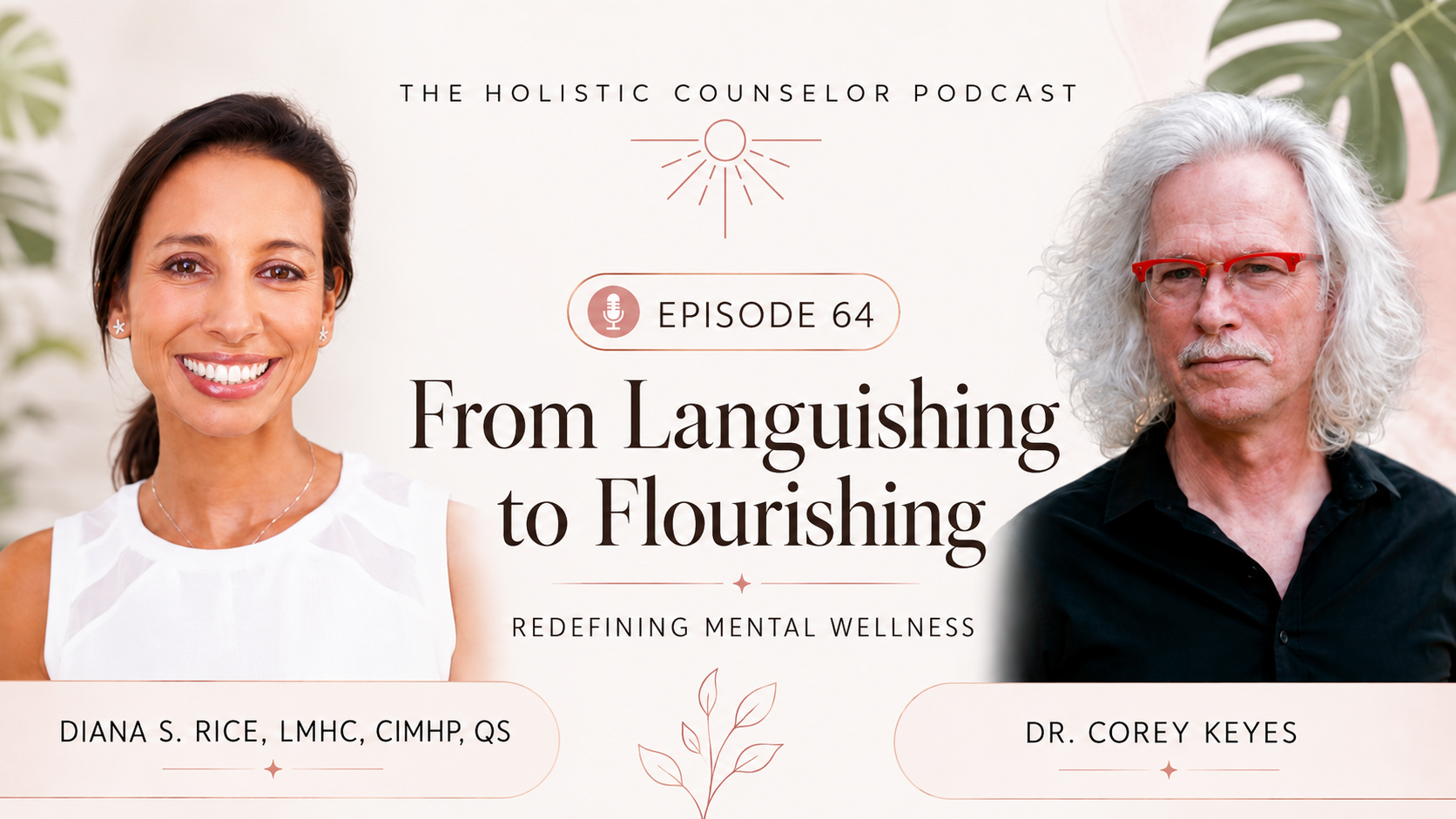
Episode 64
Languishing to Flourishing
with Dr. Corey Keyes
Hosted by Diana S. Rice, LMHC, CIMHP, QS
In this powerful conversation, host Diana S. Rice, LMHC, CIMHP, sits down with renowned sociologist and author Dr. Corey Keyes — the pioneer who coined the term languishing. If you've ever felt stuck in the fog between burnout and depression but weren't sure…
Listen to the Episode
Press play when you’re ready.
Educational content only; this podcast is not therapy, diagnosis, or medical care.
About This Conversation
Show notes
Jump to a section
In this powerful conversation, host Diana S. Rice, LMHC, CIMHP, sits down with renowned sociologist and author Dr. Corey Keyes — the pioneer who coined the term languishing. If you've ever felt stuck in the fog between burnout and depression but weren't sure how to name it, this episode is a must-listen.
Dr. Keyes unpacks the groundbreaking Mental Health Continuum model and the five daily "vitamins" of flourishing — evidence-based habits that promote resilience, emotional healing, and a renewed sense of purpose. Diana and Dr. Keyes dive into the role of spirituality, social connection, and play in long-term mental wellness and why traditional models of therapy may stop short at symptom relief without addressing the deeper need for human flourishing.
This isn't just a conversation. It's a call to reclaim your sense of aliveness.
Topics We Cover
- What is languishing, and why is it often mistaken for depression?
- The origin story behind Dr. Keyes' research and his own trauma recovery
- The difference between mental illness and the absence of mental health
- The 5 "mental health vitamins" that support healing and growth
- Why spirituality, play, and helping others are essential—not extra
- How sociological frameworks reveal what psychology often misses
- Why therapy alone may leave clients "stuck" in languishing
- How faith leaders, clinicians, and community builders can promote flourishing
Mentioned Resources
- Languishing: How to Feel Alive Again in a World That Wears Us Down by Dr. Corey Keyes Buy the book on Amazon
- Mental Health Continuum Short Form (MHC-SF): Learn more and download
- Mental Health Grace Alliance (Check out episode 57 with Joe Padilla!)
- Learn about Acedia – the ancient desert monk concept linked to modern-day languishing
Powerful Quotes from the Episode
"Most of us experience many deaths before the final one—and that's the death of our sense of aliveness. That's languishing." — Dr. Corey Keyes "We're not just here to eliminate symptoms. We're here to help people flourish." — Diana S. Rice "Spirituality isn't fluff. It's your dress rehearsal for when life throws you curveballs." — Dr. Corey Keyes
Connect with Today's Guest
- Website: https://www.coreykeyes.com
- Book: Languishing: How to Feel Alive Again in a World That Wears Us Down
- Follow Dr. Keyes' work on flourishing, sociology, and public health via Google Scholar
Connect with Diana S. Rice
- Instagram: @throughthevalleytherapy
- Podcast: The Holistic Counselor Podcast
- Website: https://www.throughthevalleytherapy.com
Episode transcript
Read the full transcript Close transcript
Automatically generated from YouTube captions. Names and wording may contain errors; listen to the episode for the original conversation.
Hello there, fearfully and wonderfully made human. I'm Diana S. Rice, licensed mental health counselor, certified integrative mental health professional, and your host here on the Holistic Counselor Podcast, where we explore faith-based, trauma-informed, and holistic approaches to mental health, emotional healing, and human flourishing.
Today's episode is deeply aligned with that mission, and it all started with a newsletter. I want to give a heartfelt shout out to Joe Padilla from Mental Health Grace Alliance. Joe joined me back on episode 57, Healing from Church Hurt with neuroscience and grace, where we explored how faith and brain science can help people recover from religious trauma and chronic emotional stress.
In a recent Grace Alliance newsletter, I was introduced to the work of Dr. Corey Keys, and it hit me like a divine appointment. His research gave language to something many of us feel but can't name. and I knew immediately I needed to bring this conversation to you.
Dr. Corey Keys is a pioneering sociologist widely recognized for introducing the world to the concepts of languishing, flourishing, and the mental health continuum. Tools that help us move beyond symptom management into a life of purpose, joy, connection, and well-being. He is professor emirorus of sociology at Emory University where he held the windship distinguished research professorship and he co-hosted the very first positive psychology summit with Gallup back in the late 1900s sorry 1999 to be exact.
Dr. Keys was also part of the MacArthur Foundation research network on successful midlife development, consulted globally with governments and nonprofits, and currently serves as an external scholar with the University of Illinois Urbana Champagne. In this conversation, I hope you'll hear the difference between languishing and depression and why naming that foggy middle is powerful.
The five mental health vitamins that help people truly flourish. Why spirituality, play, and helping others are more than just fluff. They're essential to healing. And how sociology, yes, you hear me right, sociology offers a powerful lens for understanding mental health that psychology alone often misses.
If you're tired of surviving and ready to take ownership of your healing even without a diagnosis, this episode is for you. And if you're a therapist, faith leader, or just someone who wants to live more intentionally, this framework will open new doors. So, take a deep breath, lean in, get ready to explore what it means to move from languishing to flourishing.
Thank you, Dr. Keys, for being on the show. Oh, you're welcome, Diana. Thank you for having me. Yeah. So, let's just start like uh before we even get into the science and all your research, who are you behind the research? Well, I myself uh have come up I've opened up about my my early life trauma for the first 12 years before I was adopted by my grandparents.
And that's part of the book uh and what propelled my interest actually ironically in flourishing um but also languishing. Yeah. And that's part of um that has been part of my lifelong journey and my research as I say has been about me search.
Wow. I have been looking for things that would help me stay in a healthier form of recovery. because I have two mental disorders, PTSD and depression, and it wasn't simply enough to manage those because the absence of those things did not mean I was anywhere near flourishing.
And so I intuitively knew I needed to get beyond the absence of mental illness to find something better. Wow. Wow. And so you coined the term languishing. Yes. Well, I was searching for a word, Diana, that really got at the concept that languishing is sort of the in between mental illness and good mental health.
Now, flourishing is the word I've adopted for true mental health, the presence of positive mental health. You can have the absence of those good things that we can talk about that go into flourishing, but not end up with mental illness. You could be stuck in between.
Yeah. You don't feel anything bad, but you don't feel anything good. Yeah. So, languishing was something I experienced early on in my life. Even after I was adopted into this loving, warm, oh, safe home with my grandparents. Suddenly, I was removed from all this violence.
Wow. And I was doing well in school and in sports. I went from being in detention and a problem to suddenly being an honorroll student. But I would come to the end of the day feeling this gnawing sense of emptiness. And it was very haunting to me.
I I it did not feel good. And so later on I would end up studying the very thing that haunted me. And the word that best described it for me Yeah. was to simply languish in life. Yeah. I mean, can you can you define that term a little more?
Like I mean, because I I get it. I've been there, too. I have a high a score of six. You know, the adverse childhood experience score. So, I get it. And I do um when I worked in alternative schools in Broward County, Florida, I mean, that's it.
They're in those places like you're saying. And um but we are in this generation Dr. Keys or Corey like you told me to call you. Um um we're we are having such an epidemic of anxiety and depression and people are self- diagnosing because of Tik Tok and and stuff like that.
So to me I want to the listener to really understand languishing first of all that they're not alone. What you just shared you've been there and so have I. And we're now two human beings, wounded healers that are now move forward, right? And we're trying to pass the baton and languishing.
Like that's a that's a deep word. Yeah, it it is actually a a condition that I can trace and I did a lot of historical research that goes way back in history to the ancient desert monks, Evagras, Ponticus and others who wrote about it and they used the word back then aidia and it was the eighth deadly sin.
I kid you not, there were eighth deadly sins before the 12th century when Pope Gregory actually removed it. Wow. And we don't understand why it got removed or if it got folded into sloth, but aidia was defined by the desert monks as want for interest in life.
They would get up early and go through their spiritual and physical regimens and in the midday they would suddenly come to rest as I as a young man would come to at the end of the day and I would stop doing and I would rest and suddenly they would feel this piercing darkness in their soul and emptiness in their vessel and it was haunting to them.
And what people usually want to do to get rid of it is fill the void. Yes. And it leads them, the desert monks were very worried because this emptiness would lead them to to engage in distractions rather than deep spiritual mission. Right? So they were always worried that if they got back into their spiritual work that they were doing it to distract themselves rather than to seek God.
Wow. Right. That's a very different thing, right? So when so in the modern world, what we do to fill that void is food, sex, porn, you know, name anything and everything that we sort of use to distract ourselves and it usually is used to fill this hunger that is part of our spirit that has gone missing.
Yes. Wow. Yes. And I talk about that a lot on my show with different people. So yes, so languishing is an ancient ancient thing that now the way I define it is it's the absence of the ingredients of flourishing. It's the absence of the good things.
It's not necessarily immediately the presence of bad things like depression and anxiety. Having said that, it is a gateway if you stay there too long for mental illness also coming on board. Yes. In and of itself, it's the absence of things like purpose, a sense of belonging, a sense that you anything you do matters to the world or contributes to the world, an absence of acceptance of self and other people, and an absence of happiness or well-being or interest in life.
Yeah, it's the absence of good things. Yes, it is. And and that's a hard place because you know, whatever fires together wires together, right?
neuroplasticity like what we learn well what I've learned I don't know if everybody's learned that yet but this is something actually I'm I'm teaching uh this Thursday uh faith in neuroplasticity at the United Way of Broward County um but when when this show comes out it's already happened but anyway um that what you're saying and what you're stating is that part of the mental health continuum that you created or the five vitamins of flourishing can we go into that it's part it's part of the mental health continuum.
The five vitamins are actually uh everyday activities that people can use who are depressed or languishing to begin to move up the mental health continuum. Yeah.
So the mental health continuum was my way of de of developing a diagnosis and yes I do diagnose the presence and absence of good mental health and there are 14 questions on what I call the mental health continuum short form three of which get at emotional well-being how happy satisfied with life or interested in life have you felt in the last two weeks or past month now To flourish, you have to have it only one of those three almost every day.
Wow. But that is simply not enough. There are 11 signs of functioning well. Okay. Six of them are psychological well-being. So things like do you self-acceptance? Do you like most parts of your personality? Do you have warm trusting relationships? Are you being challenged to grow and become a better person?
Do you have confidence to think and express your own ideas and opinions? Those are four out of the six psychological well-being. And then there's five social well-being that I pioneered in my dissertation as the form of social health that people need. So there's a sense of integration.
Everyone is aware of that. You have to have a sense of belonging. There's a sense of contribution that the things you do contribute worth and value to somewhere in the world. But then there's three things that get ignored. A sense of coherence. Can you make sense of the world you're a part of?
Yeah. There's a sense of social growth. Are you being challenged to become a better teammate, a member of institutions, your community, your society? And then there's social acceptance. Are you able to accept mo most parts of other people? Yeah. Right. Wow. That's empathetic.
Right. And so to flourish in addition to one out of the three emotional you have to have any six out of the 11 six or more almost every day. It could be any of the 11 signs of functioning well. Okay? Right? So six out of the 11 plus one out of the three that's seven out of the 14 almost every day.
And what what here's the way to think about it. I unintentionally turned depression on its head. Oh, okay. Now we really need to talk about this, right? Because to be depressed, psychiatrists say you have to have one out of the two anhidedonia, right?
Sadness or a loss of interest in life almost every day for two weeks or more, right? Combined with at least four out of the remaining seven signs of malfunctioning, right? Mhm. flourishing flips that on its head and says you have to have one out of the feeling good combined with six out of the 11 functioning well and you are mentally healthy.
Yeah, I love this Dr. Keys. I I'm telling you it is this is great. And the reason I say that is because I I shared with you like I'm nonpathological.
I mean I'm in a private practice but I'm spending more time u consulting and coaching and podcasting than I am I have probably you know a smaller um practice but it's because I'm trying to teach the holistic approach because many you know we're we're we're in a society that's very con conventional money driven and I'm not putting my my uh let's say mental health practitioners down or psychiatry down or anything like that.
There's a place for all of us, you know, but it's the attention of the heart of the practitioner, you know, and I want to help give tools out to the human that's listening to become a better member of society in a healthy way.
There's so much suffering and I know that through my dark night of the soul cuz that's what it is a dark night of the soul. What you were just talking about the the men in the desert searching, right? We all have to go through that at times.
Yeah. That's where growth, the obstacle is the way. That's where growth happens. But we have a a society that contributes with fear porn.
Okay. and not just you know and just um like you have this we're scared of feeling these what we call negative emotions you and you know what I'm talking about like the sadness the anger the anxiety and the depression these are symptoms to me that's what I tell my clients these are symptoms your mind your body your spirit it's telling you something so we have to be still yes listen to it just listen to it for
a little while welcome it in As Roomie said in the in in the in his poem, it's it's it's knocking on our door and welcome it in as a guest because it's here to clear the house so that you have something um good that you can take from it.
We're here. It's it's here to teach us some things. And that's a hard lesson, isn't it, Diane? I I wanted to jump over it. I did not want to work through it.
We say work through the trauma and I'm like yes no I wanted to jump over it and I thought I outsmarted it and guess what it was always in my rear view mirror and it took me to the age of 50 to 55 where I it finally exhausted me I and I had to face it.
Yes. Wow. Because otherwise it defines you or destroys you. Yes. It defi Yes. And I I did I I decided no longer do you get to define or do are you going to destroy me because my attitude was the best revenge for trauma is to make something beautiful out of it.
Amen. Gift gift something into the world that the trauma says no you are not worthy. You have nothing to give. And I'm like, "No, nothing in this world was planted without the intention to grow. Why would God ever put anything in this world without its ability to grow?"
Yeah. And I had to accept that this was the only life I had. I could and I had to do something with what I was given. Yes. I didn't like that attitude. I was given trauma. So that's what I had to deal with.
Yeah. No. And you you're so right on like this is beautiful. Like I I hope listener that you understand if you're feeling these what we're talking about the the languishing or the depression or the sadness or the anxiety like here it is. It's time to not ignore it anymore.
It's Can can I ask you is your assessment that you were just talking about is that available to to everybody to use? Like could I use that in my practice? Yes, it's it's publicly available. That was very intentional. I put it out and and it's out there in the world and anyone could use it.
It's also in my book and um but it's also on online. You could if you look up the mental health continuum short form. Okay. The MHC-SF is well known used all over the world and translated almost in most cultures now. Okay.
It's widely available and I I encourage you to use because I do want us to talk about how languishing is also part of mental illness and it doesn't get recognized and it's creating a lot of problems that we attribute only to the mental illness and it's usually untreated and so if therapy works it just leaves people free of the mental illness but it parks them in languishing.
Yeah. And that's not a good place to lead pa patients. No, not a good place because it's a revolving door. The the more severe you're languishing, the more likely you are to relapse or have a recurrence. Your remission will not last. Right? That's why I intuitively intuitively went searching for something beyond it because I felt like this is this the point of life just to get rid of the negative.
And then all I do is feel the emptiness. No. That was simply not enough. That is not a life worth living. Yeah. So it's there with with our mental illness. And even if you're free of mental illness, it's there for most people. Yeah, it's there.
So, so let's talk about it. Address it. Yeah, let's go. Let's go in there. Like, because that's that's it. Someone might be listening and they're in that fog or going through the motions or they're, you know, they're feeling better. They've gotten the help and they're, you know, like what do we do?
What do we say? How do we help? Yeah.
Well, one thing is I I it's it it's very instructive just to look at the questions and I would encourage your listeners to just even if you don't want to complete the mental health continuum short form just look at the questions like do the things that you get to do or have to do on a daily basis contribute anything of worth and value to your community your society your family now that's I'm I'm paraphrasing but that let's just Start with that one.
That's one question about social well-being. Yeah, there are a lot of people doing some very valuable things in the world and and society has led them to believe that it's not it doesn't matter. It's just expected of you. I think of caregivers and and often the work that women do that's expected because you're a female and they do all this amazing caregiving and somehow they're walking around thinking that what I do doesn't contribute anything of worth and value.
Yeah. Let's get rid of right right there. Let's address that. Yes. Now you can focus on society. I'm a sociologist. I want to change the world. But I'm not going to wait for that. I'm going to change the way I look at myself and what I do and in my immediate environment which I have control over.
The world has a lot to do in terms of changing its isms, sexism, homophobia, racism, all that. That has to change. Don't get me wrong. But while we're waiting for the world to change, we can start valuing each other's work. We can start saying, "Thank you.
I thank you for what you do for me. Wow. Right. Just thank you. I mean, and once you start hearing thank you, you start feeling, wow, what I'm doing matters. Yeah. Oh, no. I I you know, I didn't know that I was practicing positive psychology back in the day when I was working at the alternative schools, but I would when when I when I had a teenager come in and you know, I worked in alternative schools.
So, if people know what that means, it's like a lot of kids that got kicked out of school or or that was their last place to go before they really end up in jail or or someplace. But when they show up, I'd be like, they thought I was nuts.
They But they would open up after a while because they had to earn trust because, you know, people with PTSD and a young CPTtsd is what I'm talking about. Complex childhood PSTSD, the trust is gone, right? The trust is gone. I mean, you're going you're working through a lot of of of dark places inside the soul and stuff, but I would say thank you that, you know, I'm like, "Thank you for showing up."
And they're just looking at me, "Wow, you're thanking I didn't do anything." I'm like, "No, you're here. No, you're present. Yeah, you it the the mere act of showing up is just a beautiful thing. Now, are you ready um for all that I have to offer?"
No, you might not be, right? But that that's yeah that's a beautiful thing to have somebody who's a teacher who who knows what they're dealing with because I remember being in detention weekly regular basis. I could not sit still. They would have diagnosed me as ADHD.
But when in fact it I I you do not put me in a room facing away from the door having to sit still as I just couldn't. Yeah. I was afraid. Yeah. And how can anyone learn when they're afraid? Exactly. It's your It's your brain on fire. it's your system, your central nervous system, you know, it's every it's trying to keep you safe and and when people start understanding that more and more, they'll understand also the tools like what what Dr.
Keys just shared his assessment and realizing like there's ways to rewire their brain and to understand and that's there's so much out there. It's just we don't know. We don't know. We don't teach this in schools.
We don't even in my field like we're trained very insurance-based models or it depends what school you go to and nowadays I see that there's a change in the medical field you know where we're learning about nutrition and like a holistic approach of being a human but our ancestors kind of sort of knew it in a way like about mind body spirit connection um you know so why why do you think spiritual uality, you know, is a key component of mental wellness.
And so, and for those raised in traditions that emphasize suffering, guilt, suppression, how can they reconnect with spirituality as a source of flourishing instead of shame? Yeah. Yeah. I well I I'm sure most of your listeners are pretty aware of the distinction of spirituality and religion in the institutional versus but but to me spirituality does not necessarily happen in organized religion.
Mhm. Um but they can overlap and that's a beautiful thing when they do because to me spirituality is the practice the self practice arm of what religion usually talks about but we don't do. We just talk about what you should be doing. We don't work on it.
So you might get a sermon as I did as a Catholic boy on um on empathy or kindness. We should be kinder, right? And then that you go you leave and you think about kindness and then you go back to your everyday life.
Yeah. Well, spirituality is this practice of being aware and trying to encourage a mindset in yourself. You don't do this in church. You do this at home is the way I think about it. You do it in nature. You do it almost anywhere else.
But you're working on yourself becoming a kind of person by trying to encourage more kindness. Yes. And I I think of this is the way I love yoga for this very reason, right? It's it's a it's a as well as Buddhism. It's it's to become spiritual.
First you have to quiet your mind and the ego. Yes, that's yoga. We think of yoga and Buddhism only as meditation and poses, right? Well, though that's just preparation. Once you've quieted the mind and you're focused, you can begin to work on yourself and trying to think more about kindness, trying to act the create the intention to be kind today because kindness is a muscle.
Yes, it's not something that gets exercised by dice just thinking about it. You think about it and then you have to do it. Think and do. The way I describe it in my book is spirituality is a dress rehearsal. So in the way any kid who is going to do a a music performance engages in a form of rehearsal before he or she goes on stage which is very stressful.
Yes. Right. They spend a lot of time practicing, practice, practice, practice. So that when they get on stage and it's very stressful, they have the mindset and the and the the muscle memory to perform and do the right thing and not let the stress overwhelm them.
Well, guess what happens when you get out in in real life? Excuse my words, but [ __ ] happens. And what does what does it do? It makes you angry and creates negative emotions. What do negative emotions in? Make you react. Yes. The worst thing is to be reactive.
So spirituality is a dress rehearsal so that you slow things down. You're prepared for the stage of where anger and stress is going to happen. And you choose to respond out of your deeply held commitments, values, and spiritual principles. Yes. And when you do that in the midst of of bad things, you transform yourself in the situation so that when you remove yourself, you look back and you're proud.
Mhm. Rather than ashamed and disgusted with yourself. Yeah. Right. I didn't do I didn't get even. I didn't act on revenge. I didn't act on anger. No. The best thing sometimes is simply I said nothing. Yeah. And I said, "Have a good day.
We'll talk later." Right. Right. Yeah. It's empowerment. It's That's one thing that I had to teach and I still teach my clients. It's teaching them how to respond in wisdom instead of react in emotion. And that happens because, you know, well, especially if you grew up with uh in a in turmoil or chaos, your nervous system kind of already knows that and it's comfortable and and I remember it's very easy.
Yes. Someone, one of my guests, I think it I forgot which one, but she said, "People are wanting to stay in their comfortable hell instead of working hard to go into a uncomfortable heaven." Yeah. Mhm. Right. It makes sense. And and to me like like in my faith tradition, this is why I start with my clientele with uh Psalm 139 and I Psalm 23 and understanding like who they are.
You know, it's like understanding they're fearfully and wonderfully made. Understanding that they do have, you know, do not conform to the patterns of this world, but be transformed by the renewing of your mind. I mean, these are and this is what I utilize to try to reconnect their their brain because like you're saying, it's we have the right to choose.
That's how we get empowered. I could go off the second someone comes and and crosses me or cuts me off in traffic or attack me. I could and sometimes depending on how well I rested, how I ate, all the things you talk about in in in the having you know for flourishing if those are like at minim minimal or you're not getting any of that and you're deep in languishing it's so easy to pop off.
It is very easy. Yes. And then add PTSD to as you said to the situation of languishing. I many times I'd be cruising along flourishing and then I the workplace was a difficult place for me.
It was it retraumatized me in many ways I didn't realize and something would trigger would happen and suddenly I would like do something that like I thought I was crazy sometimes and I bet my colleagues thought I was and yet I what I realized was that I was I was giving away my power to choose when they did something wrong to me.
I I lashed I I said, "You don't get to do that anymore, right? You don't get to hurt me." And that was not a great way to deal with my PTSD. Like creating a concrete wall, like you don't get to hurt me anymore, right?
Um because then I gave away my power by saying I I lashed out and now the problem was me rather than me us dressing the wrong that they they did, right? And so I I had to slow things down. I had to learn how to slow things down.
And yoga was the way in which the world became manageable to me. Yeah, I'm a long-term practitioner. And boy, the mat creates a quiet place so that I can go out into the world and it comes in in in a a pace that I can handle and the best version of me comes out and God is very happy. right?
Is because boy, it's like Corey, you are being the part that I know you are capable of. And that's I always love the two wolf story because I think it's a very right that I use that all the time. The Cherokee. Yes.
Yes. that it's it's that's just part of our nature now that the than the the bad wolf we gets fed a lot more when you have been traumatized and stressed out and abused and mistreated and treated with all the isms and you're hunt you're hunting for disrespect.
Anyone who disrespects you, you will that doesn't feed the good wolf. Oh no. And I know all of us are are potent. We have the divine in us. Yeah. Just like the Buddhists say, all of us had Buddhahood. We're all potential Buddhas. I know that.
And that's how it is for us, too. I mean, I mean, Galatians 3:28 is my favorite Bible verse because it says um there's neither Jew or Greek, male or female. We're all one in Christ Jesus. And to me, that says that we have the divine in us, that we it's what we feed.
I I that Cherokee native I think it's a Native American. I'm going to put that in the show notes along with Dr. Keyy's assessment that he talked about because to me these are important tools. If people could just pick up these tools like that we mention here or in all my episodes I try to mention tools because not everybody could afford therapy.
Dr. Keys, not everybody could afford it. No. No. I know. And that's why I wrote about the five vitamins in the book because um and we can talk about more of like because spirituality and religion was one of the five vitamins that that pe people who did more of those that spiritual/religious activities even if they're depressed or languishing be began to have better days with awe, inspiration, gratitude and good things.
And that began to lift them out of those two places and move them slowly but towards flourishing. Right? And if you were flourishing, you you needed to keep doing those things because if you'd stop doing them, guess what? You started to slide back.
Yes, I agree. So that was one of the five vitamins and and th those are things we can all do. We don't have to pay anyone to go play, learn something new, help other people, engage in spiritual religious activities and so forth. We don't um we just have to prioritize them.
And and that's Yeah. So those are the five vitamins then. Spirituality, social connection, learning, play, and helping others.
I do I do talk about volunteer like sometimes people come into my office and they've already been through the a few therapists and then they come to me and I'm like when was the last time you volunteer and they're they get mad at me and they're like well I can't even get out of bed I'm so sad and I'm like I understand that but I want you to understand then you know you're paying me big bucks
and so either you're going to listen to the things that have worked that's healthy uh that's going to build you up and you because I'm all about the food and mood and the gut brain health and of course the spirituality is probably the main the starting point because we live in a culture and society that is just constantly with the news and and and social media especially the younger generations that are coming you know we blame
we it's so funny how generation after generation like the older ones like Gen X blaming uh the zillennials or the millennials blaming the Gen Z's.
The Gen Z's will be blaming Gen Alpha, right? And baby boomers are blaming everybody. But but we have to realize, guess who raised the next generation. So I'm trying, right? Go ahead. Yeah. And we're and and and it's nothing new. We think that we're we've got it so different.
And yes, I think our ancestors face different material uh economic situations. That's obvious. Yes. And yet to think of the nature of struggle as it's been a universal thing. It's been to think that languishing with a different name at the same thing has been with us throughout human history.
There is nothing new here. The world is is going to be a place where we suffer. Yes, we will suffer in various word ways in different forms and sometimes more than others some of us and sometimes because at often at the hands of each other and yet I think there is this amazing role for things of spiritual and religious because I don't can't think of anything else in life throughout human history that when practiced in what I thought Jesus's message was.
We if practiced in the way that we are supposed to work on becoming better people. Yes. The bottom line whether it's Christianity, Judaism is Islam, Buddhism, they all get back to something called the a eighthole path. How can you be a more ethical person?
Kinder, forgiving, compassionate, loving, generous. Those are the things we need to work on and human beings will always be working on that. And to think, well, the world's a difficult place right now. Yes. But that's as if God is suddenly saying, now is your opportunity to learn. here is now more than ever the ch chance to be a good person.
It's not easy, is it? But it's a really amazing a feat. He it would be so proud of us if we could actually transform our anger into kindness, our selfishness into generosity right now and stop blaming the world for a moment because everyone can blame the world throughout human history.
M it's a teaching us something. We have a choice, an opportunity. Yeah. And I'm like, I get it. When I was so defined by my trauma, I was always a victim. And blame is so easy. It is. When I've looked at that and boy, the ego then would come out and say, "You haven't fed me enough.
Come on. Look at all that I've accomplished. Come on. I'm like, yeah, exactly. Exactly. I It is the ego and how I see it because we have Christianes, you know, words. So, it's like ego equals flesh people, right? And humility, humility equals spirit.
Spirit, right? And so it depends which one you feed, which wolf you feed, right? It's And how do you do that? Well, it's it's checking yourself. It's it's understanding that you're responsible for you no matter what has happened to you. Yeah. Yeah. You may not have deserved it.
You may not have caused it. Exactly. That let's and that we need to all honor and and just but but that does not give you permission to say I have no role in doing something about it because you are the only one in the end.
Yeah. That has that choice. I can't make you. You can't make your patience. No. No. I had to choose and I had to come to a very even darker night of the soul. Night of the soul to say, "Okay, I've got to work on this and I got to the this is me.
I have to work on me." Yeah. And how do you how did you because I know I have my journey that I was given right on how to get from that place to being able and I try to share the the things that helped me but I have to have the listener understand that they're their own biology, psychology, theology.
They hear me say this probably in every episode but it's true. Like we are our own. So what worked for me might not work for Dr. Keys and Dr. keys. What worked for him might not work for the next human being. But sometimes you pick it up and you figure out, "Oh, this might work."
Okay. Um, what worked for you? How did you get out of the funk? Oh, well, every time I acknowledged that I needed help, I went I suddenly changed and transformed. I would sit in languishing because what languishing does is create an invisibility where you start to recede into the background because part of you wants to disappear and then part of you is disappearing.
M so people don't I mean when you're languishing you don't act in the way that anyone would say wow oh look at look at so and so look at Diane look at Corey he's like just you want to isolate retreat and then the more you do that the more you feel like you're on your own yes and none of us I never solved any of the problems or accomplished anything good on my own and I write
about this in the book and I had my wall of love in my stu my my my because biologically my family I I had to recreate a family.
So my my wall of love is made up of the one biological family which was my m p m p m p m p m p m p m p m p m p m p m p m p m p m p m p m p m p m p m p m p maternal grandparents but beyond that I have professors um friends, neighbors that have become my synthetic family and therapists where I simply said
I need help and and I I went searching for hope and I didn't have the I couldn't use the attitude well you don't have my lived experience I hear that a lot oh you don't you don't know what I've gone through I was like no I don't I don't but there throughout human history there have always been gurus shamans um leaders and they they have walked a path where they have tried to accumulate as much knowledge
and wisdom for themselves that could be useful all we can do is ask for help.
And that was always the key for me going from languishing to moving out towards flourishing. Yeah. Because then I had to realize then I'll I had this therapist who was a CBT therapist. She said, "Um um Corey, I want you to know as we start this journey together, maybe 20% of the magic is me.
That's that's even being generous. 80% of it's going to be that you were doing the work and CBT was filled with homework. Yeah. So, I would get to talk about things, but then I would have to work on things. Work, work, work. And I'm like, that was the key.
I had to say I I needed help. There's a guide, but ultimately nothing inside me is going to change by simply thinking. I had to do I had to do do and that was a lesson that the ego simply uh screamed at at the beginning and then it suddenly quieted because I I talk about this big time in the book.
I had to learn to start small. Yes, exactly. Every start like meditation when we did it was a minute and I would laugh at that. My therapist would laugh at me and I was like I'm thinking what would a minute a day and she would look at me Corey just just do it.
Promise me you will trust me and just do it and I would laugh and and then to make sure I was doing it we would do it together to begin and then suddenly I realized before long two months later I'm doing it five minutes a day.
The problem was I wanted to jump right to 20 minutes. Exactly. Never having done meditation would that would have been the worst thing because I would have failed and I would have said this sucks. I can't do it. Mhm. Give me something else.
Right. And I learned I had to start small. Yes. And my ego had to just I had to stop listening to it and stop laughing at what I was told cuz I had asked for help. Then when they wanted to help me, what did my ego do?
Laugh, laugh, laugh. Yeah. And you have to challenge that. Yeah. You had to challenge all that. And I'm a big believer. Nothing big has ever started with something big. It always started small. Exactly. Exactly. It's just we live in a in a culture where we're comparing things constantly.
Constantly. Because I work with mostly 25 to 35 year olds now. And so that's that's where I'm seeing I'm like, "Okay, start small. You're gonna spend 30 minutes if you can without your phone." And they freak because that's an addiction in itself. I know.
Everything's too immediate, isn't it?
And it's like I have to tell you this this amazing story that because his holiness the Dalai Lama would visit Emmery every three years. he was and he had a a relationship with and I remember one of his visits he said and at one of our meetings um I don't think people realize that I didn't just end up at the top of Everest and even today I'm not at the top of Everest every day I get
angry and I have to work on it every day and people need to understand it took me a long time to just get twothirds of the day at my personal Everest and I fall I have to climb back down to another camp lower sometimes and practice practice practice.
People look at me and they say, "Oh, I want to be like his holiness the Daly Lama." And I say, "No, you don't. I have to work at this every day." And I've been working at it a lifelong time. Yeah. And I'm like, we look at these people who seem to have their stuff together.
And it's like, he was the most honest about it. And I'm like, our young people need to hear that. Yes. Again and again and again, people that we revere are imperfect. They're still working on it. And they go easy on themselves and others, but they're always working on being a better person.
Yes. Exactly. I mean, this is this is this is why I think many people who get to a point where people think they're high up and then they fall. It is. To me, it's due to the ego. And finally, I I think the creator of the universe are going, "All right, you think you're me now.
Smite." No, no, I'm just kidding. Not smite, but no. Well, no. It's like, yeah, a little humility will do you well because Yeah. Humility is you need to always know who you are and what you are and be willing to learn every day.
Are humility is I know what I am, who I am. Yes. And I need to learn. Yes. Exactly. I will never know it all. Yes. No. And I will never be finished knowing what I am and who I am, but I will always know I have more to learn.
Yes. Yeah. Exactly. Like, so what would you um say if you were able to write your own manual of mental wellness? Like if you could red redesign the DSM, the diagnostical statistical manual. I know you're a sociologist, so it's very different than the way I was taught in school and how my, you know, what I do for a living.
Um, they tried to teach me. This is why I think I went off to private practice because it was just very not it just feel like it they just focused more on symptoms and medicinal management. And I and to me, listen, I'm not going to put anyone down that that is taking medicine.
I get it. like you're suffering and it's helping you. Good. But there are other ways too, right? And we don't want to talk about it sometimes because we're just being uh on commercials constantly bombarded of this is this, this is that, this is that, here you go, here's your symptom, here's this, and because nobody wants to feel the pain or go through it like we talked about in the beginning.
So, what do you think the clinical field is missing when it comes to measuring or supporting human well-being? Well, first off that we seem to be a health care system that I really call a sick care system. Um that's um focused on I would say triage and and and a sort of pit stop model.
If if your tires are getting worn out, you're running low on gas, come into the pit. I need to get you back in the race. Oh. Oh. Boom. the race isn't done. You got more to do. Um I I understand that model, but I I and I also respect the fact that the DSM I I used to teach it in that and the transformation from DSM 1 and 2 to three was amazing.
And and I also acknowledge the fact that we're dealing with something really complex when we were talking about mental illness because we're talking about problems and disturbances of three systems. How you think, how you feel, and how you behave. There's no other disease or disorder that is combines so many systems at and isn't it?
It's it's a very hard thing to diagnose. They're still struggling with, you know, how to diagnose it. And yet, we know that depression's out there.
We know anxiety is out there. and and when it becomes pathological and we can critique the DSM and say well the threshold might be a little arbitrary but you know we have to decide when to act or we end up treating everyone because almost everyone has some of those so I get it but at the same time what we're ignoring is the mental health continuum because I am all about the two continuum model.
The absence of mental illness does not mean everyone's mentally healthy. And the vast majority of the world exists on my side of the continuum, which is they're free of mental illness, but they're not mentally healthy. And we do nothing for those people who are languishing to some degree.
Because here's the thing. All the studies I review in my book and have come out since show that when you're flourishing or you're mentally healthy, you can do hard. You can deal with adversity. You can deal with conflict. You are quote unquote resilient.
Yes, when bad things happen, you have a bad mood, but not nearly as negative as when you're languishing and have the same bad things happen, right? So we're missing an opportunity to create mental preparedness in the world because that's people need to be mentally healthy to deal with the world that's going to be full of slings and arrows.
Yeah. And so we don't pay attention to languishing. And I think it's the reason we're not making any progress whatsoever in dealing with the crisis of mental illness. It keeps growing. Yes. because it's the gateway. If you don't deal deal with people before they become mentally ill, right, when they're languishing, it will get worse.
It will get worse. Trust me. So, how do we how do we fix that? How do I h you know, you and I are in two different places, two different fields, but it seems like we're both talking kind of the same language in a way.
So, what can I what can I do? I'm a qualified supervisor. I have interns. So, I would love to teach. I have this podcast. I would love to teach. That's what you do. You teach, right? And you've you've done these studies. Like, where would where would a practitioner say I have an intern listening right now or someone a faith leader and they're like, where would you have a start to to learn this model?
First to prioritize the mental health continuum in anything and everything you do. Because here's the thing, the research is very clear. The things we now have that focus on mental illness can lower the bad, but they don't elevate the good on the mental health continuum, and so we need my in my ideal world, we need an institute at the National Institute of Health that focuses on the mental health continuum in the physical side and in the mental side.
Okay? um because it's a very different challenge. You need to develop new novel ways to elevate positive physical health and positive mental health. Yes. Because the things we've been working on come from the the pathogenesis, the pathological model, which is necessary because we won't prevent everything.
Wow. But we need a whole new discipline that studies what are the things that deal with languishing and move people up the physical and the mental health continuum towards a flourishing state of being. Okay? Because we're we're just learning that. Mhm. And I reviewed the evidence showing that the stuff on my side of the continuum is very genetic, just as heritable as the stuff on the mental illness and physical illness side.
Yeah. Yeah. But guess what? The genes for both overlap very modestly. So we inherit both a potential for illness with in other words genetic risk and we all inherit to some degree genetic potential for physical and mental flourishing. Yes, but it takes different things, right, to elevate the good.
And we need a research initiative at a national level that gives people the p the funds and the long the the motivation to study this. Yes. So, so that that would be a great I mean that would be a a dream. You're right.
Like hopefully people are listening and and things are will change for the future. I mean we have no choice because the way we're going now is is definitely not working, you know, like diagnose and medicate, diagnose and medicate. It's not it's just we're numbing people out and there and so much hidden stuff.
And I mean like I told you in the beginning before we pressed record that I you know this was put in my lap after much prayer. It's because I was trying to break stigma in churches and I was trying to break stigma in the BIPO community, in my community, my culture.
But this is more than just those two um areas that need this. It's it's the social emotional learning. It's it's the mental health continuum. So, where do we find your work, your book, all these things? So, then maybe that's what we'll start. we'll start researching and utilizing it in our own practices first because national I I get it like you know like it is a public health issue.
You're spot on. You are spot on. But like we also said earlier it's it has to do with what we're doing within our scope of influence. Yeah. Because that's all we really have control of. I mean, this is where I get people to to, hey, you're you're freaking out over politics.
You're freaking out over this. You're freaking out. And that's because you're we're not meant our brain's not meant to have 247 of worldwide news and and things like that. And then the algorithm, oh my god, let's not go there. But they but people really don't understand that because they're they don't they don't I've done the research.
I understand like you have to take a step back and practice the pause. Yeah. So well if there was ever in my mind a place for religious institutions to step up to the plate and say we believe in something so much it resonates so deeply with the message that we have that we think we need to support this as a public health initiative.
Mhm. It doesn't mean we have all the answers, but man, the languishing to the flourishing continuum. I've heard some of the sermons and it's amazing how languishing u resonates with uh passages in in in the Bible and and the good books of of every tradition and how the elements of flourishing, purpose, belonging, acceptance, all those things also map on.
Yeah. Yeah. Now imagine if if these churches got behind this and said we don't we want to extend our influence to creating a world where people of faith and of not yet there all get this. We believe in it that much. If there was ever a place for them to say, "Oh, let's take this message and we're going to do the sacred stuff, the divine stuff, but also we want this to be part of the secular everyday world."
Yes, exactly. I I don't know what other institutions where where this maps on to as as beautifully and as obviously it it it's an it doesn't resonate with the sick care system that we've medicalized everything. It doesn't. No, not at all. No. But from the religious spiritual traditions, it seems to me it's a case where churches say that our message could be part of a public health agenda. not not trying to make the whole world uh our mission, but the mental health continuum, right?
Let's pay attention to this. Yeah. Well, Dr. Keys, I know I'm paying attention and and and I'm thinking like, oh, here comes a blog because I write a blog when I get moved to write it. So, or create a PDF with with the Christian version or some I don't know.
I have to really So, where can I find your book? Where can I find your work? Oh, well, the t it's the it's the paperback version just came out this February. It was published la last year. Uh it's called Languishing and the subtitle is how to feel alive again in a world that wears us down.
The the way to think about flourishing and I'm working on this initiative with some amazing colleagues creating a h human aliveness lab. It because when people are flourishing they feel fully alive. Yes. And I think there's amazing there's religious, spiritual, and and secular traditions that all are designed to help us feel fully alive.
Yes. And when you're languishing, people describe it this way. Uh they're dying in sight or they feel dead inside. Yes. I only want to experience one death in this life, but that's when my soul leaves. My spirit is done here and my body is done here.
Yes. But most of us experience um many deaths before that one which is what I call the death of your sense of aliveness. Your spirit goes missing. That's languishing. Yeah. So that's what the book is about scientifically. It's about mental health continuum. But really it's about this sense of aliveness and this feeling of dead emptiness that pervades many of our lives.
Yeah. Well, that's going to be the next book that I'll be reading. people. I mean, I I usually read Well, no, I actually don't. I just get excited and try to get people on my podcast. Yes, I've learned to read all these books before.
Yes, I know. And because honestly, Dr. Keys, I uh reading I can't believe I made it through college because I think my CBT I had no idea back then that's what was happening.
But when I read, I would read it and then reread it and then reread it and then I would highlight and I'm like, I can't believe I have a master's degree, people. cuz it took time because sometimes everything seems important and you have to learn this ability to sort of say, well this is let's pay attention.
Yeah. Yeah. So, so before we go, what would you like to say anything to the listener before we say goodbye? H well it is a quote that I use at the end of the book and it's been with me throughout my journey in life and why I study what I study and it was like Robert Kennedy and he said this mo many most people look at life as it is and they ask why.
I choose to look at life as it could be and ask why not. M wow. And I had a choice, right? Because the thing I could not just look at what was done to me and simply be content with why because it just wasn't enough.
The only way I could get past the trauma was to say, okay, the best gift I have to give the world is to look at how the world could be. And my attitude should be always, why not? I love it. And that's it.
I mean that our it's a much better world to live in when all of us are looking I want I want to live as if this is the world I want to be in. Yes. And always with the attitude why not me but why not others?
Yeah. Exactly. We're here we're here interconnected with all living things. To me I mean I know people think I'm some sometimes woowoo or newagy or whatever it is but it's not. It is understanding I know who I am in in Christ.
I know I know what I believe in like you were saying like my spirituality I take serious I take serious and then my physical body I take serious because it's a temple and then right and then my connection with human beings I want to love others right just as Jesus told me to love others I want to to that's my mo that's my role model is Christ and religion causes wars I get it and And it's
because ego gets in the way of a lot of leaders, no matter what religion, and then it becomes a money-making machine.
But we're not even going to go to that tangent. But to me, like Dr. Keys, this was probably well, I shouldn't say that, but one of the best episodes ever. And I thank you so much for coming on. It is because of course I I just what you said resonated big time with me.
Big time. and I cannot wait to read your book and I don't know maybe in the future collaborate with you somehow someway. I have no clue but I know this was a divine appointment and I really appreciate your time. Thanks for being on.
Oh I appreciate you having me on Diana. Thank you so much. All right listeners, you know how I end. And if you don't go back and listen to some more episodes. So remember, trust in the Lord, guard your heart and renew your mind.
Bye. And now for the disclaimer to make sure you understand that you are responsible for you. The content provided on the holistic counselor podcast is for entertainment,formational purposes only and is not intended as a substitute for professional medical advice, diagnosis, or treatment. Always seek the advice of your physician or other qualified mental health provider with any questions you may have regarding a medical or mental condition.
Never disregard professional medical advice or delay seeking it because of something you have heard on this podcast. The views expressed on this podcast are my personal opinions and do not represent the views of any professional organizations with which I am affiliated. Call your doctor, 911, or 988 immediately if you have a medical emergency.
The Holistic Counselor podcast does not recommend or endorse any specific tests, physicians, products, procedures, opinions, or other information that may be mentioned on the podcast. Reliance on any information provided by the holistic counselor podcast, guests appearing on the podcast at the invitation of the holistic counselor podcast or other listeners to the podcast is solely at your own risk.
Confidentiality notice. If you engage with the holistic counselor podcast by commenting or posting and are a client, please be aware that you may be revealing information that could compromise your confidentiality. Please remember that disclosing your identity or personal details can be linked to your clinical material.
As a therapist, I am bound by confidentiality and will not respond to any disclosures of this type on this podcast. I am committed to upholding the ethics and confidentiality of the therapeutic relationship which extends to all forms of communication in accordance with the laws and professional guidelines that govern mental health professionals.
I want you to know that your privacy is of utmost importance and you are responsible for protecting it when interacting on this platform or any other public forum. Thank you.