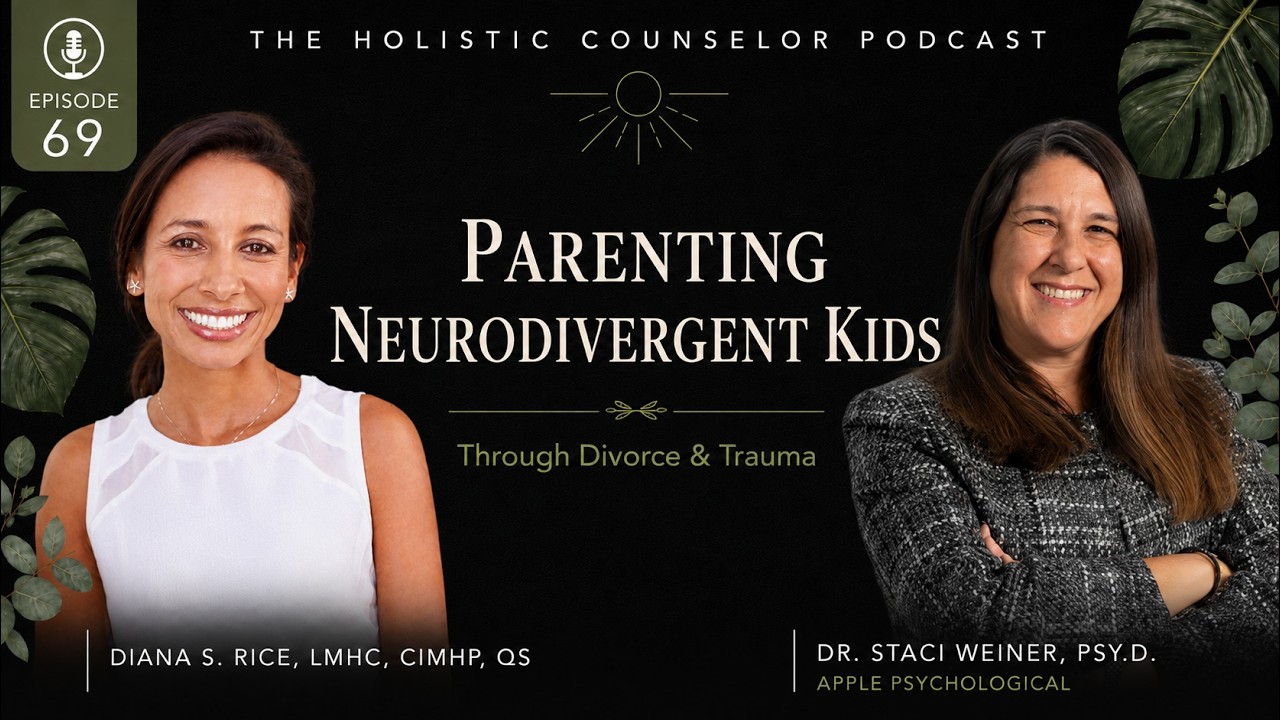
Episode 69
Parenting Neurodivergent Kids Through Divorce & Trauma: Psychological Evaluations, CBT & Cultural Wisdom, w Dr. Staci Weiner
Hosted by Diana S. Rice, LMHC, CIMHP, QS
Welcome, fearfully and wonderfully made human! This episode of The Holistic Counselor Podcast is a powerful dive into parenting, psychological evaluations, and how to better support neurodivergent kids—especially in the midst of trauma, divorce, and diagnostic…
Listen to the Episode
Press play when you’re ready.
Educational content only; this podcast is not therapy, diagnosis, or medical care.
About This Conversation
Show notes
Jump to a section
Welcome, fearfully and wonderfully made human!
This episode of The Holistic Counselor Podcast is a powerful dive into parenting, psychological evaluations, and how to better support neurodivergent kids—especially in the midst of trauma, divorce, and diagnostic confusion. Diana welcomes Dr. Staci Weiner, a licensed clinical psychologist and certified school psychologist, for a deep, practical, and grace-filled conversation about trauma, resilience, and reclaiming confidence in parenting.
Dr. Weiner is the founder of Apple Psychological, a multidisciplinary mental health practice with locations in Boca Raton, FL, and Roslyn Heights, NY. With nearly 20 years of experience, she offers psychological evaluations, forensic consultations, psychotherapy, and group therapy services for children, teens, and adults.
Together, Diana and Dr. Weiner unpack key challenges families face—including cultural stigma, the misuse of labels like autism or ADHD, the reality of co-parenting through high-conflict divorces, and how CBT can be life-changing not just for kids, but for overwhelmed parents.
In this episode, we discuss
- Why routine and predictability are critical for neurodivergent children
- How unresolved trauma shows up in parenting and relationships
- Tools parents can use to co-regulate during chaos (hello, distress tolerance!)
- The truth about psychological evaluations—what they are, why they matter, and how they're misunderstood
- Cognitive distortions commonly seen in divorcing parents and how to reframe them
- Cultural misunderstandings in mental health diagnosis and why context matters
- The difference between labeling and truly seeing someone for who they are
- Why validation and a healthy community are essential for healing
Quotes to Remember
"You actually see my child for who they are—not as a label, but as a human being." – Parent to Dr. Staci Weiner
"Not everyone can afford therapy—but you can still take agency over your healing." – Diana S. Rice
Resources Mentioned
- Apple Psychological Practice
- Robson Forensic, Inc.
- Myers-Briggs Personality Assessment (Free)
- Love Languages Assessment
- List of Cognitive Distortions (PDF)
- Episode 68 with Dr. Benson Fox
Connect with Dr. Staci Weiner
- Website: applepsychological.com
- Practice Locations: Boca Raton, FL + Roslyn Heights, NY
- Forensic Work: Robson Forensic
- Contact: Call or schedule via applepsychological.janeapp.com
Join the Divorce Support Group (Florida + Virtual)
- Pathways to Peace – A supportive hybrid group for women navigating divorce or separation. Includes education and guest experts. Contact Apple Psychological to schedule a free consult with Dr. Aisha Robinson.
Connect with Diana
- Website: throughthevalleytherapy.com
- Coaching & Consulting: transformedmindcc.com
- Instagram: @theholisticcounselorpodcast | @throughthevalleytherapy
- Podcast: The Holistic Counselor Podcast (new episodes every Wednesday!)
Episode transcript
Read the full transcript Close transcript
Automatically generated from YouTube captions. Names and wording may contain errors; listen to the episode for the original conversation.
Welcome fearfully and wonderfully made human. It's me Diana from Through the Valley Therapy and Transform Mind Consulting and Coaching and your host of the Holistic Counselor podcast where faith, science, and holistic healing intersect. This show is dedicated to breaking the stigma around mental health, especially in faith communities and culturally diverse spaces.
I invite not only experts in mental health, medicine, and holistic well wellness, but also authors and anyone whose work aligns with the mission to bring you transformative aha moments, practical tools, and soul deep encouragement. Whether you're a professional, a seeker, or someone on your healing journey, you're welcome here.
Today, I'm honored to welcome Dr. Stacy Weiner. We first connected at the Palm Beach Mental Health Counselor Association networking event and after a meaningful follow-up conversation with her and Dr. Benson Fox, who you'll remember from last week's powerful episode on faith and adulting on the autism spectrum.
I knew she'd be a perfect fit for this space. I've linked that episode in the show notes in case you missed it. Dr. Weiner is a licensed clinical psychologist and certified school psychologist with nearly two decades of experience. She's the founder of Apple Psychological, a multi-disciplinary practice in Boca Raton, Florida.
And Roslin Heights, New York. Did I say that right? Roslin Heights.
Yes.
Roslin. Roslin.
Rosin.
Tomato. Tomato. Okay. She works with children, adolescents, and adults offering psychotherapy, group therapy, and comprehensive evaluations. Her clinical specialties include anxiety, depression, ADHD, trauma, autism spectrum, spectrum disorders, and the transition to adulthood. And she also provides forensic psychological services as an expert witness with Robson Forensic, Inc.
So, let's get into this rich holistic conversation. Thank you, Dr. Weiner, for being on the show.
Absolutely. Thank you for having me.
Yeah. All right. So, let's just start a little bit with you, right, before we get into the the meat and potatoes of of what I want to talk to you about, but like who are you? Where are you from? What do you want to share with the audience?
Yeah. So, my name is Dr. Stacy Weiner. I am originally from New York uh from Long Island and I lived there for most of my life and about five years ago I moved to Boca Raton, Florida. Um I have been in PRA private practice for 20 years.
Prior to that I was a school psychologist in several districts in Long Island. Um, and as you mentioned, I also work for Robson Forensic and doing um, I love that work as well, doing expert witness work. Um, mostly with trauma situations. Um, but also a little bit of everything.
Okay. So, I know like I'm going to now my brain's going to like how did you get into the forensic uh, that that kind of work because that's that's intriguing honestly.
Yeah. Yeah. It's it's so wonderful. I love it a lot. Um, so you know, I always loved psychology. Um, but when I was little, my dad always told me, "I think you're going to be an attorney." And and uh, so it's interesting that I ended up with doing this forensic work because I work with attorneys.
Um, and we, you know, talk about various different cases and how people are impacted by different events. Um, and it's just a totally different field than the private practice work that I do. So, it just keeps me on my toes and um, I really really enjoy it.
So,
so it's
And how how did they do how did it come to me? They came to me looking for a psychologist.
Yeah, that's what I was wondering. like the lawyer the lawyers like found out about you and then the one lawyer talked to another because I did talk like I said before we I pressed uh record that I saw your interview with Bruce Law form firm and I shout out to them I like them a lot and and honestly they they are breaking stigma for me and see we all have stigma on things because to me lawyer the second I hear lawyer is the second I'm like you know
yeah I actually love working with attorneys so
do I do. I do.
Oh, well, good. So, help me break tea. We break stigma even with the therapist and the host of the podcast.
There you go.
Anyway, all right. So, listen. You've seen kids go from the classroom to the courtroom.
Yeah.
Well, that's brutal because I've seen them come out of the courtroom and like Department of Juvenile Justice and stuff back in the day when I worked with adolescence. But what's one thing you wish family courts actually understood about neurode divergent children in high conflict divorces?
Because that's something that you specialize in. Correct.
Yes. Yes. And I think that when we're talking about neuro neurode divergent people, the things that are going to be good for them are the same things that are going to be good for everyone. I think that we just want to um really make sure to keep those routines solid, be predictable and where and consistent in terms of where the child is going, what their schedule is.
Um and the difference between a neurode divergent population and a neurotypical population is they they both benefit from predictability and consistency and routine. However, um, kids who are not on the spectrum might be able to kind of go with the flow a little bit more, whereas kids who are neurode divergent really really need to understand what is um, what the schedule is, what they're what's expected of them, what they can expect in terms of their schedule.
So, so that's what I would say. Yeah.
Yeah. No, that makes a lot of sense. I mean, that's kind of human nature in a way. Like when we have boundaries, I mean, not too strict that choke us out, but when we have and that's the what I'm hearing is that with neurode diverency, you know, they're they're resilient.
I don't want to say they're not because I've worked with a a few, but it's the that's how they're created. It's a beautiful thing that they need they they need do need that. And parents that are not because that's what I see is like the parents not neurody divergent, right?
Some are. But you see what I'm saying? It's like, so they're expecting the kids to behave the way they behave. And it's like, no, learn, understand, educate. It's not blaming the parents. It's just the more you understand and know, right,
the better it's going to be. No matter if there's irreconcilable, whatever the word is, I'm not a lawyer and I don't even know if I said that word right, but you know, with divorce and stuff like that.
And so I'm sure like decades of working with this population and seeing what you've seen and you know you also have the experience of two different states because I think we forget like even though we are the United States of America which I love my country a lot but we also have things that like are like come on people let's get it together.
Uh um but e even each state cuz I grew up in New York in Queens, right? Until I was 12 and then you know long story but and then I ended up in Florida and it is two different mentalities really right like different laws different everything.
So, you know, you've worked with trauma, especially sexual abuse survivors, right?
So, how how do unresolved trauma and PTSD play into both like divorce reactions and parenting a neurode divergent child? Yeah.
And I think that you know with neurode divergent children and also with survivors of um sexual abuse or trauma such as that any sort of abuse situation really it impacts our nervous system, right? It it resets our nervous system so we're not sure of when there when it's going to be a fight or flight situation um and when when we're safe.
So if kids, let's say, who are on the spectrum or um even if there are parents who have dealt with sexual assault or or anything like that and then there's a conflict either with their child or with their spouse
and even if the person's raising their voice just a little bit, they get heightened very easily um and overloaded and have the tendency to maybe shut down um or disengage. age or maybe panic because they just don't know how to regulate in those situations because of the unresolved trauma in some cases.
Um or if they're somebody who's on the who's neurode divergent that also can pose um a difficulty to emotional regulation and and really understanding when the situation's okay. Oh, it's just my parents having a disagreement. Or whether it's, oh no, the alarm bells are going off.
This is an emergency, right?
And it's hard for them to kind of navigate through that.
So, how do you help as a psychologist um with that with parents that are dealing with that or they don't understand it completely or never receive the information? Because sometimes what happens like maybe the medical professional said, "Oh, this is your diagnosis, right?"
But then it doesn't come with a full understanding uh playbook with it. Or also like we live in a culture like that tick- tock culture where now everyone's saying they're there's there some kind of diagnosis. I I talked to do Dr. Fox about that a little bit like it is it's like everyone's got it like you know if not you you you know like oh my ex is a narcissist.
Well, they might really have narcissistic, you know, uh, the disorder or do they have the traits or is it just personality? Or it's the same with neurode divergence. Like when I hear like, oh, I'm on the spectrum. I'm on the spectrum. I'm on the spectrum.
Like, how do you deal with that?
Yeah. And it's really, you know, the label of it is not as important as what the person is experiencing, right? And we all have times when we're scared, when we think we're not safe or when we think that there's a situation that we we panic maybe.
Um so it's really listening to the person regardless of what their diagnosis is or not. Um just really understanding what their experience is and how we can help them with their coping skills and grounding themselves. So getting back like their first instinct is going to be panic.
How do we get them to first of all recognize in their body what they're experiencing physiologically? So some people their heart is racing or they get a stomach ache or um they start shaking or sweating. So really understanding what are these physiological symptoms?
How do I recognize them? And that's the body's signal that I'm starting to react emotionally to whatever it is. And so we can change that cycle from panicking to okay, now it's my time to use my strategies such as mindfulness or breathing, relaxation, changing my narrative, um things of that nature.
Also, there are certain skills like distress tolerance skills such as um like splashing your face with water or holding an ice cube or jumping in a shower. There are a lot of techniques to help us chill
and deescalate.
So, that's basically like because you have quite a few therapists that work under you, right? And psychologists. Is that correct? Yes, there is some psychologists, social workers, and mental health counselors.
Okay. How many can I ask?
How many? I don't know how many I have now. I think eight in New York um and one in Florida.
Okay. And so that means your team is taught how to and and this is why it's important because some people think they could do this. I mean, some people can. I'm not, you know, I don't know everybody. so that they could think they could do this all by themselves or on their own.
This is why I think it's really important to understand to to have your team or a a community especially if you come from an unhealthy unprocessed uh traumatic space because I know with divorce I've seen it as working with adolescence honestly and and it's hard because sometimes honestly too I've seen parents stay that's shouldn't have stayed together even though I'm a Christian woman that that divorced that word in our sphere.
I'm sure you know I you're a woman of faith.
Uh yeah, I'm I'm Jewish. Yeah. And so I know Dr. Fox and I had this conversation. So
he's a you know and no matter what faith it's just like we have to understand that the human condition like I loved how you said that like it's not about the labeling or the diagnosis. It's about the respect of the human that comes in front of you.
Right.
Yeah.
Absolutely. And I think it's a very healthy way of thinking that we're all we all have a little bit of this and a little bit of that. Right? So it really connects you with the person rather than thinking, oh, they have this and they're over there and I'm over here, right?
Whereas we're all human. We all experience emotions. Um, you know, some experience them differently than others and and that's that's how that's how we work with them. So,
right. And and the thing I don't know in your experience, but I know in my experience, I was I was able to learn these things. I wasn't born knowing this. I was born having to protect myself because that's what human condition, right? Like especially if you're raised in a not healthy environment
because that's what you you see the most. I am sure if you're working with court cases and everything like that. um you're seeing the situation where it's like a whole bunch of people that have these subconscious unhealed spaces inside of their parts in their brain and they're reacting constantly because they don't know better and I'm not excusing poor behavior but we also right I think in our field that's the point we try to understand the behavior and how do we make it better.
Yep.
Right.
Absolutely. And it's a combination of of course we want to understand it and as therapists we we do that's our work is to understand right but when you're a person in real life in a situation even when you understand sometimes it's still like hey these things are difficult and challenging and they and they elicit emotion.
So, it's that balance between like, okay, yeah, I understand where this is coming from and also this isn't fun and I have to deal with this. So, it's
Yeah. So, that's like the emotional dysregulation because I know what happens when the parent is the one melting down, you know, like what are what are your best tools for parents to co-regulate during chaos, especially when the child has sensory or behavioral needs?
Yeah. So, I'm a parent. I, you know, it's I, as a mom, um, it's hard because we beat ourselves up, right? Where we say like, "Oh, I'm a bad parent or my child is ruined forever now that I did this or um the let's say the other parent if it's in, you know, a divorce case, oh well um he or she is is ruining my child."
Um so when we say these things to ourselves it it puts a lot of undue pressure and then causes emotions right causes behaviors c and then it impacts how we respond to our child right so if we are if I'm like oh I'm such a bad parent why even bother anymore well what what might happen then I'm going to feel what helpless so you're talking about CBT right I do this the triangle of CBT right so you have like thoughts feelings and behavior behavior.
So if my thought is I'm such a bad parent, I just damaged my children. Then your feelings are going to be what? Like helplessness and and um giving up and withdrawing. And then what's your behavior going to be like? Well, maybe you're not going to talk to your children.
Maybe you're going to isolate yourself from them. And then of course that affects them, right? But if we change our thoughts as we know with CBT and and we say like okay these are things I can't control but I can model like stability and love um if and I do have control over some of this.
I have control over what I choose to present to my kids. And so it gives you that agency. And then how do you feel? You feel hopeful. You feel um you know determined maybe even more optimistic. And then how is that going to affect your behavior?
You're going to want to connect with your child. Show them love, right? So you see how that just one thought, changing that thought really impacts ultimately how you're behaving and reacting to your child.
Yeah. I mean, that would be the CBT for parents in the middle of the storm, too, because that is a hard place for divorce. I mean, I have never been, but I am the second wife.
And so I, you know, I my three older bonus kids, I love calling them bonus children because I've been their bonus mom for 30 years.
Yeah. Yeah. And then, and then my son, I mean, my son, my husband and I have a uh our son together. Uh but to me like
and then working in the Brower County school system with with that like CBT I love too because it also aligns with my faith like it's there's all words in there about challenging the thoughts. Challenging the thoughts you have to learn to challenge the thoughts right sometimes I challenge authority and they didn't like it but but you know like with CBT because honestly I have not had a conversation about CBT.
I think it's like a given in our field and and you know what a lot of people don't know that I just trained a bunch of executives.
I I trained a bunch of they hired me to train them and it was like I took it you know we have psychologies or you know therapies like we have this vocabulary we all know but when somebody never took psychology 101 or they did and they forgot because that's not their calling or their place or their learning you know let's talk about CBT a little bit more because to me like I mean you taught CBT to
doctoral students so you know your stuff me I got it from my master and then I read my books books.
I'm not like certified or anything like that, but that's all I I went my internship for a whole year was in a CBT public school.
Yeah. Wow. That's cool.
Yeah, it was it was cool. I learned a lot. I learned a lot of what to do and I learned a lot of what not to do.
So, cognitive behavioral therapy. Can you explain it a little bit more?
Yeah, sure. So it you know there's a simple way of explaining it and then of course there's more complexities as you study it in a deeper way. Um but as I explained the basics are a triangle right thoughts, feelings and behavior and changing one you know changes the whole outcome
right.
Um also these the thoughts that we have and that we develop within ourselves come from our childhood and and how we were raised and the experiences that we've had. So, um, we develop these core beliefs that override everything we do. And it's interesting when people, you know, when you're in therapy to peel the onion and and figure out what those core beliefs are because then they continue to show up in your life.
So, for example, if your core belief is like, I'm not good enough. That's a very common one. like no matter what I do like I'm not good enough right you that is going to show up in every relationship in every interaction that you have in school you know every um task that you try to do you're going to find that oh I'm not good enough or I should be I should be doing more there's a lot of the shoulds right the shoulds um yeah so
you it's it's really helpful to understand what are those core beliefs
and then how are they showing up in my life and then really understanding the specific thoughts and what what we just discussed, right? Like
and and changing them to be more adaptive, more hopeful, more optimistic and once you can do that, you you really see a huge change in the way that you even interact with the world and the way people see you also,
right? Yeah. I mean that's how I usually start honestly like because back in the day I'm not a psychologist. I don't have assessment. I mean I do assessment but I was in the public school system. I mean like or community mental health you know like most of us start out
before we you know move forward and learn more things. But I know cognitive distortions, right? Like that is the list. And I'm going to put the PDF into the show notes because to me, this is the whole point of the show is to teach people not to become their own therapists, but not everybody could afford us, Dr.
Dr. Wer. They can't. And and that's okay if they can't. But you can
take um initiative or agency over you, right? Over over you as a person. So why not learn like what do because I knew right away when you're like the shoulds I'm like yeah that's a distortion like one of the list right and so we have list of cognitive distortions that I give the the client my client and I also do like the MyersBriggs personality assessment that's one of my go-tos because it's free.
Yeah. Yeah.
And and I'm not putting you in a label because some people are like I don't want to be labeled and I'm like guess what like we got to figure this stuff out and this these are certain love language assessment. That's another one that I utilize.
Yeah. That's just because like human beings like we you come to me, you're paying me some money to give you a service, right? So, are you going to actually do the work that I give you or or you're just here to, you know, like I want to help you.
It is hard work. It is. It is. But the cognitive distortions like what I mean since you've worked with um a lot of divorcing parents, right? And this is sort of where we were trying to go to. What are the three distortions you often hear from divorcing parents and how can they reframe it?
That's a hard one. Um I mean because it's
I know
I I I think it's you know we're all different. I mean people are all different. So it's hard to say like three common distortions but um you know one distortion is catastrophizing right where you are always making things like bigger than they are and I would try to ground that person and first of all it's recognizing that we're doing that like oh it's it's all horrible like my life is over all or nothing right and that's another one.
Yes. Yes. So, I think that there's a lot of that um because when you're going through a divorce, you're going through like a major life change and there's a lot that's not known about the other side. Like, how am I going to come out of this on the other side?
So, there's a lot of fear, right? And then it becomes,
you know, this is going to be horrible, like this is going to be the worst, right? And so there's there is catastrophizing, there's all or nothing thinking, there should I should be doing this, I should be doing that. Um or I have to I have to I have to be a better parent.
I have to calm down. I have to, you know. Um so it's also the way that we're speaking to ourselves and being kind to ourselves. Um so I don't know if that answered your question. I gave you a few distortions but and so I think that that's
it was with the divorcing parents because sometimes what I've heard like when I when I would sit with the teenagers right and then they're coming you know the teenagers got the anger and and what I found is that they either were the anger was coming out words so they're beating up other kids or teachers or whatever the situations because the anger or they were beating themselves in so that's the cutters the real super depressed Right.
And then when I come find out like, oh, the parents like the and and here here I want to be very gentle with this situ because I know I worked with parents too. I don't do family therapy anymore and I don't work with adolescence.
I I'm basically just with women now. Um but
but what I what I realized was like I wasn't trying to blame the parents. Some parents like come in already and they're you know it is it's a very difficult I mean I don't know how you do it girl because that's very very difficult case loads especially when it comes to divorce because everyone's he unless it's a very nice like who was it Gwennneth Paltro that did the uncoupling do you know you know what I'm talking about
they have a lot of those things collaborative
right well
trying to make it more civil
yes right but that when the kid it is it you know that all that anger and everything and the parents are like they never did that I mean that's another cognitive star you know all you know they never
it it is just
I don't know like how do you like really help the the teenager I guess that's because my heart's been with the teenager in a situation like that I mean I've even been seeing parent parental alienation and that I mean Dr. Weiner how do you deal with that stuff?
Yeah. So the emotions I think first of all educating parents and helping them understand that to not not take things personally and understand that this anger or whatever the child is saying or how they're acting has to do with their emotional pain inside and and not being able to express it in the way in a healthy way.
So sometimes that eases things because like let's say a child says like I hate you. I never want to see you again. You ruined my life. Right?
So, which I'm sure we've heard of many times, right?
So, and that hurts. That really, really hurts parents, right? Um, and rightfully so. I can understand that. But if we understand that they're saying that because their life, this child's life is being turned upside down. They're not sure of what is going to happen or what the outcome is going to be for them.
Um, and so out of fear and anger, how could you do this to me? You know, and then often they don't even understand like the logistics of why the divorce happened, which they probably shouldn't in most cases understand the specifics, right? But because they don't know, they're just they're just lashing out, right?
And as you said, that could come in internalizing behaviors or externalizing behaviors. Um so helping the parents understand and also helping the the child validating the children that
they're you know their feelings are important and you understand why they're feeling the way they're feeling and also we can help them express their feelings in a different way and get them heard rather than ignored or you know yeah avoided. Do you have do you have like any kind of uh books or resources or like do you give them actionable tools to take home with like what do you do in your practice?
So I I don't have I read books all the time. Um I don't have any specific book about you know divorce or anything but I do think books in general are very helpful um like especially for young children
and also narratives to help them understand like a social story. so to speak like especially for kids on the spectrum
to understand like okay my parents are divorced um I will have two homes
on Monday Wednesday Friday I will be going to my mom's home on Tuesday Thursday and every other weekend I will be going to my dad's home um
I am going to decorate my room like just really
writing like a very s um simple story
okay
factual information for them to understand and Of course, this is depending on the level of functioning of the child and their age and developmental level as well, but just helping them to kind of understand what's happening in a very calm way.
Yeah.
Is often very helpful. So,
so you know, um I've seen as well when what parent refuses
to accept the autism
um diagnosis and I've seen damage done with that because they the the the kid could have had gotten the or received the help at a very young age but the parent was in denial and you know What? How do you help that? Like how do you help a child caught in that dynamic?
Because I mean this is why the divorce happened. Like I'm I'm thinking of some of the cases, right? It's like the parents have the child and then by 5 years old you're starting to see uh they're not functioning how and one parent is gaslighting the other parent and and going, "No, you're crazy.
No, you know, he's going to be fine. He's going to be fine. He's going to be fine." and now he's a 14 15year-old who's not fine who you know the poor parent now is like all right I can't be with this man or woman anymore and so what do you what you know how do you help a child caught in that
yeah so I mean I think of course there are ways to help the child but I think I would focus on the parents also um I mean of course the child we have to I'll start with the child you have to look at where they're functioning and kind of do your own assessment as a therapist as to where they're at.
And very often in those situations, the expectations are maybe way higher than the child can deliver. And so often the child is disappointing the parent and um that that takes a toll on the child um because they feel like a failure. Then they have their core belief of I'm a failure or I you know all those things.
Um, and so it's really to build up the child and help the child um know that, you know, they're doing okay and and to help them rise to whatever occasion that they can um and also again validate their feelings that they're not, you know, they're not meeting their parents expectations and how does that feel and really talking about that with them.
Um in terms of the parents, everybody goes through their own process, their own even their own I will say like grieving process sometimes as to what the their ideal was or what they thought that their child was going to be like um and understanding how that differs from the reality of what their child is like and talking to parents about that.
And I I try to even stay away from the label um and just really stick with what is happening, right? And also what would happen to the parent? What would the parent think about themselves if they had a child on the spectrum, which hopefully, you know, you know, hopefully they would think like, "My child is special.
My child is unique. My child um has a lot to offer the world. they're just different, you know, these kinds of things. But a lot of parents don't think that way. And and obviously there are a lot of struggles associated with kids on the spectrum.
So, and it's it's very hard for parents that, you know, often parents are feeling like a failure like I'm not doing the right thing as a parent. Um, so
it's validating the parents and the fact that they are trying their best. um and understanding their early childhood also and expectations of themselves,
right?
And what does it mean that their child is this way or that way,
right?
Because often it's like, oh well, maybe other people will view me
exactly
in a certain way.
Yeah. And that's Yeah. That's the next question like I wanted to ask is like so many parents they feel judged or shamed by schools, church communities or even therapists or their doctors, right? So, how can they reclaim that confidence in their parenting voice when everyone else has
an opinion?
Yeah, it's really hard. I mean, I'm not going to just say, "Oh, everything is roses." And like that would be a really bad, you know, I I think that it takes a lot of inner work for that. like a lot of meditation and mindfulness
to really understand what brings you peace,
what brings you happiness. Um, and tune out those other voices because nobody knows what's good for us as well as we do, right? So I would just you know advise people to focus on them and focus on their child what brings their child peace you know and and that's going to be very different and it's going to vary from child to child.
It's going to vary from developmental level to developmental level etc etc and just to meet their child where they're at and to meet themselves where they're at.
Yeah. And that's so that's why they need um well first community a healthy community because sometimes we you know we we don't know that it's unhealthy until we get out of it and look at it and going oh it it's like um becoming that curious observer of yourself without the the shame and the guilt that our culture and society has been putting upon you know different places.
And and you were talking about the othering earlier, which which I mean is like when you don't know a specific
say community or culture and you're looking at them, it's the fear that will rise up in you to either super be judgmental and like oh I hate them or so fearful that you run from them right into a place that's what our brain has, you know, that's what we developed in because that's how we're need is to protect ourselves.
Anyway, sorry guys, my dog. Anyway, um I just want to know like have you had a personal or professional moment that made you say this is why I do this work?
Yeah, I mean I've had many of them. I'm fortunate enough and I love what I do so much. It's so rewarding because I do get parents who say to me like you actually see my child for who they are.
I love that.
And yeah, and it's you're you're not labeling him or her, you know, you're you're not like telling me to fight with the situation. You're just kind of seeing the, you know, him where he's at.
Yeah. And I know that's might as I'm saying it like I know it sounds like pretty simple but it's actually not because as you mentioned like all the voices from outside and even from your inner self as to what should be happening and whatnot and that's I'll just put in this is why I love doing psychological evaluations because it really helps to understand
not only what the child is struggling with but more so what their strengths are. Um, so I really love to help parents like be, whoa, did you know that your child has like amazing visual spatial skills? Like, I bet you didn't know that, you know?
So, really helping them to connect uh because when you're dealing with kids either on the spectrum or ADHD or extreme anxiety,
it's it's exhausting. It's very difficult. So, and also it can be a pattern of negativity. So, we want to instill that positivity and be able to see what they're doing that is amazing and that shines through all the difficulty.
Well, well, you know, let's talk a little about the psychological evaluations, right? The evals because um I don't do them. I'm not a psychologist, so I always have to send people to you.
Yes. Um, can we just explain it because some people really don't know and I didn't have to study that to know that. I just know just go to the psychologist because you need a val.
Um, what is that? What is a psychological evaluation? How long does it usually take and how do I get one?
Okay. Well, you get one. That's an easy one. By calling us and then we schedule the appointment. But I'll give you all the information. So there are many different kinds of psychological evaluations. Um it just depends on what you what the issues are and what we're looking for.
So in the case of understanding how a child is learning um or how they would benefit um or if they need any accommodations in school um such as extra time or being in a separate location or needing the words enlarged for whatever reason.
Um you know books on tape we used to call it a long time ago but like you know
wait what's tape
tape exactly. So, you know, like um hearing the books instead of reading reading their directions for them, things of that nature. So, there's a whole host of accommodations that can be given to children based on their strengths and weaknesses um
and what is found.
And it it is so amazing because once we do that and we figure that out like what would benefit them, it's it's like a whole new person. very often they are like oh like I get it like I I can be successful now and you can only imagine how that impacts a person's self-esteem um yeah and their life so one type of evaluation is called a psychoeducational evaluation where we do a cognitive assessment and we do
um testing academic testing so we understand what their skills are um and also understand how they're doing in the classroom, how they're doing at home, and how we can help them live a more successful life.
Um so that's that's that. We also do evaluations for any emotional issues, if there are mood issues, behavioral issues, um anxiety, depression, trauma. we help to kind of tease out what what are the main concerns and what are the behaviors that the person's having and how do the behaviors impact like how are they serving the person
um so for example if a child is acting out let's say in the morning um what class they have in the morning math okay well maybe they don't like maybe they feel that they don't do well in math and they can't do math So they're choosing instead of to express that to have a meltdown every morning, right?
So we kind of figure out like what what are these behaviors? When are they occurring? Um why are they happening? And how can we change things so that we don't have that occurring? Um, and again we really because most people when I say you know it's very rare that somebody just has one diagnosis for example like ADHD often comes with other symptoms
um because that's how we adapt to those symptoms right we we try to uh overcompensate for
our difficulties so we figure so then you know what seems like one thing and what a parent might say, "Oh, my child has ADHD that I've heard that many, many times."
And even has gone so far as to put a child on stimulant medication and then finds out like, "Oh, actually, it's not the ADHD, it's an anxiety issue or it's a depression issue or they're responding to some trauma that they had in their past or so." and it just looks like ADHD because the child is hyperactive or uh can't focus, right?
But if you're anxious about something, you also have a hard time focusing.
Yeah.
So, we really need to help them understand what is impacting the most and then we can tailor the treatment based on that.
No, for sure. I I mean, like that makes a lot of sense. And what Dr. Fox said last week, I it's still ringing in my head because I'm like, I had no idea like you you should have your psycho psychological evaluation like every three years or the law or something.
And I was like, wait, what? I never
like I said, I'm still learning. I'm going to learn until God takes me home. But it's like honestly like that makes sense because we come in thinking these certain labels or diagnosis, but if you haven't gone through a a thorough psychological evaluation, which how long does it take honestly to to go through one?
Typically I tell people it's about two sess two to three sessions of about two and a half to three hours each time.
Oh, so it's a real thorough evaluation. So this is like you just mentioned like a six hours of are you like doing questions or is it like here here put this puzzle together like
yeah so there's some there's some of that and again it depends on the age of the child and we also work with adults as well. Um so it depends on you know who the person is, adult, child, young child. Um but we have a variety of different um testing materials to look at a variety of skills um including even you know memory development um fine motor functioning you know speech and language we do as well.
So you know receptive and expressive language um as well as the the typical psycho val which is you know the cognitive the social emotional and the academic assessment. So we really do I have to say like very thorough evaluations. Um we we have implemented if somebody doesn't want the entire evaluation and they just want one question answered for example like does my child meet the criteria for autism spectrum disorder or does my child have ADHD?
So we have a shorter evaluation for that and it's a more it's more abbreviated but you don't get the whole you know picture in that um you would get just you know information about what you're asking about.
Um do you take into consideration the cultural aspect of things because that's one thing that I saw honestly as when I first started in the field uh the lack of understanding of the different cultures that people come from. I mean, I'm not, you know, even though I'm American, my culture has a spirit, there was a spiritual aspect to things or and then so PE or other things happening and then they were being diagnosed.
I'm like, wait, what? No, like they don't understand you're Puerto Rican. Like, you know, like wait a minute, like how is that? So, how do you deal with that?
It's very, very important to understand the culture. extremely important because as you said you know symptoms can be misunderstood for for other you know psychopathology you know or I'm not even going to say symptoms but like just behavior can be misunderstood for symptomatology so I was actually talking with somebody recently and she's very spiritual and she believes in you know people who have passed you know like sending messages and things and so her child was saying
like, "Oh, grandma, you know, um, sent me a message or something like that and they, you know, the school like thought that the child was like psychotic and hearing voices and things,
right?
It was completely completely false. It was just that that the mom talks a lot about about, you know,
the child's grandmother and and those things, which is totally fine and great. Um so we definitely have to know right
what is going on culturally so we can understand
right
the child.
Yeah I mean so it's not the quick diagn because this is what I saw back in the day right cuz I mean when I was it was just a quick diagnosis and then the quick medication and then it's like wait a minute there's more to the human being than those things like and I love and that's why you're on the show girl.
I'm just telling you right now that is why you're on the show because I I don't just let anybody come and talk to me like I mean I'll listen but it's just like no you understand that is it's a complete
you know a well-rounded holistic approach to the human being. It's not this just one way and that's important especially with psychology right and understanding like because it it's a psychologist has a powerful influence on things that's what I realize I mean I know there's a pecking order in our field like you know psychiatry psychology and then s you know LMFTs or LMS MHC's or LCSSWS or LPC's or whatever because I'm talking to people all around the world now.
Uh, and then you had the interns. And to me, like I want an intern to understand like it's even though I said pecking order, it's your responsibility too to understand what Dr. Weiner is talking about in a way to help your client or if you want to call them patients, your patients
um or the human being that you've been called to serve the importance of being holistically minded and and respecting because I love that you kept saying like no like we have to validate the human in front of us either the child you talked about the child and you talked about the parent.
I mean you you probably have seen a lot like difficulty differently than I have because of being a forensic psychologist because that to me I'm like whoa that's big deal that's law that's legal stuff right like that like your word is coming in as evidence
yeah but I I don't you know I don't really think about it that that
sorry she's going to hang up now going
maybe I should uh think about that were. No, I'm just kidding. Um, no, I mean, I think that it's important to be confident in your experience in what you do and and I have a scope of practice and I only practice in my scope of practice of what I feel confident speaking about.
So, you know, there might be something else that comes up
that I'm like, I I am not an expert in this. I I cannot speak to this. So, I'm very careful about that. and the things that I do well, I do really really well and then I don't really go outside of that that box, right?
Um, but I have tried in my private practice to really make that box very big. So, it's sort of like an um a one-stop shop for mental health. We do so many things. We and provide so many services um individual, family, couples, we see children, adults, families. is I I love the family work that we do.
Um because like we'll have one clinician see parents and the other clinician see one child and another clinician see another child.
I love that.
And then we have supervision and talk all together
which is a really nice service. Um you know as I said we do testing. We have groups that we're running. Um one group is called Pathways to Peace which is a group for women. You said you see women uh so women going through a divorce or separation or breakup.
Really?
Yeah.
Okay. Is this online or in person?
So it's a hybrid. Um it's actually in Florida. Okay.
Um and we have it also virtual. You can join virtually as well.
Is a is it where they're recently divorced or say someone like has been five years into divor? I mean like what what do you mean by that?
It just means if they're struggling, you know, it it doesn't matter. We don't put a time period on it of like, you know, when
I think it's because I'm I'm starting to think of like, oh my goodness, my client would be so great because
over.
Yeah. It's really So, we don't put a limit on it. It's just people who are struggling to find their, you know, identity again and and figure themselves out after this experience, which is of course ch life-changing. Um, so just navigating that and I've heard that it's really been so so helpful to women who see other women who are in similar situations and being able to connect with them.
So,
right, the community part that I'm always talking about to find a a healthy community that's moving forward with with healthy tools or, you know, like learning processes that are going to bridge a gap of health and wellness, not not just sitting there and have a, you know, if some people just get together and they stay in the circle of like complaining.
I hate to say it that way, but you know what I mean. And it's okay. I mean, I'm not if you're starting new, of course you're going to have to go in there. But if like 20 years later, you're still saying the same thing over and over and over expecting different results.
We all know the meaning of that,
right? But actually, as part of this group, what we do, it's not just um a group like a process group. It's also education. So we bring in professionals like attorneys cuz you know I like attorneys you know and then people who um can be helpful like financial advisors um who can be really helpful to pe women in this that are going through this situation.
Oh my goodness. I love that. I love that a lot. Like Okay, cool. Okay. So is do you take insurance or No.
So for the groups we don't take insurance but it's really reasonable. It's $47 a group.
Oh.
Um
Okay. So it's yeah it's really
Can they hop on at any time? Like some groups you can just come in or is it like oh here's the week one this is what we're doing week two this is what we're doing that work
it's not it's not a like a curriculum or anything like that. You can jump in anytime. Um the best thing to do is have a free consultation with Dr. Aisha Robinson. Um she's our clinician. and she's a psychologist in um Florida Booker Tone and she will um talk, you know, have a free consultation with anyone about the group and kind of they can determine if they're a good fit for the group or not.
Wonderful. All right. Well, I I think I could keep talking to you on and on and keep picking your brain and and asking you some questions, but I know we both have uh probably clients or patients. I don't know. What What do you call them?
Clients or patients?
Um I think I call them patients. It's It's been like automatic now. I don't know. That's just what I've always called them from all the years.
No, it makes sense. It makes sense. I mean, it is. Psychiatrists of course call them patients. I don't Maybe they call them clients. I don't know. I think I've only had a couple of psychiatrists on actually.
Maybe it's because I I do use somewhat of a medical model like and and really look holistically and so maybe that I don't know unconsciously maybe that's why I call it.
What? Well, you Well, you know what? It's about the intention of your heart. Dr. Dr. Weiner, honestly, and I can tell your intention is to help the human being that comes across your threshold, and that's a wonderful thing. Um, and I'm so grateful that you came on the show.
Is there anything you want to say to the listener before we hang up?
No, it's been it's been a pleasure talking to you. Thank you for having me on the show. And if anybody needs um our practice, I'm sure you'll have the information on, you know, on the notes for the show.
Yeah. And um yeah, thank you.
Oh yeah, thank you. Thank you for coming on. And hey listener, remember to please try your best to trust in the Lord and guard your heart and renew your mind. Have a great one. Bye. And now for the disclaimer to make sure you understand that you are responsible for you.
The content provided on the Holistic Counselor podcast is for entertainment,formational purposes only and is not intended as a substitute for professional medical advice, diagnosis, or treatment. Always seek the advice of your physician or other qualified mental health provider with any questions you may have regarding a medical or mental condition.
Never disregard professional medical advice or delay seeking it because of something you have heard on this podcast. The views expressed on this podcast are my personal opinions and do not represent the views of any professional organizations with which I am affiliated. Call your doctor, 911, or 988 immediately if you have a medical emergency.
The holistic counselor podcast does not recommend or endorse any specific tests, physicians, products, procedures, opinions, or other information that may be mentioned on the podcast. Reliance on any information provided by the holistic counselor podcast, guests appearing on the podcast at the invitation of the holistic counselor podcast or other listeners to the podcast is solely at your own risk.
Confidentiality notice. If you engage with the holistic counselor podcast by commenting or posting and are a client, please be aware that you may be revealing information that could compromise your confidentiality. Please remember that disclosing your identity or personal details can be linked to your clinical material.
As a therapist, I am bound by confidentiality and will not respond to any disclosures of this type on this podcast. I am committed to upholding the ethics and confidentiality of the therapeutic relationship which extends to all forms of communication in accordance with the laws and professional guidelines that govern mental health professionals.
I want you to know that your privacy is of utmost importance and you are responsible for protecting it when interacting on this platform or any other public forum. Thank you.