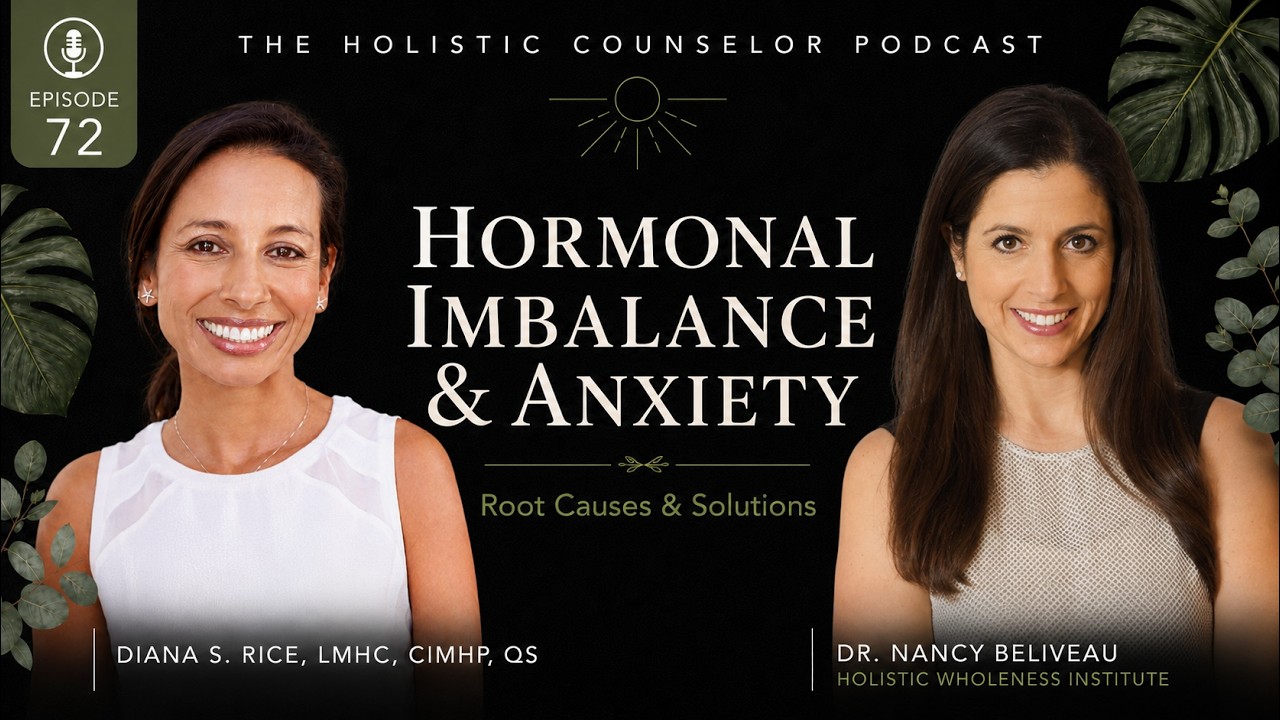
Episode 72
Hormonal Imbalance & Anxiety in Women: How to Finally Get Answers (Not Just a Pill)
with Dr. Nancy Beliveau
Hosted by Diana S. Rice, LMHC, CIMHP, QS
Welcome, fearfully and wonderfully made humans! In this powerful episode of The Holistic Counselor Podcast, Diana S. Rice, LMHC, CIMHP, CTP, QS, sits down with Dr. Nancy Beliveau—Top Doctor of Functional Medicine and founder of the Holistic Wholeness…
Listen to the Episode
Press play when you’re ready.
Educational content only; this podcast is not therapy, diagnosis, or medical care.
About This Conversation
Show notes
Jump to a section
Welcome, fearfully and wonderfully made humans! In this powerful episode of The Holistic Counselor Podcast, Diana S. Rice, LMHC, CIMHP, CTP, QS, sits down with Dr. Nancy Beliveau—Top Doctor of Functional Medicine and founder of the Holistic Wholeness Institute—to unpack the science, emotion, and theology behind hormone health and its profound impact on mental wellness.
Dr. Nancy shares her own journey from misdiagnosis and medical gaslighting to radical healing through functional medicine. She reveals how underlying hormonal imbalances like PCOS, Hashimoto's, estrogen dominance, and adrenal dysfunction are often dismissed by conventional healthcare, leading many women to feel unheard and stuck on lifelong medications.
Together, Diana and Dr. Nancy explore how the root causes of anxiety, depression, and fatigue can be uncovered through deeper testing, intentional lifestyle changes, and faith-informed care. They also talk about the importance of integration—biology, psychology, and theology—and the freedom that comes from learning to advocate for yourself.
Quotes to Share
- "You are worthy. You are worth it. You are deserving of feeling good." — Dr. Nancy Beliveau
- "No two women are the same. Our biology, psychology, and theology all intersect uniquely." — Diana S. Rice, LMHC
Key Topics Covered
- Functional labs vs. conventional labs: what you're not being told
- Root causes of mood swings, fatigue, and PMS
- Hormone myths: the truth about estrogen, progesterone, and testosterone
- The "second puberty" of midlife women
- Why traditional lab panels miss thyroid and hormone issues
- How faith, nutrition, breathwork, and nervous system regulation support hormone healing
- Addressing guilt around medication with compassion and discernment
- Internal Family Systems (IFS) and trauma-informed mental health care
- How to detox safely without extremes
- Empowering men's health too: low testosterone, ED, and emotional suppression
Resources Mentioned
- Holistic Wholeness Institute Free Masterclasses
- No Bad Parts by Dr. Richard Schwartz
- Breathly App and Pause App for breathwork
- Functional testing options: Dutch Test, salivary hormone testing, full thyroid panels
- Supplement mentions: Saccharomyces boulardii, lavender capsules, DIM, Maca
Guest Bio:
Dr. Nancy Beliveau is a Certified Functional Medicine Practitioner, Top Doctor of Functional Medicine, and founder of the Holistic Wholeness Institute. After years of struggling with unexplained health issues and being dismissed by traditional medicine, Dr. Nancy discovered functional medicine and experienced profound healing. She now dedicates her life to helping others uncover root causes and achieve true wellness—mind, body, and spirit.
Connect with Dr. Nancy:
Website: https://holisticwholenessinstitute.com
Instagram: @holisticwholenessinstitute
Connect with Diana:
Website: https://throughthevalleytherapy.com
Instagram: @throughthevalleytherapy Podcast
Instagram: @theholisticcounselorpodcast
Disclaimer:
This episode is for educational purposes only and is not a substitute for medical or psychological care. Always consult with licensed professionals before making any health decisions.
CTA: If this episode spoke to you, share it with a friend, leave a review, and subscribe for more truth-driven conversations that honor faith, science, and healing.
Episode transcript
Read the full transcript Close transcript
Automatically generated from YouTube captions. Names and wording may contain errors; listen to the episode for the original conversation.
Welcome fearfully and wonderfully made humans. I'm your host Diana Rice, licensed mental health counselor, certified integrative mental health professional, and founder of Through the Valley Therapy and Transform Mind Consulting and Coaching. On today's episode of the Holistic Counselor Podcast, I'm joined by someone who embodies the kind of clinical discernment and whole person care that this show is all about, Dr.
Nancy Bello. Belvu. Bello. Okay. Dr. Nancy. We met a few years ago through one of my grandsons. And what started as small talk over the holidays quickly turned into deep science-based spiritually grounded conversations that reminded me this woman gets it. Dr. Nancy is the founder of the Holistic Wholeness Institute, a certified functional medicine practitioner and was named a top doctor of functional medicine.
After struggling for years in the conventional sick care system, she found healing through functional medicine, getting real answers and solutions where traditional approaches fell short. Now, she's on a mission to help others get to the root of their physical and emotional symptoms so they can live fully and freely.
This topic hits home for me, too. Like many women not navigating midlife, I've been through hormone shifts, energy dips, and mood fluctuations. But I've also done the work. I've learned to listen to my body, advocate for myself, and take a functional, faith aligned approach to wellness.
No two women are the same, and our biology, psychology, and theology all intersect uniquely. That's why I'm passionate about this integrative model. It's not about bashing medication or blaming doctors. Many of them are doing their best with the training they've received. The goal here is discernment.
Learning how to ask the right questions, understand what's going on under the surface, and recognize that healing takes time, curiosity, and often a team. I hope this conversation will help our listeners feel seen, equipped, and encouraged as they take ownership of their own health journey, body, mind, and spirit.
So, Dr. Nancy, thank you for joining me.
Thanks for having me.
Yeah. All right. So, before we get into the questions, right, because you know, we've sat under tiki huts before and having like uh really deep conversations.
I'm just wondering like how did you get here to to wanting to do this because you you share that this happened you know this is how we usually get here because me too like I'm a holistic therapist because I realize I hate to call it the insurance model or the conventional model but I know when my own health issues not just my mental health issues but my own health issues sometimes what we try to do is do this cookie cutter hurry up 10 minutes and let's get to the next patient or client.
So what what what was happening with you and and can you share a little?
Yeah. Uh so I remember when I was going through puberty, my body started changing and I started gaining a lot of weight. I was always healthy, energetic, thin, but I started to get very tired, anxious, gaining a lot of weight. And I was just told it was normal by my mom to keel over and feel like you're going to die when you get your period.
Uh vomiting, calling out of school, migraines. And doctors told me the same thing. I wouldn't get my period for years. And then I'd go from being too heavy to being too thin and couldn't keep weight on me. And I was just like, "What's going on?"
An endocrinologist said, "Yeah, your thyroid's fine. Everything's fine." And I just felt so gaslighted. And I'm sure there's so many people, especially women, feeling ignored. And it's no surprise that most of our research and I don't want to use the word experiments, but really research and kind of experiments are not done on women because of the liability since we can bear children.
And I get it, but it's also frustrating, right? That we're not here to bash doctors. The insurance model, it saves lives. But when you have an average of 30 seconds with your doctor, you know, maybe they block 15 minutes and you get five if you're lucky, you know, are we really really doing those deep dives that are needed?
So ultimately after getting ignored and more and more health issues over a 10-year period and just brushed off and thrown more medications at me and only getting worse, um when I had an early but aggressive type of cancer, they removed it and then they told me that it was caught in a routine exam.
They taught me that we got it all, but when it comes back, we'll be more aggressive. And that's where I was learning that we're not really able to rely on the health care model for health, but it's really for life-saving sicknesses is kind of what we're doing because a papsmear, a mammo, it doesn't prevent cancer.
It actually just catches it early. So, like we're thankful for that.
Yes. But that's where I started to get really frustrated and I felt like when I found someone through prayer and meditation um and really my mom who was my biggest advocate
uh and we found someone who was a functional doctor and then he happened to be a pastor on Sundays which was hysterical because I tell people I'm not going to tell you what to believe kind of like you mentioned right we're all unique in our theology or background but it was so nice for me to have someone that was holistic at the time, meaning that it was natural, but recognized that he would always hand me prayers to say, not just what foods to eat and supplements, and it cured me.
Never got the cancer back. My weight normalized, my periods were a dream after that,
and I felt great. Anxiety went away, skin issues. So, I hope that that gives you a little background about why I went into this field.
Yes.
Because I felt like there needs to be more of us holistic providers out there since it's not mainstream yet,
right? And and I and I [clears throat] realized like w with my situation, it was back when I was in my 30s and and I'm realizing that too now that I have daughters in their 30s and just seeing just how many women come to me for um therapy that are in their late 20s, early 30s and they're not they're thinking like, okay, sure, they were diagnosed with depression and anxiety, but when I'm like, well, that that's symptoms.
And they're like, "No, no, no. I have the the" And I'm like, "Okay, yes, I understand. We need those boundaries. The DSM gives us boundaries. The diagnosis gives us boundaries, right, Dr. Nancy?" But when I say, "Okay, we need to get to the root."
And they're like, "Wait, what do you mean?" I'm like, "When was the last time you got blood work done?"
Right?
When you know, and so like these hormonal imbalances that it's like, "Do we ever catch a break? I'm in my 50s now and I'm in my second puberty."
Yep. Yep. That's what it is. every couple years our hormones change,
right? So, so with this imbalances and and you know, like some women go through it and they don't feel anything and they're fine, which is great, you know, but a lot I hear a lot of this PCOS, Hashimoto's, Graves disease. I mean, these these labels on and on and on.
I'm like, sure, okay, now we got the label. Now, what are we going to do about it?
Yeah, I agree. It's so interesting how hormones play a role in so many things yet uh we're so thankful for the doctors that saved my life yet there 97% of doctors are not trained in hormones and then the ones that are just prescribe a pill right
you once again as you mentioned doesn't get to the root so I love what you do because whenever I have a woman that's coming to me and saying all of a sudden you know in my 30s or after I had my child or in menopause or parmenopause I'm so anxious or I couldn't and kick this this postpartum depression.
I've been on this for 20 years.
Yeah.
You know, the thing that's amazing is I always tell them, "We need to make sure you have therapy because that's a very real thing that you need to figure out what's the root." I remember in my 30s, things that happened as a kid were starting to come out of my subconscious and bothering me in my 30s, but we we the way we cope, right, is we kind of just press through, press on,
right?
Fight, flight, fight, flight, freeze, or fawn. It's it's just how our system is made, right? It's just we have to survive.
And I think that it's we're thankful for that that we're fearfully and wonderfully made to survive and make sure our kids are eating, right? You have kids. But also, it's like, well, what part of that also might be hormonal, right? Because I've had a lot of women that have gone through therapy
and then they're like, now my therapist says I have PMDD, which if you don't know what that is, it's like premenstrual depressive disorder,
which is new,
right? And at least we're recognizing
Yes. community that around a hormone shift. So then they've gone through so much therapy and then they're coming to us because estrogen is actually a natural anti-depressant and progesterone is a natural anxolytic, but we don't want to just take estrogen or just take progesterone.
That's not the answer. It's like we want to go through natural ways to get our body to balance them. So I think it's nice to be able to collaborate with people like you.
Yes. Yeah. And it's not only like us two. I mean like honestly we have a [clears throat] whole eastern side of science and and um medicine you know traditional Chinese medicine aruvedic medicine and it's like what are we scared of why are we scared to learn new things you know is it just because of the programming that we've had over a hundred years since Rockefeller I'm not even going to go in that
well that's another whole thing that that actually is has happened right it's that everything has to be backed by science
because of the Rockefellers. Yet
they also were kind of, you know, pushing women to go to work. I think that's great. If we want to work, we don't have to stay home. Yet then they can indoctrinate our kids with what they want. And we don't have as much control.
We're wondering why are we brainwashed like this, you know, and pharma is the agenda we're pushing. So we're not against far more doctors or the Rockefellers, you know, these things save lives, but we do want to recognize that. I kind of tell people I'm like that coexist bumper sticker.
We're like, "Yes, I have my faith. I know we we share our faith yet. Like, could we all learn from each other or love each other or unite, not hate, because all want the same things, which is to be healthy and have our kids healthy and our planet healthy."
And
I think that that's also part of wholeness is is recognizing the balance we all play,
right? And that's it. It's called balance and integration, right? It's like realizing well and that's the thing because if the human being is in the ego constantly,
right? And that would be the psychology term, but to me that would be the flesh in the spiritual term. Then it's all about us and what we want. How do we see humans and uh and you know or how to me biblically based is is we're here together.
It's all throughout the Bible about us and and from Genesis to Revelation, it's about coming together for each other and loving one another and learning about I mean he gave us like the prescription right in the beginning of food and nature and sunshine and light.
Right.
Right. Dr. Nancy.
Yeah. And he taught us to not eat this and to eat that. Right.
Yes. I mean like the Daniel diet. I mean, these are things that we and I did not know that until I went to my functional doctor, Dr. Bernstein, who I've had on the show. And when he taught me these things, it sounded so out of whack.
Like, I'm like, wait, what? No way. And people would make fun of me when I had to go through the detoxification
cuz I had a thyroid issue. I had a goer growing inwards that was choking me out, but then they were telling me I need to go to a psychiatrist cuz that was an anxiety attack. And
I can't tell you how many times I've seen that. I had a woman recently, actually two people, their neck was out to their jawbone and they had trouble swallowing and breathing and they told them it was anxiety.
Yeah.
I mean, you could, you don't even need an ultrasound to see,
right?
Their neck was sticking out. And we worked with them and like you detoxing, figuring out what's causing this. Is it uh an imbalance of estrogen which promotes growth, right? Or is it heavy metals or an underlying virus causing some type of abnormality? You know these are signs like you mentioned these are symptoms that's not the root that something's wrong.
It's like our creator made us with these I call them check engine lights and what happens with our car if we just keep ignoring that check engine light.
Right.
Right. The blows and then our our car insurance kicks in. Then our health insurance kicks in. It's like what if we could just do the
the tires and the brakes and the the oil change to prevent that. Oh, but insurance doesn't cover it. Well, does your car insurance cover it? No. But that's our health, right? I would love healthcare to cover all of this. It would save pennies on the dollar.
I totally agree and I want that one day. I think that's where we're headed, but it may take 20 years. I don't know. Most public health measures take that. So, I'm sorry that that happened with you. What did you end up doing? You said you did a detox.
And so, Dr. Bernstein, first of all, taught me about nutrition because in my culture, I mean, it is it's like I was raised and a lot of people have heard my podcast. So, I was raised with a single immigrant mom from a different country.
When you're raised in the inner city, um, you're not taught like McDonald's is right there, Burger King's right there. It's fast food, fast everything. You're just survival mode. I'm just saying the higher your A score, your adverse childhood experience score, the more you're in survival, the more your body's picking up things.
And the more illnesses, sicknesses, autoimmune things can happen because of your background. And that's not a you're not doomed, people. I'm telling you that like I like how Dr. Mark Heyman says, genes are the bullets. the environment's the trigger.
I agree.
Okay. And so to me, he put me on a strict diet. I'm like, "Wait, what?" Basically, I I would make fun to this day when I see him 20 years later. I'm just like, "Dr. Bernstein, you just had me on ice cubes."
That's so funny. My naturopath put me on a liquid diet during Thanksgiving and Christmas. It was rough. I mean, I don't put people typically on that level of a strict plan. I usually find something a little more manageable for them, right? M
but I feel you on that. Meaning it was like powders and pills all day and like I don't want to scare people. That's not what you or I are recommending people do today. We're just trying to show like when you complain about reducing your sugar.
We get it. Yet it's not as bad as ice cubes and a liquid.
Well, no. He actually like it was it was no sugar, no dairy, no gluten, right? And I was like gluten, what's gluten? Like I had no 20some years ago. Like I had no idea
about the story from 1995 when glyophates came.
I had no because we don't know these things until you start doing the deep dive of the why why am I and he was able to explain it and he was a man of faith too he is a man of faith too he's a strong Christian man and he was so that's the thing it's like that's when I realized wait a minute my my spiritual walk with the Lord is really important in healing along with what I am putting in my system not only food what was I watching what was I listening to right
I totally Totally agree. Whenever we make a protocol for one of our practice members, we always make a mind, body, and spirit component. And I have some people coming from the, you know, more secular western trained nutrition realm to work for us. And as I'm training them, I tell them at some point, okay, now you come up with a protocol for this person now that you've learned my methods here, right?
And then I look at it and I'm like, you only have the food and the supplement. you're missing like 75% of what else we need. We need the mental, emotional, spiritual component, right? So like the thyroid for example, that has to do with expressing yourself, right?
So maybe you're not speaking your truth or maybe you maybe you can't say what you want to say to your mother because it's disrespectful. So you write it down and then you burn it in a jar. You got to
that's what I do with my
sing and I love my mother by the way. I'm not talking about my mother. I'm just example or it's your boss, you know, not not us, but like people that have a boss, they can't say something. And it doesn't mean you can't speak up for yourself assertively, but if you want to say some words that maybe aren't appropriate in the workplace, you could write them down and burn it in a jar.
You got to release that or in a session.
Um, so there has to be that component, as you just alluded to, of not just what you're eating, but what are you watching? What are you listening to? How many songs do we listen to? And then we're like, and you you're aware of it when you have kids usually.
Oh, wow. The words of this song. Oh, but I really like the beat. Yeah. But what are you programming yourself and these little children self subconscious to believe?
We need to be really mindful.
Yes.
Of those things.
That's the key word, mindful.
But mindful of our because we live in a society and culture that is um hurry up and wait. Hurry up, hurry up, hurry up or just do it or you're not enough.
And that's the commercialism that is that is the whole you know I I have this uh not the bait but these conversations especially with my husband you've met Jim right and so you know it's it's interesting because we I am constantly like going okay where did you get that information from because I'm a cognitive behavioral therapist so guess what I'm constantly challenging the thought process of myself going okay why am I thinking this way and why am I feeling this way
right
right so that's that's the thing. It's like becoming it's it's like you're teaching the person to advocate and understand themselves because they've never been given permission to do that.
I love that you said that because I share when we were talking about our own therapy journeys that in therapy I was talking to the therapist about I was always the good kid. I was always the perfect well- behaved easy child. And then he asked me like you just said, "Well, who told you that?"
Or, "What led you to believe that?"
And I was like, "Oh, let me think." And I had to go back and I was like, "My parents said it." And you think it's a compliment. And it is. Yet at the same time, I subconsciously made this, "You can't make mistakes. You can't mess up."
This fear of getting in trouble, even though I was always like little goody two shoes. And it's not to say you need to rebel and all that but it's just to say that we need to ask ourselves even with our not just mental thought patterns but also with food.
Okay. So for example yesterday my Italian family loves pizza and pasta and strual which are little fried do balls you dip in honey and whatnot.
Oh my gosh. So I say to myself, okay, I can have these structure sure you can enjoy them maybe once a year. We have a couple. But for the regular, I'll take macadamia nuts that look like the little fried dough balls and I'll dip them in honey with a little salt.
I go, "And this makes me feel my inner child is really happy, but I don't have to have it that way."
And it's one of those things we got to question things, right? Exactly.
Like fat-ree milk is good for you. Well, who said that TV ad in a magazine? It's like, well, is that really what you say on TV? Is that who has the biggest dollars to program you? Because is that really
what's the truth,
right? and the subliminal subliminal messaging that's out there. I study that, too. And behavioral um body stuff.
It's it's just something that I'm fascinated by. Um and the subliminal messaging. People don't pick that up on social media or anything. A lot of young people don't. They're just, you know, they don't And then they're figuring out like why am I not feeling well?
And that's the detox. Do you detox your your patients? And I I don't even like calling them patients. my client.
I call them I like to call them clients because patients like I'm sick,
right?
Like fix me. It's like
well no you're a client you're going to participate right or a practice member because we collective we don't accept every case and people like oh how do I qualify it's like well we interview you we want to know that you're ready to heal and you're going to do your part because it's like new
I roll my side you got to row your side or we're not going nowhere
I love that say that again Dr. Nancy,
well, I learned about this for marriage, for our wedding. I was really trying to find something symbolic and then I'm like, "Wow, this is great for clients as well, is a canoe." When you are in a relationship, any kind, professional, marital, friend, family, if you're the only one rowing, you're just spinning in space in the one spot.
You're going in circles. And that's how a lot of you feel with your doctor. You're the one rowing as a patient and you're not getting anywhere.
So, we need you to do your part, right? as the client or practice member, we do our part and we go in tandem,
right?
And we meet you where you're at. Like Diana's doing the and I did the liquid diet thing. Okay, most people are not going to do that. We're going to work on eating more whole foods and that's going to make you feel millions of times better.
But in terms of detox, yes, everyone goes through a detox. Some people's detox is quitting smoking. Some people's detox is doing colonics and a juice fast and a water fast because they're just at a different level. So, just like you need to meet people where they're at,
we need to meet people where they're at. And one person, her detox was cutting back on Pepsi. She went from 20 Pepsis a day down to one. And I was like, "That's great." And that was her detox, right? And we did, we did it slowly.
So, just like you is, you know, everyone you work with is unique. We just say, "Okay, when you start, we're like, let's do an audit of where you're at. Tell us a typical day of eating and drinking." Like, give me your lifestyle, typical day, week, day, weekend.
And then we teach them step by step how to just each week make one or two small changes so it's not so overwhelming. Yes. That's what we call detox. And we do that over sometimes it's several days to several weeks is pretty common.
Sometimes it's several weeks to several months. But
mine was months.
Mine was months as well. We always remind them, and I didn't have this, and I I'm guessing you didn't either, but you can tell me otherwise, is that we always tell them to have a mastery of moderation because I want you to have fun.
I don't want you prison
and you have then this unhealthy relationship with food and detoxing. It's like cleaning your house. You know how as you're
like, let's say you were going to sell your house, right? You're going to clean it out. You're going to donate stuff. You're going to clean, but you have grandkids, you have kids, right? They're coming in and out. Dirt's going to still come in.
And so that's kind of like our body when we detox. You don't do it once.
You always clean your house, right? So we want to make sure it's done at a manageable pace. You don't try to clean the roof and the ceiling and the basement.
It's not spring cleaning all the time. Like I mean it's a
do it all in one. You got to kind of Right. Always have a little bit going. So
it's constant maintenance.
Yeah. And I think that then we help move them into what's called maintenance and monitor mode, which is just like your home or your car. You wouldn't just use it and abuse it and never clean it or clean things out. With our bodies, we tell them like, listen, enjoy yourself in moderation.
If there's something you really love, have it, but you don't need to eat the whole cake or the whole pizza pie. You know, have a have a salad first, then enjoy yourself. Have a little bit. But we're not eating that all day. And we're not eating pie for breakfast.
That's not a breakfast food. are not eating pizza.
And if they are, it's we need to get to the question of why because sometimes people don't understand that it might not just be like a mental thing that you were abused. It was an addiction literally like right with the brain chemistry and stuff.
Do you want to talk about that a little bit about that?
Yeah. So, just to give everyone some credit, you know how cocaine addicts typically need unless there's a miracle. I've met pastors and they changed their life and they did it themselves or through through God helping them. I think that's great. However, most people could benefit from someone helping them to come off of drugs.
Just like sugar. Sugar is actually almost identical in the brain as cocaine. And so, we really want to recognize that why are you waking up with such low blood sugar, craving these sweet things, right? Or or having that headache. In terms of brain chemistry though, you know, sugar, it gives us a bit of a dopamine hit and it's like a quick kind of a hit.
And if we could really focus on getting that same feeling yet not necessarily in that physical realm, like for example, wake up and do some prayer or breath work or for example, you and I know we love to read our Bible and meditate on those promises or journaling.
You can still get or or hug your child or give yourself like a little bit of a self massage or do some stretching or some self-love. um you can still get that that oxytocin of feeling connected whether it's to God or if you call it universe source whatever you call this I call it call this being God to your family to yourself um that is a stronger the oxytocin is a stronger sense of safety than just
the dopamine hit we get for example from sugar or processed carbs and orange juice it's all kind of the same thing to me
right
the other thing to remember is
you want to really make sure you're working with someone that'll look at these things like so in our functional practice we've tested people's neurotransmitters and figured out let's just not throw you on an SSRI first of all we don't prescribe medications but that's what a lot of doctors will do we're not against this if you need it to save your life you know if you if you're at that point at that moment but let's like test
what levels you're at and then let's work with the right B vitamins that are going to boost brain health and help that conversion into those neurotransmitters or let's look at also your sex hormones for example progesterone and estrogen.
I mentioned testosterone when we're so anxious or depressed. Progesterone is usually imbalanced when we're feeling super anxious and irritable. And then estrogen is usually off when we're feeling down or depressed. And then testosterone, even in women, is low when we're just feeling no motivation, no energy to do anything.
Not just libido, but libido means drive, like motivation to get up and do something. And these are not standard on traditional tests and insurance won't cover it. And then we ask ourselves why is that?
Well, I believe this is what the narrative that my doctors were taught. Oh, hormones change too much so you just can't test them.
That's not actually accurate. You know how you said you question people's way of thinking? Like taught you that? Well, the pharma funded model taught them that because they just throw a birth control pill HRT at you. Not against saying you can't use these things, but we do these things naturally through, okay, let's lower stress because when cortisol is high, that raises estrogen, and when cortisol is high, that'll disrupt your progesterone.
Let's use like adaptogenic herbs, breath work, journaling, therapy,
right? Let's also use things like maca to get estrogen balanced or uh dianil methane, which is from broccoli extract to get the estrogen lower if it's too high or if it's too low, let's get it up. Let's balance these things naturally with herbs and lifestyle, not just with
medications that don't get inside and help your body do it itself.
What happened, what I've seen well with the mental health field is like the medication comes in at the age I mean because I worked with adolescence mostly until I I now I only work with adult women
and me and men I should say men too because men were like can please work with me. I'm like, "All right, let's let's not interview, but do a consultation to make sure we're the right fit because honestly, we're we might not be the right fit for you like or or at this time, right?"
So, like understanding that some people have I think that's how we started talking. I'm like, "You need to come on my show was I think I was sharing with a client that, you know, you start on the pill at 15, 16, 17, and now they're wanting to have babies.
They're 28, 29, married, and and they've been on these SSRIs or the benzo mostly. And now here I am working with a functional integrative psychiatrist getting them deprescribing,
right?
And their bodies are going well and it's scary at times because that's that's why it's important not to do this alone and not to quit stuff. Okay, we are not telling you to quit stuff and go at all because that is one of the most dangerous things I've seen where people are like I'm just quitting my my prescriptions and and I'm like wait no because your brain will start function and you can end up in the hospital with
correct
PTSD being correct.
Y
so I want to know um about labs and I want to make sure the listener understands like we are not remember this is forformational purposes only. You need to find human like doctors that are that are that have their degrees that are licensed professionals that know what they're doing.
Okay? But we're just trying to have this conversation to make sure you understand that you can advocate for yourself that you that you understand and you start questioning things in a way where you have the right to do that. Because I know when you said the word gas lit, man, before I met Dr.
Bernstein, I was at the endocrinologist. You know what they my protocol was about to be was I had to um they gave me two options back then in the when was it in early 2000s. It was a very early 2000.
I bet I knew what it was. You can say it, but I I bet I know what you're going to say.
No. Yeah. Let's see.
Terrible options. You want me to guess?
Yeah. Yeah. Yeah. Let's see.
Uh iodine, radioactive iodine to kill your thyroid and uh then you're on lifelong lifelong medication or take it out surgically. Yes. Oh, you just gave me goosebumps.
Yeah, that's it. It's still the same protocol. It hasn't changed in 20 years. That's the medical route. And it's like God gave us this organ for a reason. Who wrote that agenda that those are the only two treatment options? Like really,
really? As a mom, my son looks in two places and he doesn't find it. There's a lot more places to look, right? Look everywhere. Find someone that's going to listen to you. And if you know in your heart, this your gut, your heart doesn't feel right.
Right. That's great. You're going to like find someone, right? So, yeah, we we we things through tellahalth. So, people can contact us. We work with people through Zoom and all that and we can do in their home, but still if we're not the right fit,
conventional doctors through the insurance model, unfortunately, have been taught a narrative and they're handcuffed a bit to that. So, it's usually a good functional doctor outside of that conglomerate that will be able to give you the freedom to do what's best for you, not what the narrative says.
But in terms of labs, the standard CBC, which is just a complete blood blood count or basic metabolic panel, BMP, those two are basically what's run and covered through insurance. It's about a $9 to $11 test. If someone didn't have insurance and tries to run that lab, it's like 10 bucks.
So, naturally, that's what your insurance is going to cover. They'll cover what's cheap. Um, and those things look for things like, you know, cancer, diabetes, if you're going to have a stroke or heart attack, but that's about it. I mean, it really doesn't look for much.
So, it's kind of like I joke when I I love my child when he's like, "I looked I can't find my shoes." And he's like, "I looked everywhere." And like he looked in one spot like your doctors are kind of looking in one or two spots to determine if you're healthy.
As a as a mom, you know, we need to look everywhere and then we find our kid's other missing shoe. We need to recognize that a really good provider is really going to look everywhere. Same thing like how you don't just do CBT.
You talked about internal family systems. There's people do EMDR. Like you really need someone or work with multiple therapists like I've done to make sure you do these things. So in terms of labs, things that I really like as a standard in our practice are making sure that a complete thyroid panels run.
So that's not not just the TSH which is what the pharma funded narrative says to check and just go off of that to determine if they need medicine or not. It's like really
we also want to look at TPOAB which has to do is the uh thyroid having antibodies like essentially attacking the enzyme that helps the conversion of T4 and T3. Also anti-TG which is a uh antibbody against your own thyroid protein that's going to get converted into these hormones.
Um, we're looking for basically things like Graves or Hashimoto's because your TSH can be normal, but you feel tired.
Yeah. Uh, like your heart's racing. You don't know why. And they just call it anxiety and they give you a beta blocker or a Xanax. A traditional doctor. It's like, but it's your thyroid or like missing right now.
The other things I like as a standard are hormones. So, women and men, especially women though, because I am a woman, but men is important to get it tested as well. We'll talk about why. And we work with men as well. women, I your hormones need to be tested through saliva or through urine.
We also look at stool metabolites of estrogen because I always compare hormones to money. You know how you can't just think someone's good because they say they make 200,000 a year. You're like, "Wow, that's a lot of money." Well, if they're spending 400,000 a year, they have a problem.
So, your hormones are the same way. The way to get an accurate reading, the gold standard. I really like to do a urinary hormone metabolite test. Some people call it is that a Dutch test. It's it's basically Dutch is like Kleenex. It's essentially like the generic version is urinary hormone metabolites.
You don't need to use Dutch. And you need someone who knows what they're doing. You can't just go to Google because Google's also very manipulated by pharma narrative
or chat or chat GPT.
Chat GPT is like accurate like 20% of the time. By the way, I had someone be the other day someone who's new was like, "Well, I saw this in chat GPT and it's the opposite of what you said." I said, "Well, that's because go on duck.go," which is not funded by pharma.
It's like an independent Google that's not like um manipulated by that, and you're see all the studies that are independent, right? That are not.
And I really like that because that's where you can get and you need someone that's going to tell you to test yourself at the right point in the month if you're a woman. If you still get a cycle, if you don't, you can just get tested and really look at a complete panel because that can explain so much.
And in men, enlarged prostate is linked to high estrogen, gynecomastia, which is man boobs or trouble losing weight, low testosterone. So, we really want to recognize that women and men are both affected, but women are just a little bit more complex with their hormones.
Yeah.
I mean, and it's also having the understanding because what I hear too from, you know, well, when I was little that I didn't have to deal with that or but but people don't understand what's happened in our food and our water and the metals and the toxins and so we have to now that's why I really feel like PCOS I mean and we're also talking more about these certain things which is great that we are talking about it but talking about it is not going to cure it.
No, we the first step is awareness, right? We're talking about the I think it's Maso's like hierarchy of needs like the steps of change, right? The first is is awareness. The next step is actually doing something about it. So, we look at things like PCOS, you know, that's usually a predominance of testosterone.
So, women are growing facial hair, cysts, these cysts can become cancerous. So, this is something that I had that was not diagnosed. And then at times endometriosis, which is an estrogen dominance situation where you're gonna get these heavy bleeds, trouble conceiving, really painful.
Yeah.
And the only thing they offer you is pills and procedures. It's like narrative once again. It's like we're not
able to just cure everything with a pill or procedure. And you're not curing it. Now that scar tissue, oh, so you got a hyerectomy. Now the cysts are going to form on your breast or your lung or your bone because you're you're not getting to the root.
You're just chasing your tail. Now it's somewhere where you can't just cut out your brain or your bone. You cut out your like we need to actually get to that root,
right? And and I don't want to scare people because that's the thing like when someone's overwhelmed with not feeling well because I remember those days, Dr. Nancy, and I'm sure you could go back there because I will start crying thinking about the loneliness you feel,
the the how much money was spent.
I know
because you're trying to find the answer and how how it's just so frustrating that you felt like you just want to die.
I know. Okay.
Alone.
You feel so alone. And this is why, listen, if you're listening right now and you are feeling those things and you're trying to find,
you know, you go to one doctor, you go to a second opinion and you're just like, "Oh my gosh." And then you're still, you know, if you're a woman in your 30s and if you have children, then you're wor stress like, "No, I don't have time.
I got to take care of these kids or the husband or, you know, whatever the family and working and so so much on the shoulder." This is where you start with taking at least one minute. It's the one baby step.
Yeah.
To do breath work or to learn.
So, what helped you, Dr. Nancy? Honestly, like what what was your protocol for yourself? If I may ask, I'm sorry to be so I'm fine. Yeah, I'm open book. I don't mind at all.
Yeah. Like what was that helped you
that helped? Um, well, first was my faith because when your body is failing and you're mentally checked out, uh, and it's pretty depressing going through what
we're talking about.
There's something inside of you that I call your spirit and it's what pulls you in your faith, which is believing that you can't see it, but there's got to be better tomorrow. So, that's the first thing is faith. And I always tell people that are eating this right food and taking this supplement, but they're not doing the meditation and visualization and faith portion of visualizing themselves healthy.
You're missing I believe 80% of it because that's according to studies Joe Despensz has done really a huge part. So the first thing is faith. That's where it always starts and ends for me is really really being faith-based. Then the other piece is um I'll walk walk through a typical day that um I do that helps with hormone health is as soon as I am waking up in the morning and open my eyes before I get out of bed I do breath work.
If you're like well well my son wakes me up and then I'm running late I don't have time. It's like okay do it while you're peeing. Like ladies I get it but I try to do my breath work when I wake up. Um I do Wimhof type breathing.
I've done boxed breath. If you don't know what these are, look them up. They're great tools just to get that vagus nerve going so you start your day on the right foot. [snorts]
Um, then I wake up and I take some supplements. I really like sacroyces bolardi. Great supplement to help with estrogen balance in the gut as well as preventing candida and yeast. Um, I like to take a lavender pill in the morning and before bed.
It's really great to um act as like a natural anxolytic instead of just popping things. I like to stay calm and centered. Um, I typically will fast. I really enjoy fasting. Um, I really like Dr. Mindy Pel's protocols where you fast like a girl.
So, depending on where you are in your cycle, the days 1 through 15, you're eating lighter and fasting more. And then days 15 to 20 before 15 to 30, I meant before your cycle starts, you can have more meals and things. And then I'll typically have and when I'm fasting, I'm doing water and electrolysis.
And I'll typically have some lunch. I really like to do organic pasture-raised protein sources with vegetables, healthy fats, and then root veggies. Uh not too many grains. They can be constipating even if they're whole grains and there's loaded with pesticides. Um and then I'll do the same thing at dinner.
And I always like to wind down with if I can um a nice hot bath after I put my son down to bed and or a walk at night. Um try to avoid I try to avoid screens at night. I have like low lighting and it's just like a nice peaceful day because we know that there's going to be chaos.
So, if you could do as much as you can to deposit into your chaos bank so when the world takes withdrawals, you're like, I'm good. Because then I tell my practice members, you're going to and my staff, you're going to go into the negative.
Negative, feel negative. And that's okay. We're allowed to be angry, anxious, fearful, sad. We're allowed to be all those things. However, the more we can make deposits into our calm bank, that's actually a huge hormone regulator. People think, I just need to take estrogen or progesterone.
It's like if you help your adrenals to be calm and recharged by resting and all that, that's going to help your hormones a lot. That's the root of a lot of issues there.
Yeah, for real. Like people do not understand the hormonal and and and and guys, too. I worked with [clears throat] quite a few like 19year-olds with erectile dysfunction. Oh, I've seen it in men as well. You know what's the funniest thing is that the number one reason men will come to us is because of erectile dysfunction, not because of high blood pressure, autoimmune issue or the cancer.
The number one reason they'll come to diabetes or cholesterol is because all those things amongst many others can cause that. And um you know, we're not having you show your privates on Zoom. Don't worry that. But we're just making sure we run more lab work, figure out what's up and then men are getting that back because that's important, you know, in a way talking about the ego that's a little bit about their their ego but symptom.
Yes.
I mean,
right. And the symptom sometimes for me as a therapist because I'm not a functional doctor is because you know the guilt and shame that they started at 10, 11, 12 watching things on TV or on screens that they shouldn't have and they got addicted to that and also the video gaming and then they smoked the marijuana.
So I'm like trying to make them understand because that's heavy. That's what I'm saying. It's becoming aware like you said the awareness of
what is happening and why am I like where can I start realizing when did this start and then not and not walking you know because the guilt and shame is real
you feel bad like why can't I stop why can't I stop and they're whipping and this is why I love IFS now I'm in that I'm so much into internal family systems because
it understands we all have these parts of us
right and I'm still doing my own work I feel better Like I love how you said you wake up to do breath. I do the same. I actually while my tea is brewing I do a hundred hops,
you know, and then and then I do my breath work. There's an app called Breathley app and the and the pause app and I say these things so then I can put them in the show notes so people that are listening if they're like, "Okay, where do I start?"
We'll start with what we're talking about.
Yeah.
Right. I do a probiotic as well, Dr. Nancy. With a big glass of lemon water.
I have the lemon water as well. While the lemon is so great as a natural way to pull toxins out and it helps remove bloating, helps with digestion.
And the thing that's amazing about breath work, I was just talking about smoking. So, I'm not someone who's smoked, but when I've worked with people that need to or want to, I should say, come to us to and the need to give up smoking of some kind, whether it's marijuana or vaping or cigarettes, is that they inhale.
First of all, they're going outside because they need a break from their life. Okay, that's the first thing. Yes. fresh air, sunshine, even if it's cold out, like get some fresh air. Then they're inhaling, they're holding it, and then they're exhaling slowly through their mouth.
They're basically taking a break from life and they're getting fresh air and they're taking breaths that are very mindful. So, if we could recognize that one of the biggest things that they are addicted to is needing a break and some mindfulness and breath work.
Now, we know there's a lot of addictive chemicals in these things. I get it. But if we could do the breath work and I just another tool is there's something called the harmless cigarette. They have menthol essential oil. It literally is the shape of a cigarette and it's menthol essential oil peppermint.
I've had so many people I don't sell this product. I don't endorse it. I just think it's a great invention.
They're just doing it with that that breath since they were working from home in the pandemic. If you need to get even a diffuser next to your desk if you can with some menthol or peppermint and taking those breaths. I have a reminder go off on my phone every hour to take 20 breaths.
Once again, I know we're all back to back and we're busy. I'm sorry to be gross. I'll do it while I'm peeing.
Oh, I don't want to smell the bathroom. Okay, I get it. Like, but
Right.
Right. Let's just try to take breaths where we can. Walking to the bathroom. If your bathroom public bathroom, not a beautiful essential oil smelling bathroom like mine, take some breaths on your way to the bathroom. Or I've told my staff, take five minutes per hour and put on a one minute meditation.
You're all work from home. Do it. You have my permission. Oh, I tried it. I don't have time. This former employee told me screaming at me. I go, I think you need to make the time because this isn't working what we're here, right?
We need to have that time,
right? So, it's not only hormonal regulation, it's emotional regulation.
Yeah.
And understanding like because it isn't about being perfect at all. It's just about learning your own body and understanding what you need. Because like I said before, a lot of the women that come to me, they grew up what you said earlier, like being good, like having to be good, having especially if they were raised in a faith uh environment or a high um controlling faith.
Um and so it's it's all different walks of life that come to me and it's just that is the narrative that they were taught. And I I go, where in the Bible does it say we have to be perfect? Because if we were having to be perfect, then we would not meet Jesus.
That's exactly right. And look at how he was perfect but hung out with people that weren't perfect to show that just like there's storms and rain and clouds and sunshine. And it's there's no another big thing is not labeling us or emotions as bad.
Right.
Right. People like, "Oh, the weather's miserable or it's miserable out or it's bad weather." We're like, well, who who called it that, right? Because it's not bad to feel scared or lonely or sad or angry. It's okay. So, but do you want to live your life that way 100% of the time, 100% of days?
No. Just like we're not going to be happy all the time. So, I think same thing with foods.
You know, one of my cousins who's a dietitian, she's like, "I can't believe you ate some French fries at that restaurant the other day." And it wasn't at McDonald's. It was like a really high-end restaurant.
And I was like,
I can. It's okay. I eat a couple. It's all right. And it's it's I feel it. You know, just like when you got to throw a party at your house, there's a mess. Like, oh man, the floor's sticky and there's like stuff everywhere, sand in my house from the beach.
We got to clean it up. We clean it up, right? We maybe we do a little detox. We're not punishing ourselves. We're just
kind of I don't want to use the word repenting. We're just having balance, you Like even though I was raised Christian, there's that yin and that yang si symb symbol that there's always a little bit of yin in the yang and there's a little bit of yang in the yin.
Like we can have that balance of knowing that
it's all okay. We're not saying it's okay to sin. We're just saying that
it's okay to not be perfect. It's okay. And don't don't shame yourself. And if you do, that's also okay. And then realize, oh, I'm shaming myself. Where did this come from? Right. Let's move on from that. So that selflove.
Yeah. And that gift you give to yourself, you give it to others and then it comes back to you. All this love and joy.
Yeah. Love and joy and understanding. And it's like the fruit of the spirit. If if you guys don't know what that is, look up Galatians 5. I want to say it's verses 23. I mean 22 to 24.
But it is trying to understand every day we have a choice to live in the flesh or in the spirit in the ego or in humility. And either one takes work.
It does. So, choose wisely.
Yeah. Choose wisely.
That's what I That's what I tell people is that I used to be very caught up in fear and anxiety. Had panic attacks because I knew something was wrong. This was 20 years ago when I was going through my journey
and no one would listen to me and everyone would ignore me in the medical field. But then I realized, you know what? I can't live this way. This is exhausting. And I I went through in my head, okay, what's the worst case scenario?
Okay, so I die. It's like, well, my belief though is then I go to heaven, right?
It's really not so bad. So why am I so afraid? And it's like
that's all I'm going to choose to live in faith. It's okay to be scared. It's okay to be anxious, but you know, give yourself the space, but also
be disciplined with that to say, okay, I'm I'm going to allow myself to feel scared, but I'm going to breathe through this and let this feeling pass through me, not hold on to it and keep going down that path.
Let's go down the path of faith and surrender and trust because it's going to be a gift you give to yourself and all those that you interact with.
Yeah.
And it could be a protector part that tries to help you be prepared and that's okay. Okay, you can think that part and then that's all right. If you don't know what I'm talking about, contact Diana or some internal family
or or read Dr. Schwarz's No Bad Parts. He actually has a workbook where you can listen, that's the thing because this is what I hear as well. Well, I can't afford it. And it's true. Like I understand where where my people come from, okay?
Many many of my um
you know, my culture, they don't have the money to pay. You know, it was thousand. I'm going to just be honest. thousands of dollars to try to get to this point.
And now I look back and I'm like, okay, maybe if I, you know, the accountability, there has to be a way to start learning about you. And if you have to use your insurance, you're allowed to tell the doctor, hey, no, I want these tests done.
Well, they're going to be like, well, where'd you get it? Dr. Google, whatever. You know, but you have to realize that you God made you with spirit, with a spirit. And that is the that's what I try to empower in my clients that no, you have the right to advocate for yourself.
I mean, isn't that what the Holy Spirit's called in the word, the advocate,
right? It's almost like it's a a component that you can remember is fighting for you, right? Like we sing in my faith like this is how I fight my battles, right? And there's something someone and something fighting for you. And I think the thing that's tough is that yes, you do have the right to question things and speak up with your doctor.
And the other challenge is that insurance often won't cover the tests you need or the supplements or the organic food. The doctors aren't trained in how to read these tests. I believe it'll change one day. I don't know how long. All my public health friends think it'll be 20 years.
But what we want to remind ourselves of is that whether it's you or someone, you're paying for this insurance, right? whether you're paying it or your employer and it's thousands of dollars per year for let's just do the math, right? Let's just say it's $77,000 a year.
Like, oh, that sounds like a lot. Well, that's only a couple hundred a month. Most people, that's pretty on point. That's even on the low end for a cruddy plan. Well, most people listening to this are beyond 10 years old. So, that's $70,000 if you're 10 listening to this.
If you're 30, that's $210,000. And there's a lot of money in that. So, it's good to have insurance. You get cancer, a surgery, you break a bone. This is important, but it really doesn't cover, just like our car insurance, the care we need to get healthy.
So, my practice members, we work with people. I have someone on disability making 800 a month. I have a single mom working three jobs that is a waitress in a pizza restaurant and she works for the government during the day and she's got her son to put she struggles to put food on the table.
She's swimming in debt. Yes, she's gotten a hormonal breast cancer. Do you realize the doctor's job is to catch cancer and insurance's job is to cut it out, chemo, radiate it, but I have to figure out why I got this cancer. So, my practice members say, "If you don't invest in your health, you'll be forced to pay more later for your sickness."
Yes.
Oh, but this drug's only $20 through my insurance every month. Okay. For the rest of your life, did you do that math? Right. That's $250 a year. That's 2500 every 10 years, you know, or the next 30 years. That's $7,500. That's just on one $20 prescription.
And the average person's is on four to six.
Yes.
Like let's remember like who taught us to be brainwashed to think, oh well my car has the check engine light on. That's not covered by insurance. That $20 oil change, so I'm not going to do it. Or new tires. My sister's engine blew up.
She didn't get an oil change for a year when she was 17. New tires. I was 17. Even though I was the good kid that always listened, I didn't get new tires when my dad said I needed to and my car said I needed to and my mechanic.
And I skid when it rained and I got and I hit a telephone pole and I obstructed traffic and two other people got in an accident when I was 17. Wow.
So our cars
Yeah.
are more not even as complex as our bodies and we do stuff for them. What about us? Oh, we spent $800 on new brakes, but I can't spend a dollar on myself. It's like
you are worthy. You are worth it. And you are deserving of feeling good. And it's not like you need to spend thousands of dollars like you or I did when we first did it and then do that every year. You do it once and you learn [clears throat] the tools.
Yeah.
Right. On just like as a therapist, you teach people the tools. Not like my goal is to make you dependent on me for the rest of my life.
No. No. I I want you to get quick.
That's my That's my That's what we were talking about. Just like a parent. Your goal isn't that you have a 42-year-old kid ordering pizza on your credit card, right?
Your goal is that they're out and having a job and right earning. We want you in my practice as well, just like you do, not needing us unlike the model where you need them more and more. So, it's just a different shift of thinking,
right? And I think when people can open their minds and be like,
"Oh my gosh, this is a truth.
The truth [clears throat] sets us free." It's almost like they hear it and they're just like,
"Oh my go It's like when Martin Luther King and other people spoke like, yeah, everyone should be able to play with each other. We should all be equal. This is a universal truth what we're saying that this is how it's going to be.
It's not there yet, but we're going to speak it into existence." I was actually born on Martin Luther King Day. So, I'm like, I'm channeling his spirit. I believe he's one of my guardian angels. Like, we're going to revolutionize healthcare, but it's going to happen with us making the choice and putting the people have the power, putting
their their money where their mouth is and and not cutting that model, but just
health is the new wealth.
It is. And really thinking
Yeah. and and and realizing because sometimes I remember back in the day like why does my body hate me and all that and then when Dr. Bernstein made me shift the he's like no God made your body to love you. You have 100 trillion cells in your body all want to just take care of you.
Why are you not taking care of it? And I'm like all right
you talk to ourselves and we program them.
Like program them what you think is the CPU
is what you become. So, like really making sure that when you're having those thoughts, auditing your thoughts and being like, where did this come from?
Yes.
And that's okay to have that thought, but let's just like you have uh I call it stinking thinking. You know how we we have to shower every day. We always say we got to shower
our our thinking sometimes kind of sometimes I even write down those stinking thoughts. We talked about it earlier like where did let's get it out. Let's write it down. And then some people like I don't want someone to find my journal. I'm like tear it up, throw it out or burn it in a car or something like that.
Yeah. Oh, yeah. Definitely. You know the the ants. I like how Dr. Aean talks about the ants automatic negative thoughts and and just how to stomp them. Stomp the ants.
I love stomping the ants.
So, I know that on my I mean what resources do you have any kind of free resources? Oh, yeah. We have a lot. Do you?
Oh, yeah. Yeah. So, we have a lot of free resources. So, every week um I do a free master class, free webinar.
If you go to our website, holisticolnessinstitute.com. uh on our website holistic wholenessinstitute.com you can see I'm doing topics on autoimmunity one week next week is on hormones gut health it's a free usually hourlong masterclass it's usually on a Monday night at 5 Eastern time um and if you go on the website and you can't quite figure it out just drop us a message a text or an email something like that and we can get you hooked
up it's a free uh webinar we do different topics to the public and that's really a great way to learn more about your health, yourself, different health topics, different approach, and just kind of like you asked earlier, like what are the tests doctors are not running?
What are some natural things I can do to help understand what my body's doing and fix it? And then beyond that, if after that master class you still feel like you need some help or you're, you know what, I don't want to go to master class.
I just really know I need help. They can always reach out to us because we can work with people from anywhere since we're all online based. But I like that that's a great place to start is the free master class. Yeah, that's wonderful.
All right, so before we end this episode, is there anything you would like to say to the listener?
I would just say to the listener, if you feel like you're not seen and you're not heard, I want you to feel from Diana and I right now that we see you, we hear you, and we feel you. You're not alone. We care about you.
And we mean that. And it may be hard to hear that because maybe no one's cared about you and you haven't even cared about you because you feel like you don't have the time. You don't know if you feel worthy, but you are worthy and you are loved.
Um, and I know we don't know you yet, but we'd love to meet you and we know what it's like each of us to feel not seen or heard and not feel good. So, I want you to feel that. Um, you are deserving.
You get one precious life and you're deserving of feeling loved and that you love it. So yeah, ciao.
Oh, that's wonderful. Thank you, Dr. Nancy. And listener, please do not forget to trust in the Lord.
Guard your heart and renew your mind. Bye.
I love.
And now for the disclaimer to make sure you understand that you are responsible for you. The content provided on the holistic counselor podcast is for entertainment,formational purposes only and is not intended as a substitute for professional medical advice, diagnosis, or treatment. Always seek the advice of your physician or other qualified mental health provider with any questions you may have regarding a medical or mental condition.
Never disregard professional medical advice or delay seeking it because of something you have heard on this podcast. The views expressed on this podcast are my personal opinions and do not represent the views of any professional organizations with which I am affiliated. Call your doctor, 911, or 988 immediately if you have a medical emergency.
The Holistic Counselor podcast does not recommend or endorse any specific tests, physicians products, procedures, opinions, or other information that may be mentioned on the podcast. Reliance on any information provided by the holistic counselor podcast, guests appearing on the podcast at the invitation of the holistic counselor podcast or other listeners to the podcast is solely at your own risk.
Confidentiality notice. If you engage with the holistic counselor podcast by commenting or posting and are a client, please be aware that you may be revealing information that could compromise your confidentiality. Please remember that disclosing your identity or personal details can be linked to your clinical material.
As a therapist, I am bound by confidentiality and will not respond to any disclosures of this type on this podcast. I am committed to upholding the ethics and confidentiality of the therapeutic relationship which extends to all forms of communication in accordance with the laws and professional guidelines that govern mental health professionals.
I want you to know that your privacy is of utmost importance and you are responsible for protecting it when interacting on this platform or any other public forum. Thank you.