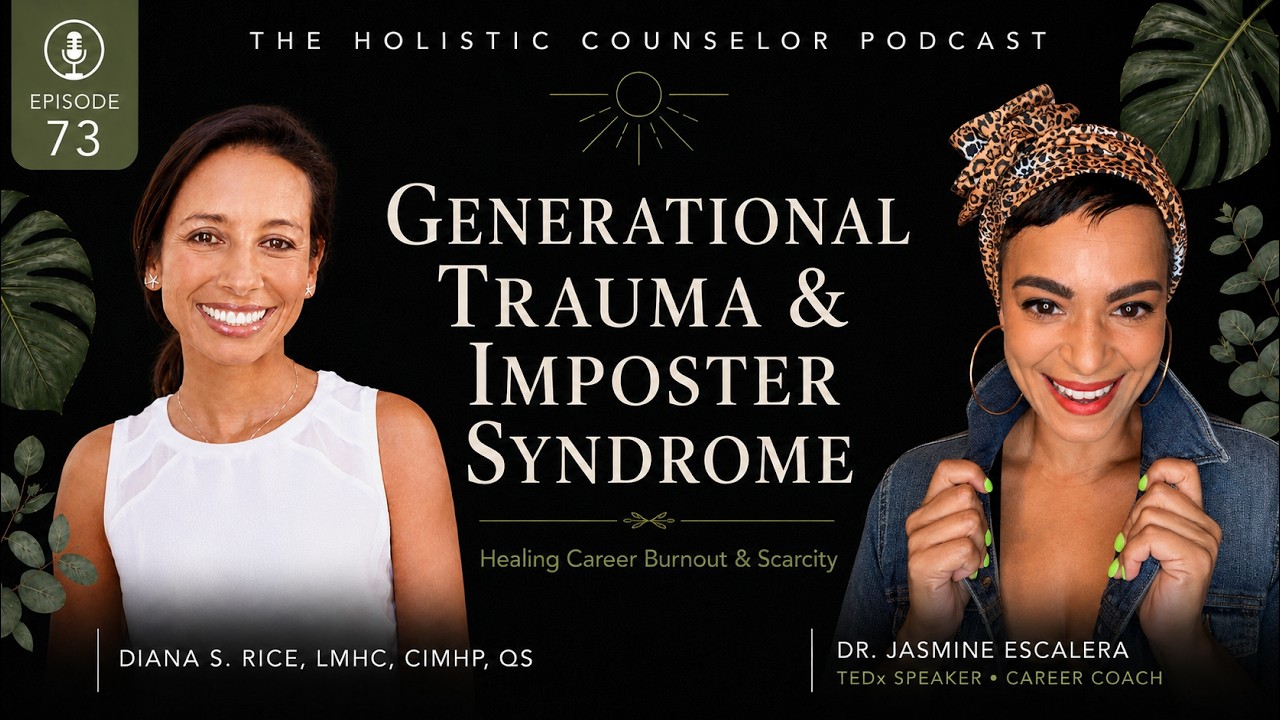
Episode 73
From Scarcity to Soul Work: Healing Generational Trauma, Imposter Syndrome, and Career Burnout
with Dr. Jasmine Escalera, Ph.D
Hosted by Diana S. Rice, LMHC, CIMHP, QS
If you've ever asked yourself, "Why do I feel stuck even though I've done everything right?" — this episode is for you. In Episode 73 of The Holistic Counselor Podcast, host Diana S. Rice, LMHC, CIMHP sits down with Dr. Jasmine Escalera, a TEDx speaker, former…
Listen to the Episode
Press play when you’re ready.
Educational content only; this podcast is not therapy, diagnosis, or medical care.
About This Conversation
Show notes
Jump to a section
If you've ever asked yourself, "Why do I feel stuck even though I've done everything right?" — this episode is for you. In Episode 73 of The Holistic Counselor Podcast, host Diana S. Rice, LMHC, CIMHP sits down with Dr. Jasmine Escalera, a TEDx speaker, former pharmacologist, and transformational career coach for women of color, to dive deep into the invisible blocks keeping many high-achieving women in cycles of burnout, self-doubt, and survival.
Together, they explore how generational trauma, scarcity mindsets, and imposter syndrome shape the inner landscape of women—especially those from culturally diverse and first-generation backgrounds. If you're ready to shift from surviving to thriving, this conversation will equip you with powerful questions, healing tools, and mindset shifts that you can actually start using today.
Whether you're on the edge of a career pivot, feeling spiritually or emotionally drained, or just starting to ask "What do I truly want?"—this episode blends holistic mental health, career wisdom, and faith-based insight into a roadmap for real transformation.
What You'll Learn
- The science and soul behind imposter syndrome
- How to identify inherited scarcity mindsets
- Why generational trauma shows up in your nervous system
- Somatic and ancestral healing tools for Black and Brown communities
- Mindset practices for first-gen professionals and cycle-breakers
- How to start rewriting toxic internal narratives today
- Daily rituals and habits that lead to freedom, clarity, and confidence
- Jasmine's "Courage Crew" and how to join the next cohort
Mic-Drop Quotes
"Scarcity got me far—but it's no longer my default. I wrote it a thank-you letter… then said goodbye." — Dr. Jasmine Escalera
"If you're fearfully and wonderfully made, the lie of not enough has no place in your story." — Diana S. Rice
"Imposter syndrome is not just yours — it's inherited. And that means you get to be the one to break it." — Dr. Jasmine Escalera
"You are your world. You get to change it. That power can't be taken from you." — Dr. Jasmine Escalera
Resources Mentioned
- Break the Cycle: A Guide to Healing Intergenerational Trauma by Dr. Mariel Buqué
- The Body Keeps the Score by Dr. Bessel van der Kolk
- ACE Score (Adverse Childhood Experience) Test
- YouTube University (seriously!)
- Viktor Frankl's Man's Search for Meaning - "Between stimulus and response there is a space. In that space is our power to choose our response. In our response lies our growth and our freedom."
-
The Courage Crew (coming back Fall 2025)
Connect with Dr. Jasmine Escalera
- Instagram: @jasmineescaleracoaching
- LinkedIn: Dr. Jasmine Escalera
- Website: www.jasmineescalera.com
Support the Podcast
If this episode spoke to you, please share it with a friend, leave a rating, or tag us on social media. Your support helps us reach more hearts and create more conversations that heal.
Subscribe on Apple Podcasts | Spotify | YouTube
Instagram: @theholisticcounselorpodcast Learn more: www.throughthevalleytherapy.com
Support This Work
Each episode takes 3–5 hours to create with care, prayer, and trauma-informed preparation. If you want to support this work and help keep the podcast sponsor-free, you can do so by visiting the merch store. Your purchase helps us continue offering Christ-centered, holistic mental-health conversations to listeners around the world. https://theholisticcounselorpodcast.printful.me/
Episode transcript
Read the full transcript Close transcript
Automatically generated from YouTube captions. Names and wording may contain errors; listen to the episode for the original conversation.
Hi there, fearfully and wonderfully made human and welcome to the Holistic Counselor podcast where faith, science, and holistic healing intersect. I'm your host, Diana S. Rice, Latina licensed therapist, certified integrative mental health professional, and a woman who knows what it's like to rise through fire with faith and a whole lot of prayer.
If you've ever felt like you're doing all the right things, excelling in your education, pushing hard in your career, showing up for everyone else, but still feel unseen, stuck, or silently struggling with questions like, "Is this it?" This episode is for you. Especially if you're a woman.
And especially if you're a woman of color who's ever felt the weight of expectations, cultural pressure, or the burnout that comes from working twice as hard for half the recognition. I want you to know you're not crazy. You're not alone. And you're not without options.
Today, I'm joined by someone who's doing powerful work to help women rewrite that story. Dr. Jasmine Escalera. She's a TED X speaker, life and career coach, and passionate advocate for women of color, stepping boldly into their worth and work. She's been featured in Forbes, Huff Post, Business Insider, and named a top job search expert on LinkedIn and Brains magazine.
But beyond the titles, Jasmine is someone who gets it. She walked the path from being a firstgen Latina with a PhD in pharmarmacology to working in nonprofit leadership to finally answering the deep deeper call to help other women find their voice, define their own success, and create careers rooted in purpose and power.
I first met Jasmine at a women's empowerment event hosted at the beautiful Five Elements Wellness Spa in Deerfield Beach, Florida. Shout out to Diana and Ornella from episode 12. And her words hit something deep in me. It was one of those moments where you feel seen in a way you didn't expect.
So, of course, I had to invite her here. So, wherever you are right now, driving, walking, working out, hiding in your car for 10 minutes of peace, take a deep breath and lean in. Thank you, Dr. Escalera for being on my show.
Oh my gosh, thank you so much for that amazing introduction. And can I say you have like the best voice for podcasting. I was like almost going into like a meditative state when you were talking. It was it was really calming and soothing.
I love it.
Oh, thank you. Yeah. Like my husband would say otherwise.
Oh, so funny. How How long have you been married?
I would Oh my goodness. We've been together 31 years.
That's amazing. Oh my goodness.
It's a miracle. It's a It's a miracle.
Well, my parents are going to be going on 43. No, 44 years. Oh my. Yeah. 44 years this year, which is a blessing for sure.
It is. It is. It's And it's hard work because people think, you know, like, oh my goodness, 30, 40, 50 years. It's just like when you really talk to couples, you realize like
relationships are are hard work. And sometimes it's they make it look easy, but you know it's both parties and no matter what relationship, right? Doing doing work.
Well, absolutely. And I was married before. I was married for uh six years and then got divorced. And I have to tell you that that marriage is what kickstarted so much of my spiritual journey and transformation was truly going through that experience. And it was almost kind of like the awareness of yes, you have to work on it together.
But what I really recognized was that I hadn't worked on it alone. So, I didn't I didn't even know what working on it together really meant because I didn't have the core foundation yet of who is Jasmine as an independent woman with independent beliefs and mindsets and values and how does she want to show up for herself and then show up for a relationship.
So, yes, marriage is definitely work and you have to work at it and you grow together for sure when you have the right partner. But for me, it kickstarted a journey of who is Jasmine?
Oh, yeah. Well, preach it, girl, because let me tell and this is what she did on stage people right here what she did just now. I love it. Well, you just gave me goosebumps because that you're so spot on because some of us get into these relationships early on and we don't know who we are or we come from places where we weren't allowed to know who we are because we picked up so many narratives, right?
We picked up so many narratives and stuff. So I want to know a little bit like you're transitioning from earning your PhD in pharmarmacology. Like first of all I don't know anyone I don't think personally that that has a PhD. Can you explain that to my audience a little bit what that that entail?
I mean like you you know you work for big big pharma. I mean I want to understand that. And then
exactly. Yeah.
And then you became a career coach for women of color. Like go ahead. Tell me tell me what how
it's a it's an interesting transition an interesting story but you know I recently started writing my first book and I I had an epiphany it all made sense even though at the time I didn't see the sense um so I grew up in the projects in Brooklyn New York to two parents who were absolutely loving but had their own trauma and challenges and my parents taught me and told me even though they hadn't gone the path of education.
They truly believe that education was the way. If you get a degree and you get a good job and you have a 401k and you get married and you have stability of income and stability in general, you're safe and you're good. And so I became really good at science and I loved it.
And because I was really good at it and everybody was telling me I was really good at it, I chose that as my field. My dad had a traumatic brain injury when I was young. So I was really interested in the brain and so my PhD was really focusing on different kinds of therapeutics and models spec specifically for sensory neurons and also for the brain because of that impact that my parents had on me.
But you know when my parents told me you get an education you get out of the projects I didn't just get a bachelor's degree I figured well let's go all the way right because I'm a super overachiever. Um, but really, you know, stepping into the world of STEM and stepping into this world of research and science back when I was in it, there weren't very many women in the field.
We talk about there not being very many people of color, but there weren't very many women. Then you add on to that women of color. Then you add on to that, you know, someone who grew up in the projects of Brooklyn, New York, and showcased herself in a different way than what was typical and normal in that area.
And my career became incredibly challenging. I always felt like I had to fight for something. Fight for a seat at the table or fight to have my voice heard or fight to have anyone really take me seriously. And I recognized that it wasn't just me and it wasn't just my field that women in general general were really feeling this way in all different areas and fields.
So I decided well why don't we start supporting and mentoring each other and that's exactly what I did. And that kickstarted my first business which was very much focused on helping women confidently navigate their career. But confidently navigate their career by understanding the limiting mindsets that they had about themselves and really understanding are you in the right environment to be the confident version of yourself.
Because often we are in environments or around individuals that impact the way we see ourselves, the way we see others and the way we see the world. And that essentially will change our behaviors simply because we're just not comfortable enough to be the version of ourselves we truly want to be.
And that was my first business. And I loved career coaching for years.
And about a year ago, I realized that, you know, I had a different calling. And so about a year ago, I pivoted into really helping and supporting women who were at different points in their lives where they had checked off all the boxes just as I did.
Okay, I did the college. I did the job. I did the marriage. I did this thing. And you know, here I am. Everybody told me it was going to be great and I was going to have it all. And I still feel unfulfilled or I still feel stuck or I still feel like this life really isn't the life I want to live.
And so I help women tap into that internal voice, that internal knowing and bring that out to the surface and undergo a reinvention in their lives to truly claim the life that they want to live in a powerful state that brings them freedom, joy, and fulfillment as they define it.
Wow. Wow. All right. When we get off, I'm hiring you. No, I'm just kidding. Anyway, well, yeah. I mean like the things that you said on stage, let me tell you like that it was it because you know I looked around and it was amazing that the um I forgot who put it on.
I just came because Diana and Arnella invited me to come and so I'm like all right let me just check take the day off and check it out and stuff.
But like honestly when you were up there and you just really spoke truth in love right not in judgment or putting others down. you were able to to me, you know, bring me up to an understanding of like, yeah, as a Latina woman, right, or a woman of color without because sometimes I've heard others speak and say, and then I'm like, no, I don't feel comfortable putting the white man down.
I'm sorry. Like that, but you were able to lift us up without putting the white man down. And I want to know like as a woman of color in predominantly white spaces. Okay. Okay. Because I felt that in college at times I look around or I go somewhere and you know you're you're taught to assimilate cuz listen I'm I'm also first generation that made it through college where I was told my education my education my education.
It's like how do you approach this? How do you, you know, help build resilience and stay and have the person stay grounded without because this is what I work in as a therapist sometimes is people they come in with such hatred or anger that you know and I get it.
They have the right to feel those things because it is like an injustice. How do you deal with that?
Yeah, you're absolutely right. And it's, you know, it's so challenging because, and I'll I'll tell it from my story and hopefully that will help others. You're right when you say it's an injustice. You're right when you say we should be mad at the white man because he has it so much easier in this life.
Look, the more factors you add into any equation, the harder the equation becomes to solve. And so when you're thinking about success and satisfaction and fulfillment in this lifetime and you add on things like skin color, you add on things like race, you add on things like gender, you're going to just the equation harder to solve because you're hitting different barriers that someone else who doesn't have those factors just simply isn't hitting.
It's just math, right? You add more variables to the equation, it becomes harder to solve. And so I get it when people come and say, "I'm angry." You're absolutely right. And I think when we try to push that anger aside or try to mark that anger as being something bad, ultimately we make it feel bad in the body.
But for me, it was always about, okay, I can be angry at all of these things and all of these injustices, or I can focus on my peace, my happiness, my freedom, my def my success as I choose to define it and really focusing on what does success, what does happiness, what does freedom really mean to Jasmine.
You know, there was a point in my life, you asked like, why did I do this PhD in pharmarmacology? Was that about the pharmaceutical industry? Yes, there was a point in my life where I wanted to go into the pharmaceutical industry. I wanted to make buku bucks and I wanted to buy my parents a home and me a home and I wanted to set us up.
And then I realized through going through the different experiences that I went through that peace and happiness and joy and fulfillment means living on the beach, being able to take my dog to watch the sunrise every morning. So it's really about understanding in this lifetime and in this journey, do I want to be focused on being unhappy, unwell, and stressed out and focusing on all of the external things that I can't control?
or do I want to look inward and to find fulfillment and happiness and joy for myself and focus on that? Now, does that mean that we're not looking at the injustices that were putting a veil over our faces? No. It just means we're making a choice to focus on ourselves and our peace.
And we also make a choice as to when we dip into those injustices to fight the fight so that we keep ourselves whole and calm. I also do believe that much of this fighting in the external is to keep us from looking inside, to keep us from looking in the internal.
It's really a way for us to not focus on the fact that we do have choice and we do have power and we can create happiness and it doesn't have to look like what everybody else thinks it's supposed to look like. So much of it, you know, often times I'll see all the things that are going on and I'll make a choice as to when I want to feel it.
I'll make a choice as to when I want to fight it because I have the capacity to. But there are other times when I'm just saying this is just a distraction from me being able to see my ultimate power of choice and my ultimate satisfaction and fulfillment in this lifetime.
And I choose to focus on that. And so I think it's really about making a choice as to what you truly want. Do you want peace and happiness and fulfillment because that comes from within, not from what's going on outside.
That's right. That's right. And and yeah, I mean, you nailed it. It is And it's hard because if you're raised like I mean, you said you were raised in the projects of you said Brooklyn, correct?
Yeah. And so being raised in inner city environments because I worked in the with the alternative high school. I come from like the inner city I mean not the projects of New York. I am from New York though. I think we talked about that like I'm from Queens.
But anyway it it is also the hypervigilance that is in our system just because we didn't have the resources that a lot of others have had right and or the knowledge or understanding. So it's not about blaming the parental units like they came to this country for the American dream and they came with what they had and the knowledge they've known.
And so it's also looking within yourself to process these things like you said and understanding, you know, because what happens sometimes these things do get stuck and the hypervigilance is real and so we pop off real quick or you know and so it's trying to disentangle like what's our Latina culture like oh no that's how she is and or that inner healing that is actually needed so you're the one in control like
absolutely yeah and I think It's you know what has helped me tremendously is look I grew up in you know I grew up in poverty we grew up not having a lot I grew up and the entrepreneurship that I saw growing up was not the entrepreneurship that I'm in now you know it was the kind of entrepreneurship that was built on survival that was built on scarcity and that was built on I have to put food on my kids plates you know so
I grew up around looking at and seeing a lot of things and recognize now that scarcity mindset lives in my body and it is something that I work on on a daytoday basis to clear and to not allow to run the show this idea of lack but I also think that what has helped me tremendously is honoring the life that I have had.
So living in scarcity as a child has helped me to become resilient and strong. you can drop me anywhere and I will figure it out. And so it's honoring the fact that you have grown up a certain way. You have that Latina pop off for sure, which is something that is should be honored and utilized, but do you want to work off of that as your default?
Is that how you want to run through the world every single day? So, I can sit here and I can say to you about a year and a half ago, I actually wrote a thank you letter to scarity. Like, it was a a homage to scarcity mindset saying, "Thank you for creating the person that I am, but I choose not to live with you as my default system.
I choose another default." So, I think there's this we don't live in an or society. We live in an end society. You can live in some components of scarcity that actually are tremendously helpful to you and you can also live completely in abundance.
It's about choosing which default you are going to act with. And so yeah, there are some times where a Latina comes and pops off. Like just this morning, you know, I was walking my dog and someone was coming, someone was approaching behind me trying to talk something to me, some guy.
And yes, the Latina came out and said very blankly like, "No, you need to cross the street." Um, but that's because I've I can use that. But when I walk through the world, that's not my default. When I walk through the world, I walk with smile and laugh and with compassion and empathy and kindness.
So, it's about paying homage to the way you grew up, the systems you grew up in, the beliefs you grew up in, because they got you far. They got you to where you are. And now that you've created a foundation, you can ask yourself, okay, how do I choose to be?
How do I choose to think? And that's where the difference comes in is saying thank you next.
Yeah. Like I mean that's some training that I had to do for myself especially when I was back in the film industry Jasmine was that when I heard no you know I would go to Miami an hour drive and sit there and you look around and you're auditioning and everyone looks like you because they're auditioning for a certain role and the next thing you know it's like okay no.
So I had to train myself next. I would leave there. I'm like next. Because some people got into their heads and that's what happens a lot is you you you either watch too much social media or the news or the narratives or the stories or what you saw in your neighborhood because sometimes I had to teach people that you're not stuck here because I you know you don't know when you're a kid.
You think this is it. This is your tribe, you know.
And so like how do you how do you let's go here because I know that I work with plenty of women that have imposttor syndrome especially if they have complex PTSD because I'm a therapist so of course I'm going to utilize a little bit of the verbiage CPTSD you know a high A score adverse childhood experience score and a lot of us it it it's the brown and black communities that have these things not you know
um not saying all of us do but we do we have a high adverse childhood experience score and if you don't know what ACES is.
I will put it in the show notes so you can take your test or you know understanding like oh our culture is beautiful where we come from can be like you say you choose to look at these things and say okay how did I build resilience from it right but some of us get so stuck in that scarcity and impoverished mindset thinking that's all there is or this is who we are and that's it and then some of us get out and then we have this imposttor syndrome thing.
I know I have it. I've had to work hard through therapy to really deal with that. So, what what are your go-to strategies for identifying and healing from it, especially being a firstgen professional?
Yeah, so imposture syndrome is real AF. Like, it is very, very real. Um, and I tend to believe that it is more pervasive in black and brown communities. And I also believe that it's generational. So generationally, none of our community members and our ancestors or people in our line lineage were allowed to take up space in any space.
And so we are carrying what I would consider generational imposttor syndrome that just resides within us. And then we are also experiencing it ourselves. And so that makes it really challenging for us to release because we not only have to release and heal what we're experiencing, but it's almost like we have to release and heal what what we have experienced through our ancestors and currently resides within us energetically and even within our DNA.
And so imposter syndrome is real and it is a challenging thing to overcome. I for sure experienced it being in the STEM field and very often being the only woman in the space and for sure being the often the only brown woman in the space.
And so for me it was saying I have imposttor syndrome. So I think there is power in acknowledging that you are experiencing something and it helps you to really identify the course of action to take to be able to overcome it. So being able to say I am experiencing imposttor syndrome right now and doubt in myself because I am in a room where I am the only person and it is challenging for me to step up and step out as a representative for my entire group.
I also am experiencing imposttor syndrome because this has been a generational pattern for my family to not be able to claim space and to take up space. We have been programmed to believe that our voice doesn't matter. There's power in saying that upfront because then you have the capacity to say, "Okay, so what can I start to do to navigate this space?"
For me, it was a lot about validation upfront. Overcoming imposttor syndrome was claiming that I had it, acknowledging that I was experiencing it, acknowledging why I was experiencing it, and then finding people who were also experiencing it. Because at first I thought, am I crazy?
Like, is there something going on? Like it I didn't know what was happening to me. And so having that validation of others who experienced it was so incredibly powerful because it meant that I wasn't the only one. Other people were experiencing it, too.
But then guess what? You have a built-in support system. You have built-in people to help you start to navigate how to overcome it, how to start owning your voice, how to start owning your value, how to start seeing yourself as yes, I should be in this space.
And it takes just I think people want the solution to be, oh, today I don't feel great and tomorrow I'm gonna feel perfect. It takes time and it's a process, but it's honoring that process every single day, trying to be different in that process.
So for me, it was the validation and then it was really starting to own my values, starting to do things that helped me to speak up, starting to see that I do belong in this space. And so everything to me is a process that we should honor and that we should take almost kind of to heart.
It is a process to overcome imposttor syndrome. The first thing is to acknowledge that you have it. To acknowledge the why and also it can be really helpful to say this what was this isn't just a me thing. This is my whole generation also encountered this which means that some of that resides in my body as well which can make it challenging but also very freeing.
Yeah. So you you say like it it it's in your body and I think that's the the missing not the missing link because I think a lot of us now especially in the mental health field are understanding the holistic approach.
I I think I've been in the holistic approach for a long long time due to my background and what's happened like I think I shared with you my son had a traumatic brain injury back in 2012 and that's when I started studying the neuroplasticity and and things like that too and so you start realizing and then you know the book the body keeps the score um the these these different um dynamics in in the field of
the brain and understanding like the whole being and not just having the insurance model conventional model of like here is the diagnosis and that's it.
It's more of understanding like there are a lot of different let's say educational information that is studied throughout the world and stuff like that. So to me like when you were going through like studying for your you know understanding what happened to your dad right and also what was happening within yourself.
Can you share with me any like resources or tools that like back in the day before you have come to this place because really you it's not linear. It's like oh wow let me get this tool and let me check this out. Oh this one worked this one didn't work and this is where because everybody wants this quick fix and this instant gratification.
So can you share like what what was on your on your journey?
I love that you asked this question because you're absolutely right. I think that um you collect tools to put in the tool box and as you go through your healing journey, life in general I feel like is a healing journey. As you go through life, you pull different tools based off of what you've accumulated or you gather new tools to put into the toolbox.
And so when I first started, you know, my own healing journey, it was very much because I was in brain science, it was very much about what is going on in my head, what is going on in my mind, what are going on within my thoughts.
And that was really helpful to build self-awareness around what were my default mechanisms, my default thoughts, my limiting beliefs. But what I really started to realize as I really stepped into my spiritual journey, my healing journey, was that because I am a Latina, because I am Caribbean, because I grew up, my ancestors grew up on an island,
water is healing. Putting my feet in the sand is healing. And what we forget is that as black as people in black and brown communities, talk therapy is was never necessarily the way that our ancestors healed. We healed through being in community, through being in circles.
We healed through dance. We healed through music. We healed through jumping in the ocean. And so so much of my spiritual practices started to integrate these different components of healing that weren't necessarily about the mindset, but they were about the body. So how can I get my body into motion so that the emotions that I'm feeling can actually start to move through me?
So there came became a point where I remember saying I'm so sick of doing this mindset work. And then that's where I triggered into what is my body asking me for? and my body was asking me for so many of these more ancestral and generational practices of healing that I think we often forget about on the healing journey.
And so I think healing actually takes a mind and body approach and we have to integrate those two.
Yeah. And especially I believe for certain communities where talking about your feelings isn't still open or widely accessible. Starting with the body can actually be the best way to start integrating people into the healing process where you don't have to sit on the traditional couch and talk about feelings.
You get to express your emotions and your healing in a different way that actually connects back to your ancestral healing and just what your soul might naturally want to do because it is what your generation just naturally did to heal. And so I think taking both approaches is really important especially for black black and brown communities where often we can't express our feelings in the same way or are taught not to and also where our ancestors just happen to do it that way anyway.
So it's in our blood and it's in our soul.
Yeah. Can you tell me? I I know what I do. I remember when I first took my husband to a drum circle where they were dancing.
I love those. Yes.
Right. and and he's just looking at me going, "Okay." Because it's he I'm married to a Caucasian white man, you know, for 30ome years and his ancestry is from Ireland and stuff like that. And I'm just like, you know, you need to figure out your stuff, too.
Like because he comes from I I think we all have these things like we we do. We and it is that's why being still right in creation in nature understanding who you are no matter I I say this a lot like your biology psychology and theology your belief systems right it is not it's not about going jasmine you're wrong no it's about you sitting within yourself and going okay I'm here on this earth right now at at this time at this day in history.
What's my responsibility?
Yeah, absolutely. 100%. And um I love that you say like what's my responsibility?
And it's funny enough um I think for a very long time I fought this and I think many many people in our specific generation are the cycle breakers because I I happen to encounter people who are around the same age bracket doing very similar work in terms of healing and we have a very similar background and story and it comes to the point of this is enough. you know, I am going to break this cycle and life is going to be different moving forward for not just for me but moving forward.
And so, you know, when I really thought about purpose and like what am I here to do? My sole purpose is to break those cycles, break those traumas, break that pattern, break those patterns that my family had to live within so that we just don't simply have to do that anymore.
And it's so important that we understand the value of breaking those patterns for ourselves and for those that come after us. Because really, we all experience generational trauma. We all experience different things as we grow up that change the way we see life or change the way we're move through life.
But we always ultimately have a choice to do it differently. And so it's important that we ask ourselves, how do I choose to do it? And that's really the cusp of I think what we're here for is how do I choose to live?
Yeah. Yeah. So, so tell me if someone wanted to work with you, right? Like what is what are you doing now? Because like sometimes I think that's another thing that we're taught um in in this culture is that you know you have to go get the nineto-ive job. you have to do this, this, and this because you need this, like, you know, to pay this bill, this air conditioning bill down here in South Florida that's about, you know, killing us here.
So, you know, like
Yeah. Yeah. Yeah. Oh, yeah. I feel you, girl. It's hot.
Yeah. And so, like what what is it? Tell me like what tool like what did it like if I'm like about to hire you and what are the things that you first use? I mean, not not to give away all your secrets because you know, you want people to hire you.
Same with me. Like I know I can sit here and teach and and I want to. And the thing is a lot of people in our community cannot afford quality help. Quality help. They might, you know, so I want this is why this podcast exists because I want to give the listener some tools, you know, because there's so much out there and but many of us live in scarcity thinking this is it and this is, you know, in the narrow-minded thinking.
How do we expand our mind? what what tools, books, resources, whatever it is that's coming up for you like that you would want to share with the listener.
Yeah, absolutely. So, in terms of what I do and then in terms of some resources or answer both. So, in terms of what I do, I help women break the patterns that are holding them back from living the life they truly desire. And what I do with the women that I work with is identify what are the limiting patterns that are running or that you're basically doing over and over that are keeping you from the life you want.
So for example, you know, after my divorce, I realized that I had a certain pattern of man that I was dating and seeking and that was coming from a very toxic place that had to be healed within myself. So I help women identify what's your specific pattern or program that's running.
We identify what that pattern is and then through working with me together we help to break that pattern and create a new one, a healthy pattern that will help you to achieve the life you want. And we get clear on what that is.
And we create daily actions and habits and rituals that support that new way of being so that you can not just heal from toxic patterns, but you can truly live out your passion, your purpose, your joy as you define it. Now, in terms of resources, there's been so many different things that I've used.
I think what's most helpful or what has been most helpful for me is really getting into understanding generational trauma. And the reason why I say that is because so much of what we're doing, what we're thinking, what we're saying, how we're moving through the world is actually a program that has already been set within us, either coming from our parents or even coming from our lineage.
We now know that we hold within us trauma from as far back as seven generations ago. So we are holding this within our body and that is running the show for us. And so getting into generational work, understanding generational trauma has really helped me to focus on what are the patterns that I'm holding and carrying and acting on that actually don't belong to me and I don't want to use anymore.
So, there's this beautiful book. I actually have it here. It's called Breaking the
I'll show you.
Okay. Well, on my end,
the cycle.
Okay.
Break the cycle.
It's an amazing book. It's a guide to intergenerational trauma. This book, Who? Jasmine.
Um, Dr. Marielle Bouquet.
Okay. Because you're frozen right now. And so, there you go.
I don't want to be frozen.
Okay. It's called Break the Cycle by who?
Break the cycle, a guide to healing intergenerational trauma by Dr. Marielle Bouquet. I believe her family is from the Dominican Republic. She um got her PhD at I believe Colombia, so she also is a New Yorker. And this really was transformative work for me because when I started to recognize that the the cycles that were repeating, I really got to ask myself, Jasmine, do you want to be a part of these cycles?
My answer was hell no. So that was very very helpful. You also mentioned another book, The Body Keeps the Score. Yeah. That one is really um beautiful because it also talks to you about how you do hold trauma and it gives you a lot of really great tool sets to release it and YouTube University is phenomenal everyone.
So I am the first proponent to say educate yourself. Education is key. when you hear something, it calls to your soul and it will just naturally start to move you in the direction that you need to go. So those would be resources that I would start with for sure.
And for me, it's always been about what's the pattern, what's the default, do I really want to live like this? And also coming face to face with and I do this exercise a lot. If I don't change this, what am I missing out on in this lifetime?
And that can be a really eyeopening exercise for us all to do of if I don't change this pattern, what could I potentially never receive in this lifetime that I would really love to have and experience?
Yeah. Right. I mean, and what you're um discussing right now is a lot of cognitive behavioral therapy, CBT. And so what you're saying, like what I'm hearing is it is like you have to learn to become your advocate. And when you start research, especially in this day and age, your algorithm will follow.
Oh, 110%.
Yeah. So, you'll start picking up more and more. I mean, and just be careful because sometimes people are in a space like you and I are, you know, I guess I think we both just love to learn. That's our brains. We love to to listen, to learn, to educate.
But some people will come to us though that are just in the frozen state of of exhaustion, right? Because they have banged their head or they're on that cycle constantly, constantly, constantly. You know, how do you help a a woman in that space?
Like, you know, what would be the first things you would do with a person that comes and they don't they're exhausted. they can't even like pick up, you know, the book or read like how would you motivate them?
Yeah. Well, the question is, do you want to keep doing what you're doing? I mean, look, this is just a reality, right? Like, you know, it only takes a few minutes a day to create to start to create a new habit and to start to create change.
And so, sometimes I have to legit get to the point where I say like, do you like the way you're living? Because if you like the way you're living, then I can't help you, right? Like I can't help you break it. And I'm a firm believer that it's not everybody's sole journey to heal within this lifetime.
And so I would love for us all to uniformally decide today is the day we are all healing because I think the world would be a completely different place in space. But for me, it's about who is this calling to and how can we take that activation to the next level?
And for those people who really do want to change, if your soul is calling for change, it only takes a few minutes a day. Like it only takes a few minutes a day. And essentially what I believe is that when we are on the cycle of negativity, when we are in the cycle of toxicity, when we are in the cycle in those patterns, our body is programmed to stay the same way.
It is addicted. Literally, we are flooding our body with neurotransmitters that cause us to become addicted to the toxic patterns and negativity that we are exposing to it every single day. And so it takes time for not just the mind to adjust to something different, but for the body to adjust to something different.
And so it's a matter of doing something different every single day. And so your body can sense and feel, wait a second, there's something different here. This feels better. This feels good. I'm liking this. And then it starts to readjust to a new way of living and flooding its system with new neurotransmitters, new emotions and then the change will start.
But again, it is not a process of I want to change and then tomorrow it's going to be great. It is incremental and it is starting somewhere.
Yeah. Somewhere one one thing, one step. I mean you know like Okay. So what would be the most easiest one step that you would suggest someone to start with? Yeah. So, I would suggest to start with what would I like if I could live my ideal life, what would that really look like?
I love this exercise and I love for people to like play with it. Like don't you don't have to sit down and answer the question in one sitting, but to almost like every day be asking yourself, show me something new that I would really love to have in my life. you know, curating your Instagram so that you're seeing the things you actually want to see, the homes you want to buy, the trips you want to go on.
It's really about understanding what would I really love my life to look like for me. Defining it for me. That's a great place to start because you mentioned actually earlier sometimes we get stuck in the what is instead of the what could be.
And so opening up access to what could be is phenomenal because then it allows us to say okay well if I do want that what is it that's holding me back from getting that and not answering that question in anything that's external to you internal to you what is holding me back from achieving that me.
So myself because often times we can say oh well my boss never gave me the raise you know so boom he's not going to give me the raise so what there's nothing I can do
and then shutsel down but when we ask ourselves the question of what can I do to achieve that or what's holding me back and myself then we start to look internal where really the answers are so I would say activate the desire first so much of us don't even activate the desire and when you activate the desire that is naturally going to drive you to I would like this now.
How can I acquire it?
Yeah. I mean, I create a faith and wellness board every year now for the last quite a few years. And I mean, some people call it a vision board. I like to call it a fa faith and wellness board
or a faith and prayer board or something because to me like I in my belief system I believe that there's a higher power out there and I want to pray because sometimes that's the thing too because I don't want to become e egotistical because these are the choices we live in the ego or you know the humility the flesh or the spirit or you know it you feed the I love the Native American proverb, right?
The two wolves, you you know the two wolf. And so it's just like we got that choice every day. It's learning to practice the pause where we pause for a second to see which wolf are we going to feed.
Yeah. Yeah. Absolutely. 100%. And you don't want the ego to be the driver, but you know, sometimes like you do need that like I'm the sugar honey iced tea, you know, and I can make this happen. Um, and so I think that there's nothing wrong with also having a little dollop of ego dropped on every tell you like
narcissism. I I can I can I can make no not narcissism. Um, and I think we also throw that word around a lot. Um,
too much. We talk about that a lot.
A little bit too much. Everybody's a narcissist nowadays when when you would know. I think it's like a 2% of the entire population or something like that.
No. to be diagnosed completely with that. Well, that's the thing with Okay, so with us in mental health, we just had this conversation last night at a meeting and it is it's like we throw around so Tik Tok it's a Tik Tok mental health mentality.
It's like we throw around all these real diagnosible where people are truly truly suffering and we're now everybody's got everything and it's just like no, it it takes time to really be diagnosed with something like that.
Absolutely. time and and working with a a trained clinician and practitioner and then going deep into that work. Um yeah, these are not these are not self diagnosis,
right? Well, and that's the thing too though is that people are so busy nowadays self diagnos well some of them but diagnosing everybody else that they're not sitting with themselves to really and then they're not and they're wondering why I'm feeling or why I'm stuck or why am I not moving forward.
It's if you have to ask that question. Are you sitting still every day to ask your spirit, ancestors, God, you know, what is it that you're needing to do to heal the whatever part is coming at that time? Because it's not a miracle thing.
Honestly, I don't think we'll ever get like that. But we can build resiliency. We could build understanding. We could build listening skills. I mean, these are the things that I know when you were up there, the confidence, you know, I I know that there was something called that you mentioned was the courage crew.
Mhm.
Do you still do that?
It's still a community that runs periodically, so it doesn't run consistently, but it's going to be opening up back again this fall in a really fun and cool way. So, there'll be more details about that. Yeah, absolutely.
Can you tell me a little bit about what that is and and
Yeah. Oh my gosh. So the courage crew started last year. It was a community of women working together to reinvent their lives. And so I guided them through different types of activities that helped them to open up the awareness to their intuition so that they could actually tap into intuitively what do I want this life to look like?
Kind of what we were talking about. I would walk them through different embodiment practices. So how do you try on the version of you that actually owns and has that life? and then also creating actions and daily habits that really help them to walk as the person they would want to be to have the life that they want to live.
And it was such a fun and cool community. Um, and I am bringing it back actually in the fall and we're going to be focused specifically on breaking patterns and cycles that are holding you back from the life you deserve. So, very much of what we talked about here.
Um, and I'm so excited to really focus it in on the pattern of scarcity because scarcity to me and this the myth of not enough is it really triggers so many of us especially when we have grown up with scarcity just being the anchor of our lives.
Um, and so I think scarcity is one of the patterns that holds us back in so many different ways. It's held me back in many ways and it's even held me back in ways that I didn't really notice.
So you know I believed in love that I had to be chosen that I could not be the chooser because if I was the chooser that means that there was bountiful amount of people who would want me but I didn't believe that that was the case and so this idea of not being enough there not being enough there not being enough love really made me sort of take whatever was given and try to make that work
rather than choose the right partner for And so scarcity is something that I think hits so many different areas of our lives.
And when we come back in the fall with the courage crew, it's really going to be around identifying how scarcity, the pattern of scarcity is affecting you and starting break that pattern.
Wow, that's wonderful. I love hearing that. And it is true because I mean people need to know like to me if you're fearfully and wonderfully made. This is why I start my podcast all the time. You're fearfully wonderfully made. That's a Bible verse.
Psalm 139 because you know that I am a Christian therapist. So many people come to me because they want in faith integrated. If some people come to me and they don't want faith integrated and you know ethically and and I I will still work with them, you know, and we'll work with the other parts of my brain anyway.
Um but that fearfully and wonderfully made that is like trying to have the human understand that if we're made in God's image then the the narratives that you have believed that you're not enough that's where we start like you know and then we challenge the thought processes constantly.
I also am really deep into internal family systems and so I love that too. But for you like the courage crew, is this going to be live like in person or is this hybrid or online or anybody in the world? Like how is that going to work out?
Yes, it's going to be online. So, it's a virtual community. The courage crew is a virtual community and I have started taking some in-person clients here in Miami, but the courage crew itself is a virtual community. and in person here in Miami. Um my goal is to work with women who are very interested in changing their mindsets but also really focusing on um sematic and soul-based work.
So I actually walk women through the healing journey. I guide them through the healing journey from a mindset and integrative perspective bringing in sematic and nervous system healers to also work with them as well. So, I partner with different healers in the Miami community so that um I can guide someone through the transformation and bring in the healers that are going to help them connect to their soul and their ancestral journey.
And so, that's been just a magical experience because I do believe that it is a mind and body job to go through healing and um if we are just tackling one or the other at some point we're going to have to become more integrative.
Yeah. No, for sure. So, before we end, I can't believe this hour is I could sit here and talk to you for more more hours. So, you said you're gonna come up to Deerfield. So, hopefully you come up to Deerfield, hang out at the beach with me.
Um, so tell me, how does someone find you? And what last word wisdom words do you want to um say to my listeners?
Absolutely. So, I um am on Instagram at Jasmine Escalera Coaching and also on LinkedIn at Dr. Jasmine Escalera. And you can always reach out to me on either of those platforms and ask about anything related to healing. I post daily on those two platforms.
It's a great space because it's just direct access to me. Um and if I had any last words to mention, I would say that the biggest thing that helped me was realizing that I do have a choice. We can it can often feel especially as women of color like the world is happening to us but we are our world and we get to change it.
We get to transform it and we get to heal it and so you always always have a choice and the power is knowing that you do and that no one can ever take that away from you.
That's right. Yeah. I mean I I don't know Victor Frankle. I mean have you ever um read the book Man Search for Meaning? No, I have not.
He has this this I'm going to find the quote and put it in the show notes, but he says something about the the response that that we have that time of response and I'm butchering it so I'm not going to even try to remember and say it, but I will find it and put it in the show notes and I'll send it to you.
But u I know that when I see it I'm like, "Oh yeah." So anyway, well, you know what, Jasmine, Dr. Escalera, thank you so much for joining me today.
Of course. and listener, please do not forget to trust in the Lord, guard your heart, and renew your mind. Bye. And now for the disclaimer to make sure you understand that you are responsible for you. The content provided on the Holistic Counselor Podcast is for entertainment,formational purposes only and is not intended as a substitute for professional medical advice, diagnosis, or treatment.
Always seek the advice of your physician or other qualified mental health provider with any questions you may have regarding a medical or mental condition. Never disregard professional medical advice or delay seeking it because of something you have heard on this podcast. The views expressed on this podcast are my personal opinions and do not represent the views of any professional organizations with which I am affiliated.
Call your doctor, 911, or 988 immediately if you have a medical emergency. The Holistic Counselor podcast does not recommend or endorse any specific tests, physicians, products, procedures, opinions, or other information that may be mentioned on the podcast. Reliance on any information provided by the holistic counselor podcast, guests appearing on the podcast at the invitation of the holistic counselor podcast or other listeners to the podcast is solely at your own risk.
Confidentiality notice. If you engage with the holistic counselor podcast by commenting or posting and are a client, please be aware that you may be revealing information that could compromise your confidentiality. Please remember that disclosing your identity or personal details can be linked to your clinical material.
As a therapist, I am bound by confidentiality and will not respond to any disclosures of this type on this podcast. I am committed to upholding the ethics and confidentiality of the therapeutic relationship which extends to all forms of communication in accordance with the laws and professional guidelines that govern mental health professionals.
I want you to know that your privacy is of utmost importance and you are responsible for protecting it when interacting on this platform or any other public forum. Thank you.