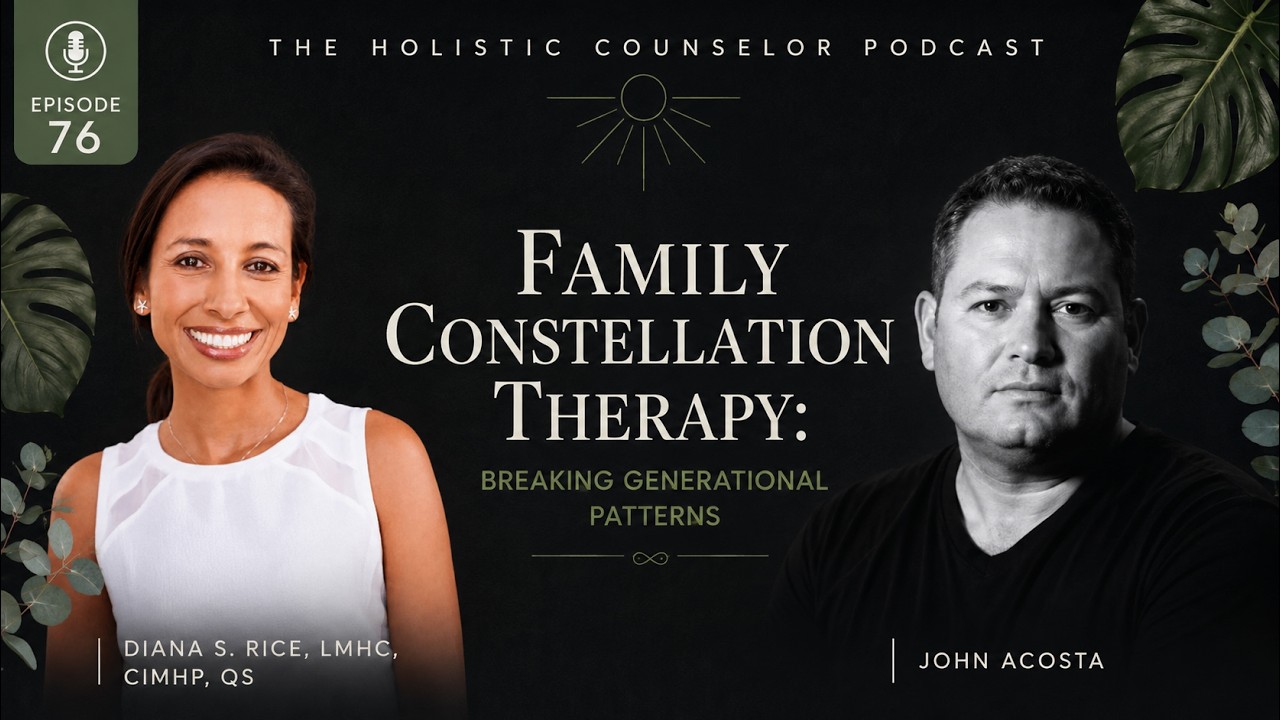
Episode 76
Family Constellation Therapy for Healing Generational Trauma | John Acosta of ZuluOne
Hosted by Diana S. Rice, LMHC, CIMHP, QS
In this deeply moving conversation, Diana sits down with John Acosta, founder of ZuluOne, to explore the healing power of Family Constellation Therapy and what it means to release what was never ours to carry. After attending his workshop at the 10th Annual…
Listen to the Episode
Press play when you’re ready.
Educational content only; this podcast is not therapy, diagnosis, or medical care.
About This Conversation
Show notes
Jump to a section
In this deeply moving conversation, Diana sits down with John Acosta, founder of ZuluOne, to explore the healing power of Family Constellation Therapy and what it means to release what was never ours to carry. After attending his workshop at the 10th Annual South Florida Behavioral Health Conference, Diana knew John's message needed to reach more people—especially those navigating generational trauma, codependency, and systemic burdens.
What You'll Hear in Episode 76
- Why John named his organization ZuluOne and how it honors the spiritual roots of this healing work
- The true origin of Family Constellation Therapy and its connection to the Zulu tribe and Bert Hellinger
- How unresolved trauma and shame silently echo through families and generations
- A breakdown of how constellation sessions work—with real examples from John's personal story and live workshops
- What "we become what we reject" means in the healing process
- Why healing requires humility, choice, and grace, not just insight
- How John blends faith, science, and ritual to help others release inherited pain
- The powerful group healing ritual involving the Circle of Brotherhood and the passing back of 13 generations of pain
- A short guided meditation to ground the listener in gratitude for life and lineage
Quotes to Remember
"We become what we reject." – John Acosta "It's not therapy, it's grace. That's the only word for it." – John Acosta "I thought I was going to another lecture, and instead I witnessed sacred, embodied truth." – Diana S. Rice "Healing doesn't start with fixing someone else—it starts with choosing to stop carrying what's not ours." – Diana S. Rice
Resources & Links Mentioned
- John Acosta's Website: https://www.zuluone.org
- ZuluOne Podcast: Buzzsprout, Spotify, Amazon, YouTube
- Contact to Book John: Cindy Biggs, CEO – cbiggs@zuluone.org
- It Didn't Start with You by Mark Wolynn – Amazon
- Another Self (Netflix series on Family Constellations)
- Encanto (Disney film featuring generational trauma themes)
- John's Substack Essay: If I Was the Devil: How Trauma Keeps Us Divided – https://johnacosta.substack.com
Connect with John
- IG: @zuluonepodcast
- Website: www.zuluone.org
- Book a session or host a workshop: Contact Page
- Read his newsletter: Systemic Newsletter on Substack
Episode Reflection
This episode is a reminder that healing doesn't just happen in the mind—it happens in the body, in community, and in the spirit. John's lived experience and spiritual humility invite us to look deeper at the systems we're born into, and the ones we're meant to restore.
Whether you're a therapist, a cycle breaker, or someone hungry for healing, Episode 76 offers hope, tools, and a gentle nudge toward transformation.
Subscribe & Follow
Follow The Holistic Counselor Podcast for weekly episodes where faith, science, and holistic mental health meet. IG: @theholisticcounselorpodcast Learn more: throughthevalleytherapy.com
Support This Work Each episode takes 3–5 hours to prepare, research, record, and produce with care, intentionality, and trauma-informed planning. If this podcast has encouraged you, supported your growth, or offered meaningful insight, one way to help keep it independent and ad-free is by visiting the merch store. Your purchase helps sustain thoughtful, holistic conversations on mental, emotional, relational, and spiritual well-being for listeners around the world.
Explore the collection: https://theholisticcounselorpodcast.printful.me/
If this episode helped you, please take a moment to leave a review or share it with someone who might benefit. Reviews are one of the most impactful ways to help others discover the show.
Episode transcript
Read the full transcript Close transcript
Automatically generated from YouTube captions. Names and wording may contain errors; listen to the episode for the original conversation.
Hello there, fearfully and wonderfully made human. I'm your host Diana, licensed mental health counselor, certified integrative mental health professional, founder of Through the Valley Therapy, and Transform Mind Consulting and Coaching. Welcome to another episode of the Holistic Counselor Podcast, where I try my best to intersect faith, science, and whole person healing to meet in the messy middle of real life.
If you've ever asked yourself, why am I like this emotionally, physically, even spiritually, this episode is for you? Because the truth is, not everything we carry started with us. Pain can echo through bloodlines. Roles get assigned before we're even born. And sometimes what feels like a personal failure is actually an inherited wound looking for a witness.
At the United Way of Broward's 10th annual South Florida Behavioral Health Conference, I stepped into a workshop. I thought that would be another lecture and instead I experienced something I can only describe as sacred embodied truth. It was led by today's guest and I knew before it ended this conversation needs to happen.
So today I'm honored to welcome John A. Aosta, the founder of Zulu 1, a family constellation facilitator trained in Romania, a US Air Force veteran. Thank you, John, for your service. A husband, a father, and someone whose storytelling cracks systems open wide. John doesn't just talk about healing.
He lives it. He works with individuals, families, and communities to help uncover the unseen dynamics that shape how we show up in the world. And whether you come from faith, science, or somewhere in between, I think you'll find something in this episode that speaks to your soul.
John, it's an honor to have you on the show.
Diana, thank you so much for having me. I was very excited to see your your email uh presenting the invitation and um I'm I'm really looking forward to this conversation.
Yeah. So, like always, I like to start with my guest story. And uh I was just I mean like I didn't know I was getting myself into when when I signed up for because there was a lot of different workshops to sign up for.
And I am a woman of faith and I I pray about every tiny thing I do. Well,
almost every tiny thing I do and um it's just something I had to learn to do to be able to function in the world for what I do and also the healing I had to do with my own family lineage. Right. So, I was so curious.
I'm like, "All right, what's this guy about?" And I walked in there and I'm like, "All right, cool." And I thought it was just another lecture. I had my notebook and everything, but it was so handson. And what I loved about it, too, is I took a a photo from my angle.
And I don't know if you got to see the photo, and if you didn't, I'm going to send it to you afterwards. And in the photo, it was us lined up,
okay? And as we lined up, I just noticed the beautiful I don't know how to describe it. The differences, but the togetherness of the people that you had us line up like and it was like from the police officer in his uniform.
Uh and and can I just say it was all the way from vanilla to dark chocolate like
Yeah. and and the and but the powerfulness male fe it was everybody honestly because we're in Brower County so we have everybody of all all I love living here and at the same time it's overwhelming but anyway so let's start with you because I'm like Zulu one how is this with that and and what does this mean and can you just go and tell us who you are and why and what's up
yeah so you know what they had a great observation right and Um, the only way that I can describe this work is being in the presence of grace. That's that's it, right? It's um being in the presence of something that is way bigger than us.
And it's undeniable when that when that when we allow ourselves to get out of the way and let grace really take over, right? At at the end of the day, that's what you know what you call it, the Holy Ghost, you know, however people interpret that.
That's my interpretation of it. But I think that's that's what we're in the presence of. And you know, I I'm I don't really have an option in this work. It's a calling for me. It's it's like, you know, God in some ways said, "Hey, man.
Um, you're going to do something. It's not going to make sense, but trust me." And I'm like, "All right." You know, I'm like, "Okay, God. Um, I've been trying to do it my way for a long time, and that obviously doesn't work." And so I surrender, right?
like um through through a massive amount of personal work and working on my my S right on my crap um is where I arrived to this place and I think that being of service is the highest calling that you can have and it's it's fulfilling and you know the God really conspires in your favor when you're listening right
and all things are removed and um that's I I don't I don't know how else to do it but I'm I'm here I'm at service and I' I've been called into some very odd spaces that I don't necessarily belong to, but I've just been received with grace and with kindness and, you know, just open doors because it's not me.
It has nothing to do with me. It's, you know, it has it literally has nothing to do with me, which is the coolest part about it,
that I can just be at service and see what happens. So, that's that's what's brought me here. Yeah.
Wow. And so, why Zulu one? What's that mean? So, um, Bert Helinger was a, uh, the the founder of Family Constellations was a Catholic priest, a Catholic missionary priest.
Wow.
And he was assigned to, um, to South Africa and to do mission work, right, with, uh, the the tribes of South Africa and particularly with the Zulu, the Zulu tribe.
Oh. And some of the traditions that the Zulu tribe um had really permeated his way of thinking, right, of like understanding the order in family systems and how things are passed down from generation to generation and if they're not dealt with, if they're not healed, they keep going, right?
And that there's a there's a magic and there's a connection in in all family systems. And so as um a as as Bert kind of went back to to Germany and um he left the priesthood to become a psychologist.
Oh wow.
And then developed this work called family constellations, right? And so it's the Zuluan um name comes from honoring the ancestry of the work, right? The the the lineage of the work that comes from these indigen indigenous tribes in South Africa. And then one that we are connected.
We all are one connected or created to the one creator, the alpha and the omega of of of who we are. So, um that's where the name comes from really.
Wow. I love that. Okay. And and so how does that connect to because usually when I have guests on and and they're in the field of psychology or helping or whatever, it's usually due to their own personal story. And I don't know if you want to share that or not.
I know you you you touched on it a little bit in the workshop. So, I'm thinking, "Oh, well, maybe he'll he'll share." So,
yeah, I'd love to.
Yeah, let's go there.
So, the story goes back to So, my my mother is um a retired US diplomat.
Wow.
And was stationed in Romania at the time. And this story sounds made up, but it is the story, right? But she had a boyfriend at the time that was killed in a car accident. And um her her his daughter was at a in a mission trip in Africa some place.
I think it's either Zambia or Zimbabwe, I can't I can't recall, but um was killed in a head-on collision. He was on the way to a dentist because he had a he had a some tooth pain and was they drove on the other side of the road, you know, the the you know, like the British the British way of driving
and head on and killed him instantly. And my mom went to her psychologist at the time, her therapist, and said, "I'm will I I'm willing to do whatever it takes to deal with this pain." and he w he said
there's this man his name is Alberto Tur doing this constellation workshop it's deals with trauma
and it was 55 Romanian psychologist sorry 35 Romanian psychologist and psychiatrists that were learning this modality
wow
from Alberto the um he's um a nutritionist he's a doctor by by training um and that had been one of Bert Helinger's original students and was they were exposed to this incredible modality. And if you don't if you know anything about Romanian culture or history,
a country that is has many many many many decades of deep deep deep-seated wounds, right? From communism and from Russian Romanian war, um from some of the policies that happened during communism, very very difficult, very very heavy, right?
And so she comes to this thing uh she does this incredible work and then comes back and tells my sister about it. My sister does it the next year. I have a younger sister that's part of the Zuluan organization. My mom, my sister, and I are all,
you know, this is a family family affair, right?
Okay.
Work. Um, and so my sister does it the next year and then I do it the the third time they go around. And she says,
I'm this punk kid in the military. I'm I'm in a band. I have like, you know, I'm I'm I'm I'm a I'm a I'm a punk kid, right? So I'm 25. I think I'm 25 26 years old. Um, and I have what some consider a lot of trauma from my childhood, from circumstantially.
My parents got divorced. It was traumatic. Some things happened. I I I grew up in Venezuela.
Oh, really?
Yeah. They threw They overthrew the government a couple times while I was there.
Are you Latin? Are you a Latin man?
Yes, I'm a Latin man. So, my mom
Oh my gosh.
Yeah. So, my mom's from Michigan and my dad's from Venezuela.
And I grew up in a household that spoke English at home, but Spanish everywhere else, right? So that's why I sound and I look like this.
Um,
that's awesome though.
Yeah. So, um, so, you know, there's there's a lot there and I can go into that story if you'd like, but you know, for for time purposes, I I won't,
but um, my mom's, you know, tells this punk kid like, "Hey," she's like, "I'll buy your ticket to Romania as a birthday gift." And I'm like, "I'm going to backpack through Spain." And I'm like, and she told me about it and I'm like, "You guys are in a cult.
This is crazy. This makes no sense. You know, like very, you know, what a 26
25 Yeah. Your brain's not fully developed yet. Exactly. You know, and you're Yeah. You play an instrument, I'm sure.
Yeah. Yes. Exactly. I thought I was cool. Right.
Yeah.
And um so she's like, "Come to this thing." And they were telling me about I'm like, "You guys are crazy." Uh you know, I I thought it was um neural linguistic programming. You know, the or the guys that you know when the guys that have people quack like a duck or talk like a Martian on stage and like they're kind of comedian
hypnosis and behavioral. Yes. Yes.
Yes. I thought it was that and I I was like this is weird. This makes no sense. I'm going to figure out how you guys are charlatans, you know, and like how you filled out the questionnaire
that that's going to trigger the conversations. Maybe like um some of the the charismatic, you know, people out there, right? It's like there's something here. Yeah. They're they're sniffing out Facebook and everything of the person and then they're calling that person up and the person's like, "Oh my gosh."
Like
Exactly. Exactly.
So, I thought it was that and then I I get there and it's this uh we're in Transylvania, right? So, in the Carpathian Mountains of Romania.
Okay.
And it's this massive ballroom and there's there's 55 Romanian psychologists and psychiatrist, my mom, my sister and I, and then Alberto um and his two sons. that are our age, right? They're my sister's age and my my age. So, I was like, okay, the only kids that are around are these guys and they're they're with this this weirdo, right, for lack of a better term at the time.
So, what's going on here? So, I'm like kind of thinking about it and looking at it. And then he is speaking in Spanish, translating into Romanian. So, none of the psychologists and psychiatrists Romanians spoke English
or Spanish for the matter, right? So he's translating in from Spanish into Romanian and then and we're doing the work and and I'm you know so traditionally how a family are you familiar with family constellations and how they work?
I'm I'm familiar of because of the class I took with genoggrams and and the psychology part of my um licensing and everything but I never you know because you could deep dive in so many ways and I just CBT is like my thing and internal family systems I'm learning now and so to me like yeah I kind of do with the genog that I had to do for for a project but other than that that's about it.
So very in the phenomenological psycho drama of Virginia Satir's um track um you know the the mother really of psycho drama
um and very in IFS world right but what you do is through a phenomenological process you pick people to represent the internal dynamics that you have in your family system and it's a very much a circle like an AA meeting or an Allenon meeting or you know what like those and then a client sits And then there's the facilitator and they say a phrase like, "What would you like to work on today?"
And they may say something like, "I'd like to work on
this anger that I feel towards my brother,
right? Let's say that's that's something that they I I'm very angry at my brother. I don't know why, but I I can't or my brother hates me, right? I don't know why. For family peace, I want to figure out."
So the most people that have not done constellations, you bring up their family of origin, right? So, mom. So, you go around the circle and you say, "Will you please, Will you please represent my mother,
Cindy?" Right? My mom's name is Cindy. Will you please represent my father, Juan, as my dad's name, right? Will you please represent my sister, Alisia? And then I place them in the circle. How I
You're using people that you don't know
that you don't know. You don't know.
Kind of like what you sort of tiny bit did with us in a way, like very similar. Yes. Okay. All right. So you place people that you have you've never met before, right, as representatives of people in your family system, right? Your family of origin.
Wow.
There might have been a a pregnancy. So one of the big questions is was there any other pregnancies that your parents had
outside of like blood or outside of that
or maybe a loss, you know, a lost pregnancy there? You know, somebody a baby died and and all of those positions have their place in the family system, right? So in my case, I had there was a pregnancy that was before me. I'm the oldest.
I I'm the oldest born, but I have a pregnancy that was before me, right? So I have an older sibling.
That sibling has a place in the family system,
right? So
I pick a representative for that that
that pregnancy. And then my myself and then my sister. That's my family of origin as we would call it.
Okay.
And then that I sit down, right? And literally they take a deep breath and without talking and through a phenomenological process they uncover or come bring to surface hidden dynamics in the family system.
So my case when I was doing family constellations my mom these are people that don't know I don't speak the same language they have unless this is an all elaborate 17-year ploy to take my $250 that you know that this thing cost right they they assembled in a way that my mom was in front of us my sister and I are like super tight and my father was at a distance looking at us like trying to get around her
from a positional standpoint, right? From his perspective, he's like, I'm
And so the facilitator gets up. He's like, "What are you feeling?" And he's like,
they don't know who they're representing, right? It's like they don't know what the dynamic. They don't know what the story is. They don't know anything. He's like, "I'm trying to get to them,
but she's in the way."
A phrase like that. And he's like, "Okay, how are you feeling?" And then she's they he go the facilitator will go to the person representing my mother. It's like, "How are you feeling?" It's like I want him far away. I'm protecting them.
Okay.
And then us, my sister and I, I was like, "How are you guys feeling?" It's like, "I don't I don't I'm just looking at the ground or I'm I'm disconnected or detached." And she's like, "I want him to look at me."
So that for me in my in my case represented exactly my family dynamic.
Wow.
So my father left and when I was in, you know, my father stepped out of the story. My mom went we went into like survival mode. All three of us came into emergency and there was no space for anybody else in that rel in those relationships, right?
We went into survival mode too close and then there was a lot of conflict between us. Not massive conflict but there arguments and tension and things
and it was three of you like three of the of you as a child, right?
Yeah. So the three of us connected, right? Like in in a defense posture,
right? Like codependency.
Exactly. Exactly. Codependency like as you would call that codependency. Yes.
Yeah. And there might have been like um triagulation sometimes.
Exactly.
Okay. Yeah. So, all right.
And so through a series of phrases that you say and give back guilt or give back
items that don't belong to you, you restructure the family into a place that makes that gives space, breathability, and give back what's not yours. And for me, that was extraordinarily
cathartic. Oh, yeah. So I get to a place where I'm in the position of I was in a in a partnership position with my mother as one would call emotional incest. My sister I was the ma man of the family you know that very Hispanic you know like oh you're the man now.
Yes. Oh my gosh. Yes. Or if like someone passes or if there is no daddy in the picture it's like
either the mom has to be both the man and the father or the son ends up with that burden.
Exactly. And so
what that created in my life is that I didn't have a space for a spouse or a partner,
right? Because I was in this partnership emotional partnership with my with my my mom.
And so and then and every relationship that I had, which is the relationship that I had before, I was looking for my mother rather than looking for a partner, right?
It's because I was already in a partnership. So I was already entangled in my family system. Yes.
And I suffered the consequences of what those were, right? And as the facilitator reorganized the family system, brought my father in, I said some phrases to my father, brought my mother in, I said some phrases to my mother, put me in the position of the child, no longer the partner of that triangulation, the emergency support system.
Um, and get back into that place. I could connect to my lineage, right? I could connect to my mother being on behind my left shoulder, my father being behind my right, fully supported by both of them regardless of the story, regardless of judgment.
Um because a lot of the pain that comes in family systems comes from judging our parents, right? Or judging other people because that says I am better than you and therefore I I'm I'm superior than you. Therefore, I can repeat that same pattern because we become what we reject.
Say that again. We become what we reject.
Yes.
Yes.
And so, you know, as we reject that, like I I was judging my father because he left and he left, he stepped out of the marriage and all this stuff
rather than coming from a place of understanding.
Yeah. And so well to me though what it sounds like especially that how you described yourself at 25 right you must have you know picked up all these narratives and stories right of your own pain that went into the subconscious and then you know what you said we we become what we reject and and the thing is you're like I will never be like my dad so you ended up becoming like so much harsher or something like that Right?
Because that's what I'm hearing is like I became this punk kid. I became, you know, and that's usually the case because I worked with adolescents for decades before I I only work with adults now. But and and and honestly, I got to tell you why, John.
I stopped working with adolescence because the adults did not want to do anything about their own intergenerational trauma. They just wanted me to fix the kid.
That makes all the sense in the world. Yeah. And I just felt like I was bump, you know, like I I I was doing the work and some of the kids got, you know, better or tools or whatever because they have to like everybody in therapy has to do their own work.
It's not like we're miracle m like people come in I'm coming to therapy and they're just you know thinking that there's like an easy thing and it and it's hard work going through the situation because you have to face it. You have to take it from the subconscious into the conscious and look at it.
M
take it out of the brain and actually choose because it's choices to either do the work with it and figure out how to learn from it
no matter how painful or
just continue the pattern.
Correct. And and one of the toughest things about constellations and it's no different than any other modality, right?
Okay. is that the person always has a choice and they can say I could have you know when when the facilitator came and said this is your dynamic and they said would you like to do a movement I could have said nope I'm good I'm going to I'm so loyal to my family system and to the pain and to the story and to the narrative and to the judgment that I'm going to keep it here
I could have said that I had all the I had all the ample opportunity I had all the agency in the world to do that to say nope I'm leaving this here it's too hard. I don't want to look at it. I don't want to deal with it.
So, there is a huge choice factor and I'm glad you brought that up because at some point I could have said, "Nope, I want to keep this here." And some people aren't ready to make that choice.
So, you just literally present the information and be like,
"This is what this is what the path looks like. It's your choice at the end of the day." And as facilitators, we have to have so much integrity to the process to respect people's choices even if that means that they will continue the pain at all cost.
And and sometimes people make the choice with because of fear.
Yeah.
Fear of change. Um sometimes their system I hate to say addicted to that kind of pattern that that's all it knows and it's not even fear. It's just like this is it. This is how it is.
Um there's so many reasons why biologically and psych psychologically we stay in these kinds of patterns and systems. Um what what I mean you said this helped you and then something shifted where you ended up going okay I want to do this now.
This is my calling now. Like
what else did you see? What other tools were given to you? Because to me, what's really important for this podcast is for the listener to truly understand the healing process with new theories and modalities and everything, but but to me because I am a believer in Jesus, right?
And I'm also trying to break the stigma in churches and in my in in in family systems of in the BIPO community and in minorities and stuff like that. So, because a lot of people be like, "Oh, this is new age or this is woowoo or um this is BS or you see the judgments."
Okay, the judgments.
I just want to make sure that the listener understands like maybe practical tips like maybe we we could go into what you did in the workshop because we were there for how long? Like 90 minutes.
Yeah, about an hour.
Yeah. And and within an hour, you actually did two things.
Exercises. Yeah.
Yeah. Exercise things. And And in those two exercises, I that's what really blew me away at the end.
Like I was just like,
"Huh?" Okay. And I've seen things like that, too. And I I am I am a personality that is open. Like I'm an open person. Like that's because I've learned that's how healing is. Like you have to be the more flexible you are in your mind, the more flexible you are in your body.
Yes.
Right. And so the more narrow you are, the more you're holding in that um that pressure that hurts you. Like people don't understand like sometimes that backachche, that headache, that neck ache, you know, you want that aspirin, you want the massage, whatever. But some people don't understand that we're that holistic being.
And it could be due to the narrow-minded judgment fear zone that many many many live in.
So that first exercise, do you remember what you did? Can you explain to the audience a little bit?
So um could can I answer a couple of those questions kind of in rapid succession?
Please. Please.
Um so the first thing you know a little bit about my my background, right? I was raised in uh I went to an all boys Catholic school, right? So I went to an all boys oppus day
all the way like to
all the way until I graduated from high school like oppus day. So we would I I would consider myself a super Christian, right? So you know very Catholic school and then on the weekends my mom's a non-denominational. My my mom's side of family is Episcopalian, right?
So
Oh wow. Episcopalian opposites two huge opposites but all meet in the middle in a kind of an odd way. And then on Sundays we would go to non-denominational church, right? Like rock Christian fun church. Like that's what that was like this is awesome compared to Catholic church, right?
I was like
we're singing songs and we're raising our hands
and you can wear whatever you want. You don't have to go up and down up and down. I was raised Catholic. So I was Catholic all the way until and and honestly I still like
Catholicism I still there's parts of it that I love and miss
honestly.
Same here. Yeah. So anyway, yeah, keep going because this is
Catholic school.
And during that time, I was, you know, and I I was saved, you know, I was I I chose Jesus Christ, you know, I I I was I was saved by Christ and and I made that decision as a 12-year-old, 13-year-old. Wow.
At Christian camp, like I went and I I gave my life to Christ.
And through my military, because I was so angry, I stepped away from my beliefs. Right. I was I was a what would you consider agnostic, atheistic at that time.
You were deconstructing.
I was deconstructing, right? I was so angry. I was so angry at everything. I was so mad at was I was mad literally at everything.
Yeah.
And that what what this work brought me full circle and through my healing is brought me full circle back to God. Right. And that's I think that's a really important narrative of
the the story. And I'm just like I'm not in charge. like I'm I'm not in charge at all. I'm here to be at service. And the more I resist, the more it's like God's like, "Hey, man. Uh that's not going to happen." So, it's it's um it's it's my way.
And I'm like, "This is amaz." And now that I'm aligned and and I've found that alignment through healing, it's it's just it's really created this incredible thing that I never and I have so many offshoots that I've been invited to places that I should never be, right?
I would never have been if it weren't for grace. Right.
And so, kind of to to talk about a little bit of of the consolation site, six months later, I met my wife.
Right.
Oh.
Met my wife. I've been with my wife since 2009.
Oh, wow.
I have two children. I have a 12-year-old incredible young man that has recently turned to Christ.
I have a 9-year-old, about to be nine-year-old girl that's in the same path. Like, I'm I have a I'm harmonious life. I'm I'm I'm the CEO of a company. I I get to do this work. I get to do this incredible healing modality.
And not to say that this is the same thing for everybody, but I've I've gone through traditional therapy. I've done, you know, a lot of different modalities, right? So, constellations for me when I was when I was picked to be a representative. It broke my brain in some way.
It was like, how is this possible? This doesn't make any sense. My logical technical I was a jet engine mechanic in the Air Force, right? You can't get more technical that you can't get much more technical than that. It's like righty tighty, lefty loosey.
You got to fix the things. If they if you don't do your job, people die, right?
Yeah.
And this technical-minded guy gets into the spiritual weird kind of woo woo technical like therapeutic modality. And I'm like, it it broke my brain. And it took me years to be able to figure out the mechanism that it came from. And the only thing that I could today I have a scientific understanding of it but my the only thing that I
that I have from a spiritual understanding is grace. Right? That's the the the framework that I work within and I that I that deeply resonates with me. Um that's the framework that I that I
And what do you mean by grace?
The presence of the divine.
Okay.
Presence of God.
That's what I mean by grace.
Yeah.
Yeah. Right.
I did a constellation for a group and uh I'll get emotional when I talk about this, but um there was these he's um the the this very famous family um very like if if I said the name, you'd know who I'm talking about, right?
Okay. Um and it was a group of women and we did it at this Jesuit um retreat in in um on on in the west and it was these group of women that had been to France for a very long time and um I was doing a consolation and um one of the women had lost um her parents went there. was really young.
Mhm.
And when we did the movement, um how much they supported each other and how much like we said a prayer at the beginning and oh man, I'll get very emotional, but um how much care they had for each other and how much grace they had for each other and how open they were and how willing they were to serve each other was just overwhelming.
It's difficult for me to still talk about it now because it was like you can't um
do this. Yeah. You can't fake that, right? You can't fake it through through this healing modality.
Yeah.
I It's almost difficult for me to think about God because of how much it humbles me in in front of the immensity of of his grace, you know. So
that's awe. That's the Yes. Exactly. Exactly. So I can't talk about it without
Yeah.
really almost losing it. Like I it's I I'm using every fiber of my body to not to not lose it because that's that's what that that looks like, right? Yeah.
And I'm so blessed to be in a place where that modality can work through me, right? Like in in some ways. So it's it's I'm so grateful for it. Yeah.
It is. It's humility. It's the humility. I could see it. I could feel it right now. I s I saw it and felt it in your workshop because I
it was so like what just happened? Like
Yes. Yeah,
but I could tell that that what happened was not because we have so much and you know and this is it. I'm about to judge it and that's where I have to learn to you know but it does because I see so much use of the word of spirituality.
I don't care if it's new age or Christianity or whatever other denomin like high controlling um a and the grace of God and the love of God is not there. It is just human beings utilizing
yes
that to to for control and power
the righteousness.
Oh my gosh. But their righteousness, not the righteousness of God.
Yes. Their righteous. It's the righteousness of their humanity and their pain. Oh,
and it's an abdication of it's an abdication of God's it's like a taking over of God's throne. It's it's I think one of the places where
most destructive forces on the planet come from that.
Yes.
Yeah. And and people are blinded to it and now they're getting more and more numb to it. And not only blinded, but it's also they're people are seeking truth, but they keep looking in the wrong places. Hello, cell phone. Hello. You know, and and to me it's like we have to understand what what you just spoke about like what you just spoke about that brought you to an awe of the creator of the universe of the alpha and omega, the beginning and the end.
Yeah.
Okay. I I think you just gave us in one hour a a teaser.
Yeah.
So I mean Yeah. Go ahead.
Can I answer back the exercise question because I love that exercise. Yes. Yes. Yes.
One of the things, you know, um I I was invited to Are you familiar with the Circle of Brotherhood in in Miami?
No, that was one of the questions I had for you.
Yeah. So, this is all all full full circle, right? So, the Circle of Brotherhood I'm going tonight. Um uh it's an organization that I've been that I've been involved with for the past 5 years.
It's black men dealing with their own community problems. That's what that's the tagline, right? Yeah.
Yep.
It's only in Miami. We need one.
There's one in PMPO, too. There's a chapter in PMPO. town.
Mhm. Yeah.
Oh, okay. Well, after this I need you to hook me up with them because if they're willing to come on this podcast, we need that. Okay.
Brother L is incredible. The executive director, Brother L. I'll I'll uh
I'll connect you with them. But what ended up happening is that they did a 21-day hunger strike to bring awareness to gun violence in Miami.
21 here. This is what the media needs to flipping put on the media.
Exactly. Exactly.
Stuff like this.
Yeah.
Not the fear porn. I'm sorry.
Yeah. Yeah. And you know, so I reached out to brother Albert, one of one of the guys there. And you know, I don't know. I was called to do it. Call it call it, you know, God conspiring and and making this happen, right?
Um and I went I drove down there and I gave him this book. And since then, I've done this work, this modality, family constellations with Trayvon Martin's mom, Sabrina Fulton, um with a circle of brotherhood. We've done several workshops and one of the workshops that we did was passing back the pain.
That that
Yeah. Yeah,
it was a jug of a gallon of water
and we were passing back 13 generations and there was several men and and in the in the group there's men that have been recently incarcerated or incarcerated for very long periods of time. What they say is that we used to be the problem and now we're the solution.
That men that were, you know, in the streets as as they would say them boys, you know, doing doing the stuff that that that that you know that cause ruckus, right, are now part of the solution. And it's incredible to see men assume that profound responsibility and agency and it's it's beautiful.
It's one of the most beautiful things I've ever been involved with. But um you know we did that exercise of passing back the pain which is you know it in constellations we do traditional constellations which is that what I was talking about the client and the facilitator and then they do the workshop
but also we do these exercises and one of the exercises that I love is you put 13 people in a in a in a line uh you know front facing and then you know like in a like in like grade school right and that type of line
and what they do is that they take a he I use a medicine ball an 8 lb medicine ball or a gallon full of water. And you say and the first generation says to the second generation and they're representing generations, right? That carried pain for for many for many years.
And they say, "In love, I took it. In love, I give it back. Please bless me if I choose to do it differently." And they give the pain back
to the church.
I see. Look, now you're getting me crying, but I have tissues.
Yeah. And it's it's so powerful that you know men that were that have never experienced something like this were extraordinarily emotional very very
working through it right it's like like that's like just being of service and being open is like working through it because first they're a lot like you know what's you know very typical systemic resistance as we would call it right the judgment call it systemic resistance
or if it's with men machismo
yeah exactly exactly So giving back and then um the 13th generation right saying lighting a candle and saying with this light I bless you to do a different
Oh yeah
and then passing it down to the generations and to the youngest member that was there and just going through that process of healing generational pain and going and giving people the opportunity to give back what's not theirs because out of loyalty to our family system we carry so much that doesn't belong to us.
That's right.
And this work gives it back and it gives an understanding and a lens that once you cross that threshold and you start understanding things from a systemic lens and you say there's a there's a technology here I don't whatever you want to call it a modality technology whatever you want to call this thing where you can give back things that don't belong to you and out of your family system you can say I give this back please bless me if I choose to do it differently
and you can release.
Yeah.
That generational curse, the generational pain, the stuff that doesn't belong to us, the not conforming to the patterns of this world, right? That's what like do not conform. Like, hey, do not conform. It's a mandate. It's not, you know, if you thought about it, if you're feeling good about it, you know, you may look at not conforming like no, no, no, no.
Do not conform to the patterns of this world,
but be transformed, right? By renewing your mind by Yeah. You transformed by renewing your mind. I mean like that is that's such a powerful
Romans 12:2 everybody. Romans 12.
Romans 12:2, right? Like that's such a powerful statement. And I think that
the story of Christ at the end of the day is a story of responsibility, of radical responsibility,
of taking on the burdens of the world and sacrificing for them, right?
Yeah.
Not not an absolution of responsibility, not an abdication of responsibility,
a taking on what responsibility really means.
Yeah.
Right.
Yeah. the the pain of this world to take that on for all of us. And I I better what better example of what we're called to do than that, you know? It's it's it's just
Yeah. Like I I don't know. That's what I'm supposed to do, right? So
yeah.
Um
Whoa.
Yeah. Yeah. Yeah. Yeah.
What comes up is John 3:17 instead of John 3:16. Um, yeah. Because everybody knows John 3:16.
Yeah.
But he did not come to condemn the world, but to save it.
Yeah.
And we all decide to condemn each other. And that's that's
John, man. Like,
yeah.
So, that second exercise is the one I think I uh
Oh my gosh, you guys.
See? Okay. Yeah. The second exercise. Um, yeah, that one I'm like, you know what I'm thinking about? I'm like, I need you to come. We need to produce something here in Deerfield Beach. I'm ready. I'll produce it. I'll put it together. You come and do it because I know working with the adolescence and alternative high schools for most of my career.
This is what is needed.
Yeah.
Permission.
Yeah.
To let it go.
And seeing that the older generation saying it's okay to let it go.
Yeah. Anyway, so can we go to the second um
yeah, so the second exercise was um we call it the mirror. Um so in and we'll put two lines of people and you could do this as many as as long as you have a uh an even number. Um you can say this person represents the best version of you and you're working right.
So just connecting with the eyes, taking a deep breath
and connecting with the presence of what the best version
stranger
with a complete stranger, right?
That to me was that blew me away when I would look into her eyes and and then go ahead and then you talk through it with
and you can say something like, you know, you can ask the best version of you a question. You can say you can say, do you have any insight for me? Do you have any a message? Um you can ask you can ask those questions and you can do it with your heart, you can do it with your block, you can do it with your intuition, you can do it with um you know you can make that whatever comes up and this work is deeply intuitive.
That's why you just like, you know, God in some way speaks through you and you're like, "What what what what is needed for this moment?" And you literally shut up and let God do the work, right? And say,
"Um, I think we're going to do mom."
And everybody's like, "Oh, no." You know, like, "Oh, no." And like, "Mom," and then it's like, "Mom, it may be money. It may be,
you know, whatever the thing that comes up." And then you switch. and the the the insights that you gain
from connecting from that is is extraordinarily powerful. And
there's one that I love doing there. So there's several exercises that you do. There's one that I love this one and this one's so powerful is um so you put people in groups of three
and one person represent is working and what I mean working is like doing the work.
Yeah.
One person is represents their inner child.
Oh
yeah. Yeah. And then one person represents the best version of them.
Wow.
So first you connect with your inner child. You bring your inner child with you and then you go you move on to your your the best version of you.
Oh wow.
Like like the the whole connected you or it may be mom and dad or it may be your intuition and your block because your blocks in some way protect you.
Mhm.
They're there to serve to protect something, right? Or it may be your your lineage. It may be your like anything that you have that they have these really creative ways of putting those things together and then and then really creating a cathartic moment
Yeah.
that people can connect
Yes.
with with with every aspect of who they are.
Yeah. I mean like wow. So how can someone either learn about this modality more or actually experience it? Like are you are you going around like Florida, around the world, around the country? I mean how does this work? because I know people are going to be like, I want to try it or I want to know more about it.
I want to make sure it aligns with my faith, etc., etc. Um, so,
so there's, um, there's a lot of a lot of information out there. It's become pretty, it's becoming very popular. Family constellation is becoming very popular from Disney all the way to, you know, so the movie Encanto by Disney.
Have you seen that movie?
No.
So, there's a movie called Encanto, right? It's about this Colombian family that has a tragedy and then the whole family h it's
as a psychologist you'll be blown away by it. But it's a family constellation. It literally is. It talks about constellations in the in the movie. Kids take on things that don't belong to them. There's a perfectionist. There's the, you know, the strong one that that that takes on burdens that don't belong to them.
And then there's the generational. There's the excluded one. There have you heard the the song We Don't Talk About Bruno?
You probably I have five. Well, yeah. Well, six now, but grandchildren and uh I can't believe I never watching KTO.
Yeah, it's a it's an incredible movie and
Okay, now I'm going to watch it.
Now you can see it from a from from this lens which will be therapeutic. Yeah, exactly. And so they talk about they have this uncle, his name is Bruno,
and you'll understand the psychological p the archetypes of it. It's like he's the excluded one that could see the future and that, you know, like you'll see the the whole and then there's this this young girl that's the chain the generational
curse breaker, right? And she explores where the trauma came from. And I mean it's it's obviously in a in a kid story,
so it has a little bit of a different format, but it it's it's it's a family constellation. It literally is a family constellation.
Wow. And um there's a book by Mark Woolen um called It Didn't Start with You
um made uh Oprah's best trauma books of 2023. Um so pretty pretty popular.
Um there's a there's a series on Netflix called Another Self that is a Turkish soap opera uh basically that is based on a friend of mine, his name is Eric Lopez. Uh the work that he's been doing in Turkey for many years. Um, the podcast, the Zulu One podcast.
All we talk about is family constellations.
Wait. Yeah.
I didn't even know you had a podcast. Oh, I'm such a bad researcher.
Yeah. So, we the we we host a family consolation podcast. We talk about family constellations and many different facilitators and people that are involved in the work. Um, different mo because family constellation has many flavors.
There's people that do family constellations with horses. There's people that do them, they're called structural constellations. There are people that do it from many different lenses uh of family constellations. And
your podcast is it on every platform?
Yeah. Spotify, Amazon, YouTube.
So it's called Zulu1 podcast.
Zulu 1 podcast. So Zu Luo N podcast.
And then our website, which is the zuluone.org website, has a resources page that's full of res uh of resources. And I go as far as finding
peer-reviewed papers talking about the benefits of family constellations. I love that
very much back it up with uh peer-reviewed research. I'm not, you know, just kind of pulling this out of my rear, right?
Um I'm very empirical. I try to try to be as as as practical as possible, right? But there's very emergent um research going around the power of family consolations and the effectiveness of the modality, which is very interesting.
Okay. Um, and also I have I have evidence that the United States government has paid for family constellations, which is really cool. Yeah.
Yeah.
What? Well, we we need something.
Yeah. We need something. Exactly.
We need some because we are where's the United We Stand, divided we fall.
Yeah. Exactly. And you know, so much of our of our politics is a mirror of the of the issues that we have. And part of my mission is to teach as many people as possible about the power of family constellations
because I think that the the the power of this country comes from our unity, right? And how how much grace that we can have with each other and how much we can hold each other accountable from a place of responsibility rather than a place of accusation.
Yeah.
And detangle from that victim perpetrator narrative that has taken over everything. Everybody's like, I'm a victim. these guys are perpetrators. It only works to Yeah, it only works separate us.
So, I think because the evil one wants to get have us all divided. So, I mean there's there's so much and I think because
you know you've been chosen to to use your powers of of for light and goodness because of who you choose to disciple under.
Yeah.
Me too. Like I see that, but it's, you know, it's constantly
taking a step back and going, "Okay, Lord, is this coming out of my ego and my flesh, or is this coming out of my spirit and humility? Help me, please." Cuz I don't ever want to be the same human being I was yesterday.
Yeah. Yeah.
I don't I don't ever want to pass on the trauma that was passed on to me generation from generation because that
I have a story, too, right, John? And so, like, man, I I I know I could sit and talk to you all for another hour or so and I might want to have you back. I I want to listen to your podcast. I will put everything in the show notes, your website and everything.
But is there anything that you would like before we close out to tell the audience or or do with us?
Um, before I say that, there's there is an article and I and you brought up a great point that I wrote on if I was the devil, how would I use unresolved trauma, right? And it's like keep people separated, keep like it talks about all of the, you know, what what we would what we see in in modern society.
Um, and
where can I find that article?
Uh, I'll send you the Substack for it. It's it's called systemic systemic newsletter. If you search my name on Substack, it shows up and I I I have
I just want to put the link in the show notes because so people can go to it and click.
I'll be I'll be happy to do that. But we can close with a guided meditation. If you if you want to do that, we can do a short little guided meditation. will be we're going to be taking three deep breaths and do a little bit of visualization and then take it from there.
Sure. Let's do it.
All right. Wrap up with that.
Yeah.
Awesome. All right. So, I'll invite you to close your eyes and cross your arms and legs. And we're going to take three deep breaths. One deep breath for your mother. In and out. One deep breath for your father. Inhale and exhale. And one deep breath for you. past, present, and future.
In and out with an awe. And in your mind, bring up mom and dad and say, "Mom, dad, thank you for giving me life. And when you're ready, come back to the space. Start opening your eyes. Wiggle your fingers and your toes. Come back.
All right, listener. Don't forget, trust in the Lord, guard your heart, and renew your mind. Bye. Thanks, John.
Thank you.
And now for the disclaimer to make sure you understand that you are responsible for you. The content provided on the Holistic Counselor Podcast is for entertainment,formational purposes only and is not intended as a substitute for professional medical advice, diagnosis, or treatment. Always seek the advice of your physician or other qualified mental health provider with any questions you may have regarding a medical or mental condition.
Never disregard professional medical advice or delay seeking it because of something you have heard on this podcast. The views expressed on this podcast are my personal opinions and do not represent the views of any professional organizations with which I am affiliated. Call your doctor, 911, or 988 immediately if you have a medical emergency.
The Holistic Counselor podcast does not recommend or endorse any specific tests, physicians, products, procedures, opinions, or other information that may be mentioned on the podcast. Reliance on any information provided by the holistic counselor podcast, guests appearing on the podcast at the invitation of the holistic counselor podcast or other listeners to the podcast is solely at your own risk.
Confidentiality notice. If you engage with the holistic counselor podcast by commenting or posting and are a client, please be aware that you may be revealing information that could compromise your confidentiality. Please remember that disclosing your identity or personal details can be linked to your clinical material.
As a therapist, I am bound by confidentiality and will not respond to any disclosures of this type on this podcast. I am committed to upholding the ethics and confidentiality of the therapeutic relationship which extends to all forms of communication in accordance with the laws and professional guidelines that govern mental health professionals.
I want you to know that your privacy is of utmost importance and you are responsible for protecting it when interacting on this platform or any other public forum. Thank you.