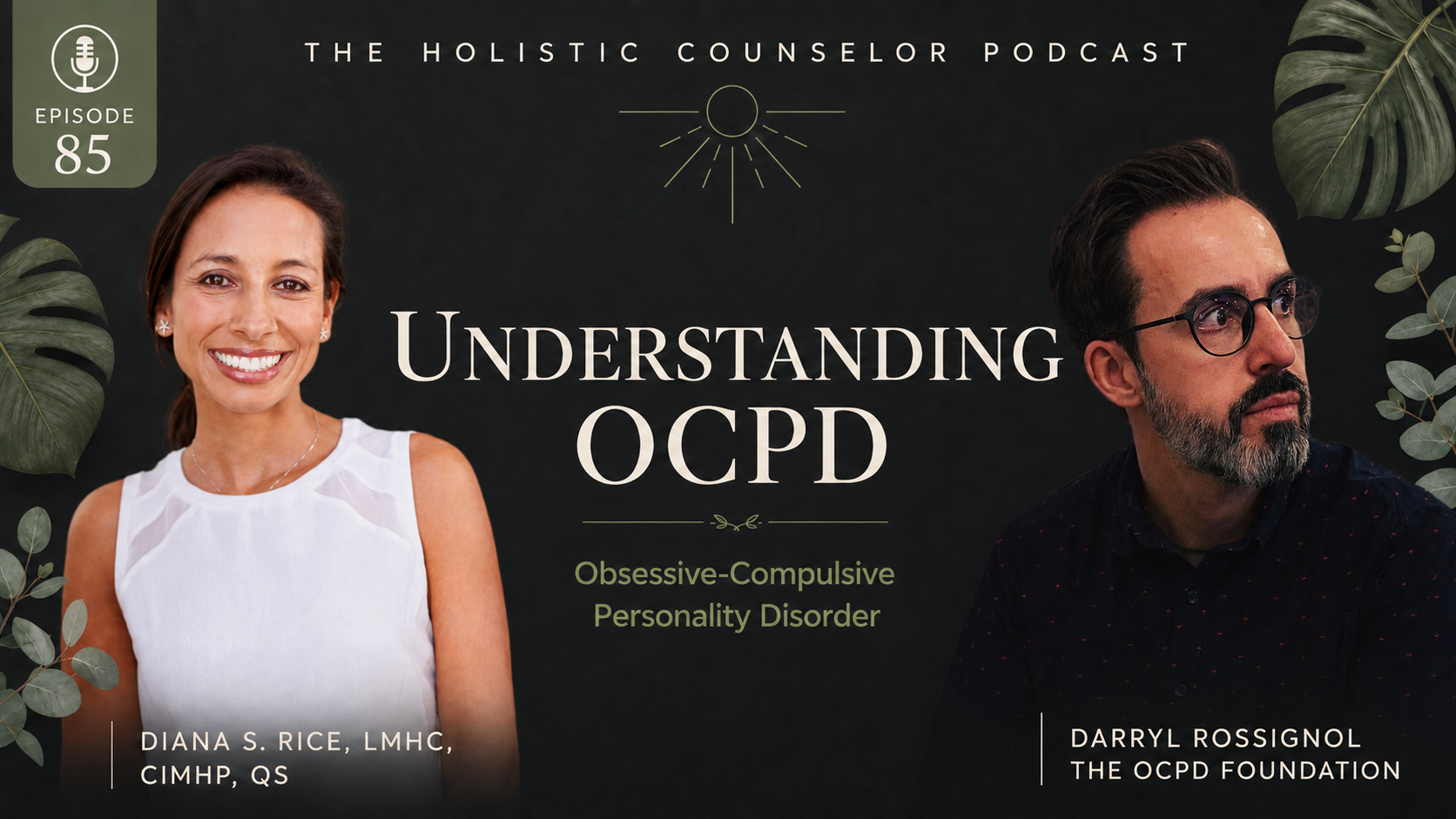
Episode 85
What Is OCPD? Understanding Obsessive-Compulsive Personality Disorder
with Darryl Rossignol of The OCPD Foundation
Hosted by Diana S. Rice, LMHC, CIMHP, QS
Welcome, fearfully and wonderfully made human! This episode is more than just educational—it's deeply personal. Host Diana S. Rice, LMHC, CIMHP, CTP, QS, shares how a YouTube rabbit hole back in 2020 (after someone she loves was diagnosed with OCPD)…
Listen to the Episode
Press play when you’re ready.
Educational content only; this podcast is not therapy, diagnosis, or medical care.
About This Conversation
Show notes
Jump to a section
Welcome, fearfully and wonderfully made human!
This episode is more than just educational—it's deeply personal. Host Diana S. Rice, LMHC, CIMHP, CTP, QS, shares how a YouTube rabbit hole back in 2020 (after someone she loves was diagnosed with OCPD) unexpectedly led her to Darryl Rossignol's videos. Fast-forward five years later—she realized the man behind that life-changing content is now sitting across from her, mic-to-mic.
In this full-circle, faith-filled conversation, Diana and Darryl explore the lesser-known but incredibly impactful world of Obsessive-Compulsive Personality Disorder (OCPD). Together, they unpack the core traits, how it differs from OCD and narcissism, the stigma around getting help, and how healing is possible.
About Today's Guest: Darryl Rossignol
After struggling with OCPD traits since childhood, Darryl spent over a decade deconstructing his personality disorder and putting the pieces back together. In 2015, he launched a YouTube channel to document his healing journey. The videos reached tens of thousands—offering language, clarity, and hope to those suffering in silence.
In 2022, Darryl founded The OCPD Foundation with the support of leading mental health professionals. The foundation is now a central hub for education, resources, and support for individuals living with OCPD and those who love them.
What We Cover in This Episode
- What is OCPD? How does it differ from OCD?
- Why is it so often misdiagnosed, dismissed, or misunderstood?
- Why is it hard for those with OCPD to seek therapy?
- How can OCPD affect relationships and faith communities?
- OCPD vs. narcissistic traits: what's the real difference?
- How can partners, clinicians, and family members support someone with OCPD?
- The role of self-awareness and spiritual growth in recovery
- Darryl's full-circle story of transformation and advocacy
Quotes to Remember: Darryl Rossignol (Founder, The OCPD Foundation)
"It's not that I had OCD—I had OCPD. And the distinction between the two changed everything about how I understood myself."
"Healing from OCPD isn't about becoming someone else. It's about learning how to manage your wiring, so you can stop hurting yourself and the people you love." Diana S. Rice, LMHC "I was watching your YouTube videos five years ago, not realizing that God would bring this full circle—and now I get to talk to the person who helped me make sense of it all."
"As therapists, we often overlook OCPD because it doesn't look like what we're trained to spot. But for the client, it's a constant internal war of 'not enough."
Resources & Mentions
- The OCPD Foundation — articles, videos, screening tools, therapist directory
- Darryl's YouTube Channel
- POPS Self-Assessment
- The Healthy Compulsive by Dr. Gary Trosclair
- DSM-5-TR Diagnostic Criteria for OCPD (APA)
- OCD vs OCPD
Feeling Seen? Here's What to Do Next
- Subscribe to the podcast & leave a review!
- Share this episode with a friend, spouse, or therapist
- Visit ocpd.org to take the self-assessment or explore support tools
- Connect with Darryl via YouTube or email: darryl@ocpd.org
- Need therapy in Florida? Learn more at ThroughTheValleyTherapy.com
Diana S. Rice, LMHC, CIMHP, QS Licensed Mental Health Counselor (FL #MH18034) Certified Integrative Mental Health Professional Qualified Supervisor for Registered Interns
Therapy
Website: www.throughthevalleytherapy.com Consulting & Coaching: www.transformedmindcc.com
Podcast: The Holistic Counselor Podcast Blog: Liberation Lunes
Instagram: @throughthevalleytherapy @theholisticcounselorpodcast
Episode transcript
Read the full transcript Close transcript
Automatically generated from YouTube captions. Names and wording may contain errors; listen to the episode for the original conversation.
Welcome fearfully and wonderfully made human. It's me Diana from Through the Valley Therapy and Transformed Mind Consulting and Coaching. Every so often, God allows us to live through a moment that brings everything full circle where curiosity, experience, and calling collide. And that's exactly what today's episode is for me.
A while ago, someone I loved re received a diagnosis of obsessive compulsive personality disorder, OCPD. I didn't know much about it at the time. So, naturally, I did what many therapists do when they hit a wall. I went down a research rabbit hole.
I started reading articles, watching videos, and trying to understand the difference between OCD and OCPD, and how it shows up in real life, especially in relationships. That deep dive led me to a series of YouTube videos that were so specific, insightful, and personal.
I binged them all. They gave me the language I didn't have. They helped me connect dots. And then, like many of us do, I tucked that information into my clinical tool belt and moved on. Fast forward to now. As I was working through a list of topics and dream guests for the Holistic Counselor podcast, I knew I wanted to revisit OCPD.
I wanted someone who really understood it, both from experience and education. That search led me to the OCPD Foundation, and I reached out to see if someone from their team would be open to joining me. When the founder replied and sent over his bio, I saw a link to a YouTube channel.
I clicked it casually and then just stared at the screen. These were the videos, the same ones I had watched years earlier, the ones that helped me understand someone I deeply loved during a time of confusion and grief. And now, without even knowing it, I had invited the man behind those videos to be a guest on my show.
All I could do was shake my head and say, "Lord, your timing is always perfect." So today, I have the absolute honor of welcoming Daryl Raw Signal. I want to call him DJ Boss Signal, but [clears throat] I'm not going to. Founder of the OCPD Foundation.
After struggling with the traits and symptoms of OCPD since childhood, Daryl spent more than a decade deconstructing his own personality disorder and rebuilding his life from the inside out. In 2015, he began documenting that journey on YouTube. Within a few short years, the project had reached tens of thousands of people.
That channel evolved into a blog, a companion website, ocpdonline.com, and eventually a support line for those navigating OCPD. Then in 2022, recognizing the need for more accessible support and education, Daryl launched the OCPD Foundation with the help of leading mental health professionals from around the world.
The foundation is now dedicated to helping individuals with OCPD so they can find help, insight, and resources they need to truly heal. Today, we're talking about what OCPD really is, why it's often mis mis missed or misunderstood even in therapy, and how to support healing, whether you're living with it or loving someone who is.
Darl, thanks for being here.
You are very welcome. Thank you very much for that introduction.
Yeah. So, let's start with your story, okay? Because like I always want to know what led you to this place, right? And so, and you've spoken openly uh about living with OCPD. I mean, that's what intrigued me when I first heard heard you, you know, when I first clicked and I was just like, "Oh my goodness, wow, this guy get and and the personality like I noticed like there was this the person that I love that I'm talking about."
I'm like, whoa, there's a little bit of like I get it. And but you write
crossover.
Yeah. Yeah. So, tell me like, you know, uh you spent years deconstructing this your own patterns and stuff. So, what led you I mean, I kind of read about it, but tell me more about your story, please.
Sure. I think where obsessivecompulsive personality disorder really tends to have a a negative um impact in in a person's life. Uh I think re it's it's really focused on relationships. Relationships can be extremely challenging on both ends. Uh most definitely for the person that is in the relationship or uh a part of a relationship with somebody with OCPD.
So it could be a family member. We're not necessarily talking uh romantic relationships. It could be an employee employer relationship, a friend uh relationship, but those relationships tend to be very very challenging. And uh the the symptoms although uh they're varied and many um where they they really have an effect is is in in like I said in relationships.
And so for me it was all of the the damage that I was doing to the relationships in my life. Um, and I don't think there was a single relationship, you know, if you go back 10, 15 years when I started to to put the puzzle pieces together, I think every one of them was being impacted negatively u in one way or another.
So, there was a recognition that there was a common denominator in all of these rec relationships, which was me, and that uh that I needed to do something. Um I have suffered with depression and anxiety throughout my life. Um they tend to come and go in cycles.
Um but this uh the symptoms and traits of OCPD were were consistent. They were always present. Um I was misdiagnosed on more than one occasion. Um put on medications that were not applicable. They weren't they weren't for for things that I even had.
Um but it was um it was essentially just bad relationships, you know. um not uh not being as good of a friend as I can be, not being as good of a partner as I could be, that led me down um similar to, you know, what you said in the introduction was going down this rabbit hole and and trying to find the answers.
And it uh a lot easier today, not just because of, you know, the foundation and and now that exists and people can find it, but even with things like uh although I have conflicting opinions on AI, but even with things like AI, you can now just type your symptoms in and it's going to give you a list of resources where in the past if I typed all my symptoms in, I wasn't, you know, I wasn't really getting anywhere.
Um, and so I I wish I could remember what it was specifically that I that I typed in, but I think we got to go back maybe 15 years, maybe maybe even longer at this point, where I did come across an article on obsessivecompulsive personality disorder.
And if you know, if you have seen all of my videos, in a couple of them, I I do talk about it as being a it was a very life-changing experience, but it was like reading my biography. It was like somebody reading my life back to me.
It was very jarring. Um, it was very distressing, very upsetting at the time. Um, I now see things in in a different light than I did back then, but it was what brought me to obsessivempulsive personality disorder. At the time, I did not know what to do about it.
I did not know where to go for help. And so, I kind of just lived with it and I tried to work on it just completely on my own without any outside help for quite a long time. Uh, and eventually, um, I put together that YouTube series.
It was, it was really more for me. I was really just looking for an outlet to kind of document what was going on. I kind of hold myself accountable in some areas. Um, and maybe connect with other people that felt similarly. I I didn't expect people to watch the videos and I was quite shocked when when they did.
Um, and and happy. Uh, and so that was really the beginning of the journey. It was kind of oh no things are not going very well. What you know what do I do?
And uh eventually kind of taking um you know taking the control over the reigns of of those problems and um you know scouring the the planet for solutions you know looking under every rock and and seeing what I could find to to help myself and then through the channel initially pass that information along to other people.
Yeah thank you for that. You know, I think before we even continue, I did uh print out the DSM5TR criteria for OCPD because even as a clinician, the reason why I had I started, it wasn't because I had a client, it was a loved one came home from the psychologist and said, "They think I have this."
And then I started reading it and I'm going, "What is I'm a therapist, I should know these things, right?" Like I But the thing is people don't understand in any medical field. Yeah. you have all these criterias but or even like law, right?
You have the laws and but you don't expect to memorize them until they start coming into your face, right? Or if you're a specialist in a certain thing. I was working with um
teenagers in alternative high schools. That was most of my career. I don't I have like, you know, antisocial behavior like I got that, you know, or stuff like that where people are diagnosed with certain. Plus, I always saw the DSM like if it kept changing, I know we need these boundaries.
I know it's an insurance model. I know that it helps people figure stuff out, but sometimes a lot of these symptoms overlap as well, right? And so, you get confusion from that.
And so, most people when they hear OCPD, they're just going straight to the OCD. So, I'm going to read the the criteria and then we're going to go and see like, oh, okay. So, this is what it says. A diagnosis requires a persistent pattern of preoccupation with order orderliness, perfectionism, and control over oneself, others, and situations at the expense of flexibility, openness, and efficiency.
This pattern must begin in early adulthood and be present across various contexts. To meet the diagnostic threshold, at least four of the following eight criteria must be present. Number one, preoccupation with details, rules, schedules, organiz organization, or lists. Two, perfectionism that interferes with completing tasks.
Three, excessive devotion to work and productivity not due to financial necessity resulting in neglect of leisure activities and relationships. Four, excessive conscientiousness. Uh, fast I don't even know what this word is. Oh my god. Fastiousness.
Yes, you're gonna explain that one. And inflex inflexibility regarding ethics and values. Number five, reluctance to to delegate tasks unless others do them exactly right. Six, miserly spending style towards self and others. Seven, reluctance to discard worn out or worthless objects even with no sentimental value.
Eight, rigidity and stubbornness in behavior, thinking or interpersonal interactions.
So those a lot.
Yeah. Well, you have and you have to have at least four. So even if you have four of those, a therapist would diagnose
a person with OCPD. It's a personality disorder. So tell me when you hear this this criteria,
you know, you said that you worked really hard to deconstru because that would be it. Like you would have at least four of these, right, Darl?
Yeah.
And you had to and all of a sudden it was like, oh my goodness.
What I come to find out, it's really really hard with someone with OCPD or um
even narcissistic personality disorder to see that they have a problem at all and go into therapy. What do you think? What do you think about that? H
I mean it's infinitely tricky. Um it is a disorder where the overwhelming majority of people with the disorder go undiagnosed. They go untreated. Um most people are are not aware you know yourself um you know not not fully aware of uh the ins and outs you know initially of OCPD.
Um, for me it's, you know, I I do feel like an anomaly to to have the selfawareness all those years ago and the openness to accept the diagnosis. I think for people with OCPD it really I mean I hope that we you know we can change this over time but it really feels as though it comes it you know it's like um you know people with drug addiction, alcohol addiction um a lot of times there needs to be a rock bottom before they seek help.
And if you don't hit that rock bottom you never you never seek the help. You become you know like a functioning alcoholic. Um, and you know, the people around you are very hesitant and resistant to to telling you that there's a problem because they they feel as though you're not going to handle that information very well.
Um, might end the friendship or the relationship. So, people um kind of walk [clears throat] very, you know, tread very lightly around you. Um, so it does require a level of openness that you you don't generally see in people with OCPD.
So, you know, one of the there's a lot of goals with the with the foundation that I I put together, but but reducing stigma and raising awareness are, you know, in the top three, you know, of the of the goals that we have and what we're trying to accomplish.
Um, if there's stigma around mental health issues, um, people with perfectionist tendencies are not going to want to come to terms or be willing to come to terms with a mental health diagnosis, right? So, you know, that makes it very tricky, you know, that stigma.
And then, um, if they're unaware that there's a disorder based around perfectionism, then they're they're also not going to come to this realization and then seek out the help that that they need. So, it is tricky and I think that, you know, we're we're trying to build a found, you know, a a foundation for the foundation and we we have to do this from the ground up. there really isn't anything out there that exists currently out, you know, outside of this.
Um, there are individuals that are doing, you know, pioneering work in the field of OCPD and they're they're incredible and they're amazing and they're they're they're doing things beyond my pay grade, you know,
but in terms of an organization, um,
you know, this is this is it. and and I I want there to be other people, other teams, other groups of people that are working on this this this this issue because without the awareness, you know, we're we're kind of stuck where we are right now.
And um so that that's kind of what I see as as as the primary issue is this this willingness to accept a diagnosis and a lot of that being around stigma and then um not being diagnosed to begin with. You know, like I like I said um before I was misdiagnosed, right?
People with OCPD that do hit rock bottom and do eventually seek out treatment are quite commonly misdiagnosed with OCD. and um
and what's the difference like that's I think is really important because you're right they they are diagnosed with OCD and many you know we'll go straight to a medication or something and but we're still not getting to the root cause of what's happening to deconstruct it right I understand that we do need meds for certain things but sometimes what happens
instead of getting to the root you're just managing symptoms and not getting to the root cause of the symptoms I I think I read the article you were talking about because I remember reading that I'm like, "Oh my goodness." Yeah. Like you said there's pioneering people.
Do you is it on your foundation like more resources like that of who we can go and
Absolutely.
Okay. Cool. I mean unless you know names now I would love for you to to tell me like what who else is
known to work with this because to me I realize like oh this makes sense. someone that grew up in in an authoritative, highly um high control religion, this can happen to them. Like if they you know or there were other things that I was reading as well besides looking at your YouTube and I'm like, "Oh, this makes sense.
This makes oh this is why." But it's also a personality that does great in this capitalistic society.
Yeah. Yeah. That's very true.
They are. They are. I mean, there's some that I know like, you know, like now that I'm that I've realized what's happening and my family member,
they're they're praised to, you know, independent and I got it all organized and I could count on that person and you see where I'm getting at. So, they're a great boss and they get stuff done. So that's a hard place because you if you don't want the house of card to to to house of card to crumble in front of you because you also might have a whole family that's
what I do know when I was I reading I think in some of your comments is like well I had to leave my husband or my wife and that woke them up and sometimes it doesn't wake them up. So
no sometimes it doesn't sometimes that's not their rock bottom.
Yeah. So
yeah, I think the topic of mental health is is just endlessly fascinating to me. Um I, you know, Steve Jobs was was thought to potentially have O, you know, undiagnosed OCPD. Certainly the people around him, the way they describe him, it sounds very much, you know, I'm I'm in no position to diagnose somebody, but it sounds very much like OCPD.
And you know, so what without OCPD, we don't have iPhones. You know, that's that's kind of what we're looking at. And I think of uh you know I I'm I'm very very into music. I'm very very into art in general. My brother is a is a full-time professional artist.
And you know and I'm not I'm not outing him. He's I'm not saying he has any mental health issues. But certainly without um you know mental health issues I don't think we have a lot of the art that we have.
Exactly. some of my favorite artists, you know, of all time were very, very tortured individuals. And [clears throat] I would prefer that they wouldn't have been tortured, but I also know that we wouldn't have the art as a result of that.
Um, and that's, you know, that's a my own opinion, but that that is how I see it. Um, you know, in terms of people that are that are working um on OCPD or with OCPD uh patients, um, Dr. Anthony Pinto is going to be the number one um you know in in my opinion number one person in the world working um on OCPD.
He developed kind of a pretest for OCPD that is on the foundation website. It's probably our most popular page. Um it isn't going to diagnose you, but it's certainly going to point you in the right direction and let you know if you know seeking help might [clears throat] be advisable.
So um that test um is is a fantastic resource and he developed that test. And then um Gary Troclair is another name. He wrote a book called The Healthy Compulsive. Um and many many people that I interact with. That's kind of the one of the their first foray into um OCPD.
Um finding out about him, reading that book. Um, and he, if I'm I'm really really paraphrasing here, but um, is is kind of of the idea of taking working on the the negative traits, working to minimize the negative traits of OCPD, but harnessing the good traits as a superpower.
So, you know, you said that people with OCPD can really excel in certain areas of their life. Well, wouldn't it be fantastic if we could take away the hurt and the pain and the the struggle of OCPD, but also harness the powers that they have from their um uh you know, attention to detail and their, you know, their general work ethic and their drive.
Um uh and so, you know, those are two people that I would, you know, highly recommend looking into. There's plenty of information about them on the foundation website, but they they have their own resources as well. Gary Trisclair has a blog that he's very active with.
Um and and I think you we also mentioned OCD.
Yeah. Yeah. So I have you know basically my elevator pitch for uh obsessivempulsive personality disorder is that there are two primary components that no matter you know where you fit with those eight requirements these two kind of you know run through all eight of those and they are the perfectionism and they are the uh black and white thinking.
So perfectionism um you know this is still within the elevator pitch. You get usually two results from it. Um and it's it's either one uh or the other. It's not both. Um so either the perfectionism drives you to excel in um the areas of your life that um resonate with you.
For people with obsessive compulsive personality disorder that's usually workrelated. Um so they generally excel. A lot of them tend to be entrepreneurial. um they tend to go into fields um you know the legal field, the medical field um really demanding fields and they tend to really excel in those.
The opposite end of the perfectionism is the um the endless procrastinator, the person that's so afraid of failing and and not achieving perfectionism that they don't uh try at all. And I've depending on, you know, what area of my life we're talking about, I fall under both both.
Although I said you usually don't. I personally do fall into both camps because I've kind of cycled out of the um I've cycled in and out of the overachieving perfectionist where uh I will um go after something at the at the cost of all of the relationships in my life.
And then um I I' I've used this example many times, but I use the example of playing the guitar for me. Um, every time I pick up the guitar, I get frustrated with not being as good as I'd like to be and then I just immediately put it back down.
Um, because I get frustrated that uh that I'm, you know, it just doesn't sound the way I want it to sound. And so I feel like I'm a failure and so then I, you know, the amount of times I bought guitars and sold them is embarrassing.
Um, so that's the perfection side. And then the black and white thinking. Now, this is where you kind of get into the eight different categories because you're going to take the black and white thinking and apply it to the um the the area that most you know resonates with you.
Um but the black and white thinking could be something's either clean or dirty, something is good or evil. Um something is right or wrong. Um something is organized or not organized the way that you want it to be. you know, maybe your record collection is organized by genre and you somebody see somebody that's organized it alphabetically and it's causes you a lot of distress because you're like, how could you think that's the right way to do it?
It's clearly not the right way to do it.
Um, so for for me, that's the the elevator pitch. There's always going to be a component of black and white thinking and there's always going to be a component of perfectionism and you and when you were reading from the DSM, it mentioned control. um that is the the underlying feature is this um need for control.
But that's going to be very different in everybody with OCPD because what is the core of that? You know, what is the they're going to have experienced individual traumas that are they're going to have led to developing OCPD?
There's no consensus as to where OCPD comes from, but I my uh it's not my theory, but the one that that's resonated with me is that it's likely to be a genetic com there's a genetic component, but if you don't experience trauma, then you're likely to not flip that switch.
So, genetically, you might be predisposed. It's it's like a uh I mentioned alcoholism earlier, but the same with an alcoholic. like you might be predisposed to alcoholism, but what if you never drink? What if you never take that first sip? Then you're never going to become an alcoholic.
So, the same with OCPD. If you're never exposed to the right sort of trauma, then you you may never get to the point of having uh a diagnosible personality disorder.
Yeah. I mean, that makes sense. I I honestly think most humans have predisposition to something, and I think of it as brain health, right? It's like something we're carrying something if it's physical, you know, diabetes, cancer, I mean, we have these things. It's nurture and nature put together.
And sometimes that's what happens with with us humans. And when you're when you were talking the black and white thinking, you know, that's a cognitive distortion,
right? That's what we learn in [clears throat] cognitive behavioral therapy. So I want to know Darl what kind of modalities helped you you know even though because I think that's the first step for any human being when they have a situation happening like okay
you know relationships are not as as loving or easy as you know and not that relationships are loving and easy all the time but you know what I mean like healthy let's put it that way and so when you're seeing some a pattern that's it and you're finally wanting to face the mirror because this is what mental health is and that's Why I'm trying to break the stigma.
It is not that I think every human has some kind of situation. It is just recognizing and having the mirror in front of you to say how do I become a better human tomorrow and what is my stuff instead of putting it on everybody else.
Why don't we look within ourselves and that you know it's a it's a balancing act because sometimes people are putting it on themselves constantly to a point of depression like it's all internalized constantly right. Um, so what helped you get, you know, to the place where you are now, where you're so
able to understand and and talk about it and not allow it to just, you know, you're riding the waves like a surfer, man. Like instead of it letting it drown you, and this is with all mental situations. We could call it mental illness.
We could call it brain illness. We could call it a bunch of different things. But like, how did you get from point A of like, oh goodness, like this sounds like me and I'm going to do something about it because a lot of people ignore their stuff.
Mhm.
So tell me what helped.
Yeah. Uh well the, you know, the start of it is definitely the rock bottom. it was, you know, relationships that were ex, you know, very, very, very important to me and and they did not survive, you know, the the OCPD essentially. You know, I I didn't seek treatment in time for, you know, like I said, go back 15 years.
And so, you know, for me, it was a rock bottom. And uh and then um you know, I spent a long time working on myself, but I I didn't know what the the cause was. I didn't know where any of these symptoms and traits were bubbling up from and uh I didn't have any good resources to gather information.
So I spent a long time working on myself and during that time I I kind of not fully but but I did I did kind of lonewolf it. I did try and stay out of relationships and I and I tried to to uh work on the traits that I thought were problematic.
And it's a lot easier to do that when you're not under stress and relationships can be very stressful. Um uh the nature of just having to to get along with somebody on a very consistent basis um despite your differences I think can be tricky for anybody whether or not you're suffering with a mental health issue.
Um, and so when I did eventually re-enter uh into uh relationships, um, I was like, "Oh, no. I I didn't fix myself at all. These these problems, I I was able to hide them or mask them." It's it's really easy to be a perfectionist when you're not living with anybody, but um and and to think that you have it under control.
Um, but then somebody is in your space and they're moving things around or they're leaving a mess somewhere and you're like, "Oh, no. I I messed up. I I I haven't figured this out. Um so, you know, at that point then it was okay, I I haven't done the work that I needed to do and clearly I can't do it on my own.
Um so for me, therapy was um was critical. It it absolutely was a a big part of getting to where I am today. Um, I'm very hesitant to call, you know, when I'm speaking this way to call it um, advice or a suggestion because I don't at all think that what worked for me is necessarily going to work for somebody else that,
you know, since starting the YouTube channel, I've talked to thousands of people. Um, and
everybody is at a different point in their journey. And for every, you know, every person I speak with, it seems like they've found a completely unique way to to deal with the the traits and the symptoms. Um, you know, the personality disorder never goes away, right?
Um, but it's can can it become manageable? Can you find joy uh in life? Can you find peace of mind? Can you um be in relationships with other people? Can you get along with people? Can you not uh judge everyone that you interact with from the moment you walk out the door till you know you get home at the end of the day?
So, um for me, therapy is key. Finding the right therapist um was, you know, is the the key to the key. Like if you if you don't find the right therapist, you're you're not going to get anywhere. And I certainly had my fair share of therapists that that weren't compatible.
That doesn't mean that necessarily that they were bad therapists, although there are good and bad in every field. Um, but uh there needed to be a personality click. Uh there needed to be a respect click. So I I needed to be meeting with somebody that I really felt had more information than I did that um that had a a higher level of intelligence.
I needed somebody that was going to push back when I needed that. Um so I needed somebody that was tough. Um, and I needed somebody that was non nonsense. Um, I think this is re a really really really important point to make because the work that we do with the foundation, one of the things that people find or or you know will find eventually the most valuable is being able to find a therapist.
Um, you know, [clears throat] my dream is to build out a national database of therapists that have experience treating people with OCPD and then eventually to go international. um there was no way to build this database prior to launching the foundation because there was nothing to show people and post launching the foundation it has turned out to be a much more grueling and timeconsuming process and we're not having the level of success that I hoped we
would and so people come to the uh foundation site looking for a therapist and they can't find one and they become very frustrated and I hear about it every day
oh man
um but the point The point of this is that I personally, even though I'm running the foundation, I personally don't believe that you, it's necessary to find a therapist with specific experience treating OCPD. Um, therapists are in general pulling from the same um, you know, bag of tools.
And if you know what the underlying causes are, if you can get to that in therapy, then you're going to have the resources to treat that person. whether you've ever treated somebody with obsessivempulsive personality disorder before or not.
And so for me, if you're listening and you feel like this this personality disorder resonates with you, um maybe you've taken the test on the website, maybe you feel like it's time that you sought out help, yes, uh a therapist with specific experience would be ideal, but it is by no means mandatory. finding somebody that you click with, somebody that when you meet, you you um have a connection with, that you respect, that when they tell
you the hard stuff, it's going to be uh it might not be easy to hear it, but you'll be you'll be able to take it.
You you won't, you know, um
right, and you won't fight against everything that they tell you, which is what people with OCPD do. you say, you know, this is [clears throat] um
this is a a trait that is not going to serve you and this is a trait that we're going to work on and and you may disagree with that. And if you don't respect the therapist, then it's going to be very easy for you to say, you know what, this isn't working out.
Um I don't now now all of a sudden you don't believe in therapy, you don't think it's the right path. So, um seeking out a therapist that that you that you gel with really really really critical. Um, and then for me, um, practicing self-awareness, you know, having that self-awareness in the beginning was was a gift.
Uh, I'm not sure where it came from, you know, other than hitting that rock bottom, I don't know what allowed me to accept that. Um,
well, you must have felt pain, Darl, because some of the people that I've I I mean, now that I understand it more and I see like, you know, years and years of studying and then I've had a couple of clients, I I would say I would diagnose with, but I don't I'm I'm a non-pathological therapist because I don't we work in different ways, but I could [clears throat] tell I say, "Okay, OCP, you might let's look through these."
It it is like challenging the thoughts constantly and having the respect. That's what I'm hearing. It's like finding someone that understands that has great modalities that they're not going to just be like this is it this you know it's
to me do you think that your therapists had modalities that you might want to share? Like were they known to do CBT, cognitive behavioral therapy, dialectical behavioral therapy, internal family systems? Were there other You see what I'm saying? Were there things that you utilize
sometime? I'm going to tell you this, Ariel. Some of the people that come that I I've had in the past,
I do MyersBriggs. Like I said, I worked in alternative high schools
and ISTP that personality goes along. If you know that ISTP personality, and if you if whoever's listening, look it up. Like because to me, the more information we gather of the human, right? like personality assessment, love languages, I don't care. Assessments to bring in together.
It's not like a horoscope where like okay today this is what you're doing. It is more of gathering the information of the unique human with the unique thumbrint with the unique village that raised them because we were talking earlier nurture and nature.
Absolutely.
And then going through each one. So, it sounds like you spent really a lot of time because something caused you pain because that's the rock bottom and it's okay to have that pain. That's what I that's how we break stigma for people to understand
perfectionism because that's what I hear right with OCPD. It's perfectionism. Perfection means never either being angry, never being this or anger in men, yes. Anger in women, no. And the opposite. Right.
Right. being sweet in men. No, you know, it's just like you see it's a cultural thing as well.
Yeah.
So, what what modalities helped you? Because to me, when I hear black and white thinking, I go straight to let's challenge the thought process of, you know, that cognitive distortion. Where did you get that from?
Yeah. Uh to to your other point, um I I do find it, you know, like I said, I find mental health just incredibly fascinating. um the the pathizing of every little part of a person's personality, actions, thoughts, um speech is is tricky. I I I do see, you know, in in my opinion, I see uh maybe underdiagnosing when it comes to OCPD, but certainly I feel like we're we're overdiagnosing in general.
Um especially in uh uh you know I feel like the United States is kind of leading the charge in in overdiagnosing or pathizing every little thing every everybody does. You know if everybody in society had obsessivempulsive personality disorder then nobody would have obsessivempulsive personality disorder.
You know it really comes down to you know you mentioned the pain. It really comes down to how much is it impacting your life and how much is it impacting the lives of people that are important to you. I think we should kind of care about everybody, but you know, we we're, you know, we're kind of selfish by nature.
And so, at the very least, we should be interested in not making other people's lives uncomfortable that we care about. You know, if this is somebody that's important to us, then we should bare minimum be worried about our actions and um what we do impacting them.
So yeah, there is uh there is pain that goes along with it. And how much pain you're experiencing, I think really determines um how maladdaptive you're going to end up being in society and um how important is it that you get along with people.
Is it only important to you that you get along with a romantic partner or do you want to get along with your romantic partner and your family and you want to get along with them and the people that you work with? um and how you know how how much distress are you under um and then turning attention to the the types of therapies that work um you know that is really individualized.
I know people that have had success with DBT, um, with CBT, with um, you know, you I I have a, you know, on the on the foundation website, I kind of a full list of treatments, uh, that you can go through that people have had varying levels of success with.
Everything that is on the because I'm not a mental health professional. I always try to make that very clear. But everything that is on the site has been either written by a mental health professional or has been vetted and gone through by a mental health professional.
So we do outline um different modalities that that there has been a little bit of research to show may help. Um for me um my therapy is just very very traditional talk therapy. I've got kind of like the one of those like yes and therapists where um I I think I've gone deep enough for the day and I have not and he's like no we're digging deeper and then I go a little deeper and he's like no we're still not there need more need more.
So, he's very good at at pulling the information out of me. And I always think I'm having these little epiphies and then only to realize that that epiphany was inconsequential and that there was 10 more below it that I needed to get to and 6 months later I'm starting to hit those.
Um, so I think there's no research that shows that anyone modality is definitively the the best course of action. Um, and um, you know, I also think it's important to mention that there's a lot of, um, things that people can do on their own.
Um, if you're able to get therapy, um, you know, I I think that that's a fortunate position to be in.
Um, there's a lot of places in the world where therapy is not accessible and there are things that you can do on your own. um when I was trying to treat my own OCPD when I barely even knew what it was um I was guessing you know it was all guesswork as to to what might help but now we know you know uh meditation can be very helpful um you know if you are religious spiritual practice
can be helpful exercise is helpful journaling is helpful a lot of thing a lot of tools that are good for other mental health issues um have crossed over into OCPD as well um practicing self-awareness, being diligent in um considering how you treat people, um not always having to be the first person to respond, not always having to interject your opinion, trying to practice be being a good listener.
Those are all things that you can do if therapy isn't currently accessible. You know, there there's there's there's things that you can do.
There are lots of resources out there. And what you're talking about is learning to be uh to listen to understand instead of listening to respond. And and to be able to do that, you have to practice that because our society it is all about like hey we listen to just respond.
We listen to respond. The reason I know how to listen to understand is because it's been trained in me for decades.
Yeah. to have that active listening also empathy
because I don't know I mean what do you think of empathy because to me like those with OC
it is personality and everything but it's
it's like I could see someone with OCPD being the best first responder or the best person to have like if there's an emergency to be the first one be like okay ABCD organize this that that no we don't have time for emotion stop with the emotion blah blah blah You see where I'm getting at?
And so
I know working with empathy and that you know challenging especially the you know if I have a male client that has that sit you know situation
it is utilizing different modalities of of what would be needed at that minute at that time. Yeah. What I'm hearing is that you probably did so much work in the last 15 20 years that now you're like in psychoanalytical is that what your your therapist practices is like Freud or something you know the old or rogerian where it's all about the human- centered which is see this is why like we have to have an understanding with
with therapy is like these modalities they might because I get push back sometimes from Christians because
many say it should just be, you know, the Bible only, biblical counseling, and it's all about the sin. [clears throat]
And to me, I'm like, uh, God is so much bigger than that. Quit putting, you know, creator into a box like that.
And sometimes what I've come to realize that it is that rigid thinking being raised in that that has caused OCPD. So it's like,
yeah. Yeah.
So what what say you about that? what would what can we say to pastors or churches or faith-based uh places where you know sometimes they like giving the devil too much power and I'm like no
so
yeah that's interesting um I I think and it is tricky because now we're talking about people with OCPD and there's going to be a lot of push back
but there you know to me this this feels like assuming that you understand you know you know if there's a god that you understand that God better than he would understand you. Um so yeah, that is that is very interesting because um it's a it's just assuming a lot that that that you don't need to seek out alternative forms of treatment.
Um you know, I uh I'm very much of the belief that if something has the potential to help, then we should have full access to it.
Um I was it last last year, I believe last year, I went and had a um a psychedelic therapeutic experience and it was very impactful and I do find it frustrating the barrier to entry um and the the limitations put on people having access to that and I know that's not it's absolutely not for everybody but to to limit people's access to to any form of treatment because of your own personal beliefs.
I I feel that's very
it's very egotistical and it's it's very controlling, you know, um both areas in which people with OCPD can struggle. So, yeah, I just think it's very presumptuous to to think that you would know what God would be okay with, especially, you know, I grew up very religious and so I'm I have a very a pretty deep I would consider it a reasonably deep understanding of of the scriptures.
But I certainly know, you know, I've read through the Bible, so I certainly know what's in there. And I don't remember the scripture that says, "Thou shalt not seek therapy."
Um, so yeah, I I think that um if you don't want it for yourself, you know, there's plenty of people that that want to try other methods and there's plenty of people that would want to only use what's what's in the Bible as a tool. that's with, you know, that's within their right, but it certainly isn't within their right to tell other people whether or not they should be able to do that.
And again, that's my opinion, but that that's how I see it.
Yeah. And you have the right to your opinion. And that's the beauty of having, you know, freedom
is in understanding and and living in the gray
because this is the situation that I uh, you know, I brought that up to I'm thinking of one of my clients right now and I'm like, it's okay to live in the gray and they were like they were so disgusted with me.
Yeah.
And I'm like, okay, but we have to go deep of why why can't you? And that's where we go for that 50 minutes, you know, and then next time we pick up and and the person wants to have to, you know, wants to
what's helpful to me is like they have to want to pick up the tools because you could give a person all the things that they need, right? It's the saying, you can bring a horse to water, you can't make them drink.
And you know, it's up to them. But then you have people because that don't have the personality disorder but are living with that person.
It could be your like you said it could be the boss, it could be your your spouse, it could be you know your child. Like what do you say to them there? Like what would you wanted those people in your life back in the day
that when you before you even faced it? Okay. Because remember you're probably living your life going what? No, I have no issues. Right.
Right.
But now looking back, hindsight, what would you want to tell the people that might now h have a person like that in their life and they're seeing that? Because I know I would not want to go to say, "Hey, this is you. Look at you.
Look at you." And ABC and everything because I think that'll make the person that has the situation shut down or be like and and put their feet down even harder,
right? What would be helpful for someone that doesn't have it but might be living with someone like that?
Yeah. Uh, you know, I think that, you know, you mentioned like, you know, the person that knows the the the individual that may may or may not have OCPD, but certainly displaying the [clears throat] the traits of somebody that has the personality disorder.
You know, I think first and foremost, it's it's the job of mental health professionals. It's certainly the the job that I'm trying to take on of running this foundation. excuse me, to to raise the awareness. Um because if you're if you're unaware of obsessivempulsive personality disorder and uh you're unaware that these symptoms um are are symptoms of a mental health issue, then you might just think that you're dealing with a jerk.
You know, you might be like, I don't I just don't want this person in my life. And so, you might just push that person away. And you know, now you've lost that relationship and that person hasn't hasn't gotten any help. So, we need we need to let people know that this disorder is real.
It exists. It's it's in the DSM. This isn't a madeup thing. Um, and that people with this disorder can can be very very challenging to interact with. Um, so we got to do our job and and raise the awareness. Um, when it comes to having somebody in your life and what can you do, the the number one most important thing is that we catch it early.
Um the the longer the disorder goes on, the the more difficult it becomes to treat. Um you know, we we quite regularly are contacted by people that are like, "Oh, my, you know, my 70-year-old mother or my 80-year-old father." And you know, deep down, I mean, I I know the truth.
You know, the truth of it is that that is probably a person that's going to go to their grave with this disorder in its fullblown capacity. Um it is very very difficult to treat somebody that's spent the the overwhelming you know part of their life you know they're in their their senior years and they've spent their entire life with this disorder and it is every bit of who they are to to separate them.
So catching this early and not misdiagnosing it I think is super super critical. So if you see these traits in a teenager that is the exact right time to get them in front of a therapist.
Be mindful of everything I've said before that if the therapist isn't a good fit, discontinue that therapist and move on to number two, number three, whatever you got to do because the longer they stay with a therapist that isn't working for them, the the they're going to have a a bad impression of therapy and they're going to be very averse to it later on in life.
So, be aware that you might have to bounce around a little bit till you find the they don't necessarily need that experience, but they they do need to click with, you know, the patient. Um, so I think in in somebody younger, um, you know, that's what you that's what you want to do.
Get them in front of a therapist. Um, regard in regards to somebody that's in the middle, so they're they're not, you know, a kid and they're they're not in their senior years. Um uh it's un it's tough because you know I have to advise people regularly that you want to try and be as gentle and as kind when approaching this person about the the traits that you're having issues with.
Um because a lot of times the the person that's in the relationship feels like they're the the victim of this disorder and so they're experiencing a lot of pain themselves. They're they're experiencing a lot of frustration, maybe sadness, maybe anxiety. And so they feel like it's unfair that they now have to go and gently tell this person that there's an issue.
But if it is, you know, your hope that you're going to reach this person somehow, you're going to have to be kind. You're going to have to be gentle. Um you're going to have to um be uh empathetic. Um even though maybe that hasn't been returned back to you.
And when bringing up the idea that they may have a disorder that they need to work on, um, pointing out that it's a disorder is is generally not the way to go. So, what I advise people to do is think about the area the the parts of that personality.
So, you know somebody that may have OCPD, think about the parts of their personality that are negatively impacting you and think about a way that you could present them to that person. Um, without throwing a ton of blame um their way, but expressing that like, you know, you're the only person I know that that kind of treats me this way.
It doesn't feel very nice. Um, I would love to continue in this relationship. I would love to um be a supportive friend, but it really just isn't okay to treat me this way. It really isn't okay to to perform, you know, these actions in this manner.
Um so, you know, I've talked about that in my in the past in some of my videos, but I really think it's just
um putting in some boundaries, saying
this is the way that you've treated me. It's unacceptable. I have love for you. I have respect for you, but I don't necessarily feel it returned. And if we want to continue this this relationship, then I I'm going to have to to put these these um stop gaps in place in order for us to continue.
Um I think that's a good starting point that, you know, that alone is not going to be enough to get somebody to go and see a therapist. um you're going to need to work with them over time, but just letting them know how how you're being negatively impacted and maybe um giving them um options as to like this is how you could talk to me in the future.
This would be a lot more of an acceptable way to communicate with me and um yeah and going from there.
Yeah. So there there's two things I want to say on that point is that if you are being abused by a human being with this disorder, find safety first. Find safety first. Okay? Because because that's and number two is that psychoeducational training is what mental health professionals do too.
Okay? And so that is something cuz sometimes I work with um clients who their loved one is having a a personality disorder or some depression, you know, some kind of diagnosis, but they might not have it, but they come to me for individual therapy on how to deal with the situation
because a lot of people don't know how. They're feeling their feels. A lot of people feel their feels and they just don't know how to organize it. And this is the beauty of mental health professionals is that if a good prof mental health professional is trained, they c you could come in with them and they know from the modalities how to help you come up with a plan for you,
right? For you to deal with the situation with without giving advice. Like honestly, I'm not supposed to give advice either, Darl.
I'm a I'm a licensed mental health counselor. what I'm supposed to do is be a mirror for the person with all the tool sets that I keep learning because it's always some or whatever I choose like I am this kind I'm CBT only if you need DBT you need to go to so and so EMDR you need to go or even the uh what you were just psychedelic therapy I mean that I'm trying to find someone to come on my show to talk about that because there's so much misunderstanding
because of what we see in the 60s and stuff and recreational use Right? Because I see a teenagers, you know, using it back in the day. But it's like trying to have the understanding that a lot of these things that have been made by plants, right?
Plant therapy and stuff like that to me, God made them. It's just human beings and our greed and our ego. We take things to try to make more money or hurt people or whatever it is. And it's that's why it's about learning to be responsible for oneself and and learn and educate yourself.
So someone that's on either side, if they feel like they might have OCPD or they think that someone they love has it, there's help now. Like this is you're right. This is the beauty of chat GPT. And you could go on psych because this is something I ask people that call me and I'm like, well, I don't have room for that, you know, because I'm only one person.
I can only see a certain amount of humans.
You go on psychology today. You put in your insurance. You tick male or female you want to see. Do you want to be online or do you want to h and they have a place where you can look up OCPD, not OCD but OCPD or personnel someone that knows and you do and you do your vetting have the questions you know pick out the top five of your state or your area
etc etc. So psychology today as well you could just go on and see who's
absolutely
f right. So there's a lot of different play or the I'm going to see if I could or unless you have it Darl on on the website the the thing I think we both read it OCPD like where I was just like whoa whoa whoa yes yes like
so stuff like that I we're going to put all the resources in the show notes uh of this episode. So before we say goodbye is there anything you would love to leave the audience with? Um, well, I I briefly just wanted to touch on on your point because, you know, I'm obviously in full agreement the idea that you would not want to be in an abusive relationship um with somebody uh with OCPD.
Um it's over the years I' I've received a lot of emails where somebody does describe that that situation and it it breaks my heart. Um, the the idea of somebody with OCPD not having empathy, I think, is, you know, you read you you read the full DSM description of OCPD.
There's nowhere in there where it mentions empathy. Um, so it isn't necessarily a well, it isn't it definitely is not a component of OCPD. People with OCPD can lack empathy. That might be um pathological. might not be pathological, but we find that most people that come to, you know, come to the foundation or that I spoke to through the the YouTube channel um that have OCPD have other coorbidities.
So, it's very possible that you're in a relationship with somebody with OCPD and
AB or C and that that's where that lack of empathy is coming from. Um, so it may or may, you know, it may or may not be tied in with the OCPD, but it's not necessary. Um, it's not necessarily true. Uh, but yeah, I I find that very very challenging when I receive those messages because I think, well, who am I to tell this person they should leave their partner of 20 years?
Never.
On the flip, well, yeah, of course, never. But on the flip side, you're like, well, what do I say now? because they're they're clearly in a relationship that that in my, you know, opinion they they shouldn't be because, you know, they're they're they're showing all the signs of somebody that's in an abused relationship or they're they're being manipulated and they're they're having to bend to the will of the person with OCPD.
So, I just wanted to, you know, it's a very good point that you made. I wanted to reiterate that that's that's not something we would ever advise somebody to do. um you know, or at the very minimum create some distance, you know, maybe have a have a separation and and see if that is enough to jar the person into that rock bottom and and getting the treatment that they need, but but definitely don't stay in an abusive relationship.
Um and then, you know, the other thing we we didn't exactly get to it, but you know, the differences between OCD and and OCPD. Um you know, I I wish I could find I I the the information is so minimal. Um but I would love to know who who named this disorder because they did not do us any favors um in terms of diagnosing in terms of public awareness.
Um so yeah these two disorders um are are very very different um but there is there can be crossover in how people perceive it. So one good example is is I'll use a personal example was that at the height of you know my OCPD and this started in at a very young age I would think um maybe even pre-teen but definitely early teens was that I would wash my hands a lot.
It was very noticeable. People would point it out. This is you know part of the reason that I was diagnosed multiple times um with OCD. But the the reasoning is really the key the key part of it. So for me, I was washing my hands um 10 times, 20 times a day u because I just thought that was the right way to do it.
This is the black and white thinking. I thought if you didn't wash your hands 20 times a day, there's something wrong with you. There's nothing wrong with me. That's dirty. Everybody should be washing their hands 20 times a day. And if somebody has OCD, there's likely an irrational fear component of if I don't wash my hands, something is going to something bad's going to happen to somebody I love, for example.
So it really comes down to the the thinking. So the the the outward signs that's not, you know, a therapist would never di diagnose some. You wouldn't go into a therapist and say, "I wash my hands 20 times and they're going to give you a diagnosis."
You've got to dig into what is the thought process behind that. What are the the traumas that you've experienced? What is, you know, what is your life situation? So, I did just want to highlight at the end because we didn't really talk about OCD that they are very very different and they very unfortunately share a very very similar
similar name.
No, for real. And maybe like you talk to who the psychiatrists that create the DSM
and start talking to them and maybe by the time uh you know DSM
I need to start networking. I need to start meeting people and
DSM who do I speak to to get these things. I
Yeah, because it's true.
And then we have to remember one's a per I mean because that's the cluster B of personal I mean see this is what I'm saying like I got this little shortorthhand thing of all the diagnosis but it's still like oh my goodness this could be this this could be that could this be also part of uh autism like those are the questions that come up because that's you know some of the symptoms are like that in
autism or like I said a personality assessment so there's so many but for anyone that's listening this is why it's just time you know for you to figure out you like we we could share our experiences.
We can talk about our own stories, but you have a story as well. And you know, like it's just getting information out there to know that you're not alone because that's the worst thing when you are going through a hard time in life and you're hitting that rock bottom or a person you love, you're watching them just, you know, go down into the rock bottom in the pit.
It's understanding that first of all, we're not made to be alone and and there's, you know, help. There's help out there. It's just finding it. Daryl found it. I I, you know, I was awakened to this a long time ago and then I was able to help.
And I'm a therapist, people. Like, so that goes to show too, even though we might be in a field, even a medical like a doctor in a medical field, we're all still human.
Yeah.
We're all still human.
Absolutely. Absolutely. H okay, Darl. Well, I appreciate How can someone find you again if you want to let let us know?
Uh the the URL of the website of the foundation is just ocpd.org and every you know we're we we're trying to be an exhaustive resource. So if there's a you know a doctor uh or a therapist, mental health professional that's working on OCPD, we're going to have them on that website.
We have a compendium of every article um that has been written up to this point that's online is on there. We have a fantastic resource uh of uh books on the topic that uh that will you know take you to somewhere that you can purchase the books.
Um we have the test that I mentioned. So really that's like a one-stop shop. Um I my personal opinion is that um you know social media is is not the best thing for society. Sorry to break the news. So, I'm, you know, we're not especially active on there because we want to encourage people to engage.
Um, we also have a forum, so we want to have people engage with us through the website itself and and not try and keep people any more than is necessary on social media. So, yeah, ocpd.org. Um, my contact information is on there as well as some of the other people that work with us.
And yeah, that's the best place to go.
All right. Well, thank you so much for having this conversation, this very important conversation with me, Darl. I just still can't believe that it was your YouTube videos. It was called uh wait my life in debris. Even the title Even the title was amazing.
I'm like oh yeah that that makes sense. And then I of [clears throat] course I binged because you know like in 2020 like you were able I was able to binge on a lot of things.
Yeah. Absolutely. Perfect binge time. Yeah.
Anyway, all right. Uh listener, please please always remember to trust in the Lord. Guard your heart and renew your mind. Bye.
Thank you.
And now for the disclaimer to make sure you understand that you are responsible for you. The content provided on the holistic counselor podcast is for entertainment,formational purposes only and is not intended as a substitute for professional medical advice, diagnosis, or treatment. Always seek the advice of your physician or other qualified mental health provider with any questions you may have regarding a medical or mental condition.
Never disregard professional medical advice or delay seeking it because of something you have heard on this podcast. The views expressed on this podcast are my personal opinions and do not represent the views of any professional organizations with which I am affiliated. Call your doctor, 911, or 988 immediately if you have a medical emergency.
The Holistic Counselor podcast does not recommend or endorse any specific tests, physicians, products, procedures, opinions, or other information that may be mentioned on the podcast. Reliance on any information provided by the holistic counselor podcast, guests appearing on the podcast at the invitation of the holistic counselor podcast or other listeners to the podcast is solely at your own risk.
Confidentiality notice. If you engage with the holistic counselor podcast by commenting or posting and are a client, please be aware that you may be revealing information that could compromise your confidentiality. Please remember that disclosing your identity or personal details can be linked to your clinical material.
As a therapist, I am bound by confidentiality and will not respond to any disclosures of this type on this podcast. I am committed to upholding the ethics and confidentiality of the therapeutic relationship which extends to all forms of communication in accordance with the laws and professional guidelines that govern mental health professionals.
I want you to know that your privacy is of utmost importance and you are responsible for protecting it when interacting on this platform or any other public forum. Thank you.