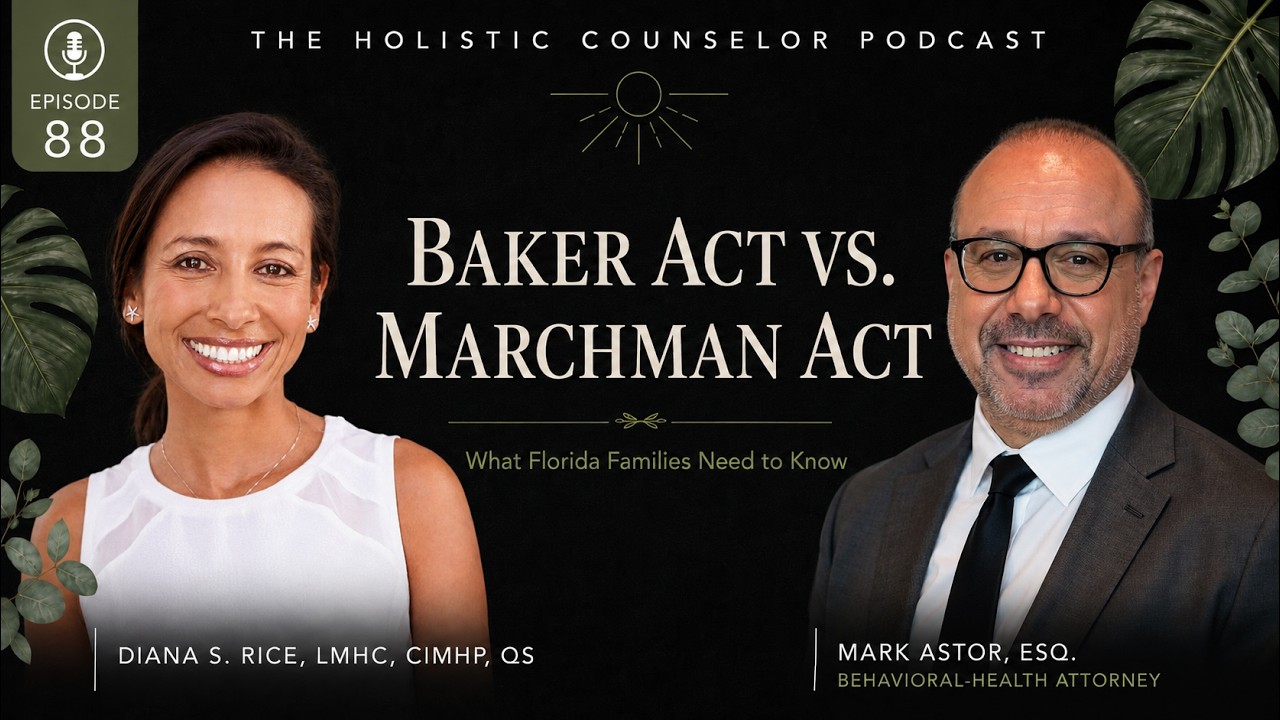
Episode 88
Baker Act, Marchman Act & Guardianship in Florida: A Trauma-Informed Look at Legal Intervention
with Attorney Mark Astor
Hosted by Diana S. Rice, LMHC, CIMHP, QS
Content Warning: This episode includes discussion of suicide, mental health crisis, and involuntary commitment. Need Help Now? Call or text 988 (Suicide & Crisis Lifeline) — available 24/7, free and confidential support. For Florida-specific help, contact…
Listen to the Episode
Press play when you’re ready.
Educational content only; this podcast is not therapy, diagnosis, or medical care.
About This Conversation
Show notes
Jump to a section
Content Warning:
This episode includes discussion of suicide, mental health crisis, and involuntary commitment. Need Help Now? Call or text 988 (Suicide & Crisis Lifeline) — available 24/7, free and confidential support. For Florida-specific help, contact 211.org or your local mobile crisis unit.
"We are not here to hurt people—we're here to help them. And sometimes, that means telling the hard truth."– Mark Astor
On this special Christmas Eve episode, Diana sits down with Mark Astor, a behavioral health attorney and former prosecutor, for a deep, transparent conversation about Florida's most misunderstood legal tools:
- The Baker Act
- The Marchman Act
- Guardianship Law
As therapists, clinicians, and families navigate the complexities of crisis care and involuntary intervention, this episode offers a non-judgmental, trauma-informed lens on what these laws really mean, when they should be used, and how they can be misused.
If you work with teens, adults with co-occurring disorders, or simply want to understand how Florida law intersects with mental health, this episode is a must-listen.
What You'll Learn
- The key differences between the Baker Act vs. Marchman Act
- How the Guardianship statute is being used in younger populations
- Why clinicians must understand their legal power—and its consequences
- How to protect client rights without abandoning ethical care
- The risks of profit-driven crisis facilities and what sovereign immunity really means
- Real stories of misused legal action, trauma, and redemption
- What to do if a loved one has been detained, misdiagnosed, or neglected in the system
Resources Mentioned
- Mark's Website: MentalHealthAddictionLawFirm.com
- BakerActAttorneys.com
- Office Phone: 561-419-6095
- Follow Mark on LinkedIn, Facebook, Twitter, IG, and TikTok
Notable Quotes
"The Marchman Act is not a punishment. It's a last-resort tool for families whose loved one's brain has been hijacked by addiction." – Mark Astor
"You're not alone. I promise you—there are people who want to help, but you have to pick up the phone." – Mark Astor
"I've seen teens Baker Acted who come out with more trauma than they went in with. This isn't a dig at the law—it's a cry for wisdom in how we apply it." – Diana Rice
"Recovery is like the stock market—up and down, but trending up if we support it right." – Mark Astor
"Faith without action in these systems doesn't protect our clients. We must be both wise and willing to learn." – Diana Rice
A Holiday Reflection from Diana
"Christmas can stir up both joy and pain. If you're listening to this today, remember—healing doesn't stop for the holidays. Sometimes the most loving gift we can give is the courage to take action, even when it's hard."
Listen & Share
Available on Apple Podcasts, Spotify, YouTube, and everywhere you stream.
Subscribe to The Holistic Counselor Podcast Follow on
Instagram: @theholisticcounselorpodcast
Episode transcript
Read the full transcript Close transcript
Automatically generated from YouTube captions. Names and wording may contain errors; listen to the episode for the original conversation.
Before we begin, a gentle content warning. This episode contains discussion around suicide, involuntary mental health holds, and trauma. If you're in a vulnerable state, take care of yourself. It's okay to pause and come back later. If you or someone you know is in crisis, you can call or text the 988 suicide and crisis lifeline available 247 across the US.
This conversation is offered with deep compassion and a desire to protect life, dignity, and recovery. Hello there, fearfully and wonderfully made humans. Welcome back to the Holistic Counselor Podcast, where faith, neuroscience, and whole person healing intersect. I'm your host, Diana Rice, licensed therapist, integrative mental health professional, and passionate advocate for ethical traumainformed care.
As this episode drops on Christmas Eve, I know many of you are navigating both the beauty and the weight of the season. For some, it's a time of peace and family connection. For others, it stirs up grief, loneliness, or complex emotions around systems and relationships that haven't always felt safe.
Wherever this finds you, I pray you know you're not alone. And that healing is always available, even during the holidays. That's why today's conversation matters. Earlier this year, I attended the Florida Civil Commitment and Guardianship Training in Boca Raton, where I had the opportunity to learn directly from attorneys, clinicians, and recovery experts about some of the most complex legal tools we're given as licensed professionals in this state.
The Baker Act, the Marchman Act, and Florida's guardianship laws. Here's the thing. As therapists in Florida, we're expected to intervene, to take action when someone is in crisis. But with that power comes a heavy responsibility. And too often, we're not thoroughly trained on how to use that power wisely.
I've seen firsthand how good intentions can unintentionally cause harm, especially when clients come in with complex trauma histories that were never considered in the moment of crisis. I think about some of the teens I've worked with Baker acted for the first time as minors, often misdiagnosed, retraumatized, and then sent back into systems that don't understand their story.
I think about the Demory Hadley case here in Brower County. One of several that raise serious questions about how we intervene, who gets protected, and what happens after the fact. I didn't walk away from the event I went to with all the answers, but I did walk away knowing I had to dig deeper.
And that's why I invited today's guest, Mark Aster, onto this show. Mark is the founding partner of Aster Simovich Law, a former Palm Beach County prosecutor, and a seasoned advocate for families navigating substance use and mental health crisis. His legal concierge firm helps families use the law as a tool for hope and recovery, not punishment or control.
Mark brings not only legal expertise, but a deep understanding of what's at stake when we invoke these laws. And my hope today is that this conversation empowers you, whether you're a clinician, a caregiver, or just a concerned Flidian, to better understand your rights, your responsibilities, and the real human impact of these legal systems.
Mark, it's an honor to have this conversation with you. Thank you for being here.
I'm so flattered that you have asked me to be a guest and to share our mission. So, I'm I'm excited to be with you.
Yeah. So tell me, I mean this is how I usually start with all my guests. How did you get to where you are? Can you share a little bit about your journey because you went from a prosecutor, right, and now you're in mental health law heavily focused on the Baker Act and Marchman Act.
How'd that happen?
Well, it's been it's been a journey for me. Um, and I'm about to go into my 32nd year of practice. And uh, so I look in the mirror and I say, "Wow, that went quick." And my father who you know unfortunately passed away about almost 9 years ago now um used to warn me the older you get the faster it goes but I didn't listen to him till I got a little older and he was right it's just racing by.
So as you uh as you pointed out I was prosecutor from actually I interned at the state attorney's office in 1993 and then I went back full-time from 1994 to 1999. Um, and one of the things, you know, I noticed pretty quickly was that I was starting to see the same faces over and over again.
You know, when you're fresh out of law school and you are a prosecutor, you know, you're full of piss and vinegar and you're like, "Okay, I want to I'm going to lock everybody up, right?" And and interestingly enough, the mandate even today in Florida's criminal system is to punish first and rehabilitate second.
Now, back in the 90s and um you know, I was prosec right around the time of the OJ Simpson case. In fact, I got interviewed about OJ's about that case. I had a you know, I haven't seen the video in a while, but I do recall I had a whole lot more hair and it was just a little bit less of my face there.
But in any event, at that, you know, the mandate even then was, you know, was was the same, punish first. Um the difference was that back then we didn't have some of these alternative courts in the criminal system. We now have drug court, mental health court, veterans court.
We have courts within the criminal system. And again, depending on what you've been charged with that, the idea is to divert you out, get you the help that you need, and then hopefully you don't come back again. But back in the 90s, we didn't have those kinds of courts.
And I what I realized was that a lot of these people that were coming back, we're not getting help for a behavioral health issue. And if you keep coming back enough, I mean, eventually here in Florida, we'll just lock you up. Yeah. And
you know, I don't think the state does a good job either through the criminal system or the mental health system of taking care of of of our citizens. Um, I was there until 99. Um, I also had gotten divorced and married within a year.
Um, and after I popped down in 99, I started doing defense work. I made a lot more money, but I was completely miserable. Um, and I I tried very hard not to practice law for for many years. I just I really lost my way.
Um, in 2004 I left I went to I moved up to to to DC. I went back to school for a year. I really really wanted to get my masters in law which I did. I also spent a year working on a presidential campaign which was an incredible experience.
Unfortunately the candidate I was working for didn't win so I had to come back. Um I came back I worked in various family businesses. Um, and then in 2009 10, I ran off to California with what money I had left after the '08 crash.
I spent three years there basically tripping in the light. Fantastic. Just having a good time. Um, and I don't know, for lack of a better word, sort of feeding my ego. Uh, I took the bar out there twice. I failed it twice. Um, I came back after three years because I had no money left.
I studied one more time for the California Bar. I failed it a third time. Um and then um then I met somebody that basically completely changed the direction of my life. So I got invited to a breakfast meeting down in Coral Gables. So I live in Bokeh.
So the meeting was at 7:30, which meant I had to be up at like 4 to get there, which I wasn't thrilled about.
And when I first heard about it, I wasn't even going to go. But I had a nagging feeling I needed to be there. And the presentation was done by a gentleman by the name of Arjun Robbins. Arjun Robbins founded a company called How to Manage a Small Law Firm.
And how to manage teaches solo and small law firm pra small law firm practitioners like us the business side of being a lawyer which is not something they teach in law school
or in our in my field either Mark.
Yeah. or doctors or dentists or chairos, any of you, you know, they teach us the basics of of our, you know, respective professions, but they don't teach us about the business side of things,
right?
Um, and I came from an entrepreneur entrepreneurial background. I had a father that left school at 14 and a mother that left school at 16. And together they built businesses. Some worked, some didn't. Um, so my father didn't have a lot of business training or financial training.
He just, you know, he learned from doing
Yeah. Um, and I heard him speak to a group of about 20 lawyers. They all looked at him like he had three heads because, you know, lawyers are by their very nature, they like to challenge everything, right? Because they think they know everything.
But the one thing they know absolutely nothing about unless they went and built a business and most haven't, is being an entrepreneurial lawyer. So, I saw him speak and it was like it was like the veil of darkness had been lifted. and I begged him for a job and I ended up I spent a year working for him and and and his company, learned about being um an entrepreneurial lawyer.
But what I didn't realize when I first went to work for them and I realized a little bit later on is what how to manage really is at their very core is they are personal growth company for lawyers. Oh,
how about that? The one profession that definitely needs a whole lot of personal growth is the legal profession. And I spent a year there working there. And they they they believe that financial growth must be preceded by personal growth.
And what I realized was the reason I was so miserable both personally and professionally was I had failed to take 100% responsibility for my life.
Wow. That's impressive for I'm telling you I
I'm a different kind of lawyer.
You're breaking stigma for me, Mark. You're the second lawyer that I put on got on this show and both of y'all now breaking stigma for me because to me I've seen such a terrible of your field. So
yeah, I mean it does the legal profession tends to attract people that um want to get love from their clients.
Um it also attracts people that are I mean they say the legal people in the legal profession are twice as likely to develop a substance use disorder. So you know it tends to attract that kind of individual. Um, so that's as an aside something I've gotten involved in.
But in any event, I I spent a year there and I decided I wanted to go on. I said, "Okay, it's time. I'm going to go and open up my own law firm. Um, and I decided I you know, I had close family members and friends who had behavioral health issues and I decided that's where I'm going to help."
I had no idea how I was going to do it. I had a background obviously in criminal law. I had read about the Marchman Act. And in February of 2016, I sat myself down in the local library here in Bokeh because they had free Wi-Fi and cheap coffee because I had no money to start a law firm.
Wow.
I also got the cheapest business cards that could possibly be made by Vista Print.
I drove around to treatment centers and I handed out my business card and said, "I'm here to help."
I made appointments for coffee and lunch, anything I could do to share the message. Um, and I did not get a March case for about 14 months. So that meant I had to I had to take different kinds of cases. I took criminal cases.
I took family law cases that I co-conceled with a friend from law school um just to pay some bills. And 11 months in I lost my dad. So uh crazy. This was it was a tumultuous time.
Yeah.
For me. Um but I was able to get a very small office. Um which we actually still have the same location just the office the initial office was a little bit bigger than the desk it was sitting in. Um that was sitting in it.
So, um, I met my wife the second year. She also had an office in the same building. Um, and actually we got married, uh, it'll be two years in on January the 6th. So, like I said, I that was the second part of my life that I took responsibility for.
Yeah.
So, you've done the work. You've done the inner work.
I'm still a work in progress, but I'm a whole.
No, but you you decided to look in the mirror and actually figure that stuff out. So, now you can actually do healing in behavioral or mental health, right? So, let me ask you because you said you you went in this and this is Marchman Act because that's your mental health and addiction specialist.
Like I've really never came across of of an attorney that just does that and so can you just because many people don't understand the Baker Act and they're unclear, right? Um so and especially listeners outside the floor. This is global this podcast. People from all over the world are listening.
So, I want to know more about the Baker Act and the Marchman Act, how they are different and and if other states have similar law laws. Of course they do, but you know, tell me more about it because I learned so, you know, for me, we learn a little bit and then we're we're told these are the things you have to do.
This is part of your licensing. And I'm like, okay, fine. And you learn and you learn, but honestly, like that's a heavy thing to put on.
Yeah. So, so the mission of the firm um even in 16 it is today is to save families whose loved ones are suffering from substance use, mental health disorders and failed attempts at recovery. So the three statutes that we are typically operating under are Marchman Act, Guardianship and Baker Act.
And depending on on the relief um that the family needs may determine, you know, which of these statutes, if not all of them, we're going to be operating operating under. Now, as an aside, I hadn't really had much up until up until my father passed.
I only knew of the Baker Act.
Mhm.
Because everybody knows about the Baker Act, right? I knew about it from when I was prosecutor. And then two days after I buried my father, I had a family member that was Baker Acted and I was there with the cops, the paramedics, and I watched them strap into a gani and take her away.
So, when I tell families I know Baker Act, I know Baker Act. Um then during COVID when people couldn't get in to see their you know their their pra you know their clinicians and practitioners and people that were in recovery started to relapse and people that had never had issues started to have issues and showed up at emergency rooms and baker facilities and called 911 and 211.
The phone started to ring off the hook with people that were getting sucked into Florida's mental health system through the Baker Act and other lawyers started calling and saying our clients are getting Bakeracted. Can you get them out? And that so that basically became a mission of mine.
I file about 150 cases every year to get people out of the Baker Act that shouldn't be there. I have, as we sit here, I have three pending right now. And I typically have two or three pending in the office because Florida's mental health system is broken.
But when the Baker Act is used correctly, it is a powerful lifesaving and essential tool. So, let me let me talk about and I know we're going the long way around here, but let me just wanted to set the stage for you.
So, Marchman Act is a statute here in Florida and is unique to Florida um that allows us to go to court and get a court order to place somebody into treatment where there is a primary substance use disorder. Okay? And it also contemplates co-occurring mental illness, but there must be primary substance use.
The Baker Act is a statute that allows the state of Florida to take custody of somebody and make them a temporary ward of the state at least initially when as a result of some type of mental health crisis they need immediate services. So for instance, Dana, someone's in your office and they start threatening
talking about killing themselves, right?
You as a clinician are considered a qualified professional under the statute and actually you're also considered a qualified professional under the Marchman Act statute
and you can issue that professional certificate and then you can call the sheriff's office and say, "Hey, I've just issued a professional certificate. I need two deputies down here right now to come and take this person to the nearest licensed Baker receiving facility."
Yeah. The problem with the Baker Act is that once you do that, there is no oversight. Meaning, other than you and the family, nobody knows they're there. Even if a judge issues an order for the person to be assessed, nobody knows they're there.
There's nobody watching. And so, what tended to happen, especially during COVID, was people got sucked into Florida's mental health system via the Baker Act and nobody knew that they were there. And if nobody knows they're there, and oh by the way, because these facilities are licensed agents of the state of Florida's mental health system, they also enjoy sovereign immunity like any other state actor.
So they can't be sued for this even if they do it wrong,
even if it's done intentionally wrong.
Right. Yeah. And that's on our should like right now that kind of triggered me because I do remember having to do that to some I worked at um alternative high schools. So teen, you know, with teens and most of my career was teens.
And for us clinicians, Mark, that's hard on us because we first do no harm. We're trying to do the right thing, but we're trained like, oh no, suicide, emergency, cops come in, puts handcuffs on the kid.
Yes.
I'm I'm going to start crying. Sorry.
Listen, I'm with you because I was there when it happened to my family member. And so if somebody shows up in an ER and the doctors, you know, baker them, they they basically fall into a big black hole, right? To be honest with you, I I like it when a clinician does it because I know that I know that I know that you know what you're doing, right?
But when the police get called to to a scene and they have to make a clinical decision and they don't have onetenth of the training that you have, sometimes it they make a mistake and sometimes they're in a situation where if we don't take somebody and something happens, we don't want to get the blame.
So, we're going to take them anyway and we'll let the doctor at the bankruptcy facility figure it out. Well, unfortunately, and this is not in every facility, but a lot of them, um, the doctor is motivated when he finds or he she finds that the person has health insurance, and they know that nobody's notice they're there.
They know that they can't be sued for this stuff, so they don't care. This is a for-profit private entity that is licensed to lock people up and keep them there. And that is the problem with the Baker Act. But obviously if somebody is actively suicidal, we want to be able to call pick up 911 and say, "Hey, listen.
I have a loved one in the house. They're suicidal. I need two deputies here right now." That's what it's meant for. So that really the difference between Marchman and Baker Act is Baker Act is focused on mental illness and Marchman is is focused on substance use.
Okay?
And I'm going to give you one other caveat so I don't try not to confuse the listeners. You can actually initiate a Marchman Act the same way you can a Baker Act. So, Baker Act is initiated one of three ways. Um, somebody files a petition, qualified professional like you, Diana, or law enforcement can do it.
The Marchman Act can also be initiated those three ways. It very rarely is. There are a couple of counties that will if you end up at the ER for a drug overdose, they'll march you. But there's only one or two counties I've encountered that do that.
And again, if that happens, you've fallen into a big black hole. Normally the Marchman Act is typically initiated when mom and dad call us and they say, "Hey, listen. We have an adult child with a long long history of substance use and co-occurring mental illness and we want to get them into treatment, right?
We've tried everything. They won't go. They're in denial or they've been but they never stay long enough or they never stay long enough in the right facility and this has been going on for five, maybe even 10 years and we can't take it anymore.
We're exhausted. we're financially drained. Can you help? And the answer is yes, usually. But, you know, recovery takes time. It's like any other disease. It takes time. And I tell families, I don't have a magic wand. If I did, I'd promise I'd wave it.
This is this is going to take a little time. But the most important thing, the initial decision that has to be made and the commitment that you have to make is to decide to make the decision to save your loved one because they can't make it.
Their brain has been kidnapped years ago, which is why they're in denial and they simply cannot even acknowledge that there's a problem here. It's why they're telling the parents, "You need to go see a shrink. Go see a doctor. There's nothing wrong with me."
Right? Despite the fact that their loved ones life is in complete shambles,
right?
So, if if their loved one cannot make that decision because of what's running the show up here,
somebody has to make that for them. Is it going to be mom and dad? Is it going to be the state either through the criminal system or or the mental health system? I mean that really that's the choice. Now sort of in between all this is is is what I the one tool that we really have become fans of which is the guardianship statue.
Okay.
And as I mentioned my wife had practiced up in Massachusetts with husband number one uh for about a dozen years and she practiced guardianship law which traditionally had been really designed for elderly people. Oh.
Um,
is this the Britney Spear thing that happened to her?
Yeah. I mean, yes, it's a little different in California, but yes, guardianship is
is basically a court order which allows you to take complete control of someone's life. And again, it depends on what you want, right? You don't have to take all of the rights away. There's about a dozen associated with guardianship. Mhm.
So my wife as brilliant brilliant as she is just came up with the idea that maybe we could use guardianship which is this sort of elderly person statute and let's use it for these behinds of cases. And obviously when we had co came along and we legalized marijuana most of our cases went from sort of primary substance use right alcohol recreational drugs to primary mental illness. some of it which is driven by that new legalized marijuana which is a complete disaster in Florida.
But
can we talk just a little bit about that because that is something that was one of my last clients came out of being Baker acted. The parents found me. I was working with teenager. I know what happened. He was playing video games all night long smoking that hardcore strong marijuana.
Went into psychosis. Got Baker Act. Went to the hospital was hospitalized. He was a he's a good kid. And then boom, two weeks. The parents had no idea how to get him out. He needed they needed you, Mark. They needed you.
Sounds like it sounds like they did. And most people don't realize you can challenge this thing because no,
unfortunately, these nefarious facilities, lie, cheat, and steal. I mean, that's that's the only way I can describe it. Fortunately, where I am in Palm Beach County, those cases are few and far between. But the New York Times did an article about nine months ago um about some of the Acadia facilities and what they're doing
um and the the horrible stuff that they're doing. But yeah, I mean the legalization of marijuana has been an absolute unmitigated disaster here in Florida.
Do not let your kids touch this stuff. Even as adults, they shouldn't be touching it.
I'm a child of the 80s, you know, and I truthfully when when they decide to legalize, I didn't think it was going to be that big of a deal. But I was really wrong. It's a very big deal. This stuff is dangerous. If you let your children use it, it will damage their brains permanently.
And I don't care if they have a card. That's beside the point.
Yeah,
it is dangerous. Do not let them use it.
It's because it's not the marijuana that's I'm telling you, I' I had I worked with teenagers in Brower County and so it's like, oh, it's legal now and adults that I know, too. And I'm like, no. And honestly, I'm going to be super honest with you.
Back in the day, I got my card because of my anxiety and I saw what it did to me and I'm like, "Oh, I got to get off." Because it it was too easy. There's no regulation and it's too strong. It's 94% THC when the stuff that was coming from Colombia back in the day in Fort Lauderdale in the 80s.
You know what I mean, Mark? Like I know like I'm saying too much, but that's who I am anyway. Well,
just because it's legal doesn't mean it's safe. I mean, last year I I had surgery twice on my arm. I tore my tricep tendon here both times. the doctor after I did the surgery, the surgeon prescribed oxycottton for me. All right.
Oh my gosh.
You know what I did? I threw it in the garbage. I said, "I'm not taking it." He said, "You're going to be in pain." I said, "I'll chop the arm off before I take that stuff. You can forget it." I said, "You obviously don't know what I do for a living.
I'm not taking oxycottton. I'll take Tylenol. That's it." Because I know how dangerous that stuff is. And it's prescribed probably by every surgeon in the country after someone comes out of surgery. And I'm not telling other people what to do. I'm just telling you I'm not taking it because I know what it can do.
Yeah.
And just because there's a prescription don't mean it's safe.
Just because it's legal, not everything is good for you.
Yep.
You're right on, man.
So yeah, back to the the the guardianship like you were talking about and these cases that you've seen in Palm Beach and what I've seen in Broward like you know that's one of the one of the reasons like it's heartbreaking what I was seeing with adolescence and I couldn't handle it was too much vicarious trauma for me and so how do people work with you like what is it that you you know because people don't know and and they trust us as the professionals they trust us therapists psychiatrists hospitals that's what they're needing help.
They're in a crisis. How do we help them?
Yeah. I mean, here's what how we help them. We we give them the the authority, the the the power to make decisions to save their loved one, right? And and you know, I tell families, they say, "Well, we're waiting for him or her to hit rock bottom."
No, no, no. It's not about them hitting rock rock bottom. It's about you hitting rock bottom. Have you had enough? Have you suffered enough? Are you done watching them flail around and fail to launch and waste their life away because their rock bottom might mean making funeral plans?
And I'm, you know, I'll be honest with you, Dian. I'm much to my maybe it it's not a good thing, but I'm very honest and and I'm blunt about this stuff because I because I' I've had it happen to family members and close friends.
And I'm just going to share a brief story. I have a a really good friend of mine about five years ago, maybe six years ago, he called me. He had a sibling that went missing. She went on a coke binge for two days.
They finally found her. Okay. Three years after that, he tells me they found his they found his brother-in-law who was addicted to pain pills hanging from the ceiling. Right. As a result of that, the wife, his sister-in-law, she also got addicted. And two days ago, they found her dead in her apartment.
When I tell you this stuff is close and personal, it is. I've also had clients that we represented that lost love once. I've had clients that didn't hire us and six months later we called them to see how things were going and their loved one was dead and and I and I simply refuse to to sugarcoat this stuff.
Tell families it's all going to be okay.
That [ __ ] only happens in the movies, not in real life. Right? Your options are you make the decision to save them, the state will do it or they be dead. I mean, that's it. I mean, that's the reality of what we're dealing with.
It's like any other disease. It will ultimately destroy and kill the host. And it will destroy your family, too.
Yeah.
And it does. That's why they call it a family disease. It destroys families. My friend's family, they're destroyed. The parents, they're beside themselves, right? He's now got a wife who's lost a brother-in-law and a sister-in-law and a sister. The whole family is devastated.
I don't know if they'll ever come back from this, but that's what this does, which is why it's so important with the work I do. and you do and other clinicians and other lawyers are doing. I mean this is how we save but it's save people but it's one at a time
right and we are going to lose some people unfortunately but we can save a lot of these people but you got to give families the power to do it
right and that's the thing they don't know what to do or where to turn or how to navigate the system or anything like that like honestly I've been a therapist in for a long time in Broward and now of course the state of Florida because I'm only online working with adults but what I hear from my colleagues, you know, especially in the substance use disorder cases or what you're talking about addictions and you know, like where where can someone that's listening right now going, "Oh my goodness, that's my loved one or this is me."
What's the first thing you would suggest for them to do?
Well, I think the first thing is to identify there's a problem, right? And I tell I tell families, you know, especially parents, and it's typically moms and dads that call us, you know, and they a lot of the time they say, "Well, how do you how do I know there's a problem?"
Well, be a nosy parent, right? But I think and it's it's typically the moms that call. My wife tells them, jokes with me. She's like, "You make all the mothers cry." No, I don't make them cry intentionally. I just have a heartto-he heart with them.
And I'm honest with them. And it's, you know, when you are honest with people and they're confronted with the truth, then yeah, it's emotional. But I think that especially in the ms, right, moms instinctively know there's a problem. I know. I mean, my mom's 82.
She knows when there's a problem with me. She doesn't have to see me. She feels it,
right? But, you know, look, I mean, if you've got somebody in the home, an adult child, you know, particularly, right? Has their behavior changed, right? Are they have they are they unable to are they not going to school? Did they drop out or are their grades terrible?
Are they not are they unable to hold down a job? What about having an intimate relationship with somebody? Are they able to do that? Um, are they are they eating properly? Are they bathing? Are they taking care of themselves? you know, are they are they sleeping during the day and up all night?
I mean, their their basic daily functions, have they changed? Did you I mean, maybe there's evidence in the house, right? Maybe you know that they're using marijuana and because somebody said, "Well, it's legal, you think it's okay. They're out in the back of the house smoking or vaping.
It's not okay." Have they admitted it to you? Maybe they tell you, "I'm using Makes me feel better." Okay. Well, why why do they need that? Right? I mean, there's typically something in the history. Maybe there's some trauma. Maybe when they were seven years old, some some therapist told them they had they had ADD and put them on some kind of medication that whacked out their brain chemistry.
And again, I'm not not telling parents what to do, but that's something we see a lot of.
Well, it's about getting to the root cause, Mark. Right. And
what what it is something triggered this,
right? And sometimes addiction. Yeah. Exactly. It's nurture and nature. And I'm not we're not here trying to blame the caregivers or, you know, or the system. the system is broken and we're trying to figure out how do we navigate it in a more healthy way for the future.
You know, 2026 is coming up. It's it's a time for I see revelation reformation and change and and what I hear Mark saying is like he's passionate. Dude, you're really passionate about this. I saw you talk with John Pulse, right? And that was so
greatation.
Oh, yeah. And that's the thing. So, it's not like that we're doomed. It's not doom and gloom. Like he's telling it like it is because this is how it is and we got to stop ignoring it. We have to we have to have these conversations, these hard conversations and realize and become responsible for ourselves.
So what would you what would you tell well first of all do you know of places that you work with like John's place I forgot the name but like places that actually if someone does need help right like prevention prevention preventative measures of like do you have resources that you give your families you work with and stuff like that to either prevent or when they're in the system already of what to do or anything that comes to Yeah.
I mean, look, not every case needs a marchman act or a guardianship, right? And and you know, that's about my my team having an honest conversation with the family about, you know, how long's this been going on for? What have you tried? What's worked?
What hasn't worked? What do you what are you actually looking for us to do, right? What do you you know, if we could wave a wand, what would you have us do? Not every family is ready to go to court. Okay, great. All right.
Well, here's let's talk about maybe doing an intervention. Here's a couple of great interventionist. Maybe we need a clinician, right? Maybe this person is not so far down the proverbial rabbit hole that they're that they've become like, "We're not there's nothing wrong with me.
I'm not going." Right? Maybe they're willing to go and do some treatment. Okay, great. Here's a couple of really great clinicians. Call Diana. She's a fabulous clinician. Give her a call. See if you can make an appointment. Right? So, I think there there are options before you go down the legal route.
Typically, unfortunately, Diana, by the time, you know, the clients get to us, we're typically the last port of call, right? This has been going on for a long time. They've they've either tried to get their loved one into treatment or they've been into treatment and it hasn't worked.
Or maybe they've maybe they filed the Marchman Act and it didn't work for whatever reason. And I use that term loosely because the Marchman Act the Marchman Act is is just a vehicle to get your loved one into treatment, right? So, when families tell me, "Well, it didn't work."
I wonder what that means. But you know, maybe they've been down the legal route and it didn't work for whatever reason, right? Um, and so I mean, one, what do you need? What have you tried? What's worked? What hasn't, okay? Let's come up with a couple of options.
Try option one. And if that doesn't work, let's talk about option two. But if you've already, you know, if you're like, "Okay, this has been going on for years and years and years and years." I'm like, "Okay, I think that we're past the point where an intervention will work, right?
Or if it does work, and and I'm a fan of interventions because interventions are great for getting people into treatment,
but you're going to need a court order to keep them there because there's going and then they're staying. And if you don't stay long enough, it you'll do this a 100 times over, it'll fail,
right? So, this is because I I want to understand more the marchman act, right? because I I remember I had a loved one and we were looking into it, but then it is a lot of time on the person because you're you could do it yourself, right?
You could go to the court and fill out the paperwork, right?
And so to me though, it's like then what? But but what I'm hearing is that okay, you're realizing there's this issue in the family system with a person. Instead of trying to go to court and spending hours and trying to figure all this out, we just hire you.
Correct. Well, I mean that's the ultimate goal, but I think what and look and some families do go down to the courthouse and then you know things go south partly because if they can actually get the paper right, their loved one is going to get a is going to get a lawyer appointed to represent them who's very skilled and handling these cases.
And if you don't have a lawyer, well, who do you think is going to win that case,
right? And that's deflating for the family. Um, so yeah, I mean, if you've got the resources, you should hire a lawyer who knows how to do these cases and has handled them and and and is primarily focused on behavioral health cases, not, you know, divorce cases and criminal cases and car accidents, which unfortunately some of my colleagues are doing in addition to marchment acts because, you know, it makes them more money, which is fine.
We all got to put food on the table, but I only have one mission
and um so I don't take those kinds of cases. So I think if if the family has resources and you need a lawyer to fight for you, right? because maybe maybe the family comes to us and they don't they don't have they don't have a treatment center lined up.
Okay, let's give you some options for that.
Okay.
Um I you know I have a couple clinicians that you know I'm fans of like you and and John that maybe can help you to find the right place that's clinically appropriate.
So and the other thing I have which I think is a really important piece I have a I have a retired cop on staff with a team of investigators. So I mean you
wow
um you know I modeled this really really when I was prosecutor we had our own own sort of police force and I I said okay I open up a law firm I want that so we get a lot of calls people that are missing they're on the streets they they walk out of treatment well who's going to go look for them I mean the police will if they can find them and it's not because they don't care they just don't have the resources
right
well I'm going to send my guy out because he'll find them right if we get an order from a judge to pick somebody up okay normally I will send John out there who's my lead guy. I'm like, John, go find him for me.
And when you find him, call law enforcement, have them send two officers down and get that court order executed. And you know, he'll make sure it gets done right and they get where they need to go. So that's a very important piece that I don't think anybody else has.
Okay.
Are you familiar with the Deore Hadley case that happened in Broward?
You're going to have to refresh my recollection on that one.
I think it was a couple of month uh well, a few months ago.
Um she I think her mom I don't want to misqued and everything but I remember watching it I was like whoa because I heard of the psychiatrist that got so she came in they the police came and got her and stuff because her mother I'm pretty sure Marchman acted her and uh arrested her put her in you know in the hospital for a couple of weeks but she never had drugs in her system and everything so
she got a lawyer to sue the hospital the psychiatrist and said it was her mom having some power and that to me that's the fear a lot of people may have.
So with that, I just want to know like what is the biggest misconceptions that a family have when their loved one is detained because sometimes there are cases like that where the whole system she was in the system for a few weeks and she was like I don't have a mental health condition and her parents and family and the psychi you'll have to look into it to see what I'm talking about because that to me I
was like whoa I was blown away and I started researching and that's why I wanted you on here too because I went to your thing your you know where I learned a lot about the Marchman Act and then this was happening at the same time.
So I was just like I want to know more because I mean this is one case out of thousands and thousands but at the same time this is the fear that some parents and family have or us clinicians like we were you know or the school systems or hospitals but they detained her and it sound like all the the evidence was like she didn't have anything in her system.
Okay. I mean that that can happen with the Baker Act. So when a well look when a family comes to us they they go through what I call a triage process. What does that mean? That means they're going to speak to somebody in our intake department.
I have three people there and their job is to is to really go through the history and find out what evidence that we have.
Sometimes parents and I used I did that you know for the first seven years it was just me and my wife. Having staff is a reason relatively new phenomenon for us. So I get to sit here with you and not have the phone ring a dozen times right.
Um, but when we speak to families, you know, I I want to know what what they know, what they really know. And what I mean by that is, you know, a lot of the time families will call me and they say, "Oh, you know, our son, our daughter is using."
Well, how do you know? I just know. And you know what? They're probably right.
But as a lawyer, we're governed by different rules. First of all, ethical rules, right? The rules of professional responsibility, responsibility, which means I only file a case in good faith. The other thing is I'm also governed by the rules of evidence, which means there's there's I have to produce evidence and it has to be admissible and relevant evidence.
So if the family's telling me we just know, that's not going to cut the mustard. I mean, you're you're probably right, but I need to know how you know. Well, if it turns out, you know, your best friend's you know, the best friend's sister told them and that person's not willing to come to court, guess what?
that person is not going to be able to testify about what somebody else said. And so part of the process, Diana, is making sure that we can actually prove the case, right? Because I don't want to file it and we lose. I don't like losing, but I also don't like having a case dismissed because it's not because none of the pleadings are even legally sufficient.
And a lawyer that does that, frankly, should be frankly disbarred. So part of the process is making sure that we can actually prove the case. If we can't, we'll say, okay, I don't think we have enough evidence here for a marsh and and and I'll tell you, I've turned cases away that not because they didn't want to help the people, but because we didn't have enough evidence, right?
And so, if I don't have enough evidence and we can't prove the case, and I don't think we have a reasonable shot of winning it, I'm going to tell the family, I don't think we can we could help you with a marchman act.
Here's another option. Right? Maybe it's an intervention, maybe it's a guardianship, right? So, there are other way other ways to skin the proverbial cat. The other thing I want to be that I'm really careful of is what is the motives? What are the motives that the family's calling us for?
And this has only happened once or twice, but you know, I'm a big believer that what the work that we do is a shield. It's not a sword.
In other words, we're trying to help people.
I love that.
Even if they don't know it, we're not trying to hurt them. And I and I'm going to give you an example. Um I've had people that called us that said, "I want a marchman act, you know, my loved one." Well, okay, great. Where do you want to send them to treatment?
Oh, I don't want to send them to treatment. I just want to get them out of the house.
Okay. Well, okay, then call the real estate law and have them evicted because that's not what I don't use the March Act to evict people and put them on the streets. Right.
Want to talk about how to help them. Great. If you're not looking to help them, you got the wrong lawyer. Those that I get those kinds of calls. I've had I've had clients that, you know, that got past the sort of the triage process and then we found out that they there there was something nefarious going on.
I had one dad who had us put his son into treatment and then we found out afterwards that the son that the dad had slept with the son's girlfriend.
Oh my word.
Okay. And yeah, of course the kid went off the rails. You bet.
Yes, of course.
Sorry, you got the wrong lawyer. Goodbye. Bye. The client. I had another client. Um, she hired us. I put her,
she was an older woman with a much younger boyfriend and he had an alcohol problem. I mean, it was clearly severe. Um, I had him picked up. I put him into treatment and he did the full 90 days and the girlfriend then who was the client called me back and said, "Well, I want you to extend it another 90 days."
And I said, "Well, I've spoken to the the clinicians at the treatment center and they tell me they don't they would not support an extension. He doesn't meet continue criteria. They feel like he has done 3 months and that he's in a position where he could continue to go to AA.
He's willing to do, you know, outpatient services on his own and they want to give him that opportunity. Obviously, if he falls flat on his face, we can revisit Marchman. So, I said, "I'm sorry. We don't have I don't have enough evidence here.
I don't have a qualified professional who's going to support this. I can't do it."
And she said to me, "Well, I'm going to file a bar complaint." And made all kinds of threats. And I called the bar and I said, "This is what's happening." And they said, "You should move to withdrawal. Fire the client." And so, I filed a motion to withdraw.
We went in front of the judge and the this was pretty funny actually. The jud she said the judge said to okay I understand miss so and so you're here to complain about Mr. Astra. I am and she spent 10 minutes you know on this diet tribe complaining about me.
And the judge looked at her and said you know sounds like you need you need a new lawyer. She said I do. He said Mr. Aster your emotion is granted. Goodbye.
Wow.
Right. But that was an instance where
again it you know and here's what really happened and I found that out this after the fact
during treatment when he was able to you know experience recovery he met somebody else
somebody who was more quote age appropriate and he told the girlfriend I don't want to be with you anymore when I get out we're done.
Yeah
that was her motive
she was using it as a sword not a shield. She didn't want to help him. She wanted to hurt him.
She met somebody else
and I'm not going to do that. That's not what that's not my mission. It's not part of our core values or who we are as a team. And so if you call me and your your um motives are not, you know, you don't come to me with clean hands, as we say in the legal profession,
call another lawyer. You got the wrong. I'm not going to take your case. I'm not sure how much money you want to give me. That's not what I do. We're here to help people. That's it.
Wow. Mark, this is this is wonder. I'm wondering one thing, too.
What if say that client I was telling you be before that really didn't know you know do you do lawsuits like that where they were hurt by the system after coming out not like in the in the process of trying to get them in or the help but say like they spent the two weeks there and they have proof evidence of like how the treatment was happening and they you know they ended up on five six
different medications that actually messed them up more and it was and then the trauma that the the kid experienced by people that were staying in the Do you take cases like that too?
Yeah. So, what we do is if we get a case like that that's we're going to probably refer that I have one or two lawyers that we work with that'll handle those kinds of cases. I will tell you they're difficult to prove.
Um I get people that call us. I get two or three calls a day from people who are wrongfully banked and they work.
And they say, "I want to sue the facility."
Guess what? This facility, even though they're private and they're forprofit, is a licensed agent of the state. And in the statute, it specifically says they are immune from being sued even if they did it wrong. Sorry, you're not getting any money. I wish I could tell you otherwise because I'd have been retired years ago and living on off an island in on an island in the Bahamas, right?
But that's not the case.
A nice island doing nice things.
Yes. But still doing this work just virtually.
Um but they do have a duty to keep you safe. And I had a girl that was sexually assaulted in a facility. We sued him for that. I had another kid that was beaten up. We sued him for that because they have a duty to keep you safe.
Okay?
Even if they did it wrong,
they got to keep you safe, right?
Boys shouldn't be mixing with girls. Men shouldn't be, you know, in the woman's, you know,
right?
Rooms and all that kinds of stuff, which is what happened on the first case.
So, they got to keep you safe. Um, and maybe sometimes there's a civil rights violation, but you know, I I don't take those. there are complicated cases and if that happens to you I'm happy to refer refer you to somebody who can take a look at it and see there's a case and if there is great we're happy to help
so you do consultations then do are they has someone work with you
yep so they call up we've got three people in our intake department who will speak to you for free um they can also give you resources so one of the things I do a lot of diners I put a lot of content out online um so I do a video almost every single day that goes out on LinkedIn and Twitter and Facebook and Instagram and Tik Tok And I talk about how things work in the real world because anybody can go read the you can go read the Baker Act online, right?
I mean, it's not rock, it's it's there, right? You can read it as well as I can, but I'm going to tell you how it works in the real world. And I put that out there for free. And I want people to get the information they need so they can decide if they want to if they even want to talk to us.
So, we'll triage the case for you for free. We'll give you resources for free. I've got a couple of ebooks that walk you through Marchment of Guardianship or walk you through how you know the things pitfalls of the Baker Act. You can have all of that for free.
Now, obviously, if you want to hire us to do legal work or you want to have a get some legal advice, yeah, I mean, I charge a small consult fee, but if you hire us, I'll give you the credit for it. So, you know, um that's just a way for us to, you know, to make sure people are serious about trying to work with us, right?
I I happy to give resources and time away, but um
I hear you.
I value my time.
No, I mean, we all do. We're we're doing important work, and that's the thing. It's like and we're just one person or one, you know, it's like you're you have your private practice and and there's thousands and thousands and thousands of people out there needing help and you know it's the starfish store, you know, you throw the one starfish into the water at a time and hoping that it's you're helping them.
So, um, how can someone work with you or find you?
Yep. So, they can find us online. Uh, we've got two websites. The main one is mentalhealth addictionlawfirm.com. That's mentalhealth addictionlawfirm.com.
Or if it's a Baker Act situation, baker attorneys.com.
Okay.
Um the main number to the office is 5614196095. And if none of those things bring you to me, just Google my name. You'll find me online.
Yeah. And where do you practice? Where are you allowed to practice? Because like to me, I could practice the whole state of Florida, right? But like what how does is it only in Palm Beach County or how does that work?
Oh, so we we cover the whole state. Um I've got a lawyer in central Florida and all our cases are electronically filed. I can file anywhere as long as I got I've got internet access. I can file a case anywhere in the state.
Um a lot of our hearings are still virtual anyway. That was a big change during co where you know and actually they made some statuto changes where so most of our moms and dads are in another state their loved ones here in Florida.
So if mom and dad are in New York or California or I've even had somebody in in Hawaii
that person can now testify on Zoom. Fabulous, right?
Oh wow.
So a lot of the hearings are on Zoom and you know I've got a lawyer that's in Central Florida. I mean if we have to drive to a hearing we drive no problem. We're covering the whole state. Um my wife and I are also licensed in Massachusetts.
So, we occasionally get calls from Massachusetts um and we can handle those cases or give you a referral for somebody up there because they have section 12 up there which is their version of the Baker Act. Okay.
I've got an amazing um uh life coach up there who's been in the system for years and years and years and he gets people out all the time.
So, um and they also have section 35 up there which is their version of the Marchman Act, but it's not nearly as flexible. You got to go to a section 35 facility and I hear they're not particularly good. So, um, nothing quite like we have here in Florida with the March Connect.
Florida's a great place to come for treatment. You know, we cleaned up our industry. There's a lot of great resources down here, fabulous clinicians. Um, and if the right facility is not down here, I mean, we'll we'll help you to find something else.
Does your websites have um a list of clinicians or those that you recommend at all?
Um, it doesn't have uh I I don't have that. I don't have a list of clinicians, but if you call us, we'll gladly give you the Yeah. Yeah. Because to me, I think that's important if someone's like listening and wanting to get their ducks in the row before they hire you or this, you know, because I know
John Ples Ps is the is the other one that spoke, the clinician that spoke with Mark at the event that I went and found Mark at.
John is a brilliant guy. I I mean, I like him personally.
He's a brilliant brilliant clinician. So, it was a real honor to do do this with him.
Yeah. Yeah.
Um, you know, I'll tell you, Diana, when I first started out, I had a list of clinicians on my website. And, you know, then I get calls, well, why am I why why aren't they on the website and oh, that clinician's no good.
I should be on the website. And I'm like, you know, I'm not a headache.
I'm not I'm not going to do the whole tit for tat thing. You know, I'm here to help people. So, I just took all the clinicians off and I said, "Look, if I get a a case that I think is, you know, we need you, I'll gladly give you a name out, but I can't do this whole thing where one clinician's calling, you know, to complain about It was just
Oh, no, no, no, no. That's Yeah. And that's not your your lane. Like to me, I mean, I have those that because I'm not substance use at all. Like, honestly, I mean, I get clients that have co-occurring conditions, but I've I've now moved uh into another aspect of my territory.
And I know my niche, like my niche is very on on purpose. This is why I do this podcast because I'm trying to get resources out there for those that need those certain things. And that I'm gonna try to get John on the podcast next.
Get him on. He's he's he's a wealth of information. Your
your viewers and listeners, they'll love him. He's just a great guy, but he's also quite brilliant.
Um Yeah. I mean, look, for us, you know, we really shifted from the, you know, the the alcohol and recreational drug type cases to primary mental illness. I mean, we see so many sick people. I mean, sometimes you say, "Wow, are we ever going to get this person, you know, well again?"
And I tell every family that works with us, you know, to think of this as a year-long journey.
Yeah,
it really is. I mean, we we tell them, look, 90, you know, 90 to 180 days of some type of residential PHP combination and then the continuum of care, right? going to AA, getting a sponsor, um, being med compliant, which is where guardianship can really help you,
um, and and continue with outpatient therapy, doing what needs to be done to maintain recovery. And, and you know, we know from our experience, if you can keep somebody in recovery for a year, they have a great chance to be in recovery for the rest of their life.
And that's the goal. I want to get it right the first time, I don't want to have you coming back over and over again because happening, something went wrong. Yes.
Right. Not that anybody's at fault, but something didn't didn't click, right?
Not everybody gets experiences recovery for the first, you know, the first time out,
right? And sometimes there's a relapse. It happens.
Yes.
But if you know, and I tell families, recovery is a bit like the stock market, right? You watch the stock market, it goes up, it goes down, it goes up, right? The it the trajectory is upwards, but there are roller it's a roller coaster.
That's recovery.
Well, that's healing, Mark.
There's a cycle to it.
Yes. And that's healing to It's the human. This is what makes us human. It's just like how do we move forward in a healthy manner though instead of it's a dance like the tango like you know two steps forward, one step back, four steps forward.
But this is what we what we are trying to get people to understand. And we need a a village a healthy village a healthy a team.
I I have one. Just because I'm a therapist doesn't mean I don't have issues.
Honestly, we get up and brush our teeth almost the same way. Right. Exactly. Mark. And so before we say goodbye, I would like to know is there anything you would like to say to encourage the listener because sometimes these are a really heavy topic.
So I just want to leave the listener today, especially when this is dropping on Christmas Eve. Anything you want to say to them? Yeah. Look, you know, interestingly enough, um, because of the time that we're doing this podcast, a lot of the time families will say, well, you know, I don't want to I don't want to I'm not going to initiate this during Christmas or or it's the new year or it's Thanksgiving.
I I don't want to do this during the holidays. And my response is, this is the best time to do it because this is the time they're most likely to have an issue, right? People are lonely, right? People drink too much at Christmas and New Year's and Thanksgiving, right?
It's an excuse to let loose and maybe use when you wouldn't have used. I think this is the best time of year to do something, right? Give them give them the the Christmas gift of recovery,
right? Do it now.
I know that so that next next Christmas they're around to enjoy it.
Don't delay it. What needs to be done? That's the first thing. The second thing is I would tell families is look, you're not alone.
And I know that they feel alone. They feel like nobody else is going through it. I promise you. And I do, you know, I one of the things I I I do is I do a lot of CLES for lawyers. Um, in fact, I'm doing one tomorrow.
I'm going to be speaking
CL tell
continuing legal education credit. Like, so you guys need continuing education credit.
You Yeah.
You do as well. I'm speaking to a group of lawyers, 50 of them. And there's four judges that are joining me to to participate in this thing. And I do CLE's um all over the state. I speak to groups of lawyers. And one of the things I tell the lawyers is, look, if you know somebody that's in crisis, including if it's you, reach out.
And inevitably somebody comes up to me after after that I've spoken and I've had calls from other lawyers. I've put lawyers in treatment. I've had calls from judges from all over the country
who have family members that have issues. You are not alone.
That's right.
You do not need to suffer alone.
Yeah.
There's people here that want to help you, that will help you, and that will bend over backwards to do whatever needs to be done to save you and your family. But you need to pick up the phone and have a conversation with us.
Right.
Yeah. That's the first step is to acknowledge it is to acknowledge
acknowledge there's a problem that you can't solve and for lawyers right that's a very right
lawyers doctors pastor
especially lawyers and doctors who have a horrendous like you know deity complex oh we can fix anything really well there's the one problem that you can't fix and that's your own problem
yeah well pride pride comes before the fall that's in my faith system I could quote a whole bunch But I love it. You know, it does. It says, "Pride comes before the fall."
And so, Mark, I would love to talk to you for another hour because I have I think we went through two questions of every all the questions I had for
I'll come back. I'll come back. I'll come I'll even share the show with John because I I have so much respect and love for him.
Oh my gosh. Anyway, but I really appreciate you. Thank you so much for being here. And listener, please do not forget to trust in the Lord. Guard your heart and renew your mind. Bye. And now for the disclaimer to make sure you understand that you are responsible for you.
The content provided on the holistic counselor podcast is for entertainment,formational purposes only and is not intended as a substitute for professional medical advice, diagnosis, or treatment. Always seek the advice of your physician or other qualified mental health provider with any questions you may have regarding a medical or mental condition.
Never disregard professional medical advice or delay seeking it because of something you have heard on this podcast. The views expressed on this podcast are my personal opinions and do not represent the views of any professional organizations with which I am affiliated. Call your doctor, 911, or 988 immediately if you have a medical emergency.
The Holistic Counselor podcast does not recommend or endorse any specific tests, physicians, products, procedures, opinions, or other information that may be mentioned on the podcast. Reliance on any information provided by the holistic counselor podcast, guests appearing on the podcast at the invitation of the holistic counselor podcast or other listeners to the podcast is solely at your own risk.
Confidentiality notice. If you engage with the holistic counselor podcast by commenting or posting and are a client, please be aware that you may be revealing information that could compromise your confidentiality. Please remember that disclosing your identity or personal details can be linked to your clinical material.
As a therapist, I am bound by confidentiality and will not respond to any disclosures of this type on this podcast. I am committed to upholding the ethics and confidentiality of the therapeutic relationship which extends to all forms of communication in accordance with the laws and professional guidelines that govern mental health professionals.
I want you to know that your privacy is of utmost importance and you are responsible for protecting it when interacting on this platform or any other public forum. Thank you.